

USPS
Ground Advantage
2–5 days$7.40
$1.20 of Premium insurance included
all-in · nothing added at checkout
Shipping an order is six decisions in a fixed order: pack it, measure and weigh it, confirm the address, pick a service, buy the label, hand it to the carrier. Do them in that order — the expensive mistakes all come from buying the label before the parcel and address are settled.
USPS, UPS and FedEx priced on your first domestic box (DHL on international lanes) the same way they are priced on somebody's thousandth: no contracts, no negotiated-rate paperwork.


 one quote
Top a prepaid wallet up with card, Apple Pay, Google Pay, ACH, or crypto — one label's worth is enough to ship your first sale today.
Updated 2026-08-15
Every shipped parcel is the same six decisions: pack it, measure and weigh it, confirm the address, pick a service, buy the label, hand the box to the carrier. None of them is hard. What trips first-timers is the sequence, because the steps feed each other in one direction only. The weight on the label has to describe the packed box, so packing comes before weighing. The quote is computed from the weight, the dimensions, and the destination, so measuring and confirming the address come before any price means anything. And the label is a purchase against all of those inputs at once, which is why buying it is step five and not step one.
Run the steps backwards and each one quietly invalidates the work behind it. Buy the label Monday night and pack the box Tuesday morning, and the parcel you hand over no longer matches the parcel you paid for. Quote a service before confirming the address, and the price you compared may not survive the correction — a fixed street number can move the destination into a different delivery category. The expensive first-timer mistakes are not exotic; nearly all of them are ordinary steps done in the wrong order, which is also why they are so easy to prevent.
This is the run sheet worth printing. Each row is a real failure mode seen on real first shipments, attached to the exact step that makes it impossible. If you only remember one thing from this page, remember that every mistake in the right-hand column is prevented by doing the left-hand column in order.
| Step | The mistake it prevents | Why the order does the protecting |
|---|---|---|
| 1. Pack it | Weighing the item instead of the shipment | The carrier weighs the box, the tape, and the cushioning together. Packing first means every later number describes the thing that actually travels. Packaging supplies on a budget |
| 2. Measure and weigh | Guessing, then getting rebilled | A guessed weight does not make the label cheaper — carriers reweigh and remeasure in the network and bill the difference to whoever bought the label. How to weigh a package |
| 3. Confirm the address | Shipping to what the buyer typed | Missing unit numbers and misspelled street names are a leading reason a first parcel boomerangs. Validate before money moves, not after the box comes back. Why packages come back |
| 4. Pick a service | Defaulting to a famous name | The right service depends on this parcel and this destination. Compare every carrier on the same box instead of inheriting a habit you have not tested. |
| 5. Buy the label | Paying the retail counter price | Walking the box to a counter and paying whatever is quoted there is the most expensive way to buy the exact same service. Buy online at commercial pricing first. |
| 6. Hand it to the carrier | Dropping it without a scan | Until an acceptance scan exists, you cannot prove the parcel does. Get the scan and the tracking number starts telling the truth on your behalf. Tracking statuses explained |
Three of those rows deserve one more sentence each, because they have whole pages behind them. Guessed measurements are not just a rebilling risk — size and weight decide which carriers will take the parcel at all, and the size and weight limits page covers how to measure and where the thresholds sit. Paying counter prices is a category of overpayment with its own mechanics, unpacked on the cheap shipping labels page and, for the postal-specific version, the USPS labels page. And when a label does go out wrong despite everything, an unused label can usually be voided, with the credit landing back in your wallet after the carrier accepts the void; the void a shipping label page covers that entire process.
The genuinely required kit fits on one shelf: a box that fits the item with a finger of space on every side, enough soft filler that nothing shifts when you shake it, a scale, a tape measure, and packing tape. The scale matters more than anything else on the list — it is the difference between a label priced on facts and a label priced on optimism. A kitchen scale is fine to start; upgrade when volume justifies it, not before.
Now the list of things you do not need, which is longer than most first-timers expect. You do not need a label printer — a home inkjet and clear tape produce a label every carrier accepts, provided the barcode stays flat and no tape seam crosses it. You do not need branded mailers, tissue paper, or thank-you cards for shipment number one; presentation is a real thing, but it is a week-two problem. You do not need a business entity, a shipping subscription, or software with a monthly fee. And you do not need your own carrier account — rate-shopping USPS, UPS, FedEx, and DHL without opening an account at any of them is exactly what the cheapest ground services page explains. The whole point of starting small is that the tooling should cost nothing until the orders justify it.
The label decides the network, and the network decides where the box can go. A USPS label can be handed to any post office counter, dropped in a collection box if it fits and fits the rules, or in many cases left for your regular mail carrier. UPS and FedEx labels go to their own stores, their own drop boxes, or the thousands of retail partners — pharmacies, office-supply stores, grocery chains — that accept parcels on their behalf. The one genuinely costly error here is crossing networks: a UPS label in a USPS collection box does not enter the UPS network, it enters limbo.
Prefer the option that produces an acceptance scan while you watch. A scan at the counter is the moment the carrier formally takes custody, and it is the fact you will lean on if the buyer ever asks where the parcel is. A box dropped after hours in an unattended bin usually gets scanned at the next pickup — normally fine, occasionally a nervous overnight gap. For a first shipment, walk it in, watch the scan happen, and send the buyer the tracking number the same hour. That last small courtesy is free, and it is a high-leverage habit a new seller can build.
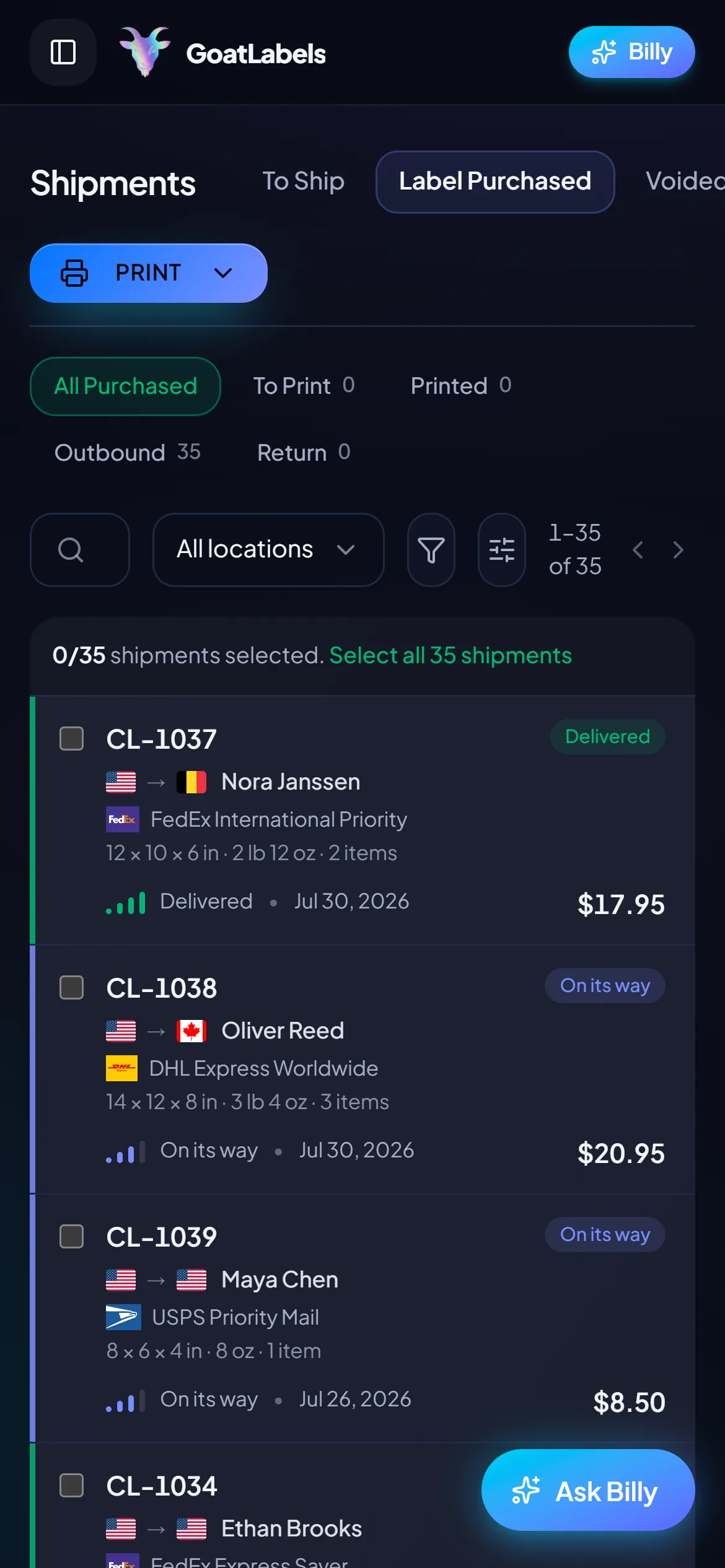
The six steps compress into three screens. The order arrives however it arrives — a marketplace notification, a DM, a text from a friend of a friend. Billy drafts the label from whatever you paste or screenshot, the address gets validated before any money moves, and the label comes out priced by every carrier on the lane at once. The parts a first-timer gets wrong are exactly the parts that are checked before you can pay.
Sold! Buyer sent their address in a DM — apartment number and all, hopefully.
Pack and weigh before this screen. The draft label can only be as honest as the numbers you bring to it.
 The checks first-timers skip
Hand it over where it gets scanned. The acceptance scan is your receipt that the parcel entered the network.
Thirteen store connectors, Shopify, Amazon, eBay, Etsy, TikTok Shop and more, sync into the To Ship queue if you already have a shop. If your first sale was a DM, a text, or a friend of a friend, paste it or screenshot it, the six steps do not change and neither do the rates. Connecting a store is a convenience for later, never a condition of shipping today.
 Shopify
 Etsy
Etsy WooCommerce
 TikTok Shop
 Amazon
 eBay
eBay Squarespace
 Wix
Wix WalmartShopify PlusSoon
 Square
 BigCommerce
 Magento
 ZapierSoon
 NetSuiteSoon
 EcwidSoon
 Temu
Temu SheinSoon
 ChannelAdvisorSoon
 SkuVaultSoon
 Zoho InventorySoon
 Patreon
Everything a first-timer needs is on the free tier, and everything that usually goes wrong on a first shipment is checked before payment instead of discovered after.
Card, Apple Pay, Google Pay, ACH, or crypto tops up one prepaid balance, and you can load a single label's worth to start. Each purchase is its own ledger line, so your very first shipping spend is legible from day one — no invoice arriving later, no minimum to meet.
Your first order probably is not in a tidy system — it is a DM, a text, or a screenshot. Billy reads what you paste and drafts the label from it, and the destination is validated with a residential or commercial badge before you pay — so the messiest possible first order still produces a clean label.
BillyLIVEThe price on the quote is the price that leaves the wallet — service, fees, everything, in one figure you see before buying. There is no subscription to justify against one sale a week, because there is no monthly fee on Free, up to 50 shipments a month.
USPS, UPS and FedEx are quoted on your exact domestic box, side by side, with delivery windows next to prices, and DHL joins on international lanes. First-timers inherit carrier habits from whoever taught them; a quote list replaces the habit with a decision you can defend.
UPS$12.48FedEx$13.22DHL$14.10USPS$11.79You will not need the REST API for order number one — but when the orders become a stream, the same account automates everything with unlimited calls and signed webhooks, on every plan. Nothing to migrate to.
First label ready
CL-1001 · print, tape, drop off
The kit list for shipment number one is short on purpose, and a computer is not on it. Pack the box, weigh it on a kitchen scale, and run the remaining four steps on the phone already sitting next to you on the table.
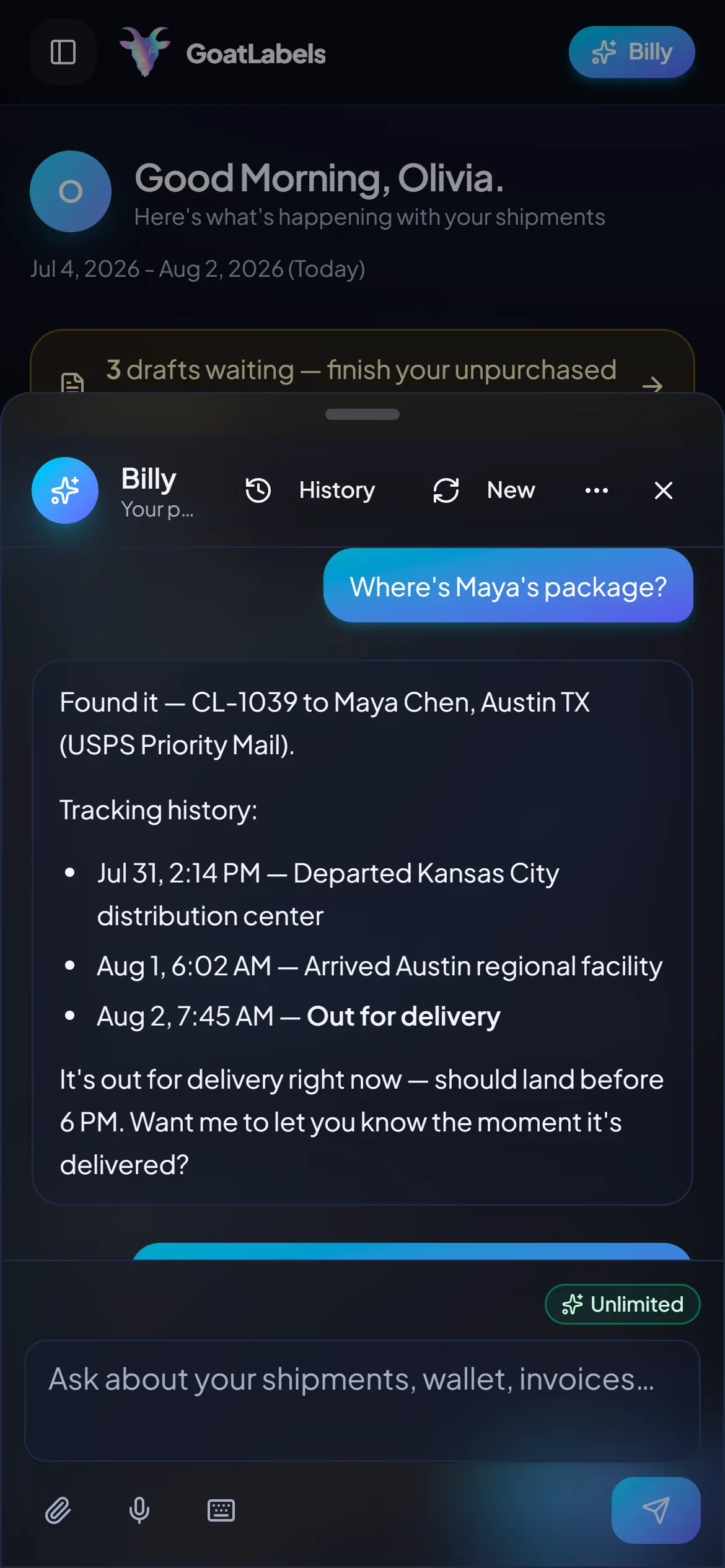
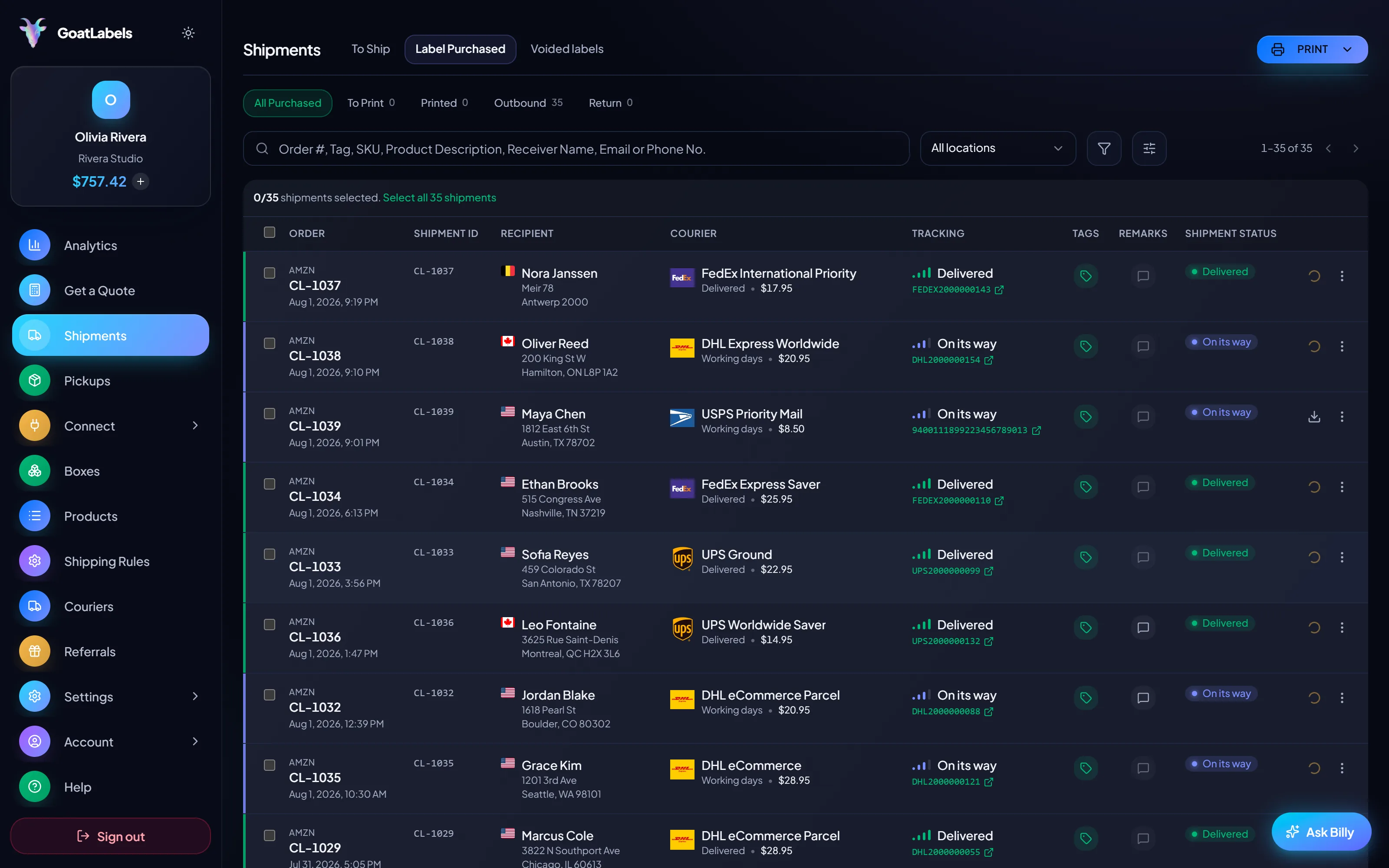
Step three is the one first-timers rush, and it is the one that boomerangs a parcel. Hold the mic, read the buyer's address out loud, and Billy writes it into the shipment, validates it, and quotes every carrier on the lane for the box you just weighed, then answers for the parcel afterwards, when the buyer asks where it has got to. Included on every plan, from label number one. This is the real product, not a render.
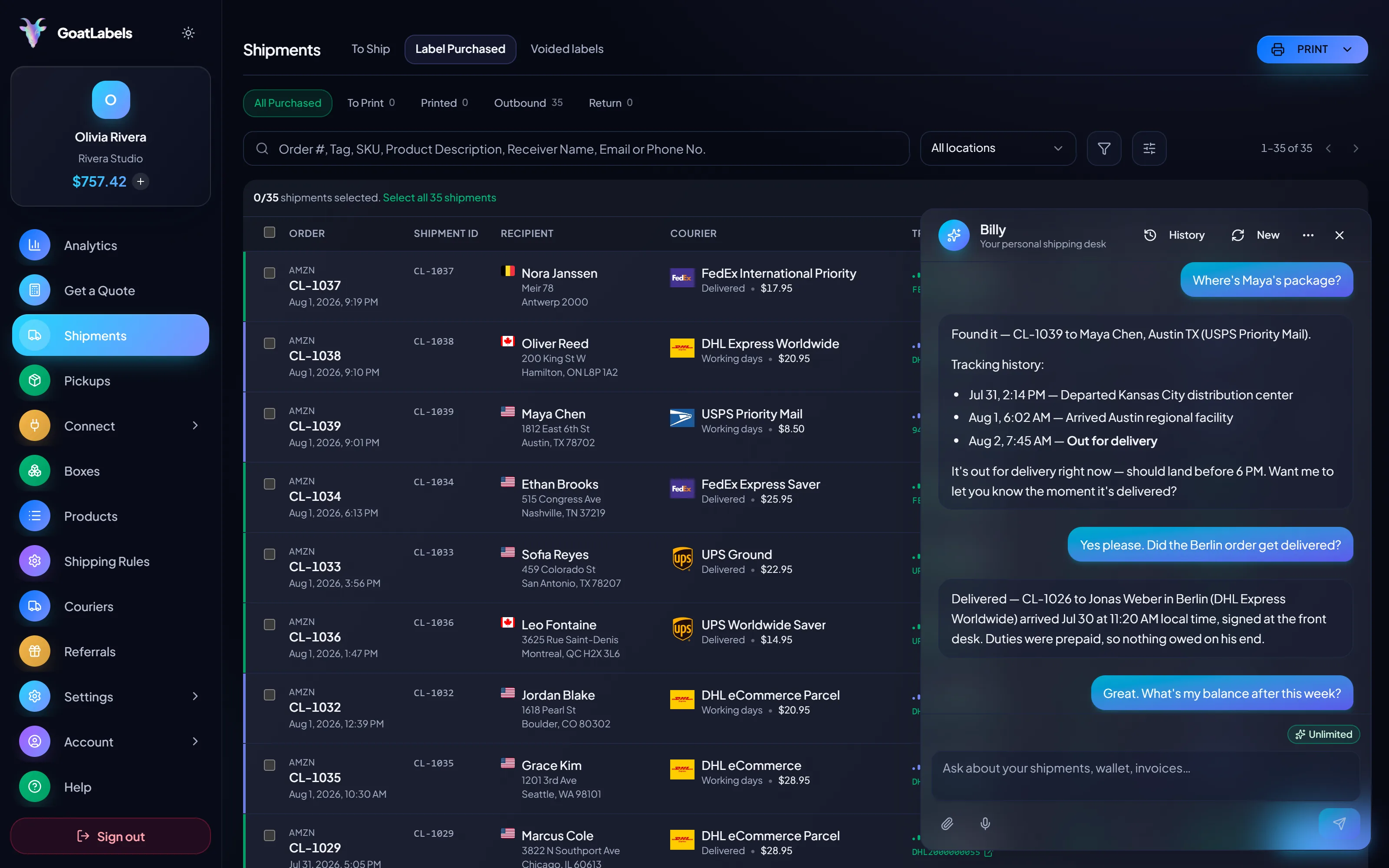
Listening
"Where has my first parcel got to?"
Accepted, in transit
CL-1001 · scanned at the counter
Speaks plain English · validates the address you read out · quotes each carrier as one all-in number · included on every plan, from your very first label.
First-timers inherit a carrier from whoever taught them. Quoting the same packed box against three of them turns step four into a decision you can defend: one all-in number and one delivery window each, with the column you pick being the exact amount that leaves your prepaid balance. Figures are illustrative.
Ground Advantage
2–5 days$7.40
$1.20 of Premium insurance included
all-in · nothing added at checkout
Ground
3–4 days$10.80
$1.20 of Premium insurance included
all-in · nothing added at checkout
Home Delivery
2–4 days$11.40
$1.20 of Premium insurance included
all-in · nothing added at checkout
Order number one is a phone and a roll of tape. Order number four hundred is a queue — and the account you started with already speaks REST and JSON over one Bearer header, with signed webhooks instead of polling and real idempotency keys. Unlimited calls on every plan, Free included, so there is nothing to migrate to later.
POST /api/v1/shipments
Authorization: Bearer sk_live_…
Idempotency-Key: ord_8421

{
  "to": { "name": "Joyce", "city": "Berlin", "country": "DE" },
  "parcel": { "weight": 2.6, "weight_unit": "lb" },
  "service": "fedex_intl_priority"
}
Nothing on the first-shipment kit list is a subscription. Free covers 50 shipments a month with all four carriers, address validation, Billy, and the API included, and there is no monthly fee — so shipment number one costs exactly one label. Pro is a flat plan for the month the orders start arriving faster than you can pack them.
 — draft a label without opening the dashboard
Rate by plan
illustrativePro: one flat monthly plan, unlimited shipments
$0 / forever
Top a wallet up with one label's worth and ship the sale you made this morning.
A first order is a DM or a screenshot, not a tidy record. The assistant that reads it into a draft label and validates the destination before you pay runs unlimited in the web app on Free. Pro adds Billy on Telegram.
Telegram, ProGET /api/v1/shipments
200 OK · plan: free
Unlimited calls on Free — still unlimited on Pro.
Once you ship regularly, Pro is one flat $40 a month with unlimited shipments.
Label prices are quoted live from USPS, UPS, FedEx, and DHL as one all-in number, and that exact amount leaves your prepaid balance — nothing added at checkout, and an unused label that is voided credits back to the wallet after the carrier accepts the void. Full pricing details
Same six steps, same live quotes, same prepaid wallet, whether the first sale came off a livestream or out of a spare room. These are the four shapes of first order, and the step each one tends to get wrong.
 Sold fast, packed later
The temptation is to buy labels while the momentum is up and pack afterwards. Do it the other way round: the label has to describe the packed box, so a label bought before the tape goes on is priced for a parcel that does not exist yet.
 A kitchen scale and a cardboard box
The genuinely required kit is shorter than it looks: box, filler, scale, tape measure, tape. The scale is the item that matters, because it is the difference between a label priced on facts and a label priced on optimism.
You do not need a label printer
Plain paper and clear tape, as long as no seam crosses the barcode

 No store, no order number, no system

 One unfulfilled order, staring at you
0
carrier accounts to open before you can print the label
A video took off and I had 80 TikTok Shop orders by morning. I printed every label from my phone on the bus to the post office.
Early customer · TikTok
TikTok Shop seller
TikTok ShopI run my Etsy shop from the kitchen. The AI reads the order, picks the carrier, the label prints. That's the whole workflow now.
Early customer · Etsy
Etsy maker
EtsyThe API is what every shipping API pretends to be. Idempotency that actually works.
Sasha R.
Staff engineer, marketplace
Pack it, weigh it, let the address check run, compare the carriers, and buy the label from a wallet you topped up two minutes ago.
Sign up in seconds. No card required to see your first quote.
Updated