

USPS
Ground Advantage
2–5 days$7.40
$1.20 of Premium insurance included
all-in · nothing added at checkout
Parcels come back for a short list of documented reasons: a missing apartment number, a residential address flagged commercial, a PO Box handed to a carrier that cannot deliver to one, or a ZIP that does not match the city. GoatLabels validates the address before you pay for the label.
USPS returns an undeliverable parcel outright; UPS and FedEx hold it, chase the address, and bill the correction to you. Same defect, different bill.


 all validated
 The outbound postage is spent whatever happens. The reship is a second purchase from the same prepaid wallet.
Returns feel random from the seller's side because the carrier never explains one. In practice the causes are a short, boring list, and four of them account for most of what comes back.
The missing secondary line. An apartment, suite, unit, or floor number that the buyer left out of a checkout field, or that a DM never contained in the first place. The street address resolves perfectly, which is why nothing looks wrong until a carrier stands in a lobby with forty mailboxes. This is the single most common defect and the one validation can flag but cannot fix — the number does not exist anywhere for software to find.
The type mismatch. A residential address entered as commercial, or the reverse. The parcel is deliverable, so it does not bounce for that reason alone, but the service was priced and routed for a different kind of door — and on UPS and FedEx the reclassification arrives later as its own charge. A shop unit inside a house and a home office are the two cases that catch sellers repeatedly.
The component mismatch. A ZIP that belongs to a different city, a street number outside the range that exists on that street, a directional prefix dropped so that North and South Main Street collapse into one. Each of these is machine-detectable before you buy, which is exactly why they are the cheapest class of defect to eliminate.
The address the carrier cannot serve at all. A PO Box handed to a carrier whose network does not deliver to one, or a military address formatted like a domestic street address. This one is an eligibility question rather than an accuracy question — see shipping to PO Boxes and APO addresses for which carrier can reach which address type.
Two non-address causes round out the list: a recipient who refuses the parcel, and a parcel that sits unclaimed at a pickup point past the hold window. Neither is your fault and neither is preventable at label time, but both come back through the same door and cost the same to reship.
The defect is only half the story. What it costs depends entirely on which carrier is holding the box, because the four handle an undeliverable parcel in genuinely different ways — and only one of them tells you at the time.
Dated block — carrier handling of an undeliverable parcel
Mechanisms as published by each carrier and reviewed August 2026. Fee amounts, attempt counts, and hold windows are deliberately absent: they change every rate cycle. Verify against the carrier's own current service guide before you build a policy on any line below.
The asymmetry is worth sitting with. USPS gives you a fast, free-ish failure: the parcel returns and you are out the postage. UPS and FedEx give you a slow, billed failure: they will often get the parcel delivered, and then charge you for having fixed your address. Neither is worse in the abstract — but if you default to one carrier and never look at the adjustments, the second shape is the one that quietly erodes margin, because the charge never appears next to the order it belongs to.
The honest answer is that the money is already gone and the only live question is who funds the second label. A framework beats a rule here, because the fair answer changes with who introduced the defect.
The buyer supplied it, character for character. Ask them to cover the reship. Quote the address back exactly as they gave it — that one line resolves most of these conversations, because the mistake is visible rather than asserted. On a marketplace, check the platform's policy first: several will not let you charge a buyer outside the original order, and a few treat the attempt as a policy violation.
Your system dropped something. An autocomplete that overwrote the unit number, a CSV column mapped to the wrong field, a transcription that lost a digit. Absorb it. It is cheaper than the review, and it is a signal to fix the intake step rather than the parcel — mapping columns once and saving the preset is the point of doing bulk labels from a CSV properly.
Nobody typed anything wrong. Refusals, unclaimed holds, and a buyer who moved between order and delivery are business costs. Decide once what you do — reship, refund, or refund minus postage — write it into your shipping policy, and stop relitigating it per order.
One thing not to do: void the returning label and expect the money back. A void applies to a label that was never used, not to one that travelled and came home. If you catch a mistake before the parcel enters the network, the credit lands back in your prepaid wallet immediately — see how voiding a label works for the deadlines that decide whether you are in time. And if the parcel is genuinely lost rather than returned, that is a claim, not a reship.
Every fix above is more expensive than the message you could have sent before buying the label. GoatLabels validates the destination address as part of the quote, before your prepaid balance moves, and shows a residential or commercial classification next to it — which is the same signal UPS and FedEx would have billed you to correct later.
Validation is not magic and this page will not pretend otherwise. It cannot conjure an apartment number nobody supplied. What it can do is separate the addresses that resolve cleanly from the ones that do not, so the handful that need a message get one, and the rest go out untouched. On a hundred orders that is two conversations instead of two returns.
The other half is intake. Most bad addresses are not typed wrong by the buyer — they are copied wrong by a human moving text between a message and a form at eleven at night. Billy reads the pasted order, the screenshot, or the spoken address and fills the fields directly, so the transcription step that generates those defects stops existing. Then the address gets validated anyway, because two checks on a free step is not extravagance.
Validation is worth nothing after purchase, so it happens at quote time. The order arrives however it arrived — a store sync, a pasted DM, a screenshot, a spoken address at the packing table — and Billy pulls the name, the street, the secondary line, and the parcel out of it rather than you retyping them at eleven at night, which is where transposed digits come from. The destination is then validated against deliverable addresses and classified residential or commercial, and anything ambiguous is surfaced for you to confirm with the buyer rather than quietly corrected. Only then do USPS, UPS, FedEx, and DHL quote the parcel, and only then does the prepaid balance move. The label prints against an address that has already been checked twice.
hey! can you send it to 214 Oak St, Austin TX — apt number is 4B, forgot to add it
Shopify, Etsy, WooCommerce, and TikTok Shop sync in; a DM or a screenshot needs no connector at all.

No address-correction charge arriving three weeks later for a defect that was visible before purchase.
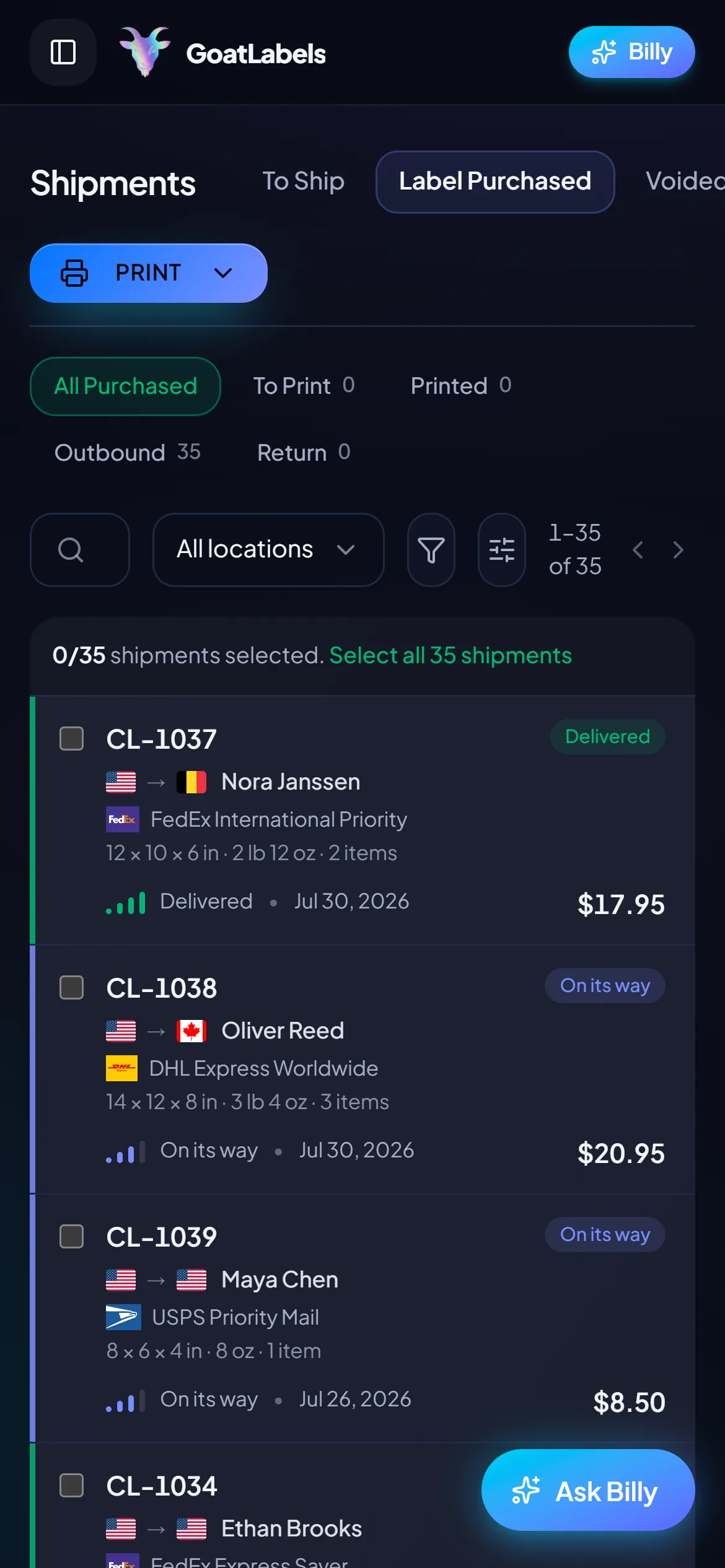
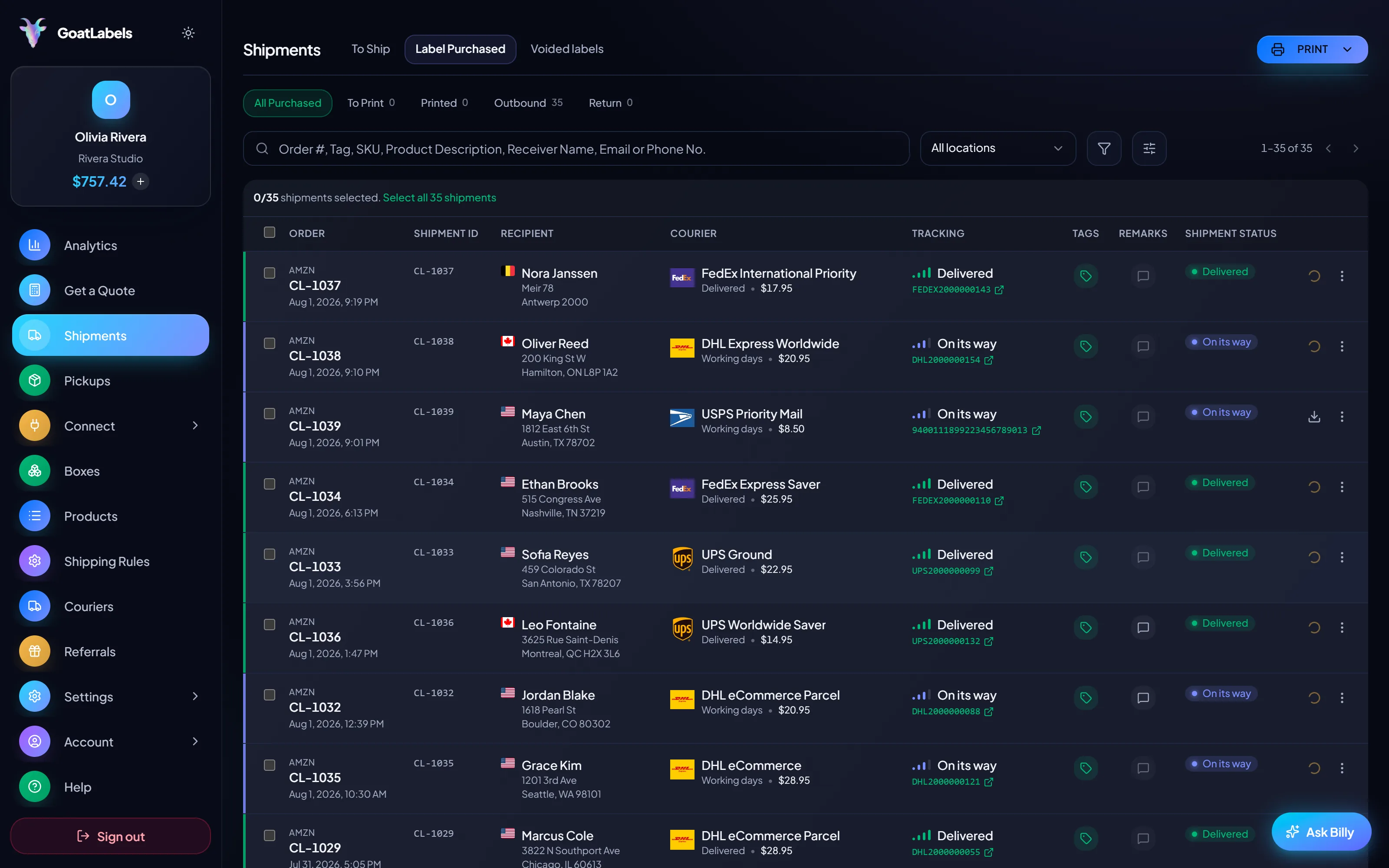
Shopify, Etsy, WooCommerce, and TikTok Shop sync into the To Ship queue, so every destination is validated and classified in the same place instead of being trusted because a checkout form accepted it. Paste an Instagram or Facebook DM and Billy pulls the street line and the unit number straight out of the message — the channel with no address fields at all is the one that produces the most returns.
 Shopify
  Etsy
Etsy  WooCommerce
  TikTok Shop
  Amazon
  eBay
eBay  Squarespace
  Wix
Wix  Walmart Shopify Plus Soon
 Square
  BigCommerce
  Magento
  Zapier Soon
 NetSuite Soon
 Ecwid Soon
 Temu
Temu  Shein Soon
 ChannelAdvisor Soon
 SkuVault Soon
 Zoho Inventory Soon
Nothing here is a returns dashboard. Every item below is a step that happens before the label exists, because after purchase your options narrow to a paid intercept and a second label.
The destination is checked at quote time, not at print time, and comes back with a residential or commercial classification attached — the same distinction UPS and FedEx would have reclassified and billed you for after delivery. Nothing is silently rewritten: an ambiguous result is shown to you to resolve.
Most bad addresses are transcription errors, not buyer errors. Paste the order, drop the screenshot, or say it out loud and Billy fills the street line, the unit number, the city, and the ZIP directly, so the retyping step that generates transposed digits and dropped apartment numbers stops happening.
There is no monthly minimum to print and no per-order fee, so buying a second label costs exactly one more label. It comes out of the same prepaid wallet as the first, and an unused label voided before it moves credits straight back to that balance.
USPS, UPS, FedEx, and DHL are quoted on the same parcel as one all-in price each, which matters more than usual on an address you are unsure about: the carrier that returns a parcel outright and the carrier that fixes the address and bills you for it are a genuinely different bet. On the international lane the gap is widest, because a returned parcel abroad can cost more than the goods inside it.
UPS $12.48 FedEx $13.22 DHL $14.10 USPS $11.79 The REST API runs the same validation the dashboard does, so a storefront can check an address at checkout instead of discovering the defect a week later. Unlimited calls on every plan means checking every address costs nothing extra.
Address validated
CL-1038 · residential · unit confirmed
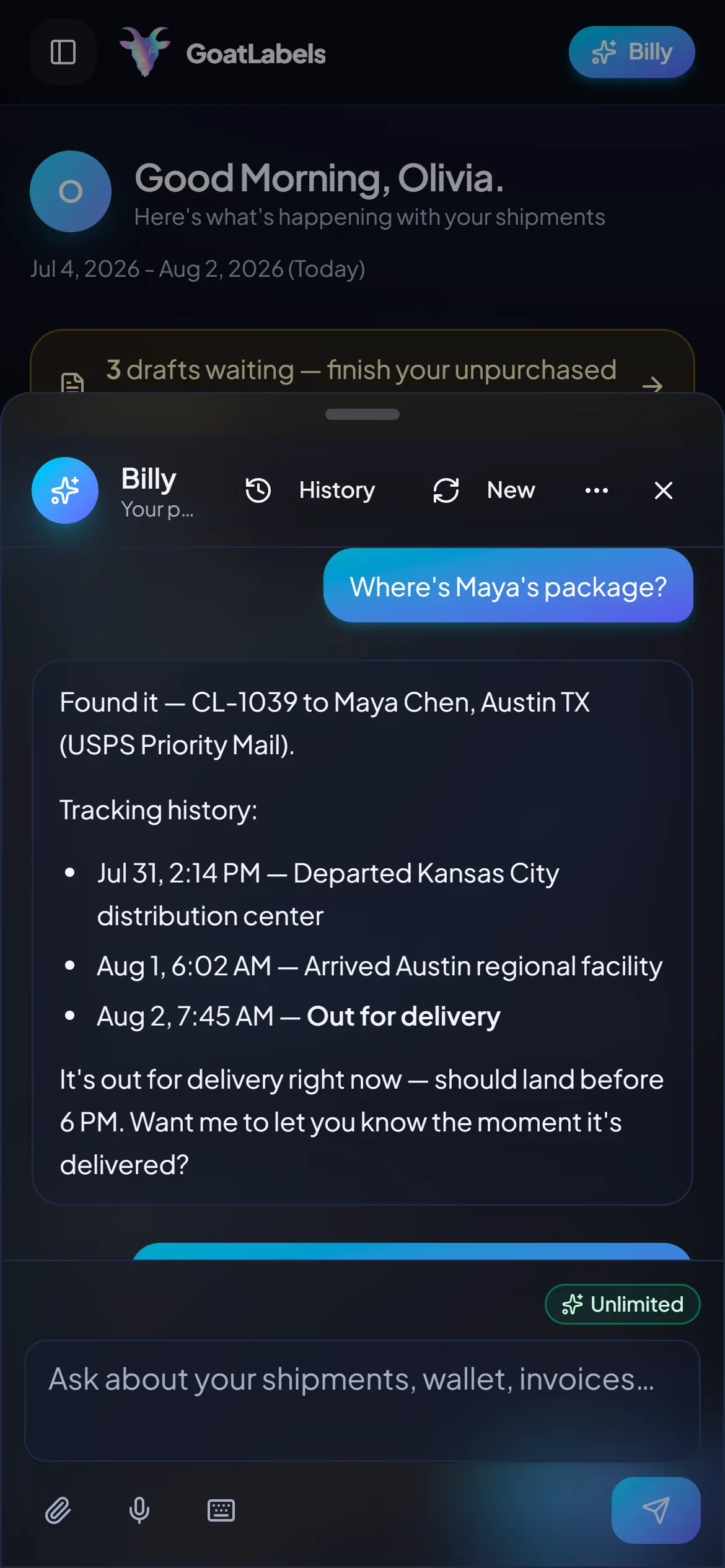
A flagged address is only cheap if you deal with it in the moment. On order forty, at the kitchen table, nobody opens a laptop to chase an apartment number — so the queue, the validation result, and the message to the buyer all have to fit on the phone in your hand.
The apartment number that turns up in a follow-up message is the one most likely to get retyped wrong, because it arrives while your hands are full. Hold the mic, say the corrected address, and Billy fills the street line and the secondary line directly, validates the destination, classifies it residential or commercial, and quotes the reship against all four carriers. It remembers repeat buyers, so an address you already fixed stays fixed. This is the real product, not a render.
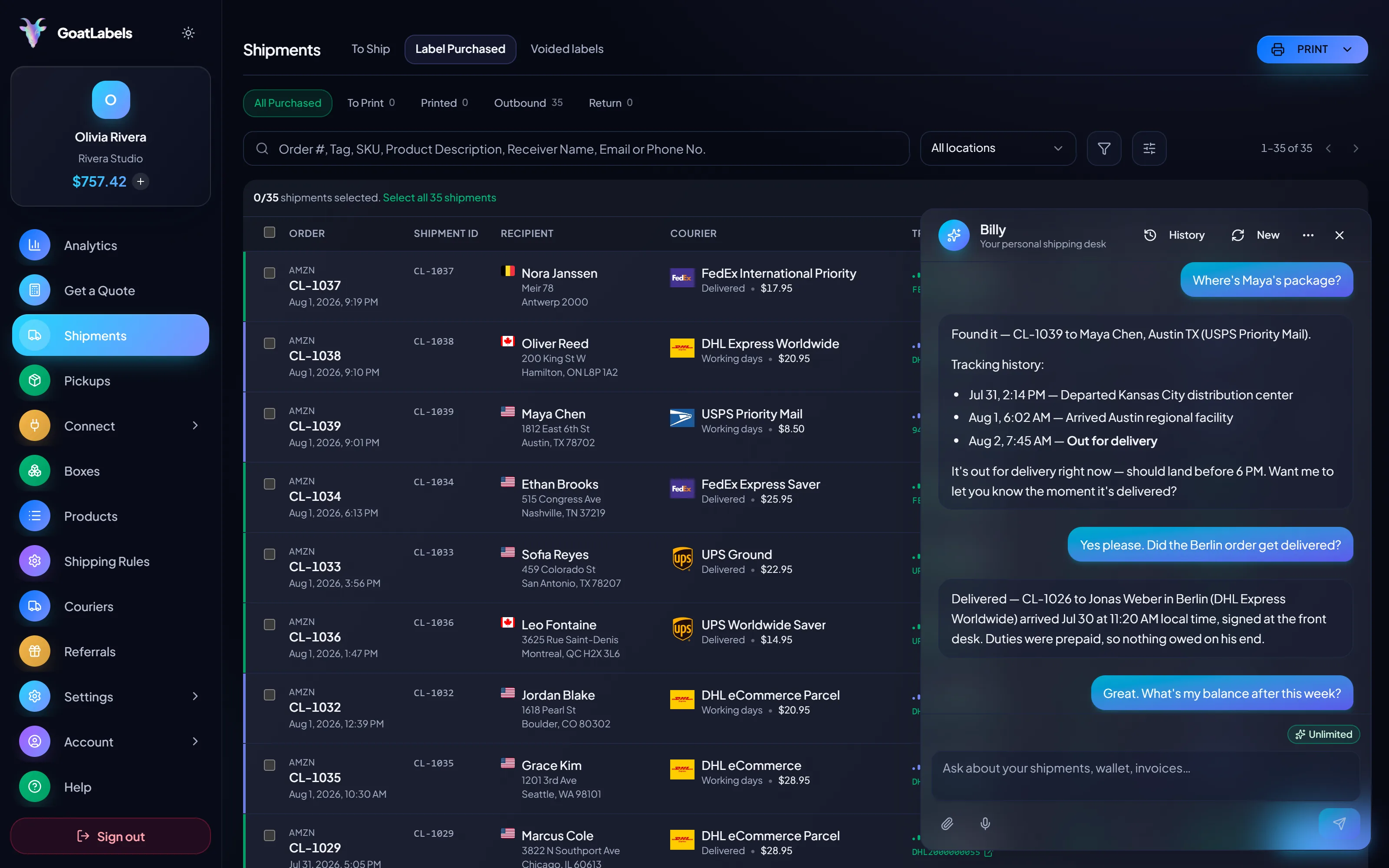
Listening
"Add apartment 4B to the Oak Street order"
Address updated
CL-1039 · validated · residential
Speaks plain English · fills the street line and the unit number · validates and classifies before you pay · included on every plan, never a pricier tier.
A returned parcel becomes a second label, and a second label is a second quote. The corrected address is rated against three carriers, the original label is voided back to your wallet, and the reship is bought from that same balance. Figures are illustrative.
Ground Advantage
2–5 days$7.40
$1.20 of Premium insurance included
all-in · nothing added at checkout
Ground
3–4 days$10.80
$1.20 of Premium insurance included
all-in · nothing added at checkout
Home Delivery
2–4 days$11.40
$1.20 of Premium insurance included
all-in · nothing added at checkout
The same validation the dashboard runs is one REST call, so a storefront can catch a missing unit number while the buyer is still on the page rather than two weeks later on a returned parcel. REST, JSON, one Bearer header, and unlimited calls on every plan — so checking every address costs nothing.
POST /api/v1/addresses/validate
Authorization: Bearer sk_live_…

{
  "street1": "214 Oak St",
  "city": "Austin",
  "state": "TX",
  "postal_code": "78701"
}
A reship should cost exactly one more label, and it does. Free covers 50 shipments a month with validation on every quote, and Pro is a flat monthly plan with unlimited shipments and cheaper label pricing. Neither charges you extra for the second label being a second label.
Volume pricing
illustrativemore volume → lower per-label rates
$0 / forever
Fund a wallet, pay per label, and validate every address before the balance moves.
The assistant that reads a pasted order or a screenshot into a draft — street line, unit number, city, ZIP — and validates the destination before you spend anything runs unlimited in the web app on Free. Pro adds Billy on Telegram.
GET /api/v1/shipments
200 OK · plan: free
Validation calls are unlimited on Free — checking every address is never a paid tier.
On Pro we will work with you to beat the label rates you are already getting from
ShippoPirate ShipShipStation Label prices are quoted live from USPS, UPS, FedEx, and DHL as one all-in number, and that exact amount leaves your prepaid balance — a reship is simply the next label, priced the same way. Full pricing details
Same validation, same wallet, same one-tap flow, whether that is four orders a week or four hundred. These are the four shapes of seller where an address reaches the label without ever being read.
TikTok Shop & live commerce
A hundred orders overnight is a hundred addresses nobody read. Validating at quote time turns that into a handful flagged for a message and the rest untouched — two conversations instead of two returns.
Etsy & independent creators
Most bad addresses are copied wrong at eleven at night rather than typed wrong by the buyer. Billy fills the fields from the message directly, so the transcription step that drops unit numbers stops existing.
Unit number missing
Order #2291 · flagged before purchase, not after
The channel with no address fields
Where a return costs most
DDP
duties prepaid — but a parcel returned from abroad can cost more than the goods
A video took off and I had 80 TikTok Shop orders by morning. I printed every label from my phone on the bus to the post office.
Early customer · TikTok
TikTok Shop seller
I run my Etsy shop from the kitchen. The AI reads the order, picks the carrier, the label prints. That's the whole workflow now.
Early customer · Etsy
Etsy maker
The API is what every shipping API pretends to be. Idempotency that actually works.
Sasha R.
Staff engineer, marketplace
Paste the order, let Billy pull the street line and the unit number out of it, and see the address validated and classified before a cent leaves your prepaid wallet.
Sign up in seconds. No card required. Address validation on every quote, on every plan.