

USPS
Priority Mail Intl
10–15 days$7.40
$1.90 of duties & taxes prepaid, not billed to your buyer
all-in · no surprises
This page covers parcels with no delivery scan. Two clocks run: the marketplace clock decides when you refund the buyer, the carrier clock decides when you can file. Refund first, recover second. Insurance is a per-shipment choice at label time, the only moment the decision is cheap.
USPS, UPS, FedEx, and DHL each decide when a parcel counts as missing, who is allowed to file, and what evidence they will look at.


 all four
 Insurance is a per-shipment option priced into the same all-in quote, decided in the one moment the decision is still cheap.
This page is about parcels with no delivery scan — the ones that went quiet in transit, or arrived broken. If tracking shows the parcel was delivered and your buyer says it never turned up, that is a different problem with a different set of remedies, and it lives on tracking says delivered, buyer says not received, which also owns the question of who ultimately pays.
Everything here follows from one structural fact: two clocks are running and they are not connected. The buyer's clock is a marketplace or a payment dispute, and it is short. The carrier's clock is an investigation, and it is long — and it does not even start until the parcel has been missing long enough for the carrier to agree that it is missing. Sellers who wait for the second clock before answering the first lose the buyer, the metric, and often the money as well. Refund or reship first. Recover second. The recovery is a separate transaction that either lands or does not.
Before any window matters, the parcel has to qualify. A late parcel is not a lost parcel, and every carrier has a threshold — expressed as elapsed transit without a scan — below which a claim is closed rather than queued. Filing early is worse than filing late, because it burns the record. The sequence that works is the same everywhere: confirm the scans have genuinely stopped, raise a trace or search if that carrier requires one first, then file against the tracking number with proof of value attached.
| Carrier | What must be true before you file | Who is allowed to file | What it will ask you for |
|---|---|---|---|
| USPS | The parcel has stopped scanning for longer than the service's own expected transit, and the service is one that carries indemnity at all. | The mailer or the addressee, but only one of them, and proof of value comes from the sender. | Proof of value, evidence of insurance where the service requires it, and for damage, the article and its packaging retained for inspection. |
| UPS | A package search has been opened and closed without locating the parcel. | The shipper, the receiver, or a third party named on the shipment. | Invoice or proof of cost of goods, the tracking number, and for damage, photographs plus retention of the packaging. |
| FedEx | The shipment shows no delivery scan and the service's transit commitment has elapsed. | The shipper or the recipient, filed against the tracking number. | Proof of value, a description of the contents, and for damage, photographs of the item and the carton before it is discarded. |
| DHL Express | The waybill has stopped progressing and a trace has been raised on the shipment. | The contracting party — usually the shipper who booked the waybill. | The commercial or proforma invoice, the waybill, and damage photographs taken before repacking. |
Carrier policy reference — compiled 2026-08-04. Filing windows, waiting periods, and default coverage caps are deliberately not printed here. They differ by service and by domestic versus international movement, and each carrier revises them on its own schedule. The governing documents are the USPS Domestic Mail Manual (indemnity and claims) together with the International Mail Manual for outbound international; the UPS Tariff / Terms and Conditions of Service for your origin country; the FedEx Service Guide in force on your ship date; and the DHL Express Terms and Conditions of Carriage. Read the one that covers your shipment before you rely on a number. Review cadence: annual, by the named marketing owner recorded with this page.
The most expensive misunderstanding in small-parcel shipping is treating default declared value as insurance. It is not a policy; it is a liability limit. It caps what the carrier will pay if a claim succeeds, and it does nothing at all if the claim fails. That distinction decides real money in three places.
First, it pays your cost, not your price. Carriers indemnify the value of the goods, evidenced by what you paid for them or what they cost you to make — not the retail figure the buyer was charged, and not the shipping you have already spent. Second, it is capped per shipment, so a consolidated parcel holding several orders concentrates several sales behind one limit. Third, it excludes categories. Fragile items, items with no verifiable cost basis, and shipments the carrier judges to have been inadequately packed are exactly the shipments where claims are refused, and inadequate packaging is the single most common denial reason on damage claims. That is why the damage row in the table above says keep the box: a damage claim without the packaging is an assertion, not evidence.
A returned parcel is a different failure with a different bill — why a package comes back, and who pays to reship covers it — and a label bought in error that never moved at all is not a claim but a void with the credit back in your wallet.
Self-insuring is a legitimate strategy and most small sellers are doing it without saying so. The question is only whether it is the cheaper one for a given parcel, and that is arithmetic you can actually do. Take the amount you would absorb if this shipment vanished — cost of goods plus the label plus the replacement's label, since a lost order usually costs you two shipments, not one. Subtract whatever default declared value would return if a claim succeeded. Multiply what is left by how often parcels like this one actually go missing in your own history. Compare that number to the premium. Below the default cap, buying coverage is paying twice for the same exposure. Above it, or on anything fragile, one-of-a-kind, or expensive to remake, the premium is almost always smaller than the loss spread across a month.
The reason this decision has to be made at label time is that it is the only moment it is cheap. Afterwards it is not a decision at all. On GoatLabels insurance is a per-shipment option chosen at quote, with the premium priced into the same all-in number as the carrier rate and paid from the same prepaid balance — so a high-value parcel and an ordinary one can be handled differently without maintaining two workflows. To be exact about what that is and is not: GoatLabels sells the option and shows you the price. It does not underwrite the coverage and it does not adjudicate the claim. Whether a claim is paid is the carrier's decision, made on the carrier's evidence standard, and no shipping platform can promise you otherwise. What a platform can do is make sure the evidence exists — the label, the declared figures, the quote, and the timeline all attached to the same shipment record — and keep the per-label price honest while you are absorbing the loss.
A lost parcel is four moves, and three of them are yours. You choose coverage in the one moment the choice is still cheap. You confirm the parcel has genuinely stopped scanning rather than merely running late. You make the buyer whole on the buyer's clock. Then you file against the tracking number with proof of value, and whatever the carrier decides arrives later as a separate event that has nothing to do with the order you already closed.
One-of-a-kind piece, no replacement stock — this is the shipment where the premium is smaller than the loss.
Default declared value is a liability cap, not a policy. Anything above it, or anything fragile, is uncovered unless coverage was chosen here.

Any carrier recovery lands as its own event, weeks later, with no relationship to the case you already closed with the buyer.
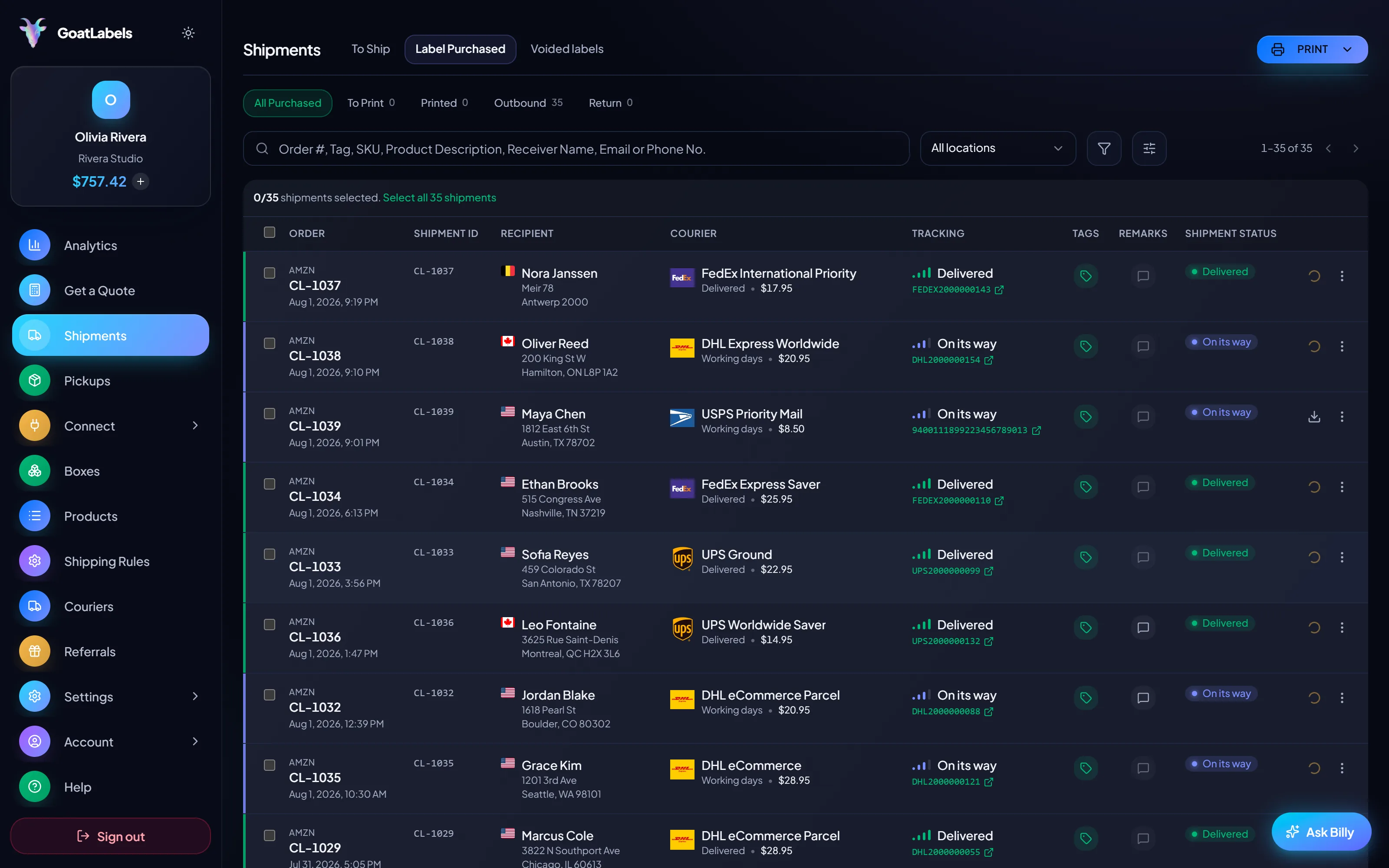
Shopify, Etsy, WooCommerce, and TikTok Shop sync into the To Ship queue, so the order, the address, the declared figures, the quote, and the tracking all land on one shipment record — which is exactly the bundle a carrier asks you to produce weeks later. Paste an Instagram or Facebook DM and Billy builds the label straight from the message, so the orders that arrived with no paperwork still leave some behind.
 Shopify
  Etsy
Etsy  WooCommerce
  TikTok Shop
  Amazon
  eBay
eBay  Squarespace
  Wix
Wix  Walmart Shopify Plus Soon
 Square
  BigCommerce
  Magento
  Zapier Soon
 NetSuite Soon
 Ecwid Soon
 Temu
Temu  Shein Soon
 ChannelAdvisor Soon
 SkuVault Soon
 Zoho Inventory Soon
Recovery is a carrier decision on a carrier evidence standard. What a shipping tool controls is the record you file with, the price you paid, and whether the replacement costs you a second time.
Coverage, the label, and the replacement label all draw on the same wallet, funded by card, Apple Pay, Google Pay, ACH, or crypto. A month with two losses in it bills you for two labels and two premiums — never for a subscription you did not use.
Billy drafts the shipment from a pasted order, a screenshot, or a spoken description, and the destination is validated before you pay. The order, the address, the declared figures, and the quote end up on one shipment record, which is exactly the bundle a claim asks for weeks later.
Choosing coverage does not open a second checkout or a separate policy account. It changes one number in the quote, and that number is what leaves your balance — so comparing an insured shipment against an uninsured one is a comparison of two prices, not two products.
USPS, UPS, FedEx, and DHL are quoted on the same parcel every time, and they do not agree about when a parcel is missing, who may file, or what proof counts. Seeing all four at quote time is also how you notice that the cheapest label on a fragile, hard-to-replace item is not always the one to buy.
UPS $12.48 FedEx $13.22 DHL $14.10 USPS $11.79 The REST API returns the label, the declared values, the quote, and the tracking history per shipment, with signed webhooks for status changes and unlimited calls on every plan — so assembling a claim file is a query rather than an afternoon of screenshots.
Label ready · coverage chosen
CL-1038 · Seattle, US
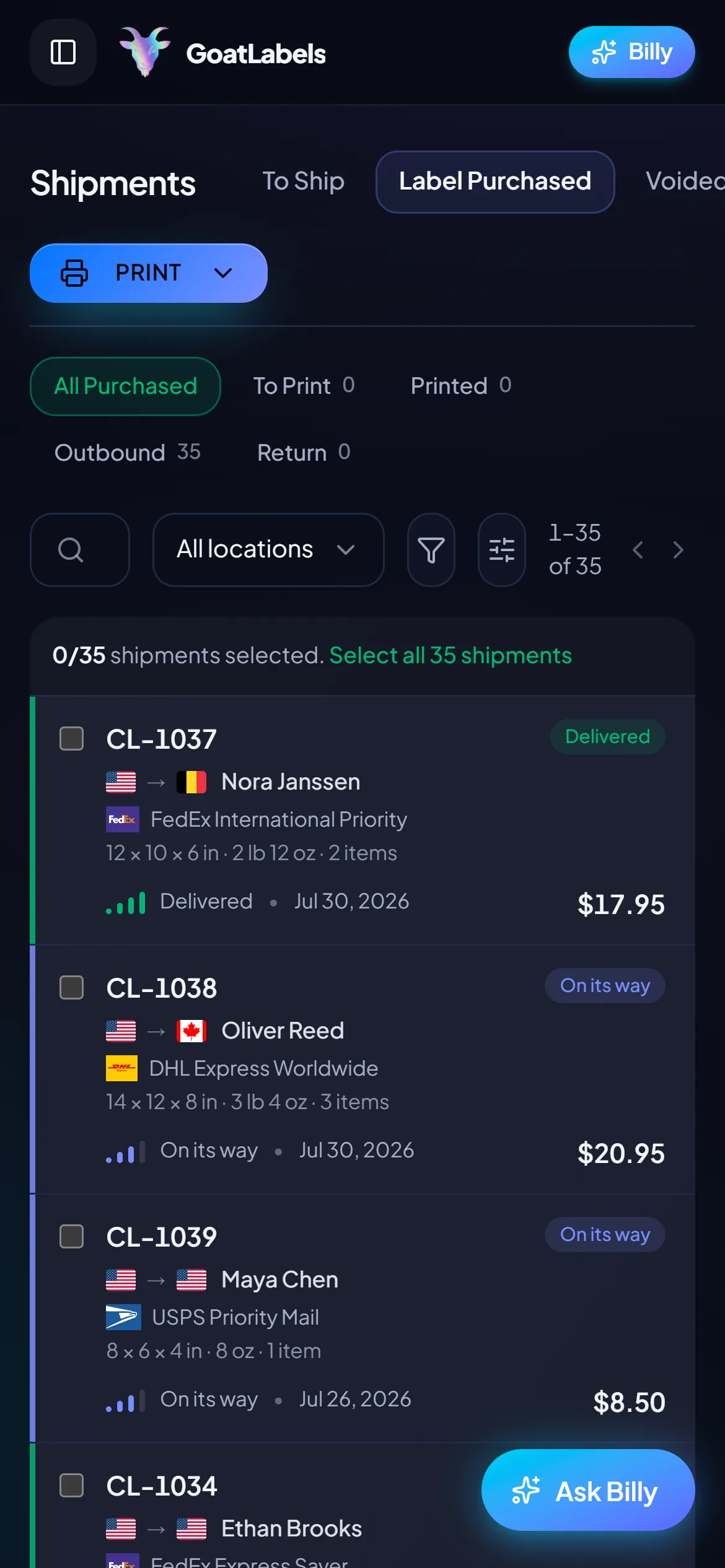
A claim weeks from now is only as good as the record you made in the ten seconds before the parcel went out. The order, the address, the declared figures, and the coverage decision all happen on the phone already in your hand at the packing table — none of it is a desktop job you will do later, because later is when the parcel is already gone.
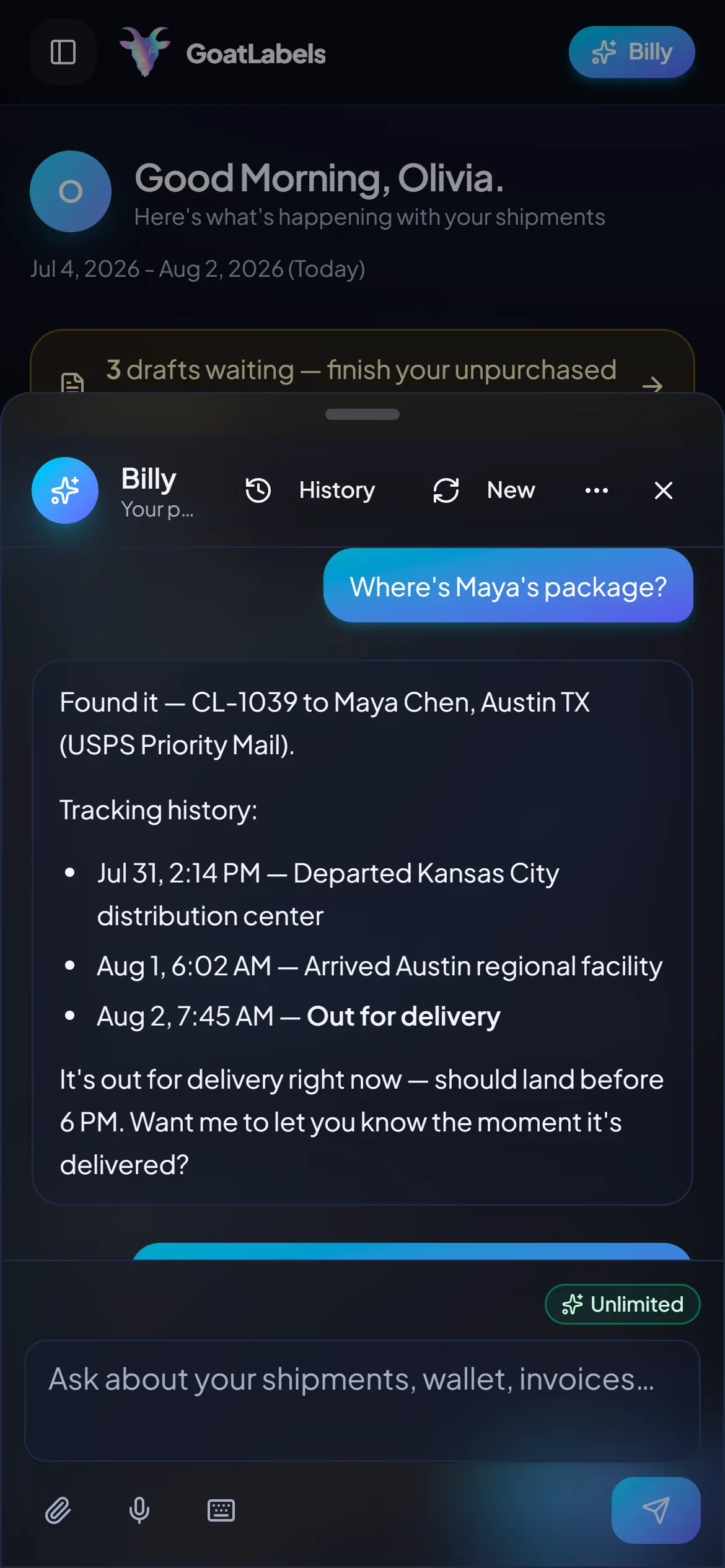
A claim filed before the parcel qualifies is closed rather than queued, and the fact that decides it is a date: when did this shipment last produce a scan. Hold the mic, ask Billy where a parcel is, and it pulls the tracking history and reads it back — the last event, where it happened, and how long ago. That is the check to run before you open a claim, and the same one to run again when the buyer asks. This is the real product, not a render.
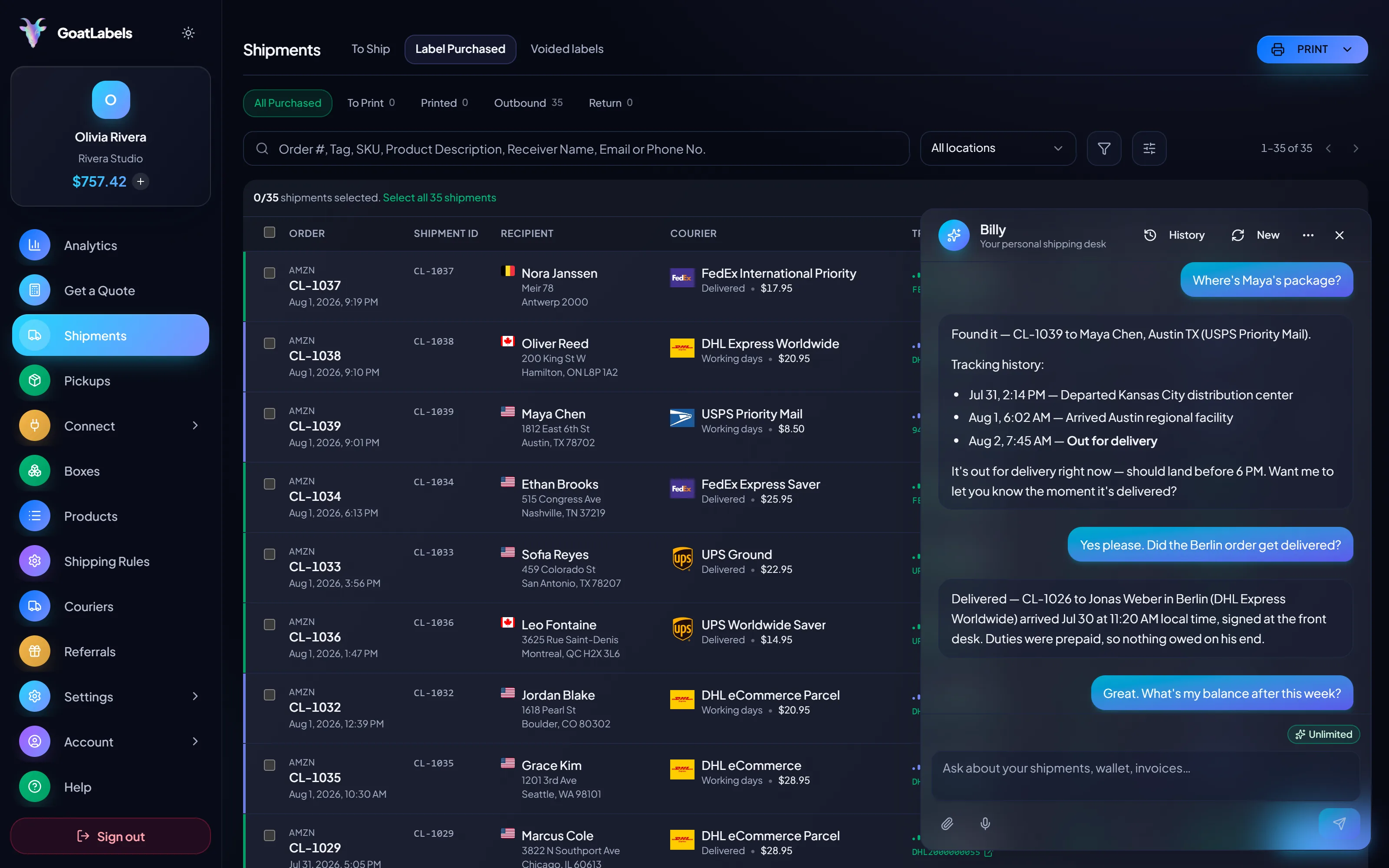
Listening
"Where's Maya's package?"
Out for delivery
CL-1039 · Austin, TX · by 6 PM
Speaks plain English · reads back the last scan and when it happened · remembers customers and saved boxes · included on every plan, never a pricier tier.
Choosing coverage does not open a second checkout or a separate policy account. It moves one figure in the quote, so an insured shipment and an uninsured one are two prices rather than two products — and the price you accept is the amount that leaves your balance.
Priority Mail Intl
10–15 days$7.40
$1.90 of duties & taxes prepaid, not billed to your buyer
all-in · no surprises
Intl Connect Plus
3–5 days$8.90
$2.20 of duties & taxes prepaid, not billed to your buyer
all-in · no surprises
Express Worldwide
1–2 days$9.80
$2.50 of duties & taxes prepaid, not billed to your buyer
all-in · no surprises
The label, the declared values, the quote, and the tracking history come back per shipment over REST and JSON with one Bearer header, and scan events arrive on signed webhooks instead of a polling loop. Unlimited calls on every plan, so pulling the evidence for a bad month costs nothing extra.
POST /api/v1/shipments
Authorization: Bearer sk_live_…
Idempotency-Key: ord_8421

{
  "to": { "name": "Joyce", "city": "Berlin", "country": "DE" },
  "parcel": { "weight": 2.6, "weight_unit": "lb" },
  "service": "fedex_intl_priority"
}
Insurance is a per-shipment option chosen at quote time with the premium inside the same all-in number, so nothing about your plan decides how a single parcel is protected. Free covers 50 shipments a month with everything else unlimited; Pro is a flat monthly plan with unlimited shipments and cheaper pricing on every label.
Volume pricing
illustrativemore volume → lower per-label rates
$0 / forever
Fund a wallet, pay per label, and decide coverage one parcel at a time.
The assistant that drafts the shipment, validates the address before you spend anything, and reads back a parcel's tracking history when you need to know whether the scans really stopped runs unlimited in the web app on Free. Pro adds Billy on Telegram.
GET /api/v1/shipments
200 OK · plan: free
Unlimited calls on Free — still unlimited on Pro.
On Pro we will work with you to beat the label rates you are already getting from
ShippoPirate ShipShipStation Label prices are quoted live from USPS, UPS, FedEx, and DHL as one all-in number and that exact amount leaves your prepaid balance. GoatLabels sells the coverage option and shows you the price; it does not underwrite the coverage and it does not decide the claim. Full pricing details
Same two clocks and the same evidence standard whether that is four orders a week or four hundred. These are the four shapes of seller where the loss lands hardest and the record made at label time matters most.
TikTok Shop & live commerce
At a few hundred orders a week a handful will always go quiet, and the account metric punishes the wait rather than the loss. Make the buyer whole on the buyer's clock, then file against the tracking number with the record already assembled.
Etsy & independent creators
One-of-a-kind stock means a lost parcel cannot be replaced at any price, which is exactly the shipment where the premium is smaller than the loss — and exactly the one people decline coverage on because the order looked small.
Coverage chosen at label time
Order #1024 · decided before the box left
The orders that live in a chat thread
Damage is its own claim
KEEP
the packaging — a discarded box ends a damage claim
A video took off and I had 80 TikTok Shop orders by morning. I printed every label from my phone on the bus to the post office.
Early customer · TikTok
TikTok Shop seller
I run my Etsy shop from the kitchen. The AI reads the order, picks the carrier, the label prints. That's the whole workflow now.
Early customer · Etsy
Etsy maker
The API is what every shipping API pretends to be. Idempotency that actually works.
Sasha R.
Staff engineer, marketplace
Quote all four carriers on the parcel in your hand, choose coverage inside the same all-in price, and keep the label, the values, and the tracking on one record for the day you need them.
Sign up in seconds. No card required. Insurance is per shipment, never a plan.