

USPS
Priority Mail · signature
2–3 days$14.20
$3.75 of signature and coverage fees, already inside the price
all-in · no surprises
This page covers parcels with a delivery scan. Once one exists a lost-package claim is very hard to win, and USPS in particular treats the scan as delivery — though damage and documented misdelivery remain claimable at UPS and FedEx. Marketplace seller protection is usually the faster remedy.
A delivery scan does not close the same doors at USPS, UPS, FedEx, and DHL — and it never closes the damage door at any of them.


 all four
 Signature type and mode are per-shipment fields, and the carrier's signature fee is priced into the same all-in quote.
This page is about parcels with a delivery scan. If tracking went quiet and never produced one, the parcel is in transit or missing, and the remedies are completely different — filing a lost or damaged package claim covers that case. Here, the carrier believes it finished the job, and everything that follows is about what that belief costs you.
A delivery scan is the carrier's own record that the service was performed, produced by its own device at its own timestamp. It is not conclusive in any legal sense, but in practice it is the strongest evidence in the room and every process downstream treats it that way. The result is that a lost-package claim on a scanned-delivered parcel is very hard to win, and at USPS in particular the scan is treated as delivery, which is why sellers who push that route usually spend two weeks to arrive where they started.
What is worth saying just as plainly is the opposite of the usual advice on this topic: the scan does not close everything. It closes the specific argument that the parcel never arrived. It says nothing about the condition of what arrived, and it says nothing about whether it arrived at the right address — and both of those are ordinary, filed, routinely investigated claims. Reaching for the wrong one is the actual error, not filing at all.
Damage is unaffected by a delivery scan, because damage claims presuppose delivery. What they depend on instead is promptness and physical evidence: the article, the packaging as it arrived, and photographs taken before anything is repacked or thrown out. A damage claim without the box is an assertion, and inadequate packaging is the most common denial reason there is.
Misdelivery is the harder and more valuable exception. It requires turning a suspicion into a record, which means asking the carrier for what it captured at the scan — the delivery point description in the tracking detail, and where the carrier retains it, the geolocation of the device at the moment of the scan. If that data puts the parcel somewhere other than the destination on the label, you are no longer arguing about whether it was delivered; you are reporting that it was delivered to the wrong place, which UPS and FedEx will investigate against the address and the delivery record. Ask early. This data is retained for a limited window and the answer stops being available long before the dispute stops mattering.
| Carrier | Lost-package route after a scan | What still survives it | What to ask for, immediately |
|---|---|---|---|
| USPS | Effectively closed. The delivery scan is treated as delivery, and a missing-parcel claim after one rarely goes anywhere. | Damage on a delivered article, where the service carries indemnity and the item and packaging are retained. | The scan detail, and a service request against the address if the scan describes a location the buyer does not recognise. |
| UPS | Hard, but not automatic — a delivery scan is evidence, not a bar. | Damage, and misdelivery you can document. UPS will run a package search against the address and the delivery record. | Delivery location detail captured at the scan, and the driver's delivery record for that stop. |
| FedEx | Hard for the same reason, and the transit commitment has already been met. | Damage, and documented delivery to the wrong address, investigated against the shipment's delivery data. | The delivery record for the tracking number, including any location data retained for that scan. |
| DHL Express | A signed or scanned proof of delivery on the waybill is what the contract is measured against. | Damage raised promptly on the waybill, and delivery to a party other than the one named on it. | Proof of delivery on the waybill, and a trace where the delivery details do not match the consignee. |
This is the question underneath every other question on this page, and the honest answer is that it depends far less on shipping law than on where the sale happened. There are two regimes, and knowing which one you are in tells you almost everything.
If the sale ran through a marketplace's own checkout — eBay, Etsy, TikTok Shop, Mercari, Poshmark and their peers — the platform adjudicates the item-not-received case under its own seller-protection policy, and those policies are built out of conditions rather than judgement. The recurring ones are: the transaction went through the platform's checkout rather than around it, valid tracking was attached to the order before the platform's own deadline, the tracking shows a delivery scan, and the delivery address matches the address on the order. Some platforms add a value threshold above which signature confirmation is required for protection to apply. Every one of those is a thing you either did at ship time or did not, which is why protection is usually lost in the first ten minutes of fulfilment rather than in the dispute. Shipping to an address a buyer sent you in a message, or uploading tracking a day late, is how sellers disqualify themselves.
If the sale ran through your own storefront — Shopify, WooCommerce, a link in a DM — no such policy exists. There is no platform to appeal to, and the buyer's remedy is a card chargeback, decided under the card network's rules rather than a marketplace's. Your evidence is the same evidence, but the audience is a bank, and the practical defence is proof that the goods went to the cardholder's address. That is one of the strongest arguments for shipping to the address on the order and nowhere else, and for keeping the buyer informed while the parcel is moving: a branded tracking page and tracking emails give the buyer somewhere to look before they reach for their bank.
Neither regime is a carrier claim, and neither is affected by one. If the parcel never arrived because it went back instead, a returned parcel is a different problem with a different bill.
Policy reference — compiled 2026-08-04. No deadline, value threshold, or protection condition is quoted with a figure on this page, because marketplace seller-protection terms change more often than any other input on this site and are versioned per platform and per region. The governing documents are each marketplace's own seller-protection and money-back-guarantee policies, and for own-storefront sales, the card networks' published chargeback rules. Carrier-side routes are governed by the USPS Domestic Mail Manual, the UPS Tariff / Terms and Conditions of Service, the FedEx Service Guide, and the DHL Express Terms and Conditions of Carriage. Review cadence: every six months, by the named marketing owner recorded with this page.
Once you have lost one of these, the temptation is to require a signature on everything. That is usually the wrong response, because you would be adding a fee and a delivery inconvenience to every buyer to defend against a small fraction of them. The calculation is the same one that governs insurance: the fee is worth paying when it is smaller than what you would absorb multiplied by how often you actually absorb it. Three situations pass that test reliably — orders above the value where a single loss outweighs a season of fees, addresses that have already produced one disputed delivery, and delivery environments where parcels are left in shared lobbies or on street-facing steps.
Two things make that a per-order decision rather than an account-wide switch. Signature type and mode are set per shipment on GoatLabels, so a high-exposure order can carry one while the rest of the day's queue does not. And the carrier's signature fee is priced into the same all-in quote as the rate itself, so you are comparing two complete prices instead of discovering an accessorial afterwards — the wider family of those add-ons is covered on shipping surcharges explained. The result is that protecting the orders worth protecting does not raise the price of the ones that are not, which is the same reason rate-shopping every parcel beats picking one carrier and one service level for everything.
The instinct is to answer the buyer immediately and figure it out afterwards. Reverse it. Pull the carrier's own record of what happened, check which protection regime the sale falls under and whether you qualified for it at ship time, then reply to the buyer with both of those already known. The fourth step is the only one that changes the future: decide whether the next label to that address, or that value band, carries a signature.
It says delivered but nothing arrived — I've checked the porch and asked my neighbours.
The scan is the evidence every later decision is argued against — by the marketplace, by the bank, and by the carrier. Reading it first changes what you say next.

Requiring a signature on everything taxes every buyer to defend against a few. Set it on the orders and addresses where the fee is smaller than the exposure.
Shopify, Etsy, WooCommerce, and TikTok Shop sync into the To Ship queue, so tracking attaches to the order it belongs to instead of being pasted in by hand a day late — which is how most sellers disqualify themselves before the dispute even starts. Paste an Instagram or Facebook DM and Billy builds the label from the message, still shipping to the validated address on the order.
 Shopify
  Etsy
Etsy  WooCommerce
  TikTok Shop
  Amazon
  eBay
eBay  Squarespace
  Wix
Wix  Walmart Shopify Plus Soon
 Square
  BigCommerce
  Magento
  Zapier Soon
 NetSuite Soon
 Ecwid Soon
 Temu
Temu  Shein Soon
 ChannelAdvisor Soon
 SkuVault Soon
 Zoho Inventory Soon
Signature, coverage, the address you shipped to, and what the buyer could see while it moved. All four are decided at label time, and all four are what a protection case is judged on later.
Every add-on you choose is paid from the same wallet as the label, funded by card, Apple Pay, Google Pay, ACH, or crypto. Protecting the orders worth protecting does not put you on a plan, and a quiet month still costs nothing to print in.
Billy drafts the shipment from the order itself — pasted, screenshotted, or spoken — and the destination is validated with a residential or commercial classification badge before you pay. Shipping to an address a buyer typed into a message is the fastest way to disqualify yourself from protection.
Signature type and mode are per-shipment fields, and the carrier's fee for them lands inside the same all-in number as the rate. You compare two finished prices at quote time instead of finding an accessorial on a statement later.
USPS, UPS, FedEx, and DHL are quoted on the same parcel every time, and they differ in what a delivered scan leaves you: how much delivery detail is retained, whether a misdelivery investigation is available, and what a signature costs. On a high-exposure order that difference can outweigh the price difference.
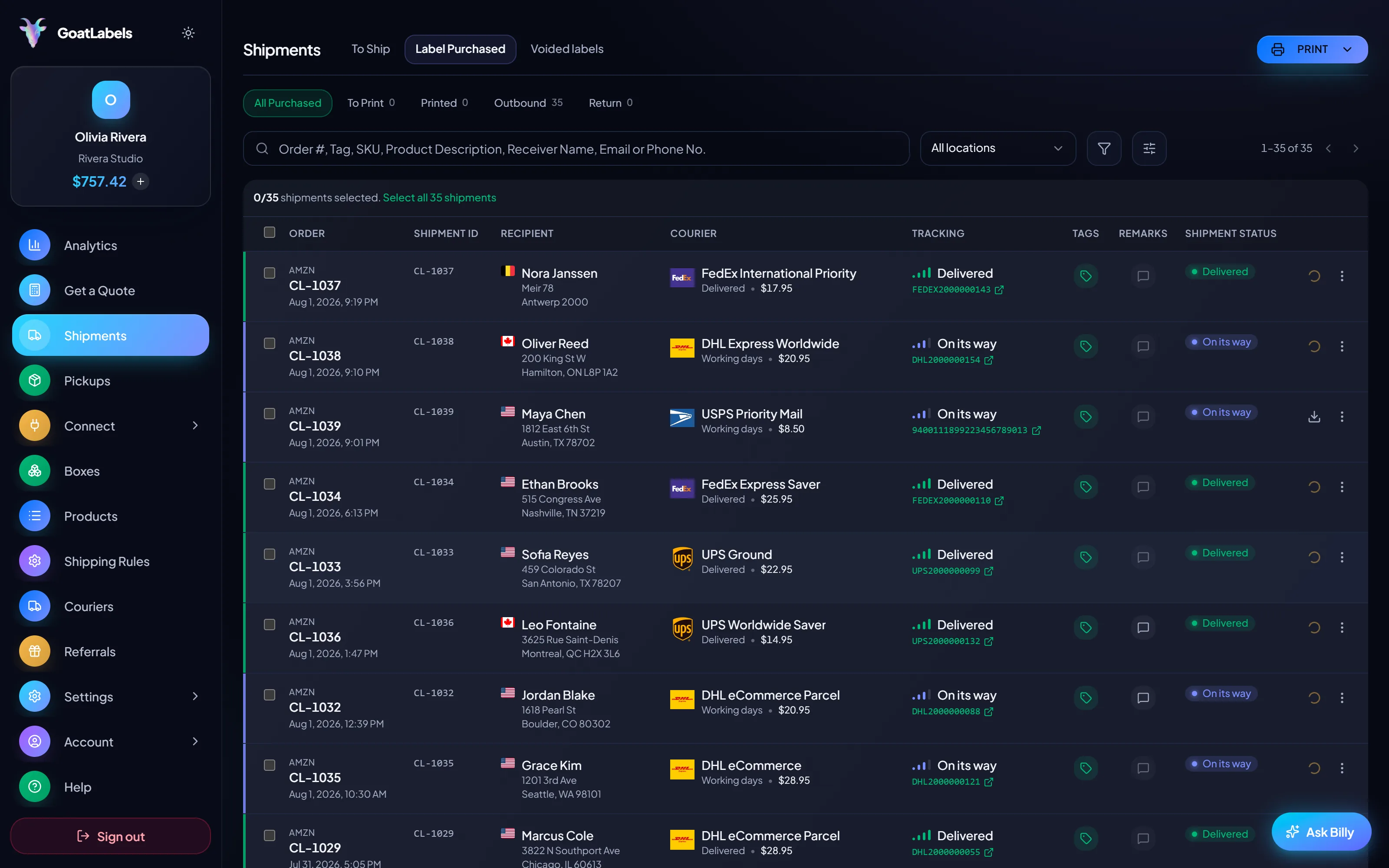
UPS $12.48 FedEx $13.22 DHL $14.10 USPS $11.79 A branded tracking page and tracking emails keep the buyer looking at the parcel instead of at their bank, and the REST API exposes the same scan history with signed webhooks on status changes — unlimited calls on every plan, so the evidence is a query rather than a screenshot hunt.
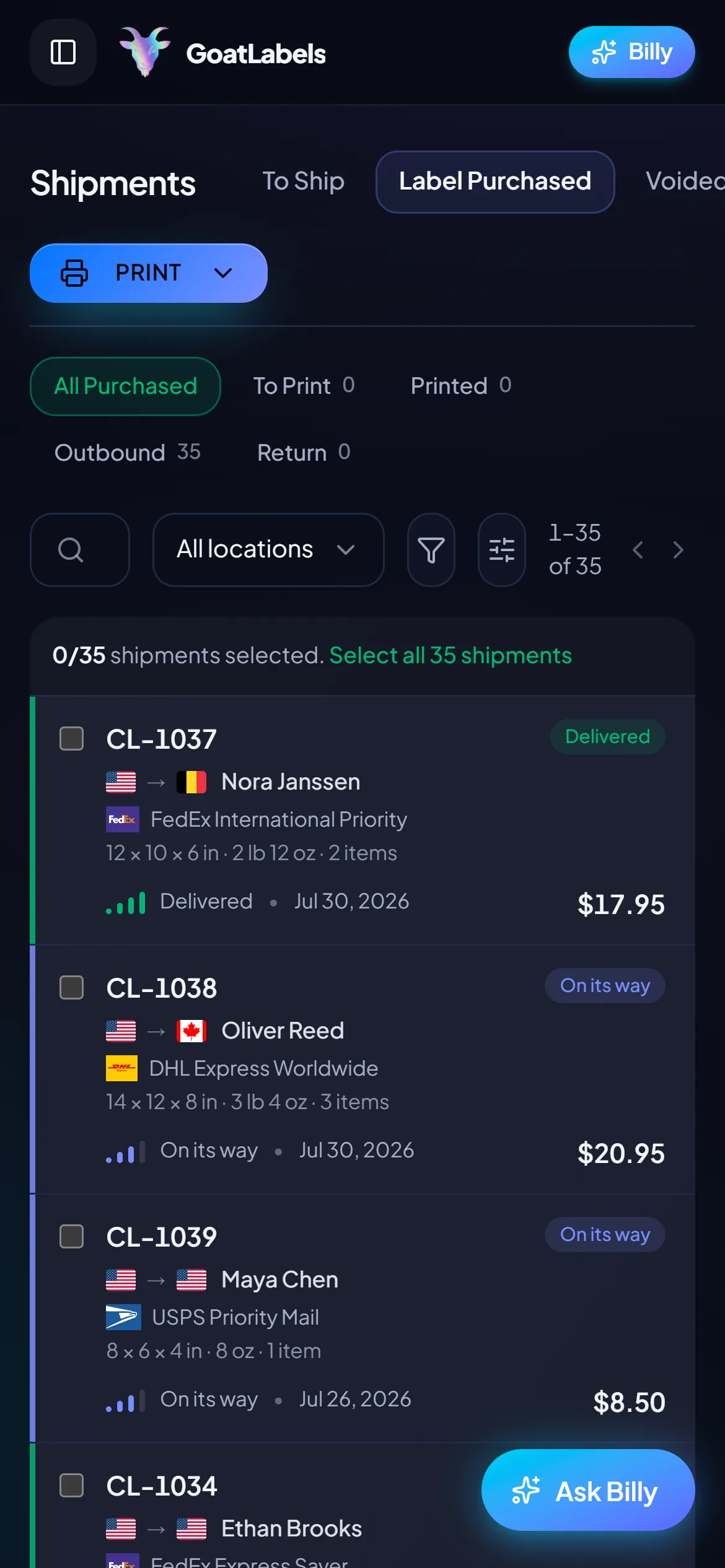
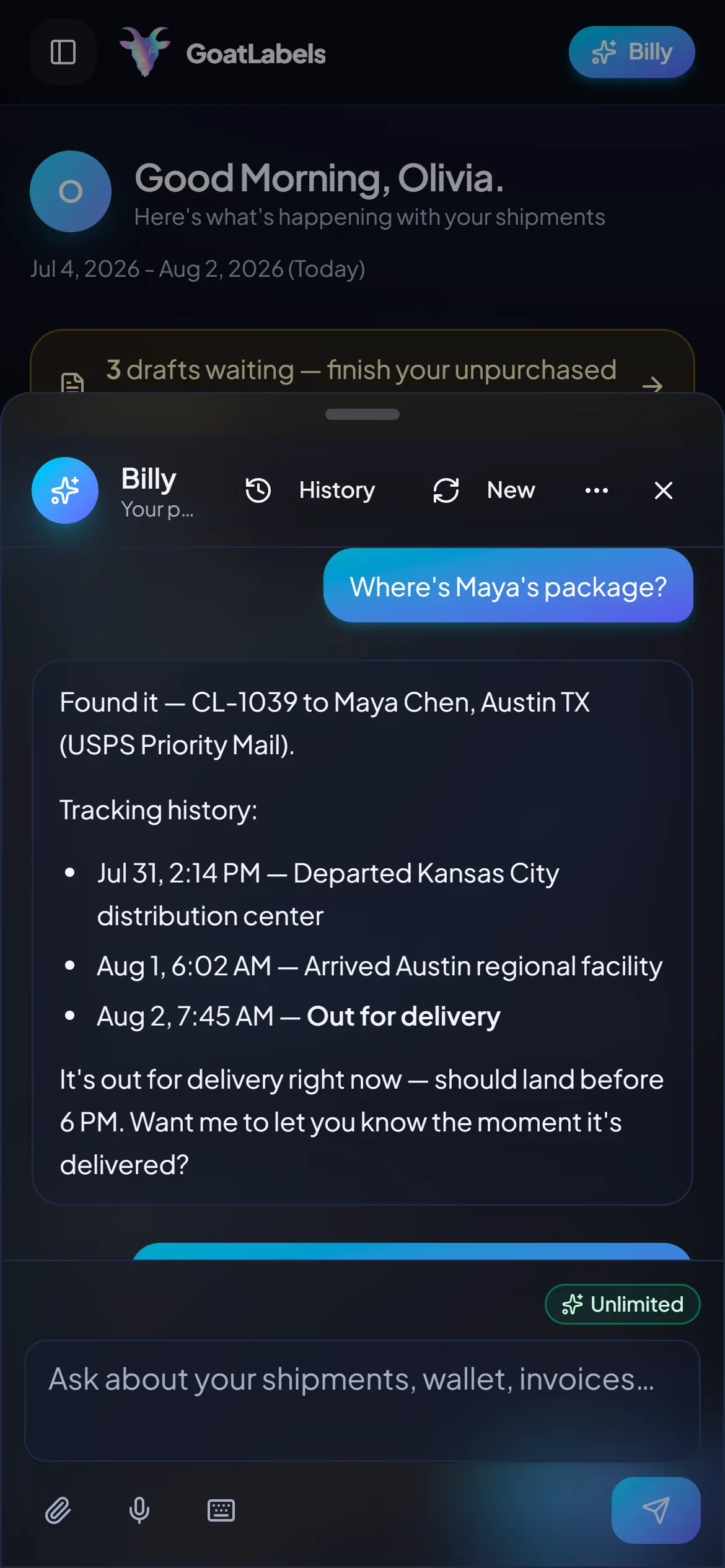
Scan history pulled
CL-1038 · Seattle, US
These messages never arrive while you are at a desk. They arrive at the packing table, in a queue, on a Sunday — and the mistake is always the same: answering before reading the scan. The full history, the address you shipped to, and the signature switch for the next label all fit on the phone the message came in on.
The buyer's message and your answer are usually ten seconds apart, and that is the whole problem. Hold the mic, name the customer, and Billy finds the shipment and reads the tracking history out loud — the delivery scan, its timestamp, and the address it went to — so the first thing you say is informed rather than apologetic. It remembers repeat buyers, so a second disputed delivery to the same address is something you know about instead of something you discover.
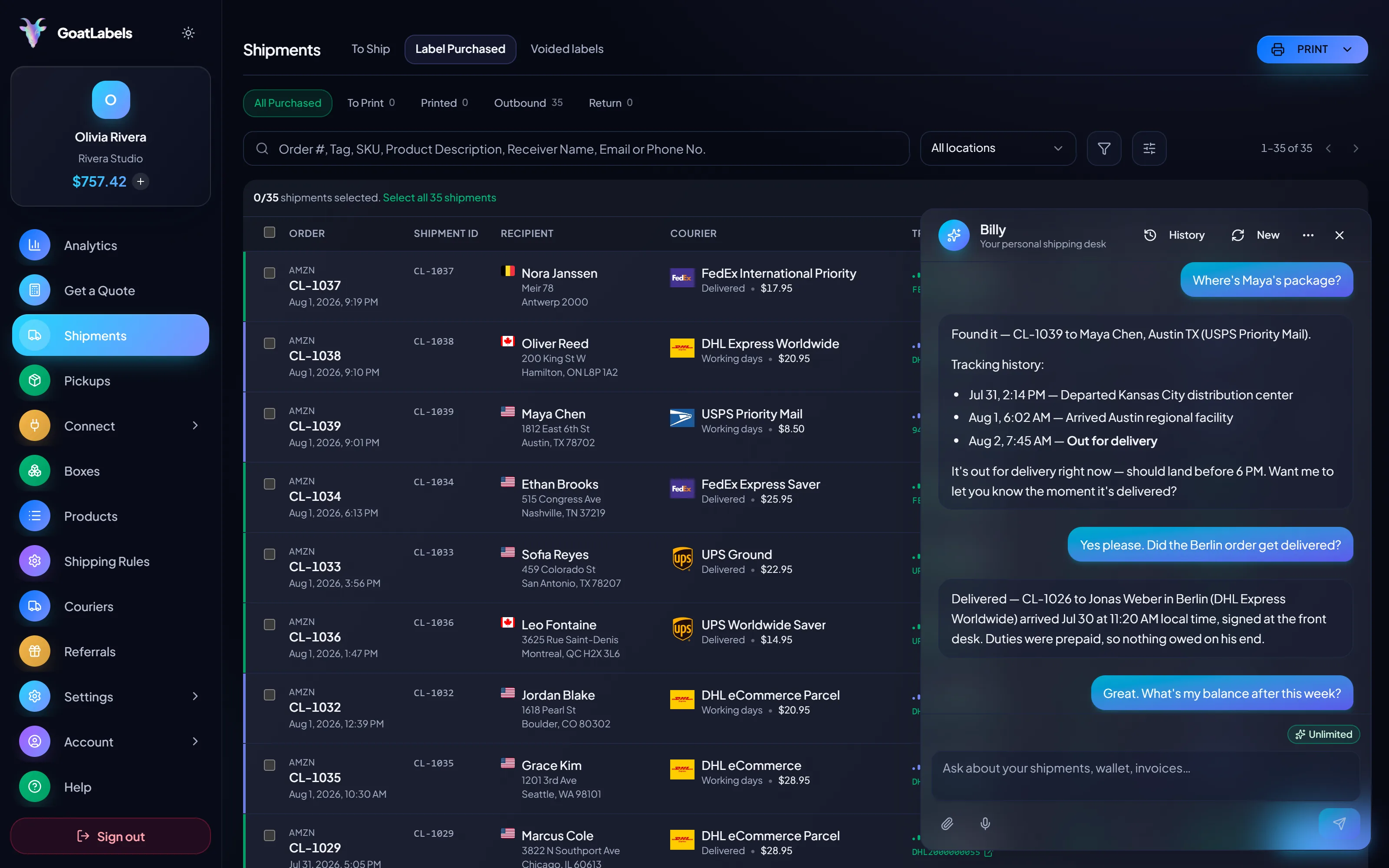
Listening
"Where's Maya's package?"
Out for delivery
CL-1039 · Austin, TX · by 6 PM
Speaks plain English · reads the full scan history, not just the last status · remembers customers and addresses · included on every plan, never a pricier tier.
Deciding whether an order is worth protecting is a comparison, and it only works if both numbers are finished. Each column here is one all-in figure with the carrier's signature and coverage fees already counted, so you are weighing two complete prices at quote time instead of finding an accessorial on a statement weeks later.
Priority Mail · signature
2–3 days$14.20
$3.75 of signature and coverage fees, already inside the price
all-in · no surprises
Ground · direct signature
2–4 days$16.60
$5.10 of signature and coverage fees, already inside the price
all-in · no surprises
Express · signature
1–2 days$24.90
$6.40 of signature and coverage fees, already inside the price
all-in · no surprises
The evidence a marketplace or a bank wants is the carrier's own record, and it should be a query rather than a hunt through four tracking sites. REST, JSON, one Bearer header, signed webhooks on every status change, and unlimited calls on every plan — so the delivery record is already in your system before the buyer messages you.
POST /api/v1/shipments
Authorization: Bearer sk_live_…
Idempotency-Key: ord_8421

{
  "to": { "name": "Joyce", "city": "Berlin", "country": "DE" },
  "parcel": { "weight": 2.6, "weight_unit": "lb" },
  "service": "fedex_intl_priority"
}
Signature, coverage, branded tracking, and the full scan history are per-shipment fields and product features, not a plan tier. Free covers 50 shipments a month with everything else unlimited, and Pro is a flat monthly plan with unlimited shipments and cheaper label pricing. Protecting the orders worth protecting never moves you up a plan.
Volume pricing
illustrativemore volume → lower per-label rates
$0 / forever
Fund a wallet, pay per label, and pay nothing at all in a month you did not ship in.
The assistant that drafts the label from the order itself — and validates the destination before you pay, which is what a protection case is judged on later — runs unlimited in the web app on Free. Pro adds Billy on Telegram.
GET /api/v1/shipments
200 OK · plan: free
Scan history and signed webhooks over unlimited calls on Free — still unlimited on Pro.
On Pro we will work with you to beat the label rates you are already getting from
ShippoPirate ShipShipStation Label prices are quoted live from USPS, UPS, FedEx, and DHL as one all-in number with signature and coverage fees inside it, and that exact amount leaves your prepaid balance — nothing added at checkout. Full pricing details
Same scan record, same protection questions, same per-shipment signature switch, whether this is your first one or your fiftieth. These are the four shapes of seller where a delivered-but-missing parcel hurts most.
TikTok Shop & live commerce
At a few hundred orders a week you will meet this every month, so the answer has to be a process rather than a panic. Pull the scan, check which regime the sale fell under, reply once, and change the setting on the next label.
Etsy & independent creators
One high-value handmade piece can be a month of margin, and marketplace protection is won or lost at ship time rather than in the case. Tracking on the order before the deadline, shipped to the address on the order, is most of it.
Protection is conditions, not judgement
Order #1024 · tracking attached, address matched
Where no seller protection exists
Where the remedy is a chargeback
Bank
decides it, under the card network's rules, not a marketplace's
A video took off and I had 80 TikTok Shop orders by morning. I printed every label from my phone on the bus to the post office.
Early customer · TikTok
TikTok Shop seller
I run my Etsy shop from the kitchen. The AI reads the order, picks the carrier, the label prints. That's the whole workflow now.
Early customer · Etsy
Etsy maker
The API is what every shipping API pretends to be. Idempotency that actually works.
Sasha R.
Staff engineer, marketplace
Ship to the validated address on the order, price signature and coverage inside the same all-in quote, and give the buyer a tracking page to watch instead of a bank to call.
Sign up in seconds. No card required. Every add-on priced into the quote.