

USPS
Ground Advantage
2–5 days$7.40
$1.20 of Premium insurance included
all-in · no fee schedule to check
A carrier's sticker rate is not what you pay. Surcharges are added for your buyer's address, the delivery area, the season, and your own account — and the triggers differ at USPS, UPS, FedEx, and DHL. GoatLabels quotes one all-in price per carrier instead of a rate card.
USPS, UPS, FedEx, and DHL each return one all-in number with the destination, seasonal, and account fees already applied — so what you compare is comparable.


 all quoted
 No weekly service charge, no volume commitment, no minimum to keep a discount alive. Fund a prepaid wallet with card, Apple Pay, Google Pay, ACH, or crypto.
A published rate is the list price of a service before anything is known about the shipment. The destination decides whether a residential or delivery-area fee fires, the calendar decides whether a peak window is open, and a carrier account decides whether anything is billing you between shipments. All three are resolved at quote time and folded into one all-in number per carrier, so the thing you compare is the thing you pay.
Can you post it to 214 Ridgeline Rd, Silverton CO 81433? It's my house, not a shop 🙂
Residential and extended-area classification comes from each carrier's own address database, not from what you type — which is why it has to be resolved at quote time rather than assumed from the address you were given.

That exact amount leaves your balance — nothing is bolted on at checkout, and nothing bills you between shipments. A carrier reweigh is the one thing that can move afterwards, and it posts as its own ledger entry rather than an unexplained charge.
Shopify, Etsy, WooCommerce, and TikTok Shop sync into the To Ship queue, so a residential address arriving from a marketplace is classified and priced exactly like one you typed yourself — rather than at whatever rate that platform's own shipping tab hands you. Paste an Instagram or Facebook DM and Billy builds the shipment straight from the message.
 Shopify
  Etsy
Etsy  WooCommerce
  TikTok Shop
  Amazon
  eBay
eBay  Squarespace
  Wix
Wix  Walmart Shopify Plus Soon
 Square
  BigCommerce
  Magento
  Zapier Soon
 NetSuite Soon
 Ecwid Soon
 Temu
Temu  Shein Soon
 ChannelAdvisor Soon
 SkuVault Soon
 Zoho Inventory Soon
The largest and most predictable surcharge on a small seller's parcels is the residential one, and it is not a fee you can argue with — because it is not a fee about you. UPS and FedEx price a delivery to a house and a delivery to a loading dock as two different products, and every parcel landing at a home carries the residential line. USPS does not make that distinction at all: a house and a business cost the same. That single structural difference is why a USPS quote and a UPS quote diverge most on consumer deliveries and converge on commercial ones, and it is the reason a carrier that looks unbeatable on your wholesale pallets can be the wrong default for your direct-to-consumer orders.
You do not get to declare the classification. Each carrier decides it from its own address database, which means a home-based business that thinks of its address as commercial is generally billed as residential, and a commercial address the database has never seen can be classified the other way. GoatLabels validates the destination at quote time and shows the residential or commercial classification the carrier is going to apply, before any money moves — which is the only moment the information is worth anything.
The second destination trigger is the delivery area surcharge. Each carrier publishes a list of ZIP codes it treats as extended or remote, and a parcel landing in one carries a fee on top of the zone-based rate. Zones measure distance; this measures how expensive the last few miles are to serve. Two towns an hour apart can sit on opposite sides of the list, so the same box to the same zone is not always the same price, and the tiers stack — several carriers publish a plain extended tier and a deeper remote tier above it. DHL runs the same mechanic internationally under a remote area surcharge. If a meaningful slice of your orders goes to rural addresses, this is the fee that decides your carrier mix, and it is decided one ZIP at a time rather than once for your whole account.
A third destination fee is the one you cause: an address correction charge when the carrier has to repair the address in transit. It is cheap relative to the alternative, which is the parcel coming back — the reasons carriers reject an address, and who ends up paying to reship, are covered on why a package comes back.
Peak or demand surcharges arrive in two shapes, and only one of them is aimed at you. The first is a flat per-parcel amount applied to residential deliveries inside a published window, and it catches everyone — a seller shipping four boxes a week pays it exactly as a seller shipping four thousand does. The second is volume-triggered: it only applies to shippers whose weekly volume exceeds a stated multiple of an earlier baseline period, which is a threshold a small seller almost never crosses. Reading a headline about peak surcharges and assuming both apply is the usual mistake; reading it and assuming neither does is the expensive one.
The peak amounts applied to oversized and irregular parcels are typically far larger than the base residential peak fee, which is why a bulky item that was marginal in October can be unprofitable in December. Those thresholds are parcel-triggered, so they live on package size and weight limits, not here.
USPS behaves differently again: it files a temporary price increase for the holiday period rather than bolting a surcharge line onto the existing rate. The practical effect on your wallet is similar, but the mechanism matters, because a temporary rate is already inside the price you are quoted rather than added to it. What all of this has in common is notice. Peak windows and holiday rates are published weeks ahead of the date they start, which is enough time to reprice your shipping options or move a class of orders to a different carrier for the window — but only if you are comparing every order rather than defaulting to one carrier and finding out from the invoice.
The third family of fees is not attached to a parcel at all. It sits on a carrier account, which is why it never appears on a rate card and only shows up on a weekly invoice: a weekly service charge for holding a scheduled daily pickup, a minimum net charge that quietly floors your discounted rate so a deep percentage discount stops applying on small parcels, earned-discount tiers that reset when volume falls, a fee for paper invoicing, and late-payment charges. None of them are hidden exactly — they are all in the service guide — but none of them are in the number you were shown when you priced the shipment.
This is also where negotiated rates get misread. A percentage off a list rate is not a price, because the list rate itself moves every year, and a discount expressed against a moving base can shrink without anyone renegotiating anything. If you are comparing your contracted rate to anything, compare the number that actually left your account for a specific parcel, not the discount you were quoted in a meeting.
GoatLabels has no account of your own to maintain and nothing to keep alive between shipments: no weekly service charge, no volume commitment, no earned-discount tier to defend, and no monthly minimum to print. If you ship nothing in a month, a month costs nothing. That is a different argument from being cheap per label, which is made properly on cheap shipping labels.
This one is informational, because it is not something GoatLabels does: we do not schedule carrier pickups. It still belongs in a surcharge page, because it is the cost most often left out of a comparison. USPS will collect parcels at your regular delivery for free, and charges for an on-demand slot at a time you choose. UPS and FedEx charge per request for an on-call collection, or hold a scheduled daily pickup against a recurring account charge. Do the arithmetic on a seller shipping a handful of parcels a week and the ranking can flip: the carrier with the cheaper label can be the more expensive shipment once collection is priced in, and the carrier whose collection is free can win on parcels where its label costs slightly more. If you drop off at a counter instead, the cost is real but it is your time rather than a line on an invoice — which is exactly why it gets left out of comparisons.
Put the three families together and the shape of the problem is clear. A published rate is the list price of a service before anything is known about the shipment. The price you actually pay is that rate, plus a fuel percentage that moves, plus whatever the destination triggers, plus whatever the season triggers, plus whatever your account triggers. Four carriers' rate cards compared side by side tell you almost nothing, because each carrier's fee schedule is a different document with different triggers.
GoatLabels resolves that by quoting each of USPS, UPS, FedEx, and DHL as one all-in number for your specific parcel and your specific destination, with the applicable fees already inside it. That exact amount is what leaves your prepaid wallet, and nothing is bolted on at checkout. Four comparable numbers is a decision you can make in seconds; four rate cards is a research project you will skip on order number forty. If you are choosing between the budget ground tiers in particular, the crossover is worked through on cheapest ground shipping services.
One thing genuinely can move after purchase: if the carrier reweighs or remeasures the parcel, it bills the difference. That is a post-shipment correction rather than a surcharge, it has its own detection and dispute process, and it is covered in full on carrier billing adjustments. On GoatLabels it posts as its own ledger entry against your wallet, so you can see what changed and why instead of finding an unexplained charge weeks later.
Deliberately no dollar amounts. Every carrier re-sets these figures at least annually and sometimes mid-year, and a stale number in a page like this is worse than no number — it gets quoted back at you. The triggers below are structural and move slowly; the amounts are in each carrier's own published service guide, which is the only copy that is current.
Verify against the current UPS, FedEx, USPS, and DHL service guides before relying on any figure. Review cadence: annual, and again whenever a peak window is announced.
Surcharges only bite when the number you decided on and the number you were charged are different documents. Everything below exists to collapse them into one.
Fund it with card, Apple Pay, Google Pay, ACH, or crypto and spend it label by label. There is no weekly service charge, no volume commitment, and no earned-discount tier that quietly expires — the things that bill you between shipments simply do not exist here.
Billy drafts the shipment from a pasted order, a screenshot, or a spoken address, and the destination is validated at quote time with the residential or commercial classification shown. Residential is the largest destination-triggered fee on a consumer parcel, so seeing it before purchase is the difference between choosing a carrier and discovering one.
Destination, seasonal, and fuel components are applied before you see the price, not after you commit to it. That exact amount leaves your balance. Nothing is bolted on at checkout, and a carrier reweigh posts as its own ledger entry rather than an unexplained charge.
The carriers do not levy the same fees, which is precisely why comparing them per order matters. USPS charges nothing extra for a residential delivery; UPS and FedEx do. One carrier's remote ZIP list is not another's. Quoting all four against the same box and the same address is the only way those differences show up as a price instead of a surprise.
UPS $12.48 FedEx $13.22 DHL $14.10 USPS $11.79 Quote and buy over REST with unlimited calls on every plan, and subscribe to signed webhooks rather than polling. Post-shipment adjustments arrive as their own records carrying the wallet delta, so a script can reconcile what changed without a human reading an invoice.
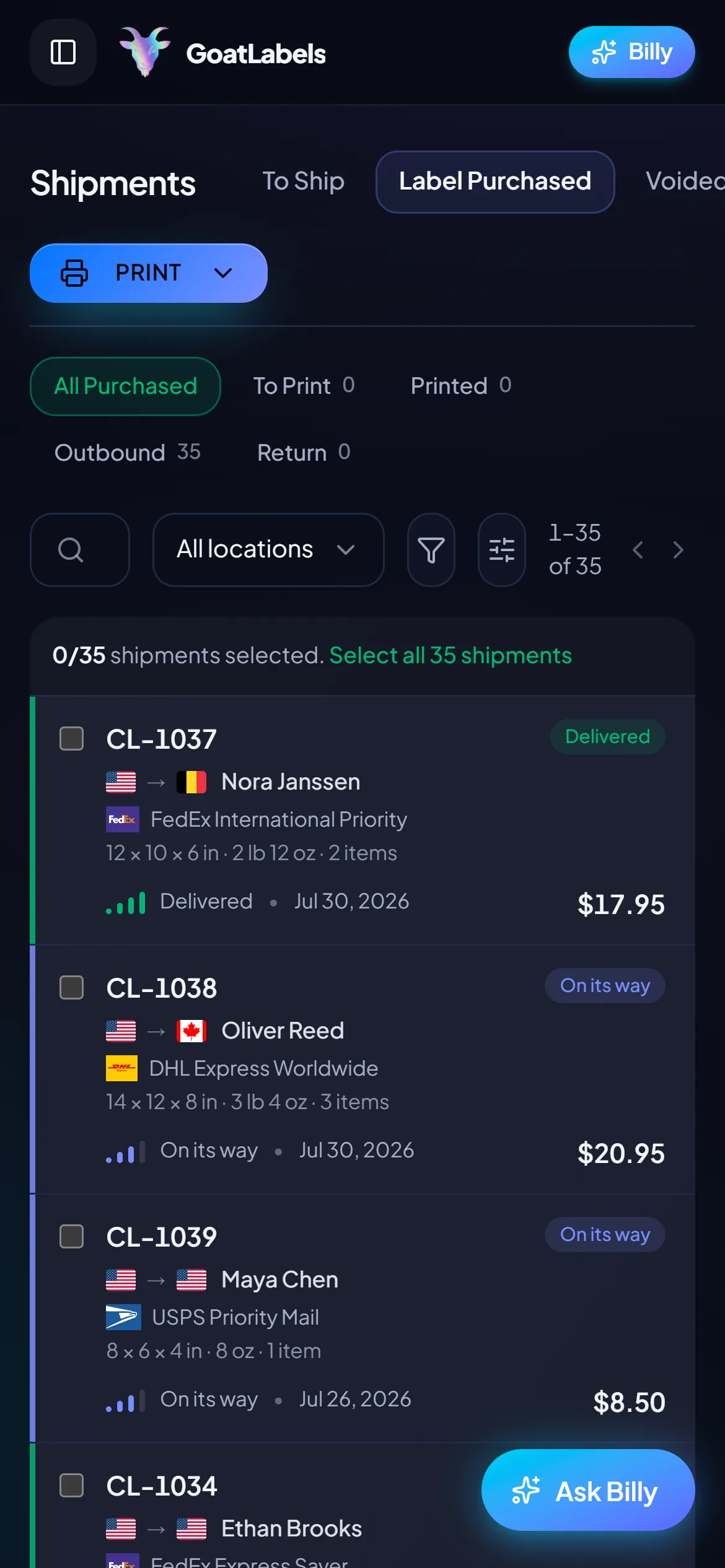
All-in quote ready
CL-1038 · Silverton, CO
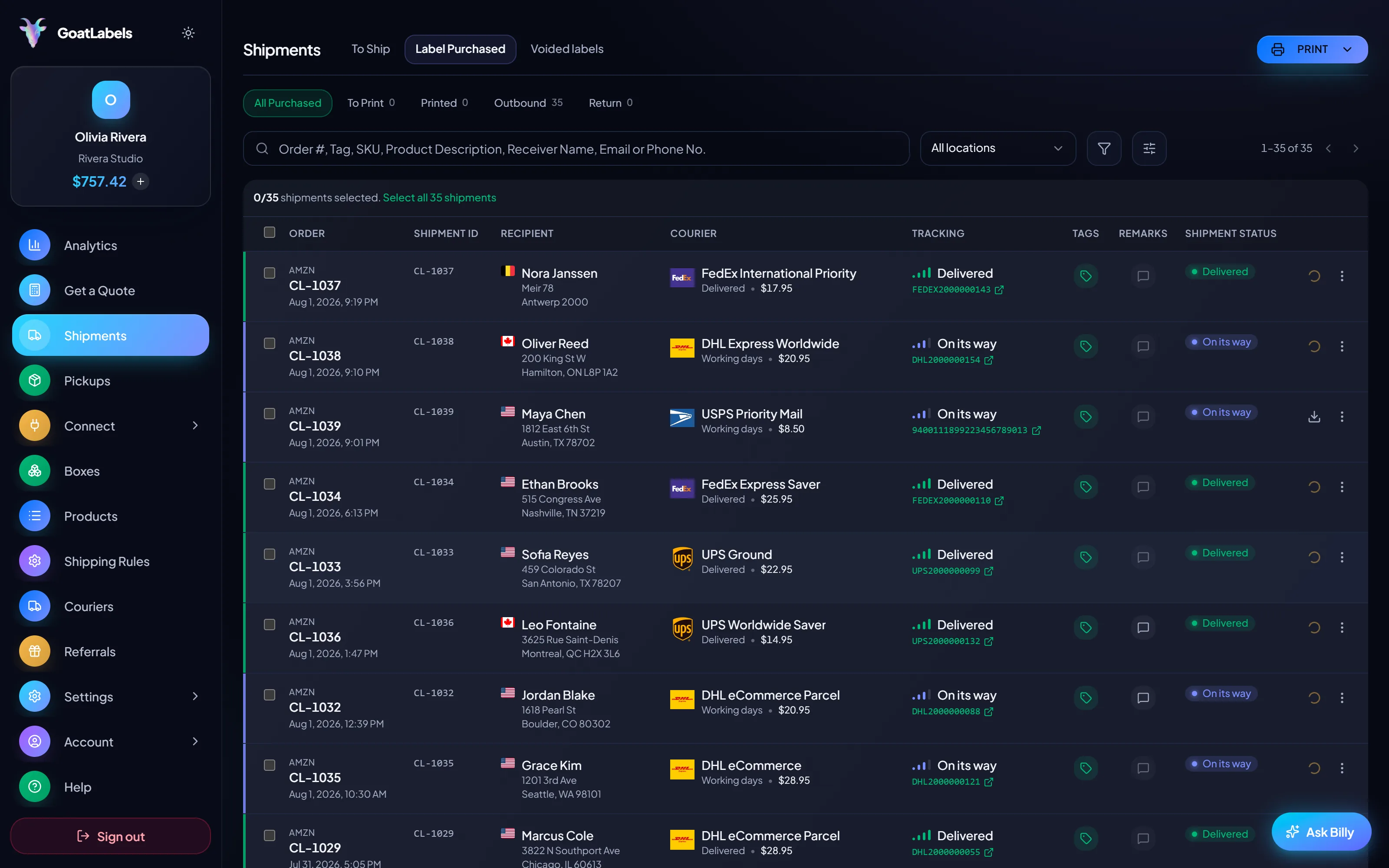
Cross-referencing four fee schedules is something nobody does standing at a kitchen table with a roll of tape — which is exactly why the fees have to be inside the price rather than beside it. The queue, the destination classification, and four all-in numbers all fit on the phone you already have open.
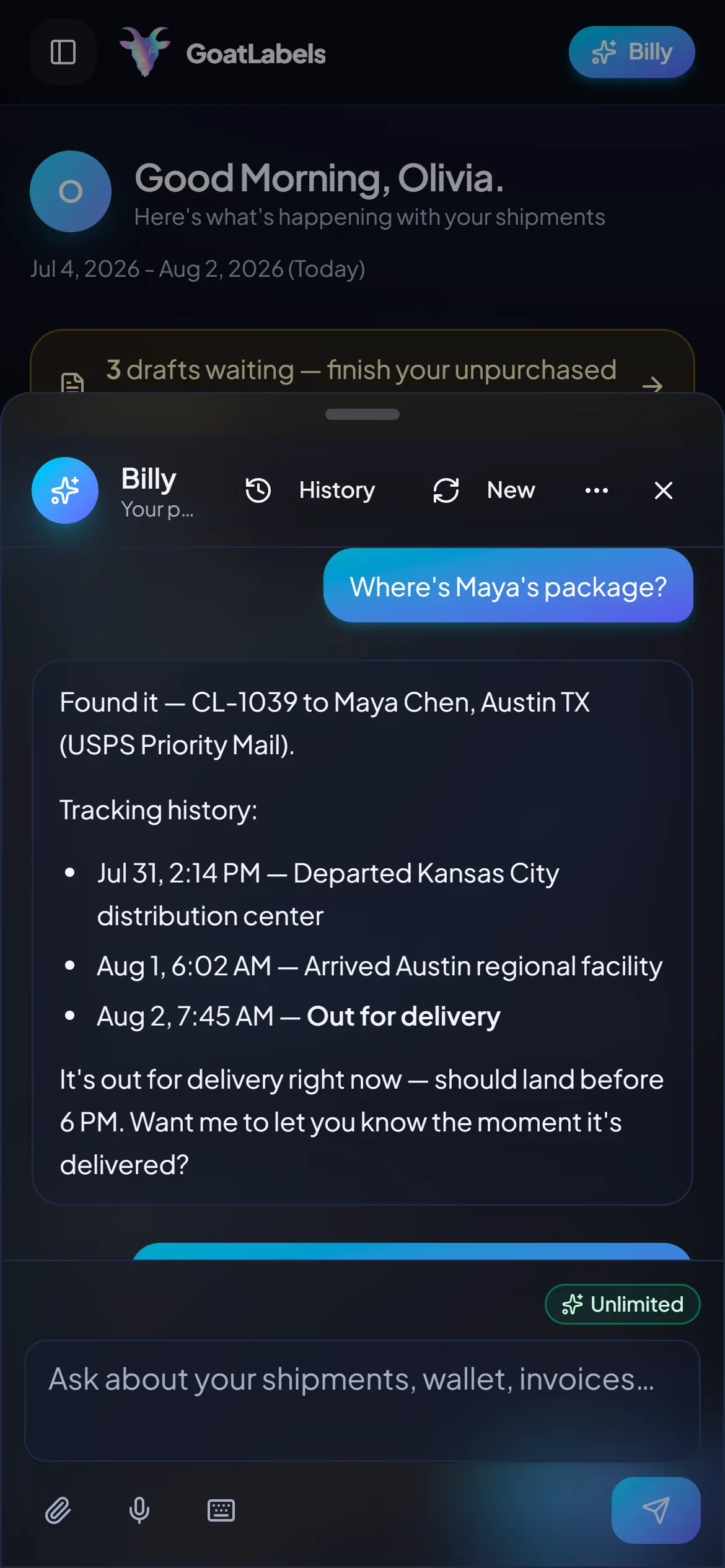
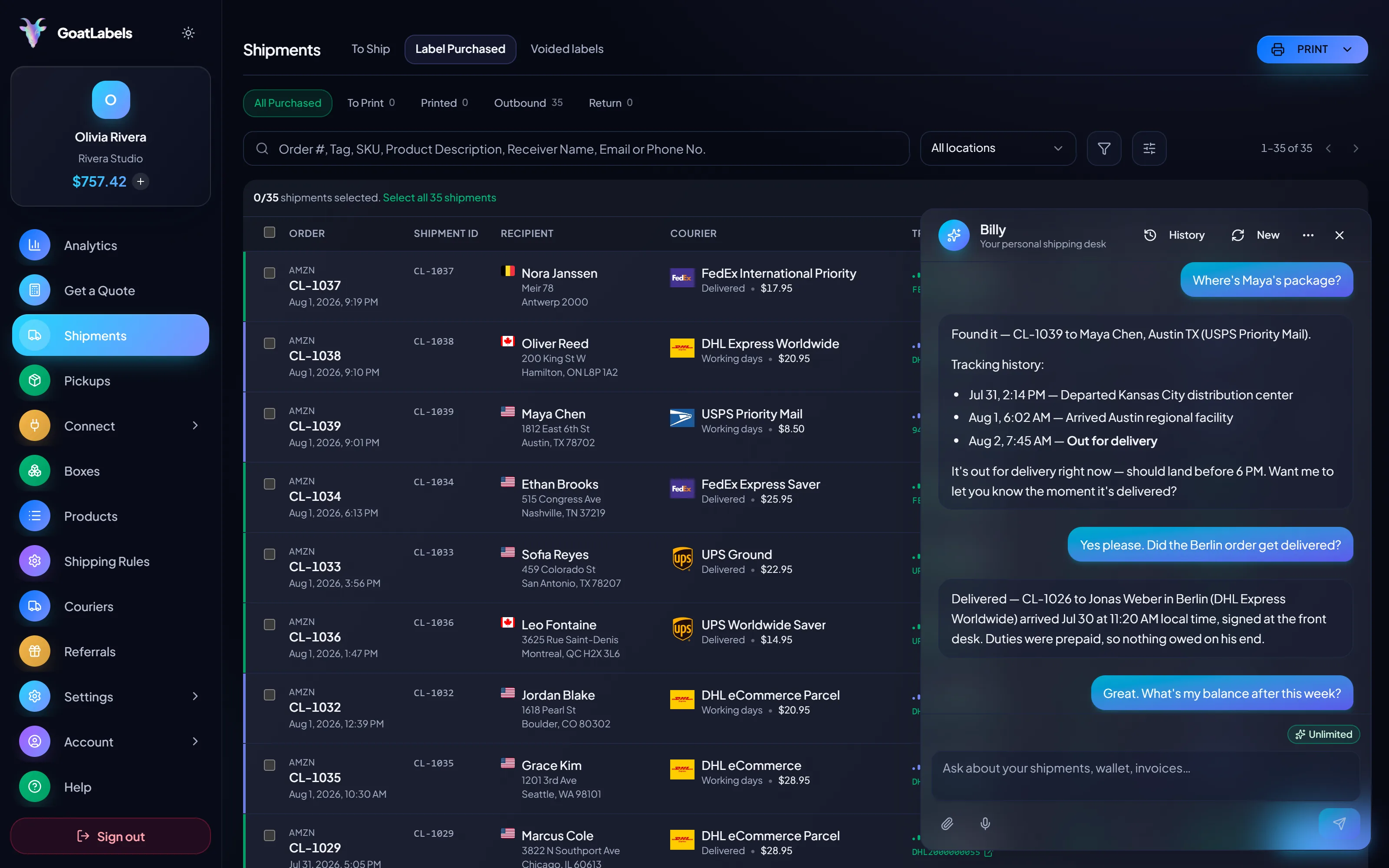
Hold the mic, read the destination off the buyer's message, and Billy validates it, tells you the classification each carrier is going to apply, and reads back four all-in numbers with the destination and seasonal components already inside them. It remembers repeat buyers and saved box sizes, and it answers for the shipment afterwards — including when a reweigh posts its own entry against your wallet. This is the real product, not a render.
Listening
"Where's Maya's package?"
Out for delivery
CL-1039 · Austin, TX · by 6 PM
Speaks plain English · says the residential or commercial classification out loud · quotes four carriers as one all-in number each · included on every plan, never a pricier tier.
Destination, seasonal, and fuel components are applied before you see a price rather than after you commit to one. The same box and the same residential address are priced against three carriers with each carrier's own fee schedule applied, and the column you pick is the exact amount that leaves your balance.
Ground Advantage
2–5 days$7.40
$1.20 of Premium insurance included
all-in · no fee schedule to check
Ground
3–4 days$10.80
$1.20 of Premium insurance included
all-in · no fee schedule to check
Home Delivery
2–4 days$11.40
$1.20 of Premium insurance included
all-in · no fee schedule to check
Quote and buy over REST with the destination, seasonal, and fuel components already applied to each carrier's price. JSON, one Bearer header, signed webhooks instead of polling, real idempotency keys, and unlimited calls on every plan — reconciling what you paid should not require a human reading an invoice.
POST /api/v1/shipments
Authorization: Bearer sk_live_…
Idempotency-Key: ord_8421

{
  "to": { "name": "Joyce", "city": "Berlin", "country": "DE" },
  "parcel": { "weight": 2.6, "weight_unit": "lb" },
  "service": "fedex_intl_priority"
}
The third family of surcharges never touches a parcel — it sits on a carrier account, which is why it shows up on a weekly invoice rather than a rate card. There is none of that here. Free covers 50 shipments a month, Pro is a flat monthly plan with unlimited shipments and cheaper label pricing, and neither charges you for a week you did not ship in.
Volume pricing
illustrativemore volume → lower per-label rates
$0 / forever
Fund a wallet, pay per label, and pay nothing at all in a month you ship nothing.
The assistant that reads an order into a draft and validates the destination before you spend anything runs unlimited in the web app on Free. Pro adds Billy on Telegram.
GET /api/v1/shipments
200 OK · plan: free
Unlimited calls on Free — still unlimited on Pro.
A percentage off a list rate is not a price. On Pro we will work with you to beat what you actually paid after surcharges — the number on your invoice — from
ShippoPirate ShipShipStation Label prices are quoted live from USPS, UPS, FedEx, and DHL as one all-in number with the applicable destination, seasonal, and fuel components already inside it, and that exact amount leaves your prepaid balance — nothing is added at checkout. Full pricing details
Same all-in quoting, same wallet, same one-tap flow, whether that is four parcels a week or four hundred. These are the four shapes of seller whose order book quietly triggers the most fees — and who therefore lose the most to a standing carrier default.
Every parcel lands at a house
UPS and FedEx price a delivery to a home and a delivery to a loading dock as two different products; USPS does not make the distinction at all. When every parcel you send is residential, that structural difference is not an edge case — it is the whole comparison.
Etsy & independent creators
Delivery area surcharges are decided one ZIP code at a time, in stacked tiers, and each carrier keeps its own list. If a meaningful slice of your orders lands somewhere the last few miles are expensive to serve, the carrier gets chosen per parcel or it gets chosen wrong.
Same box, two towns, two prices
Order #1024 · extended area applies to one of them
Committing to a price before the fees are known
Announced ahead, in two different shapes
2
peak surcharge shapes — one flat per parcel, one volume-triggered
A video took off and I had 80 TikTok Shop orders by morning. I printed every label from my phone on the bus to the post office.
Early customer · TikTok
TikTok Shop seller
I run my Etsy shop from the kitchen. The AI reads the order, picks the carrier, the label prints. That's the whole workflow now.
Early customer · Etsy
Etsy maker
The API is what every shipping API pretends to be. Idempotency that actually works.
Sasha R.
Staff engineer, marketplace
Paste the order, get four all-in numbers with the fees already applied, and buy the one that wins for that parcel and that address.
Sign up in seconds. No card required. Nothing bills you between shipments.