

USPS
Priority Mail Intl
10–15 days$7.40
$1.90 of duties & taxes prepaid, not billed to your buyer
all-in · no surprises
Measure the box before you compare prices. Some carriers refuse an over-limit parcel outright and others divert it to freight, and a light, bulky box may be billed on dimensional weight instead of actual weight. Two things move that cost: the dimensions you pack to, and the carrier's divisor.
USPS, UPS, FedEx, and DHL stop at different weights, different lengths, and different length-plus-girth figures — and convert cube to billable weight with different divisors.


 all quoted
 Store the boxes you actually pack into, so the dimensions that drive dimensional weight are entered once rather than guessed per order.
Every rate comparison has a step before price, and most sellers skip it. A carrier that cannot legally accept your parcel is not a cheaper option, it is not an option — and the four carriers stop in different places. USPS caps every domestic class at the same weight and applies two different length-plus-girth ceilings depending on the class, which catches sellers out constantly: the class most people reach for first is not the class with the largest size allowance. UPS and FedEx accept parcels several times heavier on their ground services, and impose their own separate ceilings on the longest side and on length plus girth. DHL Express states its limits per piece in metric, which is worth knowing before you convert a pallet-adjacent box in your head.
The practical consequence is that the set of carriers you are choosing between shrinks as the box grows, and it shrinks in an order that is not obvious. A heavy, compact parcel eliminates USPS long before it approaches anyone else's ceiling. A light, enormous parcel can be perfectly acceptable to USPS on one class, unmailable on another, and fine at UPS and FedEx but expensive there for a completely different reason. The figures themselves are in the dated block at the bottom of this page; the shape of the rule is what you need in your head while you are picking a box.
Girth is not a side. It is the distance once around the parcel at its thickest point, perpendicular to the length — which for a rectangular box is twice the width plus twice the height. So the figure a carrier asks for is length plus twice the width plus twice the height. The common error is adding the three dimensions together, which systematically underestimates and produces a number that clears every published limit right up until the carrier measures it.
Work an example. A 24 by 14 by 12 inch box has a length of 24 and a girth of twice 14 plus twice 12, which is 52, giving 76 inches — well inside every carrier's allowance. Now take a 40 by 20 by 18 box: length 40, girth 76, total 116 inches. That single box is over the smaller USPS class ceiling, under the larger one, and comfortably inside the UPS and FedEx limits. Nothing about the box changed; the eligible carrier list did.
Two measurement habits are worth more than any of this arithmetic. Measure the box packed, taped, and sitting the way it will sit on a conveyor, because a bulging side is what gets measured downstream, not the flat-pack dimensions printed on the carton. And measure to the next whole inch up rather than down — carriers round in their own favour, and the gap between your rounding and theirs is a classic source of a post-shipment correction you did not budget for.
Carriers sell space on a vehicle, not mass. A box full of packing peanuts occupies the same floor as a box full of bolts, so carriers convert volume into a billable weight: length times width times height, divided by a published divisor, rounded up. You are billed on whichever is greater, the actual weight or that dimensional weight. This is not a surcharge, it is a different basis for the base rate, which is why it rarely appears as a line item and instead shows up as a rate that does not match what you expected.
Where the carriers differ is in when the mechanic engages at all. UPS and FedEx apply dimensional weight to essentially every parcel on their standard services. USPS applies it only above a cubic-foot floor and only to the more distant zones on its main parcel classes. That single difference produces most of the surprises a small seller meets: a large, light parcel travelling a short distance can be billed on actual weight at USPS and on cube at UPS, and the two quotes will look like they are pricing different shipments, because in a real sense they are.
Worked through: an 18 by 14 by 12 box is 3,024 cubic inches. Divided by a divisor of 139 and rounded up, that is 22 billable pounds — for a parcel that might genuinely weigh six. If the contents actually weighed 30 pounds, dimensional weight would be irrelevant and you would be billed on 30. The moment to notice this is while you are choosing the box, not while you are reading the quote.
There are exactly two levers on dimensional weight. The divisor belongs to the carrier and you cannot move it. The dimensions belong to you and you can move them today, which makes right-sizing the highest-leverage shipping change available to a small seller — considerably more effective than trying to negotiate a rate at low volume.
The arithmetic is unusually kind here, because cube is a product of three numbers. Taking one inch off the longest side of that 18 by 14 by 12 box removes 168 cubic inches, which is more than a billable pound at a divisor of 139. Dropping a soft-goods order out of a box and into a poly mailer removes the problem entirely, because a mailer that conforms to its contents has almost no cube to convert. And for USPS specifically there is a bright line worth designing around: stay under one cubic foot and the mechanic never engages. One cubic foot is a twelve-inch cube, so any box smaller than 12 by 12 by 12 is outside dimensional-weight billing at USPS regardless of zone.
The operational half of this is consistency. Dimensional weight is computed from what you enter, so a box guessed at from memory on a busy evening quietly becomes a reweigh a fortnight later. GoatLabels lets you save the box sizes you actually pack into, so the same product ships on the same measured dimensions every time and the quote you compare is the quote you get. Once the boxes are standard, buying against them in bulk is a spreadsheet job — bulk shipping labels from a CSV covers that flow.
Going over a limit does not mean the same thing at every carrier, and the difference is the whole reason to check before you pack. USPS treats its ceilings as mailability rules: an over-limit parcel is refused at acceptance or returned to you, so the cost is a wasted day, a wasted label, and an unhappy buyer, but not an unexpected invoice. UPS and FedEx generally still move the parcel — as an over-maximum-limits shipment carrying a charge that bears no relationship to your quote, or by diverting it into their freight service, where it is priced as freight. The parcel arrives. The bill is not the one you agreed to.
Below those hard ceilings sit the graduated fees, and they are the ones that actually catch small sellers because they trigger on parcels that feel normal. Additional handling fires on length past a stated figure, on weight past a stated figure, and on packaging that is not a standard corrugated box — tubes, drums, anything wrapped in plastic, anything the automated sort has to be pulled off. A large-package surcharge fires on length plus girth past a stated figure and typically carries a minimum billable weight, so a light oversized box is billed as though it were heavy. Both stack on top of dimensional weight rather than replacing it, and both are much larger during announced peak windows. The thresholds are in the dated block below; the seasonal timing of the increases is covered on shipping surcharges explained.
If a carrier reweighs or remeasures after the parcel is already moving and bills the difference, that is a post-shipment adjustment with its own detection and dispute path — covered in full on carrier billing adjustments. If you are choosing between the budget ground tiers for a large box, the crossover is worked through on cheapest ground shipping services, and the general case for quoting rather than defaulting is on cheap shipping labels.
Everything that can rot is in this block and nowhere else on the page. Structural limits move rarely; divisors and surcharge thresholds are re-set by carriers at least annually and occasionally mid-year.
Verify every figure above against the carrier's own current service guide rather than an aggregator before packing to a threshold — divisors in particular. Review cadence: annual, plus a re-check on any announced rate or divisor change.
A rate comparison that starts at price is comparing carriers that cannot all take the parcel. Enter the packed dimensions and the weight, and the carriers whose ceilings the box exceeds drop out before anything is priced. What is left is a list of quotes that can all actually be bought, each already billed on the greater of actual and dimensional weight.
Mailer 12x9x3 · Small box 12x12x12 · Tall box 18x14x12 — saved once, reused on every order
Measure the box packed and taped, at its widest point. The dimensions you type are the dimensions you are billed on, and a guess made on a busy evening is a reweigh a fortnight later.

The quoted amount leaves your balance. If the carrier later remeasures the parcel, the difference posts as its own ledger entry rather than an unexplained charge — which is how you find out a box needs re-sizing.
Shopify, Etsy, WooCommerce, and TikTok Shop sync into the To Ship queue, so the same saved box sizes and the same four sets of carrier limits apply whichever channel the order arrived on — rather than each platform pricing on whatever dimensions it happens to be holding. Paste an Instagram or Facebook DM and Billy builds the label from the message, with the parcel still entered from the box you actually packed.
 Shopify
  Etsy
Etsy  WooCommerce
  TikTok Shop
  Amazon
  eBay
eBay  Squarespace
  Wix
Wix  Walmart Shopify Plus Soon
 Square
  BigCommerce
  Magento
  Zapier Soon
 NetSuite Soon
 Ecwid Soon
 Temu
Temu  Shein Soon
 ChannelAdvisor Soon
 SkuVault Soon
 Zoho Inventory Soon
Dimensional weight is computed from numbers you type. Everything below exists to make those numbers consistent, visible, and checked against four sets of carrier limits before you spend anything.
Store the parcels you actually ship in, so the same product goes out on the same measured dimensions every time. Labels are bought from a prepaid balance funded by card, Apple Pay, Google Pay, ACH, or crypto, with no monthly minimum to print.
Length plus twice the width plus twice the height, converted to dimensional weight at each carrier's own divisor, on every quote. Billy drafts the shipment from a pasted order, a screenshot, or a spoken address and asks for the box rather than assuming one.
The quote tells you whether you are being priced on the parcel's actual weight or on its cube, which is the difference between a box you should keep and a box you should shrink. One all-in number per carrier, and that exact amount leaves your balance.
USPS, UPS, FedEx, and DHL stop at different weights and different length-plus-girth figures, so the honest carrier list for a large box is shorter than four. Quoting all of them against the measured parcel is what turns a limit into a filter instead of a returned shipment.
UPS $12.48 FedEx $13.22 DHL $14.10 USPS $11.79 Send parcel dimensions with the rate call and get back the eligible services with billed weight resolved, on unlimited calls on every plan. Remeasures arrive as their own adjustment records over a signed webhook, so a script can spot the SKU whose box is consistently wrong.
Eligible quotes ready
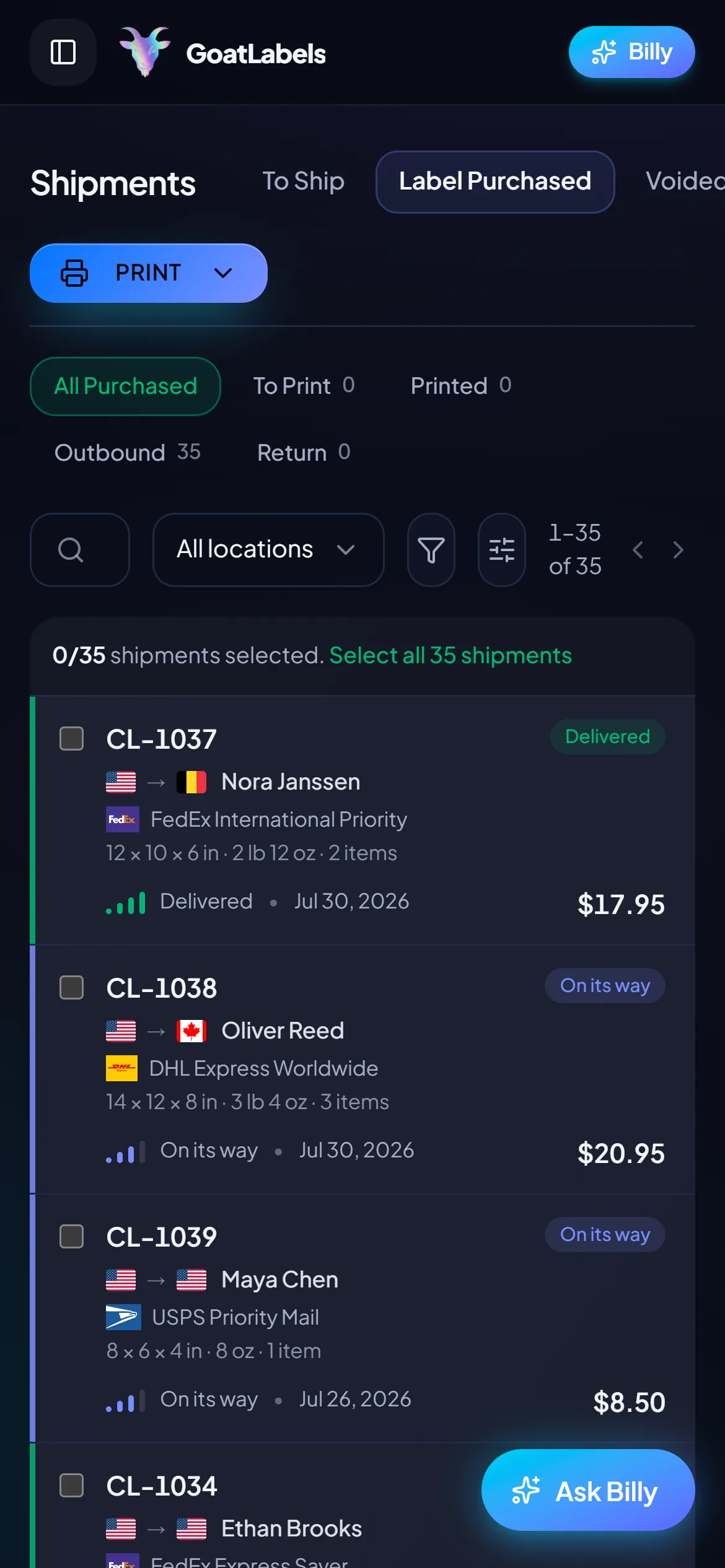
CL-1038 · 18×14×12 in
Dimensional weight is computed from numbers you type, and the only moment you know them for certain is with the taped box in front of you. The saved parcels, the eligibility filter, and the four all-in prices all fit on the phone at the packing table, which is the difference between measuring the box and remembering what it was last time.
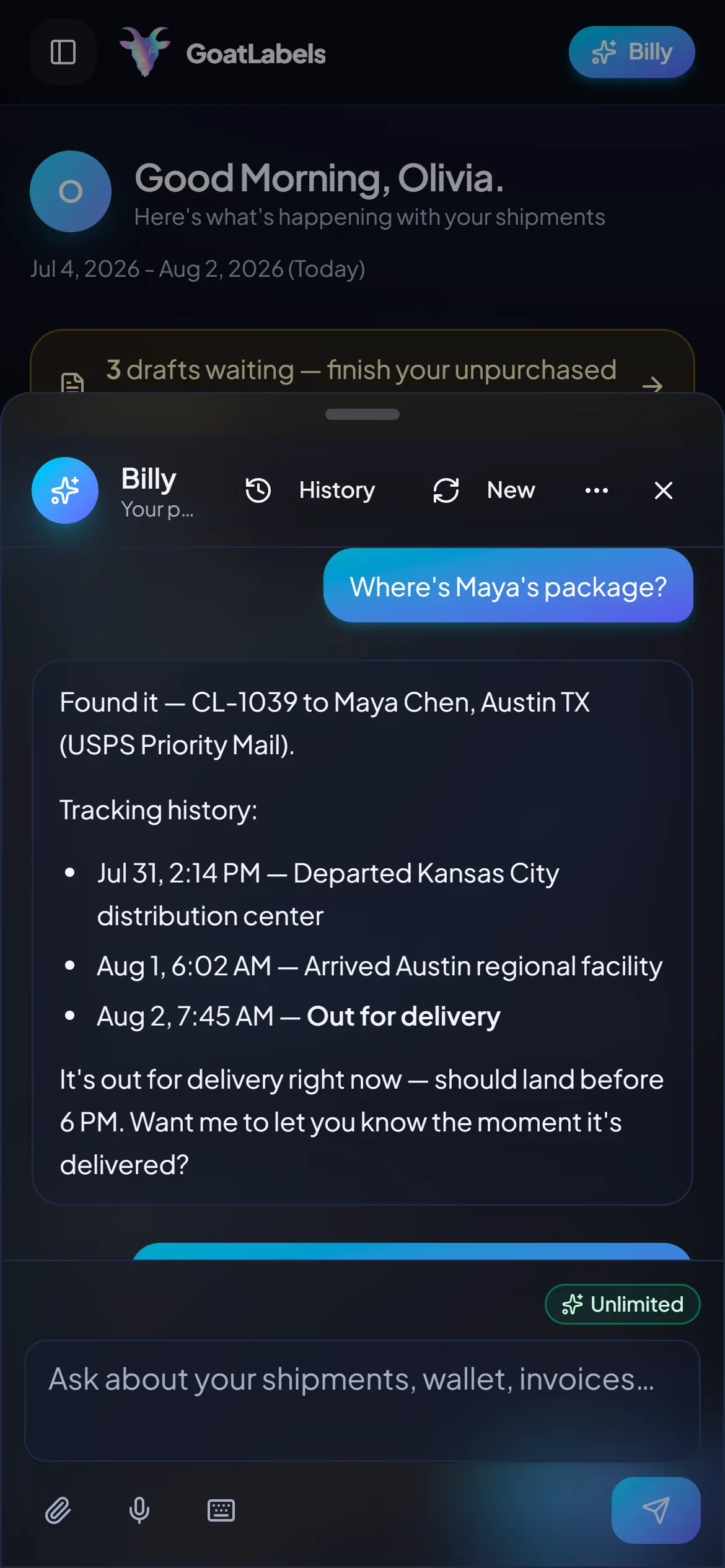
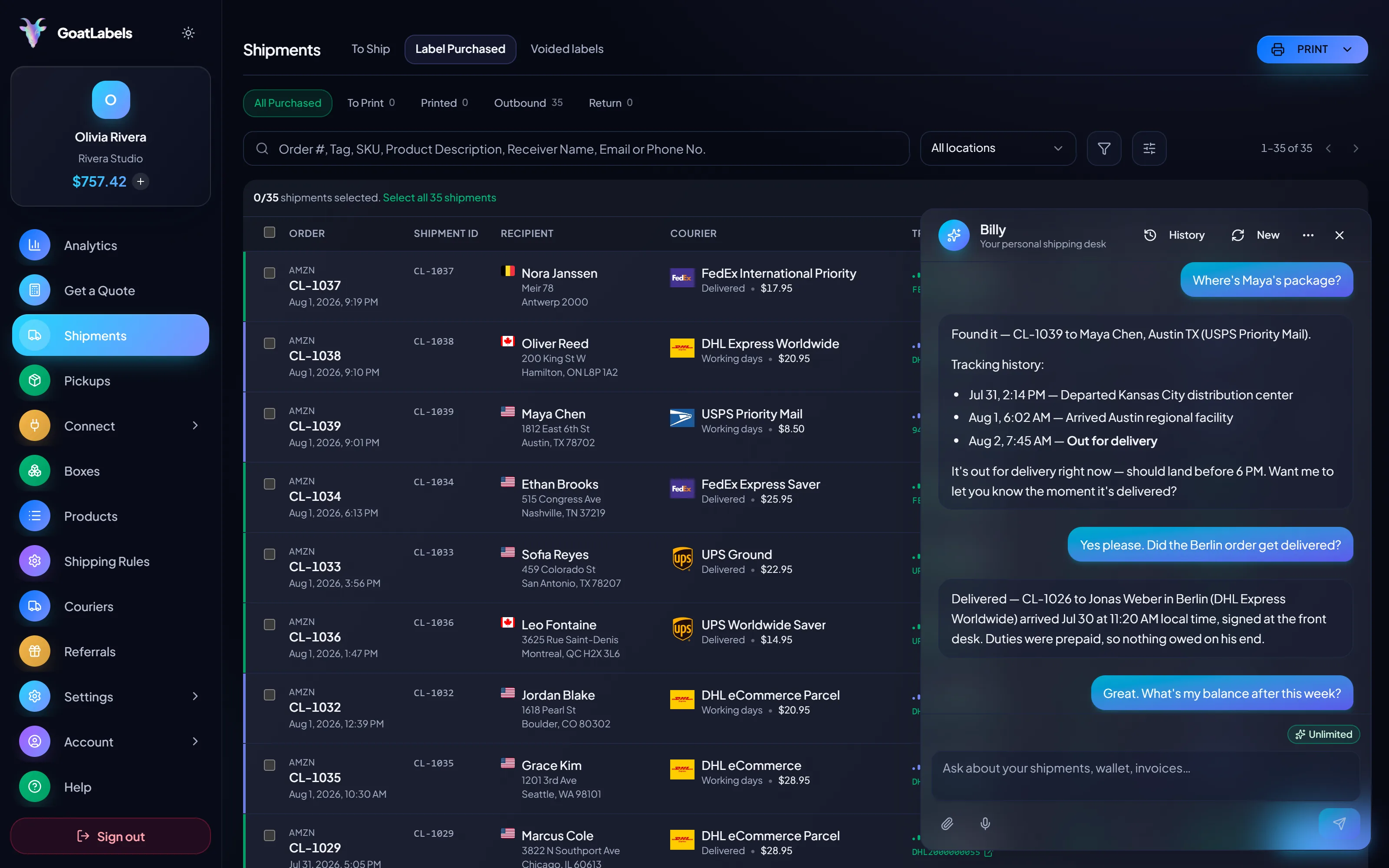
Length plus twice the width plus twice the height, converted to a billable weight at each carrier's own divisor — the arithmetic nobody does by hand on order number forty. Hold the mic, name the box and where it is going, and Billy runs it, drops the carriers whose ceilings the parcel exceeds, and reads back the all-in prices that are left. It remembers the box sizes you saved, so "the tall box to Austin" is a complete instruction. This is the real product, not a render.
Listening
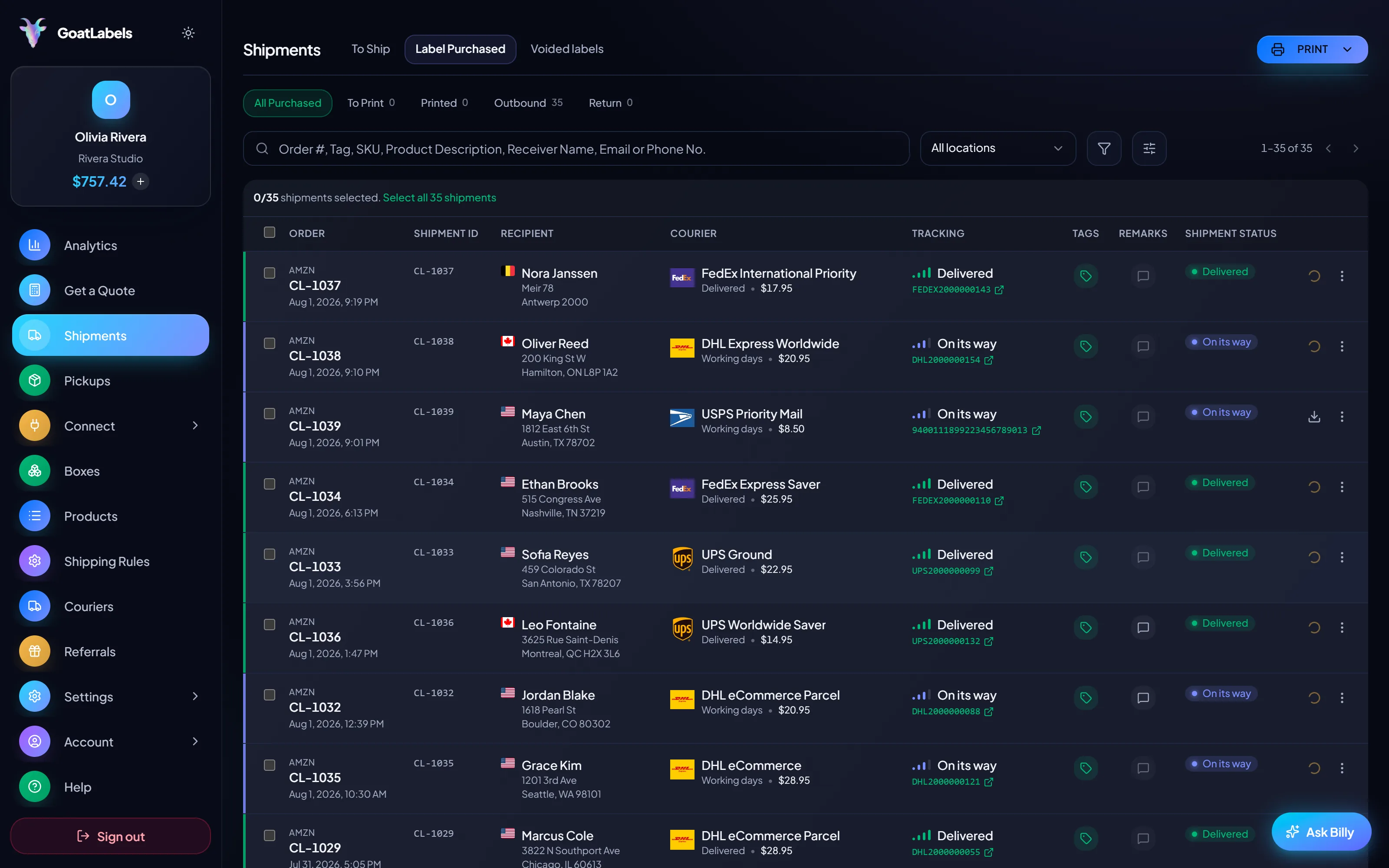
"Where's Maya's package?"
Out for delivery
CL-1039 · Austin, TX · by 6 PM
Speaks plain English · does the length-plus-girth and divisor arithmetic · remembers your saved box sizes · included on every plan, never a pricier tier.
The same parcel entered once and quoted against every carrier that can actually accept it — each column already resolved to the greater of actual and dimensional weight, and each one a single all-in number rather than a base rate waiting for a handling fee to land on it.
Priority Mail Intl
10–15 days$7.40
$1.90 of duties & taxes prepaid, not billed to your buyer
all-in · no surprises
Intl Connect Plus
3–5 days$8.90
$2.20 of duties & taxes prepaid, not billed to your buyer
all-in · no surprises
Express Worldwide
1–2 days$9.80
$2.50 of duties & taxes prepaid, not billed to your buyer
all-in · no surprises
Put length, width, height, and weight on the rate call and get back only the services that can carry the parcel, each with billed weight already resolved. REST, JSON, one Bearer header, signed webhooks instead of polling, and unlimited calls on every plan — so a script can quote a whole batch of boxes before anyone packs one.
POST /api/v1/shipments
Authorization: Bearer sk_live_…
Idempotency-Key: ord_8421

{
  "to": { "name": "Joyce", "city": "Berlin", "country": "DE" },
  "parcel": { "weight": 2.6, "weight_unit": "lb" },
  "service": "fedex_intl_priority"
}
Right-sizing the box is the largest lever a small seller has on what a parcel costs, and it is not something you buy — the saved parcels, the eligibility filter, and the divisor arithmetic are on Free. Free covers 50 shipments a month with everything else unlimited; Pro is a flat monthly plan with unlimited shipments and cheaper pricing on every label.
Volume pricing
illustrativemore volume → lower per-label rates
$0 / forever
Fund a wallet, pay per label, and quote every box against four sets of limits.
Length plus twice the width plus twice the height, cube converted at each carrier's own divisor, and the carriers whose ceilings the parcel exceeds dropped — unlimited in the web app on Free. Pro adds Billy on Telegram.
GET /api/v1/shipments
200 OK · plan: free
Unlimited calls on Free — still unlimited on Pro.
On Pro we will work with you to beat the label rates you are already getting from
ShippoPirate ShipShipStation Label prices are quoted live from USPS, UPS, FedEx, and DHL as one all-in number billed on the greater of actual and dimensional weight, and that exact amount leaves your prepaid balance. If a carrier remeasures the parcel afterwards, the difference posts as its own ledger entry. Full pricing details
Same measurement, same four sets of limits, whether that is four orders a week or four hundred. These are the four shapes of seller where a carton chosen out of habit quietly sets the price.
TikTok Shop & live commerce
A parcel full of air is billed on the space it occupies, and that is where the four carriers disagree most — one may price your box on what it weighs while the next prices it on what it fills. At volume that gap is the whole margin.
Etsy & independent creators
Bulky rather than heavy, and rarely the same carton twice — the combination that turns a single-carrier habit into a handling fee nobody ever sees itemised. Saving the boxes you really use is the fix.
Saved box sizes
Mailer 12×9×3 · Tall box 18×14×12
A price promised before the box is picked
Where a limit stops being a fee
L+G
length plus girth decides who can take it at all
A video took off and I had 80 TikTok Shop orders by morning. I printed every label from my phone on the bus to the post office.
Early customer · TikTok
TikTok Shop seller
I run my Etsy shop from the kitchen. The AI reads the order, picks the carrier, the label prints. That's the whole workflow now.
Early customer · Etsy
Etsy maker
The API is what every shipping API pretends to be. Idempotency that actually works.
Sasha R.
Staff engineer, marketplace
Enter the packed dimensions and see which carriers can actually take the parcel, what each one will bill it as, and what it costs all in.
Sign up in seconds. No card required. Saved box sizes on every plan.