

USPS
Ground Advantage
2–5 days$7.40
$1.20 of Premium insurance included
all-in · priced on the parcel you described
A poly mailer ships the item's own dimensions; a box ships the box's. That difference drives the price gap — but a mailer also gives up crush protection, and a damage claim can fail if the packaging wasn't adequate for the contents. Choose by fragility first and dimensions second.
They price the packed domestic parcel you describe, DHL on international lanes. Quote the same order as a mailer and as a box and the price gap stops being folklore.


 DHL: international
Fund the wallet with card, Apple Pay, Google Pay, ACH, or crypto — quoting a parcel twice costs nothing, and saved package sizes make the comparison a selection, not a retype.
A box is a small tax you pay on every dimension. Its walls add length, width, and height that the item inside never asked for, its corrugated board adds ounces before the first product goes in, and its empty corners are volume you are shipping to nobody. A poly mailer collapses all of that: it conforms to the item, so what the carrier prices is something very close to the item itself, packed. That is the whole economic case, and it is real — across a season of soft goods, the difference between shipping garments in bags and shipping them in boxes is a visible line in the margin, not a rounding error.
The mechanics of how a carrier turns a packed parcel into a price — where dimensional weight takes over from the scale, and how a parcel with no flat sides gets measured — are owned by the size-and-weight guide, and one sentence covers what this page needs from it: past a certain volume, you are billed on the space the parcel occupies rather than what it weighs, which punishes boxy air and rewards the conforming bag twice over. The honest way to see the gap on your own product is not a rule of thumb at all. Quote the same order both ways, as the mailer you would actually ship and as the box you would actually ship, and read the two all-in numbers. The comparison takes a minute and settles the price half of this page permanently for that item.
The bag's weakness is the mirror image of its strength. A mailer conforms to the item, which means everything that happens to the mailer happens to the item. There is no crumple zone, no standoff distance, and nothing to stop the parcel above it in the sack from printing its corners into your product. Carrier networks are built around conveyors, chutes, and stacking, and none of those systems treats a soft parcel gently because it looks soft. The realistic model is that your mailer will spend time at the bottom of a pile, and the only question is whether the item inside can hold the weight.
The second thing a mailer gives up is quieter and more expensive: standing in a damage claim. Carriers do not pay out simply because an item broke in their network — they judge whether the packaging was adequate for the contents, and an item that plainly needed rigid protection, shipped in an unpadded bag, loses that judgment before the argument starts. The claim mechanics, filing windows, and evidence standards belong to the claims guide; the one sentence this page keeps is that packaging choice is claim strategy, made days before anything goes wrong. A mailer saves real money on the parcels that never needed protection and silently voids your safety net on the parcels that did — which is exactly why the decision runs fragility first and dimensions second.
Most inventories cluster into a handful of categories, and the format decision is stable within each one. The table below is the working verdict sheet: the recommended format per category and the reason it wins, judged against how each category actually fails in transit.
| Category | Verdict | Why |
|---|---|---|
| Apparel and soft goods | Poly mailer | Nothing to crush, and the mailer's conforming shape is the whole price advantage. A folded garment is its own padding. |
| Books and media | Rigid mailer, box past one or two | The block survives crushing; the corners do not. A single book takes a rigid mailer with corner room — a stack wants walls before it wants padding. |
| Prints, photos, and flat art | Rigid mailer only, never poly alone | The enemy is bending, not breaking. Stiffener boards in a rigid mailer beat a box for anything flat; an unstiffened poly bag is a folded print waiting to happen. |
| Electronics | Box, cushioned on every face | Screens, connectors, and solder joints all fail on impact rather than pressure alone. Claims on electronics are also where packaging adequacy is scrutinised hardest. |
| Ceramics and glass | Box, usually double-boxed | No mailer of any kind. The packing standard for the genuinely brittle is walls, cushioning distance, and no item-to-wall contact. |
| Mixed lots and bundles | Box | Items grinding against each other inside a bag damage each other without any help from the carrier. Walls plus internal separation, sized to kill the rattle. |
Verdict sheet — compiled 2026-08-15.Category verdicts are compiled against the packaging guidance each carrier publishes for claims adequacy — USPS packaging instructions, the UPS and FedEx packaging guidelines, and DHL Express packing advice — which is the standard a damage claim on that category will be judged against. The physical logic rots slowly, but carriers do revise what they consider adequate for specific goods; re-checked annually against those published guidelines by the named marketing owner recorded with this page.
The choice is not actually binary, and the middle formats solve most of the hard cases. The rigid mailer — chipboard or corrugated envelope — keeps the conforming footprint of a bag while adding exactly one property: it resists bending. That single property is why it owns the flat categories outright. Box-in-bag runs the other direction: a small box protecting the item, slipped inside a poly mailer that carries the label and keeps the weather out, giving you walls where the item is and conformity everywhere else. And padded mailers sit in between, buying a centimeter of forgiveness for items that are robust but scuffable. Each hybrid costs a little more than plain poly and much less than the full box, which is exactly the trade the middle categories want.
The upgrade trigger worth writing down is the mid-listing drift: shops rarely re-decide packaging when the product mix changes, so the mailer that was right for the original catalogue quietly ships the new, heavier, more brittle additions too. The fix is a habit, not a policy — when a new item enters the shop, it gets the arm-press test and its own line on the verdict sheet, and when an item starts coming back damaged, the format gets re-decided before the third replacement goes out. Keep both formats on the shelf, keep both as saved package sizes so quoting either is a selection rather than a retype, and let each order take the packaging its contents deserve rather than the packaging the shop happens to have. The goal is never the cheapest bag; it is the cheapest label on a parcel that arrives intact — priced across the budget ground services the same way every other parcel is.
The verdict sheet settles half the decision at your own bench, and it is the half no rate comparison can answer for you. The other half is arithmetic, and it is only worth trusting if you run it on the parcel as it would actually ship. That is what this loop is for: the order arrives, the address gets validated, and the same shipment is quoted as the mailer you would send and as the box you would send, so the price gap stops being folklore about mailers in general and becomes two numbers about this item.
the two tees in the navy — same address as last time
Quote the parcel as it will actually ship, not the item on its own. Some services and rate tiers are built around rigid, machinable parcels, so a floppy bag is always accepted somewhere but not always at the price you assumed.
 Billy AI
Where dimensional weight takes over from the scale, and how a parcel with no flat sides is measured, is the size-and-weight guide's subject. This loop only needs the packed parcel described honestly, whichever shape it ended up.
Thirteen store connectors, Shopify, Amazon, eBay, Etsy, TikTok Shop and more, sync into one To Ship queue, and a pasted DM lands in the same place, which matters here because the format call is a property of what is in the parcel, not of where it sold. The tee ships in a bag whether it went out via a shop or a message thread; the ceramic gets walls either way. One queue means one verdict sheet rather than a different packing habit per channel.
 Shopify
 Etsy
Etsy WooCommerce
 TikTok Shop
 Amazon
 eBay
eBay Squarespace
 Wix
Wix WalmartShopify PlusSoon
 Square
 BigCommerce
 Magento
 ZapierSoon
 NetSuiteSoon
 EcwidSoon
 Temu
Temu SheinSoon
 ChannelAdvisorSoon
 SkuVaultSoon
 Zoho InventorySoon
 Patreon
The fragility half of the decision happens at your bench. The dimensions half is a pair of quotes, and these are the places the product makes that pair cheap to run.
Card, Apple Pay, Google Pay, ACH, and crypto all fund the same wallet, and the label debits exactly its quoted all-in amount whether the parcel is a bag or a box. Comparing formats never means comparing billing surprises.
Paste an order, drop a screenshot, or speak the address and Billy drafts the shipment on every plan. The packaging stays your call — the verdict table on this page is a judgment about your product that no assistant should silently override.
BillyLIVESave your standard mailer and your standard box once, and the mailer-vs-box comparison becomes two selections on the same order. The format decision only stays honest if re-running the numbers is cheaper than guessing.
They are quoted against the parcel as packed, with DHL on international lanes, and the winner can flip when the format changes: the carrier that loves your mailer is not always the carrier that loves your box. Rate-shopping catches the flip automatically.
UPS$12.48FedEx$13.22DHL$14.10USPS$11.79The API covers the shipment lifecycle the dashboard uses, with signed webhooks and unlimited calls on every plan — so a shop that encodes its verdict sheet per SKU can apply the right packaging dimensions in code on every order.
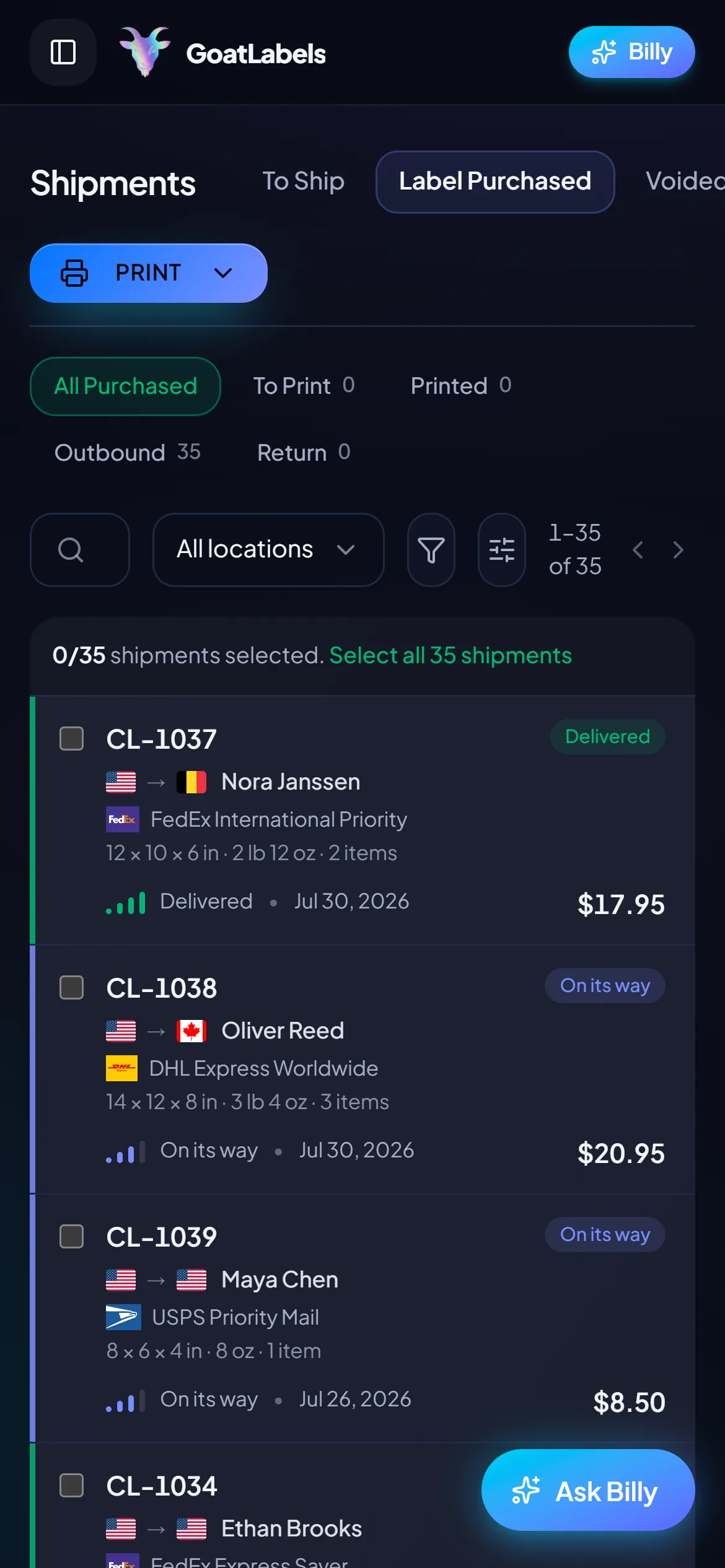
Quoted as a mailer · label ready
Same order, box quote read first
The fragility half of this decision is physical: you press the packed bag, you feel whether the item can take a stack of heavier parcels, and you decide. That happens standing at the packing table with a roll of tape, which is exactly where the pricing half should happen too — not at a laptop in another room, after the format has already been chosen by habit.
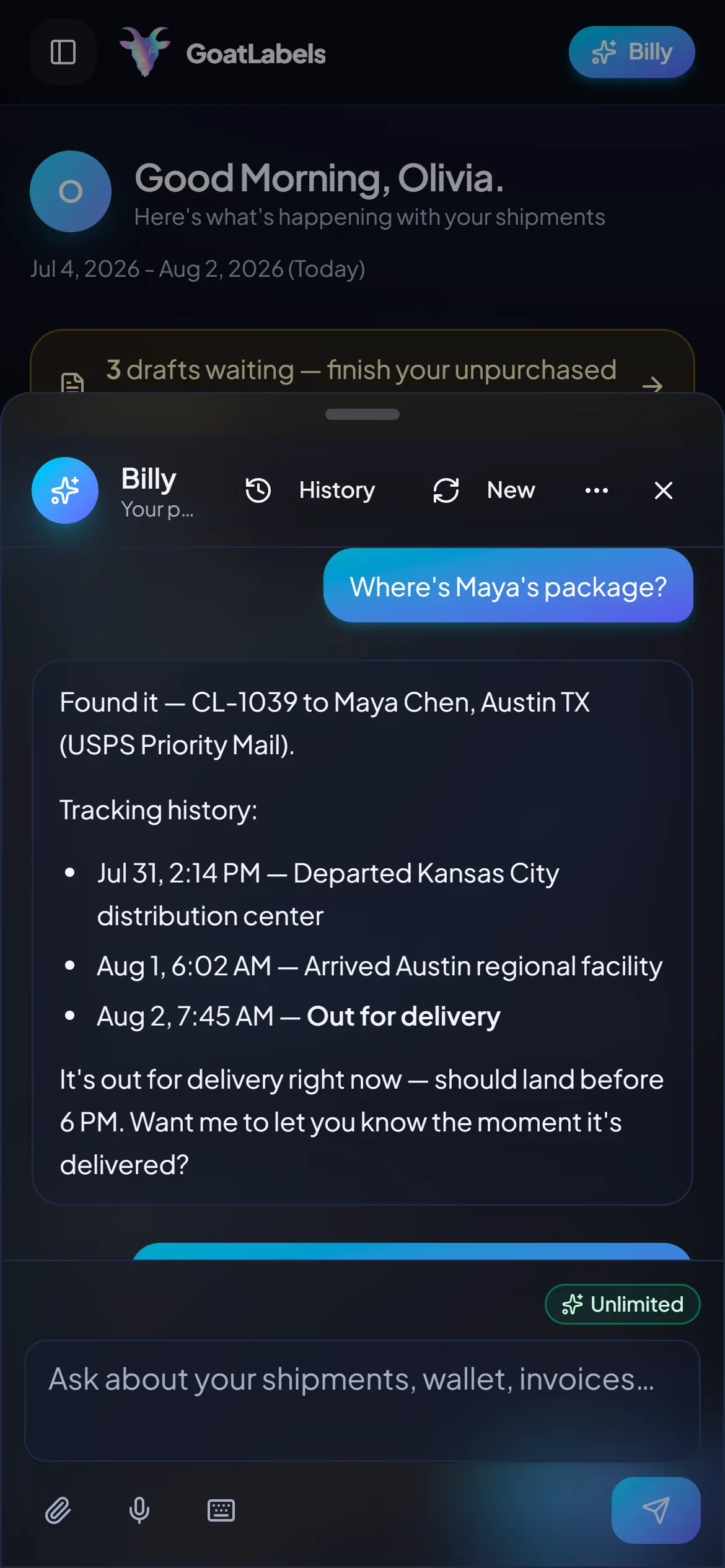
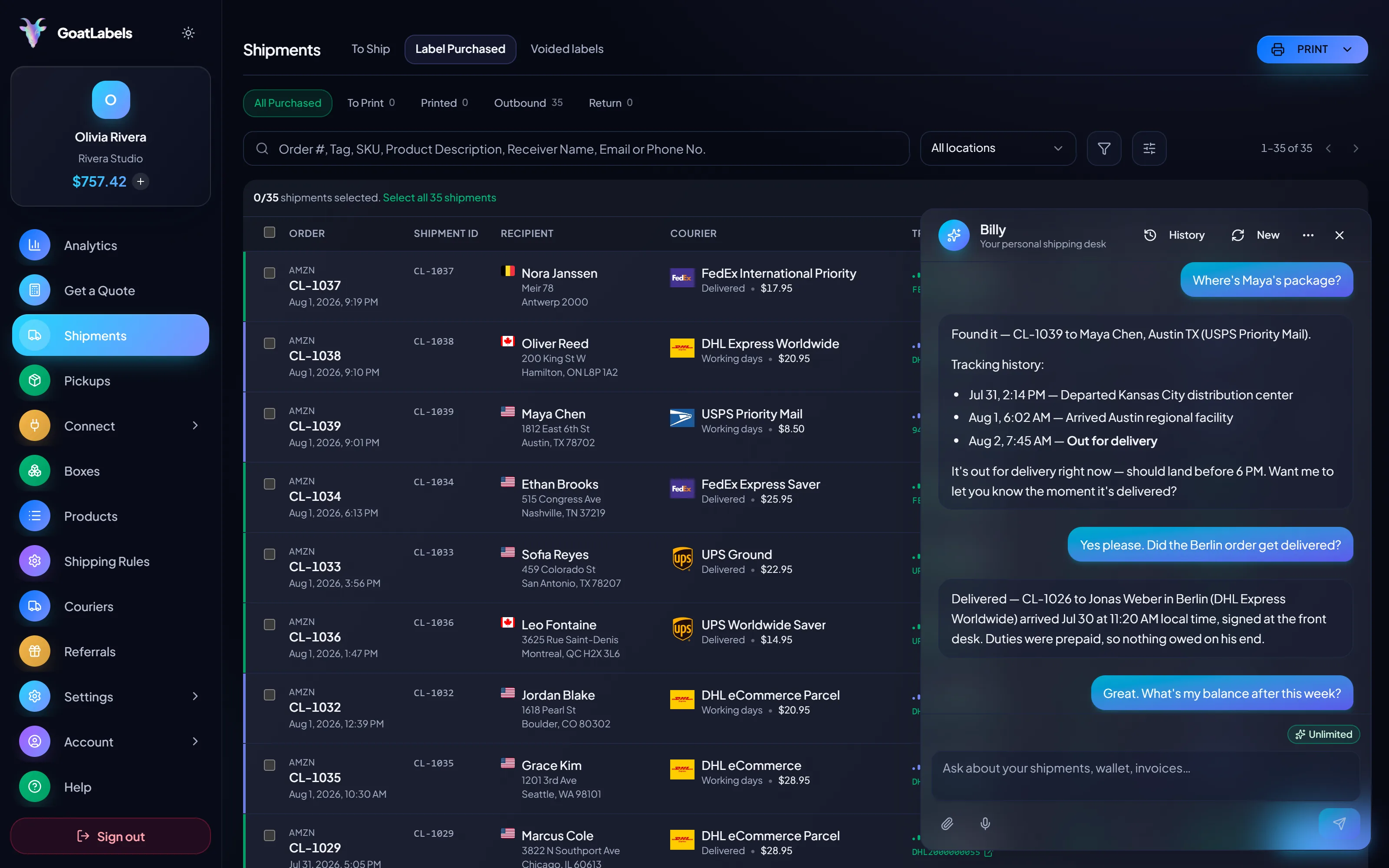
Packing is not a keyboard job, and a format comparison you have to stop and type is a comparison you will quietly stop running. Say the address and Billy drafts the shipment; ask about a parcel later and it reads the tracking history back — useful on the item you have just re-decided the packaging for, because the next damaged one is the signal to re-decide again. Included on every plan. This is the real product, not a render.
Listening
"Two tees, going to the usual address"
Out for delivery
Delivered undamaged · mailer held up
Speaks plain English · remembers your saved package sizes, bag and box · included on every plan.
Carriers do not agree about a conforming bag and a rigid box, which is why the cheapest carrier for your mailer is not reliably the cheapest carrier for the same order in a box. Quoting the parcel as packed catches that flip on its own; each column is one all-in number locked at quote time. Run it once per format and the answer holds for that item. Figures are illustrative.
Ground Advantage
2–5 days$7.40
$1.20 of Premium insurance included
all-in · priced on the parcel you described
Ground
3–4 days$10.80
$1.20 of Premium insurance included
all-in · priced on the parcel you described
Home Delivery
2–4 days$11.40
$1.20 of Premium insurance included
all-in · priced on the parcel you described
A shop that has run the verdict sheet across its catalogue already knows which SKUs go in a bag and which need walls — and the packed dimensions for each. Send them per order over REST and JSON rather than re-deciding at the bench, and quote both formats programmatically on the lines where the call is genuinely close.
POST /api/v1/shipments
Authorization: Bearer sk_live_…
Idempotency-Key: ord_8421

{
  "to": { "name": "Joyce", "city": "Berlin", "country": "DE" },
  "parcel": { "weight": 2.6, "weight_unit": "lb" },
  "service": "fedex_intl_priority"
}
The format decision only stays honest if re-running the numbers is cheaper than guessing, and nothing here charges per quote or per API call. Free covers 50 shipments a month with all four carriers, saved package sizes, Billy, and the API. Pro is a flat plan for volume — never a condition of comparing a bag against a box.
 — draft a label without leaving the packing table
Rate by plan
illustrativeone flat plan, unlimited shipments
$0 / forever
Quote both formats on every order and it still costs one label to ship.
The assistant that turns a pasted order into a draft label runs unlimited in the web app on Free. It drafts the shipment and validates the address; the packaging call stays yours, on every plan.
Telegram, ProGET /api/v1/shipments
200 OK · plan: free
Unlimited calls on Free — still unlimited on Pro.
Put a real parcel through and compare the side-by-side rate against what that label costs you on
ShippoPirate ShipShipStationLabel prices are quoted live from USPS, UPS and FedEx (DHL on international lanes) on the packed parcel you describe, as one all-in number, and that exact amount leaves your prepaid balance. Packaging adequacy for a damage claim is judged by the carrier against its own published guidance. Full pricing details
The table above is the general answer; these are the shops that live inside one row of it — including the one whose product mix drifted out of the row it started in.
 Nothing to crush, everything to save
A folded garment is its own padding, so the conforming bag wins on both dimensions and weight with nothing given up. Across a season this is the clearest money in the whole comparison — and the arm-press test still runs on anything new that joins the catalogue.

 Bending, not breaking, is the enemy
The rigid mailer owns this row outright: it keeps a bag's footprint and adds exactly one property, resistance to folding. Stiffener boards inside beat a box on price and on protection, and an unstiffened poly bag is a creased print waiting to happen.
Rigid mailer, boards in
Conforming footprint, no fold in the artwork

 A price promised before the format is chosen
 The mailer that was right two catalogues ago
1
new item, one arm-press test, one line added to the verdict sheet
Updated
Related guides: lost or damaged package claims andpackage size and weight limits.
A video took off and I had 80 TikTok Shop orders by morning. I printed every label from my phone on the bus to the post office.
Early customer · TikTok
TikTok Shop seller
 TikTok Shop
I run my Etsy shop from the kitchen. The AI reads the order, picks the carrier, the label prints. That's the whole workflow now.
Early customer · Etsy
Etsy maker
EtsyThe API is what every shipping API pretends to be. Idempotency that actually works.
Sasha R.
Staff engineer, marketplace
Run the verdict sheet on your catalogue once, save both package sizes, and quote every order across the carriers as it will actually ship.
No contract. No card required. Quote a parcel both ways before buying anything.
Updated