

USPS
Ground Advantage
3–6 days$16.90
$1.20 of Premium insurance included
all-in · nothing added at checkout
These three budget services are priced and operated differently. USPS Ground Advantage tends to win on the lightest parcels and on rural addresses. UPS Ground Saver and FedEx Ground Economy hand many parcels to USPS for the final mile, which changes transit and PO Box behaviour more than it changes price.
Weight, zone, and how rural the address is all move the winner, so the comparison is per parcel — not a service you pick once and stick to.


 all quoted
 No UPS or FedEx account number and no negotiated volume commitment — fund a prepaid wallet and buy the cheapest ground tier per order.
These three get lumped together as "the cheap ground option" and they are not the same product. One of them is a single carrier moving your parcel from acceptance to doorstep. The other two are hybrids: a private network hauls the parcel most of the way and then, for a large share of deliveries, hands it to the postal service for the last leg. That structural difference is what produces every practical difference below — the transit spread, the behaviour at unusual addresses, and where each one's price advantage sits.
Dated fact block — carrier service specifics
| USPS Ground Advantage | UPS Ground Saver | FedEx Ground Economy | |
|---|---|---|---|
| Previously called | Replaced First-Class Package Service and Retail Ground | UPS SurePost | FedEx SmartPost |
| Who carries it | USPS end to end | UPS line-haul, USPS often performs the final mile | FedEx line-haul, USPS often performs the final mile |
| Maximum weight | 70 lb | 70 lb | 70 lb |
| Published transit | 2–5 business days | 2–7 business days | 2–7 business days |
| Below one pound | Priced in sub-pound weight bands | Separate under-1-lb tier | Separate under-1-lb tier |
| PO Box and APO/FPO | An ordinary destination | Depends on whether USPS does that parcel's final mile | Depends on whether USPS does that parcel's final mile |
| Tracking | Included | Included | Included |
Verified against each carrier's own published service pages for USPS Ground Advantage, UPS Ground Saver, and FedEx Ground Economy on 3 August 2026. These are the carriers' figures, not GoatLabels product claims, and both hybrid services have been renamed once already — re-check annually. Published transit windows are the carriers' own estimates and are not guarantees.
There is no single pound number where one service overtakes another, and any article that gives you one is selling certainty it does not have. The crossover is a surface in three variables — weight, zone, and the density of the delivery address — and it moves when any carrier reprices. What is stable is the shape of that surface, and knowing the shape is what lets you stop guessing.
Under a pound is where USPS Ground Advantage is strongest. It prices in sub-pound weight bands rather than rounding a light parcel up into a one-pound rate, and it has no handoff to buy, because it is USPS the whole way. The hybrid tiers have their own under-one-pound pricing and can be competitive, but they are paying for a line-haul plus a final mile, and at the very light end that structure is working against them.
Between one and roughly five pounds is the contested band, and it is decided mostly by zone. Short zones favour whoever has the least handling in the middle; long zones favour whoever has the cheapest coast-to-coast line-haul, which is where the private networks earn their keep. This is the range where a standing default costs the most money, because it is the range where the answer genuinely flips order to order.
Above that, the economy tiers stop being the interesting comparison at all — the standard ground products from UPS and FedEx come into range, and they buy back the transit time you gave up. And at any weight, if the box is bulky rather than heavy, the billed weight may not be the weight on your scale: dimensional weight has its own two levers and its own page, package size and weight limits by carrier.
The method is more useful than the table. Pack the box you actually ship, weigh it taped, measure it taped, then quote that parcel to a near zone and a far zone against USPS, UPS, FedEx, and DHL and write down which won each. Re-run it when your packaging changes or when rates reset. That half hour tells you more about your own crossover than any general comparison can, including this one. Marketplace sellers comparing this against a platform's flat weight tiers should also read how flat tier pricing steps instead of slopes.
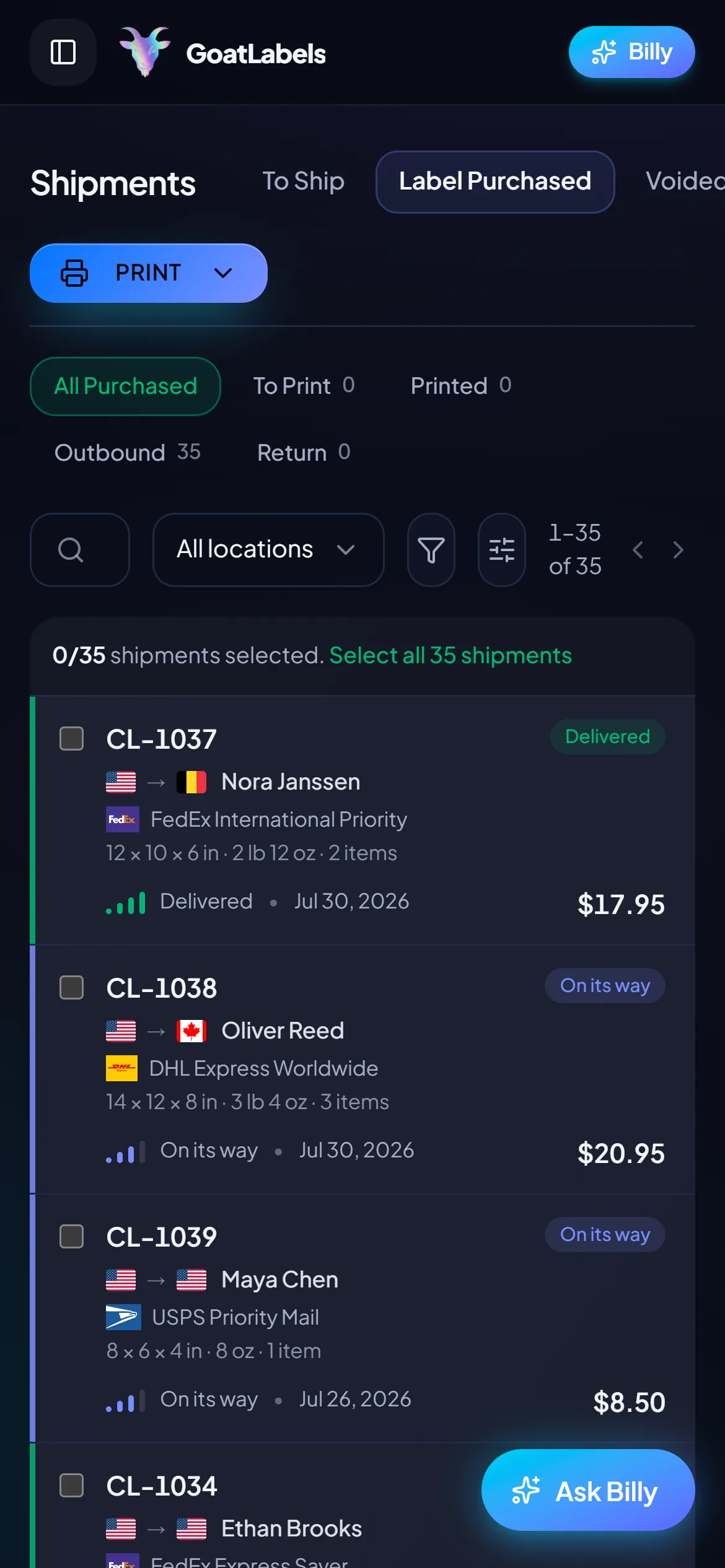
The reason sellers default to one cheap ground service is not conviction, it is friction: comparing meant three carrier sites per parcel, and nobody does that on order forty. When the same parcel comes back priced by four carriers on one screen, with the delivery window next to each number, choosing per order costs nothing and the default stops being defensible.
Weighed and measured taped shut, not from the carton spec — the numbers that decide which ground tier wins are the ones on the finished box.
Nothing here needs a UPS or FedEx account number, a negotiated contract, or a volume commitment.

Print at home or on a thermal printer and drop it off — no carrier account number required on any of the three.
Price your parcel to a dense metro address and then to a farm, and you are not comparing the same three services any more. USPS already goes to every delivery point in the country every delivery day, as an obligation rather than a commercial decision, so a remote address is an ordinary stop on an existing route. A network built around commercial density has to be paid to go there, which is why remote and residential deliveries carry their own line items on the private carriers and why those line items grow fastest exactly where the population thins out.
The practical consequence is that your cheapest ground service is partly a function of your customer list. A seller shipping mostly to cities and a seller shipping mostly to small towns will land on different defaults from the same catalogue of boxes — which is another way of saying neither of them should have a default. What triggers each of those fees, and how to see one coming, belongs to shipping surcharges explained; here it is enough to know that they are already inside the all-in number you are shown, rather than waiting to be added later.
UPS Ground Saver and FedEx Ground Economy both hand a large share of parcels to USPS for the last leg. Sellers discover this the first time a tracking page shows a FedEx label being scanned by a postal carrier and assume something has gone wrong. Nothing has: that hybrid design is the product. The private network does the expensive part — moving freight across the country — and buys the cheapest possible doorstep delivery from the one organisation that was going to that doorstep anyway.
Three things follow from it, and they are the reasons to care. First, transit: a handoff between two networks is a real event that takes real time, which is why the published windows on the hybrids run wider than on the USPS service. Second, the delivery day: once a parcel is in the postal stream, it delivers on the postal service's schedule, not the private carrier's. Third, unusual addresses: a hybrid parcel that would have been refused by the private carrier can sometimes be delivered anyway because USPS finishes it — which is precisely why PO Box and military-address behaviour on these services is conditional rather than a yes or a no. That case is fiddly enough to have its own page: can UPS or FedEx deliver to a PO Box?
Shopify, Etsy, WooCommerce, and TikTok Shop sync into the To Ship queue, so every order gets USPS Ground Advantage, UPS Ground Saver, and FedEx Ground Economy priced against the same box — instead of whatever ground service each platform decided to hand you. Paste an Instagram or Facebook DM and Billy builds the shipment from the message, and it gets the same four quotes.
 Shopify
  Etsy
Etsy  WooCommerce
  TikTok Shop
  Amazon
  eBay
eBay  Squarespace
  Wix
Wix  Walmart Shopify Plus Soon
 Square
  BigCommerce
  Magento
  Zapier Soon
 NetSuite Soon
 Ecwid Soon
 Temu
Temu  Shein Soon
 ChannelAdvisor Soon
 SkuVault Soon
 Zoho Inventory Soon
Two ground quotes that look a dollar apart on a rate card can finish several dollars apart once the address, the box, and the season are priced in. Comparing these three only means something if the number you compare is the number you pay.
You do not need a UPS or FedEx account number, a negotiated contract, or a minimum volume to buy any of these three services here. Fund a balance with a card, Apple Pay, Google Pay, ACH, or crypto and buy the winner per order, with no monthly minimum to print.
Whether an address is residential or commercial changes which fees the private carriers apply, so it is validated and classified at quote time rather than discovered afterwards. A cheap ground quote to a misclassified address is not actually a cheap ground quote.
Each of the three comes back as a single number with the fees its own network would charge for that address already inside it. That is the only form in which a three-way ground comparison means anything — a rate-card ranking and an invoice ranking are routinely different lists.
USPS, UPS, FedEx, and DHL quote the same box at the same time, with the delivery window beside each price. That is what makes choosing per order practical rather than aspirational: the comparison that used to cost three browser tabs now costs no clicks at all, so the standing default has nothing left to defend.
UPS $12.48 FedEx $13.22 DHL $14.10 USPS $11.79 If service selection is a rule in your system rather than a decision at a screen, the REST API returns every eligible service with its all-in price so your own logic picks — cheapest, or cheapest that meets a date. Unlimited calls on every plan.
A persistent belief among newer sellers is that the UPS and FedEx economy tiers are contract products — that you need an account number, a sales conversation, and a volume commitment before you can touch them. You do not. All three services are quoted and bought here against a prepaid wallet with no carrier account of your own, no negotiated agreement, and no minimum. There is nothing to qualify for and nothing to renew.
Practically that means the label prints on an ordinary office printer on plain paper, or on a thermal printer if you have one, and the parcel is accepted at drop-off with that label on it. Two honest limits. First, we do not schedule carrier pickups, so your plan is drop-off or a pickup arrangement you already have — do not choose a service on the assumption that a truck will be summoned. Second, drop-off locations are not interchangeable: a parcel on a USPS service goes into the postal network, and a parcel on a private carrier's service goes to that carrier, even when USPS will end up finishing the delivery. If you are shipping USPS specifically, USPS shipping labels covers picking the service before you pay.
Cheapest ground tier ready
CL-1038 · zone 6 · residential
Choosing per order only beats defaulting if you will actually do it on order forty — and nobody opens three carrier sites at the kitchen table. Weigh the taped box, quote it, and buy the winner from the phone already in your hand.
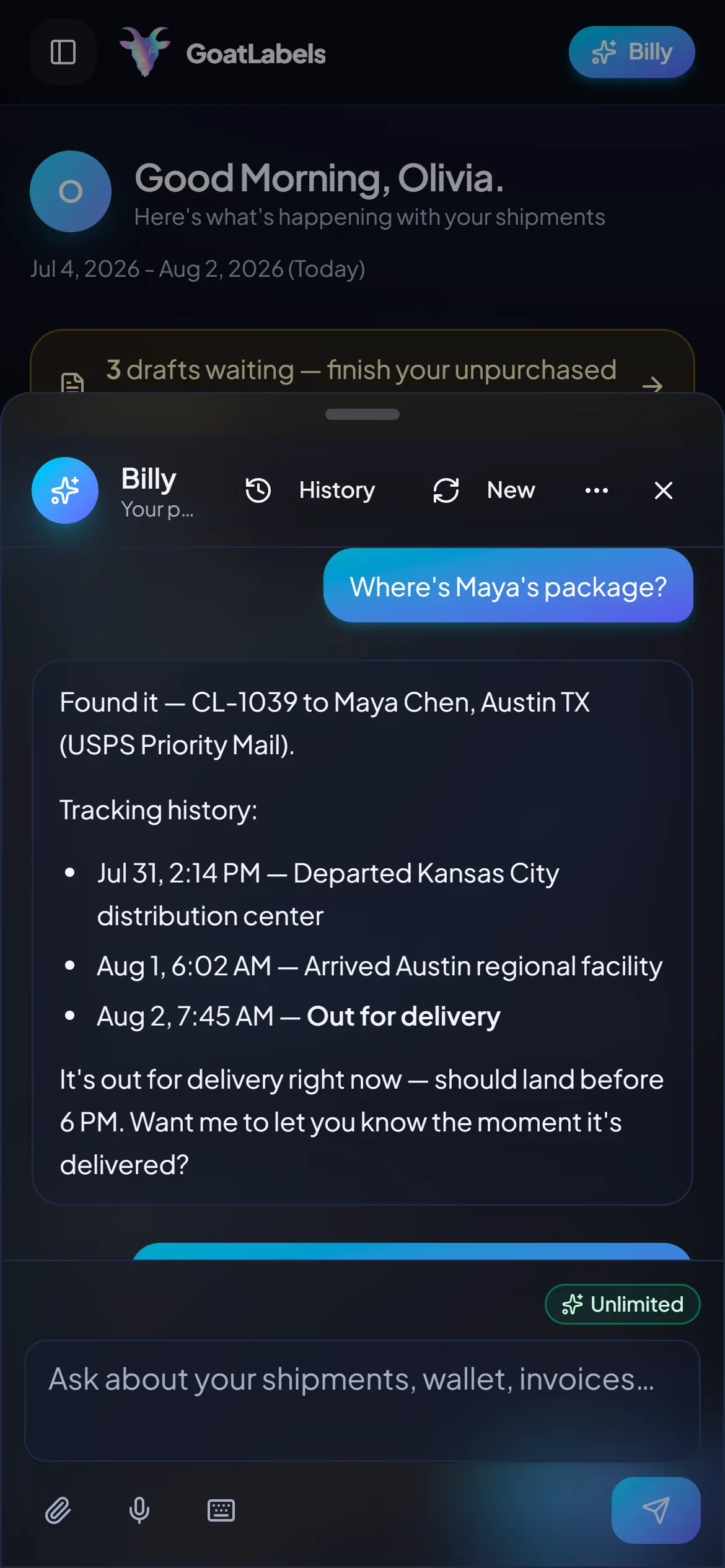
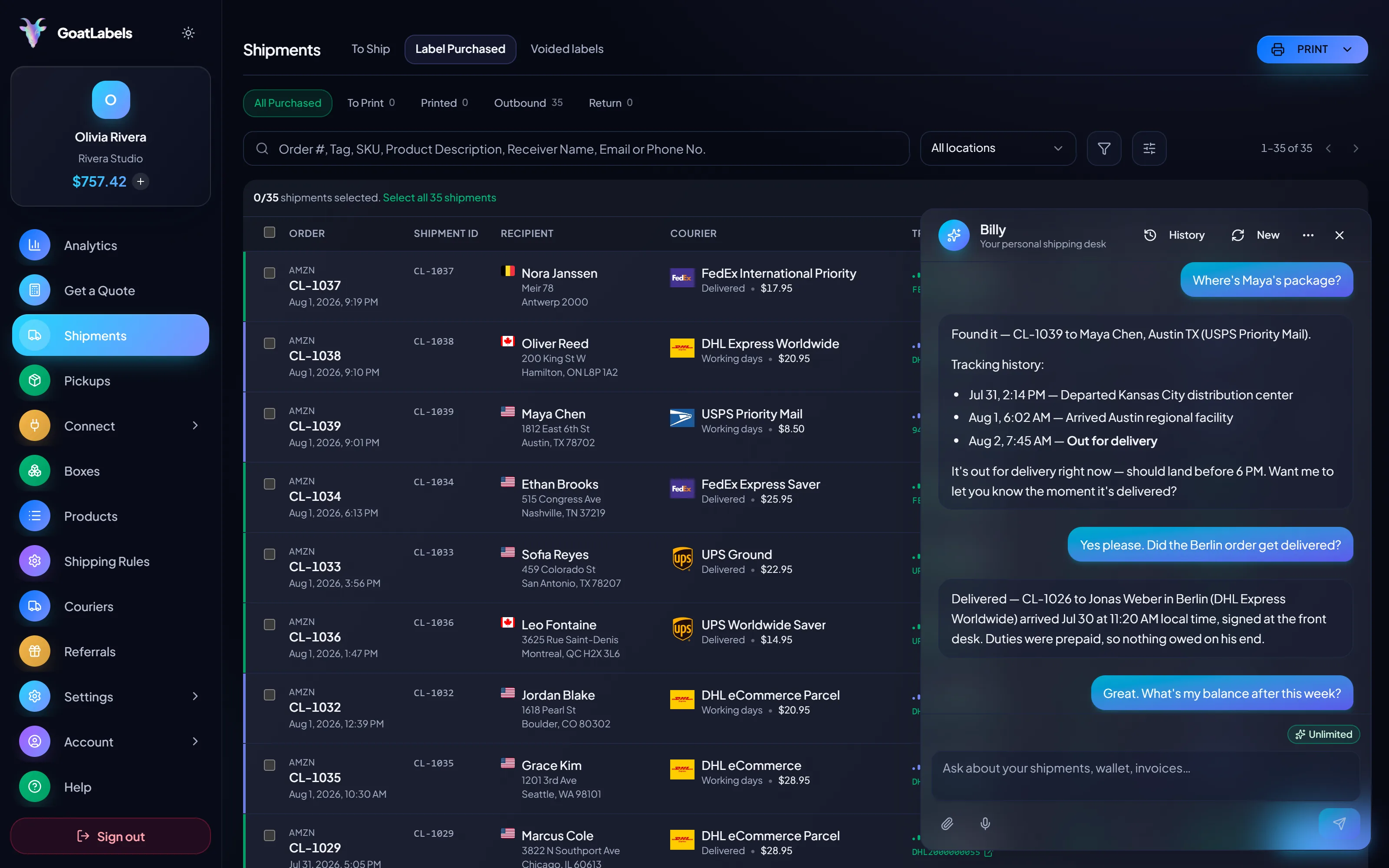
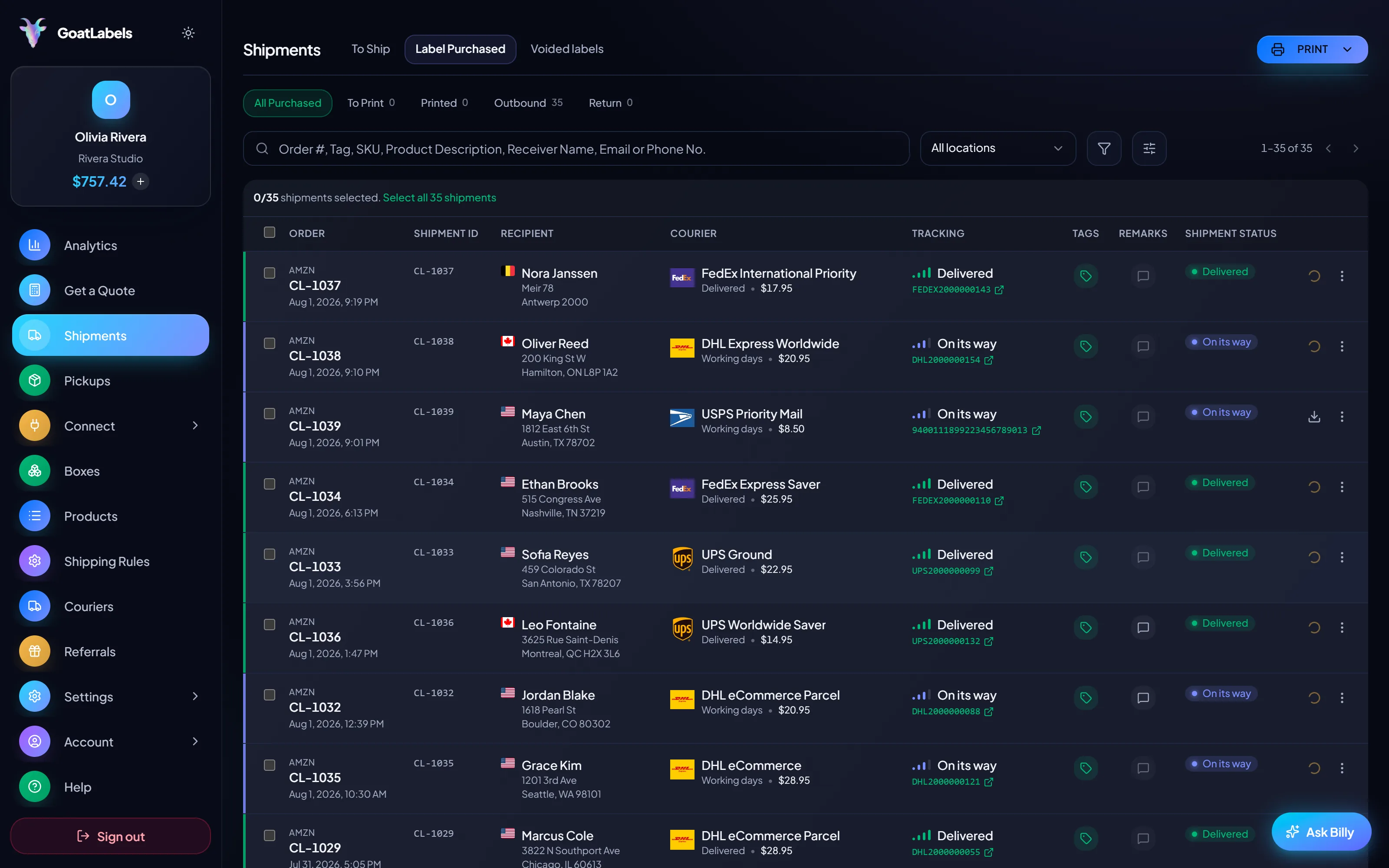
The standing default survives because comparing costs effort at the exact moment your hands are full. Hold the mic, say the box and where it is going, and Billy quotes USPS, UPS, FedEx, and DHL on that parcel, reads the all-in prices and the delivery windows back out loud, and queues the one you pick. It remembers saved box sizes, so the box you ship most gets measured once. This is the real product, not a render.
Listening
"Cheapest ground for the nine pound box to zone 6?"
Cheapest that hits the date
CL-1039 · ground · 3–5 days
Speaks plain English · quotes all four carriers as one all-in price each · remembers saved boxes · included on every plan, never a pricier tier.
A heavier parcel going a longer distance flips the answer a light one just gave you. The same box is priced against all three ground services at once, so the winner is read off the quote rather than assumed from a rate card. Figures are illustrative.
Ground Advantage
3–6 days$16.90
$1.20 of Premium insurance included
all-in · nothing added at checkout
Ground
3–5 days$14.20
$1.20 of Premium insurance included
all-in · nothing added at checkout
Home Delivery
3–5 days$14.80
$1.20 of Premium insurance included
all-in · nothing added at checkout
Rate-shop returns every eligible service for the parcel with its all-in price and window, so your own rule chooses — cheapest outright, or cheapest that still meets the promised date. REST, JSON, one Bearer header, and unlimited calls on every plan.
POST /api/v1/shipments
Authorization: Bearer sk_live_…
Idempotency-Key: ord_8421

{
  "to": { "name": "Joyce", "city": "Berlin", "country": "DE" },
  "parcel": { "weight": 2.6, "weight_unit": "lb" },
  "service": "fedex_intl_priority"
}
The cheap ground tiers are not contract products here, and no plan is a gate on which of them you can see. Free covers 50 shipments a month with all four carriers quoted on every parcel; Pro is a flat monthly plan with unlimited shipments and cheaper label pricing. Below that volume, pay-per-label is simply the cheaper path — which is why it is the default.
Volume pricing
illustrativemore volume → lower per-label rates
$0 / forever
Fund a wallet, buy the winning ground tier per order, and pay nothing in a quiet month.
The assistant that reads a box and a destination into a draft — and validates the address, so the residential classification the private carriers price on is right before you pay — runs unlimited in the web app on Free. Pro adds Billy on Telegram.
GET /api/v1/shipments
200 OK · plan: free
Rate-shopping every eligible ground service from your own code is unlimited on Free — still unlimited on Pro.
On Pro we will work with you to beat the label rates you are already getting from
ShippoPirate ShipShipStation Ground prices are quoted live from USPS, UPS, FedEx, and DHL as one all-in number with the address's own surcharges already inside it, and that exact amount leaves your prepaid balance. Full pricing details
Weight, zone, and how rural the address is decide the winner, so the right tier is a property of the parcel rather than of the seller. These are the four shapes of seller where a standing default costs the most and shows it the least.
TikTok Shop & live commerce
Below a pound is where the three tiers diverge most, and a hundred parcels overnight is where a small per-parcel gap becomes real money. Quoting per order rather than defaulting is the entire saving — so it has to survive order number forty, not just order one.
Etsy & independent creators
A big light box is priced on volume rather than mass, which moves the crossover in a way the scale alone never shows you. Low and uneven volume also means nothing here is worth a contract — a quiet month should bill you nothing at all.
Same box, three ground prices
Order #1024 · buy the lowest that hits the date
The orders with no connector
Where density changes the answer
USPS
already goes to every delivery point — the other two often buy that last mile
A video took off and I had 80 TikTok Shop orders by morning. I printed every label from my phone on the bus to the post office.
Early customer · TikTok
TikTok Shop seller
I run my Etsy shop from the kitchen. The AI reads the order, picks the carrier, the label prints. That's the whole workflow now.
Early customer · Etsy
Etsy maker
The API is what every shipping API pretends to be. Idempotency that actually works.
Sasha R.
Staff engineer, marketplace
Weigh the box you actually ship, quote it against USPS, UPS, FedEx, and DHL at once, and buy the cheapest ground service that still hits the date — from a prepaid wallet, per order.
Sign up in seconds. No card required. No UPS or FedEx account number needed.