

USPS
Ground Advantage
2–5 days$7.40
$1.20 of Premium insurance included
all-in · nothing added at checkout
Mercari prepaid labels are priced in flat weight tiers, so your cost jumps at each band instead of tracking the real rate. Ship on Your Own wins where a live quote beats the tier you would land in — but Mercari Shipping Protection does not cover a label you bought yourself.
USPS, UPS, FedEx, and DHL quoted on the packed weight and the buyer's real ZIP — no band to round up into.


 four, side by side
 Top up with card, Apple Pay, Google Pay, ACH, or crypto and spend it a label at a time. A month with two sales bills you for two labels.
A Mercari prepaid label is priced in bands. Everything from the bottom of a band to the top of it costs the same, and the price is national — the buyer being two states away or six time zones away does not move it. That is a genuinely useful property: it is predictable, you can put it in a listing before you know who buys, and you never get a nasty surprise from a distant buyer.
It also means your cost steps rather than slopes. Inside a band, extra ounces are free; at a band boundary the price jumps by the whole difference between one band and the next. A live carrier rate behaves the opposite way on both counts: it moves more or less continuously with weight, and it moves a great deal with distance. Two different shapes of pricing, which is why neither one is always cheaper — the parcel decides. The question worth answering is not whether Mercari's labels are expensive; it is where, on your own items, the step function crosses the slope.
Weigh the parcel packed, not the item. Boxes, poly mailers, bubble wrap, and the invoice all count, and it is the packed weight that decides which band you land in. Note where you sit within that band — a parcel that only just cleared the boundary is paying for weight it does not have, and that is the single strongest signal that a live rate will beat the tier.
Then quote the same packed weight and the buyer's actual ZIP across USPS, UPS, FedEx, and DHL, and compare one all-in number against the band price on Mercari's current chart. Do this on your three most common parcels rather than once, because the answer is not a constant. Short zones favour the live rate, since the tier is charging you a national average you are not using. Long zones favour the tier for exactly the same reason. And the heavier and denser the item, the more the two diverge. Where a specific carrier stops being the cheap ground option is a carrier-level question with its own answer: the cheapest ground service, compared works through it properly, and how the four-carrier rate-shop prices a parcel covers the all-in quote itself. Run the comparison once per parcel shape and you will have a rule you can apply at listing time instead of re-checking every sale.
Mercari Shipping Protection attaches to labels bought through Mercari. Buy the label yourself and it does not follow you — that is the real cost of Ship on Your Own, and it is the one most crossover comparisons quietly leave out. If a parcel goes missing or arrives smashed, the recourse you have is the carrier's own declared-value coverage plus whatever insurance you bought on the shipment, not Mercari's programme. So the honest version of the comparison is: does the live rate beat the tier by enough to also pay for the cover you just lost?
GoatLabels puts insurance on the quote as a per-shipment toggle, with the premium recorded against that shipment so you can see what each one actually cost you. To be exact about what that is: we sell the option and the premium sits on the shipment record — we do not underwrite the policy and we do not adjudicate the claim. What a claim then involves, and which clock starts when, is its own subject. The second thing to respect is the tracking rule: Mercari expects valid, scanning tracking on the order, and the payout timeline keys off it. Use a trackable service, enter the number on the order, and buy the label the day the parcel actually goes so the first scan lands right behind the entry.
There is no Mercari connector. Store sync covers Shopify, Etsy, WooCommerce, and TikTok Shop, and Mercari is not on that list — so a Mercari sale reaches a label the way any unconnected order does: you paste the order or screenshot it, and Billy pulls out the buyer, the address, and the parcel and validates the address before you spend anything. That workflow has its own page and is the same one used for every channel with no order feed.
The return leg stays manual as well. Nothing writes back to Mercari, so once the label is bought you enter the tracking number on the Mercari order yourself, inside Mercari's window. For a closet seller shipping a handful of items a week that is a few seconds per order, and it buys you the thing the tier cannot give you: a price that reflects where this particular parcel is actually going.
The crossover only pays if the parcel is weighed packed and priced to the buyer's real ZIP. This is that loop: the order arrives as a paste, Billy validates the address, four carriers quote the packed box, the label leaves one prepaid balance — and the tracking number goes back onto the Mercari order, because the payout keys off it.
bought the boots — shipping to Austin, TX 78701
There is no Mercari connector, so the order arrives as a paste or a screenshot. Weigh the parcel packed — mailer, filler, and invoice all count toward where the band would have landed.

Then enter the tracking number on the Mercari order inside Mercari's window. Nothing writes back for you, and a number that never scans causes far more trouble than a late one.
Store sync covers Shopify, Etsy, WooCommerce, and TikTok Shop. Mercari is not one of them, so a Mercari sale never lands in a queue on its own: you paste the order or screenshot it, Billy drafts the label, and you enter the tracking number back on the Mercari order yourself.
 Shopify
  Etsy
Etsy  WooCommerce
  TikTok Shop
  Amazon
  eBay
eBay  Squarespace
  Wix
Wix  Walmart Shopify Plus Soon
 Square
  BigCommerce
  Magento
  Zapier Soon
 NetSuite Soon
 Ecwid Soon
 Temu
Temu  Shein Soon
 ChannelAdvisor Soon
 SkuVault Soon
 Zoho Inventory Soon
None of this makes Mercari's label wrong. It makes the comparison checkable, on the parcel in front of you, before you commit to shipping it either way.
Selling out of a wardrobe is lumpy by nature: four sales one week, none the next. Fund a prepaid balance with card, Apple Pay, Google Pay, ACH, or crypto and spend it label by label. There is no monthly minimum to print, so a quiet month costs you nothing and never makes the crossover math worse.
Mercari has no connector here, so the order arrives as text on a screen. Paste it or screenshot it and Billy extracts the buyer, the address, and the parcel and validates the address before money moves. A mistyped address is the most expensive line item in shipping, and it is the one failure a flat tier does not protect you from either.
A live quote charges for the weight you actually have instead of the top of the band you landed in, and it is a single all-in number that is final at quote time. That exact amount leaves your prepaid balance. If a carrier re-weighs the parcel, the adjustment arrives as its own readable ledger entry rather than as an unexplained difference.
A flat tier is a national average, so the buyer two states away subsidises the one across the country. Quoting USPS, UPS, FedEx, and DHL against the real destination is what turns that average back into a price, and it opens up services a marketplace label does not offer at all — which is where heavier and bulkier listings stop being a losing sale.
UPS $12.48 FedEx $13.22 DHL $14.10 USPS $11.79 If your closet has become a business, quote and buy from your own script over REST and JSON, with signed webhooks for tracking events and real idempotency keys so a retried order never buys two labels. Automating it does not move you to a pricier tier — API calls are unlimited on the free plan too.
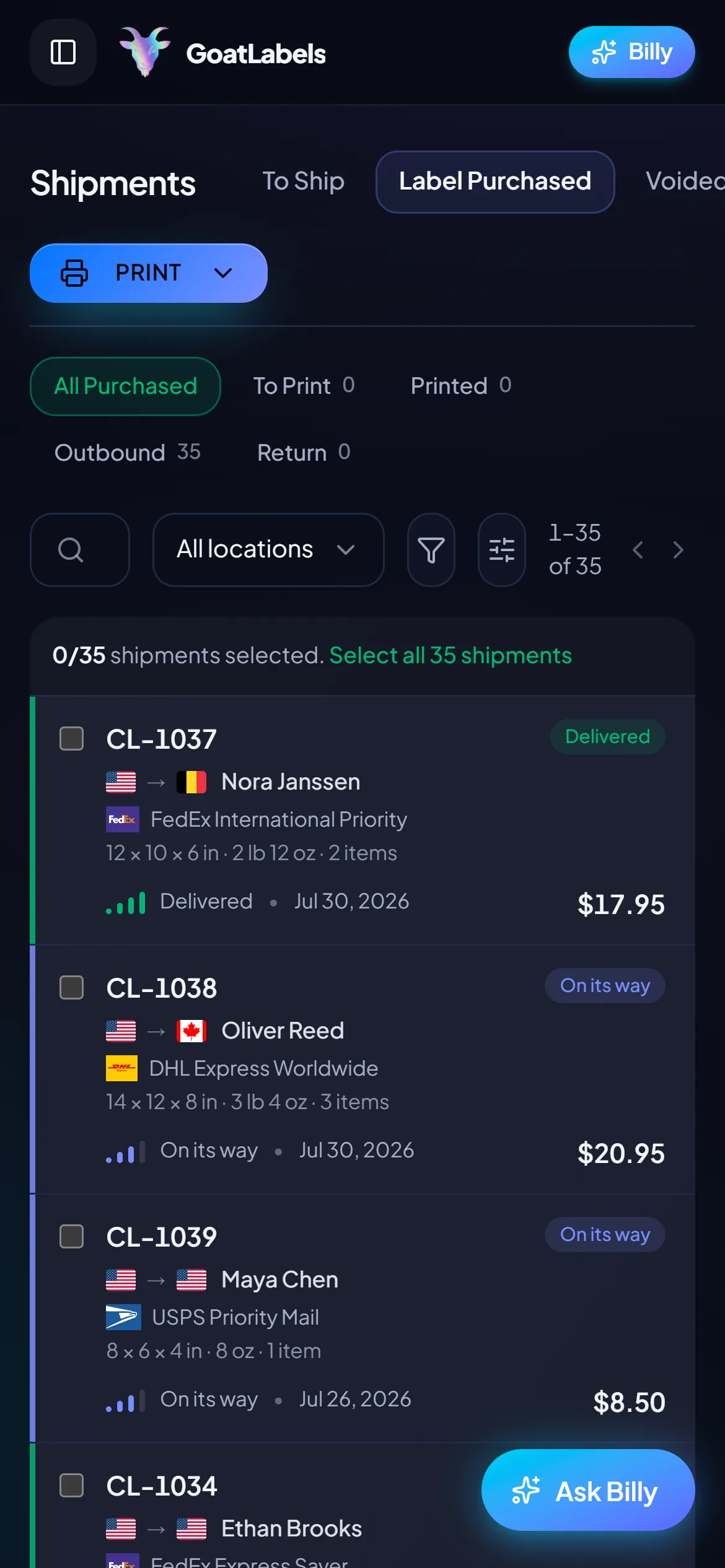
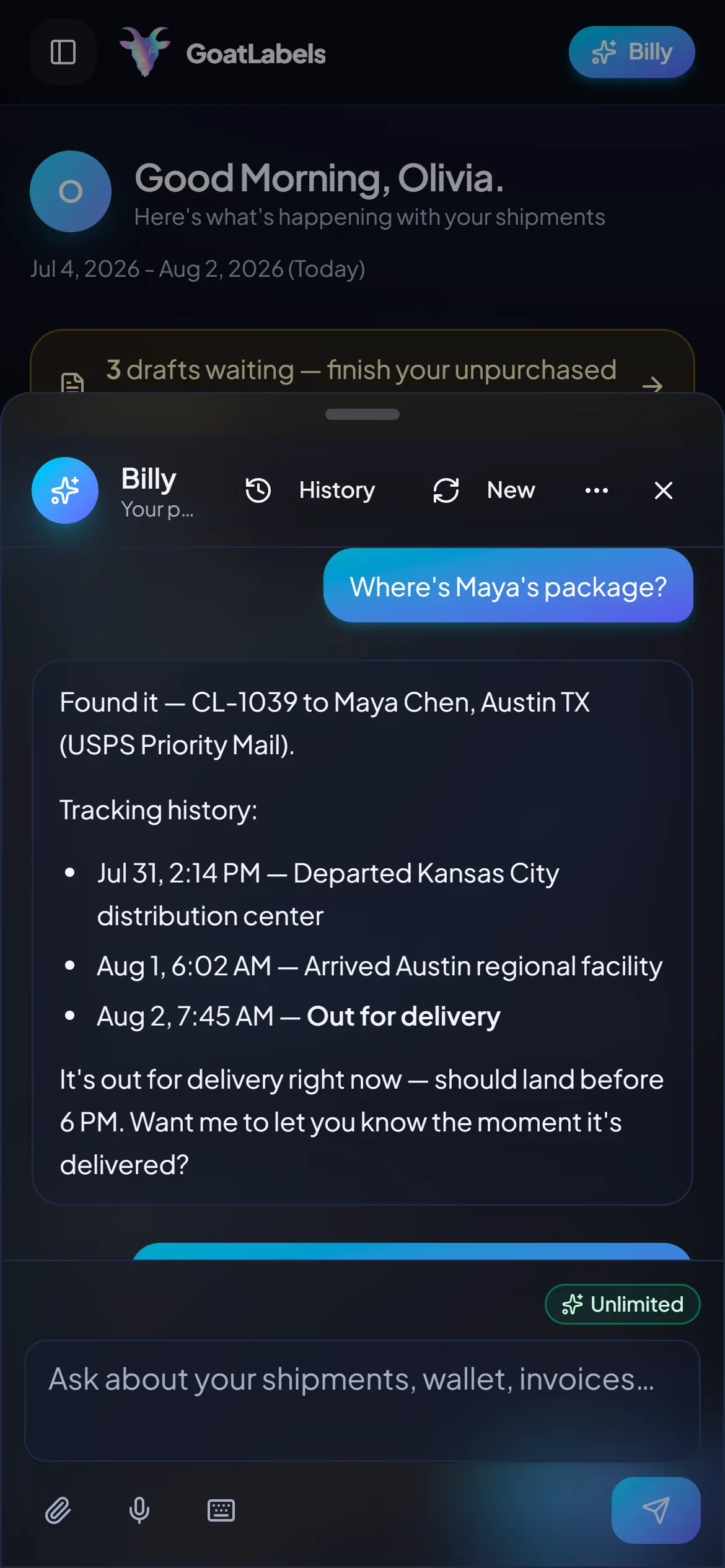
Mercari order · label ready
Austin, TX · enter tracking on the order
Mercari is a phone app, and so is the rest of this. Weigh the packed parcel on the kitchen scale, quote it against four carriers, buy the label, and print it — without the laptop ever coming into it.
Packing a closet sale is a two-handed job. Ask out loud — Billy finds the shipment, quotes USPS, UPS, FedEx, and DHL on the box you just weighed, and reads the all-in price back so you can compare it to the band without opening a tab. Included on every plan. This is the real product, not a render.
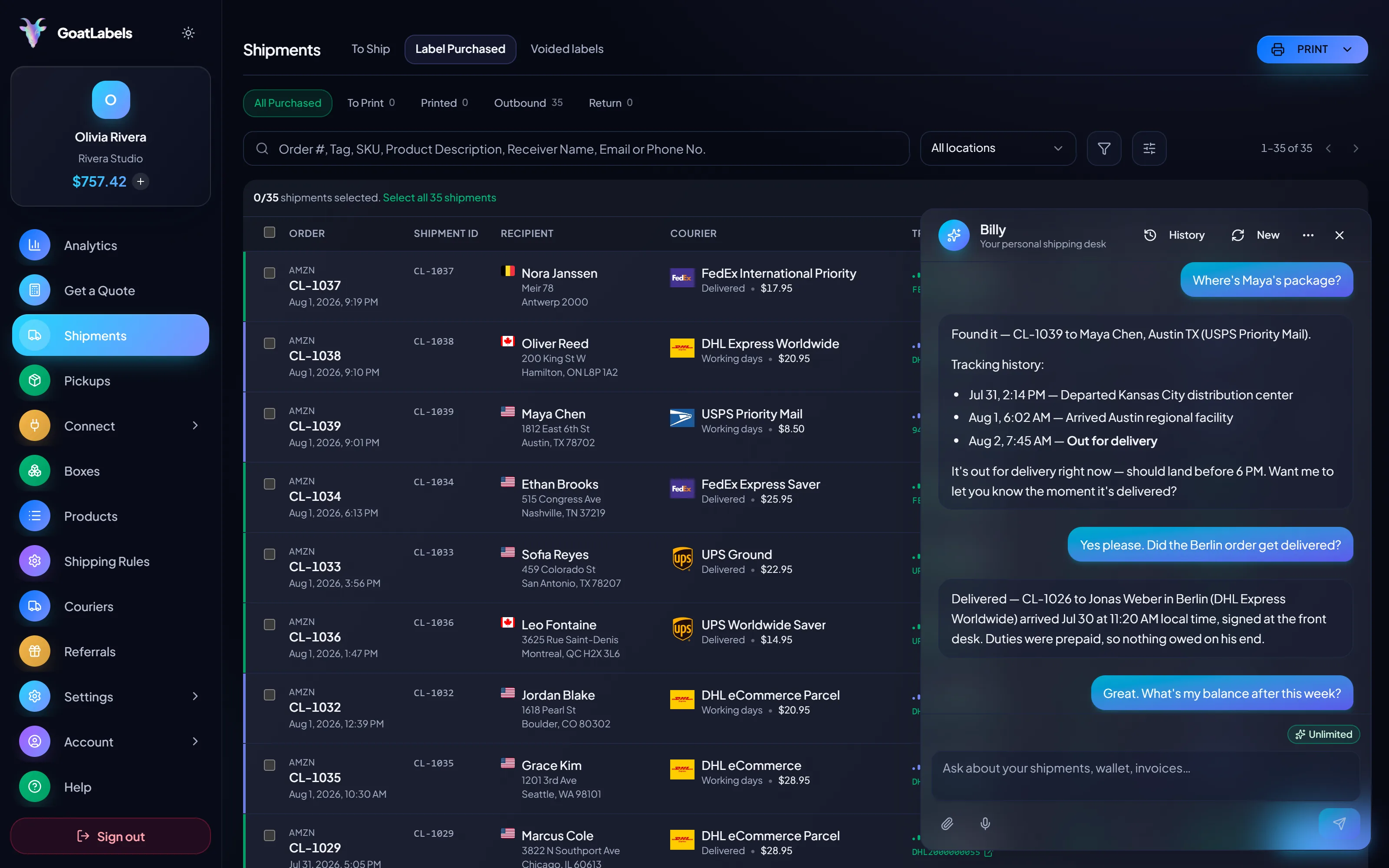
Listening
"What did the boots cost to ship?"
Out for delivery
Austin, TX · scanned this morning
Speaks plain English · remembers your saved box sizes · phone at the kitchen table, browser, or Telegram on Pro.
A banded prepaid label charges the whole band, so a parcel that lands just inside the next one up pays for weight it does not have. Quoting the packed box against three carriers gives you one all-in figure each instead, and the column you pick is what leaves your prepaid balance. Figures are illustrative.
Ground Advantage
2–5 days$7.40
$1.20 of Premium insurance included
all-in · nothing added at checkout
Ground
3–4 days$10.80
$1.20 of Premium insurance included
all-in · nothing added at checkout
Home Delivery
2–4 days$11.40
$1.20 of Premium insurance included
all-in · nothing added at checkout
Most Mercari sellers never open this section. It is here, free, for the ones cross-listing hundreds of items from a spreadsheet — because changing shipping tools later just to get an API is a migration nobody wants to do twice.
POST /api/v1/shipments
Authorization: Bearer sk_live_…
Idempotency-Key: ord_8421

{
  "to": { "name": "Joyce", "city": "Berlin", "country": "DE" },
  "parcel": { "weight": 2.6, "weight_unit": "lb" },
  "service": "fedex_intl_priority"
}
Selling out of a wardrobe is four sales one week and none the next, and a monthly fee would quietly move the crossover against you. Free covers 50 shipments a month with connected shops, the assistant, and the API all included. Pro is a flat plan for when the volume makes it cheaper, never a condition of printing anything.
Volume pricing
illustrativemore volume → lower per-label rates
$0 / forever
Enough for a closet clear-out, and nothing owed in the months nothing sells.
The assistant that turns a pasted Mercari order into a draft label runs on Free, unlimited, in the web app on desktop and mobile. Pro adds Billy on Telegram.
GET /api/v1/shipments
200 OK · plan: free
Unlimited calls on Free — still unlimited on Pro.
Bring your invoice: on Pro we work with you to beat the rates you're getting from
ShippoPirateShipShipStation Label prices are quoted live from USPS, UPS, FedEx, and DHL and shown as one all-in number, with nothing added at checkout. Mercari's own band pricing is Mercari's — take the current figures from its help centre and put them next to a quote. Full pricing details
Four kinds of Mercari seller, and the parcel shape that decides which label is cheaper for each of them.
Boots, denim, hardware, books
The clearest case for buying your own label: a national flat band charges you for a cross-country trip the parcel is not taking. Quote it to the buyer's actual ZIP and the difference is visible before you commit to shipping.
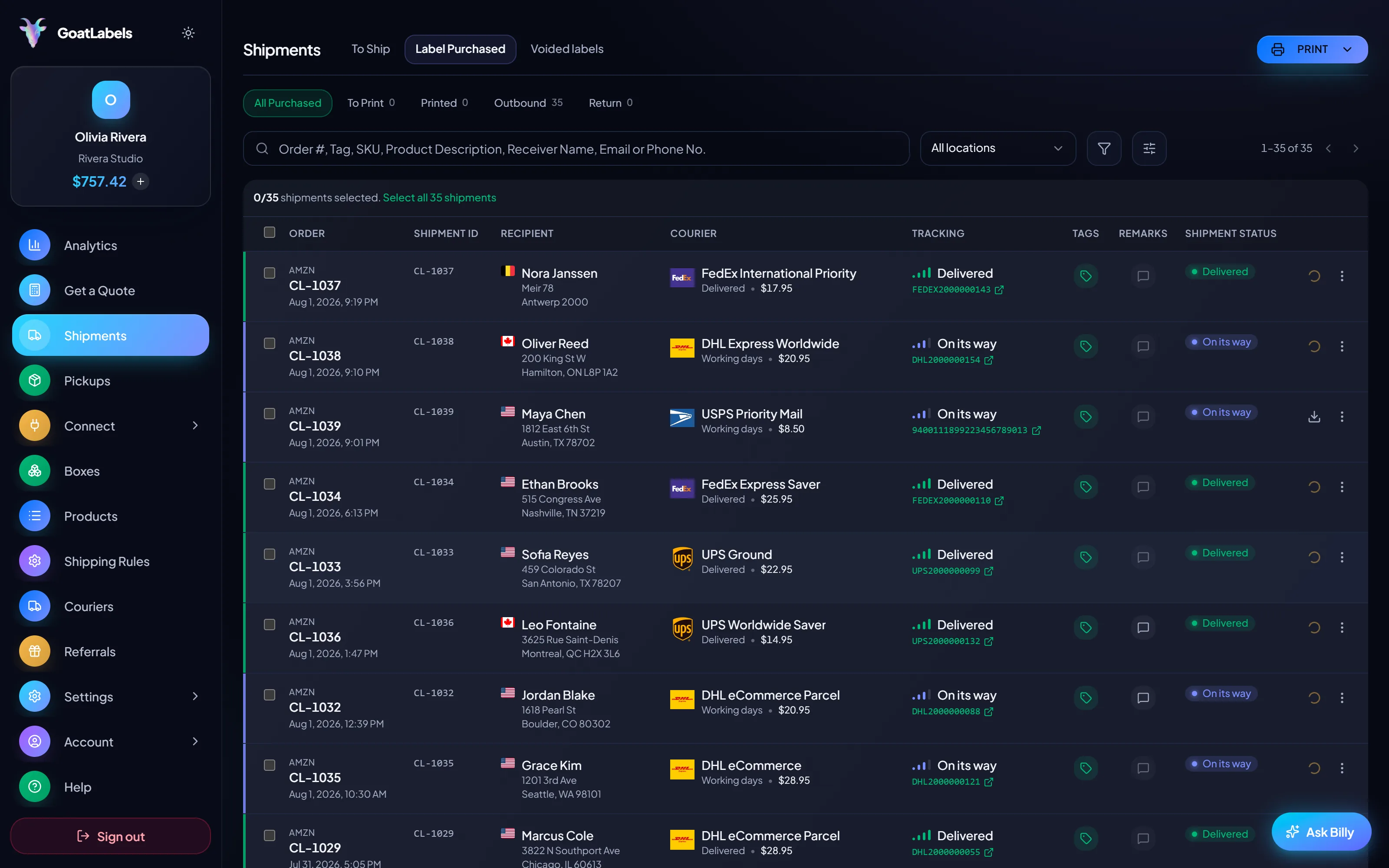
The extra ounce that cost a whole step
Repackaging is sometimes the cheaper fix and sometimes not. Weigh it packed, see how far into the band you fell, and let a continuous rate price the ounces you actually have instead of the ones you were rounded up to.
Weighed packed, then quoted
Mailer, filler, and invoice all count toward the band
Cross-listed, sold wherever it goes first
Mercari plus a shop of your own
1
prepaid balance and one queue behind every channel you list on
A video took off and I had 80 TikTok Shop orders by morning. I printed every label from my phone on the bus to the post office.
Early customer · TikTok
TikTok Shop seller
I run my Etsy shop from the kitchen. The AI reads the order, picks the carrier, the label prints. That's the whole workflow now.
Early customer · Etsy
Etsy maker
The API is what every shipping API pretends to be. Idempotency that actually works.
Sasha R.
Staff engineer, marketplace
Weigh it packed, quote it against USPS, UPS, FedEx, and DHL to the buyer's real ZIP, and put that number next to Mercari's current tier before you decide.
No card required to sign up, no monthly minimum to print, and Mercari Shipping Protection does not follow a label you buy yourself.