

USPS
Ground Advantage
2–5 days$7.40
$0.00 of residential surcharge — USPS does not levy one
all-in · deliverable to the box
No. UPS and FedEx cannot deliver to a USPS PO Box, and they reach APO, FPO, and DPO addresses only through economy services where USPS performs the final mile. For these destinations the comparison collapses to one carrier before price — a cheaper label from the wrong carrier just comes back.
A postal box or a military address is a delivery-network fact, not a preference. The quote you compare should only contain carriers that can physically complete it.


 all quoted
 The destination is checked and classified at quote time, before anything leaves your prepaid wallet — because a wrong-carrier label is spent money, not a failed transaction.
A PO Box is not an address in the ordinary sense. It is a locked receptacle inside a Post Office, in a lobby the Postal Service owns, opened by a key the Postal Service issued. UPS and FedEx cannot deliver into one for the same reason a supermarket cannot put groceries in your neighbour's safe: there is no access and no mechanism to grant it. This is not a policy either carrier could soften if enough customers asked. It is the physical layout of the network.
What makes it expensive is the timing of the failure. Nothing stops you buying a UPS or FedEx label to a PO Box — the address is a valid string, it passes format checks, and the label prints. The parcel is accepted, travels, and only becomes undeliverable at the destination, days later. You get it back, usually with an address correction fee attached, having paid for a label, paid for a return, and spent a week of the buyer's patience. So for these destinations the comparison genuinely does collapse to one carrier before price is even considered: a cheaper label from a carrier that cannot deliver is not a cheaper label.
There is one real exception, and it is not widely understood. USPS Street Addressing is an opt-in service on an individual box that lets the holder receive mail addressed to the Post Office's own street address, followed by a hash and their box number — so instead of addressing to a box, you address to a building that happens to contain the box. Because it is an ordinary street address, any carrier can deliver to it. The parcel is delivered to the Post Office, and USPS staff put it in the box or leave a notice, exactly as they would for anything else that does not fit.
Two things stop this from being a general workaround. It is enabled per box and per location rather than switched on everywhere, so you cannot assume any given box holder has it. And even holders who do have it habitually give out the PO Box form of their address, because that is the version they have typed a thousand times — which means the address you receive from a marketplace tells you nothing either way. The practical rule for a seller: if a buyer sends you a street address ending in a hash and a number, that is Street Addressing and all four carriers are back in play. If they send you a PO Box, treat it as USPS-only and ask before assuming otherwise. Asking costs one message; guessing costs a round trip.
On the USPS side, eligibility is the easy part: the main classes all deliver to a PO Box, so choosing between Ground Advantage, Priority Mail, Priority Mail Express, and First-Class is the ordinary speed-versus-price decision rather than a question of whether the parcel can arrive. What differs is the final step. A parcel too large for the box does not get crammed in — the holder gets a notice slip and collects it at the counter, and it is held for a stated number of days before it is returned. A box that has been closed or whose rental has lapsed returns everything, which is a real failure mode when a buyer moved months after ordering. Signature services still work, with the holder signing at the counter rather than at a door.
On the UPS and FedEx side, submitting a PO Box does not produce a useful error. Their systems accept the address, sell you the label, and move the parcel until a human at the destination has nowhere to put it. The outcome is a return, an address correction charge, and doubled transit. The one nuance worth naming is the budget ground tiers, where the private carrier collects and line-hauls and USPS performs the final mile — which changes the PO Box picture for those specific services and is worked through on cheapest ground shipping services, not here. The broader question of what carriers do with a parcel they cannot deliver, and who pays to send it again, is on why a package comes back.
Military addresses are the other family that decides the carrier for you, and they confuse sellers because they are neither domestic nor international in the usual sense. An APO, FPO, or DPO address is a domestic USPS address that happens to terminate overseas: you pay domestic postage, USPS carries it into the military postal system, and the military moves it the rest of the way. UPS and FedEx do not deliver to them.
The format is rigid and the failures come from improvising. Write the recipient's full name. Then the unit and box line exactly as it was given to you — service members provide it in forms like a PSC number with a box number, or a unit number with a box number, and it should be copied rather than tidied. Then the city, which is literally the word APO, FPO, or DPO. Then the two-letter armed forces state code, then the ZIP with its four-digit extension if you have it.
What must not appear is the part sellers add out of helpfulness: the host country, the base name, or a foreign city. Writing a European city and country onto a military address is the single most common way one gets handed to an international carrier that cannot complete it, and the recovery is slow. Military parcels also need a customs declaration even though you are paying domestic postage — customs forms for a small parcel going abroad covers which form and how to fill it in.
Almost all of the cost here is avoidable, because the signals are textual and they arrive before you spend anything. A destination is USPS-only if the address line contains PO Box, P.O. Box, or POB; if it contains PSC or a unit-and-box construction; if the city is APO, FPO, or DPO; if the state is one of the armed forces codes; or if the ZIP falls in one of the military ranges. Those are the checks worth building into whatever step of your process happens before purchase.
GoatLabels does that check at quote time rather than at print time. The destination is validated before payment, with the classification shown, and the rate list you are comparing is the list of carriers that can actually complete the delivery — so the cheapest quote on the screen is never a UPS label to a postal box. If a label does need cancelling, the credit returns to your prepaid wallet and is spendable on the next label rather than queued behind a card reversal; the deadlines and mechanics of that are covered on how to void a shipping label. For the USPS side of the flow in general, see USPS shipping labels.
These are structural postal conventions rather than prices, so they move slowly — but they are the specifics most often typed from memory and got wrong, so they live in one dated block rather than scattered through the prose.
Verify address conventions and ZIP ranges against the current USPS Postal Addressing Standards before relying on them. Review cadence: annual.
For most destinations a quote is a price comparison. For a postal box or a military address it is an eligibility question first, and the answer is knowable from the address text alone. Paste or type the destination, let it be classified, and compare only the carriers that can physically complete the delivery.
Hi! Send it to PO Box 4120, Bozeman MT 59715 — thank you!
A PO Box, a PSC or unit line, an APO, FPO, or DPO city, or an armed forces state code are all readable from the text. None of them require a carrier to tell you at the depot.

Buying a label the network cannot complete spends the money immediately and fails days later. Checking eligibility at quote time is the only point at which the information is still worth something.
Shopify, Etsy, WooCommerce, and TikTok Shop sync into the To Ship queue, so a PO Box typed into a marketplace checkout is classified there exactly as one you typed yourself — before a label is bought rather than after it is returned. Paste an Instagram or Facebook DM and Billy builds the shipment from the message, copying the unit and box lines instead of tidying them.
 Shopify
  Etsy
Etsy  WooCommerce
  TikTok Shop
  Amazon
  eBay
eBay  Squarespace
  Wix
Wix  Walmart Shopify Plus Soon
 Square
  BigCommerce
  Magento
  Zapier Soon
 NetSuite Soon
 Ecwid Soon
 Temu
Temu  Shein Soon
 ChannelAdvisor Soon
 SkuVault Soon
 Zoho Inventory Soon
Every carrier system will accept a PO Box address and take your money. The useful check is the one that happens before purchase, on the destination itself.
Labels are bought from a balance funded by card, Apple Pay, Google Pay, ACH, or crypto, with no monthly minimum to print. If a label has to be cancelled because an address turned out to be a box, the credit lands back in the balance rather than queueing behind a card reversal.
Paste a buyer's message, drop a screenshot, or speak the address and Billy drafts the shipment from it — including the unit and box lines that military addresses depend on being copied exactly rather than tidied up.
The price you compare already contains what applies to that destination, and that exact amount leaves your balance when you buy. A USPS-only destination shows you USPS services priced properly rather than a cheaper quote you cannot use.
USPS, UPS, FedEx, and DHL are quoted against the same parcel wherever all four can complete the delivery. To a postal box or a military address the honest list is shorter, and showing a short list is the point — an eligibility filter that runs before pricing is what stops a cheap label from becoming a returned parcel.
UPS $12.48 FedEx $13.22 DHL $14.10 USPS $11.79 Address validation and the eligible service list come back with the rate call, on unlimited calls on every plan. A script can refuse to buy against a destination its carrier cannot serve instead of discovering it from a return scan, and signed webhooks carry the tracking events either way.
Destination classified
CL-1038 · APO AE 09123
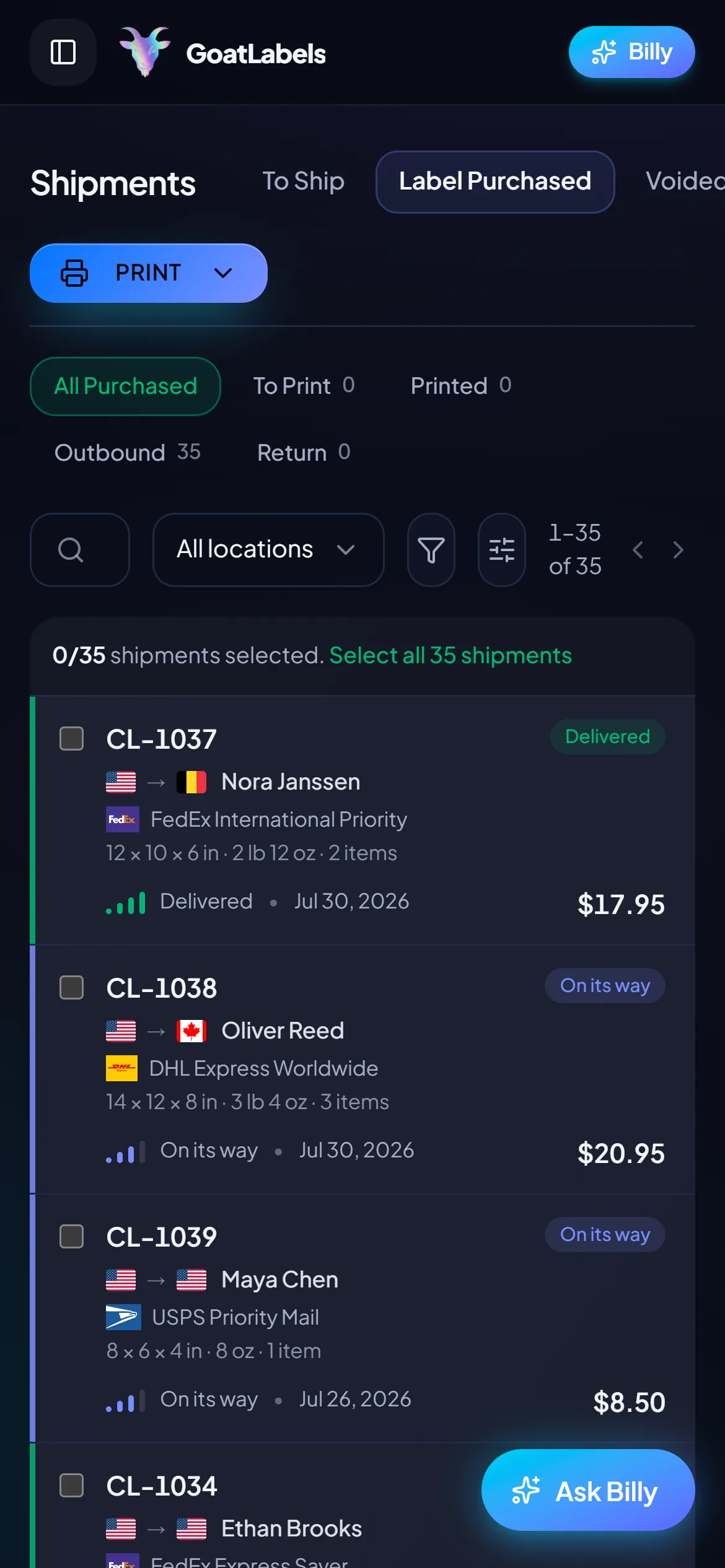
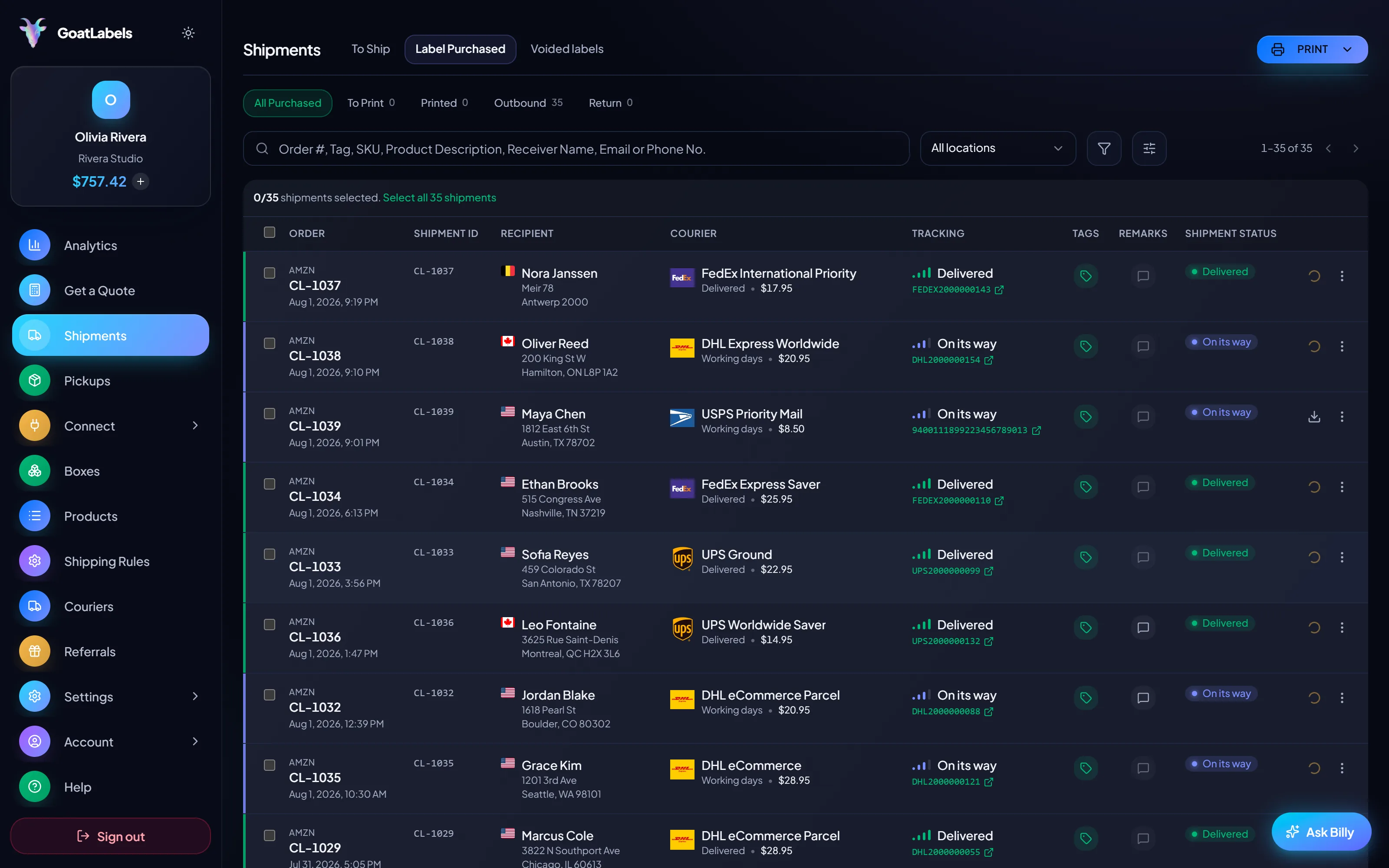
Everything that makes a destination USPS-only is readable from the address text, and it is all knowable before you spend anything — so the check should not require sitting down at a desk. The queue, the classification, and the carriers that can actually complete the delivery fit on the phone in your hand.
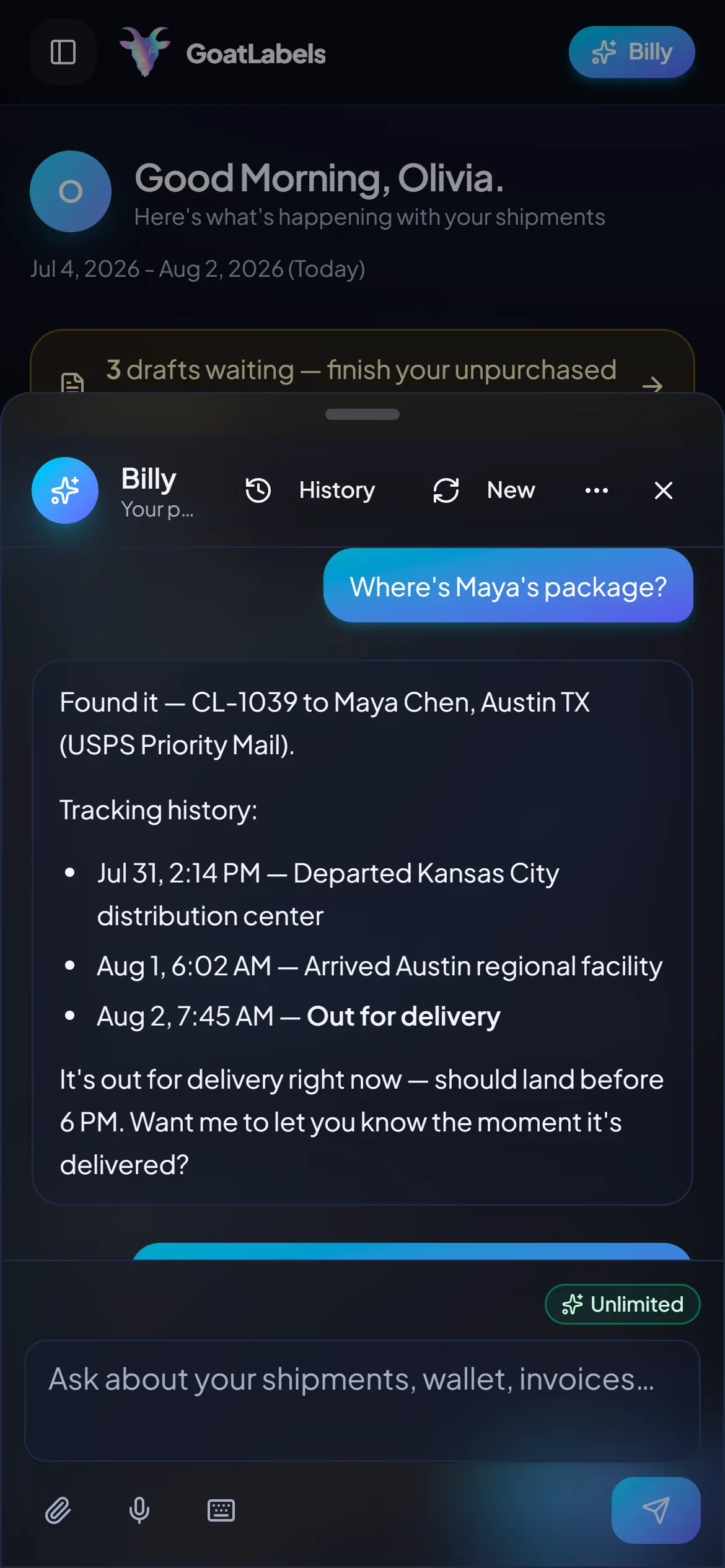
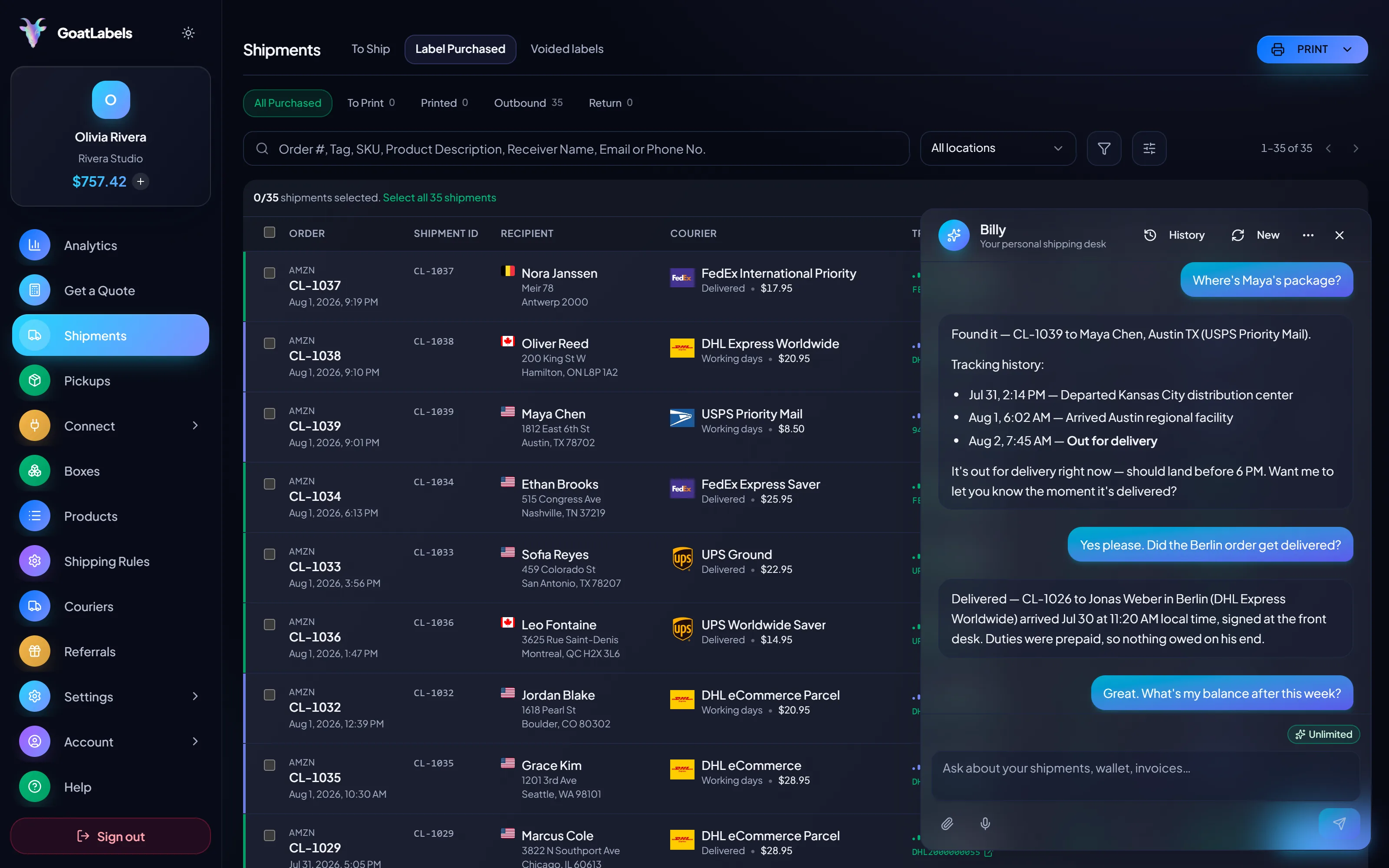
Read the destination off the buyer's message and Billy validates it, tells you whether it is a postal box or a military address, and quotes back only the carriers that can complete the delivery. Unit and box lines are copied as given rather than tidied into something the military postal system will not route, and it answers for the shipment afterwards — where it is, and what happened if it came back. This is the real product, not a render.
Listening
"Where's Maya's package?"
Out for delivery
CL-1039 · Austin, TX · by 6 PM
Speaks plain English · flags PO Box, PSC, and APO, FPO, or DPO destinations out loud · remembers customers and saved boxes · included on every plan, never a pricier tier.
A PO Box removes UPS, FedEx, and DHL before price is even considered, so what is left is the ordinary speed-versus-price decision across the USPS classes that do deliver there. Each column is one all-in number locked at quote time, and that exact amount leaves your prepaid balance.
Ground Advantage
2–5 days$7.40
$0.00 of residential surcharge — USPS does not levy one
all-in · deliverable to the box
Priority Mail
1–3 days$9.85
$0.00 of residential surcharge — USPS does not levy one
all-in · deliverable to the box
Priority Mail Express
1–2 days$31.40
$0.00 of residential surcharge — USPS does not levy one
all-in · deliverable to the box
Address validation and the eligible service list come back with the rate call, so a script can decline a UPS label to a postal box instead of learning about it from a return scan a week later. REST, JSON, one Bearer header, signed webhooks instead of polling, unlimited calls on every plan.
POST /api/v1/shipments
Authorization: Bearer sk_live_…
Idempotency-Key: ord_8421

{
  "to": { "name": "Joyce", "city": "Berlin", "country": "DE" },
  "parcel": { "weight": 2.6, "weight_unit": "lb" },
  "service": "fedex_intl_priority"
}
The destination check is not a tier. Free covers 50 shipments a month with address validation and the eligibility filter on every one of them, and Pro is a flat monthly plan with unlimited shipments and cheaper label pricing. Neither charges you for a quiet month, and neither puts the check that saves you a returned parcel behind a paywall.
Volume pricing
illustrativemore volume → lower per-label rates
$0 / forever
Fund a wallet, validate every destination, and pay only for the labels you actually buy.
The assistant that reads a buyer's message into a draft, copies the unit and box lines verbatim, and validates the destination before you spend anything runs unlimited in the web app on Free. Pro adds Billy on Telegram.
GET /api/v1/shipments
200 OK · plan: free
Unlimited calls on Free — still unlimited on Pro.
On Pro we will work with you to beat the label rates you are already getting from
ShippoPirate ShipShipStation Label prices are quoted live from USPS, UPS, FedEx, and DHL as one all-in number, and that exact amount leaves your prepaid balance — from the carriers that can complete the delivery, and only those. Full pricing details
Same validation, same wallet, same one-tap flow. These are the four shapes of seller whose order book regularly contains a destination where eligibility settles the question before price gets a say.
TikTok Shop & live commerce
A hundred orders overnight means nobody reads a hundred addresses, and a single PO Box bought as a UPS label is a return, a correction fee, and doubled transit. The check has to run on every destination automatically or it does not run at all.
Etsy & independent creators
Buyers who would rather not give a stranger a home address use a PO Box, so this is not a rare edge case on a handmade shop — it is a steady slice of the order book, and a returned parcel costs more than the whole order made.
PO Box detected before purchase
Order #1024 · USPS services priced, others withheld
Where PSC and unit lines get retyped
Domestic postage, overseas delivery
USPS
the only carrier that reaches APO, FPO, and DPO directly
A video took off and I had 80 TikTok Shop orders by morning. I printed every label from my phone on the bus to the post office.
Early customer · TikTok
TikTok Shop seller
I run my Etsy shop from the kitchen. The AI reads the order, picks the carrier, the label prints. That's the whole workflow now.
Early customer · Etsy
Etsy maker
The API is what every shipping API pretends to be. Idempotency that actually works.
Sasha R.
Staff engineer, marketplace
Paste the address, let the destination be classified, and compare only the carriers that can complete it — then buy from a prepaid wallet.
Sign up in seconds. No card required. No monthly minimum to print.