

USPS
Priority Mail Intl
10–15 days$7.40
$1.90 of duties & taxes prepaid, not billed to your buyer
all-in · no surprises
An unused label can usually be refunded, but the deadline to ask and the wait to be paid differ by carrier, and some carriers never bill a label you did not use. On GoatLabels the credit returns to your prepaid wallet, so it is spendable on the next label rather than queued to a card.
USPS, UPS, FedEx, and DHL each decide an unused label differently — the request goes to the right one with the right record attached.


 all four
 Fund with card, Apple Pay, Google Pay, ACH, or crypto — a void credits the same prepaid wallet either way.
A void is not a cancellation in the ordinary sense. The carrier has already issued a tracking number and reserved the service; voiding asks it to un-issue that, and every carrier grants the request on its own terms. Three conditions do almost all of the work. The first is whether the parcel has been scanned — once a carrier has physically accepted the item, there is nothing left to void, because the service has begun. After you cancel, peel the printed label off the box and destroy it before the driver arrives; a pickup scan reactivates the sticker and the full postage is billed again. The second is the age of the label, since each carrier sets an outside limit past which an unused label is written off rather than reversed. The third is how the label was billed, and that one changes what the word refund even means.
Carriers that charge at purchase have money to give back, so you file, wait for a decision, and watch for a credit. Carriers that bill on movement never charged you for a label that did not move, so there is nothing to reverse — the correct outcome is an invoice that simply never mentions it. Both are fine. They look completely different on a ledger, they resolve on different timescales, and confusing the two is why sellers spend a week chasing a refund that was never owed.
Cancelling in the dashboard only asks the carrier to void the tracking number. If the printed sticker is still on the parcel when the driver scans it, the void is reversed and you are billed again. Peel it off (or cover it completely) before pickup or drop-off.
| Carrier | What a void actually is there | What decides whether you get it | The document that governs it |
|---|---|---|---|
| USPS | A refund request against unused postage, reviewed by the Postal Service rather than granted on the spot. | Whether the label has been scanned, and how old the postage is. | USPS Domestic Mail Manual and the refund flow inside Click-N-Ship. |
| UPS | A void on the shipment record, which stops the charge from finalising rather than reversing a settled one. | Whether the shipment has been picked up or dropped, and how far the billing cycle has run. | The UPS Tariff / Terms and Conditions of Service for your origin country. |
| FedEx | Cancellation of an issued but unmoved shipment; billing is driven by movement, so an untouched label may simply never be invoiced. | Whether a scan exists, and how the label was billed. | The FedEx Service Guide in force on your ship date. |
| DHL Express | Deletion of the shipment before it enters the network, handled as a booking cancellation. | Whether the waybill has been collected or handed over. | DHL Express Terms and Conditions of Carriage for the origin country. |
Carrier policy reference — compiled 2026-08-04. Day counts are deliberately not printed on this page. Each carrier publishes its own refund window in its own terms and revises it without notifying resellers, and the third-party articles that quote those windows disagree with each other for the same carrier. The four documents named in the table above are the governing sources; check the one that covers your label before you rely on a date, and treat a competitor's help centre as hearsay. Review cadence: re-checked against each carrier's published terms at its annual rate announcement, by the named marketing owner recorded with this page.
Most people arrive here wanting to edit, not void. A digit is wrong in the street number, the apartment line is missing, the service is one tier too slow. It feels like a text field. It is not. A purchased label is a priced contract, and the destination, the service level, the declared weight and dimensions, and any signature or insurance option were all inputs to that price. Change any one of them and the price is different, which means the label is different. No carrier lets you retype a destination on an issued label and keep the tracking number, and any tool that appears to is quietly voiding and rebuying underneath.
So the practical question is not how to edit but how fast you notice, and the cheapest place to notice is before you pay. GoatLabels validates the destination at quote time and shows a residential or commercial classification badge on the address before money moves, which removes the single most common reason a seller ends up on this page at all. If a bad address does survive that check and the parcel comes back instead, what happens to a returned parcel is a different process with a different bill attached.
This is the part that decides whether a void costs you a morning or costs you nothing. A refund to a card is not money you can ship with today. It leaves the carrier, crosses a processor, and then waits on your issuing bank's posting cycle — and during that wait you still have a parcel to send, so you pay for the corrected label out of pocket and carry both amounts until the reversal lands. The money was never really returned to you; it was returned to a statement.
A prepaid wallet collapses that. When a void is granted, the credit posts back to the same balance the label was bought from, and the corrected label can be bought from it in the same session — same money, completely different liquidity. It arrives as balance regardless of how you funded: card, Apple Pay, Google Pay, ACH bank transfer, or crypto all top up one balance, and the credit does not care which rail put the money there. It also arrives as its own ledger line rather than as a silently smaller number, so a void you requested and a void you were granted are two visibly different things. That single mechanic is why this page exists on a shipping site instead of on a carrier's help centre — and it is the reason a cheap label stays cheap when an order goes sideways.
Some labels are simply gone. Anything with an acceptance scan has been performed, so there is nothing to un-issue. A duplicate printed from a stale browser tab and then dropped in the same sack as the original will usually both move, and both get billed. A label bought against the wrong parcel and then used anyway is not a void case either — it is a mis-declared shipment, and the carrier will correct the price after the fact rather than give the label back. That last one is the most expensive kind of mistake, because it arrives quietly, weeks later, as a post-shipment billing adjustment rather than as a refusal you can argue with on the day.
The prevention list is short and dull, which is why it works. Buy the label at the moment you pack the parcel rather than in a batch the night before, so the weight on the label is the weight in your hand. Save the box sizes you actually use, so the dimensions are a selection instead of a retype. Let the address validation run and read the classification badge before you pay. Quote all four carriers on the same parcel so the service you buy is a choice rather than a habit. And keep the balance prepaid rather than the plan subscribed, because nothing on GoatLabels charges a monthly minimum to print, so a week you spend voiding and rebuying two labels is a week that costs you the price of two labels and nothing else.
A void is a three-step loop, and the only step that is slow is the one the carrier owns. You raise the request from the shipment itself so the tracking number, service, and purchase record travel with it. The carrier reviews it against its own window. The credit posts back to your prepaid balance as its own ledger line, and the corrected label is bought from that same balance before the parcel is even taped.
Apartment number missing — the label printed with a street address the validator flagged as incomplete.
Only a label with no acceptance scan is a void candidate. Once the carrier has the parcel, the service has begun and this stops being a refund question.

The credit is spendable the moment it posts, so the replacement label comes out of the returned money rather than out of your pocket while a card reversal clears.
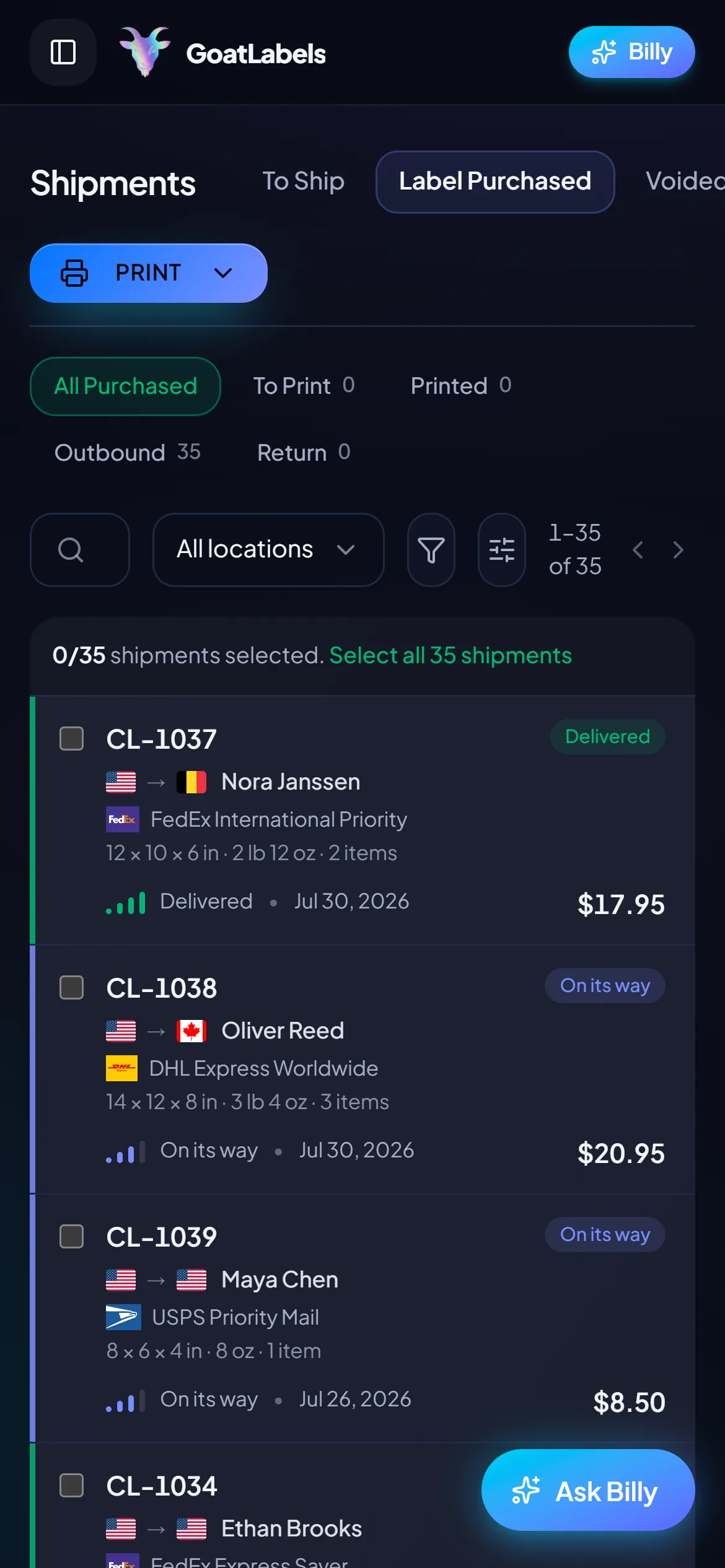
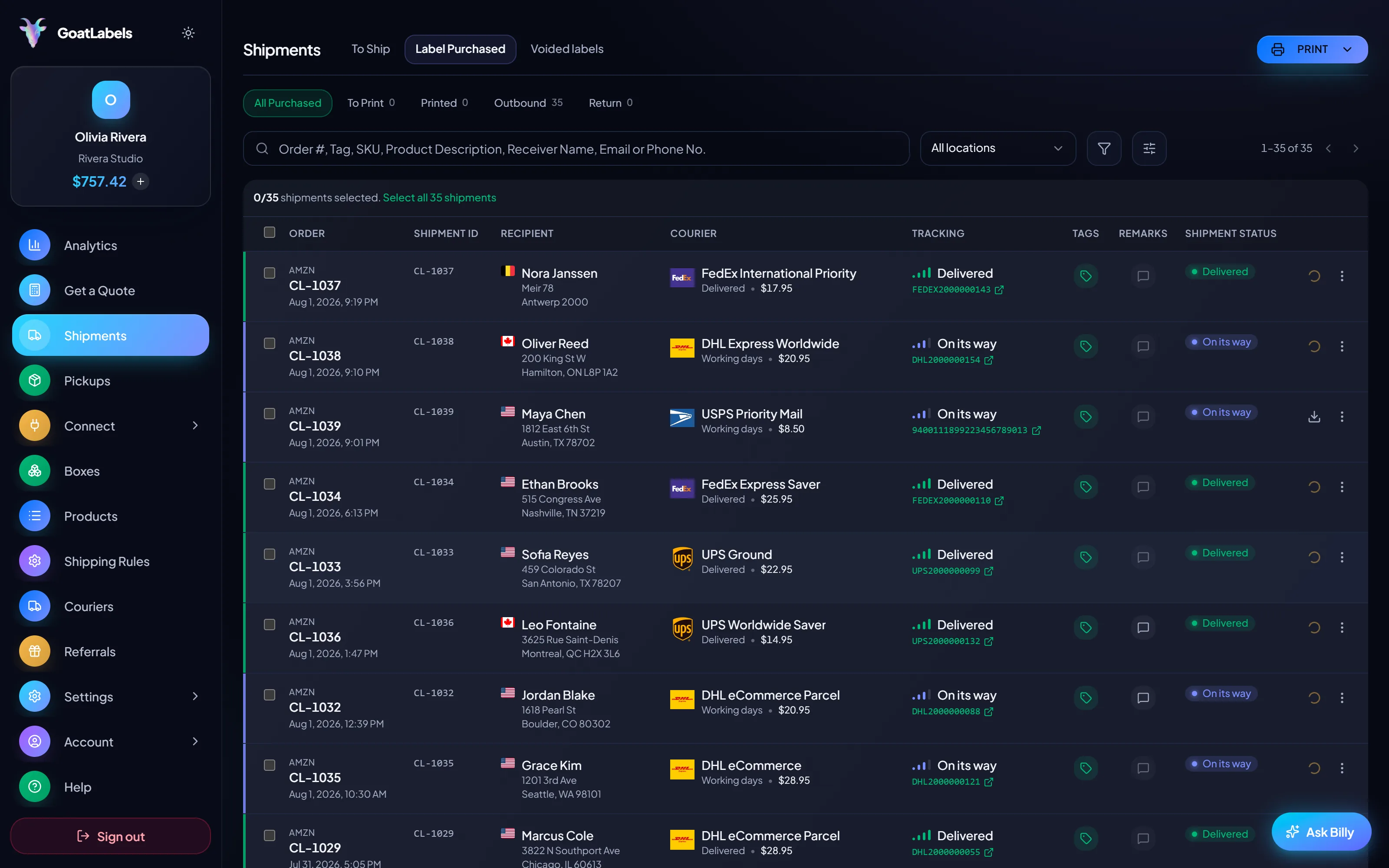
Shopify, Etsy, WooCommerce, and TikTok Shop sync into the To Ship queue, and the label you buy sits on a shipment record here rather than inside the storefront — which is what turns a void into a request against a tracking number instead of a support thread with whoever sold you the postage. Paste an Instagram or Facebook DM and Billy builds the label from the message; the void, the credit, and the rebuy behave identically.
 Shopify
  Etsy
Etsy  WooCommerce
  TikTok Shop
  Amazon
  eBay
eBay  Squarespace
  Wix
Wix  Walmart Shopify Plus Soon
 Square
  BigCommerce
  Magento
  Zapier Soon
 NetSuite Soon
 Ecwid Soon
 Temu
Temu  Shein Soon
 ChannelAdvisor Soon
 SkuVault Soon
 Zoho Inventory Soon
Voiding is only cheap if the money comes back somewhere you can spend it, the replacement is priced honestly, and nothing bills you for the month in between.
Card, Apple Pay, Google Pay, ACH, and crypto all top up one prepaid balance, and a granted void credits that same balance as its own ledger line. It is spendable the moment it posts, which is the whole difference between a refund and a reversal you are waiting on.
Billy drafts the label from a pasted order, a screenshot, or a spoken address, and the destination is validated with a residential or commercial classification badge before money moves. Most voids are an address defect that was visible at quote time.
The number you see is the number that leaves your balance, so there is no separate fee stack to unpick when a label is voided. What was taken is what comes back, and anything the carrier corrects after movement arrives as its own adjustment entry instead of as an unexplained difference.
USPS, UPS, FedEx, and DHL are quoted against the same parcel every time, including the replacement. A label bought in a hurry to fix a mistake is exactly the label people overpay for, so the corrected one gets the same four prices and the same delivery windows as the original.
UPS $12.48 FedEx $13.22 DHL $14.10 USPS $11.79 The REST API covers the same lifecycle the dashboard does, with signed webhooks instead of polling and real idempotency keys, so a retried job never buys the label twice. Unlimited calls on every plan.
Void requested
CL-1038 · Seattle, US
Nobody notices a missing apartment line at a desk. They notice it at the bench, holding a box that is heavier than the one they weighed last night. Both halves of the fix — the void request and the corrected label — fit on the phone that is already next to the tape gun, which is the difference between sorting it now and finding it in a pile on Monday.
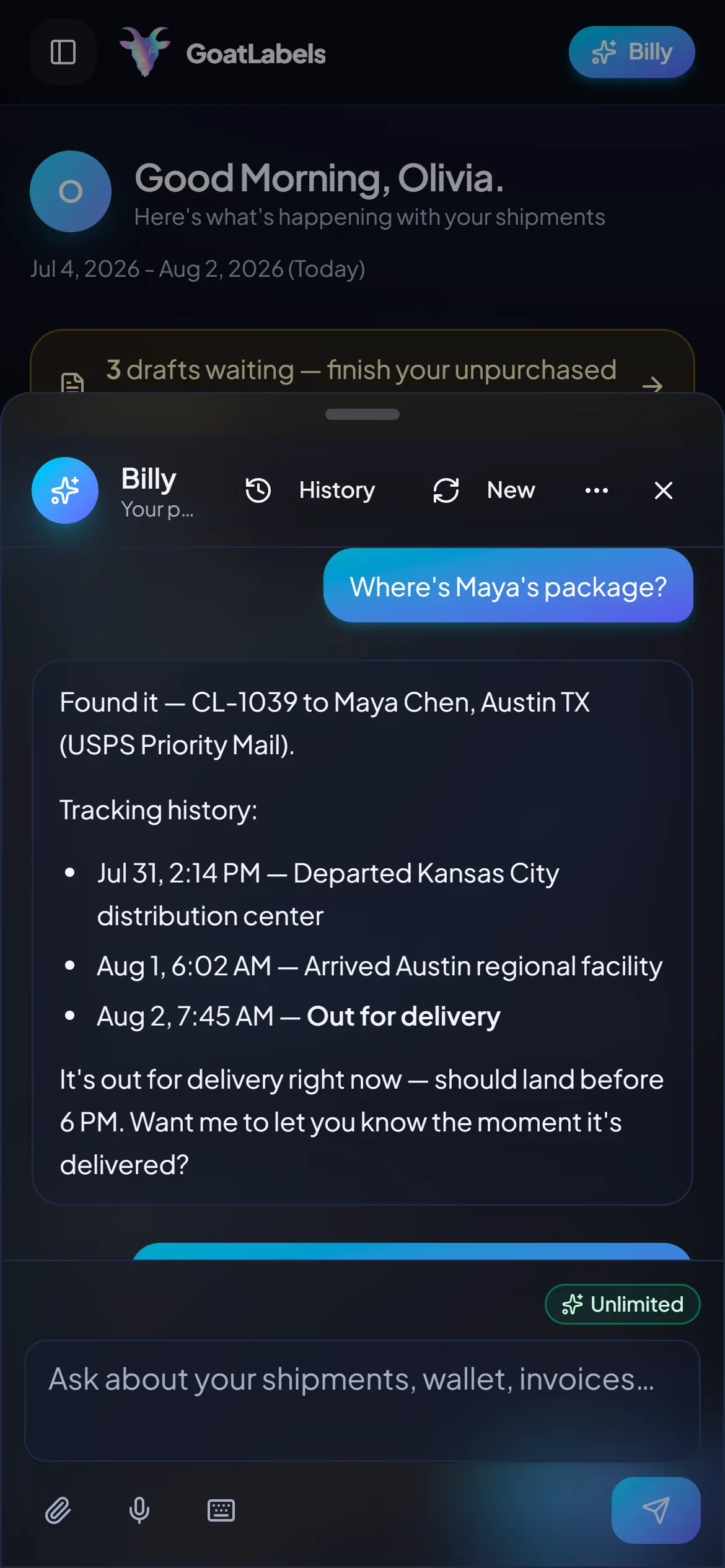
A void has two states worth knowing and both of them are questions, not screens: did the carrier grant it, and has the credit landed yet. Ask out loud and Billy reads the shipment back — requested, granted, or refused, and whether the balance has moved. Then dictate the corrected address and it drafts the replacement, quoted across all four carriers, while the parcel is still open in front of you. This is the real product, not a render.
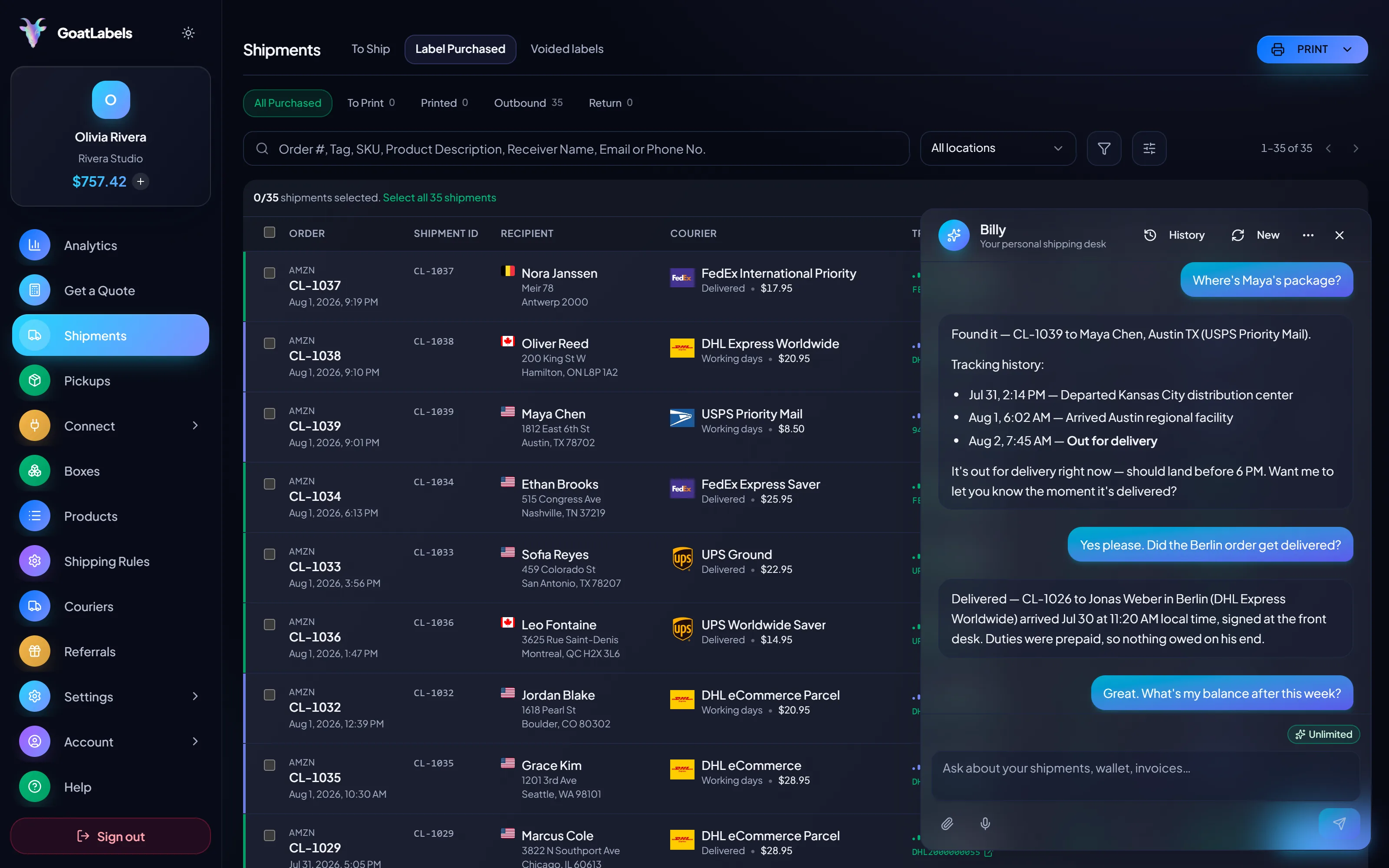
Listening
"Did the void on Maya's label clear?"
Credit posted
CL-1039 · back to wallet balance
Speaks plain English · reads a shipment's void and credit state back · drafts the corrected label from a spoken address · included on every plan, never a pricier tier.
A label bought in a hurry to correct a mistake is exactly the label people overpay for — the first instinct is to rebuy whatever was bought the first time. The corrected parcel is quoted against every carrier at once instead, each column one all-in number locked at quote time, so the rebuy is a decision rather than a reflex.
Priority Mail Intl
10–15 days$7.40
$1.90 of duties & taxes prepaid, not billed to your buyer
all-in · no surprises
Intl Connect Plus
3–5 days$8.90
$2.20 of duties & taxes prepaid, not billed to your buyer
all-in · no surprises
Express Worldwide
1–2 days$9.80
$2.50 of duties & taxes prepaid, not billed to your buyer
all-in · no surprises
Buy, void, and rebuy over REST and JSON with one Bearer header. A signed webhook tells you when the carrier grants or refuses the request instead of you polling for it, and real idempotency keys mean a retried job never buys the replacement twice. Unlimited calls on every plan.
POST /api/v1/shipments
Authorization: Bearer sk_live_…
Idempotency-Key: ord_8421

{
  "to": { "name": "Joyce", "city": "Berlin", "country": "DE" },
  "parcel": { "weight": 2.6, "weight_unit": "lb" },
  "service": "fedex_intl_priority"
}
You do not have to be on a plan to void a label or to take the credit back into your balance. Free covers 50 shipments a month with everything else unlimited, and Pro is a flat monthly plan with unlimited shipments and cheaper label pricing. Either way a granted void credits the same prepaid wallet the label was bought from, and a week spent voiding and rebuying two labels costs you the price of two labels.
Volume pricing
illustrativemore volume → lower per-label rates
$0 / forever
Fund a wallet, pay per label, and take credits straight back into the same balance.
The assistant that reads a pasted order or a screenshot into a draft also validates the destination before money moves, which is where the majority of these mistakes are actually catchable. It runs unlimited in the web app on Free. Pro adds Billy on Telegram.
GET /api/v1/shipments
200 OK · plan: free
Unlimited calls on Free — still unlimited on Pro.
On Pro we will work with you to beat the label rates you are already getting from
ShippoPirate ShipShipStation Label prices are quoted live from USPS, UPS, FedEx, and DHL as one all-in number, that exact amount leaves your prepaid balance, and a granted void credits the same amount back to it. Full pricing details
Same wallet, same credit, same requote on the replacement, whether that is two labels a week or two hundred a night. These are the four shapes of seller where money stuck in a card reversal hurts most.
TikTok Shop & live commerce
Labels printed the night before are labels bought against a guess: the weight changes when the item is actually in the box, and the service gets chosen before the buyer's date is confirmed. Voiding a handful every morning is normal — what matters is that the credit is spendable by the time you rebuy.
Etsy & independent creators
Low volume and no float. When a label is wrong, paying for the corrected one out of pocket while a card reversal crawls through a bank's posting cycle is the actual cost of the mistake — not the postage.
Void granted, credit posted
Order #1024 · spendable on the corrected label
Where the apartment line goes missing
Where a rebuy is most expensive
DDP
duties quoted inside the same all-in number
A video took off and I had 80 TikTok Shop orders by morning. I printed every label from my phone on the bus to the post office.
Early customer · TikTok
TikTok Shop seller
I run my Etsy shop from the kitchen. The AI reads the order, picks the carrier, the label prints. That's the whole workflow now.
Early customer · Etsy
Etsy maker
The API is what every shipping API pretends to be. Idempotency that actually works.
Sasha R.
Staff engineer, marketplace
Validate the address at quote, buy the cheapest of four carriers, and if it still goes wrong, take the credit back into the same balance and reprint.
Sign up in seconds. No card required. Credits land as spendable balance.