

USPS
Ground Advantage
2–5 days$7.40
$1.20 of Premium insurance included
quoted price · wallet debit
An adjustment is a post-shipment correction: the carrier reweighed or remeasured the parcel and bills the difference. GoatLabels posts each one as its own ledger entry against your wallet, so you can see what changed and dispute it instead of finding an unexplained charge weeks later.
USPS, UPS, FedEx, and DHL all re-rate parcels after movement, but they detect, bill, and let you dispute it on completely different terms.


 all four
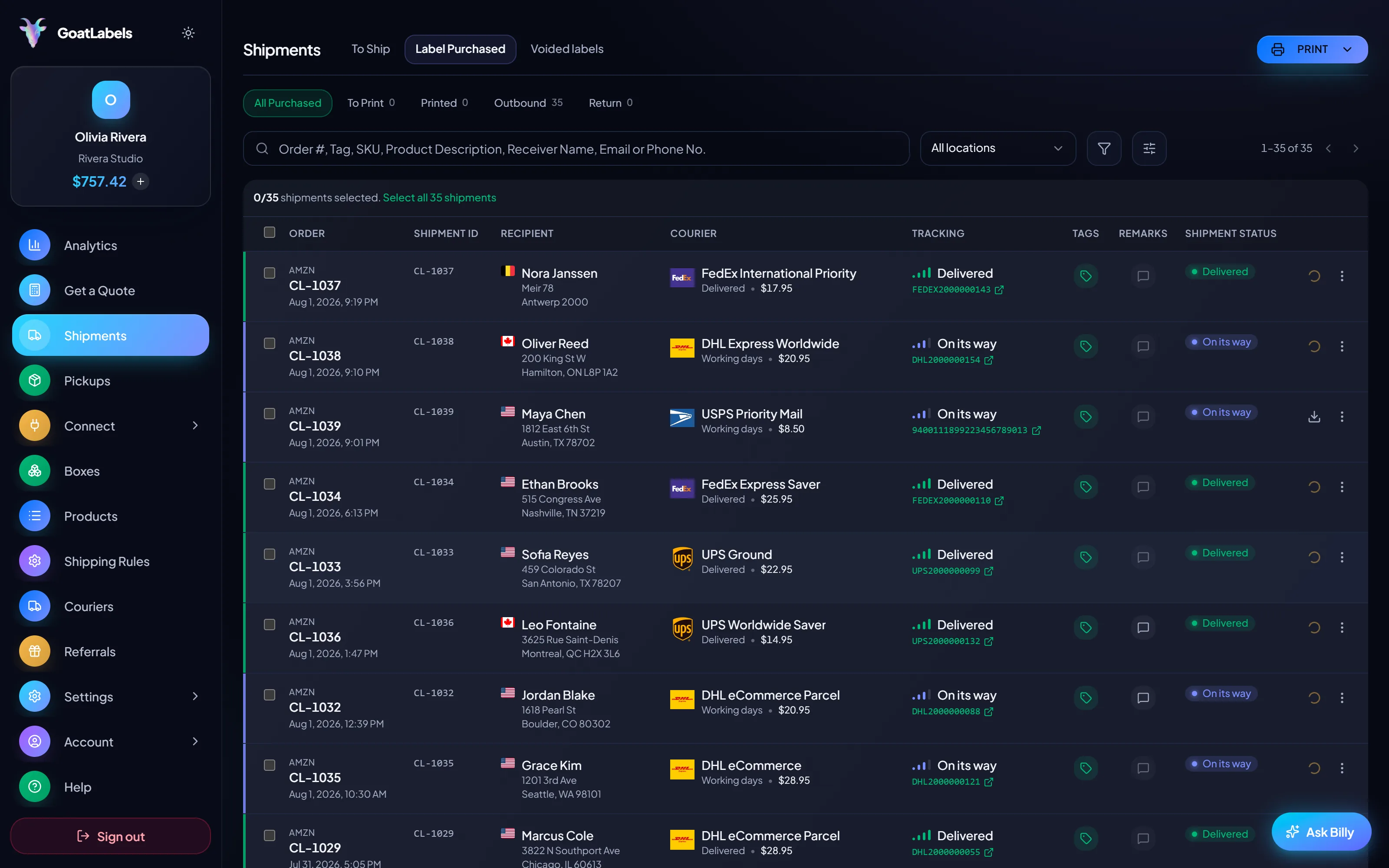
 Each adjustment posts against the shipment that caused it with the wallet delta attached, so you can see what changed and argue with the right parcel.
An adjustment is not a fee. It is a re-rate: the carrier has decided that the shipment it carried was not the shipment your label described, and it is charging the difference between the two. That framing matters, because it tells you what a dispute has to argue. You are not asking for a discount. You are asserting that the parcel the carrier measured is not the parcel you handed over — or that its measurement of it was wrong.
Four things trigger the re-rate, and all four are detected after the parcel has left you. Why a box gets measured the way it does, what a divisor is, and how to keep your own numbers honest belongs on package size and weight limits; which surcharges exist and what triggers them belongs on shipping surcharges explained. This page is about what happens after — how each of the four is caught, how it reaches your account, and what beats it.
| Trigger | What the carrier is correcting | Where it gets detected |
|---|---|---|
| Reweigh | The sorter's scale disagrees with the weight you declared, so the shipment is re-rated at the sorter's figure. | Automatically, in-line, on essentially every parcel that passes a modern sortation belt. |
| Dimensional reclassification | The parcel is remeasured and the billable weight changes because volume, not mass, sets the price for that box. | By the same in-line scanner array that weighs it, using the carrier's own divisor. |
| Service and accessorial reclassification | The carrier decides the shipment was a different thing than the label said — a delivery type or handling category applied after the fact. | At delivery or at address resolution, once the carrier's own data on the destination overrides yours. |
| Address correction | The carrier repaired an incomplete or wrong destination in order to deliver it, and bills for having done so. | In transit, by the delivering station, and usually visible in the tracking history before the charge appears. |
Detection is the part everyone gets wrong. Nobody opens your box and nobody second-guesses you personally. Parcels cross an instrumented belt that weighs and dimensions them in motion, thousands per hour, and the captured figures are compared against the declared ones automatically. If the difference exceeds that carrier's tolerance, a correction record is generated without a human ever being involved. This is why adjustments cluster: one box template that is consistently mis-declared produces one adjustment per shipment, on every parcel that used it, and they all arrive together.
Billing is where the carriers diverge. Some finalise charges on a cycle and fold corrections into the next one, so the adjustment reads as a line on an invoice you were expecting. Others post them individually against the shipment. Either way, the charge is downstream of movement, which is why a parcel your buyer received two weeks ago can still change price. The dispute route diverges too: each carrier runs its own claims-style review with its own filing window and its own idea of what evidence counts, and none of them will re-open a shipment on a general complaint about pricing.
Carrier policy reference — compiled 2026-08-04. Dispute windows, weight and dimension tolerances, and the fee names attached to each correction are deliberately not printed here. Every carrier revises them on its own schedule, usually alongside an annual rate announcement, and the third-party articles that quote them are frequently a year behind. The governing documents are the USPS Domestic Mail Manual and the current USPS Notice 123 price list; the UPS Tariff / Terms and Conditions of Service for your origin country; the FedEx Service Guide in force on your ship date; and the DHL Express Terms and Conditions of Carriage. Check the one that covers your shipment before you file. Review cadence: re-checked at each carrier's annual rate announcement by the named marketing owner recorded with this page.
A dispute is decided on one question: whose measurement of this specific parcel is more credible? The carrier's answer was produced by calibrated equipment at the moment of handling and is timestamped against the tracking number. To beat that you need something recorded at pack time — a scale reading of the packed parcel, the outside dimensions of the box you actually used, and ideally a photograph in which the label or tracking number is legible next to the scale display. Evidence assembled after the adjustment lands is the weakest category there is, because it proves what a box like that weighs rather than what that box weighed.
Three habits make that evidence cheap to have. Weigh the parcel packed and sealed, not the contents. Use a small number of box templates with saved dimensions rather than whatever carton is nearest, so the declared figures are a selection instead of a guess. And file against the tracking number while the pack-time record is still findable — a dispute is a factual argument about one parcel, and it decays fast. If the correction is large and the label has not moved at all, you are in a different situation entirely: voiding an unused label and rebuying it credits your balance rather than starting a dispute you cannot win.
The reason most sellers never dispute anything is that they cannot tell what
happened. A platform that nets corrections into a single monthly figure has
destroyed the only thing a dispute needs: the link between one charge and one
parcel. GoatLabels records each adjustment as its own object attached to the
shipment that caused it, carrying the wallet delta, so a correction is
always answerable in the form this parcel, this much, this date.
They are readable through the REST API and pushed as a
shipment.adjustment.created webhook the moment one posts, which
means the pattern shows up as data instead of as a feeling that shipping got
more expensive this quarter.
One thing to be exact about, because it is the question everyone asks second: the prepaid wallet is the first source of funds for an adjustment, not a ceiling on what a carrier can bill. If a correction exceeds the balance available, the shortfall is charged to the payment method on file. That is the honest version, and it is why the ledger matters more than the balance — the amount is going to be collected either way, so the useful thing is knowing which parcel produced it and whether the carrier's measurement can be contested. Everything else on this site is priced so that nothing else moves without you: quotes are one all-in number that leaves your balance exactly as shown, and there is no monthly minimum to print, so the adjustment ledger is the only place your costs can change after the fact.
An adjustment is not a fee somebody decided to add. It is the gap between the parcel your label described and the parcel a sorter measured, priced at the carrier's own figure. So the whole thing is decided in three places: what you declare, what the belt captures, and whether the correction reaches you attached to the shipment that produced it. Get the first one right and the third one readable, and the middle one stops being a mystery.
1 hoodie + 1 tee, 10×7×4 box, 1.4 lb on the scale taped shut — ship to Jordan L., Brooklyn NY
A saved box template is the cheapest anti-adjustment habit there is: the declared figures become a selection you made once rather than a guess you make per parcel.

If a carrier re-rates the parcel afterwards, the difference lands as its own record against this tracking number with the wallet delta attached, and fires shipment.adjustment.created on a webhook — so it arrives as data rather than as a balance you noticed was smaller.
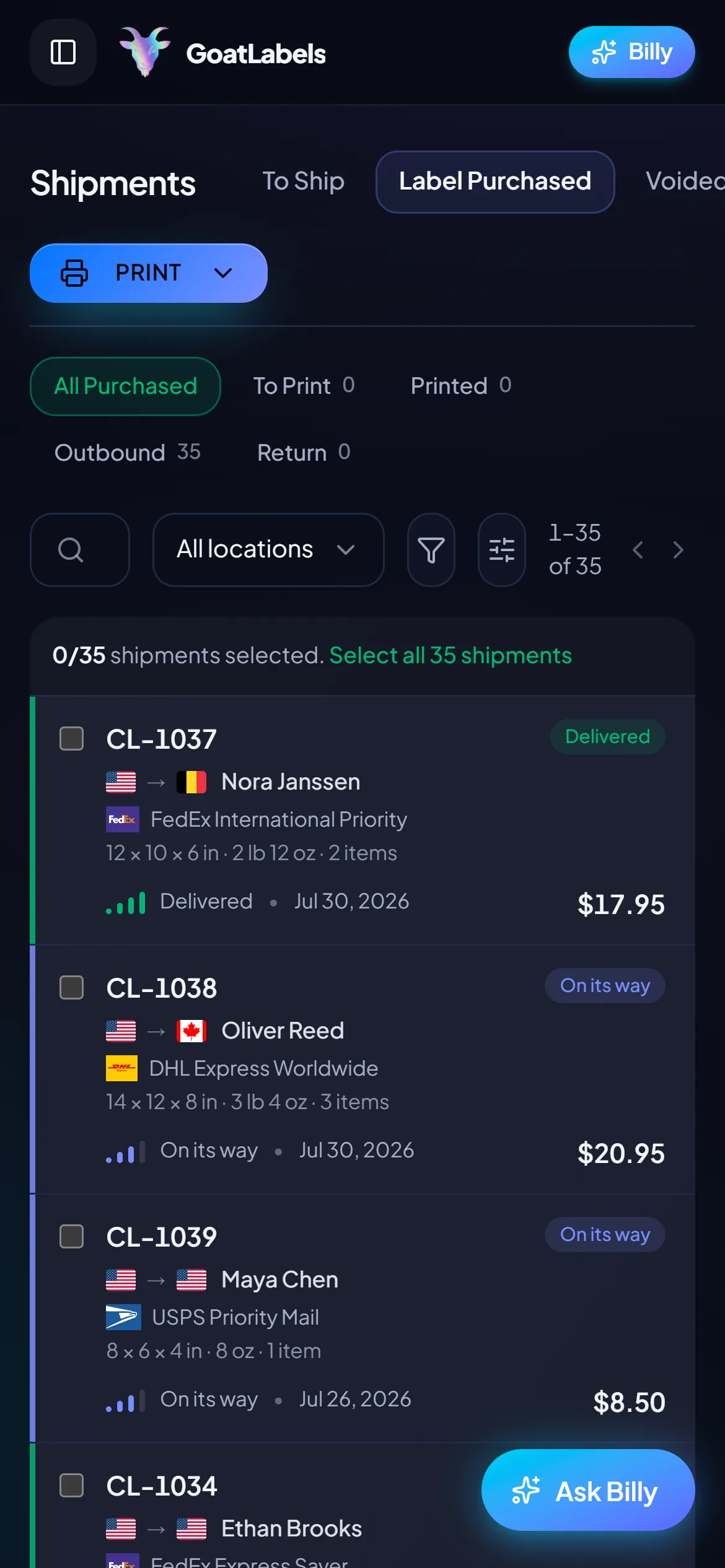
Shopify, Etsy, WooCommerce, and TikTok Shop sync into the To Ship queue, so every parcel is declared the same way and every post-shipment correction posts back against the same shipment record — instead of arriving spread across separate carrier invoices you reconcile by hand. Paste an Instagram or Facebook DM and Billy builds the label straight from the message, with the same declaration and the same ledger behind it.
 Shopify
  Etsy
Etsy  WooCommerce
  TikTok Shop
  Amazon
  eBay
eBay  Squarespace
  Wix
Wix  Walmart Shopify Plus Soon
 Square
  BigCommerce
  Magento
  Zapier Soon
 NetSuite Soon
 Ecwid Soon
 Temu
Temu  Shein Soon
 ChannelAdvisor Soon
 SkuVault Soon
 Zoho Inventory Soon
Adjustments are a carrier reality on every platform. The difference is whether they arrive attached to a parcel with a delta you can check, or as a smaller number at the end of the month.
An adjustment draws on the prepaid balance you funded with card, Apple Pay, Google Pay, ACH, or crypto. If the correction is larger than the balance available, the shortfall goes to the payment method on file — the wallet is the first source of funds, not a cap on what a carrier can bill.
Billy drafts the shipment from a pasted order, a screenshot, or a spoken description, and the address is validated with a residential or commercial classification badge before you pay. The two figures a sorter checks are the two figures worth getting right at pack time.
The number you see at quote is the number that leaves your balance. The single thing that can change it afterwards is a carrier re-rate, and that arrives as its own entry against the shipment rather than as an unexplained difference in a monthly total.
USPS, UPS, FedEx, and DHL are priced against the same parcel every time, and each one re-rates on its own tolerances and its own cycle. Seeing all four at quote time is also how you notice when one of them consistently re-rates the same box template you keep using.
UPS $12.48 FedEx $13.22 DHL $14.10 USPS $11.79 Every adjustment is a retrievable record on the shipment, and shipment.adjustment.created fires with the wallet delta attached. Signed webhooks, real idempotency keys, unlimited calls on every plan — so reconciliation is a job that runs, not a spreadsheet someone maintains.
Adjustment posted
CL-1038 · reweigh · wallet delta attached
A dispute is decided on whose measurement of one specific parcel is more credible, and the carrier's was produced by calibrated equipment at the moment of handling. The only thing that beats it is a record made at pack time, which means it has to be made on the device already in your hand, next to the tape.
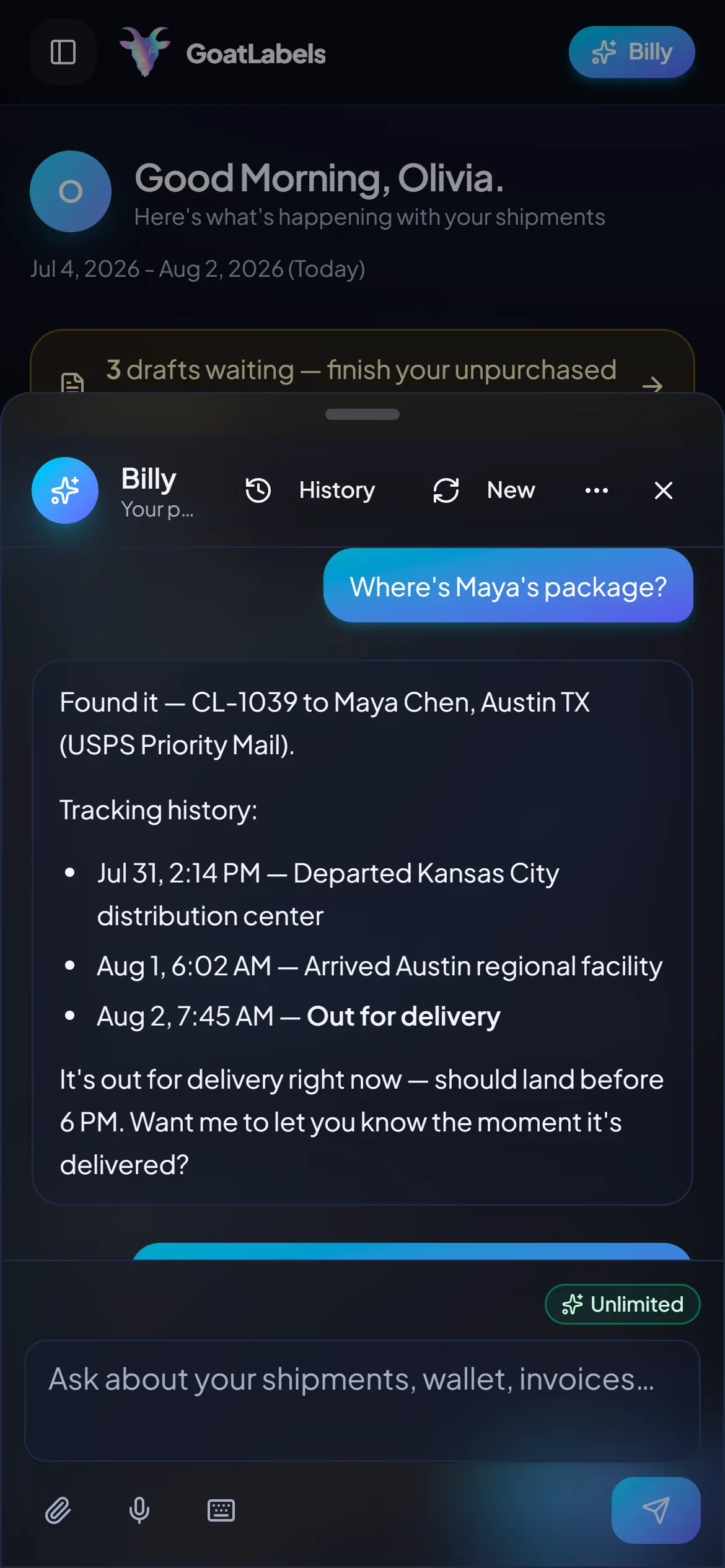
An adjustment is only arguable if you can find it. Ask Billy which shipment a correction landed on, what the carrier said it was correcting, and what it did to the balance — and it reads that shipment's history back, adjustment records included. It remembers repeat buyers and saved box sizes too, which is the other half of not getting re-rated in the first place. This is the real product, not a render.
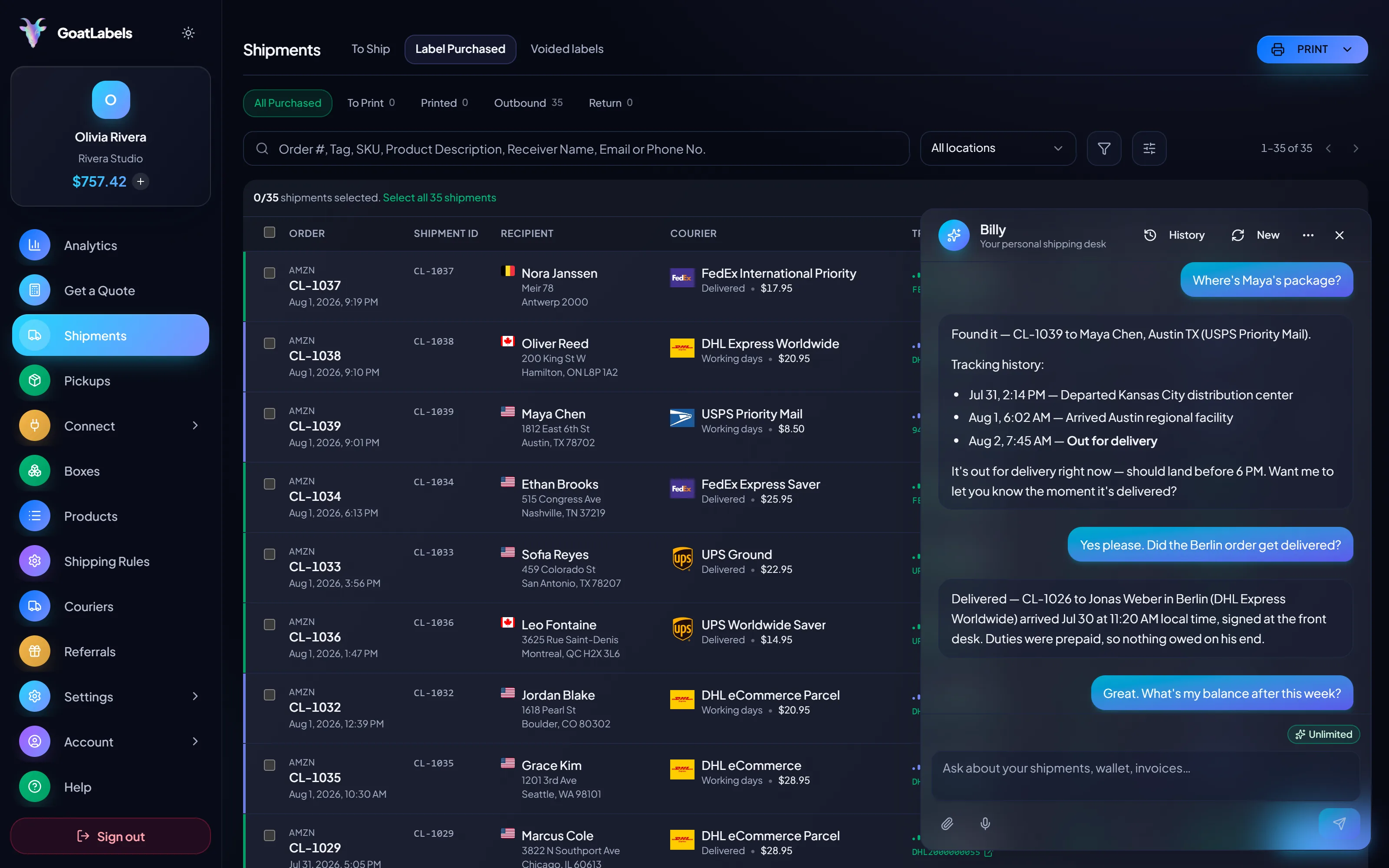
Listening
"What changed on the Brooklyn parcel?"
Reweigh adjustment
CL-1039 · posted against this shipment
Speaks plain English · finds the shipment a correction posted against · remembers customers and saved boxes · included on every plan, never a pricier tier.
Every carrier is priced against the same declared parcel, and the column you buy is the amount that leaves your balance. A carrier that later re-rates that parcel posts the difference against this tracking number as its own record, never as an unexplained figure in a monthly total. Figures are illustrative.
Ground Advantage
2–5 days$7.40
$1.20 of Premium insurance included
quoted price · wallet debit
Ground
3–4 days$10.80
$1.20 of Premium insurance included
quoted price · wallet debit
Home Delivery
2–4 days$11.40
$1.20 of Premium insurance included
quoted price · wallet debit
Adjustments are first-class records, not a line in a PDF invoice. Read them per shipment over REST, or take shipment.adjustment.created on a signed webhook the moment one posts, with the wallet delta in the payload.
GET /api/v1/shipments/shp_44819/adjustments
Authorization: Bearer sk_live_…

// every correction the carrier posted against this parcel
Free covers 50 shipments a month, and Pro is a flat monthly plan with unlimited shipments and cheaper label pricing. Neither adds anything to a quote: the number you see leaves your balance exactly as shown, and the single thing that can move it afterwards is a carrier re-rate — which arrives as its own entry against the shipment rather than as a difference in a monthly total.
Volume pricing
illustrativemore volume → lower per-label rates
$0 / forever
Fund a wallet, pay per label, and see every post-shipment correction named.
The assistant that reads a pasted order into a draft, carries the saved box dimensions through, and validates the address before you spend anything runs unlimited in the web app on Free. Pro adds Billy on Telegram.
GET /api/v1/shipments
200 OK · plan: free
Adjustment records and their webhooks are on Free too — reconciliation is not a paid tier.
On Pro we will work with you to beat the label rates you are already getting from
ShippoPirate ShipShipStation Label prices are quoted live from USPS, UPS, FedEx, and DHL as one all-in number, and that exact amount leaves your prepaid balance. A carrier re-rate afterwards posts as its own record against the shipment, with the wallet delta attached. Full pricing details
One box template that is consistently mis-declared produces one correction per shipment that used it, and they all land together. These are the four shapes of seller where that happens quietly enough to go unnoticed for a quarter.
TikTok Shop & live commerce
A hundred parcels overnight off one saved box means a single mis-declared template becomes a hundred corrections that land in the same batch. Reading them per shipment is the difference between fixing the template and absorbing the quarter.
Etsy & independent creators
Volume rather than mass sets the price on a big light box, which is exactly the parcel a sorter re-measures and re-rates. Low, uneven volume also means the correction lands long after the order was forgotten.
Same parcel, re-rated
Order #1024 · reweigh · posted to this shipment
The parcels nobody measured
Where a correction costs most
DDP
duties quoted inside the price, so a re-rate is the only variable left
A video took off and I had 80 TikTok Shop orders by morning. I printed every label from my phone on the bus to the post office.
Early customer · TikTok
TikTok Shop seller
I run my Etsy shop from the kitchen. The AI reads the order, picks the carrier, the label prints. That's the whole workflow now.
Early customer · Etsy
Etsy maker
The API is what every shipping API pretends to be. Idempotency that actually works.
Sasha R.
Staff engineer, marketplace
Quote all four carriers on the parcel in your hand, validate the address before you pay, and see every post-shipment correction as its own entry with the wallet delta attached.
Sign up in seconds. No card required. Adjustments visible per shipment and on a webhook.