

USPS
Ground Advantage
2–5 days$7.40
$1.20 of Premium insurance included
all-in · classification already applied
Address validation checks a delivery point against the carrier's database, so a failure means one of a few defects: a missing unit number, a street the database doesn't know yet, a ZIP that doesn't match the city, or a vanity city name. Each has a specific fix — applied before purchase, it costs nothing.
Every destination is validated against the carrier's delivery-point data while you are still comparing USPS, UPS and FedEx, or DHL on international lanes, so a failure costs you a question to the buyer, not a returned box.


 DHL: international
The classification that moves the price on UPS and FedEx shows on the address as a badge at quote time, so the surcharge is inside the number you compare.
Updated
Address validation is widely misunderstood as a map lookup, and the misunderstanding is why the failures feel so wrong. The validator never asks whether a building exists. It asks whether the exact string you submitted resolves to a delivery point — an entry in the carrier's database of places mail is actually delivered. A delivery point is more specific than a building: in a multi-unit property, every apartment is its own entry, which is why a tower with four hundred units and a correct street address can still fail on a missing unit line. The database is compiled from carrier operations, not from satellite imagery, so it encodes how mail is delivered rather than what is physically there.
That distinction explains every failure class on this page. A house can stand, receive packages daily, and still fail validation because the string arrived misspelled, incomplete, or in a locally popular format the database does not prefer. Equally, validation passing is not a guarantee of delivery — it is a guarantee that the address is a known deliverable point, which is the strongest pre-purchase signal available. GoatLabels runs this check at quote time, on every address, before any money leaves the wallet, because the entire value of the check is its timing: a failure caught at quote costs a message to the buyer, while the same failure caught by the carrier costs postage, weeks, and often the sale.
Almost every validation failure a small seller will ever see falls into one of five classes, and each class points at a different root cause with a different fix. The triage below is the whole discipline: read which failure you have, ask the buyer the one question that resolves it, and only override where the table says an override is defensible.
| Failure | What actually went wrong | The one question to ask the buyer | Override safe? |
|---|---|---|---|
| Missing secondary (unit, apt, suite) | Multi-unit building — the street address alone is not a delivery point; every unit is its own database entry. | Which apartment or unit number should be on the label? | No. The parcel may reach the lobby and stop there, or come straight back. |
| Unknown street or number | Typo, transposed digits, or a street the database has not learned yet (new construction). | Can you copy the address exactly as your other deliveries print it? | Only for confirmed new construction — never for an unconfirmed typo. |
| ZIP does not match the city or street | Buyer typed the town they say they live in, not the town the ZIP belongs to — or one digit is wrong. | Is the ZIP code exactly right? Which does your mail actually use? | No. A wrong ZIP routes the parcel to the wrong sort facility first. |
| Vanity or preferred city name | Many places accept several city names for one ZIP; the database prefers one. The address is fine, the label wording differs. | Nothing — accept the validator's suggested standard form. | Take the suggestion instead. The corrected form is the same place. |
| Destination is a PO Box or military address | Not a defect at all — an eligibility rule. Some carriers cannot deliver there, so the quote list shrinks. | Nothing — pick a service that can actually deliver to it. | Not applicable — this is carrier selection, not address correction. |
Two rows deserve a second look. The vanity-name row is the one failure where nobody is wrong: many ZIP codes accept several city names, and the validator is simply nudging you toward the standard form — take the suggestion and move on. The last row is not a defect at all but an eligibility rule: some destinations decide the carrier before price does, and which carriers can reach a PO Box or an APO address is its own subject. Everything else in the table is a genuine defect in the string, and the fix is a question, not a workaround.
The database lags reality in a few well-known places. A new subdivision exists as concrete and mailboxes before it exists as delivery points; the carriers add streets on their own operational schedule, and until they do, a perfectly real address fails as unknown. Rural addresses carry a different version of the problem: many were renumbered when counties adopted emergency-services addressing, so the address a long-time resident recites from memory and the address the database holds can be two different strings for one farmhouse. In both cases the buyer is the authority the database lacks. Ask how their mail and parcels actually arrive — the format printed on something recently delivered — and use that string.
This is also the honest boundary of validation as a tool. It is a database check, and a database can be behind. The discipline is to treat a failure as a prompt for evidence rather than as either an immovable wall or an ignorable nag: when the buyer supplies evidence the database lacks, override with confidence; when they cannot, the validator was probably right. Sellers importing a spreadsheet of addresses get the same check applied to every row of a CSV before any label in the file is bought, which turns this triage from a per-order chore into a batch report.
Validation returns one more fact that has nothing to do with deliverability: whether the delivery point is residential or commercial. On UPS and FedEx that classification moves the price, and the destination-fee mechanics behind it are covered in our guide to shipping surcharges. What matters on this page is where the fact surfaces. A seller who quotes against a rate card discovers the classification when the bill does; GoatLabels resolves it during validation and shows a residential or commercial badge on the address before payment, so the carrier comparison is between all-in numbers that already know what kind of door they are pricing. A home that looks commercial because a business is registered there, or a storefront the database still lists as residential, is visible as a badge you can question — before it is a line item you cannot.
The override exists because the database is not perfect, and it is dangerous because the database is mostly right. The safe overrides share one property: independent evidence. A buyer confirming a new-construction address against mail they already receive, a rural recipient dictating the exact renumbered format — in those cases you know something the database does not, and shipping on the buyer's string is the correct call. The unsafe overrides share the opposite property: impatience. Overriding a missing unit number because the buyer is slow to reply, or a ZIP mismatch because the label needs to go out tonight, converts a free question into a gamble with postage on the table.
The stakes of that gamble are not abstract. An undeliverable parcel is refused or returned on the carrier's terms, and what happens to a returned parcel — including who pays for the journey home — is a separate process with its own bill. Validation at quote time exists precisely so that page stays theoretical: the defect classes above are all visible before purchase, every one of them is fixable for free while the label is still a draft, and the only failures worth carrying past the check are the ones where you hold better evidence than the database.
The triage above is built into the flow. An address arrives however the order arrived (synced store, pasted DM, CSV row) and is checked against delivery-point data while the carrier quotes are being built. A failure names its defect class, you resolve it with the buyer while the label is still a draft, and money only moves once the destination is a known delivery point with its classification badge attached.
Buyer pasted their address from a saved note — building number present, apartment line missing.
A failed check stops nothing except payment. The draft label waits while you confirm the fix, and nothing is charged until the address resolves.
 Draft, checked
The corrected address costs nothing. The uncorrected one costs return postage, weeks of transit, and often the sale — which is the entire argument for checking before money moves.
Thirteen store connectors, Shopify, Amazon, eBay, Etsy, TikTok Shop and more, sync into the To Ship queue, and every synced destination goes through the same delivery-point check as one you typed yourself. A checkout form that accepted a missing apartment line has not validated anything, it has handed you an unvalidated address, tidily formatted.
 Shopify
 Etsy
Etsy WooCommerce
 TikTok Shop
 Amazon
 eBay
eBay Squarespace
 Wix
Wix WalmartShopify PlusSoon
 Square
 BigCommerce
 Magento
 ZapierSoon
 NetSuiteSoon
 EcwidSoon
 Temu
Temu SheinSoon
 ChannelAdvisorSoon
 SkuVaultSoon
 Zoho InventorySoon
 Patreon
Validation earns its place because of what happens next: four honest quotes on a destination the carrier recognises, paid from a balance that only moves when you buy.
Card, Apple Pay, Google Pay, ACH, and crypto top up one balance. A failed validation charges nothing — the draft waits while you confirm the fix with the buyer, and the wallet moves only when a validated label is actually bought.
Paste the DM, drop the screenshot, or speak the address — Billy drafts the label and the destination goes through the same delivery-point check as a typed one. The apartment line a buyer buried in a follow-up message is exactly the defect the validator is there to catch.
BillyLIVEThe residential or commercial badge resolved at validation feeds the quote, so the number you compare across carriers already includes the destination fees that classification triggers. What you see at quote is what leaves the wallet.
USPS, UPS and FedEx are priced against the identical validated domestic destination, DHL joins on international lanes, and eligibility rules are applied first: a destination only one carrier can reach shows you that carrier, not a quote that will bounce.
UPS$12.48FedEx$13.22DHL$14.10USPS$11.79Address validation runs on API-created shipments exactly as in the dashboard, with unlimited calls on every plan and signed webhooks for the lifecycle — so a checkout integration can catch the missing unit while the buyer is still on the page.
Address validated
CL-1044 · unit line added
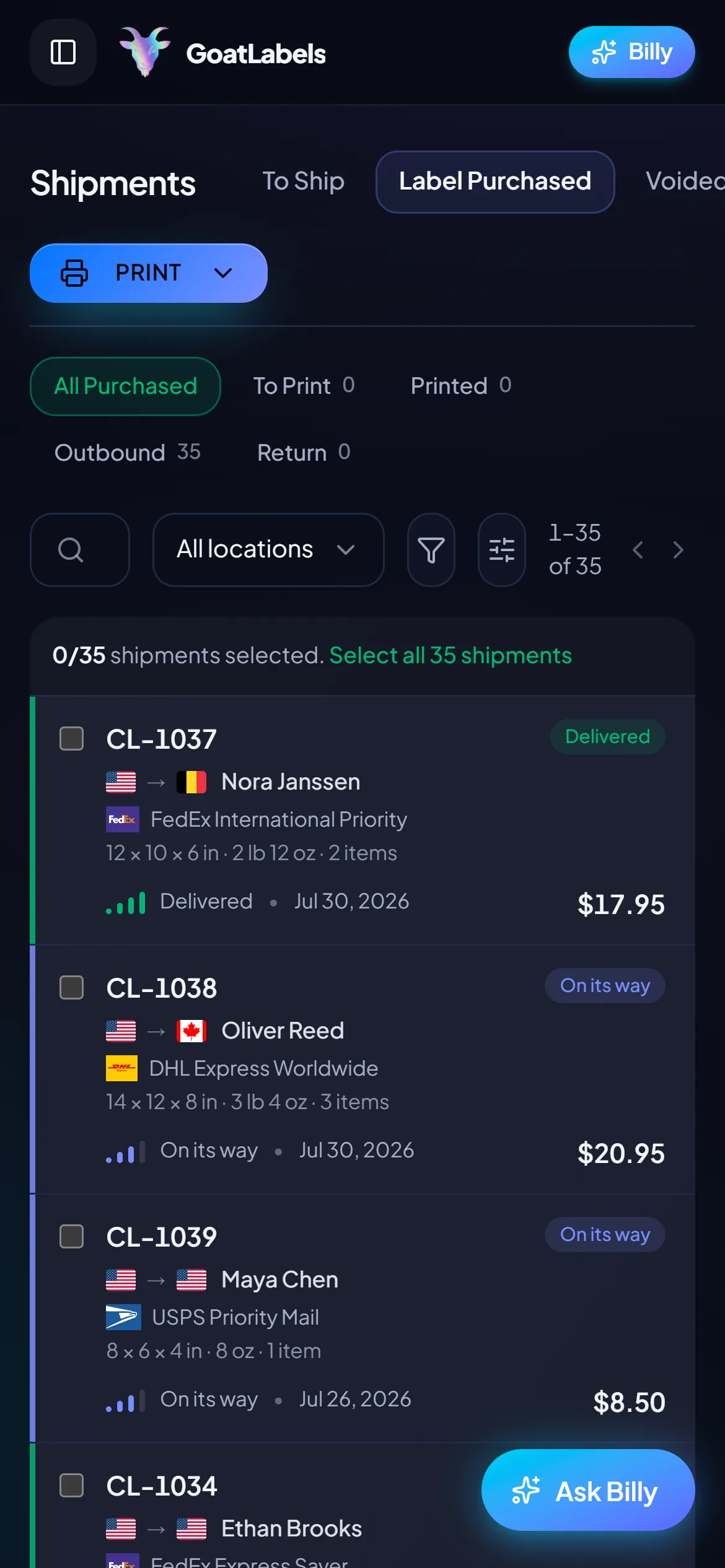
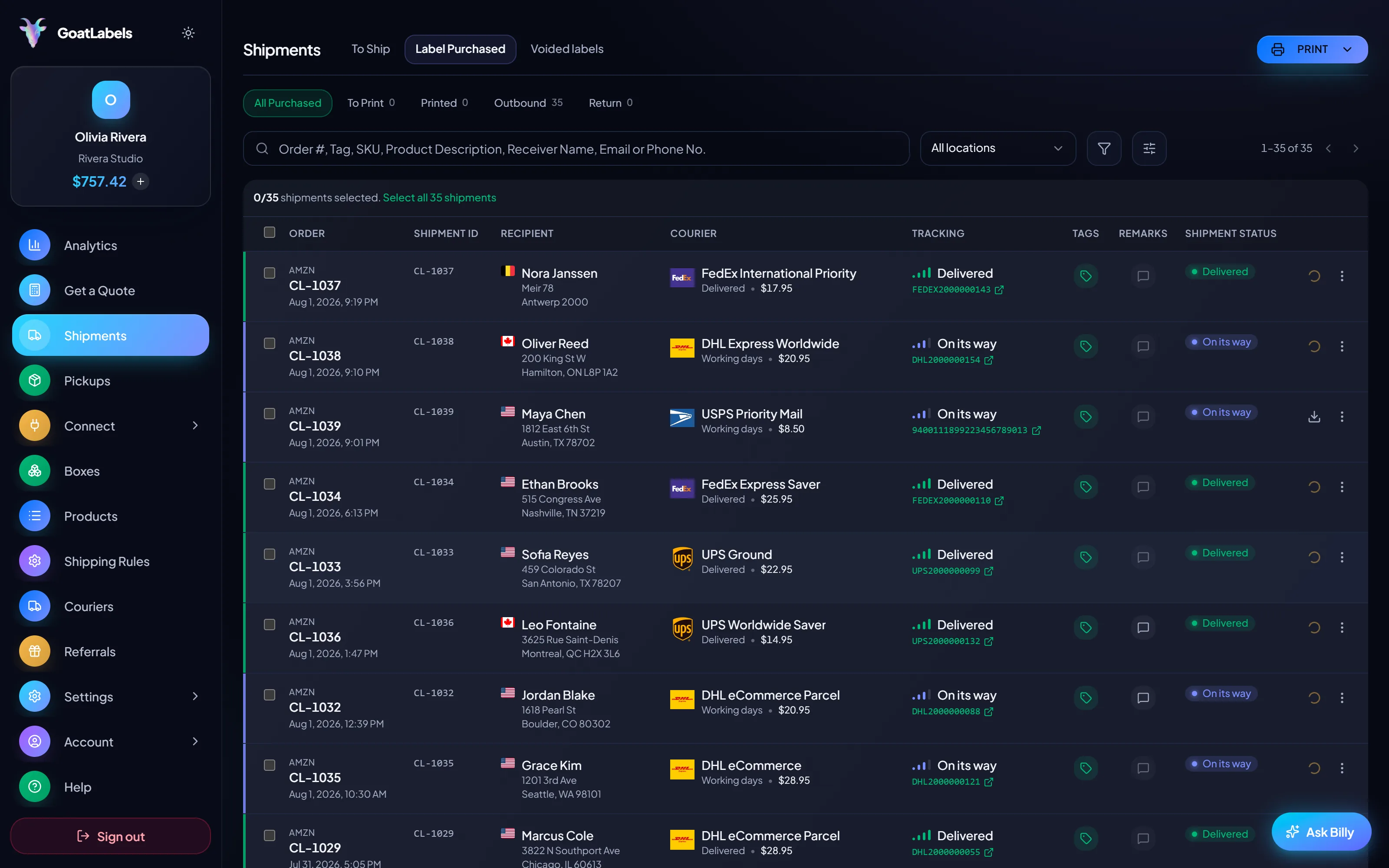
A validation failure is only cheap if you can act on it in the minute it appears. The queue, the defect class, the one question worth sending the buyer, and the re-checked address all fit on a phone — no laptop leg, no waiting until you are back at a desk.
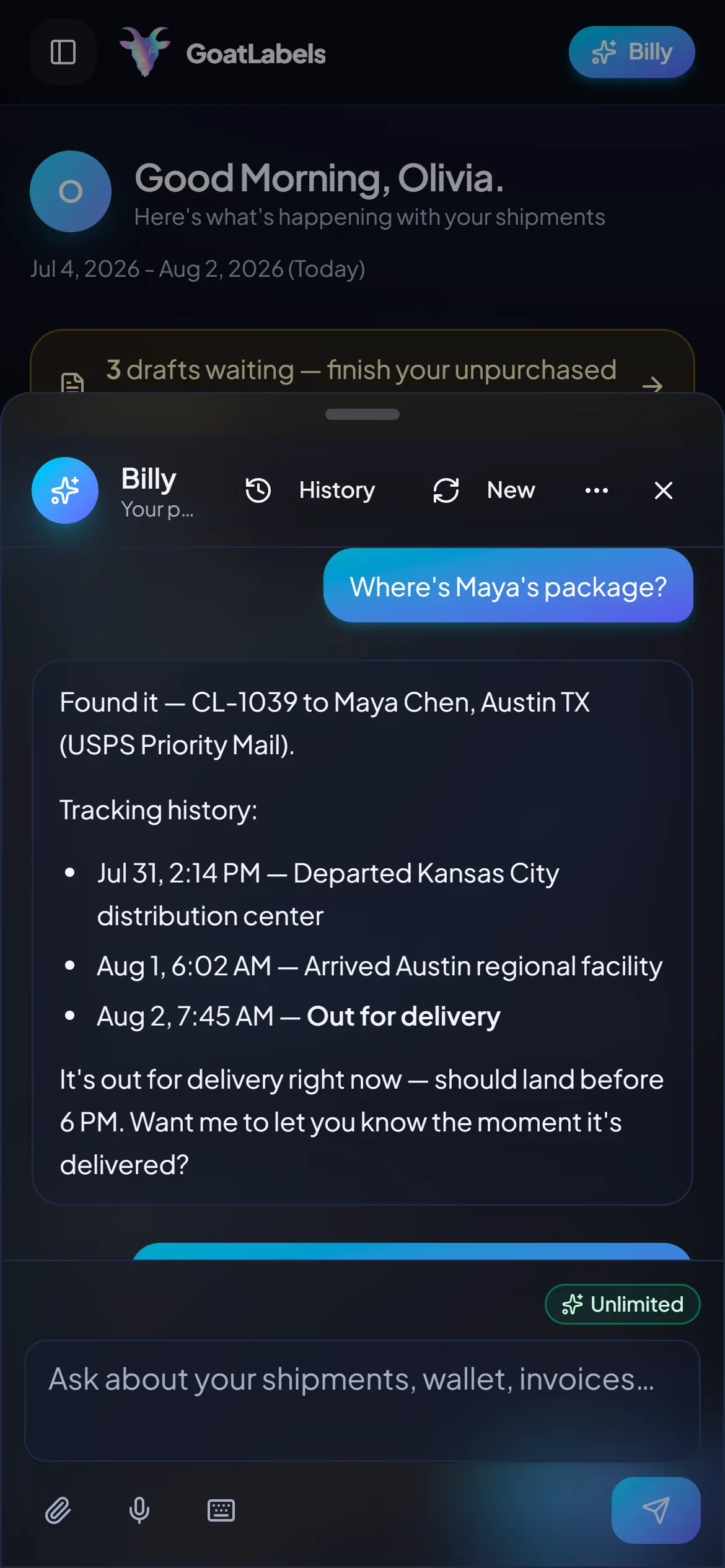
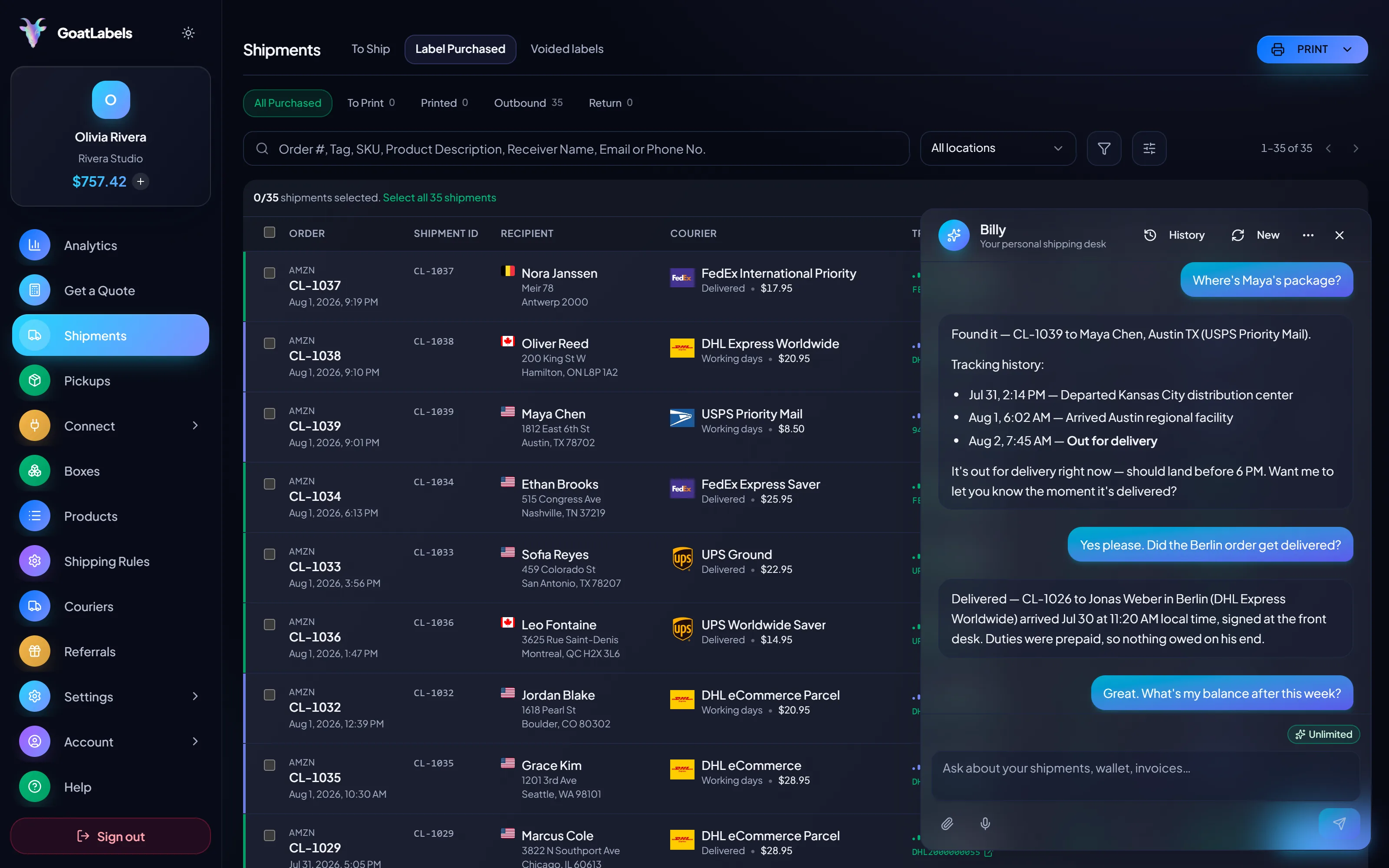
Speaking an address is how a lot of them arrive anyway — off a phone call, off a note, off a buyer standing in front of you. Hold the mic, say it, and Billy writes it into the shipment, resolves it against delivery-point data, and tells you which part failed before anything is bought. It remembers repeat buyers, so an address you corrected once stays corrected. Included on every plan. This is the real product, not a render.
Listening
"Did the Brooklyn address ever get its unit number?"
Validated, out for delivery
CL-1044 · Brooklyn, NY · residential
Speaks plain English · names the defect class out loud · says the residential or commercial classification · included on every plan, never a pricier tier.
A carrier comparison only means something once every column is pricing the same known delivery point with the same classification attached. These three quote a residential address that passed the check, each as one all-in number, and the column you pick is exactly what leaves your prepaid balance. Figures are illustrative.
Ground Advantage
2–5 days$7.40
$1.20 of Premium insurance included
all-in · classification already applied
Ground
3–4 days$10.80
$1.20 of Premium insurance included
all-in · classification already applied
Home Delivery
2–4 days$11.40
$1.20 of Premium insurance included
all-in · classification already applied
The same delivery-point check runs on API-created shipments, so a checkout integration can surface a defect class at the one moment the buyer can still fix it themselves. REST, JSON, one Bearer header, signed webhooks instead of polling, real idempotency keys, and unlimited calls on every plan.
POST /api/v1/shipments
Authorization: Bearer sk_live_…
Idempotency-Key: ord_8421

{
  "to": { "name": "Joyce", "city": "Berlin", "country": "DE" },
  "parcel": { "weight": 2.6, "weight_unit": "lb" },
  "service": "fedex_intl_priority"
}
A check billed per lookup is a check you start skipping on the cheap orders — which are exactly the orders one returned parcel wipes out. Address validation runs on both plans: Free includes 100 validations a month (repeat lookups served from cache do not count), and Pro makes validation unlimited. Free covers 50 shipments a month; Pro is a flat monthly plan with unlimited shipments.
 — fix an address without opening the dashboard
Rate by plan
illustrativepay for labels, not for seats
$0 / forever
Fund a wallet, check every address, and pay only for the labels you actually buy.
The assistant that lifts an address out of a DM, a screenshot, or a spoken sentence and puts it through the same delivery-point check runs unlimited in the web app on Free. Pro adds Billy on Telegram.
Telegram, ProGET /api/v1/shipments
200 OK · plan: free
Unlimited calls on Free — still unlimited on Pro.
Put a real parcel through and compare the side-by-side rate against what that label costs you on
ShippoPirate ShipShipStationA failed check charges nothing at all — the draft simply waits while you ask the buyer. An undeliverable parcel charges the outbound label first and the journey home afterwards, which is why the free check is the one that pays for itself. Full pricing details
Same check, same wallet, same one-tap fix, whether that is four parcels a week or four hundred. These are the four shapes of seller whose order book produces the most failed validations — and the most returned boxes when the check gets skipped.
 Cities, towers, missing unit lines
Buyers type their building and forget their apartment, and a street address alone is not a delivery point. It is a very common failure an ecommerce seller sees, and one message fixes it — as long as the check ran before the label was bought.
 Where the database is the thing that is wrong
Emergency-services renumbering left plenty of homes with two truthful addresses: the one the resident recites and the one the carrier holds. Ask how their parcels actually arrive, use that string, and override only on the evidence they hand you.
Override on evidence, never on impatience
A buyer-confirmed new build is a reason; a slow reply is not

 Typed by a buyer, in a hurry, on a phone

 Every row checked before any label is bought
CSV
validated row by row, so the triage is a batch report instead of a per-order chore
A video took off and I had 80 TikTok Shop orders by morning. I printed every label from my phone on the bus to the post office.
Early customer · TikTok
TikTok Shop seller
TikTok ShopI run my Etsy shop from the kitchen. The AI reads the order, picks the carrier, the label prints. That's the whole workflow now.
Early customer · Etsy
Etsy maker
EtsyThe API is what every shipping API pretends to be. Idempotency that actually works.
Sasha R.
Staff engineer, marketplace
Every destination validated and classified at quote time, every carrier on the lane priced on the checked address, and nothing charged until you buy the label.
Sign up in seconds. No card required. Validation runs on every plan.
Updated