

USPS
Ground Advantage
2 to 5 days$11.40
all-in · quoted on the carton you actually packed
Carriers give away branded boxes free, but each is tied to the service printed on it — ship a branded box on the wrong service and it gets rerated. Reused boxes are fine when old barcodes are covered and the walls are sound. Spend on cushioning; save on nearly everything else.
Free branded box, bulk plain carton, or a reused Amazon box: whatever you pack in, USPS, UPS and FedEx quote the same domestic parcel side by side, and DHL joins on international lanes.


 any box
No monthly fee to print labels on Free: fund a prepaid wallet by card, Apple Pay, Google Pay, ACH, or crypto and put the savings into better packaging.
Updated 2026-08-15
The best-kept non-secret in parcel shipping is that carriers give packaging away. Boxes, rigid envelopes, tubes — ordered online in quantity or picked up at a counter, at no charge. Carriers do this for a reason, and the reason is the rule: branded packaging exists to feed parcels into a specific service, and the branding printed on the box is read by the network as a declaration of which service the parcel is travelling on. A branded box is not a free box in general. It is a free box for that service.
Use it correctly and the deal is genuinely excellent — sturdy, standardised packaging at zero unit cost, forever. Use it on a cheaper service than the one printed on the cardboard and you have created the exact mismatch carriers scan for: the parcel gets rerated to the branded service after the fact, and the difference is billed to whoever bought the label — how that bill arrives and what a dispute takes isthe carrier billing adjustments page'ssubject. The rulebook, in the dated table below, is short: match the box to the service, or use plain cardboard, which belongs to every service equally. If you mostly ship the postal network, the wider mechanics of buying that service well live on the USPS shipping labels page.
The recycling pile is a legitimate supply chain. Carriers do not require new packaging, and a reused carton that protects its contents is exactly as shippable as one that arrived flat-packed yesterday. The conditions are mechanical, not bureaucratic. First, dead data: every old barcode, tracking label, and address block must be covered or blacked out, because sortation machines read whatever scans first, and a stale barcode can route your parcel to its previous life. Second, structure: a box survives on the rigidity of its walls, so crushed corners, soft creases, and torn flaps disqualify a carton no matter how good the tape job. Third, history: old hazmat diamonds and lithium-battery markings trigger handling rules whether or not the contents still justify them, so they must be fully obscured, not half-covered by the new label.
One more reuse trap is dimensional, not cosmetic: a scavenged box that is much bigger than the item costs real money, because carriers bill on the greater of actual and dimensional weight, and oversized air is billable — the divisors and thresholds live onthe package size and weight limits page. The right reused box is the smallest sound one, not the nearest one.
Budget packaging is not about buying cheap things; it is about knowing your cost per parcel shipped and lowering it deliberately. The method takes five minutes. Divide everything you spend on supplies by the number of parcels that spend covers, and you get a unit cost — usually a surprisingly small number, which is exactly why it gets ignored while pennies leak on every box. Then attack the components in order of consumption. Tape is used on every parcel, so case-quantity tape is the first bulk buy with no downside. Your single most-shipped box size is second, but only after your order history has proven which size that is — bulk-buying variety is how sellers end up with a shelf of guesses. Cushioning is third. Everything else stays bought-as-needed until volume argues otherwise.
The buy-versus-free decision then becomes arithmetic instead of vibes: a free branded box at zero unit cost wins whenever its bound service also wins the postage comparison, and loses whenever a cheaper service plus a bulk plain carton beats it on the combined number. That is a per-parcel decision, which is why quoting each parcel across carriers — with the box's real dimensions — is part of the supplies budget, not separate from it. The broader postage side of that arithmetic lives onthe cheap shipping labels page.
| Supply | How you get it | The service rule | Typical unit cost |
|---|---|---|---|
| USPS Priority Mail boxes and envelopes | Free — Postal Store or counter | Priority Mail (or Priority Express, for its own branded range) only | $0.00, in any quantity |
| UPS Express branded packaging | Free — for account holders and at stores | UPS air and express services only, never ground | $0.00 |
| FedEx Express branded packaging | Free — ordered or in-store | FedEx Express services only, never ground or economy | $0.00 |
| Plain corrugated boxes, common small sizes | Bought in packs of 25–100 | Any carrier, any service — plain is universal | ≈ $0.40–$1.20 each in bulk |
| Poly mailers, mid size | Bought in packs of 100+ | Any service that accepts soft-sided parcels | ≈ $0.06–$0.15 each in bulk |
| Packing tape, 2-inch | Bought by the 6–36 roll case | Consumed on every parcel — the truest bulk buy | ≈ $1–$2.50 per roll in case quantities |
| Reused cartons (Amazon and retail boxes) | Free — the recycling pile | Any service, if barcodes are covered and walls are sound | $0.00 |
Supplies reference — verified 2026-08-15.Free-packaging availability and service bindings checked against the USPS Postal Store and the UPS and FedEx packaging-supplies pages; per-unit price ranges reflect mid-2026 bulk pricing from mainstream packaging suppliers and move with paper and resin markets. Service names and box line-ups change — confirm the binding on the carrier's own supplies page before ordering a season's worth. Next review: 2027-02.
Every line above is about spending less. This one is about the two places where spending less is a false economy, because the downside is priced in order value rather than in cents. The first is cushioning. A box's job is to keep the item away from the walls, and filler is what does that job; skipping it converts a few saved cents into a damage rate, and a single damaged order can erase months of filler savings once you count the refund, the reshipment, and the review. For anything genuinely breakable, pack to the standard a claim would be judged against — that standard isthe how to ship fragile items page'sterritory. The second is the box itself, whenever weight or value is involved: wall strength is the one spec on the supplies list that is load-bearing in the literal sense.
Everything else on the bench is negotiable. Branded tissue, printed mailers, stickers, and handwritten notes are marketing spend, not shipping spend — worth doing when margins support them, never a reason a parcel arrives safely or does not. A budget supplies operation done right looks boring: free or bulk boxes matched to their services, tape by the case, honest cushioning, and every saved dollar visible in the unit-cost number instead of vanishing into a drawer of impulse-bought packaging.
A supplies budget and a postage budget are the same budget, and the packing bench is where they meet. The parcel goes into whatever the rulebook allows (a free branded carton travelling its own service, a bulk plain box, or a sound reused one with the old barcodes blacked out), and then the real dimensions and weight of that carton get quoted against every carrier on the lane. Repack into something smaller and the number moves while you are still standing there, which is the entire reason to run the two decisions in one place instead of two.
just sold the vase!! what box do I even use for this
Measure the carton you actually used, not the one you meant to use. A free branded box travels its own service and nothing else; plain and reused cardboard belongs to every service equally.
 Billy AI
Because Free has no monthly fee to print, the cost per parcel really is postage plus packaging and nothing else — which is the only condition under which the unit-cost method above stays auditable.
Thirteen store connectors, Shopify, Amazon, eBay, Etsy, TikTok Shop and more, sync their orders into one To Ship queue, so the same three box sizes and the same case of tape serve every channel instead of each platform pulling you into its own tool with its own habits. Paste an Instagram or Facebook DM and Billy builds the label straight from the message, the carton on the bench does not care which app the sale came from.
 Shopify
 Etsy
Etsy WooCommerce
 TikTok Shop
 Amazon
 eBay
eBay Squarespace
 Wix
Wix WalmartShopify PlusSoon
 Square
 BigCommerce
 Magento
 ZapierSoon
 NetSuiteSoon
 EcwidSoon
 Temu
Temu SheinSoon
 ChannelAdvisorSoon
 SkuVaultSoon
 Zoho InventorySoon
 Patreon
A supplies budget only works when the postage next to it is honest — quoted all-in, compared across carriers, and free of monthly overhead.
There is no monthly fee to print labels on Free, so your cost per parcel is postage plus packaging and nothing else. The prepaid wallet — funded by card, Apple Pay, Google Pay, ACH, or crypto — keeps postage its own clean ledger line, which is what makes the unit-cost method auditable.
Billy drafts a label from a pasted order, a screenshot, or your voice — box dimensions included — and validates the destination with a residential or commercial badge before payment. The parcel gets priced on the box you actually chose, not the one you remembered.
BillyLIVEBecause every quote is one final number, repacking the same order into a smaller carton shows its saving immediately — quote, repack, requote. The free-box-versus-bulk-box decision becomes a comparison you can run at the bench in seconds.
USPS, UPS and FedEx are quoted on the same domestic dimensions and weight, side by side, with DHL on international lanes. That is what settles the branded-box question per parcel: if the bound service wins anyway, the free box is pure profit; if it loses, plain cardboard and the cheaper service win on the combined number.
UPS$12.48FedEx$13.22DHL$14.10USPS$11.79Ship the same three box sizes all day? The REST API quotes and buys against stored parcel profiles with unlimited calls on every plan — the supplies discipline and the postage discipline end up in the same script.
Requote ready
Smaller carton · new all-in price
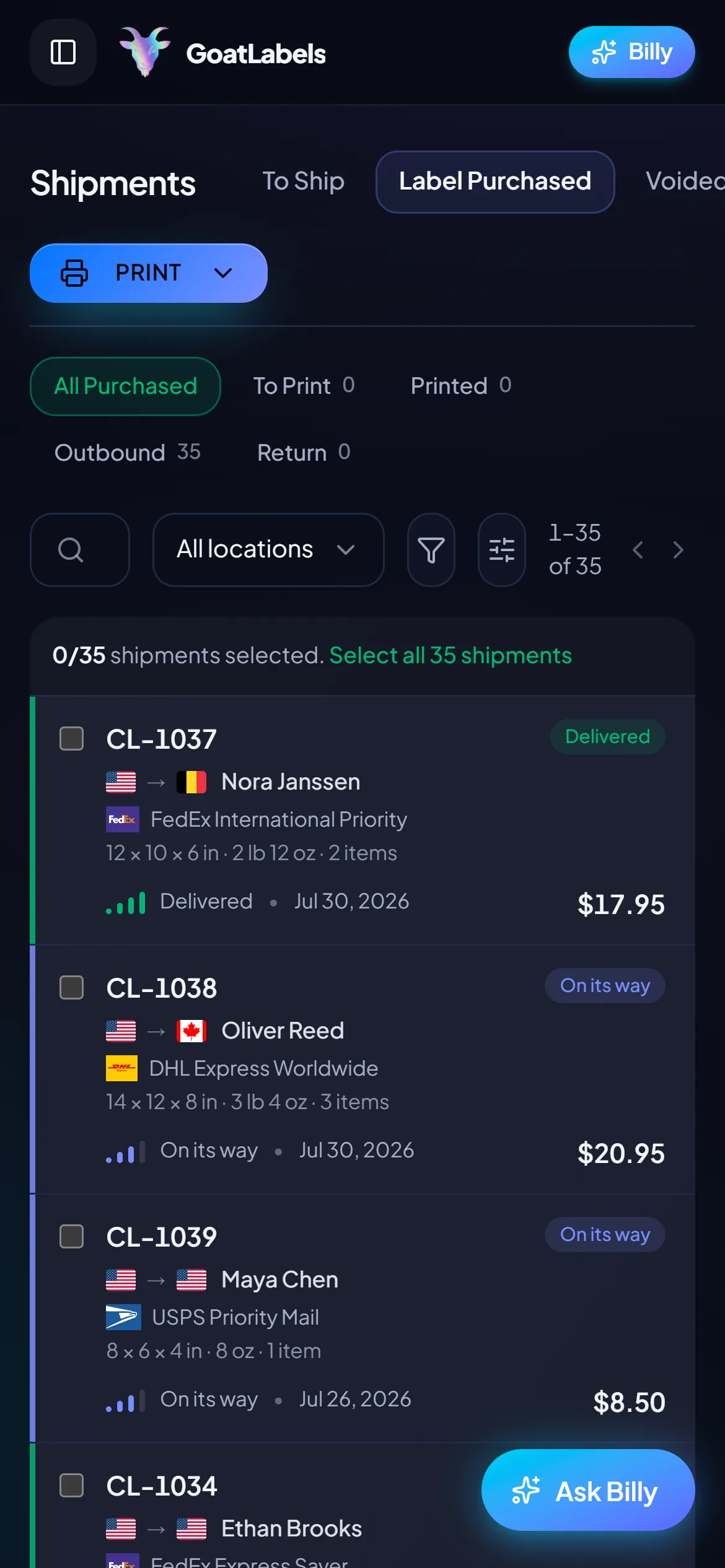
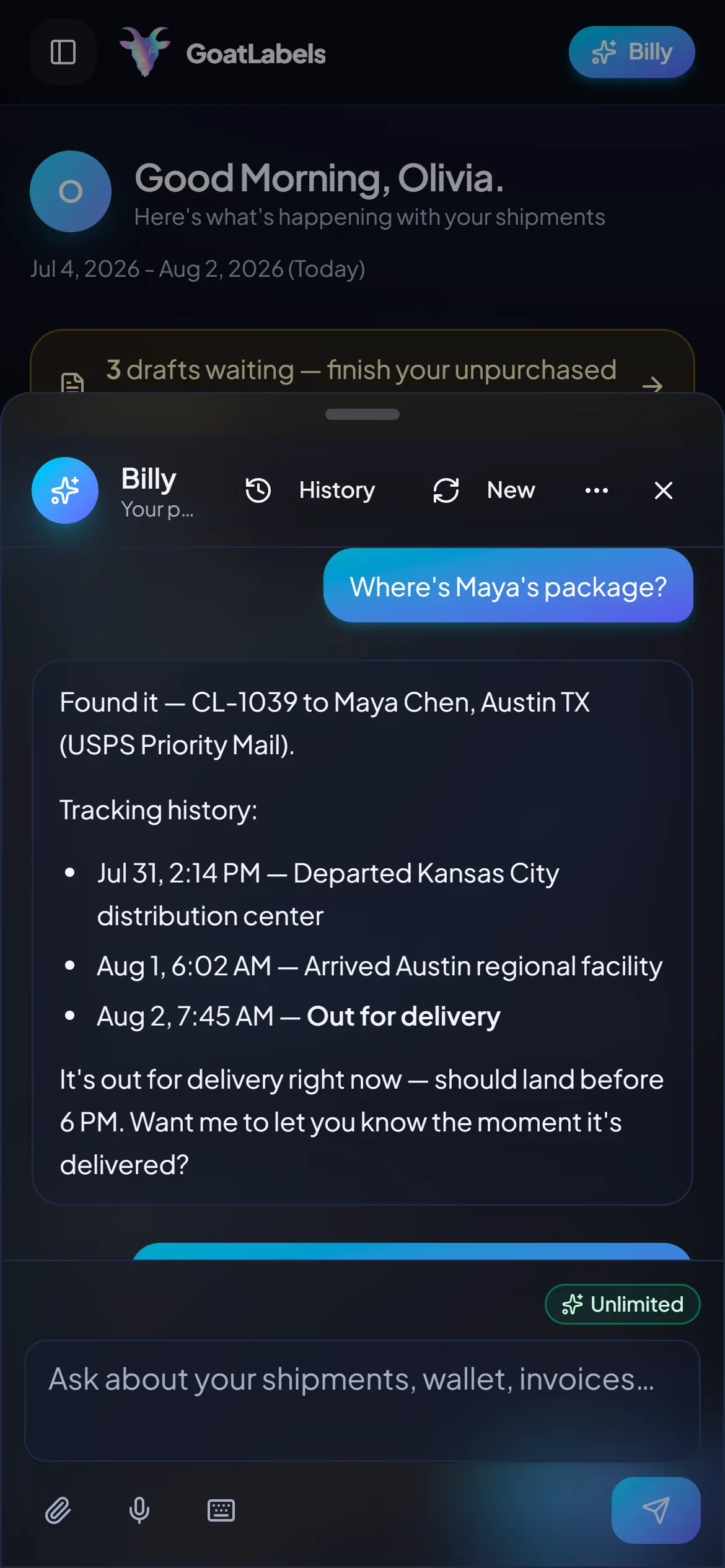
The box decision is only cheap if you can test it where you are standing. Enter the smaller carton's dimensions on the phone beside the tape gun, watch the all-in numbers move, and keep whichever packing choice won: no laptop, no second trip across the room to find out whether the repack was worth it.
Packing is a two-handed job, and a phone screen is the worst thing to touch mid-roll. Hold the mic, say the carton and where it is going, and Billy drafts the shipment, validates the address, and reads the all-in prices back, so trying the smaller box costs you one sentence instead of a trip to the desk. Included on every plan. This is the real product, not a render.
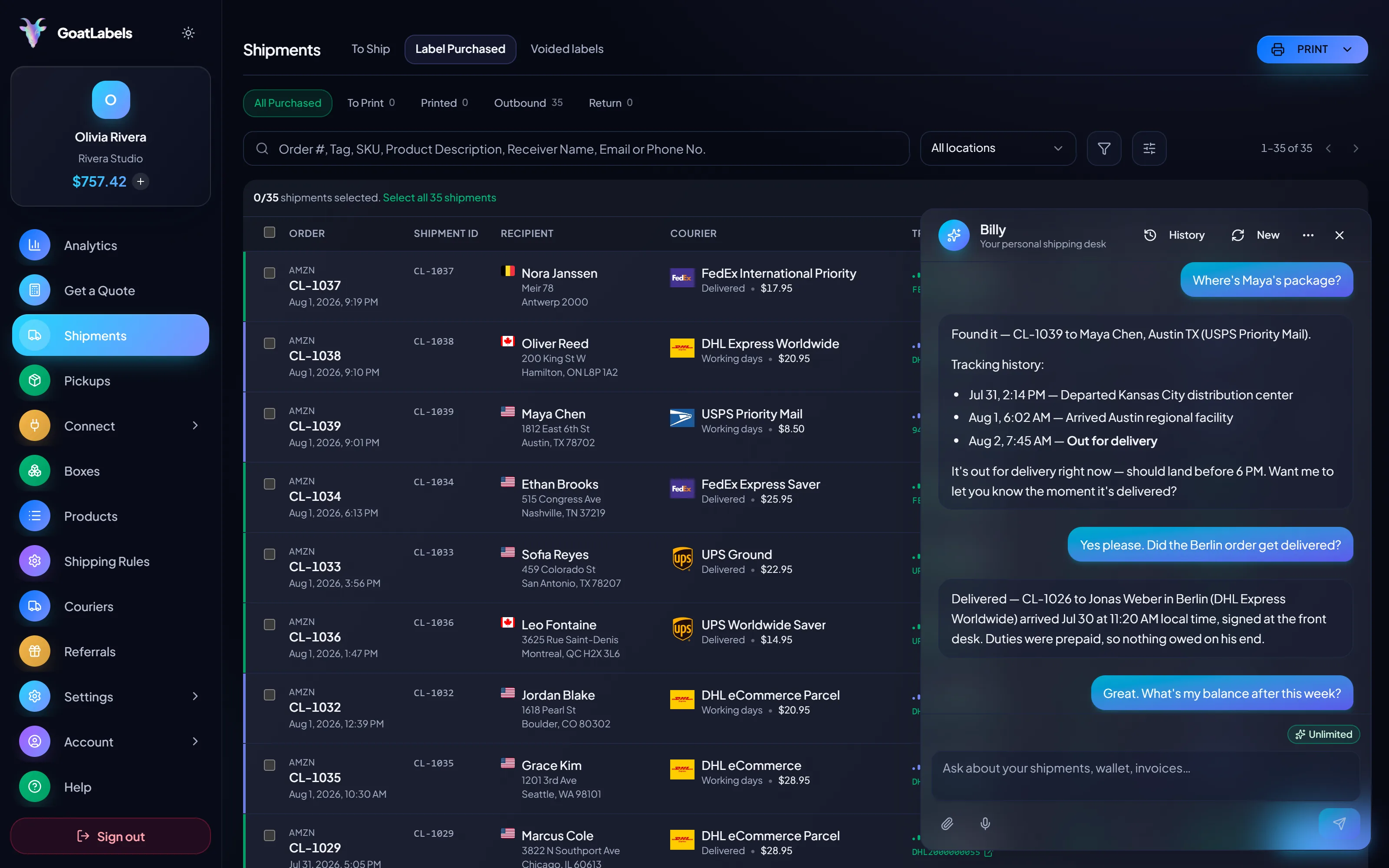
Listening
"Ten by seven by four, going to Austin"
Quoted
Quoted on the carton you just packed
Speaks plain English · takes box dimensions by voice · remembers your saved box sizes · included on every plan, never a pricier tier.
A supplies decision is never finished until the postage beside it is known. A free branded carton only wins when its bound service also wins the comparison, and the smallest sound reused box only wins if the dimensional saving actually shows up in a quote. Each carrier on the lane priced against the same packed carton is what turns that from a habit into arithmetic.
Ground Advantage
2 to 5 days$11.40
all-in · quoted on the carton you actually packed
Ground
1 to 5 days$9.85
all-in · quoted on the carton you actually packed
Ground
1 to 5 days$11.20
all-in · quoted on the carton you actually packed
Once your order history has proven which cartons are worth buying by the case, those dimensions stop being something anyone should retype. Quote and buy against stored parcel profiles over REST and JSON, and the supplies discipline and the postage discipline end up living in the same script.
POST /api/v1/shipments
Authorization: Bearer sk_live_…
Idempotency-Key: ord_8421

{
  "to": { "name": "Joyce", "city": "Berlin", "country": "DE" },
  "parcel": { "weight": 2.6, "weight_unit": "lb" },
  "service": "fedex_intl_priority"
}
The unit-cost method above only works if the number really is postage plus packaging. A monthly subscription quietly adds a third term — and one that grows as a share of every parcel exactly when your volume falls, which is backwards for anyone counting pennies per box. Free covers 50 shipments a month with no monthly fee; past that, Pro is one flat $40 monthly plan with unlimited shipments.
 — draft a label without leaving the packing table
Rate by plan
illustrativePro: one flat monthly plan, unlimited shipments
$0 / forever
Spend the subscription you did not buy on cushioning, where it actually prevents a loss.
The assistant that turns a spoken carton size and a pasted order into a draft label runs unlimited in the web app on Free. Pro adds Billy on Telegram.
Telegram, ProGET /api/v1/shipments
200 OK · plan: free
Unlimited calls on Free — still unlimited on Pro.
Put a real parcel through and compare the side-by-side rate against what that label costs you on
ShippoPirate ShipShipStationLabel prices are quoted live from USPS, UPS, FedEx, and DHL as one all-in number against the dimensions you enter. Supply prices are the suppliers' own and move with paper and resin markets — the table above is a dated snapshot, not a rate card. Full pricing details
Different shelves, same arithmetic: match the box to the service, know the unit cost, and let live quotes decide the postage side.
 Zero unit cost, one rule
The free branded range is the right starting inventory — no cash tied up in cardboard while volume is unpredictable. The habit to build from day one: the branded box travels its own service, and everything else ships in plain or reused cartons.
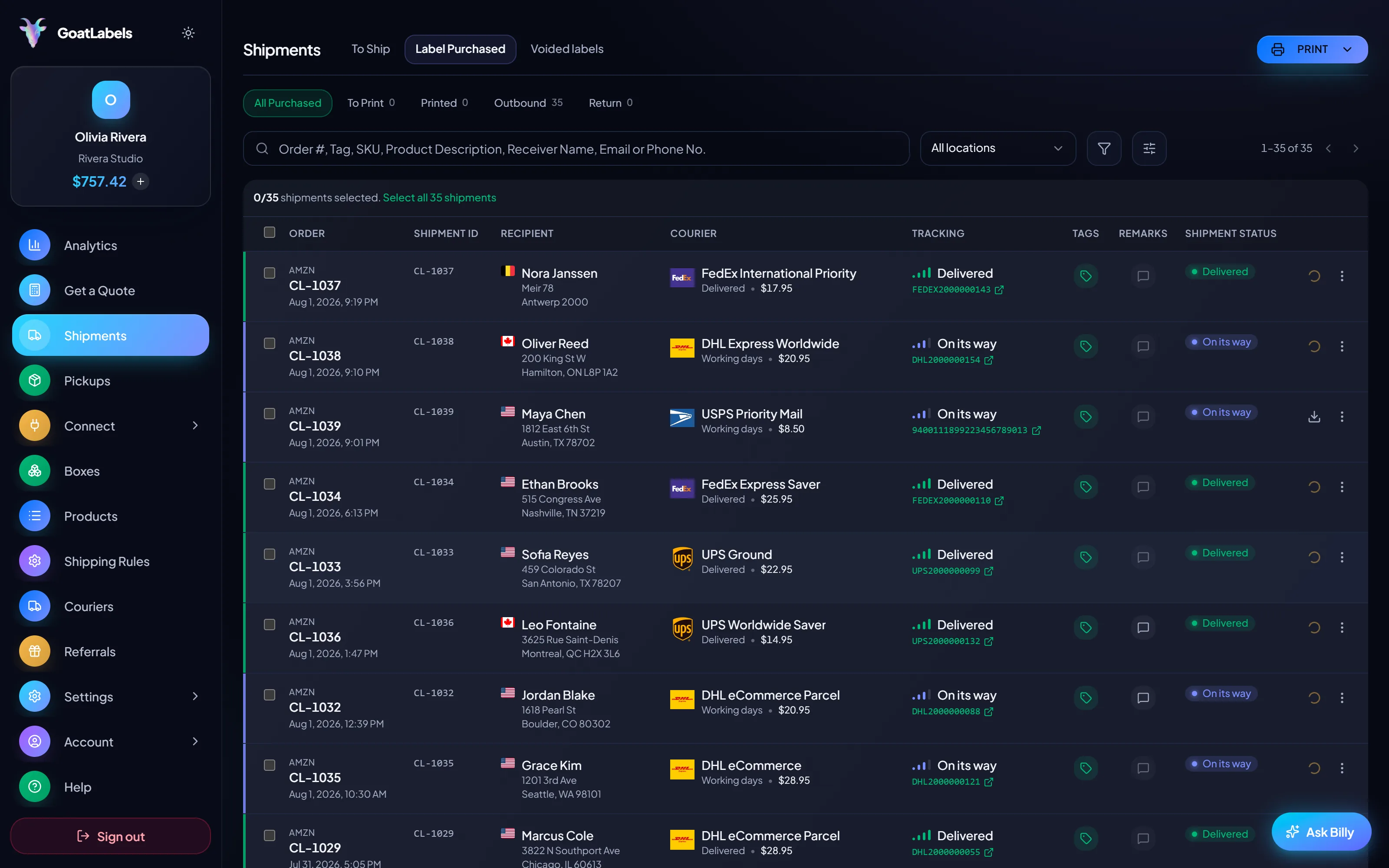
 Reused cartons, covered barcodes
Sourcing boxes for free is a real margin lever at thrift-flip economics. The discipline is dead data and wall strength: black out every old barcode, reject anything with soft corners, and take the smallest sound box so dimensional billing never eats the saving.
Repack and requote
Smaller box, new all-in number, in seconds

 Where supplies stay minimal

 The unit-cost graduates
3 sizes
bulk-bought once order history proves them
A video took off and I had 80 TikTok Shop orders by morning. I printed every label from my phone on the bus to the post office.
Early customer · TikTok
TikTok Shop seller
TikTok ShopI run my Etsy shop from the kitchen. The AI reads the order, picks the carrier, the label prints. That's the whole workflow now.
Early customer · Etsy
Etsy maker
EtsyThe API is what every shipping API pretends to be. Idempotency that actually works.
Sasha R.
Staff engineer, marketplace
Pack in whatever the rulebook allows, then let USPS, UPS and FedEx compete for the domestic postage, DHL on international lanes, one all-in number each, and no monthly fee on Free, up to 50 shipments a month.
Sign up in seconds. No card required. No subscription on Free.
Updated