

USPS
Ground Advantage
2–5 days$7.40
$1.20 of Premium insurance included
all-in · premium inside the number
Carriers engineer for drops, so packing — not the word Fragile — decides survival: rigid outer box, cushioning on every face, no item-to-wall contact, double-boxing for the genuinely brittle. Pack to the standard a damage claim will be judged against, and photograph the packed box before sealing.
A parcel packed for automated sortation survives any network, so pack once to the standard, then let USPS, UPS and FedEx compete on the price of carrying it (DHL on international lanes).


 live quotes
Flip it on per shipment at quote time and the premium sits inside the same all-in number — high-value breakables covered, the coffee mug run not paying for it.
Updated
The sticker assumes a person is handling your box and can choose to be gentle with it. Neither is true for most of a parcel's journey. A small-parcel network is a machine: belts running at sorting speed, diverters that shove, chutes that drop parcels onto other parcels, and trailers loaded floor to ceiling where your box carries whatever lands on top of it. None of that equipment reads. The humans in the loop work at a pace set by the machine, and carriers are explicit in their packaging guidance that parcels must be packed to survive normal automated handling — which is a polite way of saying the network will treat your box like every other box, sticker or not.
This is why the framing of this page is the claim standard rather than gentleness. When a damaged parcel becomes a damage claim, the review does not ask whether the network was kind; it asks whether the packing was adequate for the handling the service is designed around. A Fragile sticker on an under-packed box does not help that review — it documents that you knew the item was fragile and packed it anyway. The sticker is fine as a courtesy for the final doorstep handoff. The survival plan is the cushioning, and the standard you should pack to is the one the claim will be judged against.
Cushioning has one job: when the box stops suddenly, the item inside must decelerate over distance instead of against cardboard. That gives you the three variables that matter. Distance — there must be cushion between the item and every wall, all six faces, because the network does not agree to drop your box on the face you padded best. Density and recovery — the material must still be thick after the tenth impact, not just the first; crumpled paper compresses and stays compressed, loose fill migrates and lets a heavy item sink through it to a wall mid-journey, while wrapped bubble layers and foam hold their loft. Immobilisation — the item cannot be allowed to move, because a moving item arrives at each impact with its own momentum and eventually finds the one unpadded path. Wrap the item, fill every void, and then apply the only test that matters at the bench: shake the closed box firmly. If anything shifts or rattles, it is not packed yet — open it and fill the void it found.
Cushioning spec — verified against USPS, UPS, and FedEx published packaging guidance on 2026-08-15. Carrier guidance for fragile contents converges on: at least 2 inches (5 cm) of cushioning between the item and every wall, and at least 2 inches between the item and any other item in the same box; for double-boxed shipments, roughly 3 inches (8 cm) of cushioning between inner and outer box on all faces; a new, rigid outer box rated for the contents' weight, seams sealed with pressure-sensitive packing tape at least 2 inches wide. Re-check cadence: annually, by the named review owner recorded with this page.
Material choice follows from the recovery rule. Bubble wrap taped around the item in overlapping layers is the workhorse; foam sheets and inserts are better for flat faces and screens; air pillows fill large voids but should never be the layer touching a brittle item, because a punctured pillow is an instant void. Crumpled kraft paper is acceptable as void fill around already-cushioned items and poor as primary protection. Loose fill peanuts on their own are the classic failure: they feel protective at packing time and let dense items migrate to the box wall by the first sort.
Double-boxing is for the genuinely brittle — ceramics, glass, framed work under glass, instruments, anything where a single sharp shock ends the sale. The construction is simple and specific. Wrap the item and cushion it inside a snug inner box until it passes the shake test on its own. Then float that inner box inside an outer box large enough to leave a cushion gap on all six faces, and fill the gap with material that holds its shape, so the inner box cannot drift into contact with the outer wall. The outer box takes the scrapes, punctures, and crushing; the gap between the boxes absorbs the shocks; the inner cushion handles whatever is left. An impact has to defeat all three layers in order before anything reaches the item — and this is the construction that carrier packaging guidance names for fragile goods, which means it is also the construction a claims review accepts without argument.
The cost objection is real but smaller than it looks. The second box adds weight and size, and occasionally that pushes a parcel into a higher billing tier — the size and weight limits page covers where those thresholds sit. Quote the double-boxed parcel across every carrier on the lane before deciding the protection is too expensive, because rate-shopping the finished box is how a label stays cheap even with the second box on, and the difference is usually a fraction of what a single broken ceramic costs in refund, reship, and the review that mentions it.
Everything above is prevention. This section is for the parcel that breaks anyway, because some will, and when one does, the claim turns on a question you can no longer photograph: was the packing adequate? Sellers who seal first and litigate later are reduced to describing their cushioning from memory to a reviewer looking at a shattered outcome. Sellers who photograph before sealing hand the reviewer the answer. The habit costs thirty seconds per parcel, and the checklist below is written to match what a packing review actually asks.
| Shot | What it proves in a review |
|---|---|
| 1. The item, unwrapped | Condition before packing — the claim's baseline. Get the whole item and any weak points (handles, rims, glass faces) in frame. |
| 2. The item, wrapped | That the first cushion layer existed and covered the item completely, not just the convenient faces. |
| 3. In the box, before closing | Cushioning visible on every face and no item-to-wall contact — the exact standard a packing review checks. |
| 4. Sealed, with the label on | Ties the packing photos to this shipment: box condition at handover, seams taped, tracking number legible. |
Where insurance fits: on GoatLabels it is a per-shipment toggle at quote time, with the premium folded into the same all-in price, so the one-of-one ceramic gets covered and the sticker run does not pay for it. Be clear-eyed about what the toggle buys — the carrier or insurer underwrites the coverage and adjudicates the claim, and adequate packing is a condition of paying out, which is why this page comes before the insurance decision. The filing windows, required evidence, and the claims process itself are the lost or damaged claims page's subject; ship enough fragile parcels and you will use both pages, in that order.
Everything above happens before this section starts: the item is wrapped, every face is cushioned, the box has passed the shake test, and the four photos are taken. Only then does the order become a label — and the sequence matters, because the insurance toggle is offered at quote time, which is after the box is closed. Weigh and measure the finished, double-boxed parcel rather than the item, quote that, and decide coverage on the thing you actually built.
the glazed stoneware pair — ship to Renee C., Providence, RI 02903
Double-boxing changes the parcel, so it changes the quote: measure and weigh the outer box with the cushion gap in it. Where the second box crosses a billing threshold is the size-and-weight page's subject, not this one.
 Billy AI
Keep the four photos with the order. If the parcel arrives broken, the packing question is already answered in pictures — the filing windows and the evidence a carrier wants belong to the claims page.
Thirteen store connectors, Shopify, Amazon, eBay, Etsy, TikTok Shop and more, sync their orders into one To Ship queue, so the packing bench works from a single list instead of four tabs, and a validated address means the ceramic is not making a second trip through the sorters. A DM or a screenshot with no connector behind it gets the same treatment: the same cushioning spec, the same four photos, the same per-shipment insurance toggle.
 Shopify
 Etsy
Etsy WooCommerce
 TikTok Shop
 Amazon
 eBay
eBay Squarespace
 Wix
Wix WalmartShopify PlusSoon
 Square
 BigCommerce
 Magento
 ZapierSoon
 NetSuiteSoon
 EcwidSoon
 Temu
Temu SheinSoon
 ChannelAdvisorSoon
 SkuVaultSoon
 Zoho InventorySoon
 Patreon
Nothing here packs a box for you. What it does is stop the finished parcel from being punished twice — once by the network and again by the price of protecting it.
Card, Apple Pay, Google Pay, ACH, and crypto fund the same wallet, and a label with insurance on it debits one all-in number rather than a postage charge plus a separate premium line. Void it and, after the carrier accepts the void, the whole amount, coverage included, credits back.
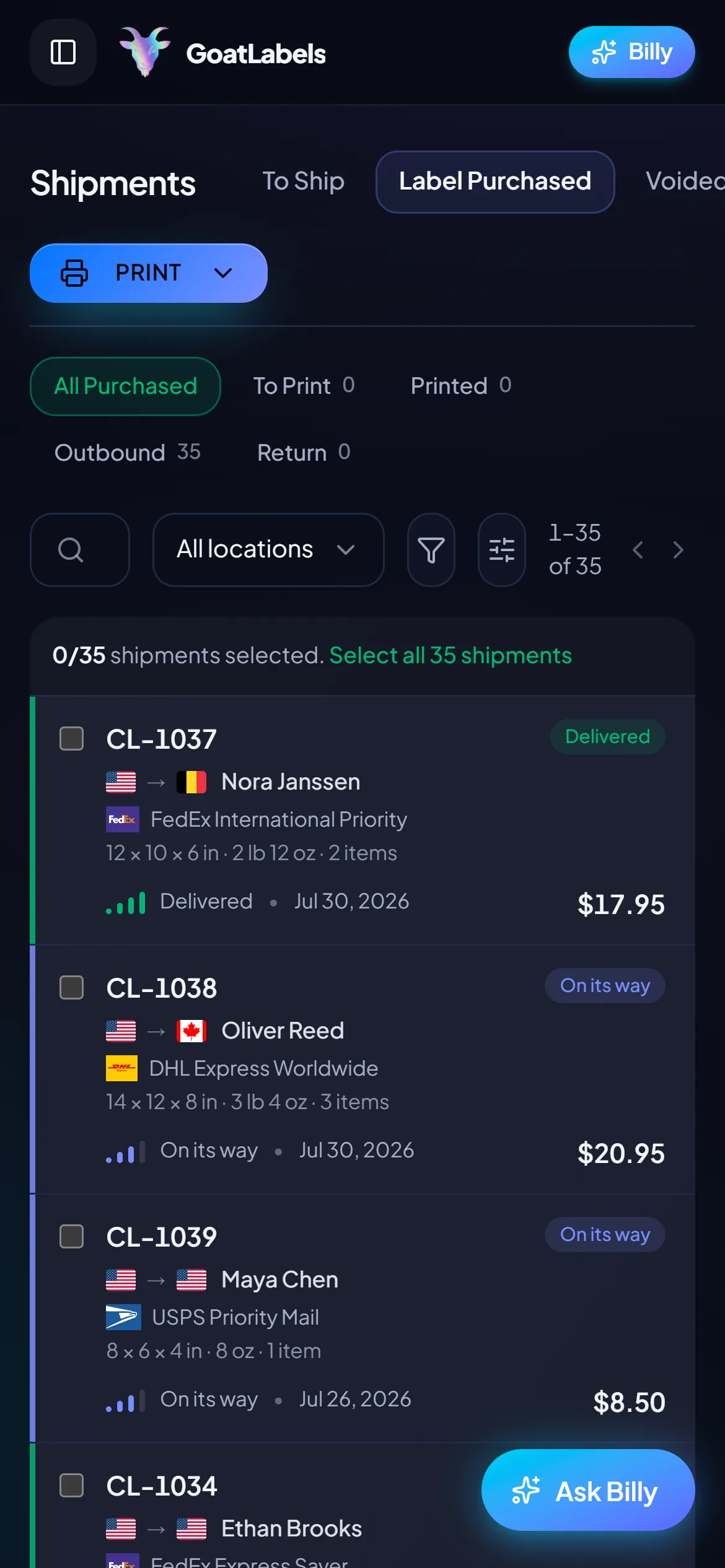
Paste the order, drop a screenshot, or say the address out loud and Billy builds the shipment and validates the destination. The packing decisions stay entirely yours — no assistant should be quietly choosing whether a vase gets a second box.
BillyLIVEFlip coverage on for the one-of-one piece and leave it off for the sticker run. The premium sits inside the same all-in price and on that shipment's record, so you can see what protecting each parcel actually cost. The carrier or insurer underwrites and adjudicates; adequate packing stays a condition of paying out.
A double-boxed parcel is bigger and heavier than the single box you were tempted by, and the carriers do not agree on what that costs. USPS, UPS and FedEx are quoted on the domestic parcel as packed, DHL on international lanes, which is how the protection stops being an argument and becomes a number you can put next to the price of one refund and one reship.
UPS$12.48FedEx$13.22DHL$14.10USPS$11.79A shop that knows which SKUs get double-boxed can send those packed dimensions per order over REST and JSON, with signed webhooks for delivery exceptions and idempotency keys so a retry never buys two labels. Unlimited calls on every plan.
Double-boxed · label ready
Providence, RI · insurance on
The four pre-seal photos are already on your phone, and so is the packing table. There is no reason the quoting half should happen somewhere else: measure the finished box, price it, toggle coverage, and print, without walking to a laptop with bubble wrap under your arm.
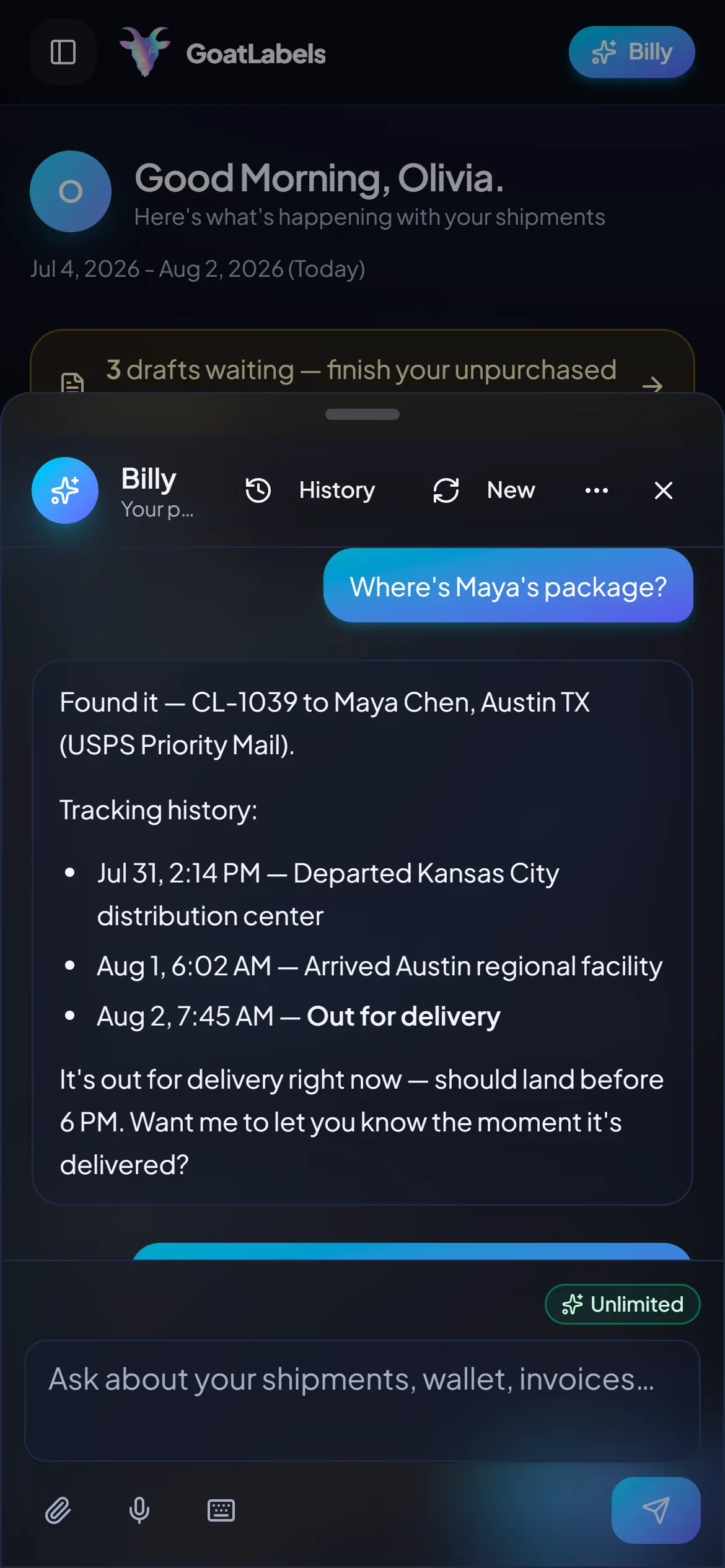
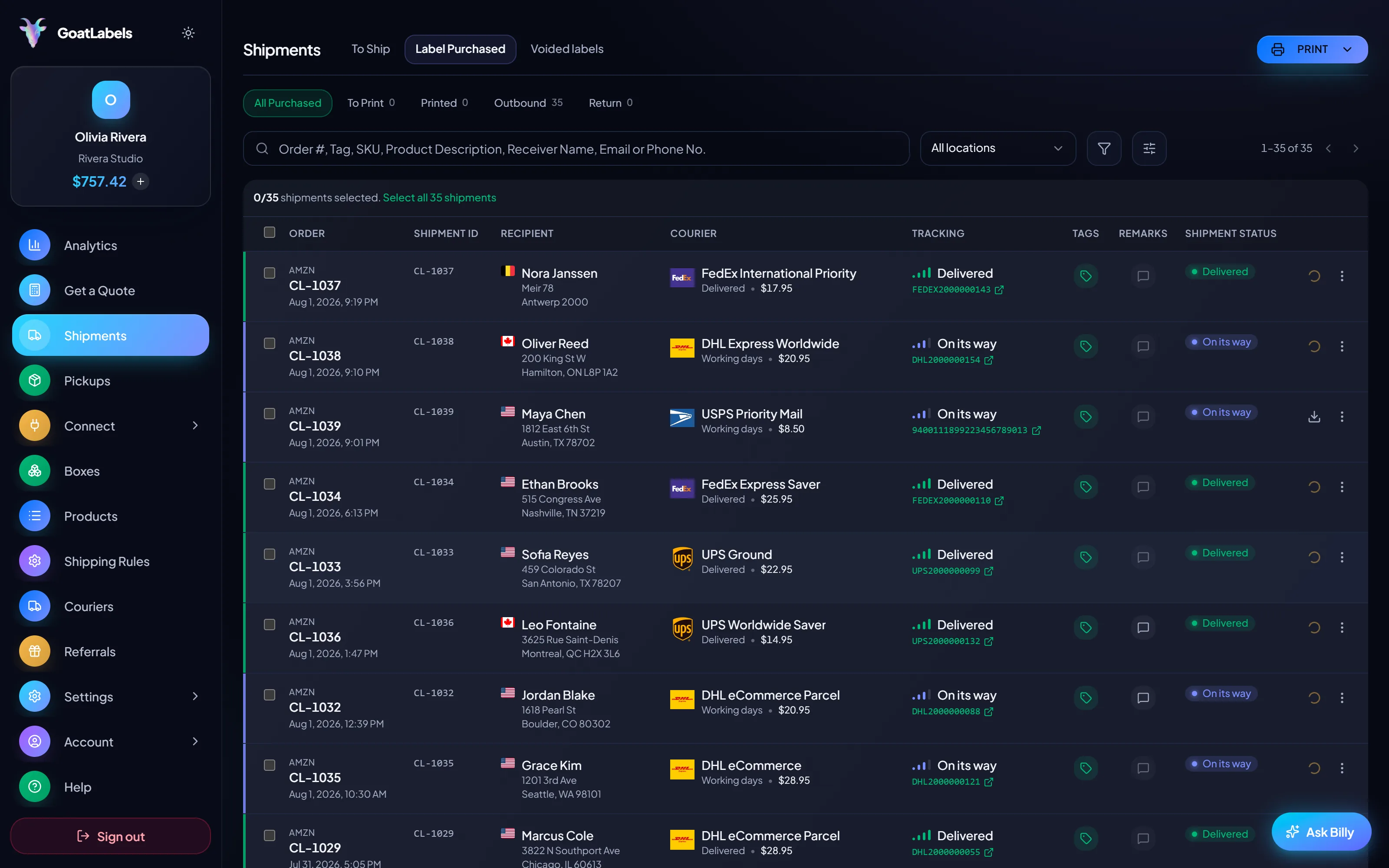
Wrapping is a two-handed job and the phone is always the wrong distance away. Say the address out loud and Billy builds the shipment; ask where a parcel got to and it reads the tracking history back. Useful on a breakable in particular, because a buyer who can watch the parcel move is a buyer who is not messaging you about it. Included on every plan. This is the real product, not a render.
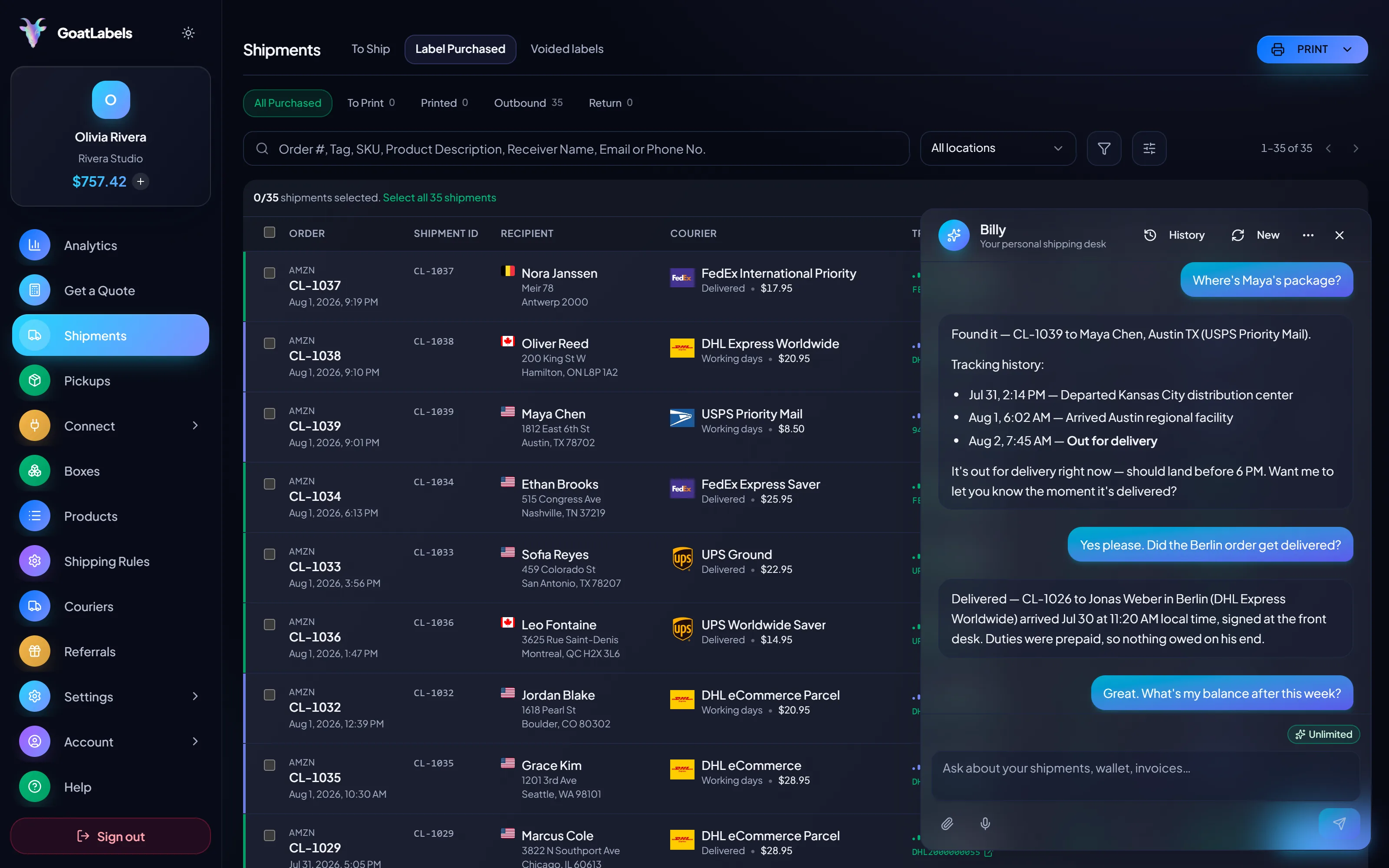
Listening
"Where is Renee's stoneware pair?"
Out for delivery
Providence, RI · scanned this morning
Speaks plain English · remembers your saved box sizes, inner and outer · included on every plan.
This is the comparison the cost objection to double-boxing deserves: the outer box as it will actually ship, quoted against three carriers, each as one all-in number with the insurance premium already inside it. Put that against a refund, a reship, and the review that mentions the breakage. Figures are illustrative.
Ground Advantage
2–5 days$7.40
$1.20 of Premium insurance included
all-in · premium inside the number
Ground
3–4 days$10.80
$1.20 of Premium insurance included
all-in · premium inside the number
Home Delivery
2–4 days$11.40
$1.20 of Premium insurance included
all-in · premium inside the number
A shop that has decided which of its products get a second box already knows the outer dimensions for each one. Send those per order over REST and JSON instead of shipping the catalogue's item measurements, and let signed webhooks tell you which shipments hit a delivery exception — the parcels most likely to become a claim.
POST /api/v1/shipments
Authorization: Bearer sk_live_…
Idempotency-Key: ord_8421

{
  "to": { "name": "Joyce", "city": "Berlin", "country": "DE" },
  "parcel": { "weight": 2.6, "weight_unit": "lb" },
  "service": "fedex_intl_priority"
}
A maker who sends a handful of pieces a week should not be paying a monthly fee to have insurance available, and a shop where one line is breakable should not be buying coverage across the whole catalogue. Free covers 50 shipments a month with all four carriers, Billy, and the API. Pro is a flat plan for volume — the per-shipment insurance toggle is on both.
 — draft a label without leaving the packing table
Rate by plan
illustrativepay for labels, not for seats
$0 / forever
Enough for a kiln's output, and nothing owed in a month you fired nothing.
The assistant that turns a collector DM into a draft label, and validates the address before anything is spent, runs unlimited in the web app on Free. Pro adds Billy on Telegram.
Telegram, ProGET /api/v1/shipments
200 OK · plan: free
Unlimited calls on Free — still unlimited on Pro.
Put a real parcel through and compare the side-by-side rate against what that label costs you on
ShippoPirate ShipShipStationLabel prices are quoted live from USPS, UPS, FedEx, and DHL as one all-in number, with any insurance premium inside it and nothing added at checkout. Coverage is underwritten and adjudicated by the carrier or insurer, and adequate packing is a condition of a payout. Full pricing details
The cushioning spec does not care whether the brittle thing is stoneware, vintage glass, framed art, or a candle in a jar — but the sellers packing them hit different corners of the problem.
 Handmade, irreplaceable, glazed
A one-of-one piece cannot be remade at claim value, so the double-box is the default and the pre-seal photos are the receipts. Insurance goes on per shipment at quote — the premium rides inside the all-in price on exactly the parcels that warrant it.
 Twenty breakables after one stream
A good night ends with a table of glassware to pack. The standard does not relax at volume (wrap, fill, shake-test, photograph, next), and each finished box gets its own carrier quote, so the heavy ones ride with whoever wins them.
Post-stream batch packed
18 boxes · cushioned, photographed, quoted

 Glass faces, corner impacts

 Jars by the dozen, synced from the store
2 in
of cushion between jars — item-to-item counts like item-to-wall
A video took off and I had 80 TikTok Shop orders by morning. I printed every label from my phone on the bus to the post office.
Early customer · TikTok
TikTok Shop seller
TikTok ShopI run my Etsy shop from the kitchen. The AI reads the order, picks the carrier, the label prints. That's the whole workflow now.
Early customer · Etsy
Etsy maker
EtsyThe API is what every shipping API pretends to be. Idempotency that actually works.
Sasha R.
Staff engineer, marketplace
Cushion every face, photograph before sealing, toggle insurance on the parcels that warrant it, and quote USPS, UPS and FedEx on the finished box, DHL on international lanes.
Sign up in seconds. No card required. No monthly fee on Free, up to 50 shipments a month.
Updated