

USPS
Ground Advantage
2 to 5 days$11.40
all-in · premium inside when the toggle is on
Insurance is priced per shipment, so decide per shipment: weigh the premium against the item's replacement cost times the realistic chance of loss on that lane, minus what the carrier already covers by default. High-value, low-volume parcels usually clear that bar; cheap, frequent ones rarely do.
USPS, UPS and FedEx are quoted on every domestic parcel, DHL on international lanes, and the insurance toggle sits on the shipment, so the decision is made where the exposure is, not once in a settings screen.


 DHL: international
Fund the wallet with card, Apple Pay, Google Pay, ACH, or crypto — when you insure, the premium is folded into the quoted price and that exact amount leaves the balance.
Shipping insurance is one of the few purchases a seller makes where the fair price is genuinely computable. You are buying protection against a loss whose size you know — the replacement cost of the item, minus whatever the carrier already covers by default — and whose probability you can estimate from your own history. Multiply the two and you have the expected loss on that parcel. The premium is worth paying when it is smaller than that expected loss, and not worth paying when it is larger. Everything else on this page is just a way of getting honest inputs into that one comparison.
The formula is easier to use flipped around: divide the quoted premium by your loss rate, and you get the break-even exposure — the uncovered value at which insurance stops being a fee and starts being a fair trade. A premium divided by a one-in-five-hundred loss rate breaks even at five hundred times the premium in uncovered value. Parcels above that line deserve the toggle; parcels below it are quietly subsidising the insurer. What surprises most sellers who run the division for the first time is how high the break-even line sits for an ordinary domestic parcel that gets scanned at acceptance and delivered to a house. Insurance earns its premium on the tails, not on the typical order.
Worked example bands — compiled 2026-08-15.Illustrative arithmetic only, not a rate card: at a loss rate of one parcel in two hundred, a two-dollar premium breaks even at four hundred dollars of uncovered value; at one in a thousand, the same premium needs two thousand dollars of exposure to be a fair trade. Premiums scale with declared value and change without notice, so never reuse these bands as answers — re-run the division with the actual premium shown on your own quote, because the toggle prices each shipment individually. Re-checked with each pricing review by the named marketing owner recorded with this page.
| Loss rate | Premium | Break-even uncovered value |
|---|---|---|
| One in two hundred | Two dollars | Four hundred dollars |
| One in a thousand | Two dollars | Two thousand dollars |
The loss rate is the input sellers guess worst, because memory is a terrible ledger — one painful loss feels like a pattern, and two hundred uneventful deliveries feel like nothing at all. Count instead. A loss, for this arithmetic, is a parcel that never produced a delivery scan or that arrived damaged beyond use; a parcel the tracking says was delivered but the buyer says never came is a different dispute with different remedies, and it belongs to the delivered-but-not-received guide, not to this count. Divide honest losses by total shipments, and keep the division per lane: domestic ground to residential addresses, international economy, and anything routed through a freight forwarder are three different risks that deserve three different rates.
Small histories need one extra tool. If you have shipped three hundred parcels and lost none, your loss rate is not zero — it is merely unknown and probably small. A useful ceiling: with zero losses in a sample, the true rate is very likely below three divided by the number of shipments, so three hundred clean parcels bound the rate near one percent, not at nothing. Use the ceiling when deciding, and replace it with your measured rate as the history grows. Sellers who skip this step self-insure on the assumption that nothing has ever gone wrong, then meet their first loss with no reserve and no premium either.
Self-insuring is not the same thing as declining insurance. Declining is simply hoping; self-insuring is running the insurance company yourself, with yourself as the only customer. The mechanics take one spreadsheet column. Each time the arithmetic says skip the premium, credit the amount you would have paid into a reserve line. When a parcel is lost, pay the replacement out of the reserve and record the drawdown. The column now does something subtle and valuable: it turns your insurance decision into a falsifiable bet. A reserve that climbs steadily is proof the premiums were overpriced for your book of parcels. A reserve that keeps going negative is proof your loss-rate estimate was optimistic, and the toggle deserves another look.
The two strategies also mix, and the per-shipment toggle is what makes the mix workable. Because GoatLabels prices insurance per shipment rather than as an account setting, you can self-insure the base of cheap, frequent parcels where the reserve method wins, and buy the premium only on the outliers — the one order this month whose replacement cost would wipe out a quarter of reserve growth in a single loss. One honest boundary belongs here: GoatLabels sells the insurance option at label time and records the premium on the shipment, and the insurer underwrites the policy and decides the claim. No label platform pays claims out of its own pocket, and any page that implies otherwise is selling something it does not control.
Run the division across a real order book and the answers cluster. Clearing the bar almost every time: one-off high-value items, because a single loss is a material fraction of the month; international parcels on economy services, where handoffs multiply and the loss rate is genuinely higher; anything shipped to a freight forwarder, where the carrier's obligation ends at the forwarder's dock; and fragile goods whose damage rate dwarfs their disappearance rate. Failing the bar almost every time: inexpensive, replaceable, frequently shipped items — the volume that makes the loss rate measurable is the same volume that makes each individual loss ignorable, and a reserve funded by a hundred skipped premiums absorbs the occasional replacement without complaint.
Two adjacent facts complete the decision, and both live elsewhere by design. Carriers include some declared-value coverage by default on some services, which shrinks the uncovered exposure in your formula, and the per-carrier specifics plus the filing process live on the lost-and-damaged claims guide. And the premium is only one line in the landed cost of a label; the habit that keeps the whole number down is quoting USPS, UPS and FedEx on every domestic parcel (DHL on international lanes), which is the cheap-labels argument in one sentence, and it costs nothing to adopt because printing has no monthly fee on Free (up to 50 shipments a month).
The insurance call is only rational if it happens where the numbers are — on the quote, with the premium visible next to the exposure. The flow keeps the arithmetic honest: the parcel arrives with a value, the quote shows the premium, the toggle records the choice, and the shipment carries the premium on its record so your reserve ledger has real data to reconcile against.
Vintage camera lens, one of one — replacement cost high, buyer overseas, economy service on the shortlist.
The break-even division takes seconds once the premium is on screen: premium over loss rate, compared against uncovered value. High and rare insures; cheap and frequent self-insures.
 Decision support
Self-insurers get the same benefit in reverse: the premiums you declined are visible on past quotes, which is exactly the number your reserve column needs.
13 store connectors, including Shopify, Etsy, WooCommerce and TikTok Shop, sync orders into one To Ship queue, and the insurance choice stays on each shipment rather than on the connection — so the cheap repeat item from one channel and the one-off high-value piece from another get judged separately, which is what the break-even division actually requires. Paste an Instagram or Facebook DM instead and the same per-shipment toggle is sitting on that quote too.
 Shopify
 Etsy
Etsy WooCommerce
 TikTok Shop
 Amazon
 eBay
eBay Squarespace
 Wix
Wix WalmartShopify PlusSoon
 Square
 BigCommerce
 Magento
 ZapierSoon
 NetSuiteSoon
 EcwidSoon
 Temu
Temu SheinSoon
 ChannelAdvisorSoon
 SkuVaultSoon
 Zoho InventorySoon
 Patreon
A decision method is only as good as the numbers you feed it. These are the places the product hands you a real number instead of a guess.
Card, Apple Pay, Google Pay, ACH, and crypto all fund the same wallet, and an insured label debits exactly its quoted all-in amount — premium inside. Nothing about the insurance decision creates a second bill to reconcile later.
Paste an order, drop a screenshot, or speak the address and Billy drafts the shipment on every plan. The insurance toggle stays a human decision on the quote — an assistant that silently insured everything would be spending your margin on parcels that never clear the break-even bar.
BillyLIVEThe quoted number is the number that leaves the balance. When the premium is folded into one visible price rather than scattered across fees, comparing the insured and uninsured versions of the same label is a subtraction, not an investigation.
They are priced against the same parcel each time, with DHL on international lanes. The carrier choice moves the base price and the lane risk at once, so the insurance division is worth re-running when the winning carrier changes, and here it is on screen when that happens.
UPS$12.48FedEx$13.22DHL$14.10USPS$11.79The API covers the shipment lifecycle the dashboard uses, with signed webhooks and unlimited calls on every plan — so a seller codifying a decision rule can build against real shipment records instead of exported guesses.
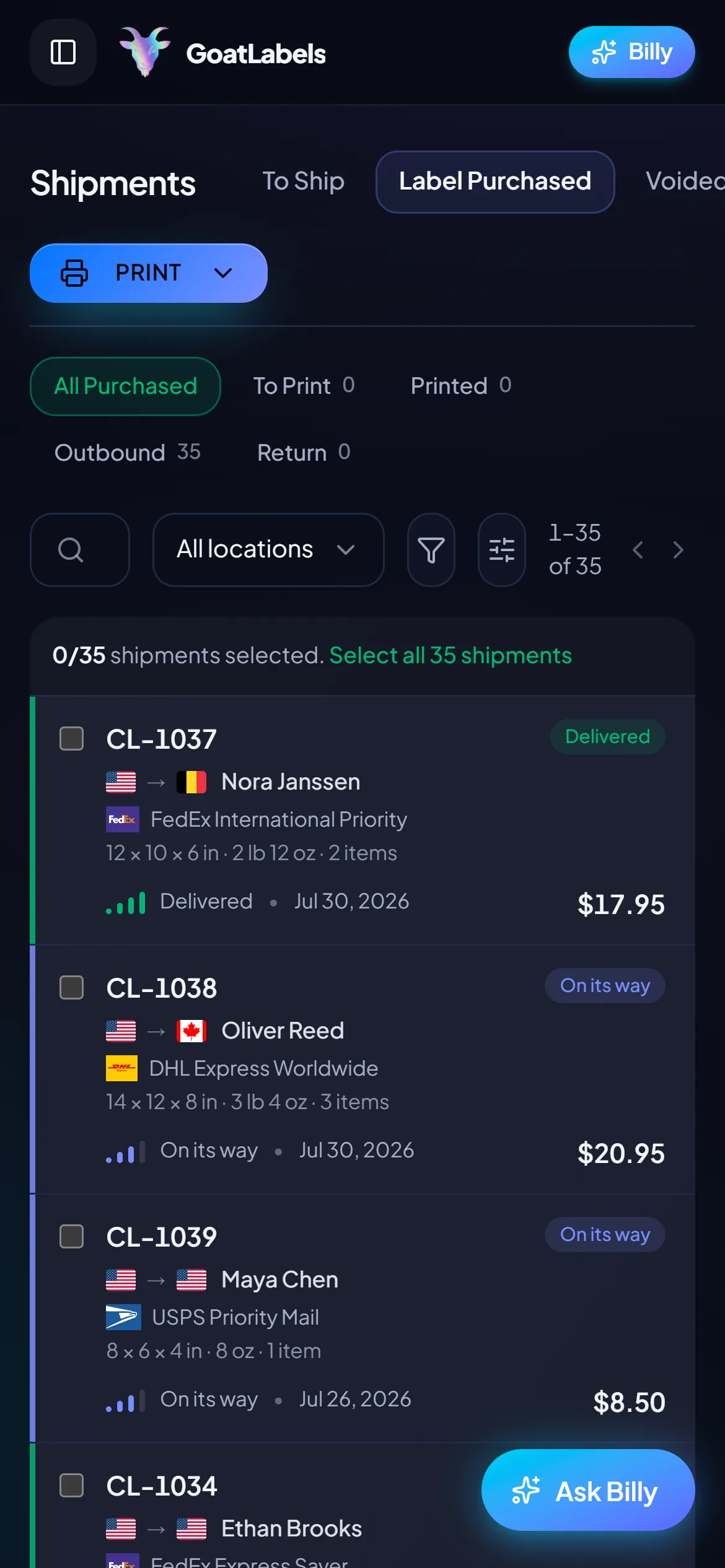
Premium quoted
This shipment only · toggle before you buy
The break-even calculation is one division, and it only helps if you run it where the parcel is. The quote, the premium for that specific shipment, and the toggle all sit on one mobile screen — so deciding takes the few seconds between taping the box and printing the label, rather than a blanket policy you set once and stopped thinking about.
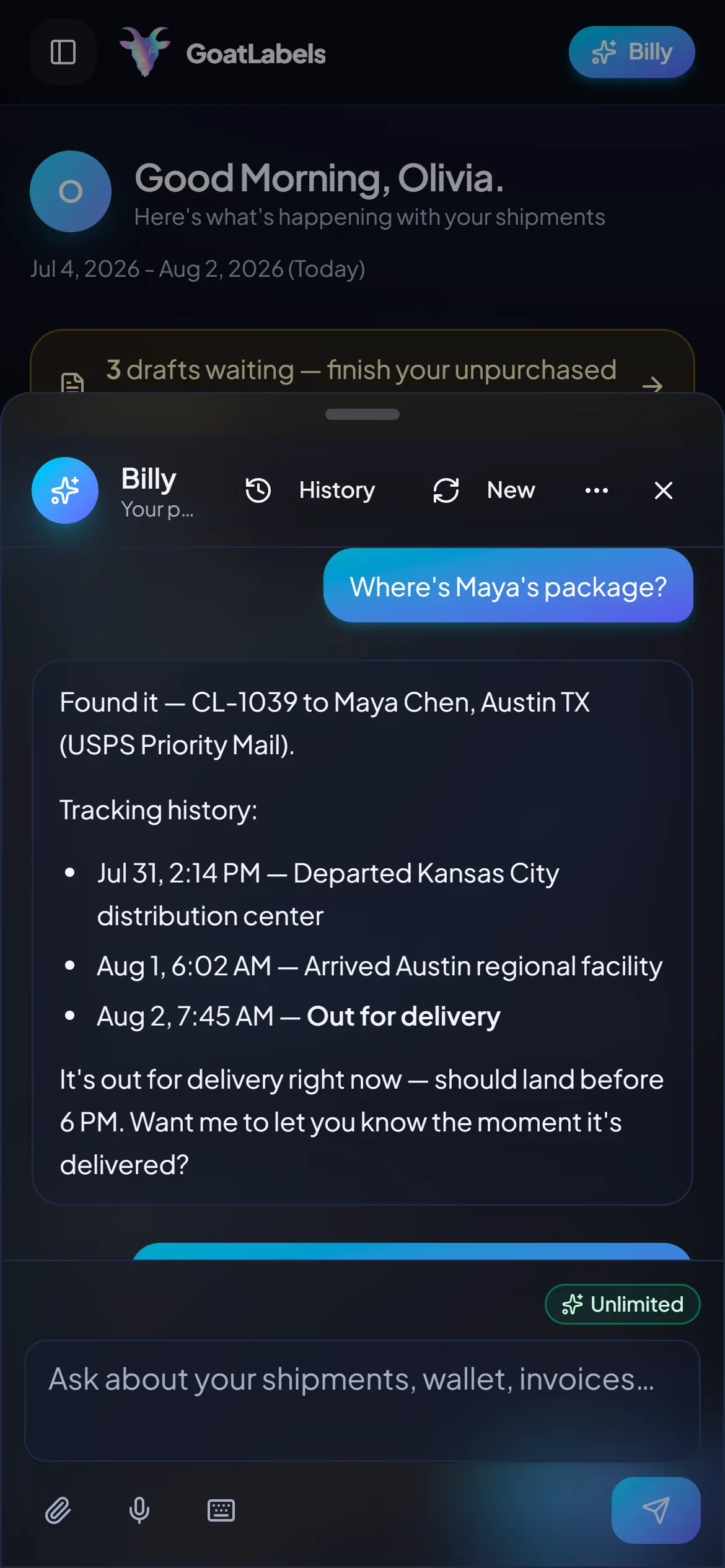
Speak the order and Billy builds the shipment, validates the address, and quotes the carriers, but it does not flip the insurance switch for you, and that is deliberate: an assistant that quietly insured everything would spend your margin on the parcels that never clear the break-even bar. Ask what a past shipment cost and it reads the premium back off the record instead. Included on every plan. This is the real product, not a render.
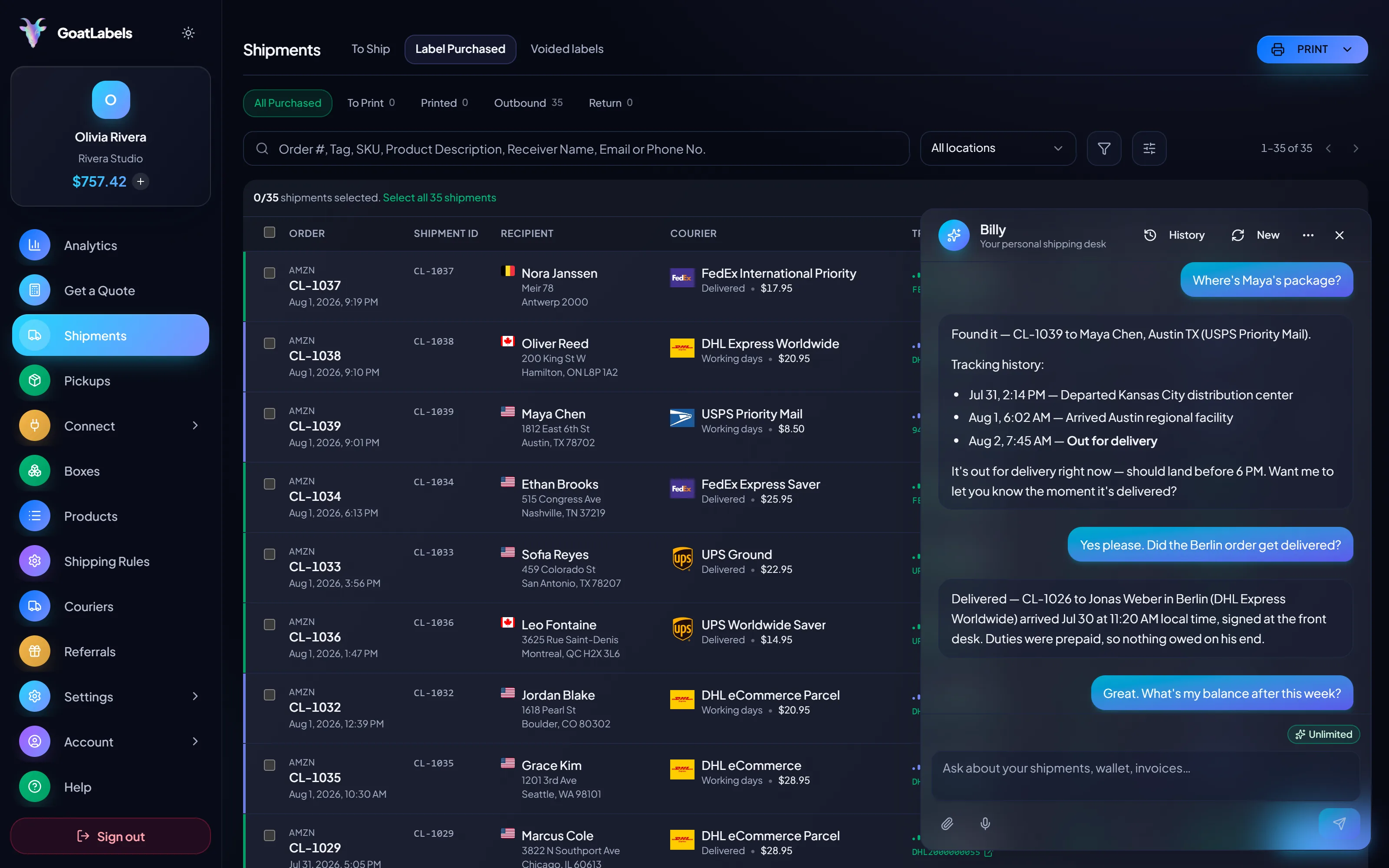
Listening
"Did we insure the camera lens?"
On the record
Premium persisted with the shipment
Speaks plain English · drafts from a paste, a screenshot, or your voice · reads the premium back off past shipments · never decides the toggle for you.
When insurance is quoted as its own fee stack, comparing the covered and uncovered versions of the same label becomes an investigation. Here the premium is folded into the single all-in figure for the service you picked, so the difference between the two is a subtraction you can do in your head — which is exactly the input the break-even division has been waiting for.
Ground Advantage
2 to 5 days$11.40
all-in · premium inside when the toggle is on
Ground
1 to 5 days$9.85
all-in · premium inside when the toggle is on
Ground
1 to 5 days$11.20
all-in · premium inside when the toggle is on
Once the division has produced a threshold per lane, it stops needing a human at the bench. Drive the same shipment lifecycle from your own script — rate the parcel, apply your rule to the exposure, and buy with the insurance choice attached — so every order is judged the same way instead of by whoever happens to be packing. Unlimited calls on every plan, so re-rating a month of orders to test a rule costs nothing.
POST /api/v1/shipments
Authorization: Bearer sk_live_…
Idempotency-Key: ord_8421

{
  "to": { "name": "Joyce", "city": "Berlin", "country": "DE" },
  "parcel": { "weight": 2.6, "weight_unit": "lb" },
  "service": "fedex_intl_priority"
}
A subscription quietly changes the break-even sum, because a fixed monthly cost has to be earned back across whatever you happened to ship that month. Free covers 50 shipments a month with no monthly fee, so the only numbers left in the division are the premium, your loss rate, and the uncovered value. Past 50 shipments a month, Pro is one flat $40 monthly plan with unlimited shipments; it never buys coverage, and it never turns insurance into a plan feature.
 — draft a label without opening the dashboard
Rate by plan
illustrativePro: one flat monthly plan, unlimited shipments
$0 / forever
Insure the outliers, self-insure the rest, and owe nothing in the months you ship nothing.
The assistant that turns a pasted order into a draft label runs unlimited in the web app on Free, and never flips the insurance toggle on your behalf. Pro adds Billy on Telegram.
Telegram, ProGET /api/v1/shipments
200 OK · plan: free
Unlimited calls on Free — still unlimited on Pro.
Put a real parcel through and compare the side-by-side rate against what that label costs you on
ShippoPirate ShipShipStationInsurance here is an option sold at quote time, with the premium folded into the all-in price and recorded against the shipment. GoatLabels does not underwrite the policy and does not decide the claim — the insurer does, and what filing one involves lives on the lost-and-damaged claims guide. Full pricing details
Run premium over loss rate across a real order book and the answers cluster into four shapes. These are them, with the strategy each one points at.
 One-off high-value items
A single loss on a one-of-a-kind piece is a material fraction of the month, which is precisely the shape a premium is priced for. Because the toggle is per shipment, buying it here commits you to nothing on the hundred cheap parcels sitting around it.
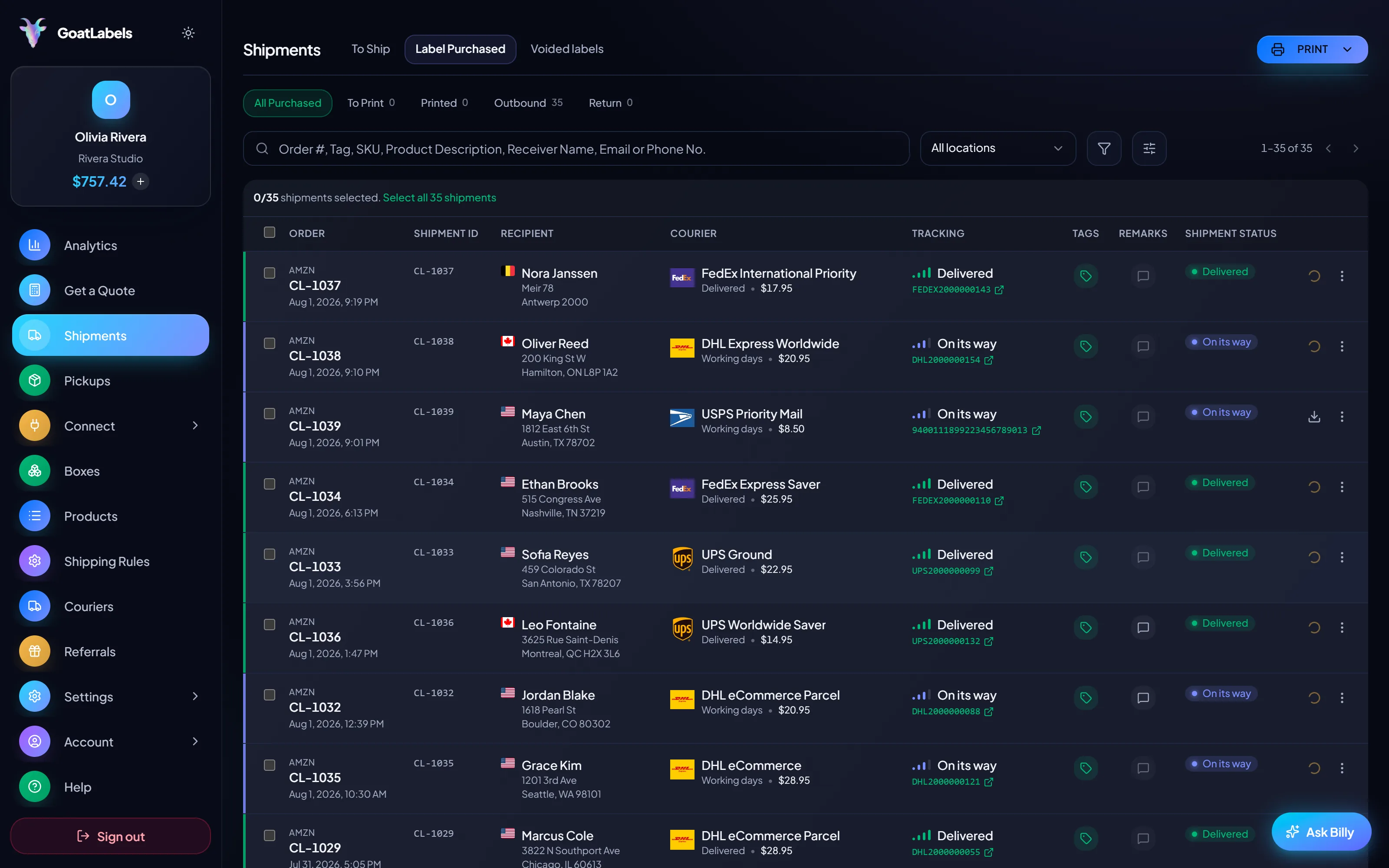
 Cheap, replaceable, frequently shipped
The volume that makes a loss rate measurable is the same volume that makes each individual loss absorbable. Credit every skipped premium to a reserve column and the strategy turns falsifiable: a reserve that climbs was right, one that keeps running dry was not.
The skipped premium is still on the quote
Which is exactly the number a reserve column is built from

 The lanes with the most handoffs

 Where a decision becomes a rule
1
threshold per lane, applied at quote instead of guessed at the bench
Updated 2026-08-15
A video took off and I had 80 TikTok Shop orders by morning. I printed every label from my phone on the bus to the post office.
Early customer · TikTok
TikTok Shop seller
TikTok ShopI run my Etsy shop from the kitchen. The AI reads the order, picks the carrier, the label prints. That's the whole workflow now.
Early customer · Etsy
Etsy maker
EtsyThe API is what every shipping API pretends to be. Idempotency that actually works.
Sasha R.
Staff engineer, marketplace
Quote the parcel across the carriers, read the premium against the exposure, and flip the toggle only when the arithmetic says to.
No contract. No card required. Insurance stays a per-shipment choice.
Updated