

USPS
Ground Advantage
2 to 5 days$11.40
all-in · the window is an estimate
USPS parcels routinely move without scanning — a tracking gap means no scanner saw the parcel, not that it stopped moving. The diagnostic that matters is which scan is missing: no acceptance scan means USPS may never have taken possession, while a mid-route gap usually resolves at the next hub.
A stall after an acceptance scan, a mid-route hub, or out-for-delivery are three different situations with three different fuses — the branch you are on decides the action.


 4 branches
Branded tracking emails go out as scans arrive, and the gap between scans is yours to narrate — a checkpoint date beats a refund issued out of anxiety.
Nothing on this page can make USPS scan a container sooner. What the loop below controls is the part that decides whether a gap is a mystery or a diagnosis: the address is validated before money moves, the label is bought on the day the parcel actually goes so the first scan lands right behind it, and every scan that does arrive lands in one queue under the buyer's own branded tracking page. A stall you can name is a stall you can act on.
tracking hasn't moved since Tuesday — is my order actually coming?
A mistyped address is the one stall cause you control completely, and it is the one that looks identical to a lost parcel from the buyer's side of the tracking page.
 Billy AI
Buying a label days before the parcel moves manufactures a gap at the front of the journey that looks exactly like the one you are trying to diagnose. Buy it when it goes.
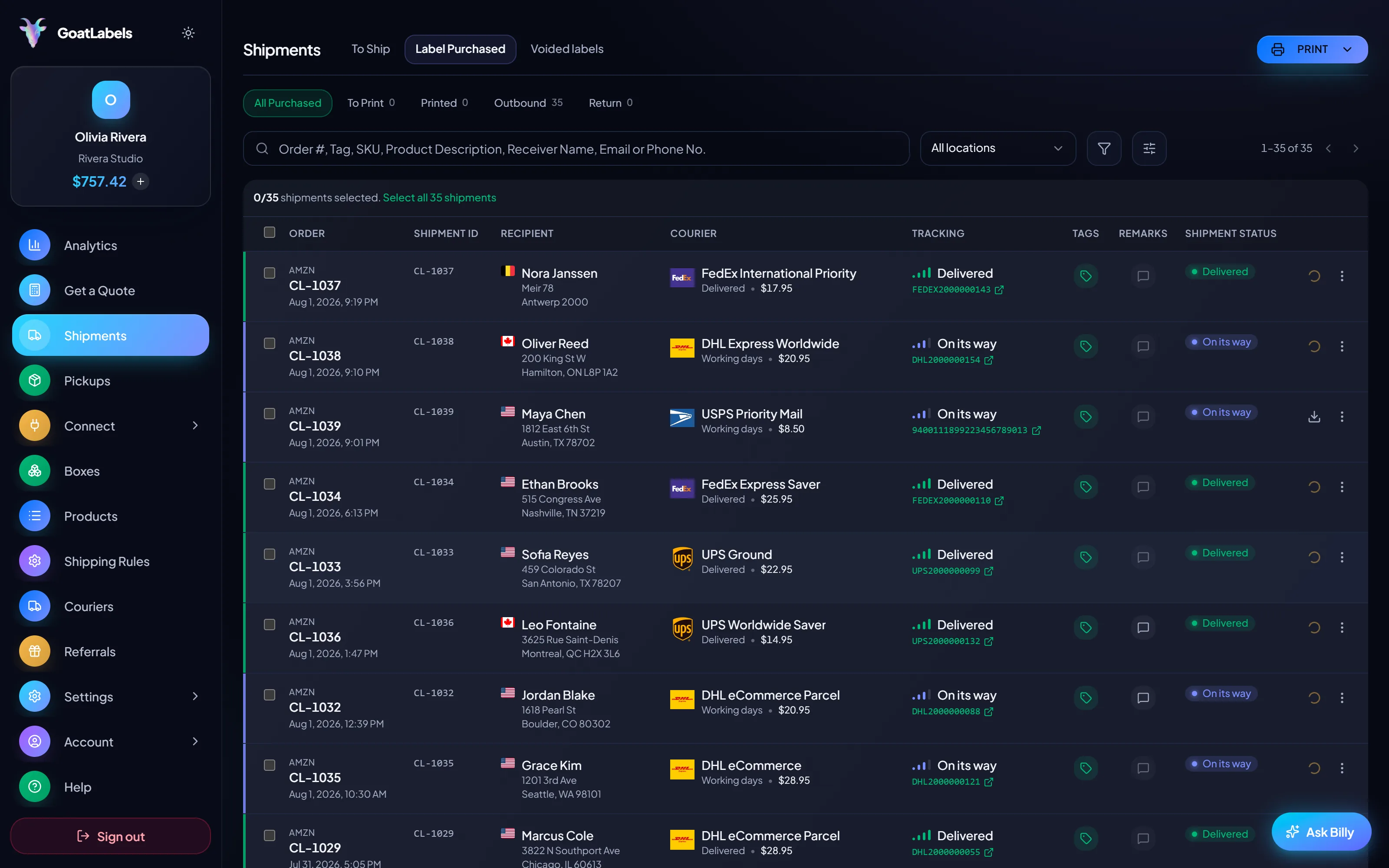
Thirteen store connectors, Shopify, Amazon, eBay, Etsy, TikTok Shop and more, sync into the To Ship queue and tracking pushes back to the channel when you print, so the parcel that has not moved surfaces by scanning one list instead of by opening four dashboards. Orders pasted from an Instagram or Facebook DM sit in the same list with the same scan history.
 Shopify
 Etsy
Etsy WooCommerce
 TikTok Shop
 Amazon
 eBay
eBay Squarespace
 Wix
Wix WalmartShopify PlusSoon
 Square
 BigCommerce
 Magento
 ZapierSoon
 NetSuiteSoon
 EcwidSoon
 Temu
Temu SheinSoon
 ChannelAdvisorSoon
 SkuVaultSoon
 Zoho InventorySoon
 Patreon
Updated
USPS tracking is generated by barcode readers in specific physical places — counter scanners, automated sortation lines, carrier handhelds — and a parcel only produces an update when it passes one. The part that defuses most panics: parcels do not travel as individual pieces. They ride in sacks and containers, and a container can be loaded, driven across three states, and unloaded while the parcels inside meet no scanner at all. A piece that misses the reader on a conveyor — label face-down, wedged against another box — goes dark until the next pass catches it. None of that is the parcel stopping; it is the log skipping.
The gap that behaves differently is the one at the very start. An acceptance scan is the event that proves USPS took possession, and it is also the easiest scan to miss: collection-box drops are not scanned at the box, and a busy counter may sack a prepaid parcel without scanning it in. That is why a parcel can be genuinely moving while tracking still reads as label created — and why, if possession itself is ever in question, the round-stamped acceptance receipt from a counter drop is worth the extra minute in line. What each status string physically means across all four carriers is a separate reference — our tracking status concordance covers the translation layer — while this page covers what to do when the strings stop coming.
The last scan you have is the whole diagnostic. It tells you where the parcel was last proven alive, which failure modes are still possible, and how long silence is normal at that point in the journey. The branches below run from worst-informed to best-informed: no scan at all leaves possession itself uncertain, while a stall after out-for-delivery narrows the world to one route and one day.
Gap-diagnosis reference — verified against USPS published guidance on 2026-08-15.Waits are drawn from USPS's own service commitments and Missing Mail guidance: Ground Advantage carries a 2–5 business day delivery estimate, and USPS accepts a Missing Mail search request once 7 days have passed since the mailing date. USPS revises service estimates and search eligibility, so re-check usps.com before acting on a day count.
| Last scan you have | What it usually means | The action | Realistic wait |
|---|---|---|---|
| No scan at all (label created only) | USPS may not have possession — the drop was never scanned in, or the parcel never reached USPS. | Confirm the physical drop. A round-stamped counter receipt is proof of possession; a collection-box drop has none. | 2–3 business days for a first facility scan, longer from a collection box |
| Acceptance scan only | USPS has it, but it has not met an automated sorter yet — or it is riding in a container between scans. | Wait, then request updates by text or email on the tracking number. Movement usually resumes at the next hub. | 3–5 business days beyond the service's delivery estimate before escalating |
| Mid-route hub scan, then silence | The most common stall, and the most benign: containers cross the country without piece-level scans. | Wait out the realistic window, then file a Missing Mail search describing the item and packaging. | Ground Advantage estimates run 2–5 business days; give a stall about a week past the estimate |
| Arrived at destination-area facility, then silence | The parcel is close but unsorted, misrouted within the building, or waiting on the next route cycle. | A short wait, then contact your local destination Post Office directly — they can check the floor. | 2–3 business days before the phone call |
| Out for delivery, then silence | The route ended without a delivery or return scan — carrier ran out of time, or the scan was missed at the door. | Check with the buyer the next day; if nothing, contact the destination Post Office same-week. | 1–2 business days — this branch has the shortest fuse |
Escalation has an order because each rung is cheaper than the next and each generates information the next rung needs. The first rung costs nothing: request text or email updates on the tracking number, which both alerts you the moment the parcel resurfaces and registers your interest against the piece. The second rung is the Missing Mail search — a formal request for USPS to physically look, using your description of the item, the packaging, and both addresses. It is not a complaint form; the description is operational, used to match the parcel in facilities and at the recovery center, so the specific detail — brown box, this size, this labeling — does real work. File it once your branch's realistic wait has expired and the mailing date qualifies under the eligibility timing in the dated block above.
The third rung is the claim, and it exists for the minority of stalls that were genuinely losses. A parcel that never resurfaces becomes a lost-package case with filing windows, evidence requirements, and a payout capped by the coverage on the label — how to file a lost package claim as a seller owns that process end to end, including what default coverage leaves exposed. The ladder's discipline is not skipping rungs in either direction: a claim filed on day three of a routine mid-route gap will simply be premature, and a search filed after the buyer has already been refunded recovers a parcel nobody is waiting for.
The seller's real exposure during a stall is rarely the parcel — most stalls end with a scan, not a loss. It is the buyer relationship souring in the silence. The message that works is specific and dated: the parcel was last scanned at this facility on this date, gaps between scans are normal for this service, and you will check in with a decision on a named day. That converts an open-ended anxiety into a bounded wait, and it commits you to the escalation ladder instead of to hope. What it should not promise is a refund on a date — refund on evidence, when the search has run its course and the parcel is genuinely treated as lost, at which point the claim process pays you back rather than the buyer's goodwill.
Two edge cases round out the script. If tracking eventually shows delivered and the buyer still reports nothing, that is a different dispute with different rules — the delivery scan changes everything, and delivered but not received owns that path. And if you ship a replacement while the original is in limbo, buy it as a new label for a new parcel; should the original then surface, an unused replacement label can be voided, and after the carrier accepts the void the credit posts back to your wallet instead of being written off. On GoatLabels the narration is half-automated anyway: the buyer follows a branded tracking page under your name and gets emails as scans arrive, so the conversation starts from a shared, current view of the log instead of from a screenshot exchange.
Nothing makes USPS scan a container sooner. What a seller controls is visibility, the buyer's experience of the wait, and what a replacement costs when one is needed.
Every shipment's latest scan sits in one queue, so the parcel that has not moved in a week surfaces by scanning a list — not by a buyer's angry message. The wallet that bought the label sits beside it: card, Apple Pay, Google Pay, ACH, or crypto in, labels out.
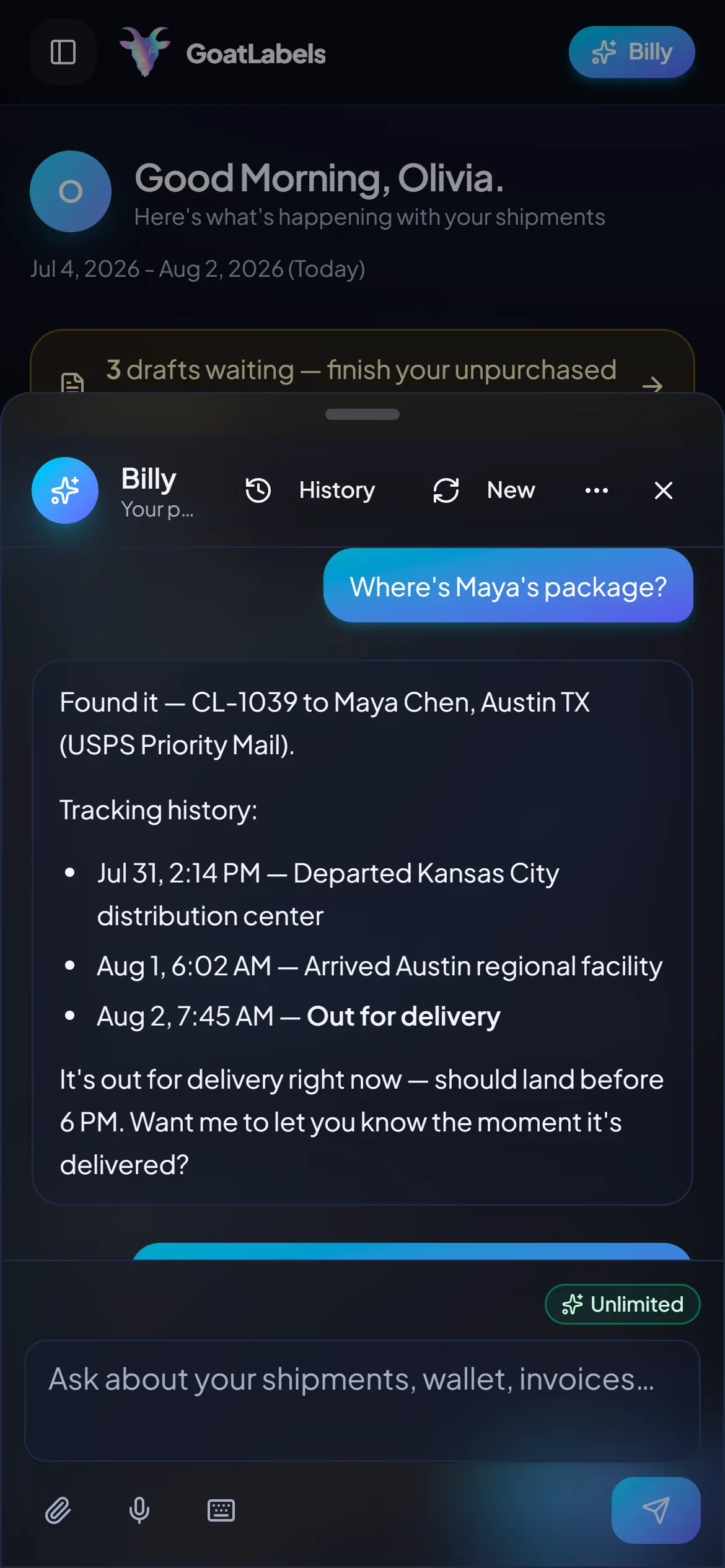
Billy reads a shipment's state back in plain English — the last scan and when it happened. If you decide to reship, paste the original order or speak the address and Billy drafts the replacement label. The diagnosis stays yours; the clerical work does not.
BillyLIVEIf a stall turns into a reship, the replacement is quoted all-in across USPS, UPS and FedEx like any other domestic label (DHL on international lanes), from the same prepaid balance, and an unused label can be voided for credit after the carrier accepts the void, rather than eaten. No monthly fee on Free (up to 50 shipments a month) either way.
Buyers watch a tracking page under your name and get emails as scans arrive, so the days between scans are narrated by your brand instead of interrogated in your inbox.
UPS$12.48FedEx$13.22DHL$14.10USPS$11.79Signed webhooks push shipment events as they happen, so a script can flag any tracking number with no new event in a set window — the diagnosis table above, automated. Unlimited API calls on every plan.
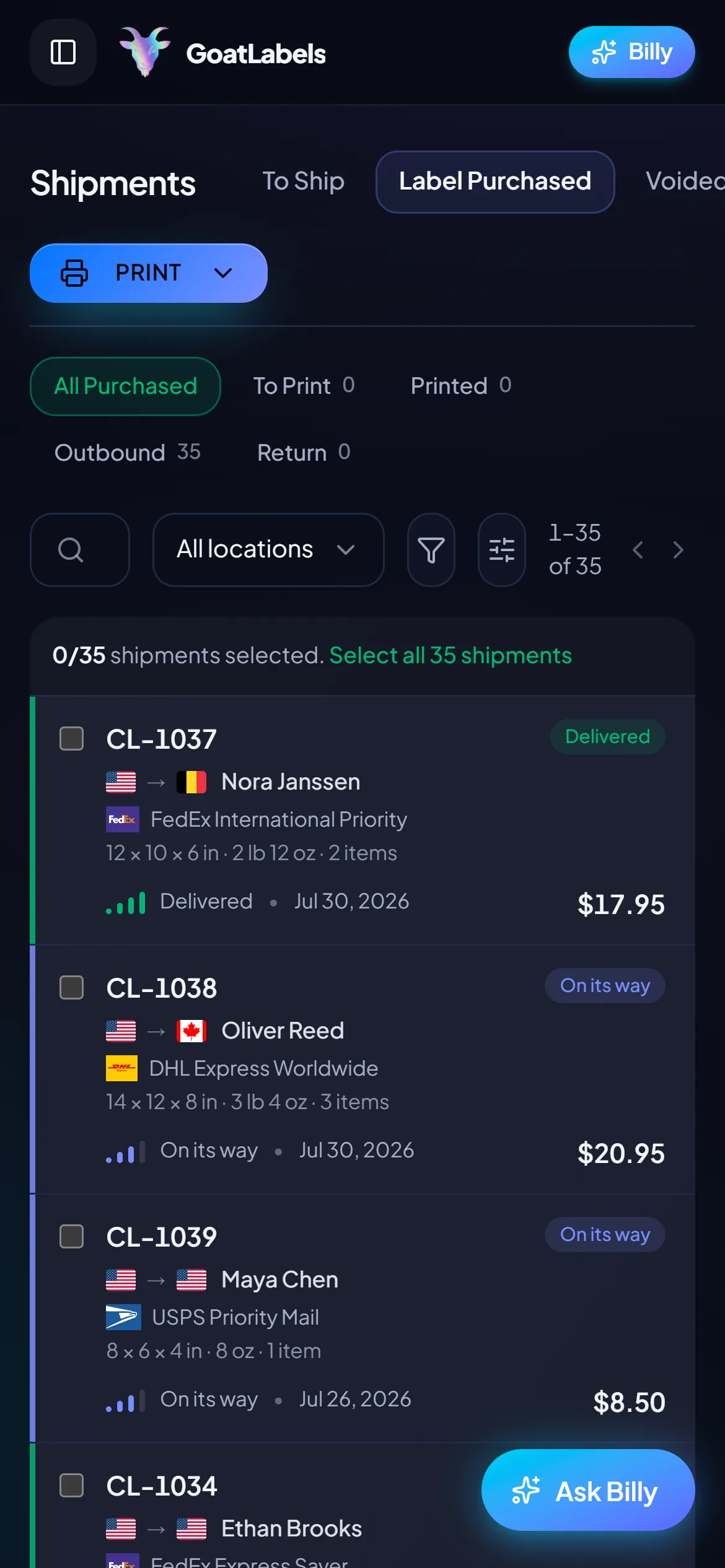
No new scan
Mid-route hub · flagged for review
Stalls get found when checking is cheap. The whole shipment list, each parcel's latest scan, and the buyer's own tracking page are on the phone, so the sweep that catches a quiet parcel happens standing in line rather than as a task you schedule and then skip.
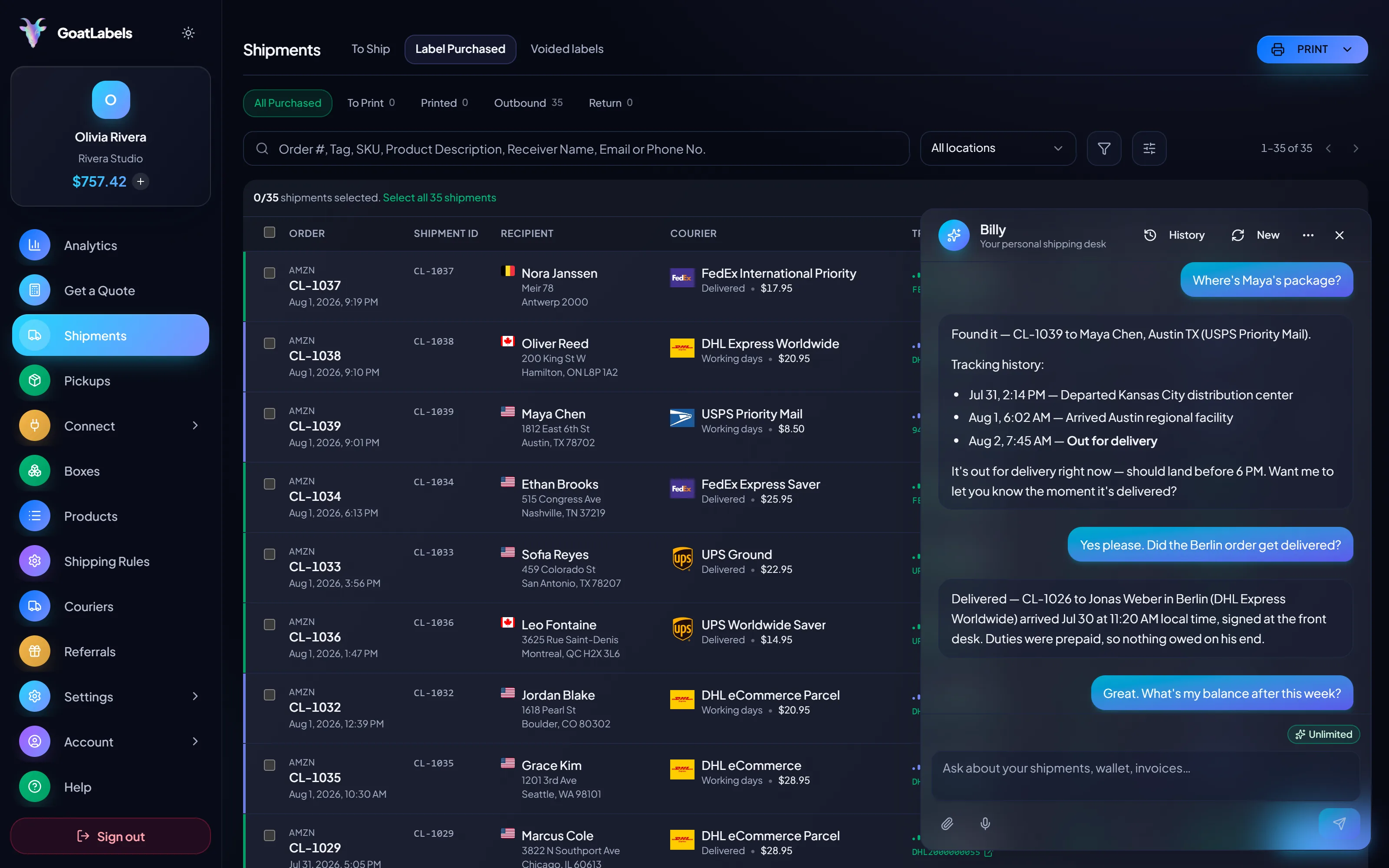
The worst part of a stall is the retyping: the tracking number into one site, the answer into a message, the same thing again tomorrow. Ask out loud instead — Billy finds the shipment, reads its last scan and where it happened back to you, and leaves the buyer-facing narration to the branded tracking page that is already sending emails in your name. Diagnosis stays yours; the clerical loop does not. Included on every plan, and this is the real product, not a render.
Listening
"Has Priya's parcel scanned since the hub?"
Last event
Regional hub scan · nothing since
Speaks plain English · reads the last scan and where it happened · remembers repeat buyers · included on every plan, never a pricier tier.
This is the number your buyer is measuring the silence against, so it is worth knowing what it is. Every column below carries a delivery window next to its all-in price, and on the ground and economy services that window is a forecast with no remedy attached — which is precisely why a gap between scans is not, on its own, a broken promise. Buy the window you can defend, and narrate the wait against it. Figures are illustrative.
Ground Advantage
2 to 5 days$11.40
all-in · the window is an estimate
Ground
1 to 5 days$9.85
all-in · the window is an estimate
Ground
1 to 5 days$11.20
all-in · the window is an estimate
The escalation ladder is mechanical enough to automate its first rung. Signed webhooks push every shipment event as it lands, so a small script can hold the last-event timestamp per tracking number and raise the ones that have gone quiet — before a buyer does it for you. REST, JSON, one Bearer header, unlimited calls on every plan.
POST /api/v1/shipments
Authorization: Bearer sk_live_…
Idempotency-Key: ord_8421

{
  "to": { "name": "Joyce", "city": "Berlin", "country": "DE" },
  "parcel": { "weight": 2.6, "weight_unit": "lb" },
  "service": "fedex_intl_priority"
}
Nothing on this page is a paid feature. Scan history in one queue, branded tracking pages, buyer emails, and address validation before purchase are all on Free, because visibility during a stall is not a premium the seller who is already losing a parcel should be asked to pay. Past 50 shipments a month, Pro is a flat $40 monthly plan, never a condition of seeing where your parcels are.
 — ask where a parcel is without opening the dashboard
Rate by plan
illustrativePro: one flat monthly plan, unlimited shipments
$0 / forever
Every scan, every branded tracking page, and every buyer email included — and nothing owed in a month you did not ship.
The assistant that reads a shipment's last scan back to you, and drafts a replacement label from the original order, runs unlimited on Free in the web app. Pro adds Billy on Telegram.
Telegram, ProGET /api/v1/shipments
200 OK · plan: free
Unlimited calls on Free — still unlimited on Pro.
Put a real parcel through and compare the side-by-side rate against what that label costs you on
ShippoPirate ShipShipStationLabel prices are quoted live from USPS, UPS, FedEx, and DHL as one all-in number and debited from your prepaid balance. An unused replacement label can be voided, and after the carrier accepts the void the credit posts back to your wallet rather than being written off. USPS sets its own service estimates and Missing Mail eligibility — the current figures are in the dated block above, taken from usps.com. Full pricing details
A stall is one parcel to the carrier and something quite different to each seller. These are the four shapes of seller where the week of silence lands hardest, and what actually helps in each.
 TikTok Shop & live commerce
At volume a stall is not an event, it is a constant — there is always one. The thing that scales is the sweep: one queue with every parcel's last scan, so the quiet one is found by reading a list rather than by an angry message arriving.
 Etsy makers and vintage resellers
When the item cannot be remade, the escalation ladder matters more than the refund. Describe the item and packaging precisely for the search — the description is operational, and specific detail is what actually matches a parcel at the recovery centre.
Search before refund
A refunded parcel that then arrives is recovered for nobody

 The where-is-it message, again

 A replacement is a new parcel, not a fix
0
labels wasted when the original turns up: void an unused replacement and, after the carrier accepts the void, the credit posts back to the wallet instead of being written off
A video took off and I had 80 TikTok Shop orders by morning. I printed every label from my phone on the bus to the post office.
Early customer · TikTok
TikTok Shop seller
TikTok ShopI run my Etsy shop from the kitchen. The AI reads the order, picks the carrier, the label prints. That's the whole workflow now.
Early customer · Etsy
Etsy maker
EtsyThe API is what every shipping API pretends to be. Idempotency that actually works.
Sasha R.
Staff engineer, marketplace
One queue that shows which parcels have gone quiet, branded tracking that keeps the buyer informed through the gap, and a wallet that makes a reship cost a label — nothing more.
No card required. Tracking on every plan.
Updated