

USPS
Ground Advantage
2 to 5 days$11.40
all-in · signature fee inside
Signature options are a ladder: indirect lets a neighbor sign, direct requires someone at the address, adult requires ID. Each level changes who can accept the parcel and what evidence exists afterward — and past a declared-value line, carriers stop asking and require one. The fee is chosen per shipment.
USPS, UPS, FedEx, and DHL each name their signature levels differently. The ladder is chosen on the shipment, and the fee is folded into each carrier's quote.


 all four
Fund the wallet with card, Apple Pay, Google Pay, ACH, or crypto — when you add a signature, the per-carrier fee is folded into the quoted price before you pay.
Signature services look like one checkbox and are actually a ladder with three rungs, and each rung answers a different question. Indirect signature asks only that some accountable human accepted the parcel — a neighbor, a building manager, the front desk — which is enough to stop a doorstep drop without forcing your buyer to be home. Direct signature narrows the answer to someone at the delivery address itself, so the parcel cannot detour through a helpful stranger. Adult signature is the odd one out: it is the only rung where the driver verifies who is signing, checking government-issued ID for age before the parcel changes hands. The first two rungs buy you evidence; the third buys you a gatekeeper.
The carriers agree on the ladder and disagree on the vocabulary, which is where sellers get lost. FedEx names all three rungs explicitly. UPS sells two and lets driver-release rules stand in for the bottom rung. USPS builds its ladder out of extra services stacked on top of ordinary tracking. DHL Express treats a signature as closer to the service norm than an add-on. The matrix below translates the four vocabularies onto one ladder, because the practical question is never which brand name to buy — it is which rung this parcel needs, and each carrier has a rung that matches.
| Carrier | The ladder as they name it | Who may sign at each rung | Proof captured | Governing document |
|---|---|---|---|---|
| USPS | Signature Confirmation, and an adult-signature tier on top of it. | Standard: anyone at the address. Adult tier: a person of qualifying age with ID, checked by the carrier. | Signer name and signature image attached to the tracking record. | USPS Domestic Mail Manual, extra services section. |
| UPS | Signature Required, and Adult Signature Required above it. | Signature Required: someone at the delivery address. Adult: age verified against government-issued ID. | Signature captured on the delivery record, retrievable as proof of delivery. | UPS Service Guide and Tariff for the origin country. |
| FedEx | The full three-rung ladder by name: Indirect, Direct, and Adult Signature Required. | Indirect: a neighbor or building manager may sign. Direct: someone at the address. Adult: ID checked for age. | Signature proof-of-delivery document with the signer identified. | FedEx Service Guide in force on your ship date. |
| DHL Express | Signature on delivery as the service norm, with restricted-release options. | A person at the destination signs the waybill record; release options vary by destination country. | Signed waybill data on the shipment record, available as proof of delivery. | DHL Express Terms and Conditions of Carriage for the origin country. |
Signature service matrix — compiled 2026-08-15.Level names, release options, and the declared-value lines that make a signature mandatory are set by each carrier and revised without notice; the fees change with each rate year. The dollar thresholds are therefore deliberately not printed here — the four governing documents named in the table are the sources to check before relying on a line, and the live fee for any parcel appears inside the quote itself. Re-checked against each carrier's published service guide at its annual rate announcement.
Every rung of the ladder produces the same category of artifact — a record that a named human accepted the parcel — but the strength of that artifact climbs with the rung. An indirect signature proves acceptance happened somewhere near the address, which defeats the claim that the parcel was never delivered at all but not the claim that it never reached the buyer. A direct signature ties acceptance to the address itself. An adult signature ties it to a person whose ID the carrier checked, which is as close to courtroom-grade as parcel delivery gets. Compare that with an unsigned delivery, where the whole record is a scan and perhaps a doorstep photo: proof the driver was there, and silence about everyone else.
What that artifact is worth depends on where you spend it. Carriers accept their own signature records as strong evidence in misdelivery investigations, and a signed proof-of-delivery document is retrievable long after the buyer conversation has gone cold. Whether it wins a marketplace or payment-processor dispute is a different question with its own framework, and that framework lives on the delivered-but-not-received guide rather than here. This page's honest summary is one sentence: a signature changes what you can prove, and the venue decides what proof is enough.
Below a certain point, the signature fee is a choice you make parcel by parcel. Above it, the carrier makes the choice for you, and three triggers do nearly all of the work. The first is declared value: every carrier draws a line in its service guide above which a shipment must travel with a signature, because the carrier wants a named acceptance on record before it carries that much liability. The second is the commodity: goods the law requires an adult to receive travel on adult signature regardless of what they cost. The third is the service itself — some premium and high-coverage services bundle a signature into the product, so the requirement arrives with the service choice rather than as a line item you can strike.
The practical consequence for a seller is that signature cost is not always avoidable, and pretending it is skews rate comparisons. When a parcel crosses a mandatory line, the honest quote includes the signature fee, and a comparison that omits it undercounts exactly the carriers that enforce it. That is why the per-shipment model matters: the signature type is chosen on the shipment, the per-carrier fee is folded into the all-in number at quote time, and a mandatory signature shows up as a visible price difference instead of a surprise. Fees that arrive by other routes — destination, season, account — are a different subject, covered on the surcharges guide.
A signature requirement is a promise that the parcel will not be released without one, and carriers keep that promise even when it costs everyone a week. The failure path runs in three stages. First the driver leaves a notice and takes the parcel back — no rung of the ladder permits leaving it anyway. Then comes the attempt cycle: a small number of redelivery tries on subsequent days, each ending in another notice if nobody qualifying is there. Finally the parcel goes to ground — held at a depot, post office, or pickup point for a limited window in which the buyer can collect it, sign, and show ID if the rung demands it. Only when that window closes does the parcel turn around, and the return leg has costs and consequences of its own.
Sellers can shorten the failure path more cheaply than they can buy their way out of it. Telling the buyer at purchase that a signature is coming turns the first attempt into the last one more often than any carrier option does. The carrier-side delivery-management tools can reschedule an attempt or redirect to a pickup point, though the adult rung refuses online waivers on principle — the ID check is the service, and a waiver would delete it. And the rung itself is worth matching to the buyer: direct signature on a parcel headed to a workplace with a front desk fails less than adult signature headed to an empty house. The decision of whether the fee is worth paying at all is arithmetic, and it belongs to the same expected-value method as the insurance decision — weigh the fee against what an unproven delivery would cost you, and let the label itself stay cheap either way.
The signature call is per parcel, so it has to happen where the parcel is priced — on the quote, with the fee visible next to the value it protects. The flow keeps it honest: the order arrives with a value and a destination, the quote shows each carrier's price with the chosen signature level folded in, and the shipment record keeps the signature type so the proof-of-delivery trail starts before the label prints.
Limited-run watch, high declared value, buyer in an apartment building with a front desk that signs for parcels.
The rung question takes seconds once the ladder is understood: does this parcel need any acceptance, acceptance at the address, or acceptance by a verified adult. Most parcels need the first; the expensive mistakes come from the few that needed the third.
 Decision support
When a dispute arrives months later, the shipment record answers the first question before it is asked: what level was bought, what it cost, and what the carrier captured at the door.
Shopify, Etsy, WooCommerce, TikTok Shop, Amazon, eBay, Walmart, Square, BigCommerce, Magento and the rest of the connector list drop orders into one To Ship queue — and not one of them carries a signature policy in with it. The rung is chosen on the shipment, against the declared value and the destination actually in front of you, whether the order arrived from a connector, a CSV, or a screenshot.
 Shopify
 Etsy
Etsy WooCommerce
 TikTok Shop
 Amazon
 eBay
eBay Squarespace
 Wix
Wix WalmartShopify PlusSoon
 Square
 BigCommerce
 Magento
 ZapierSoon
 NetSuiteSoon
 EcwidSoon
 Temu
Temu SheinSoon
 ChannelAdvisorSoon
 SkuVaultSoon
 Zoho InventorySoon
 Patreon
Signature services predate every shipping platform. What a platform adds is the ability to choose the rung one parcel at a time and see its true cost before paying.
Card, Apple Pay, Google Pay, ACH, and crypto all fund the same wallet, and a signed label debits exactly its quoted all-in amount — signature fee inside. The fee never arrives as a separate charge to match back to a parcel.
Paste an order, drop a screenshot, or speak the address and Billy drafts the shipment on every plan. The signature level stays a human decision on the quote — a parcel that legally requires an adult signature is not a judgment call an assistant should silently make for you.
BillyLIVEThe quoted number is the number that leaves the balance. When the signature fee is folded into one visible price per carrier, comparing the signed and unsigned versions of the same label is a glance, and a mandatory signature is a price difference you can see rather than an invoice line you discover.
USPS, UPS, FedEx, and DHL price their signature services differently, and the gap between carriers can exceed the fee itself. Because USPS, UPS and FedEx are quoted on every domestic parcel (DHL on international lanes) with the chosen level applied, the rung you need gets rate-shopped exactly like the postage under it.
UPS$12.48FedEx$13.22DHL$14.10USPS$11.79The API covers the shipment lifecycle the dashboard uses — signature type included — with signed webhooks and unlimited calls on every plan, so a seller who codifies a signature rule by value band can apply it in code against real shipment records.
Signature level saved
On the shipment record, fee inside the price
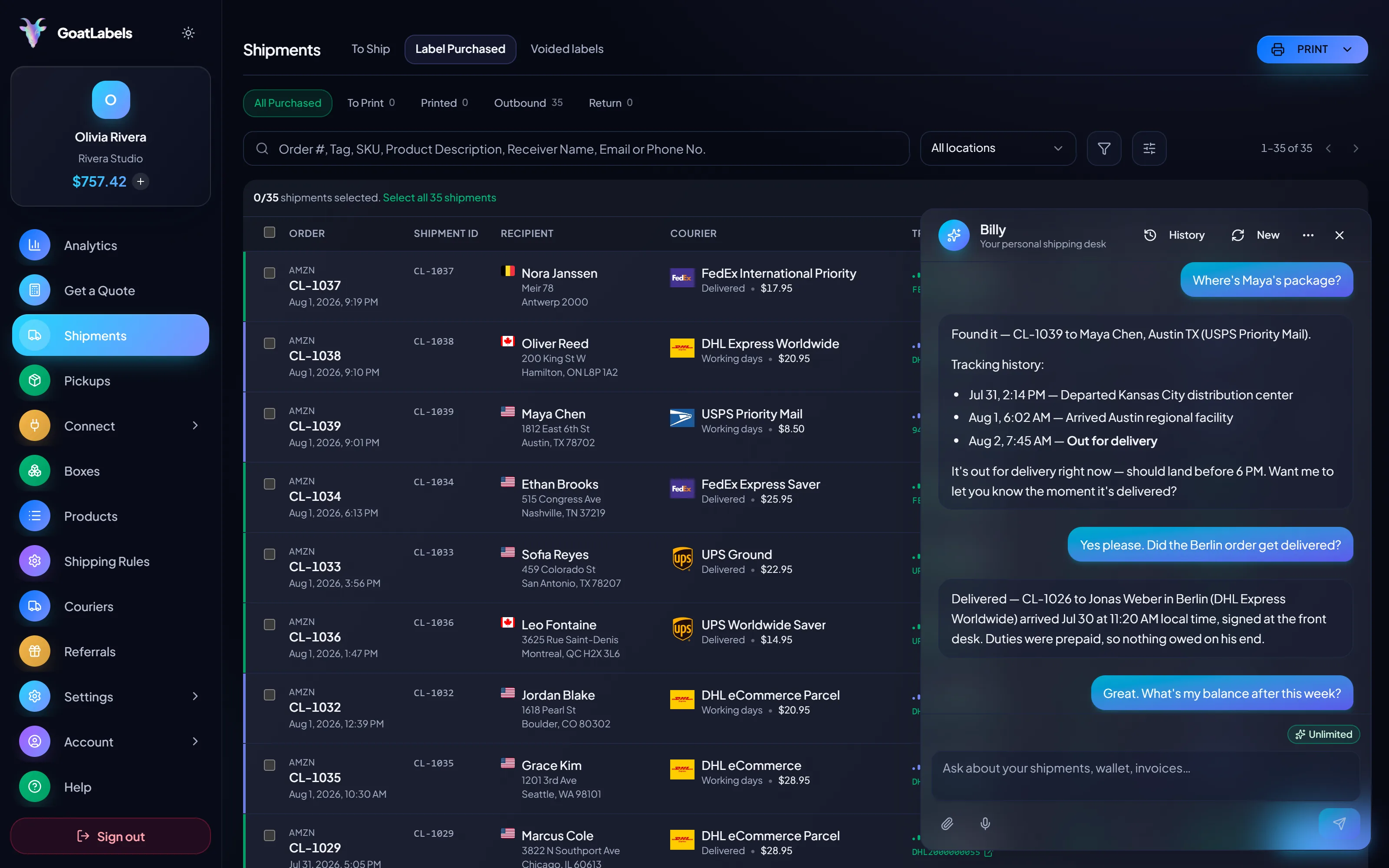
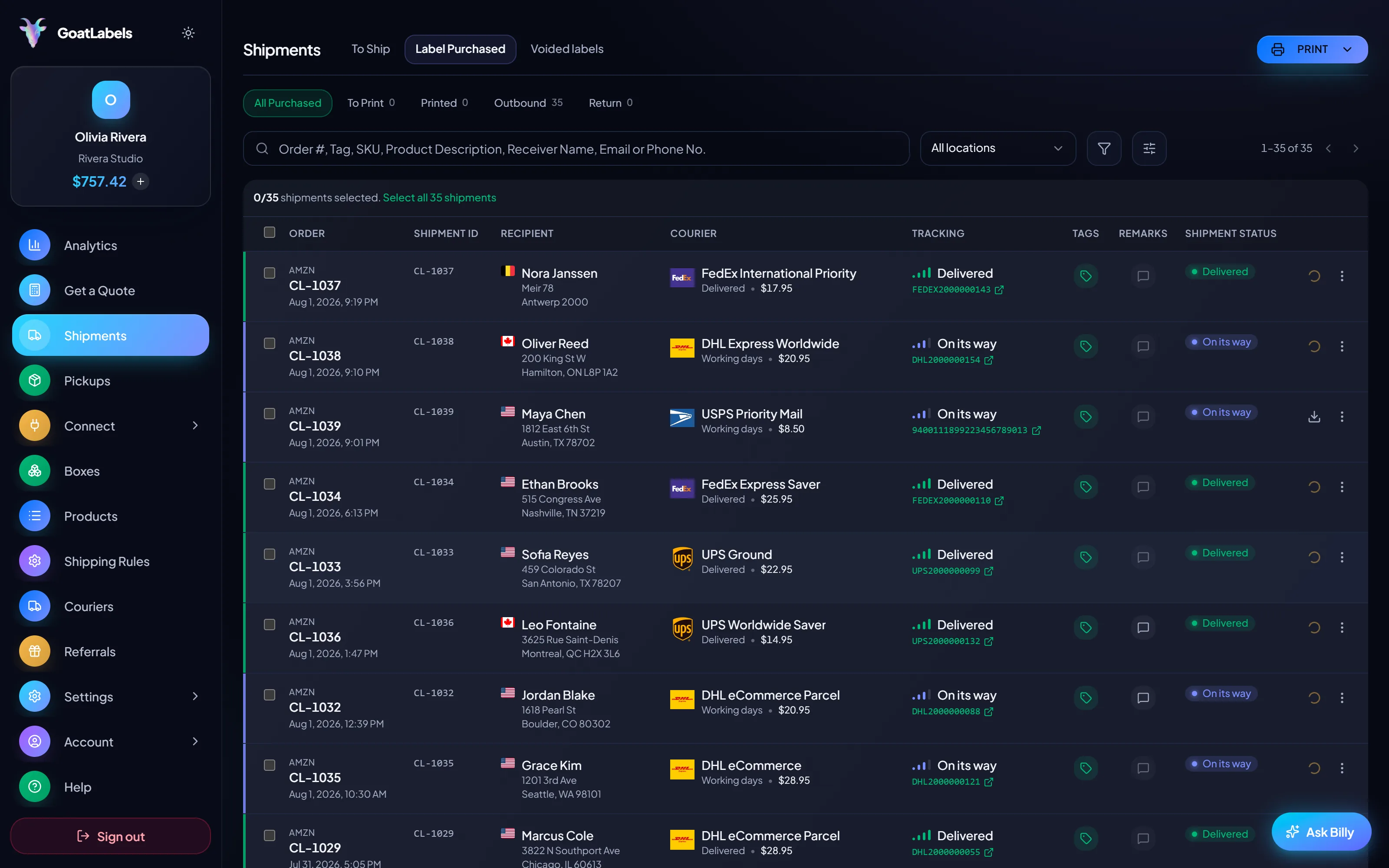
The signature decision is a judgement about the parcel in front of you — its value, its destination, whether anyone will be there — and it is worst made from memory at a desk hours later. Every part of it fits on the phone at the packing bench: the quote, the level, the fee folded into the price, and the record that keeps all three.
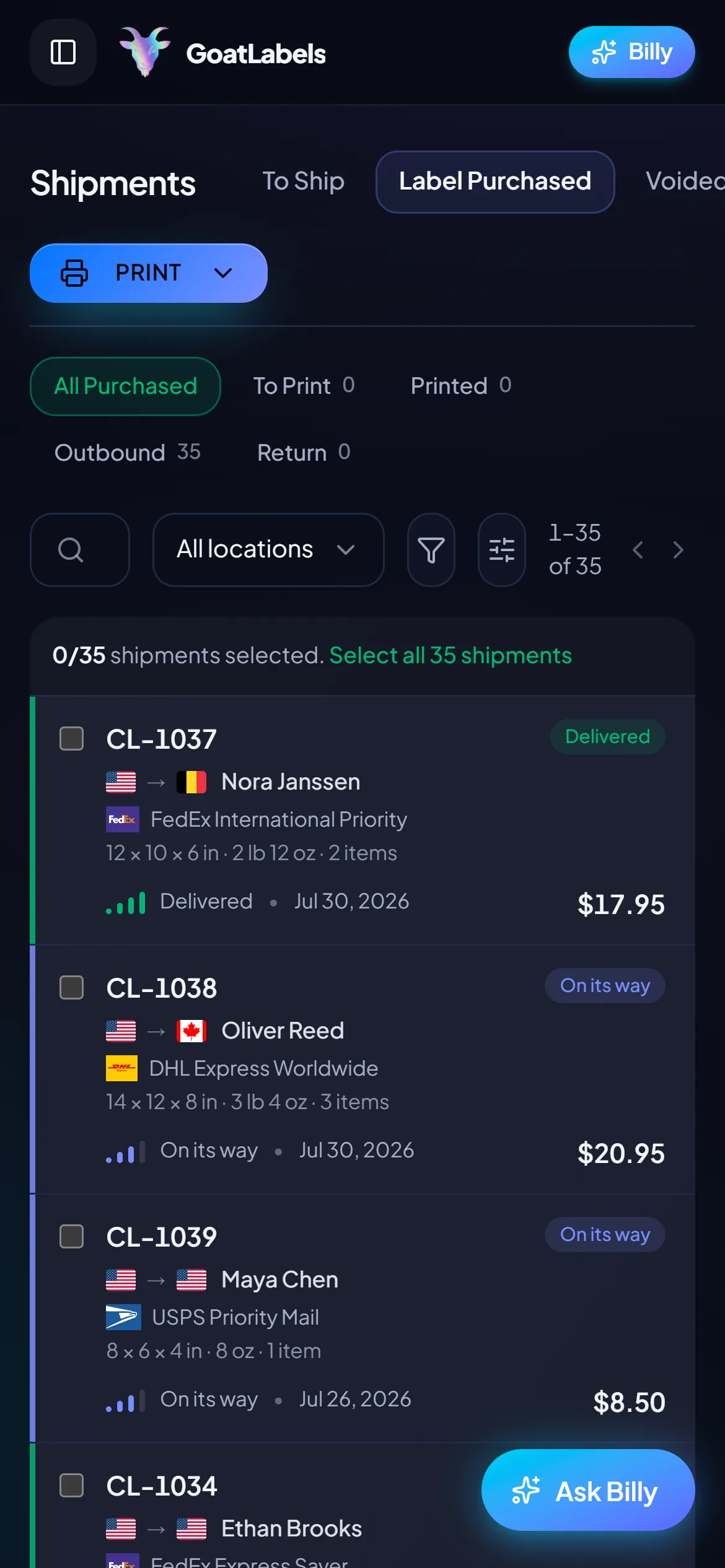
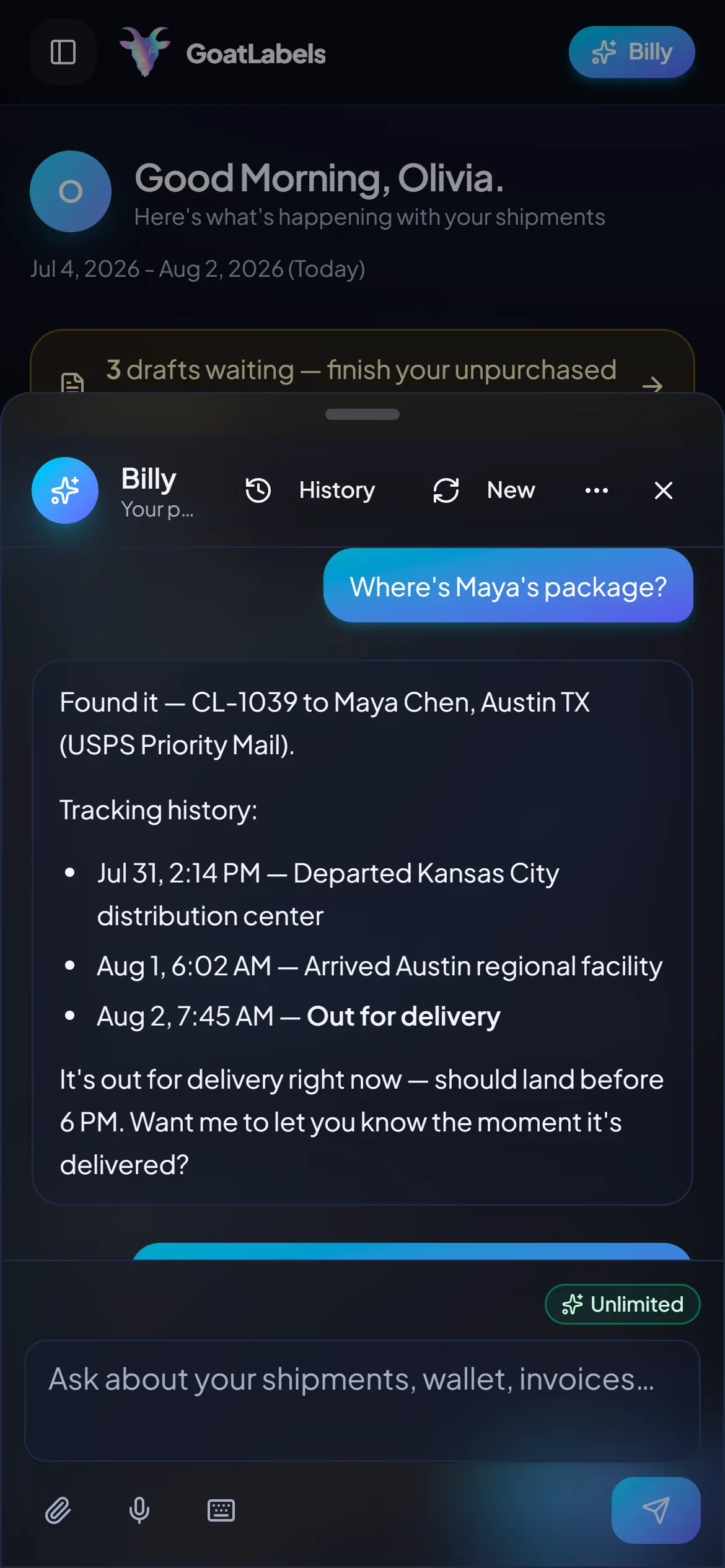
A signature buys evidence, and evidence is only useful if you can reach it without digging. Ask out loud and Billy finds the shipment and reads its delivery status back, so the question a buyer asks in a message gets answered in the same minute. What Billy will not do is quietly choose a signature level for you — a parcel that legally needs an adult to receive it is not a call an assistant should make. Included on every plan. This is the real product, not a render.
Listening
"Has the watch order been delivered yet?"
Delivered
Signed for at the address · level saved on the record
Speaks plain English · finds the shipment and reads its status back · included on every plan, never a pricier tier.
A comparison that leaves the signature fee out flatters exactly the carriers that charge most for it. Add a rung and the per-carrier fee is folded into the same all-in figure you were already comparing, so the signed and unsigned versions of a label are one glance apart and there is no separate line to reconcile later. The sample parcel below illustrates the all-in format itself.
Ground Advantage
2 to 5 days$11.40
all-in · signature fee inside
Ground
1 to 5 days$9.85
all-in · signature fee inside
Ground
1 to 5 days$11.20
all-in · signature fee inside
Most sellers who buy signatures end up with a rule in their head: above this value, sign for it. A rule in a head is applied unevenly on a busy Friday. The API covers the same shipment lifecycle the dashboard does — signature type included — so the rule can live in code and apply to every shipment identically.
POST /api/v1/shipments
Authorization: Bearer sk_live_…
Idempotency-Key: ord_8421

{
  "to": { "name": "Joyce", "city": "Berlin", "country": "DE" },
  "parcel": { "weight": 2.6, "weight_unit": "lb" },
  "service": "fedex_intl_priority"
}
Signature services are the carriers' products and the fee is the carriers' fee — it appears inside the quote and leaves your wallet with the label. There is no plan here that unlocks a level, no per-shipment platform surcharge for choosing one, and no monthly fee on Free. Free covers 50 shipments a month; past that, Pro is one flat $40 monthly plan with unlimited shipments.
 — check a delivery without opening the dashboard
Rate by plan
illustrativeone flat plan, unlimited shipments
$0 / forever
Choose indirect, direct, or adult on any shipment, on the free plan, from the first parcel.
The assistant that drafts the label and finds the shipment afterwards runs unlimited on Free. The signature level stays a human decision on either plan — that is a policy choice, not a feature gate.
Telegram, ProGET /api/v1/shipments
200 OK · plan: free
Unlimited calls on Free — still unlimited on Pro.
Put a real parcel through and compare the side-by-side rate against what that label costs you on
ShippoPirate ShipShipStationSignature fees, level names, and the declared-value lines that make a signature mandatory are each carrier's to set and revise; the live fee for any parcel appears inside that parcel's quote. Label prices are quoted from USPS, UPS, FedEx, and DHL as one all-in number and that exact amount leaves your prepaid wallet. Full pricing details
Buying a signature on everything is as wasteful as buying it on nothing, and the sellers who get this right are choosing per parcel rather than per policy. Four cases where the ladder repays the fee.
 Where the choice stops being yours
Cross the line in a carrier's service guide and the signature arrives with the shipment whether you asked for it or not. Because the fee is folded into each quote, the mandatory rung shows up as a visible price difference between carriers instead of a surprise on a later invoice.
 The one rung that checks ID
Adult signature is not a stronger version of direct signature — it is a different service, because the carrier verifies who is signing rather than that someone did. It cannot be waived online, which is exactly the point of it.
Adult rung, chosen at quote
ID checked at the door · no online release

 Telling the buyer before the driver does
 Front desks, mail rooms, and empty houses
1
attempt, if the rung matches who is actually there to sign
Updated 2026-08-15
A video took off and I had 80 TikTok Shop orders by morning. I printed every label from my phone on the bus to the post office.
Early customer · TikTok
TikTok Shop seller
TikTok ShopI run my Etsy shop from the kitchen. The AI reads the order, picks the carrier, the label prints. That's the whole workflow now.
Early customer · Etsy
Etsy maker
EtsyThe API is what every shipping API pretends to be. Idempotency that actually works.
Sasha R.
Staff engineer, marketplace
Quote the parcel across carriers, pick the rung it actually needs, and let the fee ride inside one all-in number you approved.
No card required. Signature level stays a per-shipment choice.
Updated