

USPS
Ground Advantage
3–6 days$16.90
$1.20 of Premium insurance included
all-in · one balance for every carton
When Faire covers shipping and you use your own carrier, Faire reimburses you at its Ship with Faire rate for the same carrier, service, and package — so you keep the difference when you beat it. On multi-carton orders every tracking number must be entered or the reimbursement is short.
USPS, UPS, FedEx, and DHL priced on each carton's own weight and dimensions, so you know which side of Faire's rate you are on before you buy.


 per carton, not per order
 Card, Apple Pay, Google Pay, ACH, or crypto funds one balance, so a four-carton wholesale order and a single DTC parcel come out of the same money.
On an order where Faire is covering shipping, you have two routes: print Faire's own label, or ship with your own carrier account and get reimbursed. The second route is the interesting one, because of how the reimbursement is set. Faire does not pay your invoice. It pays what it would have charged for the same carrier, the same service, and the same package — its own Ship with Faire rate for that shipment, used as a benchmark.
That single design decision is what makes this page worth writing. Reimbursement at a benchmark rate turns shipping into a spread rather than a pass-through: beat the benchmark on that carton and the difference is yours to keep, miss it and you absorb the excess yourself. It is effectively a rate cap with your margin on the upside. And because the benchmark is defined by carrier, service, and package rather than by your relationship or your volume, it is knowable before you buy anything — which is what separates this from the usual vague advice to shop around. You are not hoping for a saving. You are quoting against a number you can predict.
A DTC parcel and a wholesale carton are not the same problem. The carton is heavier, denser, and going to a shop rather than a house, and every one of those differences widens the gap between carriers. On a light poly mailer the four carriers cluster; on a thirty-pound carton going four zones out they do not, and the winner changes with the destination in a way no default carrier can track for you. Quote USPS, UPS, FedEx, and DHL on the same carton and you get four all-in prices to put against Faire's benchmark — how that four-carrier rate-shop prices a parcel covers the mechanics of the quote itself.
Two things move a carton's price more than the base rate does, and both are worth knowing before you pack. The first is dimensional weight: a carton that is bulky for its weight gets billed on its size, and the divisor that converts one to the other is the carrier's, not yours — package size and weight limits by carrier is where that gets worked through. The second is surcharges, which attach to the destination and the season rather than to the parcel, and are catalogued by trigger on shipping surcharges explained. There is one that works in wholesale's favour: retail stores are commercial addresses, so the residential surcharge that quietly taxes DTC shipping usually does not apply. GoatLabels validates the address at quote time and shows whether it classified as residential or commercial before you pay, which on a wholesale carton is the difference between a benchmark you beat and one you do not.
Wholesale orders rarely leave in one box. A four-carton order is four parcels, four weights, four sets of dimensions, and four tracking numbers — and the reimbursement follows the tracking. Enter one number for a four-carton shipment and only one carton is recognised: the buyer cannot follow the rest, and what comes back to you reflects one parcel instead of four. This is the single most common way brands lose money on the self-ship route, and it is not a pricing mistake, it is a data-entry one.
So treat each carton as its own shipment from the start. Weigh and measure them individually rather than dividing a total by four, because the heaviest carton and the bulkiest carton are usually not the same box and they will not price the same either. Quote each one, buy each one, and enter every resulting tracking number against the Faire order before you close it out. Then reconcile: what the four labels actually cost you, against what Faire reimbursed. That comparison is the whole point of shipping it yourself, and it only works if the tracking is complete. Brands sending a lot of orders in a batch can drive the same loop from a spreadsheet instead of the screen — bulk labels from a CSV covers the column mapping, the per-row address validation, and the row-by-row purchase.
Often. If a carton is small and light, if the benchmark already sits at or under anything you can quote, or if the order is one box going somewhere ordinary, printing Faire's own label is the correct answer and the reconciliation work is not worth the spread you would earn. The general framework for deciding when a platform's own label wins is argued on when the platform's own label is the right call. Self-shipping earns its keep on the heavy, the bulky, the multi-carton, and the routes where you already know a particular carrier is strong — not on every order by default.
The self-ship route only pays if every carton is priced on its own numbers and every tracking number lands on the Faire order. This is that loop: the order arrives, each carton is weighed and quoted separately, each label is bought from one prepaid balance, and what you actually paid is sitting next to what Faire reimbursed when you close the order out.
Reorder: 12x candle 8oz, 6x diffuser, 24x soap. Deliver to the shop, not the warehouse — closed Mondays.
There is no Faire connector: the order arrives as a paste or a screenshot, and every carton is entered with its own weight and dimensions rather than a total divided four ways.

Every tracking number goes onto the Faire order before you close it, because the reimbursement follows the tracking. Then reconcile: four ledger lines for what you paid, against what Faire reimbursed at its own rate.
Store sync covers Shopify, Etsy, WooCommerce, and TikTok Shop. Faire is not one of them, so a wholesale order never lands in a queue on its own: you paste the order or drop the packing list, Billy keeps each carton its own shipment, and every tracking number goes back onto the Faire order by hand — which is the step the reimbursement follows.
 Shopify
  Etsy
Etsy  WooCommerce
  TikTok Shop
  Amazon
  eBay
eBay  Squarespace
  Wix
Wix  Walmart Shopify Plus Soon
 Square
  BigCommerce
  Magento
  Zapier Soon
 NetSuite Soon
 Ecwid Soon
 Temu
Temu  Shein Soon
 ChannelAdvisor Soon
 SkuVault Soon
 Zoho Inventory Soon
Faire reimburses at its Ship with Faire rate for the same carrier, service, and package. Everything below exists to get the carton under that number and keep the difference, or to tell you honestly that you cannot.
A four-carton order and a single DTC parcel come out of the same prepaid balance, funded by card, Apple Pay, Google Pay, ACH, or crypto. No monthly minimum to print, which matters when wholesale arrives as a burst of orders after a trade show and then goes quiet for weeks.
No Faire connector exists, so the order arrives as text. Billy reads the retailer, the ship-to, and the line items out of a paste or a screenshot, validates the address, and keeps each carton as its own shipment — because a total weight divided by four prices none of the four correctly.
Each carton gets one all-in number that is final at quote time and leaves the balance as its own ledger line. That is what makes the reconciliation possible at all: four readable entries to set against what Faire reimbursed, instead of one blended figure you cannot take apart.
Light parcels price similarly across carriers. Heavy, dense, commercially-addressed cartons do not — the spread at wholesale weights is wide enough to sit on both sides of Faire's benchmark on the same order. Quoting USPS, UPS, FedEx, and DHL on each carton is how you find out which side you are on before the money moves.
UPS $12.48 FedEx $13.22 DHL $14.10 USPS $11.79 Wholesale is seasonal, and a market week can produce more orders than the rest of the quarter. Quote and buy from your own script over REST and JSON, with signed webhooks for tracking events and real idempotency keys so a retried order never buys two labels. Unlimited calls on every plan.
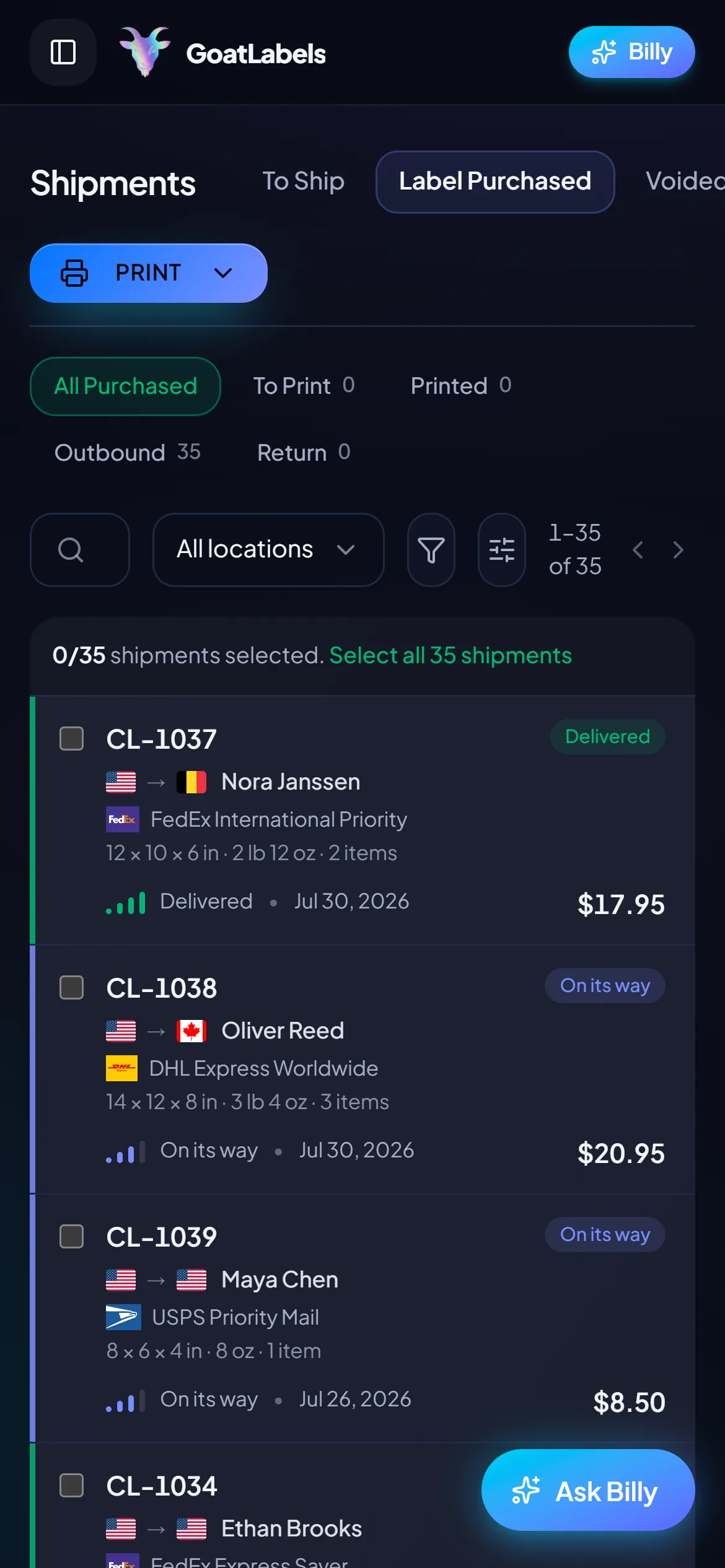
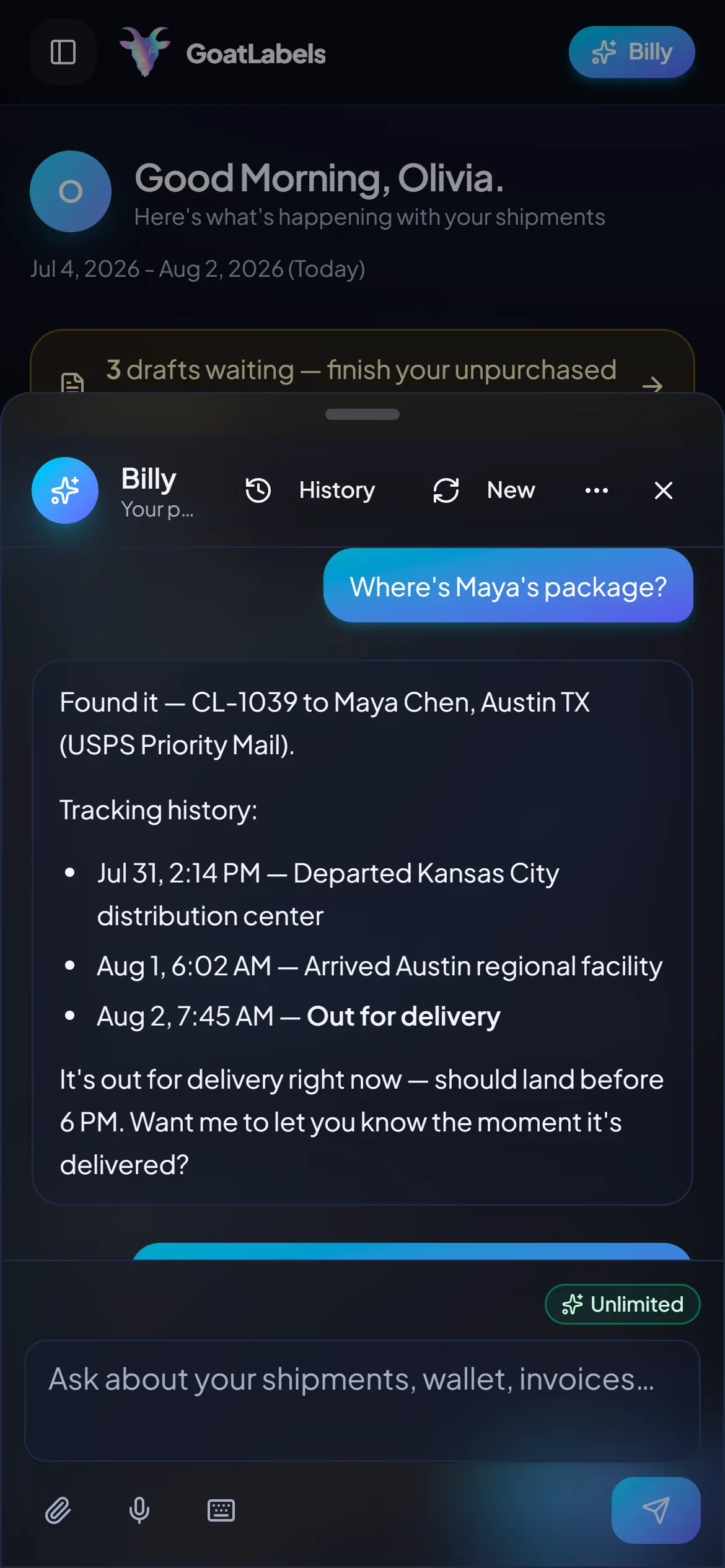
Carton 3 of 4 · label ready
Commercial address · tracking to the Faire order
A wholesale order gets packed where the stock is — on the studio floor, with a scale and a tape measure and no laptop in reach. So each carton gets weighed, quoted, and bought from the phone, in the order the boxes are taped shut.
Packing a wholesale order is a two-handed job from the first carton to the last. Ask out loud — Billy finds the shipment, quotes USPS, UPS, FedEx, and DHL on the carton you just weighed, and reads the all-in price back so you can put it against Faire's rate without stopping. Included on every plan. This is the real product, not a render.
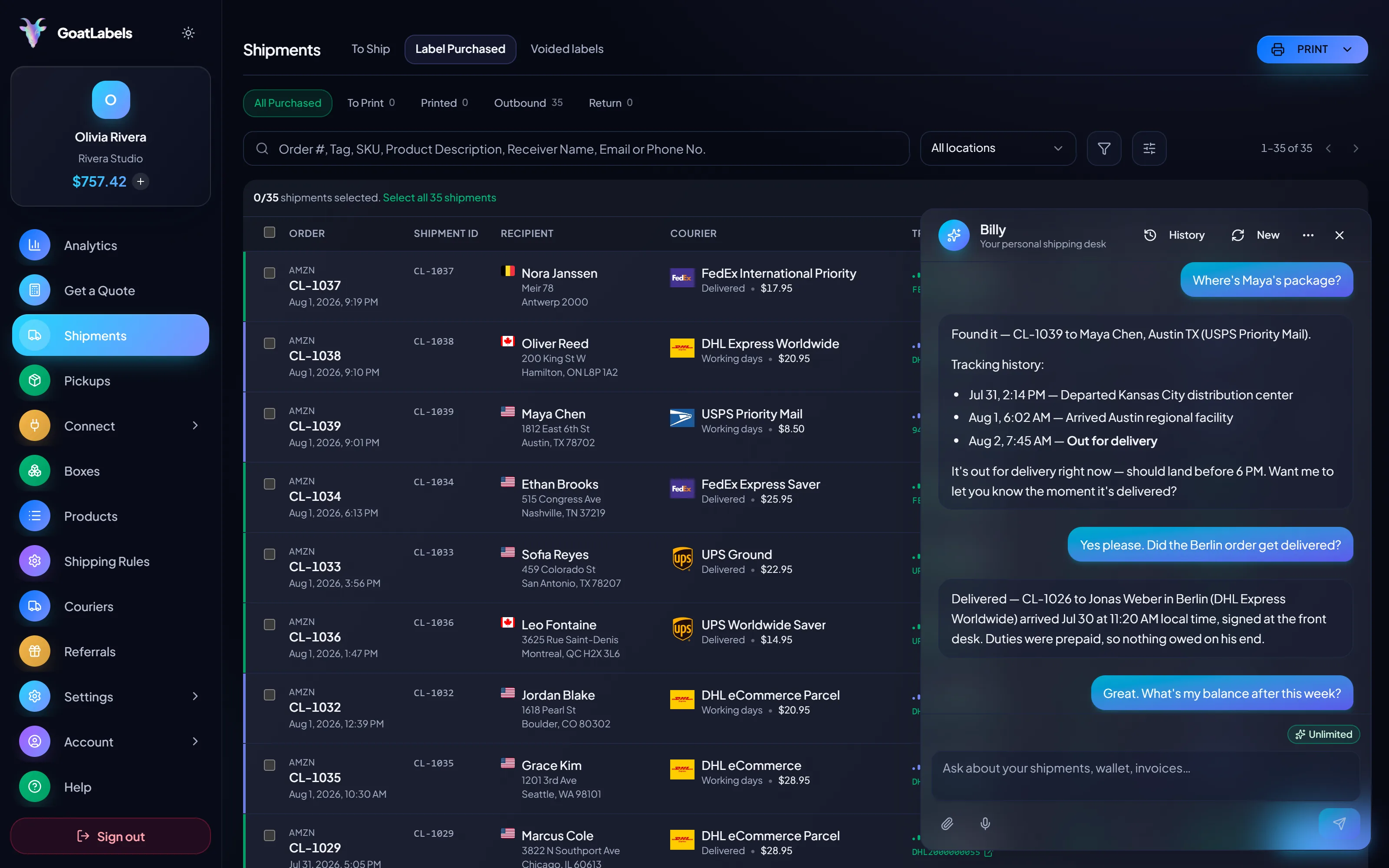
Listening
"What did the Northside cartons cost?"
Out for delivery
Carton 3 of 4 · scanned this morning
Speaks plain English · remembers your saved carton sizes · phone on the studio floor, browser, or Telegram on Pro.
A wholesale order that leaves in four cartons is four quotes, not one. Each carton is rated against all three ground services and bought from the same prepaid balance, which is also the record you reconcile the reimbursement against. Figures are illustrative.
Ground Advantage
3–6 days$16.90
$1.20 of Premium insurance included
all-in · one balance for every carton
Ground
3–5 days$14.20
$1.20 of Premium insurance included
all-in · one balance for every carton
Home Delivery
3–5 days$14.80
$1.20 of Premium insurance included
all-in · one balance for every carton
A trade show can produce more orders than the rest of the quarter, each of them several cartons. The API is here, free, on the plan you are already on — because changing shipping tools mid-season just to get one is a migration nobody wants to do twice.
POST /api/v1/shipments
Authorization: Bearer sk_live_…
Idempotency-Key: ord_8421

{
  "to": { "name": "Joyce", "city": "Berlin", "country": "DE" },
  "parcel": { "weight": 2.6, "weight_unit": "lb" },
  "service": "fedex_intl_priority"
}
Wholesale arrives in bursts — a market week, then weeks of nothing — and a monthly fee would come out of the same spread you are working. Free covers 50 shipments a month with connected shops, the assistant, and the API all included. Pro is a flat plan for the season that goes big, never a condition of printing a carton label.
Volume pricing
illustrativemore volume → lower per-label rates
$0 / forever
Enough for a brand shipping its own wholesale, and nothing owed between markets.
The assistant that turns a pasted wholesale order into per-carton draft labels runs on Free, unlimited, in the web app on desktop and mobile. Pro adds Billy on Telegram.
GET /api/v1/shipments
200 OK · plan: free
Unlimited calls on Free — still unlimited on Pro.
Bring your invoice: on Pro we work with you to beat the rates you're getting from
ShippoPirateShipShipStation Label prices are quoted live from USPS, UPS, FedEx, and DHL and shown as one all-in number, with nothing added at checkout. What Faire reimburses is Faire's own rate for the same carrier, service, and package — this is only the number you set against it. Full pricing details
Three shapes of wholesale brand where self-shipping beats the benchmark often enough to be worth the reconciliation, and one where the answer is simply one balance for everything.
No 3PL, cartons packed in-house
You already know your boxes and your usual routes better than a benchmark rate does. Quoting each carton against four carriers turns that knowledge into a number rather than an instinct, and the difference from Faire's rate is bankable margin instead of a saving you assume.
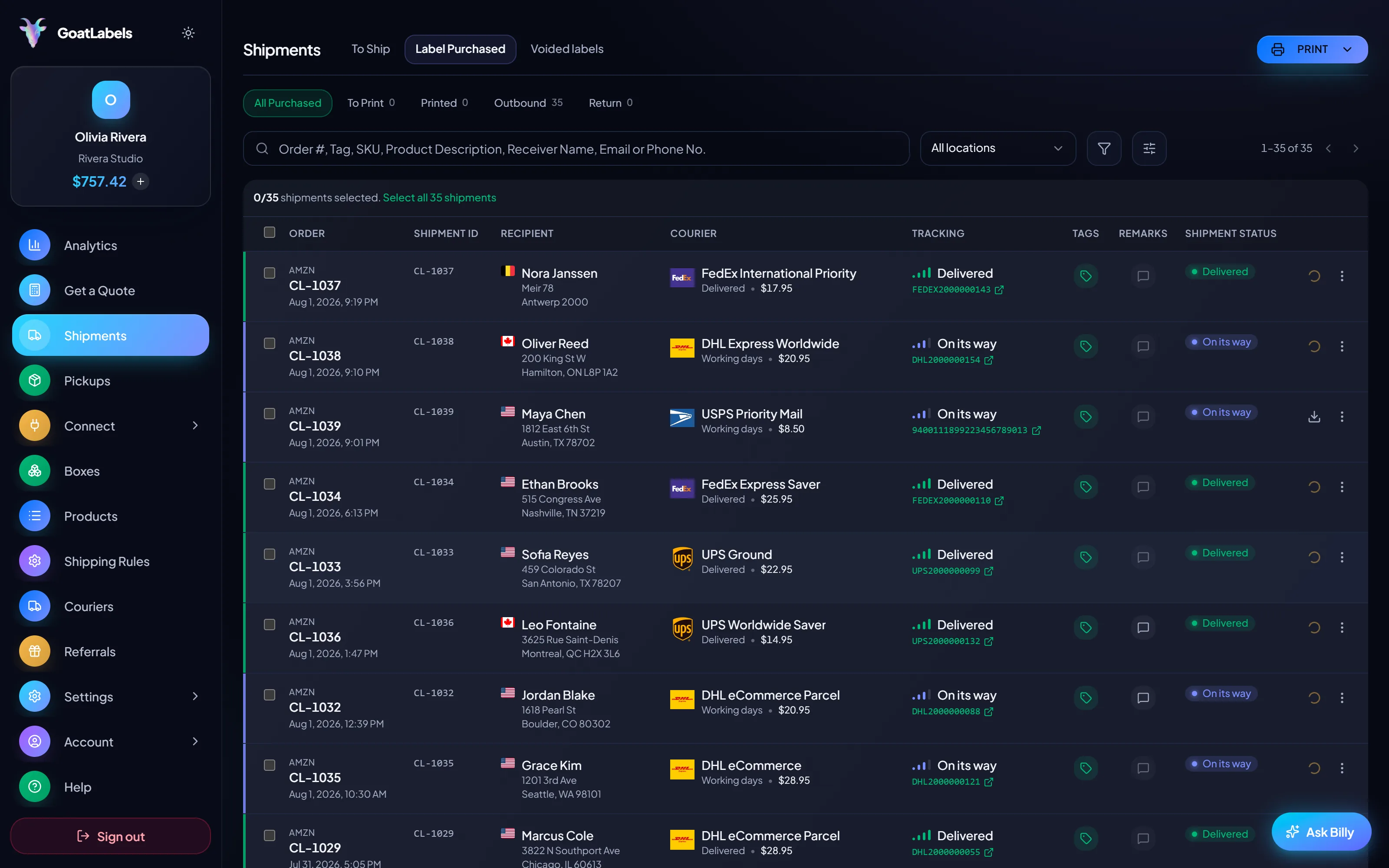
Bulky, dense, or oversized cases
Ceramics, candles, glassware, anything sold by the case. These are the cartons where dimensional billing and destination surcharges decide the price, and where two carriers can quote the same box very differently on the same day.
Measured, then quoted
Each carton on its own weight and dimensions, never a total split four ways
The restock that arrived as a message
Faire alongside your own store
1
prepaid balance and one queue behind wholesale cartons and DTC parcels alike
A video took off and I had 80 TikTok Shop orders by morning. I printed every label from my phone on the bus to the post office.
Early customer · TikTok
TikTok Shop seller
I run my Etsy shop from the kitchen. The AI reads the order, picks the carrier, the label prints. That's the whole workflow now.
Early customer · Etsy
Etsy maker
The API is what every shipping API pretends to be. Idempotency that actually works.
Sasha R.
Staff engineer, marketplace
Weigh each carton, quote it across USPS, UPS, FedEx, and DHL, buy from one prepaid balance, and put every tracking number on the Faire order before you close it.
Free to start, no card required, no monthly minimum to print. Faire sets the reimbursement rate; we only help you price against it.