

USPS
Priority Mail Intl
10–15 days$7.40
$1.90 of duties & taxes prepaid, not billed to your buyer
all-in · no surprises
For Amazon orders, use Amazon Buy Shipping. A label bought outside it forfeits the A-to-z claim protection and the on-time delivery credit Amazon grants Buy Shipping labels, and GoatLabels has no Amazon connector. The honest split is Buy Shipping on Amazon, one prepaid wallet everywhere else.
USPS, UPS, FedEx, and DHL quoted on the same parcel for Shopify, Etsy, WooCommerce, TikTok Shop, and every DM sale — the orders Amazon was never going to protect anyway.


 all quoted
 Buy Shipping for Amazon. One prepaid wallet for everything else, funded by card, Apple Pay, Google Pay, ACH, or crypto.
Nothing on this page tries to pull an Amazon order out of Buy Shipping. This is the other half of the week: the Shopify, Etsy, WooCommerce, and TikTok Shop orders, plus the sales that arrive as a message and never become an order record at all. Those have no claim policy attached to them and no protected label to buy, so the only things left to get right are the retyping, the carrier choice, and what it costs you to hold the tool in a quiet month.
Hey! 2x hoodies (M) 1x tee (L) 😅 Ship to: Maya R. Austin, TX 78701
Shopify, Etsy, WooCommerce, and TikTok Shop sync into the To Ship queue. A DM, a screenshot, or a typed address lands in the same queue at the same rates. Amazon orders are the one thing that does not appear here — there is no connector, and they belong in Buy Shipping.

The exact quoted amount leaves your prepaid wallet — nothing is added at checkout. Void the label and the credit lands back in the balance. None of this changes how an Amazon order should be shipped; it changes what the other channels cost to run alongside it.
Most comparison pages are written by the challenger and reach the challenger's conclusion. This one does not, so it is worth stating the general rule properly — this is the page on this site that owns it, and everywhere else links here rather than re-arguing it.
A marketplace's own label is the right choice whenever the platform has attached something to that label that you cannot buy separately. Usually that something is risk transfer: a claim the platform will absorb, a metric it will not hold against you, a dispute it decides in your favour because it sold you the shipping. Sometimes it is a rate you could not reach on your own. Occasionally it is eligibility for a badge or a programme that drives your sales.
Notice what is not on that list: convenience, habit, and a slightly cheaper quote. Those are the reasons sellers usually give for going outside, and they are the weakest ones available. A protection you gave up does not bill you on the day you gave it up. It bills you months later, in a claim you now own, and by then the saving is unrecoverable and unmeasured.
So the test is a single question, asked per channel rather than per order: what does this platform attach to its own label, and what is it worth on a bad day? When the answer is "nothing much" — a plain prepaid label with no claim coverage and no metric shielding — you are free to shop. When the answer includes claim coverage or account health, use theirs. Amazon is the clearest case of the second kind in e-commerce, which is why this page exists and why it reaches the conclusion it does.
Buy Shipping is not just a purchasing convenience inside Seller Central. It is the mechanism by which Amazon takes on part of your shipping risk, and the protections it carries are attached to the label rather than to your account. That distinction is the whole argument: you forfeit them one order at a time, quietly, on exactly the orders where you decided to be clever.
Two protections do the heavy lifting. The first is claim coverage: where a buyer files an A-to-z claim on an order shipped with a compliant Buy Shipping label, correctly and on time, Amazon's own policy is what stands between that claim and your account. The second is metric shielding: Amazon sold you the service, so a carrier's late day on Amazon's own label is not treated the same way as a late day on a label Amazon knows nothing about.
Neither of those is something a third-party tool can replicate, and we are not going to imply otherwise. GoatLabels can quote you four carriers on that parcel. It cannot make Amazon absorb a claim on it.
Dated block — Amazon policy specifics, reviewed August 2026
The mechanisms below are Amazon's, described qualitatively on purpose. Amazon revises Buy Shipping eligibility, the carrier list, the claim policy, and the on-time delivery rate calculation on its own cycle, and a specific number printed here would be wrong before it was useful.
Source: Amazon's own Seller Central policy pages for Buy Shipping, A-to-z Guarantee claims, and on-time delivery rate. Re-check at each Amazon policy cycle. Nothing in this block appears in this page's title, description, or opening answer.
On-time delivery rate is the metric sellers underestimate, because it is measured on delivery rather than on dispatch. You can pack the same day, hand the parcel over on time, and still take the hit when the carrier loses a day in a sort facility — that is the risk Amazon's own label partially absorbs and an outside label hands back to you.
The mechanism is worth understanding rather than memorising. Amazon needs tracking it can validate, from a carrier it recognises, resolving to a delivery event inside the promised window. Buy Shipping supplies all three by construction. An outside label means you are asserting the tracking number, and every gap in that chain — an unrecognised carrier, a scan that never happened, a delivery event a day late — lands in your metrics rather than in a protection.
There is a second-order effect that catches multi-channel sellers. Account health is not per-order, it is a rate over a window, so a handful of outside labels during a busy week can move a number that then constrains you for months. The cheap label was not cheap; it was a small saving with a large, delayed, correlated risk attached. If you want to see how the same logic plays out where a marketplace does not attach protection, compare with shipping labels for TikTok, where buying your own is often the right answer.
Exceptions exist. They are fewer than sellers want them to be, and each one should be a decision you could defend out loud.
Buy Shipping cannot price the parcel. Oversize, freight-shaped, or a lane its carriers do not serve. If Amazon's tool will not sell you a label, an outside label is not a preference, it is the only way the order ships.
A service you genuinely need is unavailable there. Rare, and worth double-checking before you rely on it, because the carrier list moves.
The order is not really an Amazon order. A replacement you are sending goodwill, a sample, a wholesale carton to a buyer you met through the channel — these were never inside the protection to begin with.
What is not on the list: a cheaper quote on an ordinary order. If the only thing you gained is a small rate difference, you traded claim coverage and metric protection for it, and that trade loses on any parcel that goes wrong. Where a genuinely cheaper carrier does change the economics is on the channels with no protection attached at all — see how the four-carrier rate-shop works for those.
The practical shape of a multi-channel seller's week is not "Amazon versus everyone". It is Amazon plus two or three other places, each with its own idea of what a label is. The instinct is to unify all of it into one tool. That instinct is what leads people to buy outside labels for Amazon orders, and it is why this page exists.
The workable arrangement is two systems, not one and not five. Amazon orders are bought in Buy Shipping, where the protections live and where the tracking arrives without you touching it. Everything else — Shopify, Etsy, WooCommerce, TikTok Shop, and the sales that arrive as a DM with no connector anywhere — goes into a single To Ship queue with one prepaid wallet behind it, where four carriers get quoted on every parcel because nothing is protecting those orders for you.
That arrangement costs nothing to hold. There is no monthly minimum to print here, so the non-Amazon side bills you only for the labels you actually buy, and a quiet month is a quiet month. It also puts the rate-shopping where it is worth doing: on the orders where the label price is genuinely the whole decision, rather than on the ones where you would be trading away a claim policy to save a small amount. If you run an ops suite over the top of all of it, GoatLabels vs ShipStation covers that comparison, and pricing shows what the non-Amazon side costs to run.
And to be explicit about our own gap, because it is the fair thing to do on a page like this: there is no GoatLabels Amazon connector. An Amazon order does not appear in the queue. That is a real limitation, it is part of why the recommendation on this page is what it is, and we would rather you read it here than discover it after signing up.
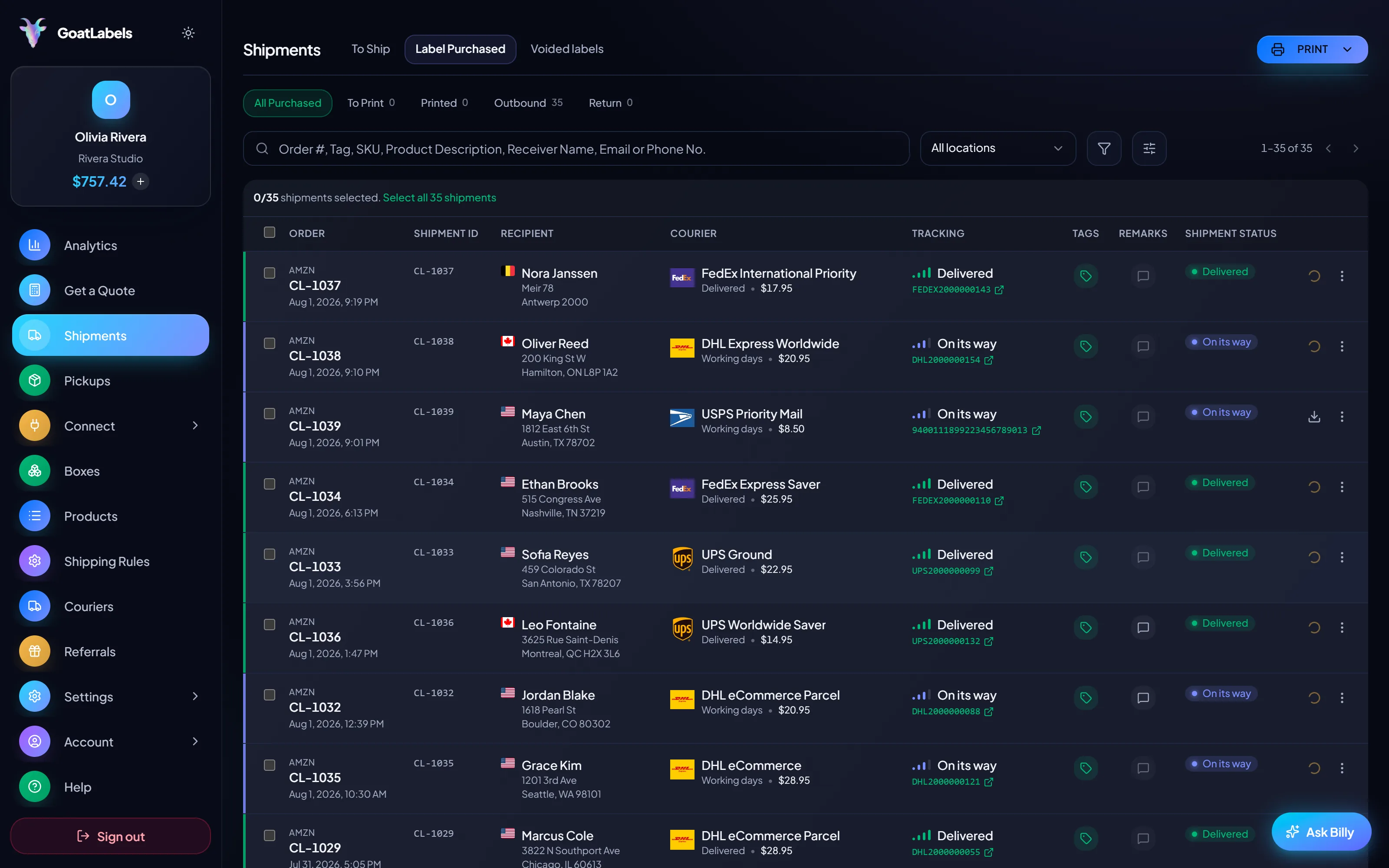
These four sync into one To Ship queue and take tracking back when you print: Shopify, Etsy, WooCommerce, and TikTok Shop. Amazon is deliberately absent — there is no GoatLabels Amazon connector, and an Amazon order belongs in Buy Shipping anyway. Sales that arrive as a message rather than an order record still work here: paste the DM or the screenshot and Billy drafts the label from it, no connector required.
 Shopify
  Etsy
Etsy  WooCommerce
  TikTok Shop
 None of the five below transfers risk the way an Amazon label does, and we are not going to claim otherwise. What they do is make the channels with no protection attached cheaper to run and cheaper to hold — which is where the argument on this page actually lives.
Fund it with card, Apple Pay, Google Pay, ACH, or crypto, then pay per label out of that balance. That matters more than usual here: you are already paying for Amazon's side of the operation, so the second system should cost nothing in a week you barely used it. Void a shipment and the amount credits straight back to the balance.
The AI assistant drafts the whole label from a pasted DM, a screenshot, or a spoken address — and validates the address before you spend anything. On channels with no claim policy behind them, a bad address is a loss you absorb yourself, so catching it early is worth more here than on the Amazon side.
One all-in price per service at quote time, and that exact amount leaves your balance. Fuel, residential, and handling are inside it. There is no day-after carrier invoice to reconcile against a marketplace settlement report — the two ledgers stay separate and both stay legible.
USPS, UPS, FedEx, and DHL priced against the same parcel every time. Rate-shopping is a weak reason to leave Buy Shipping and a strong reason to run it everywhere else: on an Etsy or TikTok Shop order there is no claim coverage to trade away, so the cheapest service that still hits the date is simply the right answer. International services quote duties and taxes inside the same all-in number.
UPS $12.48 FedEx $13.22 DHL $14.10 USPS $11.79 REST, JSON, one Bearer header, real idempotency keys, and signed webhooks — unlimited calls on every plan. If you already automate Amazon through Seller Central, this is how the other channels get the same treatment without a second subscription tier to unlock it.
Label ready
CL-1038 · Seattle, US
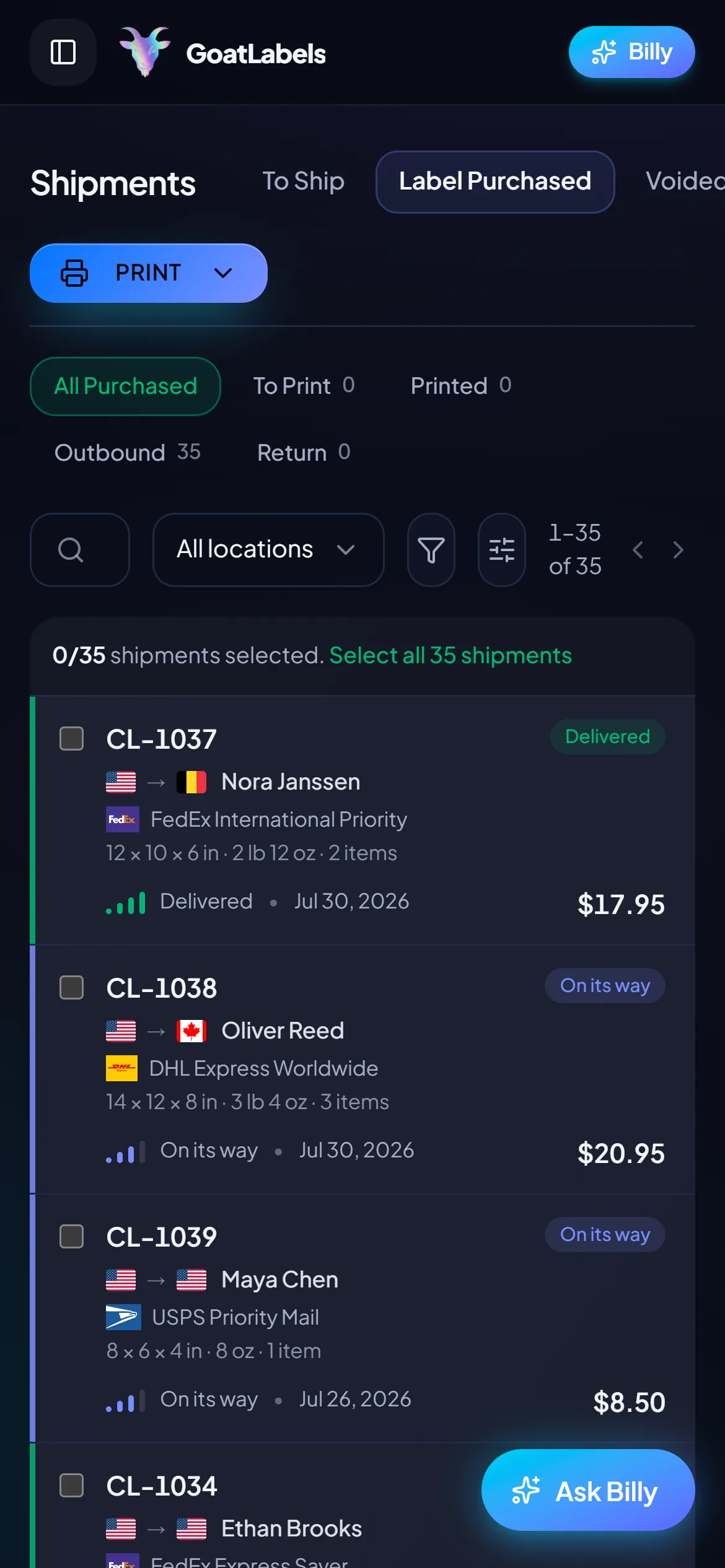
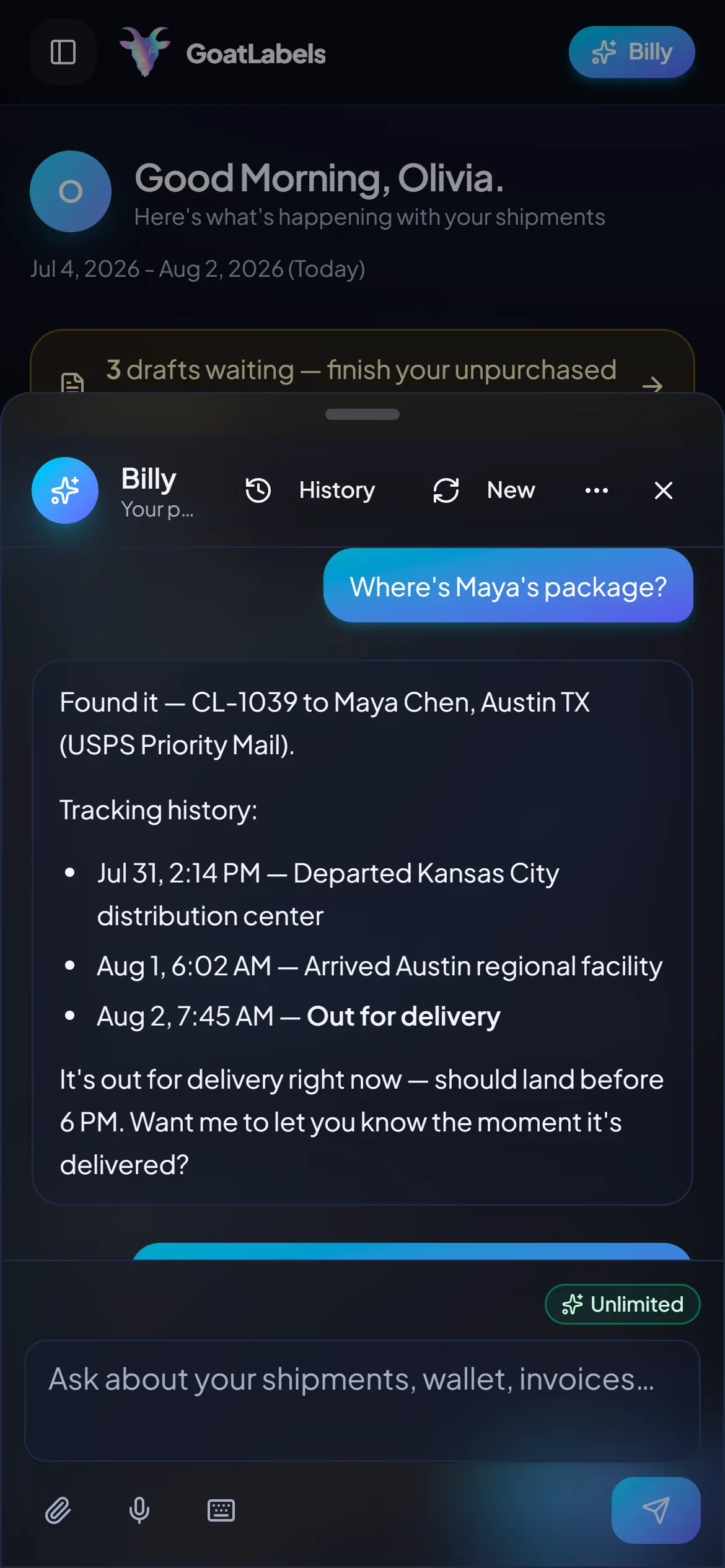
Seller Central is a desk job. The other half of your week is not: a TikTok Shop rush, an Etsy order, a DM asking whether you ship to Austin. Those arrive on the phone already in your hand, and the queue, the four quotes, and the buy button all fit there too.
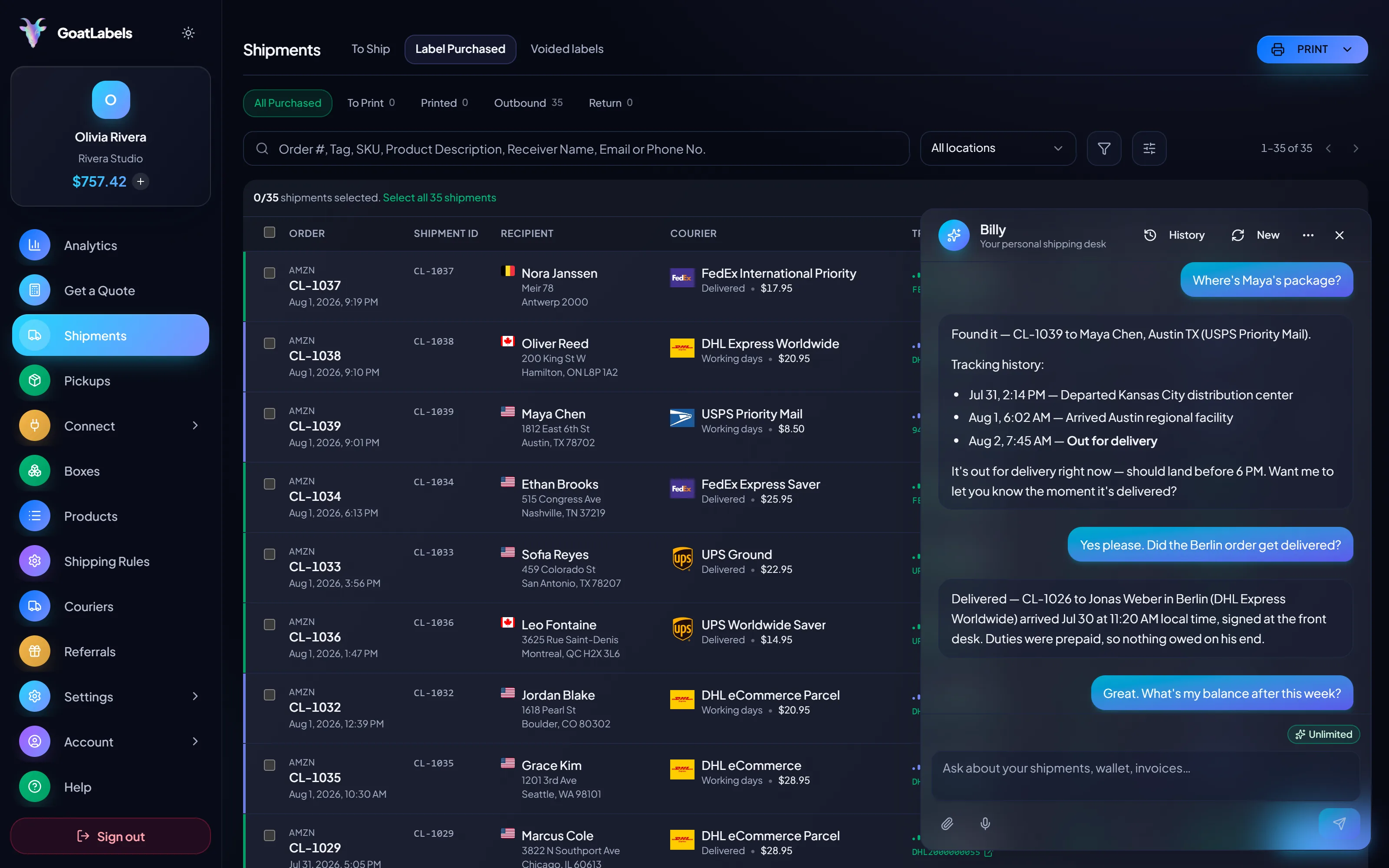
An Amazon order arrives as a structured record with a ship-by date attached. A message asking "can you ship this to Austin?" arrives as a sentence. Hold the mic or paste the message, and Billy pulls out the name, the address, and the parcel, quotes USPS, UPS, FedEx, and DHL on it, and queues the one you pick — then answers for the label afterwards. This is the real product, not a render.
Listening
"Where's Maya's package?"
Out for delivery
CL-1039 · Austin, TX · by 6 PM
Speaks plain English · quotes all four carriers as one all-in price each · remembers customers and saved boxes · included on every plan, never a pricier tier.
On an Amazon order, a cheaper quote is a bad reason to leave a protected label. On the channels below there is no protection to leave, so the same parcel is quoted against every carrier at once and each column is one all-in number locked at quote time. Figures here are an illustrative example, not a quoted rate.
Priority Mail Intl
10–15 days$7.40
$1.90 of duties & taxes prepaid, not billed to your buyer
all-in · no surprises
Intl Connect Plus
3–5 days$8.90
$2.20 of duties & taxes prepaid, not billed to your buyer
all-in · no surprises
Express Worldwide
1–2 days$9.80
$2.50 of duties & taxes prepaid, not billed to your buyer
all-in · no surprises
Amazon has its own APIs for its own orders. This one is for everything else: REST, JSON, one Bearer header, signed webhooks instead of polling, and real idempotency keys. Unlimited calls on every plan, so the non-Amazon side never becomes the expensive integration.
POST /api/v1/shipments
Authorization: Bearer sk_live_…
Idempotency-Key: ord_8421

{
  "to": { "name": "Joyce", "city": "Berlin", "country": "DE" },
  "parcel": { "weight": 2.6, "weight_unit": "lb" },
  "service": "fedex_intl_priority"
}
The whole recommendation on this page — keep Buy Shipping, run everything else here — only works if the second system is cheap to sit alongside the first. Free covers 50 shipments a month with everything else unlimited, and there is no subscription underneath it, so a month where Amazon carried the volume bills you nothing at all. Pro is optional and flat, for when the non-Amazon side is the bigger half.
Volume pricing
illustrativemore volume → lower per-label rates
$0 / forever
A second label system that costs nothing in the months Amazon carries the load.
The assistant that turns a DM or a screenshot into a checked draft — and validates the address before you spend anything — runs unlimited in the web app on Free. Pro adds Billy on Telegram.
GET /api/v1/shipments
200 OK · plan: free
Unlimited calls on Free — still unlimited on Pro.
On Pro we will work with you to beat the label rates you are already getting from
ShippoPirate ShipShipStation Label prices are quoted live from USPS, UPS, FedEx, and DHL as one all-in number, and that exact amount leaves your prepaid balance. Amazon's own pricing and protections are Amazon's — nothing here changes them. Full pricing details
Nobody who sells only on Amazon needs this page — Buy Shipping is the answer and there is nothing to add. The sellers below run Amazon alongside something else, and it is the something else that is costing them a second subscription and an hour a week.
TikTok Shop & live commerce
The Amazon half is protected and settled. The live-selling half is a hundred orders overnight with no claim policy attached to any of them, which is exactly where rate-shopping four carriers pays and where a protected platform label is not on offer.
Etsy & independent creators
Uneven volume on the Etsy side and steady volume on the Amazon side, priced by two completely different logics. Buy Shipping handles one; a prepaid wallet with no monthly minimum handles the other without charging you for the quiet weeks.
Two systems, on purpose
Amazon in Buy Shipping · everything else in one queue
The orders with no connector anywhere
Why one system was the wrong goal
2
systems is the right number, not one and not five
Selling on more than one marketplace? See shipping labels for Etsy and for TikTok, where the platform label is not always the right answer.
A video took off and I had 80 TikTok Shop orders by morning. I printed every label from my phone on the bus to the post office.
Early customer · TikTok
TikTok Shop seller
I run my Etsy shop from the kitchen. The AI reads the order, picks the carrier, the label prints. That's the whole workflow now.
Early customer · Etsy
Etsy maker
The API is what every shipping API pretends to be. Idempotency that actually works.
Sasha R.
Staff engineer, marketplace
One To Ship queue for Shopify, Etsy, WooCommerce, TikTok Shop, and every DM sale, with USPS, UPS, FedEx, and DHL quoted on each parcel and one prepaid wallet behind all of it.
Sign up in seconds. No card required. No monthly minimum, so it costs nothing to hold alongside Amazon.
GoatLabels is not affiliated with, endorsed by, or sponsored by Amazon. Buy Shipping, the A-to-z Guarantee, and Seller Fulfilled Prime are Amazon programmes and their terms are Amazon's to publish — check Seller Central for current policy before relying on any protection described here.