

USPS
Ground Advantage
2 to 5 days$11.40
all-in · only your confirm buys it
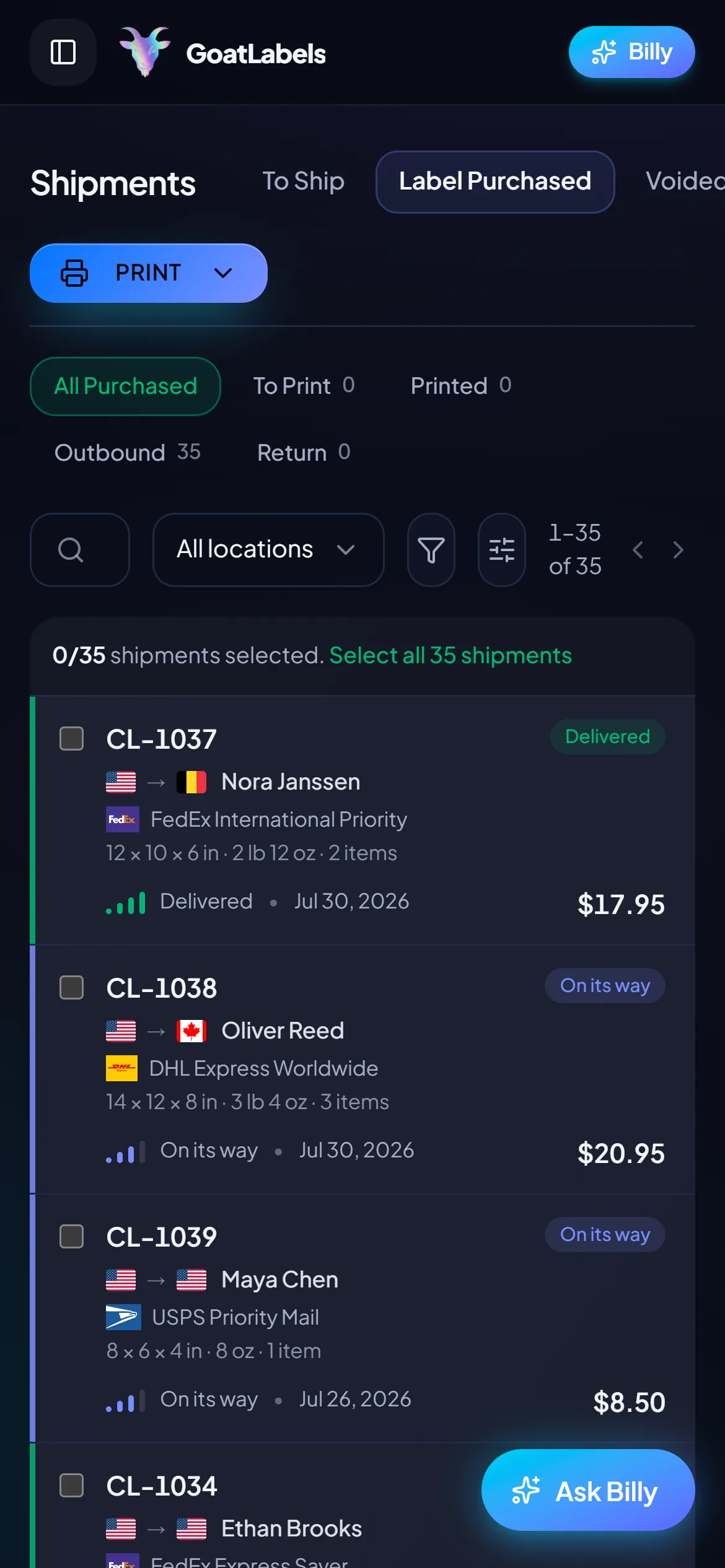
Dictate the order — name, address, what's in the box, roughly what it weighs — and a draft label appears for review with the address validated before any money moves. Voice fits the moment your hands are full of tape and cardboard; the checking step stays on screen, where errors are visible.
The draft Billy builds from your dictation is quoted against USPS, UPS and FedEx, plus DHL on international lanes, each an all-in price, before you commit to any of them.


 DHL: international
Card, Apple Pay, Google Pay, ACH, or crypto fund one prepaid balance — and only your explicit confirm spends it, never a spoken sentence.
The order of operations is the whole safety story on this page. Dictation is the capture step and nothing more — it does not price anything, print anything, or spend anything. What you said lands as a draft, printed back field by field so a mishear is something you read rather than something you discover; the destination is validated against real address data before payment; the carriers that serve the lane quote the parcel; and only your explicit confirm moves money.
two pounds, to Priya in Austin — Brindle Way, unit 4B, it's the ceramic mug
You do not need to speak like a form. Say it the way you would tell a colleague, hesitations included — the parsing step does the structuring, and a missing piece stays visibly missing instead of being silently invented.
 Billy AI
Nothing is ever purchased from a spoken sentence alone. The buying step is explicit and it is yours — which is what makes dictating a stack of parcels back to back safe.
Thirteen store connectors, Shopify, Amazon, eBay, Etsy, TikTok Shop and more, sync their orders into the To Ship queue, and an Instagram or Facebook DM gets pasted or screenshotted in. A dictated order joins them at exactly the same place: the same draft, the same address validation, the same carrier quotes. The mode is situational; what happens after it never varies.
 Shopify
 Etsy
Etsy WooCommerce
 TikTok Shop
 Amazon
 eBay
eBay Squarespace
 Wix
Wix WalmartShopify PlusSoon
 Square
 BigCommerce
 Magento
 ZapierSoon
 NetSuiteSoon
 EcwidSoon
 Temu
Temu SheinSoon
 ChannelAdvisorSoon
 SkuVaultSoon
 Zoho InventorySoon
 Patreon
Updated 2026-08-15
Every label tool assumes you are sitting down. The reality of a packing session is the opposite: one hand is holding a box flap shut, the other is stretching tape, the phone is propped against a roll of bubble wrap a metre away, and the order you are packing is a name you can see on a slip but would have to stop everything to type. Voice exists for exactly that posture. You say the order out loud — who it goes to, where, what is in the box, roughly what it weighs — and keep taping while a draft label assembles itself. The dictation is the capture step, nothing more. It does not price anything, it does not print anything, and it certainly does not spend anything.
This matters because the alternative is not typing carefully at a desk. The alternative, in practice, is a scribbled note that gets keyed in later that evening, from memory, in a batch, which is precisely the workflow that produces transposed digits and missing apartment lines. Speaking the order at the moment you are holding the parcel keeps the order and the object together. The wider intake story — pasting an order or screenshotting a DM thread and letting Billy draft from it — is covered end to end on the AI shipping labels page; this page is about the one intake mode that works when neither of your hands is free.
A usable dictation carries four things, and you can say them in any order and in plain speech. The recipient's name. The full destination — street line with the unit if there is one, city, state, and postcode. What the parcel is, in a phrase, because the contents description follows the shipment through customs forms and claims later. And a weight, which can be honest approximation: a figure read off the bench scale beats a guess, but a guess beats a blank, because the draft shows you the number and you can correct it against the scale before you buy.
You do not need to speak like a form. Saying it the way you would tell a colleague — the whole thing in one breath, hesitations included — is fine, because the parsing step is doing the structuring, not you. What the draft does with an incomplete dictation is the useful part: a missing piece stays visibly missing instead of being silently invented. An order with no weight shows an empty weight field waiting for a number, not a fabricated one. The draft is a checklist of what you actually said, which is exactly what you want to read back before money is involved.
Dictation has failure modes, and pretending otherwise would be selling you a mis-shipped parcel. Fourth Street becomes 4th Street, apartment B is heard as apartment D, a spoken postcode loses a digit to a tape gun screeching at the wrong moment. The design answer is not a better microphone — it is that nothing you speak is final. Everything lands in a draft first, printed back on screen field by field, and the checking step deliberately stays visual because errors that are inaudible are usually obvious in text.
Then the second net: before payment, the destination is validated against real address data, with a residential or commercial classification badge shown on the result. An address that does not resolve — a street number that does not exist on that street, a unit the building does not have — is flagged while the label is still unbought, which is the only moment a mistake is free. The mishear that survives both the draft read-back and validation is rare, and even then the label is usually voidable for a wallet credit rather than a write-off. The order of operations is the whole safety story: speak, read, validate, and only then pay.
Voice is one of three ways an order gets into a draft, and the right one is situational rather than a matter of taste. Paste wins when the order is already text in front of you and your hands are on a keyboard — a desk moment, not a bench moment. A screenshot wins when the order lives inside a DM thread and scrolling out the address would mean retyping it anyway. Voice wins when the parcel is in your hands: mid-pack, mid-tape, phone out of reach, or simply when the queue is long enough that walking to a keyboard between every box is the slowest part of the job.
The reason the three modes are interchangeable is that they converge immediately. Whichever way the order arrives, it becomes the same draft, gets the same address validation, and is quoted as one all-in price per carrier: USPS, UPS and FedEx on every domestic parcel, DHL on international lanes. That comparison is what makes a cheap label a choice rather than a default. And because Billy is included on every plan with no monthly fee on Free, dictating your two parcels a week costs exactly what the two labels cost. The intake mode is never the thing you pay for; it is just the door the order walked in through.
Speaking an order is only an improvement if nothing downstream trusts the microphone. These five things are what make the spoken order as checkable as a typed one — and every one of them applies to a pasted or screenshotted order identically.
The prepaid wallet is funded once by card, Apple Pay, Google Pay, ACH, or crypto, and a label debits it only when you tap buy on a draft you have read. A sentence spoken over a tape gun cannot move money, which is precisely why dictating a stack of parcels back to back is safe.
Billy takes the whole order in one breath, hesitations included, and does the structuring you would otherwise be doing in your head — recipient, destination, contents, weight. What it will not do is fill a gap you left: an order with no weight shows an empty weight field waiting for a number, never an invented one.
BillyLIVEThe draft is priced as one final number per carrier, and that exact amount leaves the balance. If the weight you spoke was a guess, correct it against the scale in the draft and the quote moves with it — which is the cheapest possible moment to find out you were wrong.
Nothing about the intake mode narrows the comparison. USPS, UPS and FedEx quote a dictated domestic parcel, and DHL an international one, exactly as they quote a synced storefront order, so the convenience of speaking never costs you the choice of who carries it.
UPS$12.48FedEx$13.22DHL$14.10USPS$11.79Voice wins when the parcel is in your hands. For the orders already sitting in a system, the REST API covers the same lifecycle — create, quote, buy, void — with signed webhooks, idempotency keys, and unlimited calls on every plan. Different door, same draft, same validation.
Draft from voice
Validated · ready to review
A bench session has a rhythm — pick, pack, tape, next — and walking to a laptop between boxes breaks it every single time. Voice keeps the rhythm: the phone stays propped where it is, the order is spoken over the tape gun, and the only moment that needs your eyes is the one that should — reading the draft before you pay.
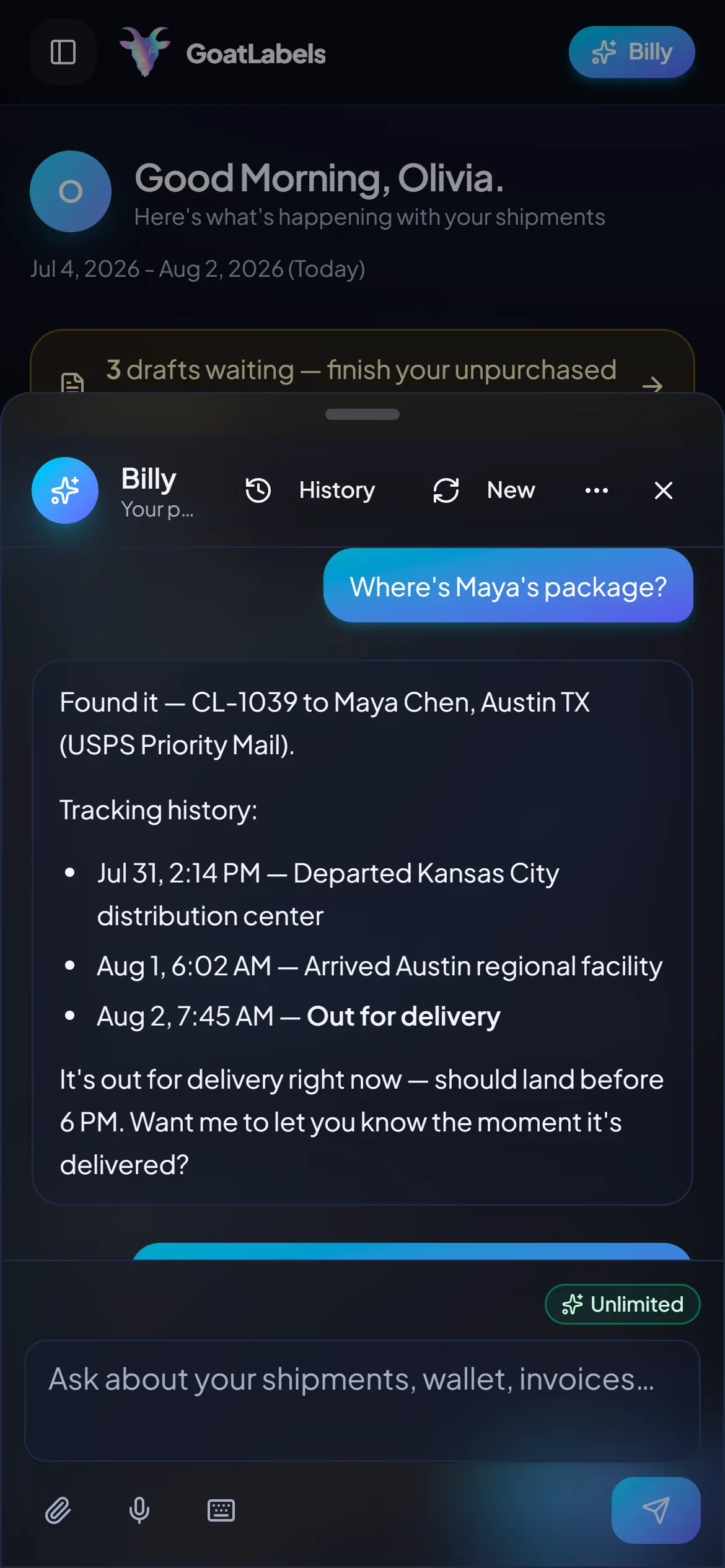
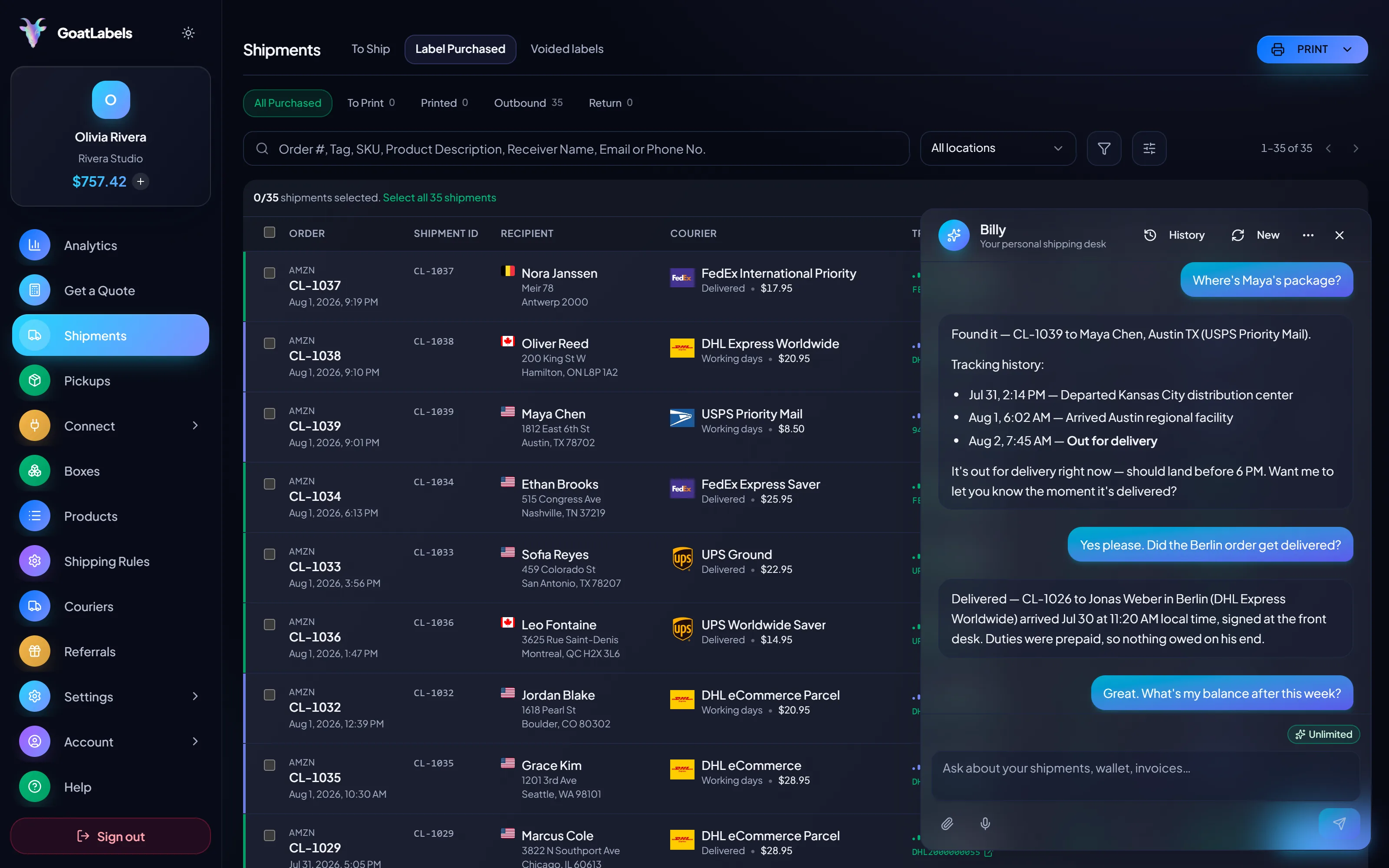
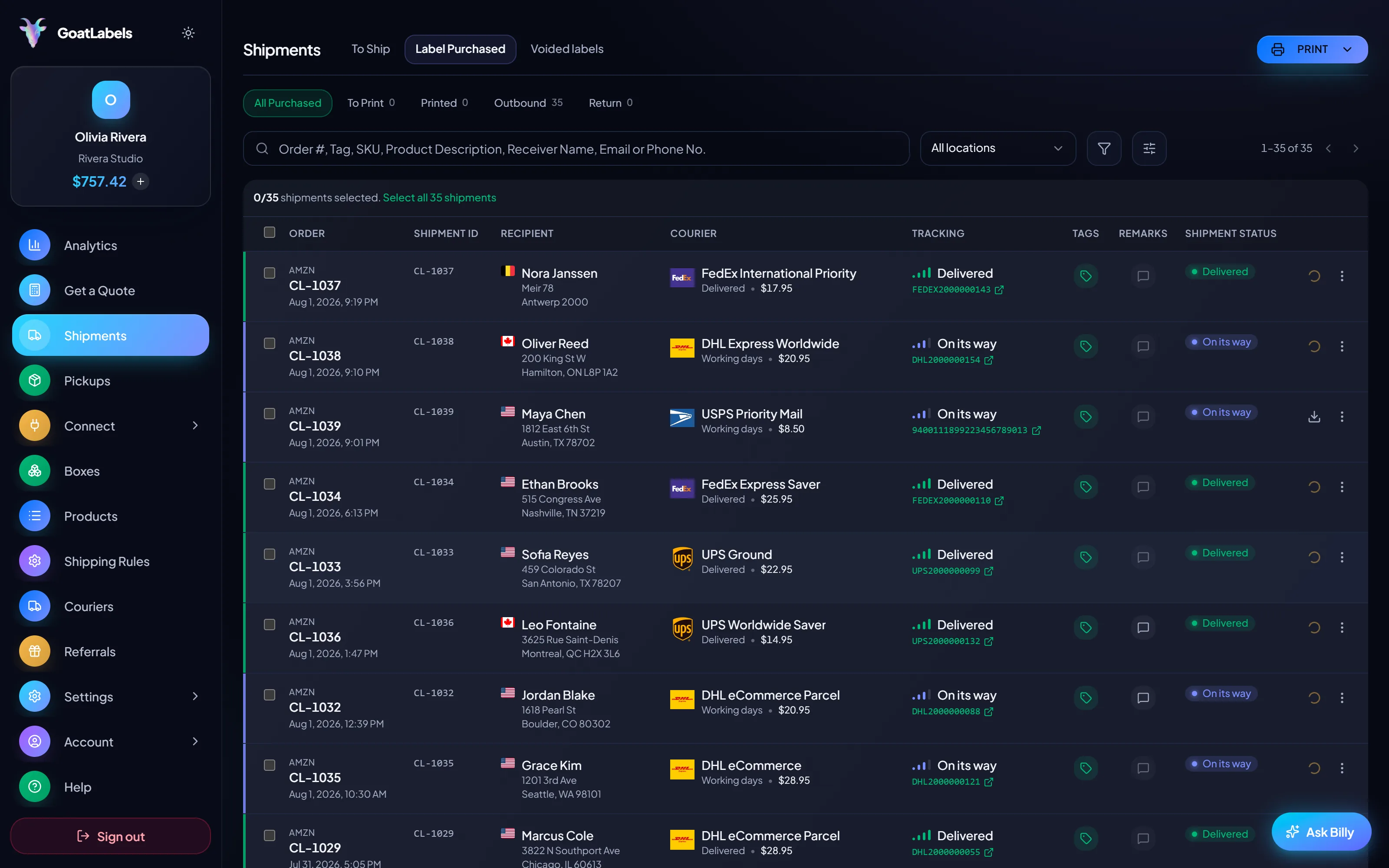
Hold the mic and speak the order the way you would tell a teammate: the buyer, the address, what is in the box, what the scale says. Billy structures it into a draft shipment while you finish the parcel, validates the destination before payment, and quotes it against every carrier that serves the lane. Then ask the follow-ups out loud too — whether the address cleared validation, which carrier is cheapest all-in — and read the answers off the screen you already have propped on the bench.
Listening
"Two pounds, to Priya in Austin — Brindle Way, unit 4B."
Draft ready
Address validated · carriers quoted
Speaks plain English · drafts from voice, paste, or a screenshot · validates the address before any money moves · included on every plan, never a pricier tier.
This is the screen the dictation leads to, and it is the reason the review step is visual rather than spoken back at you. Each column is one carrier's all-in number with its delivery window, read at a glance, and the one you pick is what leaves the prepaid balance on your explicit confirm. Figures are illustrative.
Ground Advantage
2 to 5 days$11.40
all-in · only your confirm buys it
Ground
1 to 5 days$9.85
all-in · only your confirm buys it
Ground
1 to 5 days$11.20
all-in · only your confirm buys it
Dictation is for the order that is physically in your hands. An order that already exists in a system does not need speaking — it needs an endpoint. Both arrive at the same draft, get the same address validation, and are quoted against the same carriers, so choosing between them is situational rather than architectural.
POST /api/v1/shipments
Authorization: Bearer sk_live_…
Idempotency-Key: ord_8421

{
  "to": { "name": "Joyce", "city": "Berlin", "country": "DE" },
  "parcel": { "weight": 2.6, "weight_unit": "lb" },
  "service": "fedex_intl_priority"
}
Billy drafts from voice, from a pasted order, and from a screenshot, and none of the three sits behind a tier. Free covers 50 shipments a month with the assistant unlimited in the web app and the API unlimited on top; Pro is a flat monthly plan with unlimited shipments. Dictating your two parcels a week costs exactly what the two labels cost.
 — dictate an order without opening the dashboard at all
Rate by plan
illustrativePro: one flat monthly plan, unlimited shipments
$0 / forever
Speak the order, read the draft, buy the label — and owe nothing in a month you did not ship.
The assistant this entire page is about runs unlimited on Free in the web app, on desktop and on the phone propped against the bubble wrap. Pro adds Billy on Telegram — the same dictation, without opening the dashboard.
Telegram, ProGET /api/v1/shipments
200 OK · plan: free
Unlimited calls on Free — still unlimited on Pro.
Put a real parcel through and compare the side-by-side rate against what that label costs you on
ShippoPirate ShipShipStationLabel prices are quoted live from USPS, UPS, FedEx, and DHL as one all-in number and that exact amount leaves your prepaid balance on your confirm — never on a spoken sentence. A label bought in error can usually be voided for wallet credit. Full pricing details
Voice is not a preference, it is a posture. These are the four situations where the walk to a screen is what actually costs the time — and the one where speaking is plainly the wrong tool.
 One hand on the box, one on the tape
The alternative to speaking is not typing carefully at a desk — it is a scribbled note keyed in from memory that evening, which is exactly the workflow that produces transposed digits and missing apartment lines.
 Kitchen table, studio bench, market stall
Speaking the order at the moment you are holding the parcel keeps the order and the object together. Everything after that is deliberately visual, because a mishear is inaudible and obvious in text.
Speak, read, validate, pay
In that order — it is the whole safety story

 Paste wins here, and that is fine

 Several parcels, one review pass
0
labels bought by a spoken sentence — each dictation becomes its own draft, and every purchase is an explicit tap of yours
A video took off and I had 80 TikTok Shop orders by morning. I printed every label from my phone on the bus to the post office.
Early customer · TikTok
TikTok Shop seller
TikTok ShopI run my Etsy shop from the kitchen. The AI reads the order, picks the carrier, the label prints. That's the whole workflow now.
Early customer · Etsy
Etsy maker
EtsyThe API is what every shipping API pretends to be. Idempotency that actually works.
Sasha R.
Staff engineer, marketplace
Dictate the order, read the draft, check the validated address, and buy the cheapest quote, all before the tape gun cools down.
No card required. Voice drafting included on every plan.
Updated