

USPS
Priority Mail Intl
6–10 days$28.10
$3.90 of duties & taxes shown inside the total
all-in · door bill visible upfront
A US-to-Canada parcel clears customs on its declared value and description, then hands to a domestic last-mile network that varies by service. Landed cost depends on whether tax and duty are collected upfront or at the buyer's door — and the biggest delays come from vague descriptions, not distance.
USPS hands to Canada Post through the postal stream; UPS, FedEx, and DHL clear their own trucks through brokerage. Same border, different bill, different doorstep.


 DHL: international
Description, declared value, country of origin, and your HS code stored per product — the second parcel to Canada reuses the first one's paperwork.
Updated
Every US-to-Canada service is really two journeys stapled together: the carrier that takes the parcel to the border, and the network that delivers it after clearance. The split matters more than the brand on the label. A USPS international service travels the postal stream — it crosses as mail, clears through the postal customs process, and is handed to Canada Post, whose carriers reach every address in the country. A courier service never changes hands: the same UPS, FedEx, or DHL network that collected the parcel clears it through its own brokerage and delivers it with its own drivers.
Neither is simply better. The postal handoff is the only path that treats a rural route, a post office box, and a downtown condo as the same job, and it is usually the budget option. The courier path is faster, tracked in more detail, and clears customs more predictably — but it treats remote postal codes as extended-area territory and prices them accordingly. The point of quoting both on the same parcel is that the destination decides the winner, not the habit.
Canadian customs works from exactly what you declared: the description, the declared value, and the country of origin. Value is converted to Canadian dollars and taxed — a federal sales tax plus, for most provinces, a harmonized provincial component that depends on where your buyer lives, not where the parcel enters. Duty is a separate question answered by classification and origin, and here US sellers get a structural break: goods that genuinely originate in the United States broadly qualify for preferential treatment under the US-Canada-Mexico trade agreement, which zeroes out duty on much of what small sellers ship. Tax survives that test; duty often does not.
The two customs streams also apply different low-value relief, which is why the same declared value can clear free by courier and be assessed by post. The current thresholds sit in the dated lane sheet below, because they are set by trade agreement and regulation and can move. What does not move is the mechanism: below the relevant line the parcel clears without assessment, above it the buyer side of the transaction owes tax and possibly duty, and the collection method depends entirely on which network is holding the parcel. The form itself, HS codes, and the choice between prepaying charges or leaving them to the buyer are covered on customs forms for small parcels — one guide for every lane.
The complaint that damages a cross-border store is rarely the shipping price. It is the second bill: a buyer who paid for the item and the postage, then opens the door to a demand for tax plus a fee for the privilege of being charged it. On the postal side that fee is a flat handling charge Canada Post applies when it presents CBSA charges. On courier ground services it is a brokerage fee that scales with the entry work. Express services usually fold routine brokerage into the rate, which is part of what you are paying for in the higher price — the assessment still happens, but the fee for processing it does not land on your buyer separately.
Prevention is a pricing decision, not a shipping trick. You can choose a service and declared-value combination that clears under the assessment lines. You can prepay duties and taxes so the parcel arrives settled — the DDP-versus-DDU decision, which belongs to the customs guide. Or you can simply say at checkout that import charges may apply, which converts an ambush into a known term of sale. What you should not do is nothing, because the buyer who gets surprised once orders domestic after that.
Distance does not delay parcels into Canada; paperwork does. The border processes millions of small parcels on declared data alone, and anything a machine cannot classify gets routed to a human, which is what a customs hold actually is. The classic trigger is a description that names a category instead of a thing. A parcel declared as clothing, gift, or accessories cannot be classified, so it waits. A parcel declared as a cotton t-shirt, a ceramic coffee mug, or a paperback novel clears on the first pass. Value plausibility is the second trigger — a declared value far below what the description suggests reads as understatement and invites reassessment, which takes longer than honest declaration ever would.
This is a data-entry problem, so it has a data-entry fix. GoatLabels puts customs items on the shipment — description, declared value, country of origin, and the HS code you supply — and saves them as templates per product, so the declaration that cleared cleanly last month is the one that ships this month. Billy will draft the plain-word description from a pasted order for you; the HS code and the values stay yours, because classification is a legal statement only the seller can make. One typed-once template beats a fresh improvisation on every label, and it is the single cheapest thing you can do for transit time on this lane. If a parcel is already held, the general steps to get it released are on package stuck in customs.
A refused or undeliverable parcel does not wait in Canada for instructions. It re-crosses the border as a return, which means it clears customs a second time in the other direction, and on courier services the return transportation is generally billed to you as the shipper. Refusal at the door over unexpected fees is the common case; an address defect the carrier cannot resolve is the other. What each carrier does with an undeliverable parcel, and who pays for the ride home, is the subject of package returned to sender. A parcel that stops scanning entirely somewhere past the border is a different problem with a different clock — lost and damaged claims covers the filing windows. And because every one of these outcomes starts from the label price, it is worth remembering that the four-way quote that makes a cheap label cheap applies to this lane too: the carriers disagree more on international parcels than on domestic ones, not less.
| Service family | Final mile | Customs handoff | Who collects, and how |
|---|---|---|---|
| Postal stream (USPS international services) | Canada Post, which reaches every Canadian address including rural routes and PO boxes | USPS carries to the border; CBSA assesses in the postal stream; Canada Post presents charges | Tax and any duty collected from the buyer at or before delivery, plus a flat Canada Post handling fee when charges apply |
| Courier ground (UPS Standard, FedEx International Ground) | The courier's own Canadian network; remote postal codes may route as extended-area | Cleared commercially by the courier's brokerage as the truck crosses | Duties, taxes, and a brokerage fee billed to the buyer on ground services unless the shipper prepays |
| Courier express (UPS Worldwide, FedEx International Priority, DHL Express) | The courier's own network, fastest into major metros | Cleared in flight or on arrival by the courier's own brokerage | Routine brokerage is typically built into express service; taxes and duty still assessed and billed |
Dated figures, all in one place.As of the verification date above: courier shipments from the US enter under the CUSMA low-value rules — no tax below CAD $40 declared value and no duty below CAD $150 — while the postal stream applies the older CAD $20 line for both. Canada Post charges a flat handling fee (under CAD $10) when it presents charges; courier ground brokerage varies by entry value and is published in each courier's Canadian fee schedule. Typical transit: postal services roughly one to two weeks, courier ground about four to seven business days, express one to three. These figures are CBSA, Canada Post, and courier policy — re-checked every 6 months by the named review owner recorded with this page; check the source before building prices on them. Source for the thresholds: CBSA, low-value shipment thresholds.
A US-to-Canada parcel is a customs declaration with a box attached, and the border makes its decisions from the declaration rather than the box. This is the loop that keeps the two agreeing: the order arrives however it arrives, Billy drafts a plain-word description and validates the address, the declaration is saved against the SKU, and both customs streams are priced before anything leaves the wallet.
can you send the mug to Moose Jaw, SK? postal code S6H 0A1
The postal code does more work here than a ZIP does at home: whether the address is a rural route, a post office box, or a downtown condo decides which service families can reach it at all, and the quote answers that before you choose.
 Billy AI
The declaration that cleared cleanly is the one that ships next month, because it was saved rather than improvised. On this lane that single habit does more for a parcel's journey than any service upgrade does.
Shopify, Etsy, WooCommerce, TikTok Shop, Amazon, eBay, Squarespace, Wix, Walmart, Square, BigCommerce, Magento, and Temu sync into the same To Ship queue, with tracking pushed back when you print. A Canadian order from any of them sits beside a Canadian order you pasted out of a DM — and both pick up the same saved customs template for the same SKU.
 Shopify
 Etsy
Etsy WooCommerce
 TikTok Shop
 Amazon
 eBay
eBay Squarespace
 Wix
Wix WalmartShopify PlusSoon
 Square
 BigCommerce
 Magento
 ZapierSoon
 NetSuiteSoon
 EcwidSoon
 Temu
Temu SheinSoon
 ChannelAdvisorSoon
 SkuVaultSoon
 Zoho InventorySoon
 Patreon
A Canadian parcel is a declaration with a box attached. Everything below exists to make the declaration accurate, reusable, and priced honestly before the wallet is touched.
Card, Apple Pay, Google Pay, ACH, and crypto top up one balance that pays for Canadian labels and domestic ones alike. No monthly plan sits underneath it on Free, so a slow month on the export side costs nothing — the wallet only moves when a label is bought.
Paste the order and Billy writes the plain-word item description the border can actually classify — a cotton t-shirt, not merchandise. The declared value and the HS code stay yours to supply, because classification is the seller's legal statement, not an autocomplete.
BillyLIVEEach carrier comes back as one all-in number with the duties and taxes portion broken out inside it, so you can see what the door bill would be before choosing who pays it. The amount you approve is the amount that leaves the balance.
USPS rides to Canada Post's every-address network; UPS, FedEx, and DHL clear and deliver on their own. Quoting all four on the same parcel is how a rural Manitoba address and a Toronto condo end up on different services without anyone having to memorise why.
UPS$12.48FedEx$13.22DHL$14.10USPS$11.79Customs items ride the same shipment objects the dashboard uses, on unlimited calls with signed webhooks, so a store can generate declared, validated Canadian labels in code. Saved customs templates apply there too — map a SKU to its declaration once.
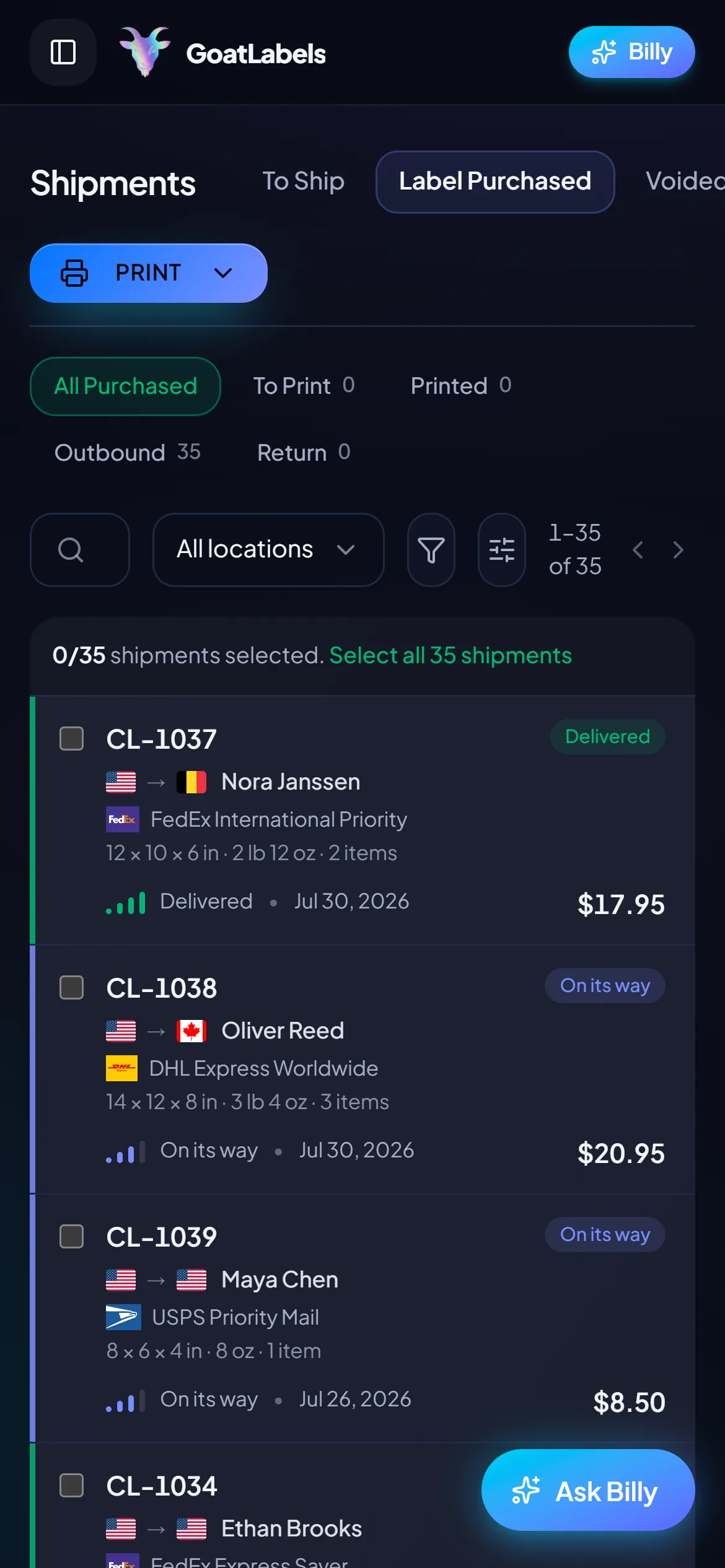
Declared label ready
Moose Jaw, SK · customs template applied
Nothing about a Canadian parcel actually requires a desk. The declaration is stored against the product, the address validator runs on the phone, and both customs streams come back priced on the same screen — so the border paperwork stops being the reason international orders wait until Friday.
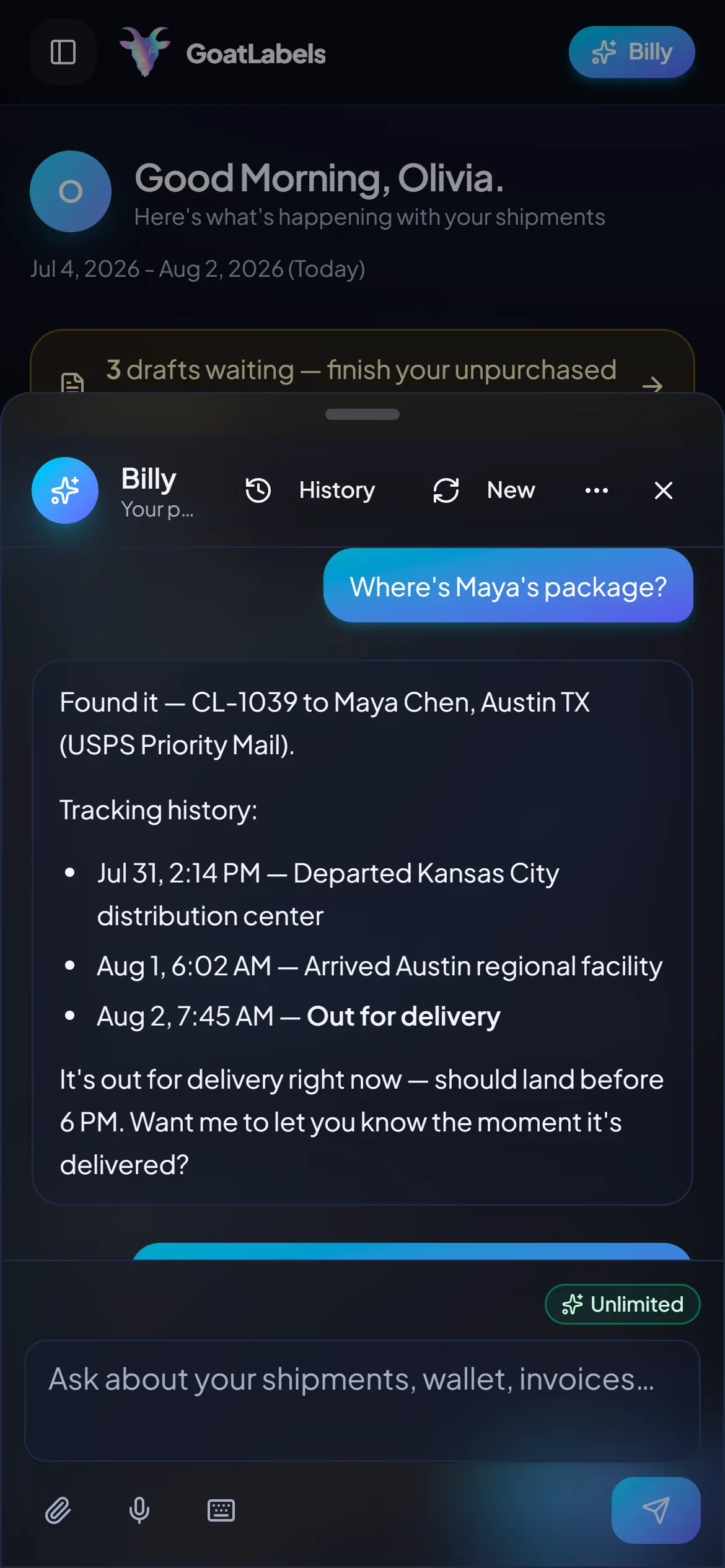
Cross-border tracking has more moving parts than a domestic one: a handoff, a clearance, and quite often a final-mile carrier that is not the one you bought from. Ask out loud and Billy pulls the shipment up and reads back where it actually is, so the answer you give a Canadian buyer is the current one rather than the last scan you remember. Included on every plan. This is the real product, not a render.
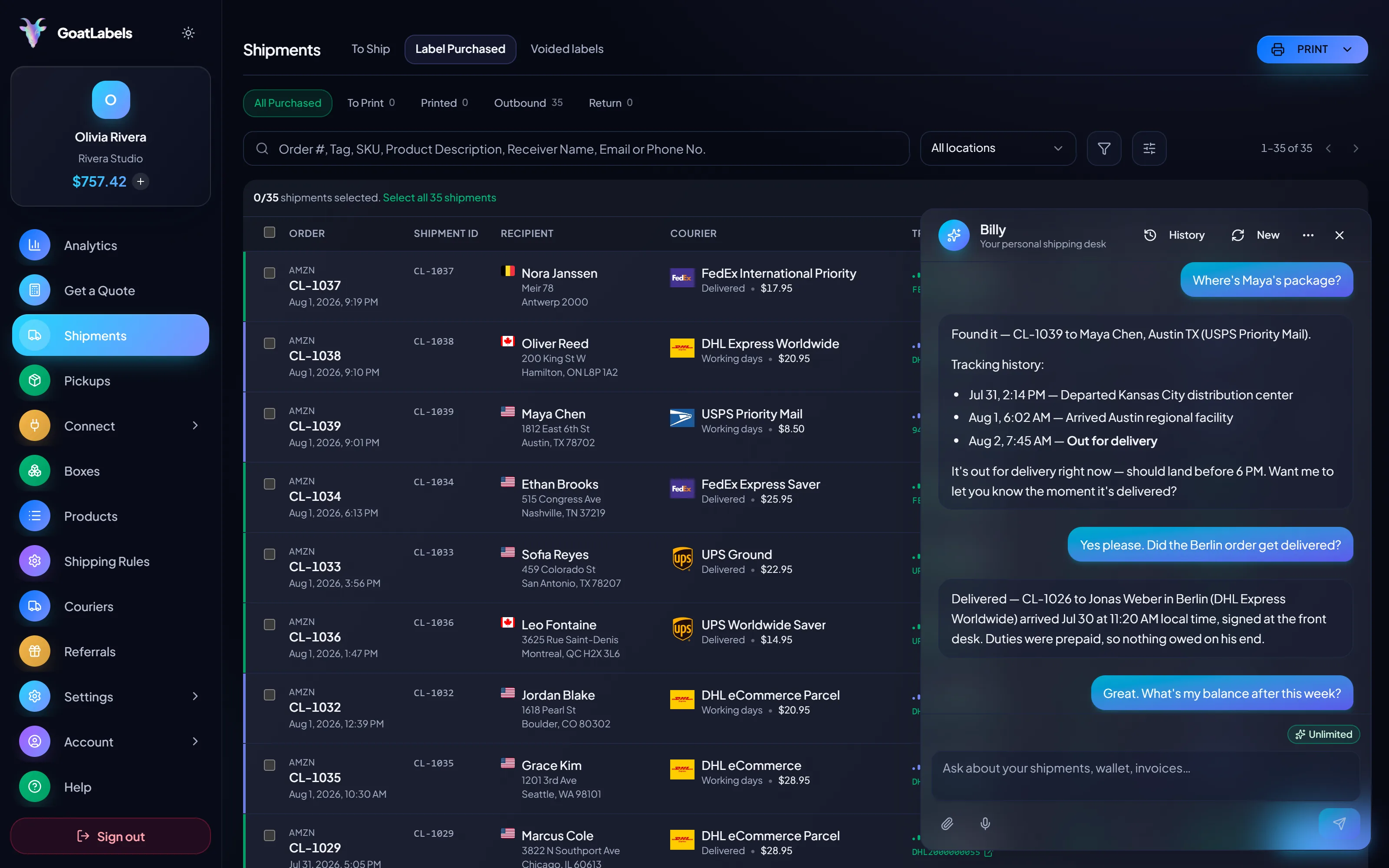
Listening
"Has the Moose Jaw parcel cleared yet?"
Out for delivery
Moose Jaw, SK · with the final-mile carrier
Speaks plain English · knows which network is actually holding a cross-border parcel · included on every plan, never a pricier tier.
Postal stream and courier services quoted side by side on the identical parcel — each column one all-in number with the duties and taxes portion shown inside it, so the door-bill question is answered before you buy, not after your buyer complains. Example parcel, illustrative figures, not a live quote.
Priority Mail Intl
6–10 days$28.10
$3.90 of duties & taxes shown inside the total
all-in · door bill visible upfront
Standard to Canada
4–7 days$25.60
$5.10 of duties & taxes shown inside the total
all-in · door bill visible upfront
Express Worldwide
1–3 days$39.40
$6.30 of duties & taxes shown inside the total
all-in · door bill visible upfront
A cross-border label is a declaration, and a declaration is structured data — which is what makes this the lane where an API earns its keep. Attach customs items to the shipment, let the saved per-SKU template fill them in, and buy: REST, JSON, one Bearer header, unlimited calls on every plan including Free.
POST /api/v1/shipments
Authorization: Bearer sk_live_…
Idempotency-Key: ord_8421

{
  "to": { "name": "Joyce", "city": "Berlin", "country": "DE" },
  "parcel": { "weight": 2.6, "weight_unit": "lb" },
  "service": "fedex_intl_priority"
}
Most stores meet Canada as a trickle rather than a market: a handful of orders a month alongside the domestic volume that pays the bills. Nothing here charges extra for the border — customs items, saved declarations, and both customs streams are on the free plan, and the wallet only moves when a label is bought.
 — ask whether a parcel has cleared without opening the dashboard
Rate by plan
illustrativePro: one flat monthly plan, unlimited shipments
$0 / forever
A few Canadian orders a month, on the plan that costs nothing to keep open.
The assistant that turns a pasted order into a description the border can classify — a ceramic mug, not merchandise — runs on Free, unlimited, in the web app. Pro adds Billy on Telegram.
Telegram, ProGET /api/v1/shipments
200 OK · plan: free
Unlimited calls on Free — still unlimited on Pro.
Put a real parcel through and compare the side-by-side rate against what that label costs you on
ShippoPirate ShipShipStationLabel prices are quoted live from USPS, UPS, FedEx, and DHL as one all-in number with the duties-and-taxes portion shown inside it. What the border assesses, and what a final-mile carrier charges to present it, are theirs to set rather than ours — the lane sheet above names the source for each. Full pricing details
What wins into Canada is decided by the postal code and the declaration, not by the brand on the label. These are the four cases where choosing out of habit costs the most.
 Where only the postal stream reaches
A courier network treats a remote postal code as extended-area territory; the postal stream hands to a universal-service carrier that treats every Canadian address as the same job. Quoting both on the same parcel is how that gets decided per address instead of per store.
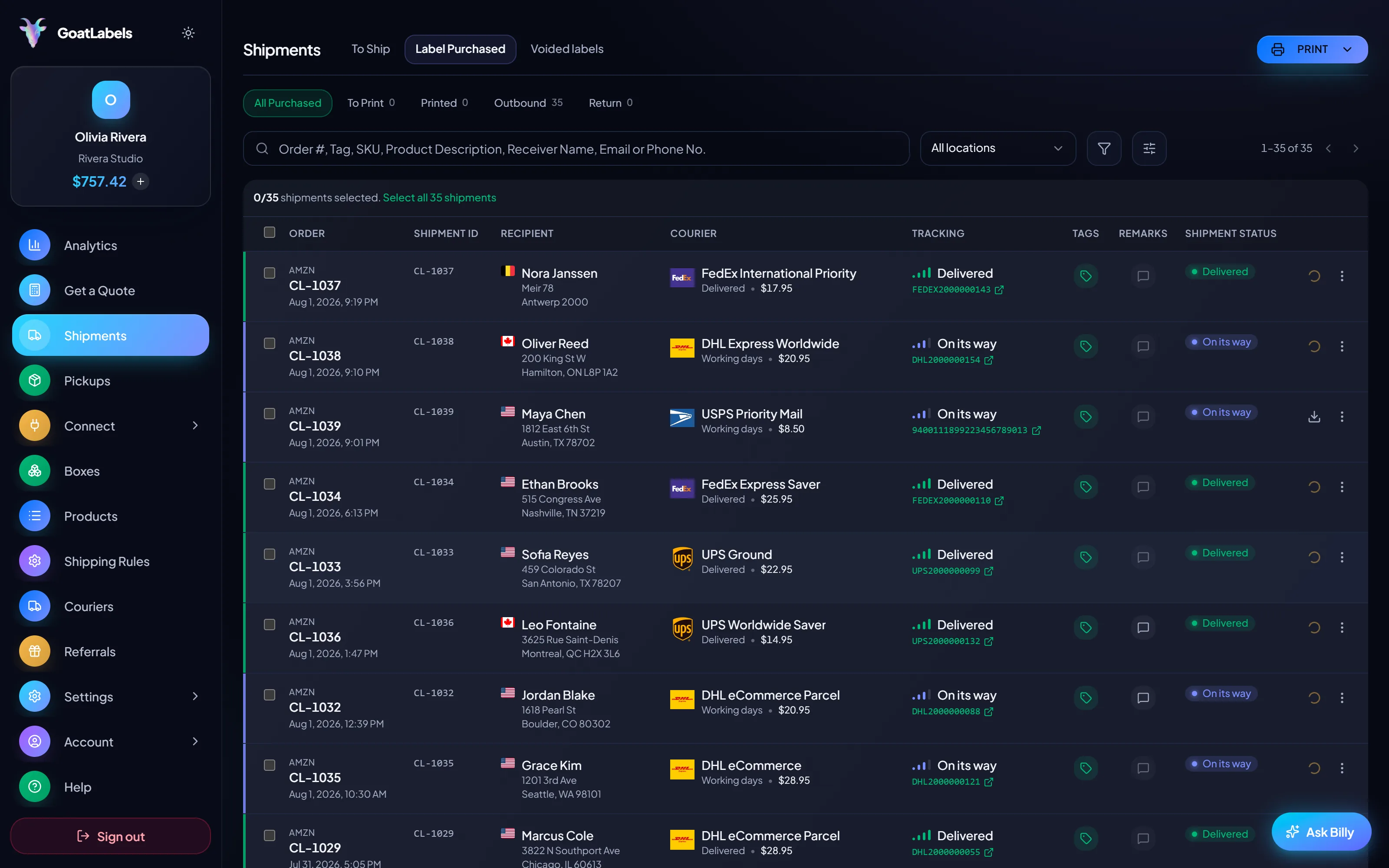
 One declaration, shipped over and over
The second parcel of a product should never be a fresh improvisation. Save the description, value, origin, and HS code against the SKU and the paperwork that cleared without a query last month is the paperwork on today's label.
Customs template reused
Description, origin, and HS code carried from the last clean clearance

 The order with no connector behind it

 The second bill, at the door
0
surprises when the buyer was told at checkout what the door may ask for
The rest of the international-lane series:the UK,the EU,Australia,Mexico (the other USMCA lane),Germany, andJapan — and the form every one of these lanes starts from, oncustoms forms for small parcels.
A video took off and I had 80 TikTok Shop orders by morning. I printed every label from my phone on the bus to the post office.
Early customer · TikTok
TikTok Shop seller
TikTok ShopI run my Etsy shop from the kitchen. The AI reads the order, picks the carrier, the label prints. That's the whole workflow now.
Early customer · Etsy
Etsy maker
EtsyThe API is what every shipping API pretends to be. Idempotency that actually works.
Sasha R.
Staff engineer, marketplace
Enter one real Canadian order, see the postal stream and the couriers priced all-in on the same screen, and ship it with the declaration saved for next time.
No card required. Customs templates on every plan.
Updated