

USPS
Priority Mail Intl
10–15 days$7.40
$1.90 of duties & taxes prepaid, not billed to your buyer
all-in · nothing waiting at the door
Customs holds have a short cause list: a description too vague to classify, a declared value that looks wrong, taxes waiting on the buyer to pay, or a restricted item. The fix depends on the cause — and for most of them, the person customs will talk to is the addressee, not you.
USPS hands parcels to the destination post and its customs queue; UPS, FedEx, and DHL clear through their own brokers. The quote you pick is also picking who handles a hold.


 4 carriers
Where the service supports it, duties and taxes are quoted inside the all-in price and prepaid — so a frequent hold on consumer parcels, charges waiting on the buyer, never starts.
A parcel sitting in customs feels like one problem, but it is four different problems wearing the same tracking status, and they have different actors, different clocks, and different endings. The diagnostic below is the whole method: read the most recent tracking event and any message the carrier or buyer has received, match it to a cause, and the row tells you who can act and what the action is.
| Cause | How it announces itself | Who can act | The action |
|---|---|---|---|
| Description too vague to classify | Tracking parks at a customs or clearance event with no fee notice to anyone, or the carrier emails asking for more product detail. | You, through the carrier | Answer the carrier's information request with a specific description of what the item is, what it is made of, and what it is for. |
| Declared value looks wrong | Clearance stalls and the carrier or customs asks for proof of value — an invoice, a payment record, a listing. | You supply evidence; the addressee may be asked to confirm | Send the sales record that shows what the buyer actually paid. Consistency between label, form, and receipt is what releases it. |
| Charges waiting on the buyer | Tracking shows something like awaiting payment or a customs notice, and the buyer has a fee notice, a card, an email, or a text from the carrier or post. | The addressee, and only the addressee | Coach the buyer to pay through the official channel on the notice before the deadline. Nothing you do from the origin side moves this one. |
| Restricted or prohibited item | A seizure, inspection, or refusal event, sometimes followed by a letter to the addressee rather than any tracking update at all. | Customs decides; the addressee receives the paperwork | Cooperate with any information request and expect return, abandonment, or destruction. This is the one cause with no fix in transit. |
The vague description deserves a concrete illustration, because it is the cause sellers create themselves and the easiest one to stop creating. A declaration that reads gift, accessories, or samples gives the officer nothing to classify and nothing to value, so the parcel leaves the automated stream and joins a manual queue. The same item declared as handmade ceramic coffee mug, glazed stoneware answers what it is, what it is made of, and roughly what it should be worth, all in one line — and a declaration that answers those questions rarely gets asked them in person. Which form those words go on, and how HS codes work, is the customs-forms page's subject; this page cares about what happens when the words were not good enough.
The instinct when your parcel is held is to call someone, and the frustration of this problem is that almost nobody you can call is the right party. Import customs in the destination country is a domestic authority: its legal counterparty is the importer, and for a small consumer parcel the importer is your buyer, the addressee. It has no relationship with a foreign seller, and no obligation to discuss the shipment with one. The origin carrier that sold you the label is your one indirect channel — it can lodge a query, forward an information request, and tell you what its own network knows — and for UPS, FedEx, and DHL, whose brokers file the customs entry, that channel is genuinely useful. For postal shipments the handoff is longer: USPS passes the parcel to the destination post, which deals with its own customs, which deals with your buyer.
So the practical division of labour is this. You act on the causes that live in the paperwork — vague descriptions and doubted values — by answering the carrier's requests quickly and with evidence. Your buyer acts on the causes that live at the destination — unpaid charges and any notice customs sends. And nobody acts on a seizure except customs itself. Knowing which side of that line your cause sits on saves the week most sellers spend emailing the wrong organisation.
A frequent hold on consumer parcels is also the most survivable: the parcel has cleared assessment and is simply waiting for import charges the buyer did not expect. The sale is rarely lost to the fee itself — it is lost to the surprise, and to the silence that follows while the buyer decides the whole thing is a scam. The coaching message worth sending has three parts: this notice is real and expected on international orders; pay it through the official carrier or postal channel printed on the notice, never through a link in an unexpected text, because fee-notice phishing imitates exactly this moment; and it has a deadline, after which the parcel starts its journey back. Send it the day tracking shows a customs event, before the buyer messages you.
The structural fix is to remove the surprise entirely. Where the service supports it, choosing DDP at quote time folds duties and taxes into the one all-in price you pay, so your buyer never meets a fee notice at all — the trade-off against DDU, and who should choose which, is covered with the customs forms. Short of that, a line in your listing that import charges are the buyer's responsibility converts the surprise into an agreement made at checkout, which is a much easier conversation to have later.
Hold length is a function of cause, not of luck. Charge holds last exactly as long as the buyer takes to pay, bounded by the notice deadline. Paperwork holds — description and value — last as long as the review queue plus your response time, which is why answering an information request the day it arrives is the single highest-leverage thing a seller can do. Seizures for restricted items resolve on legal timescales or not at all. The honest general statement is that most holds resolve without anyone doing anything wrong, and the ones that do not resolve end one of three ways: the parcel is returned to you, abandoned, or destroyed, with refused charges most likely to produce a return and prohibited items least likely to.
Timeline reference — verified against CBP's traveler and e-commerce guidance and carrier brokerage documentation on 2026-08-15. Routine clearance is typically hours to a few days; a paperwork or valuation review typically adds days to a few weeks; charge holds run to the deadline printed on the buyer's notice, commonly measured in weeks. No destination publishes a binding maximum for every case, so treat any precise day-count you read elsewhere as that publisher's anecdote. Source for the US side: CBP e-commerce guidance. Next review: 2027-02.
If the parcel does start coming back, the returned-to-sender page covers what each carrier does with it and who pays to reship. If it stops moving entirely and never resolves into either delivery or return, that becomes a lost-parcel problem, and the claims page covers the filing windows for a parcel with no delivery scan.
Three of the four causes are decided before the parcel leaves you: the description you wrote, the value you declared, and whether your buyer was ever going to meet a fee notice. This loop is where those get settled. The order arrives however it arrived, the address is validated before money moves, four carriers quote the parcel — and where the service supports it, duties and taxes are quoted inside the same all-in number, which is what removes a frequent hold on consumer parcels entirely.
the glazed mug — shipping to Lisbon, Portugal 1250-096
Which carrier you pick is also picking who handles a hold: USPS hands the parcel to the destination post and its customs queue, while UPS, FedEx, and DHL clear through their own brokers and can carry an information request back to you.
 Billy AI
Your buyer gets a tracking page to watch instead of a silence to fill. Which form the description goes on, and how HS codes work, stays with the customs-forms page — this loop is about the parcel not stopping.
Thirteen store connectors, Shopify, Amazon, eBay, Etsy, TikTok Shop and more, sync overseas orders into one To Ship queue with the buyer and the address already structured, which is one fewer place for a name or a postcode to be mistyped. The orders that go abroad with a one-word description are almost always the other kind, a DM, a screenshot, a message thread, so paste those in and let Billy pull out the buyer and validate the address before anything is spent.
 Shopify
 Etsy
Etsy WooCommerce
 TikTok Shop
 Amazon
 eBay
eBay Squarespace
 Wix
Wix WalmartShopify PlusSoon
 Square
 BigCommerce
 Magento
 ZapierSoon
 NetSuiteSoon
 EcwidSoon
 Temu
Temu SheinSoon
 ChannelAdvisorSoon
 SkuVaultSoon
 Zoho InventorySoon
 Patreon
Import customs answers to the addressee, not to you — which makes almost everything useful a seller can do into something done before the parcel left. These are the five places this product sits in that window.
Card, Apple Pay, Google Pay, ACH, and crypto fund the same wallet, and where a service supports prepaid duties the charge comes out of that one balance rather than turning up as a bill at your buyer's door. Void the label and, after the carrier accepts the void, the whole amount credits back.
Paste the order, drop a screenshot, or say the address out loud and Billy drafts the shipment and validates the destination. An address a foreign carrier cannot deliver to is the failure you least want to discover after clearance, because by then the actor who can fix it is somebody else.
BillyLIVEWhere the service supports DDP, the quote you read already contains the duties and taxes, and that exact amount leaves the balance. A frequent hold on consumer parcels is charges waiting on the buyer — prepaying them is the one structural fix that removes the cause rather than shortening the wait.
USPS hands your parcel to the destination post, which deals with its own customs, which deals with your buyer — a long chain with no useful seat for you. UPS, FedEx, and DHL file entries through their own brokers, which is a channel that can actually carry an information request back. Quoting all four means picking the price and the escalation path together.
UPS$12.48FedEx$13.22DHL$14.10USPS$11.79Signed webhooks deliver tracking events as they land, so a parcel that parks at a clearance event surfaces itself instead of waiting for someone to refresh a page. REST and JSON, real idempotency keys, unlimited calls on every plan.
Customs event · buyer notified
Lisbon, PT · notice deadline noted
The fee-notice hold is not lost to the fee — it is lost to the surprise and the silence afterwards, while the buyer decides the whole thing is a scam. That is a message you want to send the day the customs event appears, from wherever you are, not the evening you next open a laptop.
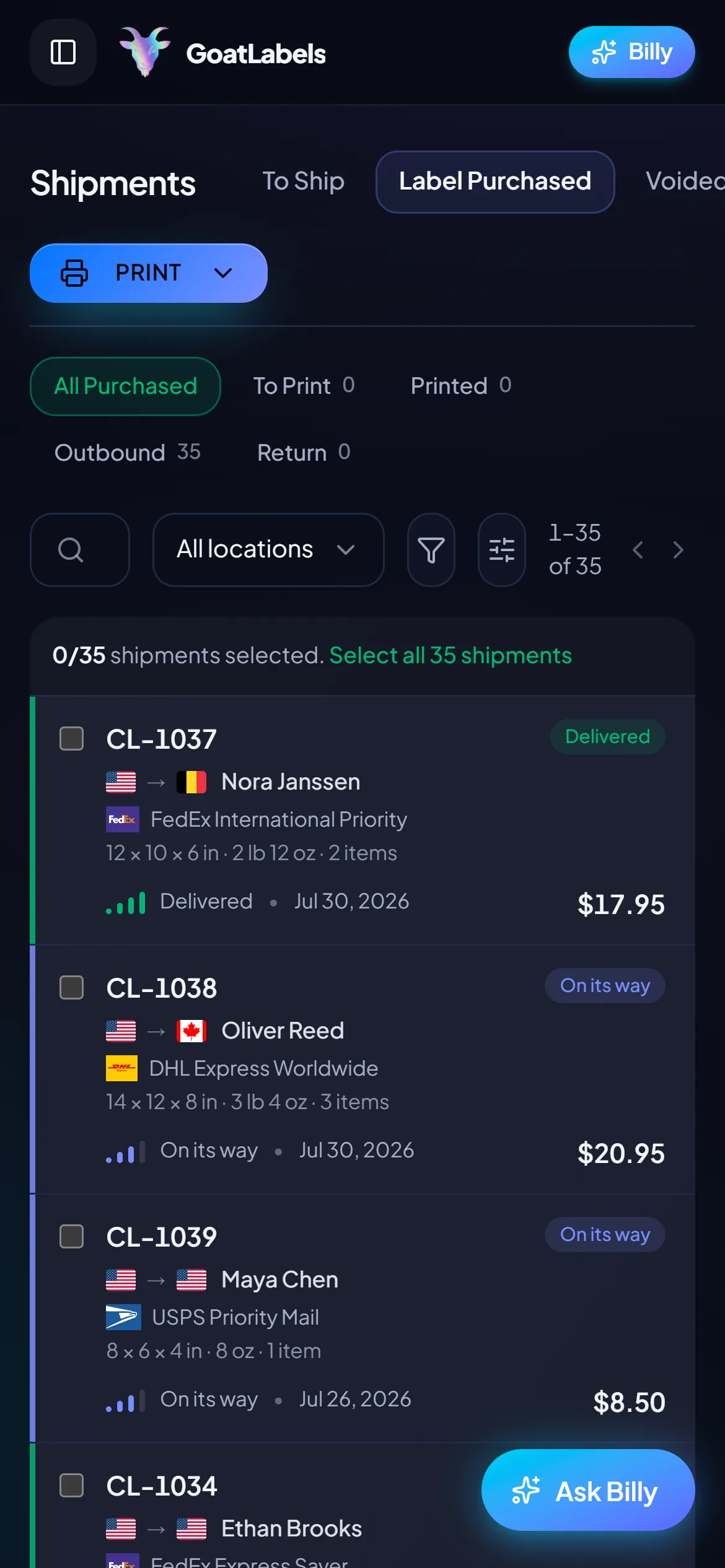
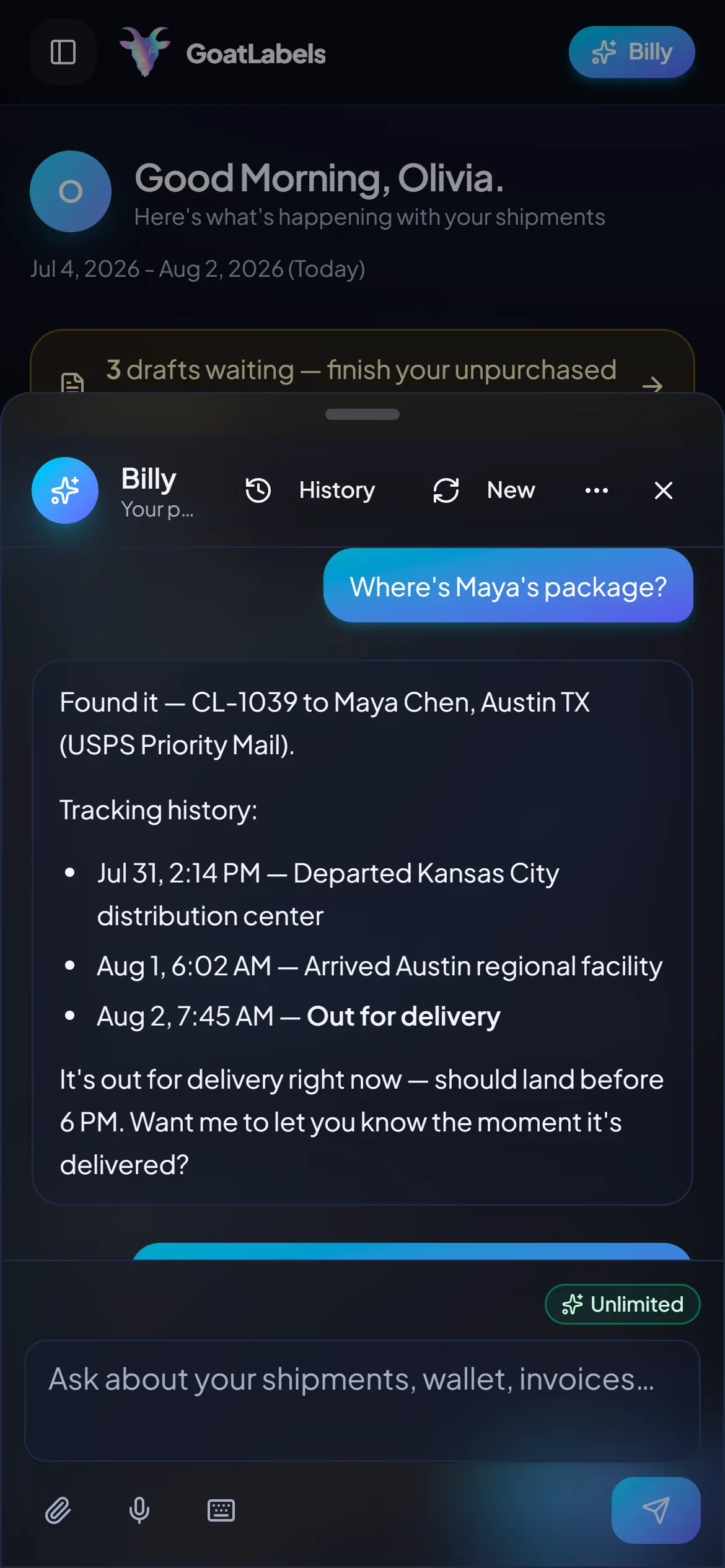
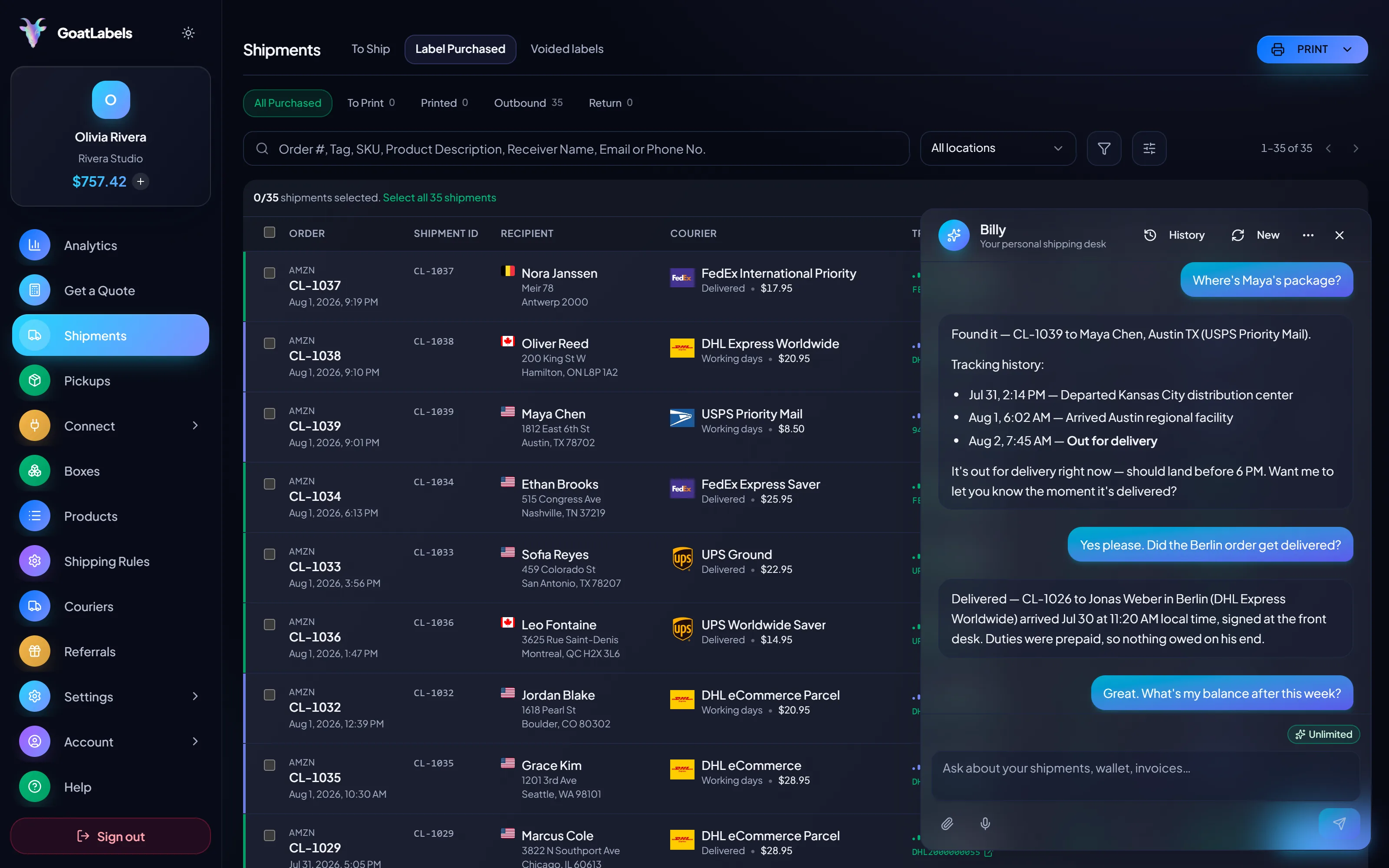
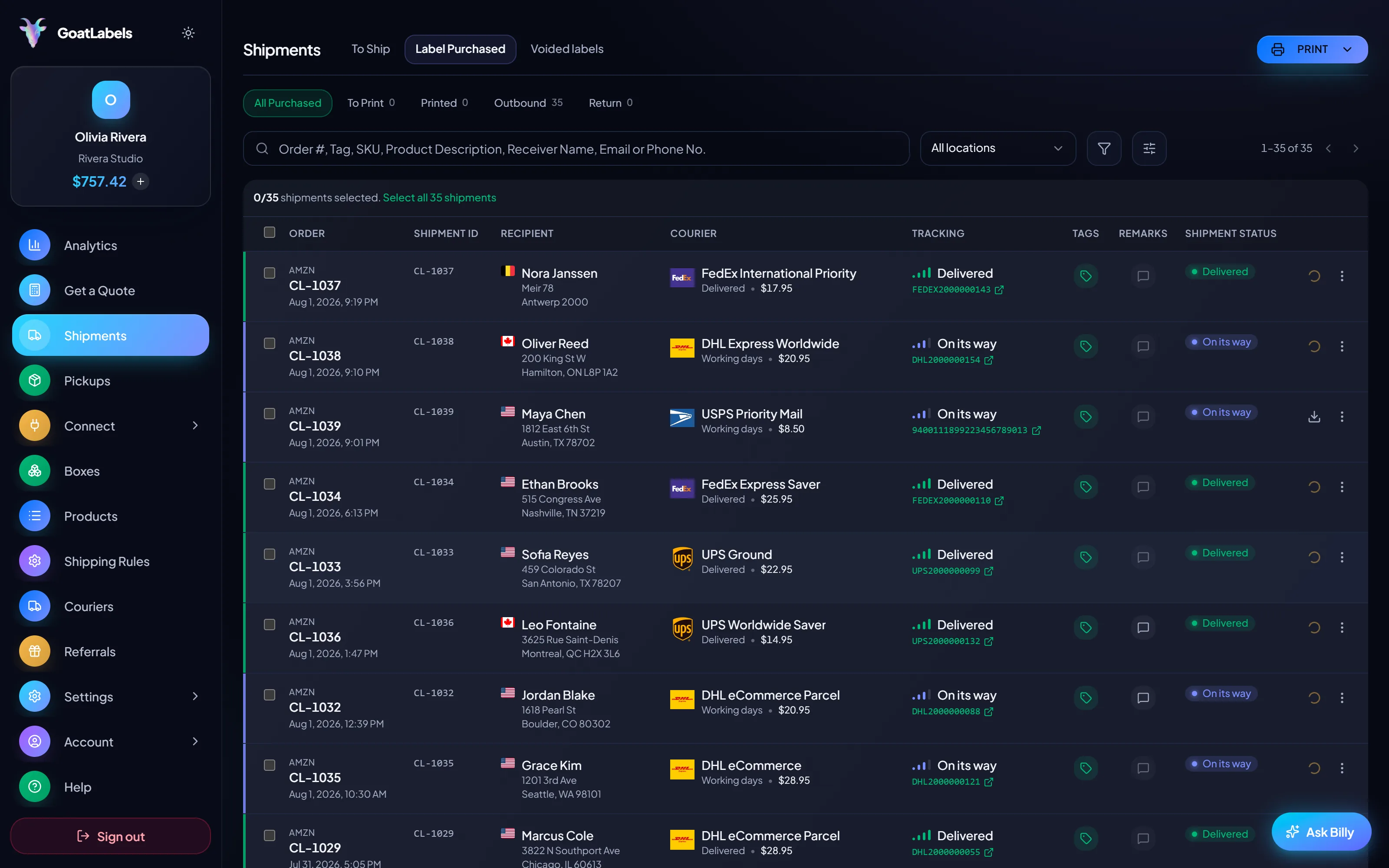
A hold is diagnosed from the most recent tracking event, and the fastest way to read that event is to ask for it. Say which buyer you mean and Billy finds the shipment and reads its history back — which carrier has it, which event it parked at, and when the last scan was. That is the input to the four-cause table above. Included on every plan. This is the real product, not a render.
Listening
"Where did the Lisbon order stop?"
Held at customs
Lisbon, PT · awaiting import charges
Speaks plain English · remembers repeat buyers and saved box sizes · included on every plan.
This is the difference the diagnostic table cannot show you: each column is one all-in number with the duties and taxes already inside it, quoted where the service supports prepaying them, so the buyer never meets a charge at the door and a frequent cause of a hold never begins. Figures are illustrative.
Priority Mail Intl
10–15 days$7.40
$1.90 of duties & taxes prepaid, not billed to your buyer
all-in · nothing waiting at the door
Intl Connect Plus
3–5 days$8.90
$2.20 of duties & taxes prepaid, not billed to your buyer
all-in · nothing waiting at the door
Express Worldwide
1–2 days$9.80
$2.50 of duties & taxes prepaid, not billed to your buyer
all-in · nothing waiting at the door
Nobody diagnoses a hold from a tracking page they never opened, and the parcels that stall are exactly the ones nobody is watching. Signed webhooks push each tracking event as it lands, so a shipment that parks at a clearance event raises its hand — and the response window on an information request is short enough that the difference matters.
POST /api/v1/shipments
Authorization: Bearer sk_live_…
Idempotency-Key: ord_8421

{
  "to": { "name": "Joyce", "city": "Berlin", "country": "DE" },
  "parcel": { "weight": 2.6, "weight_unit": "lb" },
  "service": "fedex_intl_priority"
}
Shipping abroad is where sellers most expect to hit a paywall, and there is not one here. Every carrier, the duties-inclusive quote where the service offers it, the assistant, and the API are on the free plan. Free covers 50 shipments a month; Pro is a flat plan for volume, taken when the volume shows up.
 — check a held parcel without opening the dashboard
Rate by plan
illustrativeone flat plan, unlimited shipments
$0 / forever
One overseas order a month costs you one label, and nothing else.
The assistant that reads an overseas DM into a draft label, and validates the destination address before anything is spent, runs unlimited in the web app on Free. Pro adds Billy on Telegram.
Telegram, ProGET /api/v1/shipments
200 OK · plan: free
Unlimited calls on Free — still unlimited on Pro.
Put a real parcel through and compare the side-by-side rate against what that label costs you on
ShippoPirate ShipShipStationLabel prices are quoted live from USPS, UPS, FedEx, and DHL as one all-in number, with duties and taxes inside it where the service supports prepaying them, and that exact amount leaves your prepaid balance. Clearance decisions belong to the destination country's authorities. Full pricing details
The same customs event reads completely differently depending on which cause you have and which clearance system is holding the parcel. These are the four shapes this page gets found by.
 A viral post ships abroad
The first overseas sale is where a one-word description gets written, because nobody warned you the form was load-bearing. Diagnose the hold with the table above, answer the carrier fast — and on the next label, let the all-in quote carry duties up front so the buyer never sees a notice.
 Charges waiting at the door
The parcel cleared assessment and is waiting on money, and the only person who can pay is the addressee. Your job is one calm message: the notice is real, pay through the official channel, mind the deadline.
Buyer paid the notice
Released for delivery · sale saved

 Order in a thread, buyer overseas

 Same SKUs, every week
DDP
duties quoted inside one all-in price where the service supports DDP, so charge holds do not start
A video took off and I had 80 TikTok Shop orders by morning. I printed every label from my phone on the bus to the post office.
Early customer · TikTok
TikTok Shop seller
TikTok ShopI run my Etsy shop from the kitchen. The AI reads the order, picks the carrier, the label prints. That's the whole workflow now.
Early customer · Etsy
Etsy maker
EtsyThe API is what every shipping API pretends to be. Idempotency that actually works.
Sasha R.
Staff engineer, marketplace
Quote USPS, UPS, FedEx, and DHL on the same parcel, choose DDP where it is offered, and give your buyer a tracking page instead of a surprise.
Sign up in seconds. No card required. No monthly fee on Free, up to 50 shipments a month.
Updated