

USPS
Priority Mail Intl
6–10 days$31.70
$6.20 of taxes & duties shown inside the total
all-in · the door bill is visible here
For lower-value parcels the UK collects VAT at the point of sale rather than at the border — on marketplace orders the marketplace collects it, on direct orders the seller does. Above the threshold, the buyer's carrier collects at delivery. Which side of that line you sell on decides your paperwork.
USPS, UPS, FedEx, and DHL all cross the same border under the same VAT rules — the carrier decides speed and price, the sales channel decides who collects the tax.


 DHL: international
Description, declared value, origin, and your HS code stored as customs templates — the paperwork that cleared last week ships again unchanged.
Updated
The UK made a decision after Brexit that most US sellers still have not internalised: for lower-value consignments, it moved VAT collection off the border entirely and onto the point of sale. Below a published consignment value, the tax on a parcel from the US is not assessed when the parcel lands — it was supposed to be charged when the buyer paid, by whoever ran the checkout. Above that value, the traditional model survives: the parcel is assessed on arrival, and import VAT plus any duty is collected from the buyer before delivery.
Everything else on this page follows from which side of that line a given order sits on. Below it, your questions are about registration and checkout configuration. Above it, your questions are about what your buyer will be billed at the door and whether you warned them. The line is a declared-value test on the consignment, so you know the answer for every order before you print anything — the figure itself sits in the dated block below, because it belongs to HMRC and this page refuses to let it rot in a paragraph.
For under-the-line sales the UK splits sellers into two regimes by channel, and the difference is close to absolute. Sell through a marketplace and the marketplace becomes the deemed supplier for tax purposes: it charges the buyer VAT at checkout, remits it under its own UK registration, and your parcel rides that arrangement. You register nothing and file nothing. Sell the identical item from your own website and every one of those obligations is yours — UK VAT registration with HMRC, VAT charged at your checkout, and periodic returns, with no sales-volume floor beneath which an overseas seller is excused.
This is why UK strategy is really channel strategy for a small US seller. A maker doing a handful of UK orders a month through Etsy has no UK tax admin at all, which is a genuinely strong argument for routing UK demand through a marketplace even when your own site is cheaper elsewhere — the mechanics of shipping those orders are on shipping labels for Etsy. A seller with real direct UK volume should price the registration burden in, or ship above-the-line and let the border collect. What you should not do is sell direct under the line and collect nothing, because the parcel's customs data names the seller, and the obligation does not evaporate just because the checkout ignored it.
The declaration is not one form for all three routes; it is the same form carrying different signals. Every route needs the basics done honestly — a specific description, the price actually paid, the country of origin, and the HS code you supply. What changes is the tax status that travels with the customs data. A marketplace parcel carries the marketplace's collection arrangement. A direct under-the-line parcel should flag your VAT registration so the border knows the tax is already paid. An over-the-line parcel carries no tax flag at all, because collection is the border's job. Get the flag wrong in either direction and your buyer is double-charged or your parcel is held while someone works out which story is true. The form itself, field by field, along with the choice between prepaying charges and leaving them to the buyer, is covered on customs forms for small parcels.
When collection does fall to the border, the number your buyer sees is never just the tax. The delivering carrier fronts the VAT and duty to HMRC, does the entry work, and charges a clearance or handling fee for having done both — a fee that is fixed or semi-fixed, which means it is proportionally brutal on small orders. Tax that would have been a few pounds at checkout becomes a doorstep demand of tax plus fee, presented to a buyer who thought they had already paid for everything. The parcels that generate one-star cross-border reviews are almost never late; they are fee-ambushed.
Treat the fee as a design input. Under-the-line sales collected at checkout produce no doorstep bill at all, which is the entire point of the regime. Above the line, either warn the buyer at checkout in plain words, or ship duty-paid so the charges are yours — the DDP-versus-DDU trade-off lives on the customs guide. A buyer who refuses the bill sends the parcel back across the Atlantic at your expense, and package returned to sender explains who pays for that ride.
UK Border Force clears small parcels on data, and data problems are the delays. The same discipline that works on every lane works here: describe the thing, not the category. A silver-plated pendant necklace clears; jewellery invites a query. Declare the transaction price, not a diplomatic undervaluation — reassessment on an implausible value takes far longer than tax on an honest one, and understatement is the border's oldest pattern-match. GoatLabels stores all of it as customs items on the shipment — description, value, origin, and your HS code — and saves them as per-product templates, so a SKU that cleared cleanly keeps shipping on the identical declaration. Billy drafts the plain-word description from a pasted order; the value and the code remain yours, because they are legal statements only a seller can make. On a lane where the paperwork is the product, that template is worth more than any rate discount — though the four-way quote on cheap shipping labels applies here too, and the carriers disagree hardest on international parcels.
| Order | Who collects the VAT | What you must register | What the declaration must show |
|---|---|---|---|
| Marketplace order, under the value line | The marketplace, at checkout, as deemed supplier | None for you — the marketplace's UK VAT registration covers the sale | Accurate description and value; the marketplace's tax status travels in the customs data |
| Your own website, under the value line | You, at checkout | UK VAT registration with HMRC, with returns to file — no sales minimum exempts an overseas seller | Description, value, and your VAT status flagged so the border does not collect a second time |
| Any channel, over the value line | The border — the delivering carrier advances import VAT and any duty, then bills the buyer plus a handling fee | None required for a standard buyer-pays import; acting as importer yourself changes that | Description and value drive the assessment; understatement is reassessed, not waved through |
Dated figures, all in one place.As of the verification date above: the value line is £135 per consignment — goods value, excluding shipping and insurance — and UK VAT's standard rate is 20%. At or below £135 (GOV.UK, checked 2026-10-21), checkout collection applies and no import VAT is due at the border; above it, import VAT and any duty are assessed on arrival and carriers charge a clearance or handling fee (single-digit pounds at Royal Mail; percentage-based with minimums at the express couriers) on top of the advanced charges. These are HMRC and carrier figures, re-checked every 6 months by the named review owner recorded with this page. Sources: GOV.UK, goods sold directly to UK customers and GOV.UK, goods sold through online marketplaces; confirm against them before building your checkout.
A UK-bound parcel carries two stories that have to match: what happened at your checkout, and what the customs data claims happened. This is the loop that keeps them aligned — the order arrives with its channel attached, Billy drafts a description the border can classify, the tax route travels in the declaration, and four carriers are priced before the wallet moves.
do you post to the UK? it would be going to Sheffield, S1 2HE
On this lane the channel is not trivia. It is the input that decides whether the tax was already taken at checkout or is waiting at your buyer's door, and the declaration has to carry whichever of those is true.
 Billy AI
A declaration whose tax flag disagrees with the checkout is the fastest way to get a buyer charged twice, and the slowest thing you can do to a parcel. Saving it per SKU means the version that cleared cleanly is the version that ships again.
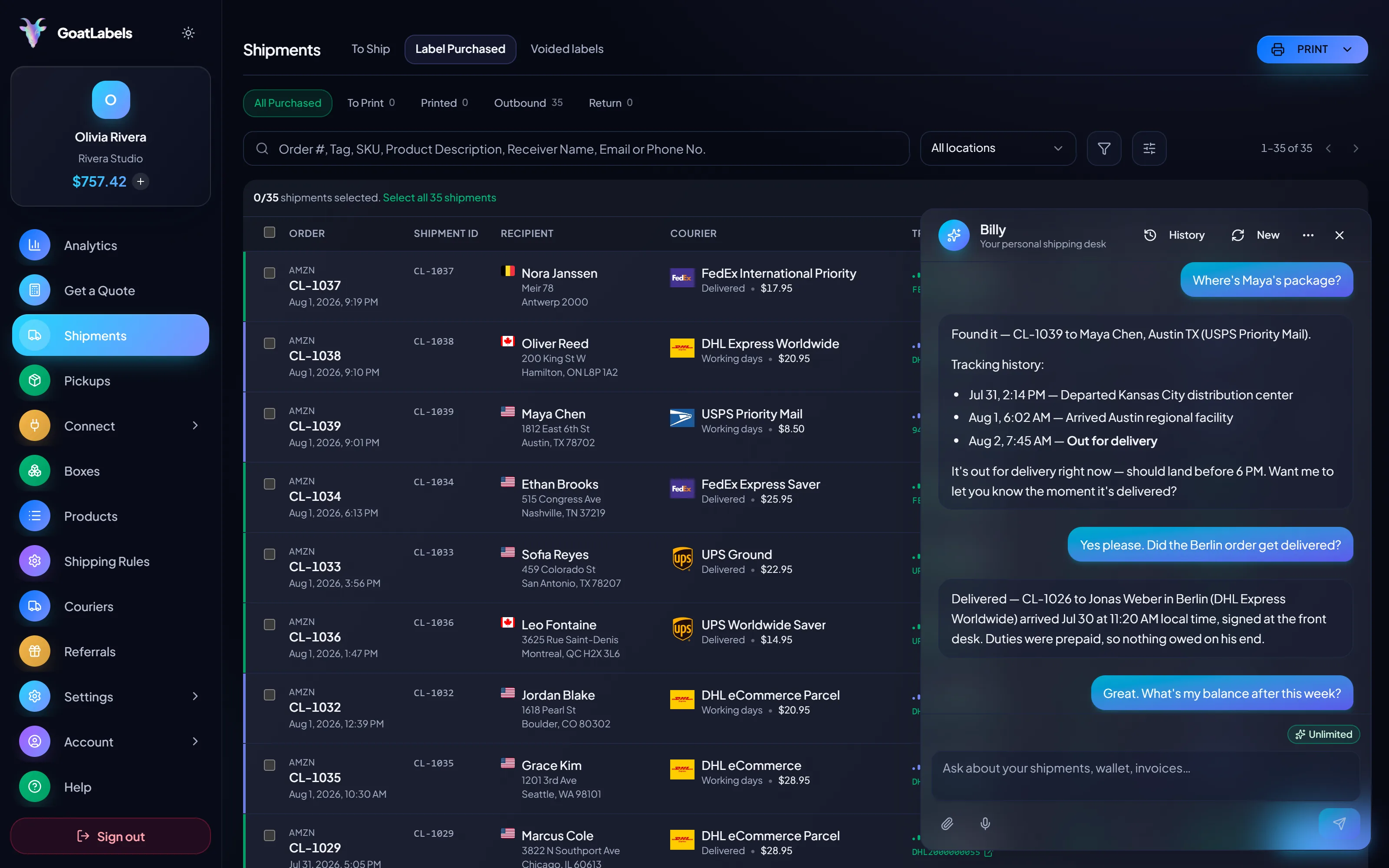
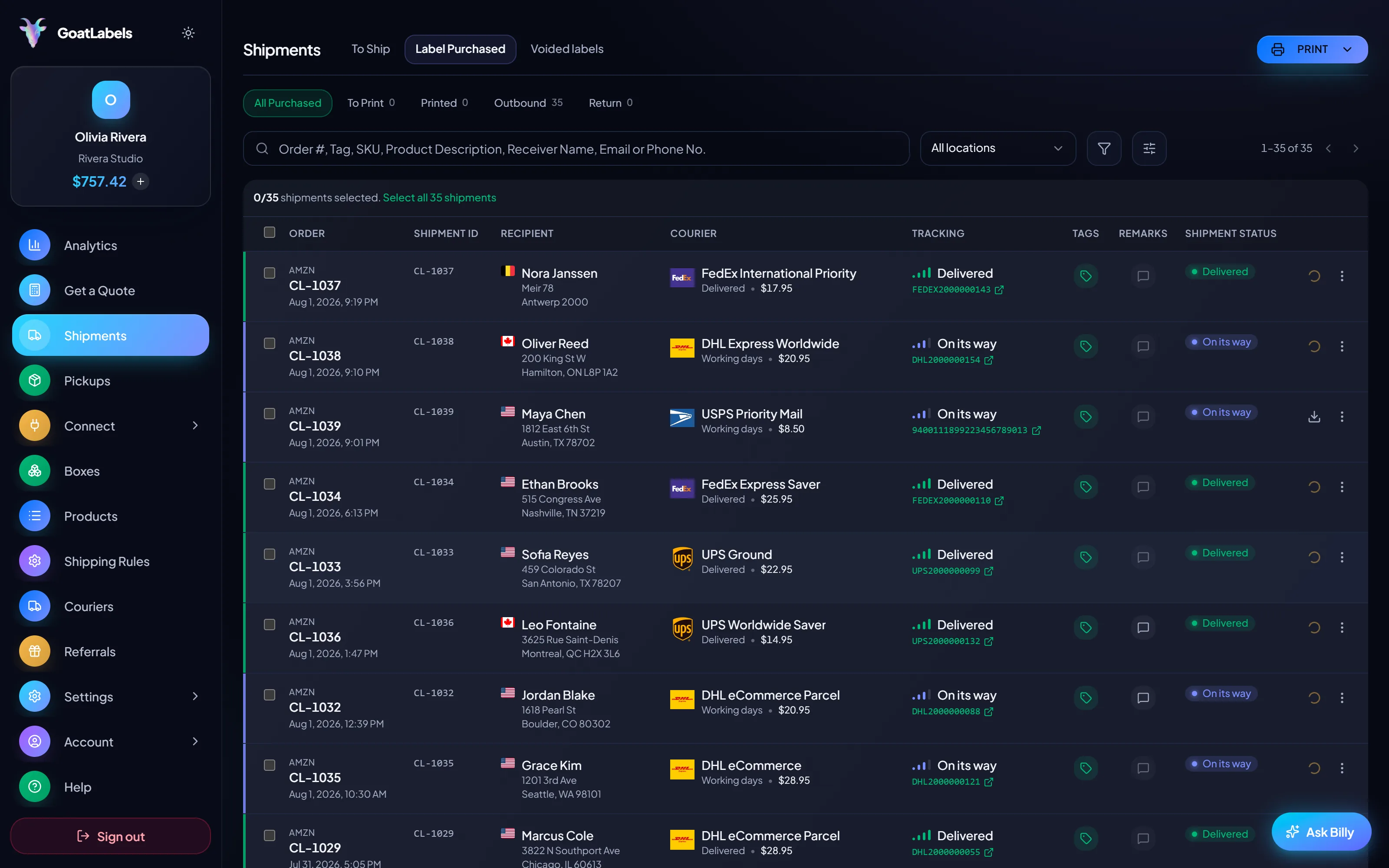
Shopify, Etsy, WooCommerce, TikTok Shop, Amazon, eBay, Squarespace, Wix, Walmart, Square, BigCommerce, Magento, and Temu sync into one To Ship queue, so a UK order from a marketplace lands beside a UK order from your own checkout. They ship identically and they are taxed differently — which is exactly why they belong in the same queue with the channel still attached to each one.
 Shopify
 Etsy
Etsy WooCommerce
 TikTok Shop
 Amazon
 eBay
eBay Squarespace
 Wix
Wix WalmartShopify PlusSoon
 Square
 BigCommerce
 Magento
 ZapierSoon
 NetSuiteSoon
 EcwidSoon
 Temu
Temu SheinSoon
 ChannelAdvisorSoon
 SkuVaultSoon
 Zoho InventorySoon
 Patreon
Once you know which side of the value line an order sits on, the shipping part is mechanical: an honest declaration, four prices, one wallet. Everything below is that mechanism.
Card, Apple Pay, Google Pay, ACH, and crypto fund one balance that buys UK labels and domestic ones alike. On Free, nothing monthly sits under it, so a store whose UK demand is three parcels a month pays for exactly three parcels.
Paste the order and Billy drafts the specific, plain-word item description UK customs data needs — a wool scarf, not apparel. Declared value and HS code stay yours to supply: they are the seller's legal statements, and no assistant should be guessing them.
BillyLIVEWhere the service supports DDP, a UK quote is one all-in number with the taxes-and-duties portion broken out inside it, so the difference between an under-the-line and over-the-line order is on the screen before money moves. What you approve is what leaves the balance.
USPS hands to Royal Mail's every-address network; UPS, FedEx, and DHL fly and deliver on their own. The spread between those four on the same transatlantic parcel is wider than on any domestic quote, which is exactly why the lane rewards rate-shopping.
UPS$12.48FedEx$13.22DHL$14.10USPS$11.79Customs items ride the same shipment objects as the dashboard, on unlimited calls with signed webhooks, so your checkout can flag the VAT route and generate the matching declared label in code. Saved customs templates apply per SKU there too.
Declared label ready
Sheffield, UK · tax route flagged
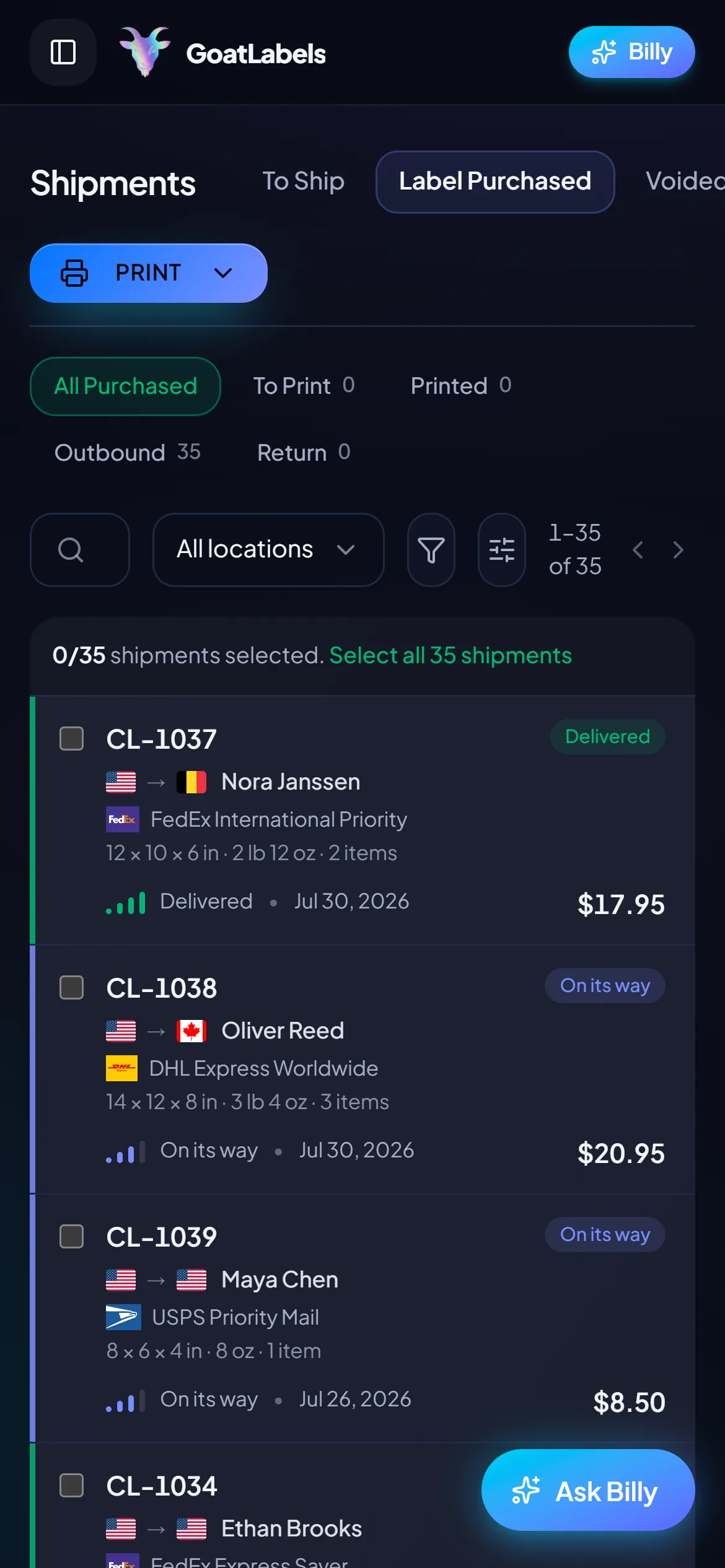
A store with a handful of UK orders a month should not need a desk session to ship them. The declaration is stored against the product, the postcode is validated on the phone, and the taxes-and-duties portion is visible inside each quote before you commit to who pays it.
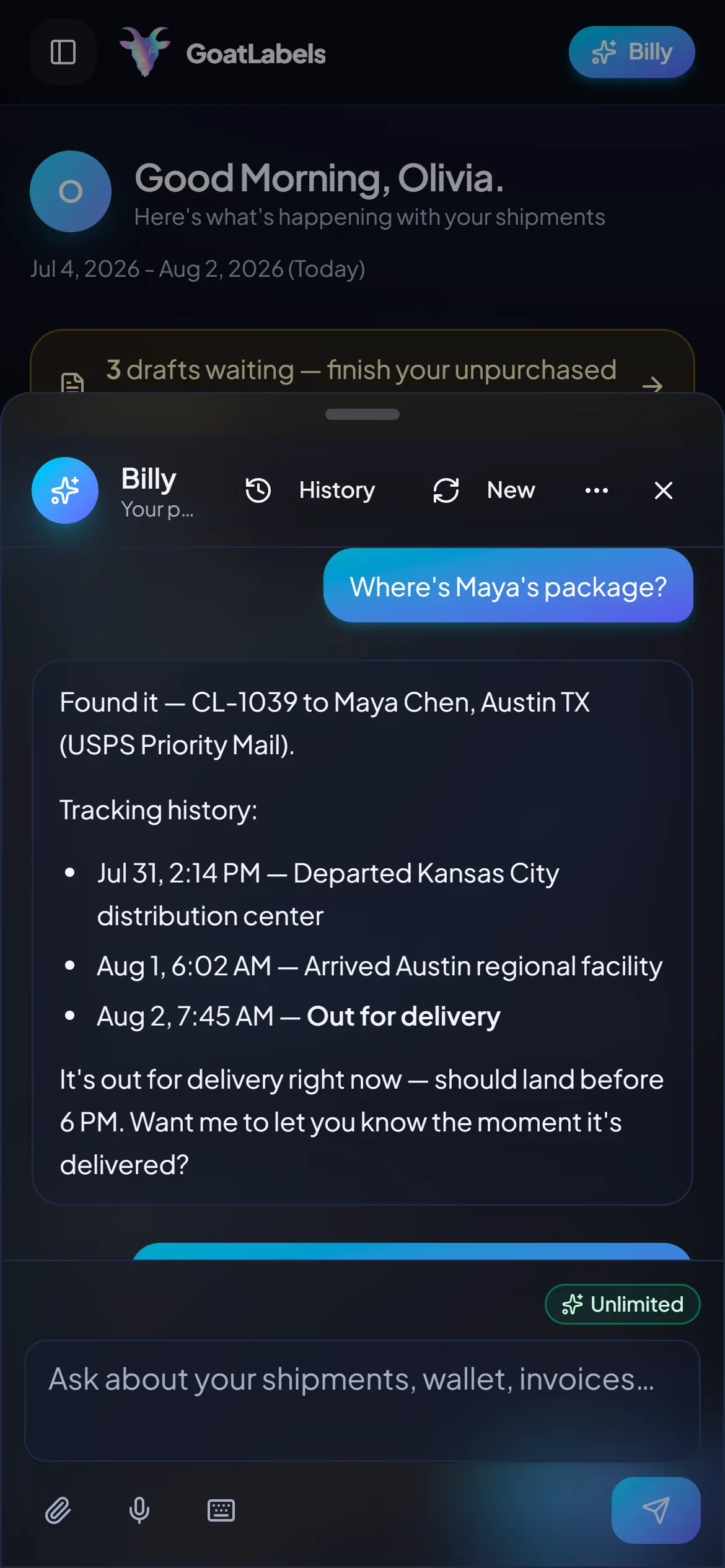
The message that arrives from a UK buyer is rarely where is it. It is what is this bill. Ask out loud and Billy pulls the shipment up and reads back what you paid, what the quote showed as the taxes-and-duties portion, and where the parcel is now — so the reply is a fact rather than a guess. Included on every plan. This is the real product, not a render.
Listening
"What did the Sheffield parcel cost all in?"
Out for delivery
Sheffield, UK · with the final-mile carrier
Speaks plain English · reads back the all-in price and the tax portion inside it · included on every plan, never a pricier tier.
A UK-bound parcel quoted across the postal stream and the couriers at once — each column one all-in number with the taxes-and-duties portion visible inside it, so you know what the border will want before the label exists. Figures are an illustrative example, not a live quote.
Priority Mail Intl
6–10 days$31.70
$6.20 of taxes & duties shown inside the total
all-in · the door bill is visible here
Intl Connect Plus
3–5 days$29.90
$6.90 of taxes & duties shown inside the total
all-in · the door bill is visible here
Express Worldwide
1–3 days$41.20
$7.40 of taxes & duties shown inside the total
all-in · the door bill is visible here
On this lane the tax decision is made at your checkout and then has to survive into the customs data. That is an integration problem, which is why the API is the honest answer for any store with real direct UK volume: pass the route with the shipment, attach the customs items, buy — REST, JSON, one Bearer header, unlimited calls on every plan.
POST /api/v1/shipments
Authorization: Bearer sk_live_…
Idempotency-Key: ord_8421

{
  "to": { "name": "Joyce", "city": "Berlin", "country": "DE" },
  "parcel": { "weight": 2.6, "weight_unit": "lb" },
  "service": "fedex_intl_priority"
}
UK demand usually starts as a trickle, and a monthly plan prices a trickle badly. Customs items, per-SKU saved declarations, and all four carriers are on the free plan, so the cost of finding out whether the UK works for you is the postage on the parcels you actually send.
 — check a transatlantic parcel without opening the dashboard
Rate by plan
illustrativePro: one flat monthly plan, unlimited shipments
$0 / forever
A handful of transatlantic orders a month, with nothing owed for the months with none.
The assistant that turns a pasted order into the plain-word description UK customs data needs — a wool scarf, not apparel — runs on Free, unlimited, in the web app. Pro adds Billy on Telegram.
Telegram, ProGET /api/v1/shipments
200 OK · plan: free
Unlimited calls on Free — still unlimited on Pro.
Put a real parcel through and compare the side-by-side rate against what that label costs you on
ShippoPirate ShipShipStationLabel prices are quoted live from USPS, UPS, FedEx, and DHL as one all-in number, with the taxes-and-duties portion shown inside it where the service supports DDP. What HMRC assesses, and what a carrier charges to advance and collect it, are theirs to set; the dated block above names the source. Full pricing details
Your paperwork on this lane is decided by where the sale happened and what it was worth, not by what is in the box. These are the four sellers that distinction pulls apart.
 The deemed supplier does the collecting
The lightest-admin version of the UK for a small US seller: the platform charges the buyer and remits under its own registration, and your job shrinks back to an honest declaration and a parcel that turns up.

 The obligations are yours
Selling the identical item from your own site moves the whole tax job onto you, which makes the customs data the place your checkout's decision becomes visible. A declaration that agrees with the checkout is the entire deliverable.
Route flagged in the customs data
So the same tax is never collected a second time

 A direct sale, whatever the app
The doorstep bill nobody agreed to
0
one-star reviews from a fee the buyer was told about at checkout
The rest of the international-lane series:Canada,the EU,Australia,Germany,Japan, andMexico — and the declaration every lane starts from, oncustoms forms for small parcels.
A video took off and I had 80 TikTok Shop orders by morning. I printed every label from my phone on the bus to the post office.
Early customer · TikTok
TikTok Shop seller
 TikTok Shop
I run my Etsy shop from the kitchen. The AI reads the order, picks the carrier, the label prints. That's the whole workflow now.
Early customer · Etsy
Etsy maker
EtsyThe API is what every shipping API pretends to be. Idempotency that actually works.
Sasha R.
Staff engineer, marketplace
Quote one real UK order across all four carriers, see the tax portion inside the all-in number, and save the declaration as a template for every order after it.
No card required. Customs templates on every plan.
Updated