

USPS
Priority Mail Intl
7–12 days$33.80
$7.10 of taxes & duties shown inside the total
all-in · route three priced honestly
Every EU-bound parcel is taxed from the first euro, but collection splits three ways: through a marketplace's IOSS number, through your own IOSS registration, or at the buyer's door with a carrier fee on top. The label and customs declaration must match the collection route you chose.
USPS, UPS, FedEx, and DHL all feed the same unified EU customs data model — the carrier picks the speed, the IOSS route decides who collects the tax.


 DHL: international
Description, declared value, origin, and your HS code saved as customs templates — the EU takes one setup, and the setup is stored, not retyped.
Updated
For years, small parcels into Europe slipped under a value floor below which nobody assessed anything, and a generation of sellers built habits on it. The EU abolished that VAT exemption in a single reform: every commercial parcel entering the union is now liable for VAT from the first euro of declared value. Customs duty followed in 2026: the old duty relief for low-value parcels was replaced by a flat duty per item category, so a small parcel now owes both. The low-value line survives as the ceiling for the checkout-collection scheme this page is about. The exact figures and dates sit in the dated block below.
The reform's real content was not the tax; it was the plumbing. If every parcel owes VAT, collecting it parcel-by-parcel at the border would bury both the customs services and every buyer's doorstep in fees. So the EU built a route for the tax to be collected where the sale happens — at checkout — and carried to the border as data instead of as a doorstep transaction. That route is the Import One-Stop Shop, and every US seller shipping to the EU is on one of three versions of it, whether they chose deliberately or not.
The first two routes collect at checkout and differ only in whose registration does the work. On a marketplace, the platform is the deemed supplier for qualifying consignments: it charges the buyer VAT at the rate of the buyer's country, remits it under its own IOSS number, and that number must travel with your parcel's customs data. You register nothing — but you also cannot opt out, and your declaration has to carry the marketplace's arrangement correctly for the parcel to clear as already-taxed. Selling on Etsy, this is the machinery humming underneath every EU order; the shipping side of those orders is covered on shipping labels for Etsy.
Selling from your own website, the same checkout-collection privilege requires your own IOSS registration — one number, obtained once, covering all member states, with monthly remittance of what you collected. It is genuinely one setup for the whole union, but it is accounting overhead with a fixed cost in attention, which is why the honest advice for a seller doing a handful of direct EU orders a month is often route three instead. The threshold question is volume: enough direct EU orders to make a monthly filing routine, and the number pays for itself in doorstep experience.
The default route — no IOSS anywhere in the chain — still works. The parcel arrives, the destination country assesses VAT on it, and the delivering carrier or postal operator advances the tax, then bills your buyer for it plus a clearance fee before handing the parcel over. The fee is the sting: it is fixed or semi-fixed, so on a small order it can exceed the tax itself, and it lands on a buyer who believed they had already paid in full. Some buyers pay it grudgingly. Some refuse, and a refused EU parcel comes back across the Atlantic with return charges attached — package returned to sender covers who pays for that. Route three is not wrong; it is simply the route where the border's costs become your buyer's problem, and it should be a choice you make with open eyes rather than a default you fell into. Prepaying the charges yourself is the other way out — the DDP-versus-DDU decision, covered on the customs guide.
The three routes fail in one shared way: a declaration that tells a different story than the checkout did. An IOSS number is not printed on the parcel — it travels in the electronic customs data ahead of it, which means the label workflow that generates your customs data is where the route is actually implemented. A marketplace sale must carry the marketplace's number; a direct IOSS sale must carry yours, mistyped by nobody; a route-three parcel must carry none. Get the data wrong and the failure modes are concrete: already-taxed parcels taxed again at the door, or over-ceiling parcels carrying a number that cannot apply, held while the border reconciles the contradiction. GoatLabels keeps the declaration itself accurate the same way on every lane — customs items with description, declared value, origin, and your HS code, saved as per-SKU templates so the paperwork that cleared last month ships identically this month. Billy drafts the plain-word description from a pasted order; the value and code remain yours, because they are the seller's legal statements. The form, field by field, is customs forms for small parcels.
The unified machinery is real: one registration or one marketplace arrangement, one customs data standard, one declaration discipline, and your parcel clears the same way into Portugal as into Finland. What the union did not harmonise is the percentage and the pavement. VAT rates are national, and checkout collection charges the buyer's country's rate, so the same item carries different tax to different buyers by design. And the final mile belongs to national posts and local courier operations whose delivery habits differ far more than their customs handling does — signature culture, locker networks, redelivery patience. Quoting USPS, UPS, FedEx, and DHL against each EU order catches both kinds of variation at once. It is the same argument cheap shipping labels makes for domestic parcels, sharpened by the fact that international quotes diverge harder. One setup covers the paperwork; the quote still deserves to be per-parcel. For the largest single market, the Germany-specific details are on shipping to Germany from the US.
| Route | Who collects | What the declaration carries | What the buyer sees | When it applies |
|---|---|---|---|---|
| Route one: marketplace IOSS | The marketplace, at checkout, as deemed supplier under its own IOSS registration | The marketplace's IOSS number travels in the electronic customs data with your honest description and value | Nothing at the door — tax was in the checkout total | Marketplace sales under the scheme's value ceiling |
| Route two: your own IOSS | You, at checkout, remitting monthly through one EU registration that covers all member states | Your IOSS number in the customs data; a missing or mistyped number means double taxation at the door | Nothing at the door when the data is right | Direct sales under the ceiling, once volume justifies the accounting |
| Route three: collection at the door | The border — the delivering carrier or postal operator advances the VAT and bills the buyer, plus a clearance fee | No IOSS data; description and value drive the assessment | A doorstep bill of tax plus fee, and the option to refuse the parcel | Any consignment over the ceiling, and under-ceiling direct sales where the seller has no IOSS |
Dated figures, all in one place.Checked 2026-10-21 against the European Commission and the Council of the EU: the EU abolished its low-value VAT exemption on 1 July 2021, so VAT applies from the first euro of declared value, and IOSS covers consignments of up to €150 intrinsic value. Above €150, IOSS cannot apply and VAT and duty are assessed at the border. Below it there is no longer any customs-duty relief: since 1 July 2026 a flat €3 customs duty applies to each item (goods sharing a tariff classification, description and, where applicable, origin) in a consignment sold to an EU consumer, under any VAT scheme, with a narrow exception for preferential-origin goods declared without IOSS, scheduled to run until 1 July 2028. The Commission's guidance of 5 October 2026 also describes a separate €2 per-item Union handling fee, expected from 1 November 2026. National VAT standard rates span roughly 17% to 27% across member states (checked 2026-08-15), applied by the buyer's country. Carrier and postal clearance fees on route three are set nationally and per operator. Sources: European Commission, €3 customs duty, Commission guidance, 5 October 2026, Council of the EU, 11 February 2026, and European Commission, low value consignments. Re-checked every 6 months by the named review owner recorded with this page; the EU customs reform is still moving, so verify before building a checkout on these figures.
An IOSS number is never printed on a parcel — it travels ahead of it in the electronic customs data, which means the label workflow is where an EU tax route stops being a policy and becomes a fact. This is that loop: the order arrives with its channel, Billy drafts a description twenty-seven customs services can classify, the route's data is attached, and four carriers are priced before the wallet moves.
can you ship the linen tablecloth to Ghent? 9000, Belgium
Twenty-seven destinations share one declaration standard, so the form does not change between Lisbon and Helsinki. What changes is the buyer's country — which sets the rate charged at checkout, and which national network knocks on the door.
 Billy AI
The failure mode here is a declaration telling a different story than the checkout did — a route number missing, mistyped, or attached to a consignment it cannot cover. Saving the declaration per SKU takes the improvisation out of the half you control.
Shopify, Etsy, WooCommerce, TikTok Shop, Amazon, eBay, Squarespace, Wix, Walmart, Square, BigCommerce, Magento, and Temu sync into one To Ship queue. For the EU that queue is carrying two different tax stories side by side: a marketplace order rides the platform's registration, a direct order rides yours or none at all. Same box, same declaration discipline, a different number in the customs data.
 Shopify
 Etsy
Etsy WooCommerce
 TikTok Shop
 Amazon
 eBay
eBay Squarespace
 Wix
Wix WalmartShopify PlusSoon
 Square
 BigCommerce
 Magento
 ZapierSoon
 NetSuiteSoon
 EcwidSoon
 Temu
Temu SheinSoon
 ChannelAdvisorSoon
 SkuVaultSoon
 Zoho InventorySoon
 Patreon
IOSS lives or dies in the customs data your label workflow generates. Everything below exists to make that data accurate, reusable, and priced honestly before the wallet moves.
Card, Apple Pay, Google Pay, ACH, and crypto fund one balance that buys labels to Munich, Madrid, and Milwaukee alike. No monthly plan underneath on Free, so an EU experiment that sells four parcels costs exactly four parcels.
Paste the order and Billy writes the specific item description EU customs data classifies on the first pass — a linen tablecloth, not homewares. Declared value and HS code stay yours: they are legal statements, and the scheme ceiling turns on the value you declare.
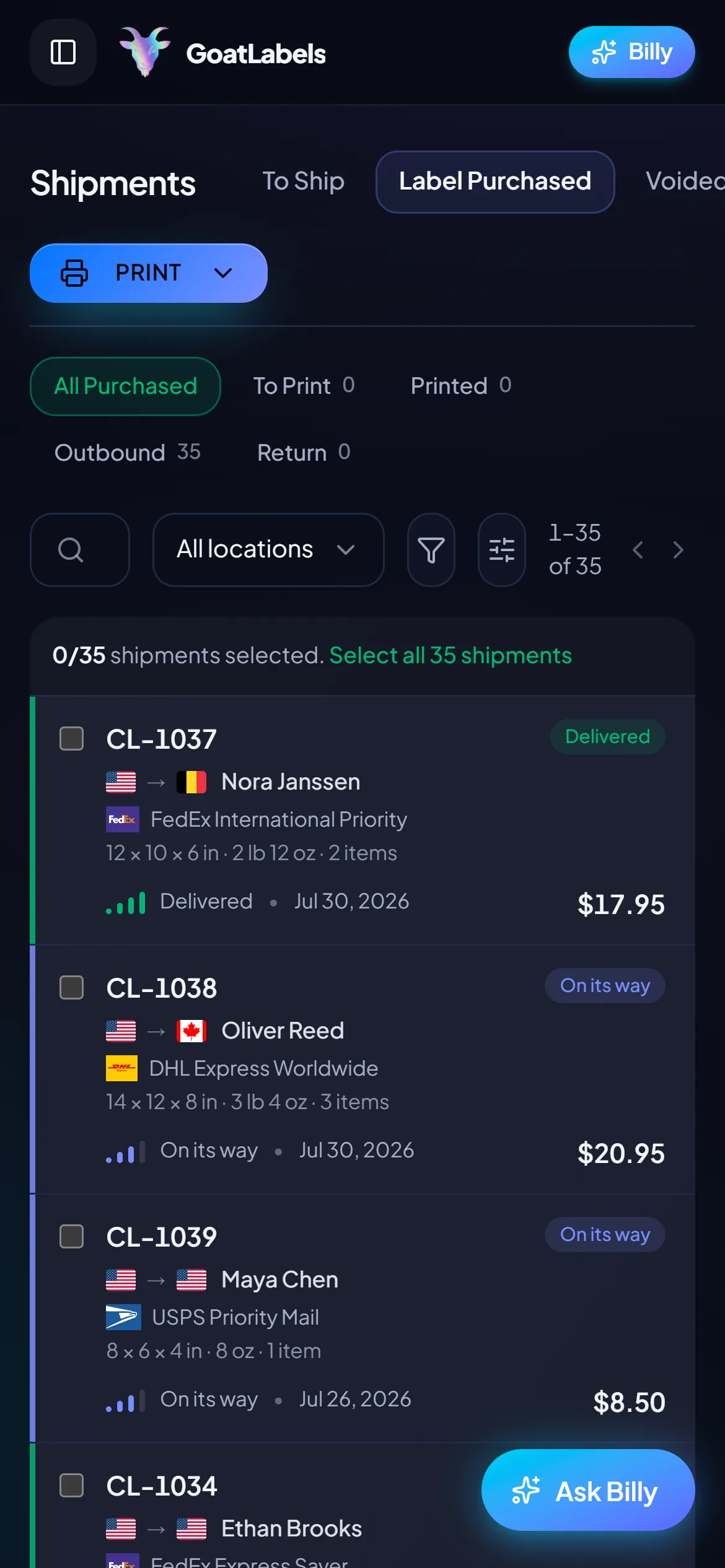
BillyLIVEWhere the service supports DDP, an EU quote is one all-in number with the taxes-and-duties portion broken out inside it, so route three's doorstep economics are on screen before you commit to them. What you approve is exactly what leaves the balance.
USPS hands to national posts with their locker networks and letterbox reach; UPS, FedEx, and DHL clear and deliver on their own networks. The four diverge harder on transatlantic parcels than on anything domestic, which is why this lane rewards a per-order quote.
UPS$12.48FedEx$13.22DHL$14.10USPS$11.79Customs items ride the same shipment objects the dashboard uses, on unlimited calls with signed webhooks, so your checkout can pass the route's tax data and generate the matching declared label in code — with per-SKU customs templates applied automatically.
Declared label ready
Ghent, BE · route data attached
The paperwork does not change from Porto to Tallinn, and that is precisely what makes an EU order shippable from a phone: the declaration is stored against the product, the validator knows the destination country's address format, and, where the service supports DDP, the taxes-and-duties portion sits inside the quote.
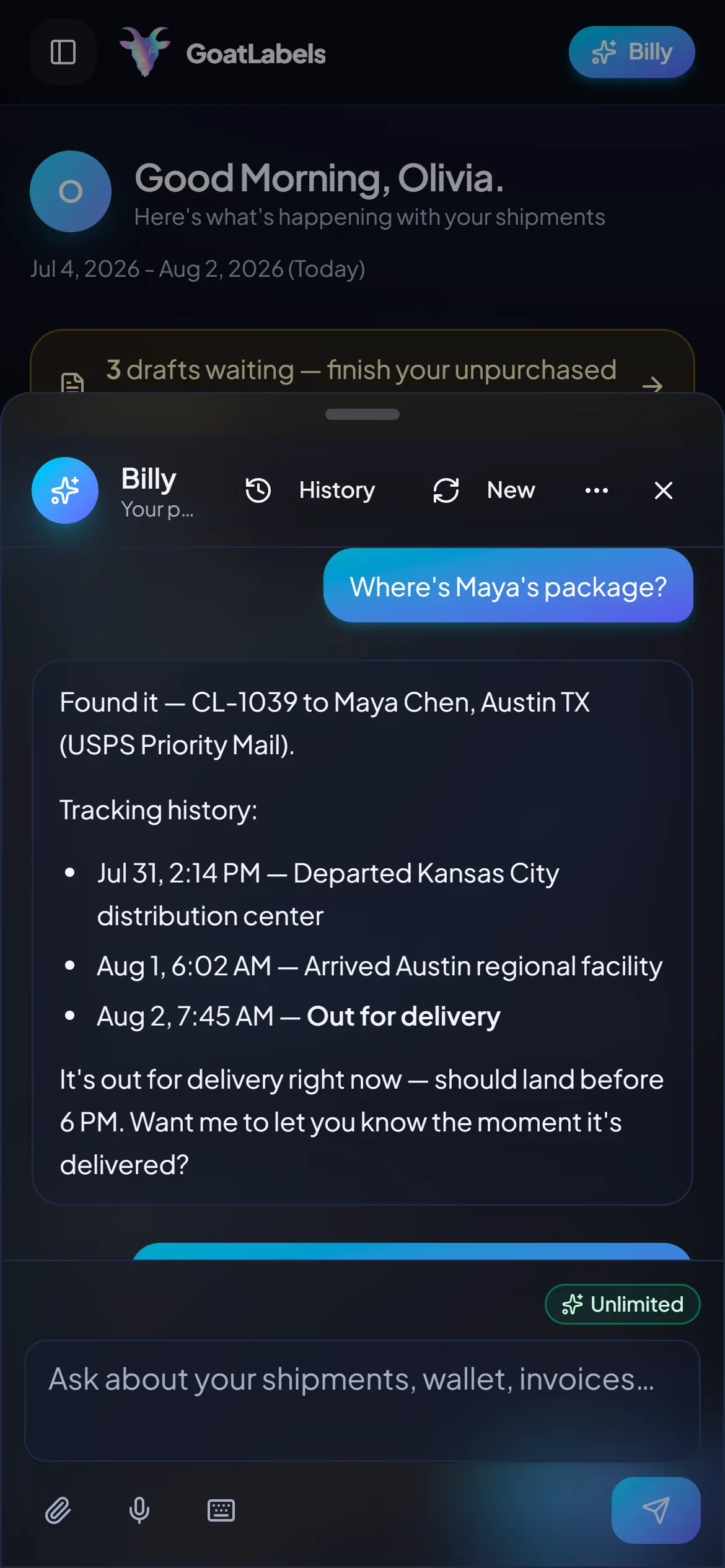
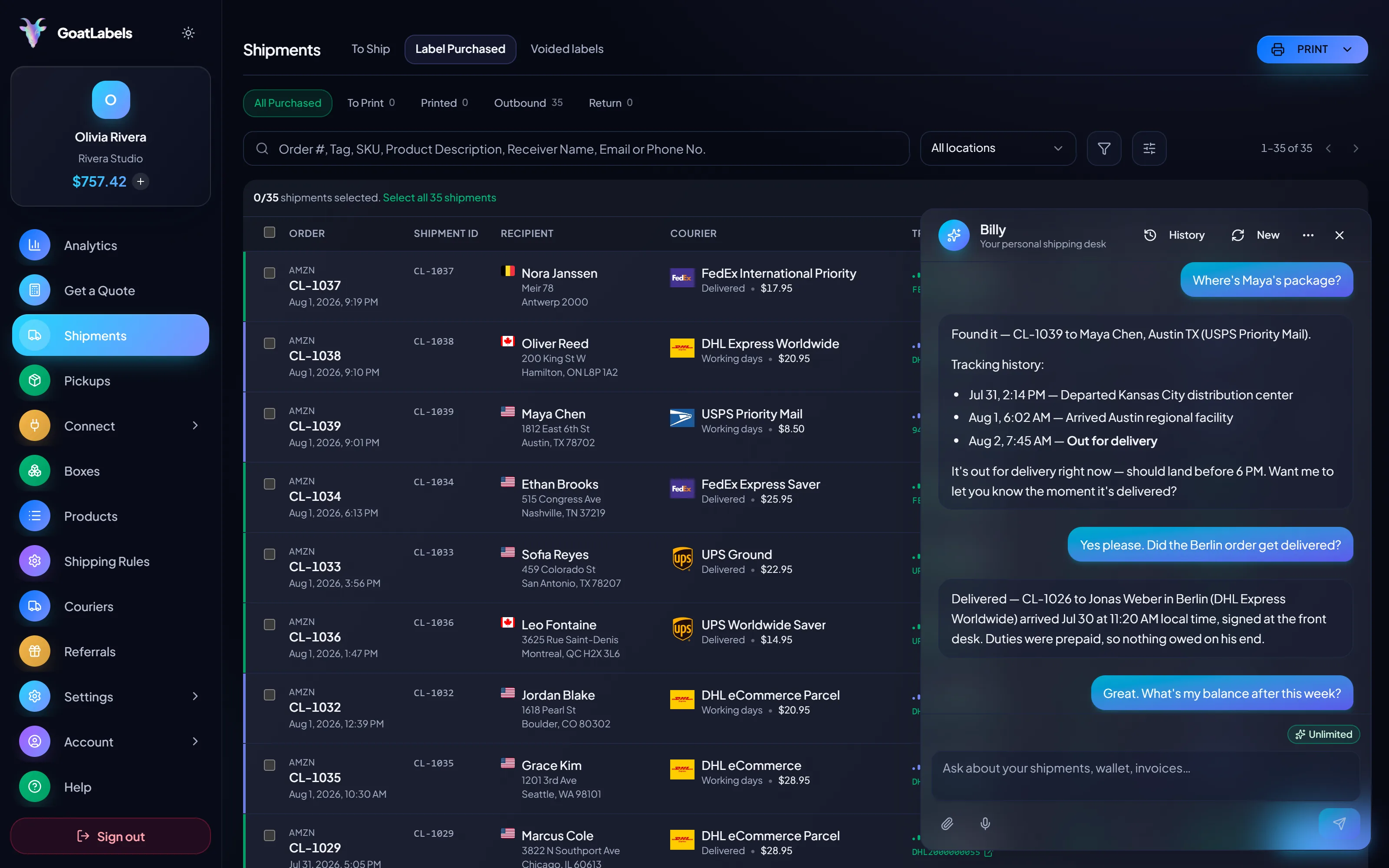
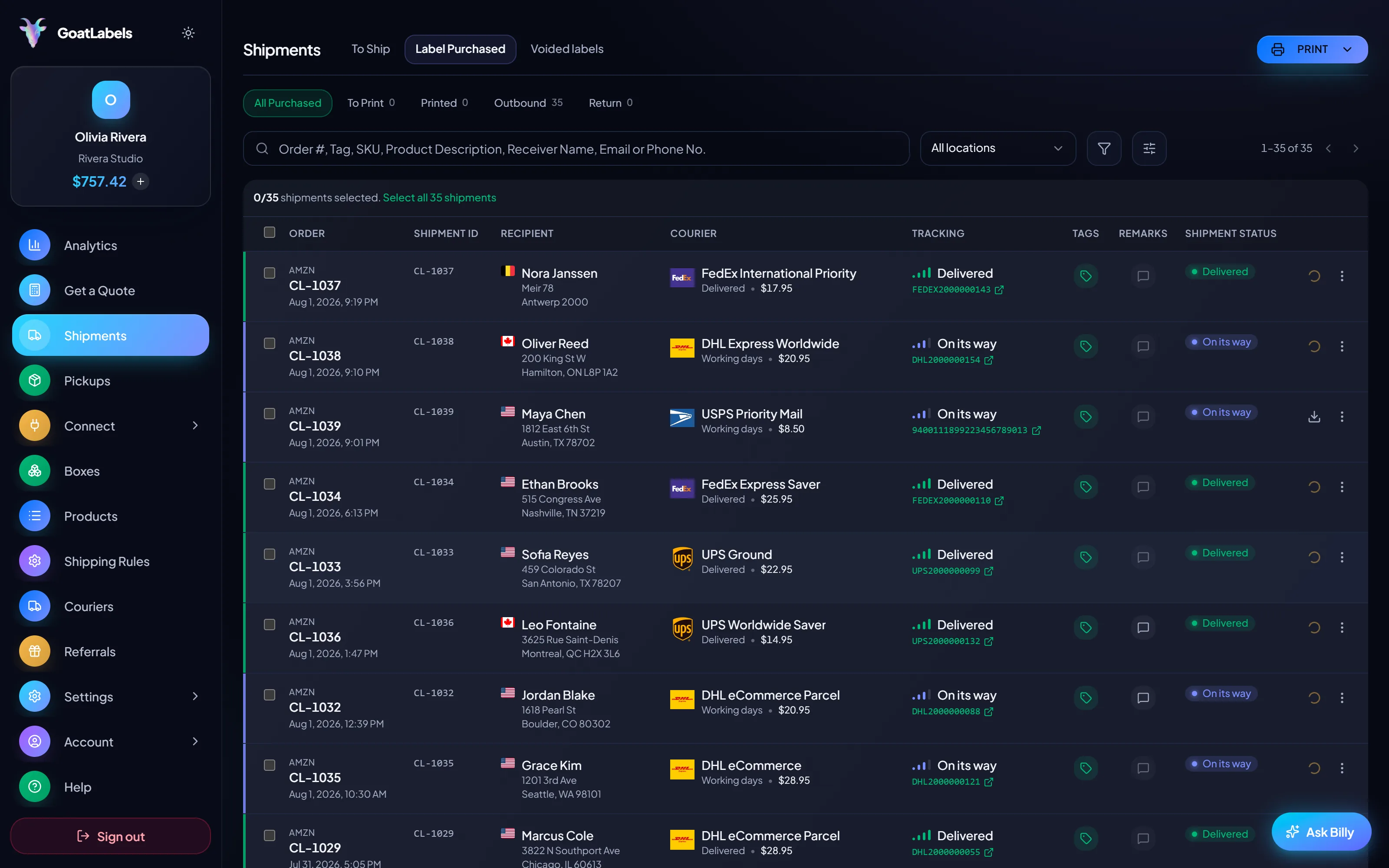
A store selling into the EU ends up tracking parcels across a dozen national networks with a dozen delivery habits — a locker here, a letterbox there, a neighbour somewhere else. Ask out loud and Billy finds the shipment and reads its status back, so a buyer in Ghent gets an answer without you first working out which network is holding it. Included on every plan. This is the real product, not a render.
Listening
"Where is the Ghent parcel now?"
Out for delivery
Ghent, BE · with the national carrier
Speaks plain English · finds the parcel whichever national network has it · included on every plan, never a pricier tier.
An EU-bound parcel quoted across the postal stream and the couriers at once, each column one all-in number with the taxes-and-duties portion inside it where the service supports DDP, so route three's doorstep bill can be a number you saw before buying, not a surprise your buyer reports. Figures are an illustrative example, not a live quote.
Priority Mail Intl
7–12 days$33.80
$7.10 of taxes & duties shown inside the total
all-in · route three priced honestly
Intl Connect Plus
3–6 days$31.40
$7.80 of taxes & duties shown inside the total
all-in · route three priced honestly
Express Worldwide
1–3 days$43.90
$8.60 of taxes & duties shown inside the total
all-in · route three priced honestly
An EU tax route lives or dies as a value in the electronic customs data, and a value is exactly the sort of thing that should never be retyped by a human at the end of a packing session. Pass it with the shipment, attach the customs items, buy — REST, JSON, one Bearer header, unlimited calls on every plan including Free.
POST /api/v1/shipments
Authorization: Bearer sk_live_…
Idempotency-Key: ord_8421

{
  "to": { "name": "Joyce", "city": "Berlin", "country": "DE" },
  "parcel": { "weight": 2.6, "weight_unit": "lb" },
  "service": "fedex_intl_priority"
}
Selling into the EU means a few parcels each to a lot of different countries, which is the shape a monthly plan handles worst. Customs items, per-SKU declarations, and all four carriers are on the free plan, so an experiment in four member states costs the postage on the parcels it sends and nothing else.
 — check a parcel on a national network without opening the dashboard
Rate by plan
illustrativePro: one flat monthly plan, unlimited shipments
$0 / forever
Four parcels to four countries this month, and nothing owed for the twenty-three you did not reach.
The assistant that drafts one description clearing in any member state — a linen tablecloth, not homewares — runs on Free, unlimited, in the web app. Pro adds Billy on Telegram.
Telegram, ProGET /api/v1/shipments
200 OK · plan: free
Unlimited calls on Free — still unlimited on Pro.
Put a real parcel through and compare the side-by-side rate against what that label costs you on
ShippoPirate ShipShipStationLabel prices are quoted live from USPS, UPS, FedEx, and DHL as one all-in number, with the taxes-and-duties portion shown inside it where the service supports DDP. The scheme's rules, the national rates, and each operator's clearance fee belong to the authorities and carriers that set them; the dated block above names the source. Full pricing details
What the EU standardised was the declaration. What it left national is the rate your buyer pays and the network that delivers — which is why the route is a store-level decision and the carrier stays an order-level one.
 The platform's registration travels
The lightest version of Europe for a small US seller: the platform collects at checkout under its own arrangement, and your obligation narrows to a declaration that carries it correctly and a parcel that turns up.

 One registration, monthly filing
Direct volume is where registering into the scheme starts paying for its own accounting: one number covering every member state, and buyers who are never met at the door by a bill they did not agree to.
Route and declaration agree
The number in the customs data matches what the checkout did

 A direct sale with no platform behind it
National networks, national habits
1
prepaid balance behind every member state you have ever shipped to
The rest of the international-lane series:Canada,the UK,Australia,Germany,Japan, andMexico — and the declaration every lane starts from, oncustoms forms for small parcels.
A video took off and I had 80 TikTok Shop orders by morning. I printed every label from my phone on the bus to the post office.
Early customer · TikTok
TikTok Shop seller
 TikTok Shop
I run my Etsy shop from the kitchen. The AI reads the order, picks the carrier, the label prints. That's the whole workflow now.
Early customer · Etsy
Etsy maker
EtsyThe API is what every shipping API pretends to be. Idempotency that actually works.
Sasha R.
Staff engineer, marketplace
Enter one real EU order, see all four carriers priced with the tax portion inside, and save the declaration as a template that covers all twenty-seven markets.
No card required. Customs templates on every plan.
Updated