

USPS
Priority Mail Intl
1–3 weeks$42.60
$5.80 of taxes & duties shown inside the total
all-in · the tier spread priced honestly
Australia taxes low-value imports at the point of sale, but only sellers above a turnover threshold must register and collect; marketplaces collect for their sellers regardless. Distance makes service choice the biggest cost lever on this lane — economy and premium tiers diverge more than anywhere else.
USPS hands to Australia Post's every-address network; UPS, FedEx, and DHL fly their own metro networks. Same GST rules, same quarantine screening, very different clocks.


 DHL: international
Description, declared value, origin, and your HS code stored as customs templates — with the platform's tax identifier riding the customs data when a marketplace collected GST at checkout.
Updated
The three tax regimes in this series each chose a different place to put the burden. The UK puts it on every direct seller from the first sale; the EU built optional machinery any seller can register into. Australia ties the obligation to size, not to the act of selling. GST on low-value imported goods is collected at the point of sale, but the duty to register with the Australian Taxation Office and collect it only attaches once your annual sales connected with Australia cross a published turnover threshold. Below that threshold, a US seller shipping direct collects nothing, registers nothing, and files nothing — and because the border does not assess low-value goods as a fallback, the parcel simply arrives with no tax event anywhere. For a maker doing a handful of Australian orders a month, this is the friendliest of the point-of-sale regimes by a wide margin.
The marketplace rule closes the gap from the other side. Australian law treats an electronic distribution platform as the supplier for GST purposes, and every major marketplace clears the turnover threshold on its own aggregate sales, so a marketplace order carries checkout-collected GST no matter how small the seller behind it is. The platform charges the buyer, remits the tax, and its identifier travels in the parcel's customs data so the border can see the tax was handled. Goods above the low-value line sit outside all of this: they are assessed on entry the traditional way, with duty and GST collected from the buyer before delivery. The form those declarations ride on, and the choice between prepaying charges and leaving them to the buyer, live on customs forms for small parcels.
Every border screens parcels for value; Australia also screens them for biology. An island continent with an agricultural economy runs a quarantine regime that treats the parcel stream as a disease vector, which means your box is assessed on what it is made of, not just what it is worth. The screening list is concrete and mostly stable, and it is full of things sellers do not think of as risky: a bark-edge cutting board, the seed beads in a piece of jewellery, the feather trim on a hat, a tin of cookies, a secondhand tent with last summer's campsite still on the pegs. The table below names the categories that get small parcels opened and what happens to each.
The commonest intercept of all is not the product but the gesture: a seller tucks a sealed candy or a sprig of dried lavender in as a freebie, declares only the product, and the undeclared extra is what parks the parcel at the quarantine desk. The fix costs nothing. Declare everything that is physically in the box, and write descriptions that name the material — a beeswax candle, a pine-wood toy, a cotton scarf — because a description that answers the biosecurity question is the cheapest way through it. Billy drafts that plain-word description from a pasted order; the declared value and the HS code stay yours to supply, because they are the seller's legal statements.
On a short lane the speed tiers crowd together; across the Pacific they pull apart. This is the lane where the gap between the cheapest service and the fastest is measured in dollars and in weeks at the same time, which makes service choice the biggest cost lever you have. The postal stream crosses as mail and hands to Australia Post, whose network reaches every address in the country — PO boxes, island states, outback rural routes — at the friendliest price and the slowest clock. The express couriers fly their own networks into Sydney, Melbourne, and the other capitals in a few business days, at a premium that is proportionally larger here than on any domestic quote. In between, courier economy tiers split the difference.
The decision is the order, not the store. A low-value order to a patient buyer belongs on the postal stream; a high-value order, a promised date, or a remote address each push the answer around in different directions. Quoting all four carriers on the same international parcel is how the decision gets made per order instead of by habit, the same argument cheap shipping labels makes inside the US, at the distance where it pays most.
A trans-Pacific parcel travels through two networks and one seam, and the seam is where sellers panic. On the postal stream the tracking story starts in USPS systems and finishes in Australia Post's, and between the US export scan and the first Australian processing scan sits a stretch of days where nothing updates — the parcel is flying, queuing, and clearing, none of which generates a scan event. A quiet week in the tracking history is the lane working normally, not a parcel going missing. Courier services scan more continuously because one company holds the parcel end to end, which is part of what the express premium buys.
The practical move is to manage the buyer's clock, not just the parcel's. Tell Australian buyers the realistic band for the tier they paid for, and let the tracking speak for itself: GoatLabels gives every shipment a branded tracking page and sends tracking emails to the buyer, so the where-is-it question lands on a page instead of in your inbox during the quiet stretch. A parcel that has genuinely stopped — no scan long past the band, on any network — becomes a claims question with its own filing windows, covered on lost and damaged claims.
When the quarantine desk does flag a parcel, there are four exits. The parcel is inspected and released, which costs days. It is treated — cleaned, fumigated, or otherwise made safe — with the fee billed before release, typically to the receiver. It is exported back to you at cost. Or it is destroyed, with no compensation for the goods. Which exit applies depends on what the risk item is and whether treatment is feasible, and none of the outcomes is negotiable from the US side after the fact — the decision was really made when the declaration was written, which is why the materials discipline above is worth more on this lane than anywhere else.
Refusals and dead addresses end the ordinary way, made longer by the ocean: an undeliverable or refused parcel comes back across the Pacific as a return, and on courier services the return transportation is generally billed to you as the shipper. What each carrier does with an undeliverable parcel, and who pays for the ride home, is the subject of package returned to sender. Every one of these outcomes starts from the label you chose, and the four-way quote is what keeps the choice honest at this distance.
| Service family | Final mile | GST collection model | Typical transit band |
|---|---|---|---|
| Postal stream (USPS international services) | Australia Post, which reaches every Australian address including PO boxes and remote outback routes | Under the low-value line: checkout collection when the seller or platform is registered, otherwise uncollected; over the line: assessed on entry and billed to the buyer | Roughly one to three weeks by service tier, economy end longest |
| Courier economy (FedEx International Connect Plus, UPS Worldwide Expedited) | The courier's network into metros; remote postal codes may hand to agents or add days | Same GST rules; cleared by the courier's brokerage, over-the-line entries billed to the buyer with a disbursement fee | Roughly one to two weeks |
| Courier express (UPS Worldwide Saver, FedEx International Priority, DHL Express) | The courier's own network, fastest into Sydney, Melbourne, and the other capitals | Same GST rules; routine clearance folded into express handling, assessment still applies over the line | Roughly two to five business days to the metros |
| What is in the parcel | Why it is flagged | What happens |
|---|---|---|
| Wooden and plant-material items (raw, bark-on, or handmade) | Untreated timber and plant fibre can carry borers, fungi, and bark pests | Inspection; treatment such as fumigation at cost if risk is found, destruction if it cannot be treated |
| Seeds — including craft kits, seed-bead jewellery, and unlabelled packets | Seeds are live plant material and most are import-conditional or prohibited outright | Seizure of the seeds; the rest of the parcel may be released, re-exported, or destroyed with it |
| Feathers, untreated hides, and animal products | Untreated animal material can carry disease agents Australian agriculture has never met | Treatment at cost where feasible, otherwise export back or destruction |
| Food of any kind — including sealed commercial snacks added as freebies | Foodstuffs are assessed against import conditions regardless of packaging | Undeclared food is seized; the parcel is delayed while the rest is inspected |
| Used outdoor gear — tents, hiking boots, fishing and camping equipment | Soil residue is one of the highest-risk materials in the parcel stream | Cleaning or treatment at cost before release; heavily soiled items can be re-exported or destroyed |
Dated figures, all in one place.As of the verification date above: the low-value goods line is AUD $1,000 in customs value per consignment, the GST rate is 10%, and the registration turnover threshold for overseas sellers is AUD $75,000 of sales connected with Australia in a rolling 12-month period — a regime in force since 1 July 2018. Above AUD $1,000, duty and GST are assessed at the border and collected from the buyer before delivery. Biosecurity treatment, storage, and re-export fees are set in the Department of Agriculture, Fisheries and Forestry's published charging schedule and billed to whoever the direction is issued to, usually the receiver. Transit bands in the lane sheet are typical, not guaranteed. These are ATO, ABF, and DAFF figures, re-checked every 6 months by the named review owner recorded with this page. Verify against the source before building prices or promises on them. Source for the GST line: ATO, GST on low value imported goods.
Distance makes every ounce count and the quarantine desk makes every material count, so an Australian parcel is decided twice before it is ever priced. This is the loop that respects both: weigh the box the way it will actually travel, let Billy draft a description that says what things are made of, and read the tier spread off one screen instead of guessing at it.
could you post the beeswax candles to Ballarat VIC 3350?
Weigh it packed. Over this distance the difference between the item's weight and the box's weight stops being a rounding error, and the padding you added to survive an ocean crossing is part of what you are paying to move.
 Billy AI
Then set the buyer's expectations to match the tier you bought rather than the one they imagined. A branded tracking page and tracking emails do that work for you through the quiet stretch this lane always has.
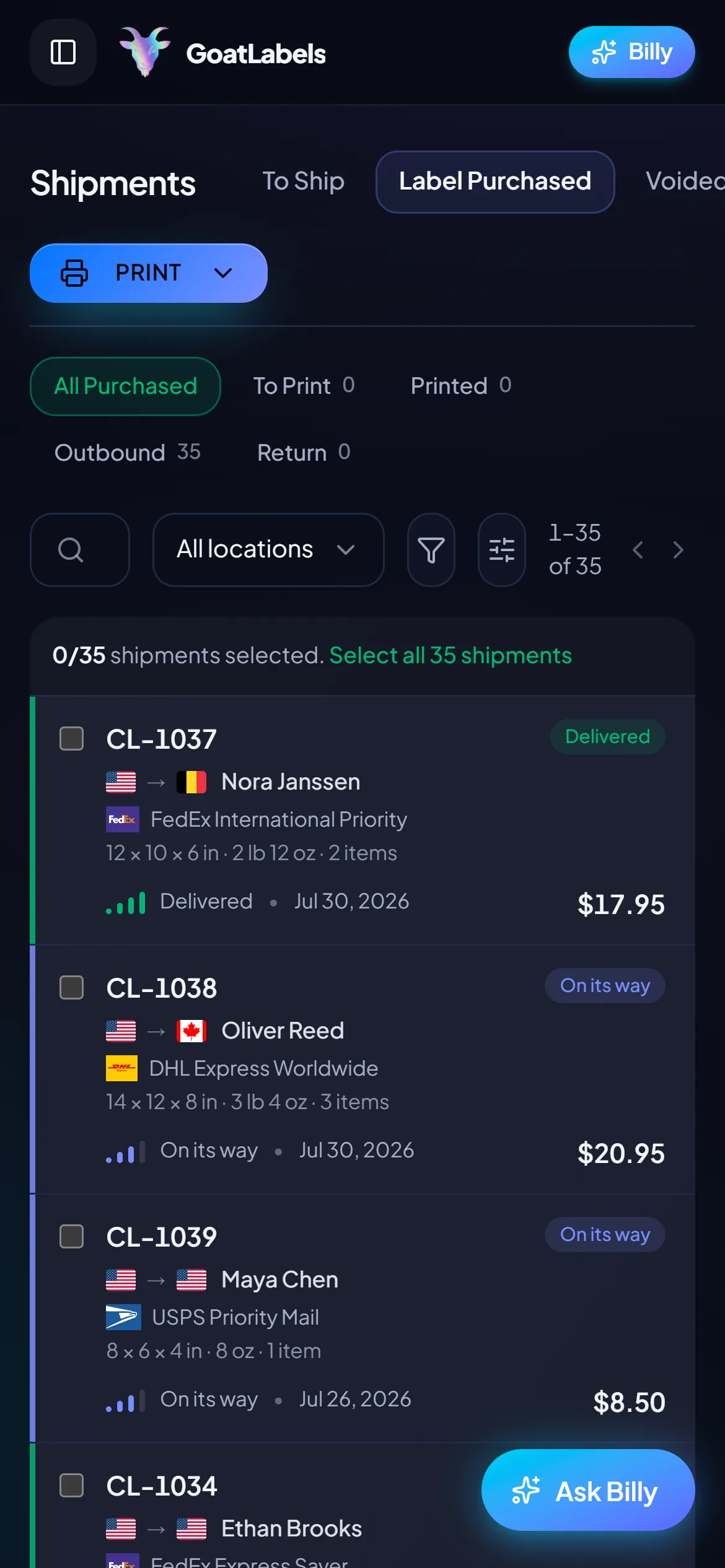
Shopify, Etsy, WooCommerce, TikTok Shop, Amazon, eBay, Squarespace, Wix, Walmart, Square, BigCommerce, Magento, and Temu sync into one To Ship queue, and a marketplace order arrives with the platform's tax arrangement already attached. What no connector can do for you is weigh the box or name what is inside it — and on this lane those two are the whole decision.
 Shopify
 Etsy
Etsy WooCommerce
 TikTok Shop
 Amazon
 eBay
eBay Squarespace
 Wix
Wix WalmartShopify PlusSoon
 Square
 BigCommerce
 Magento
 ZapierSoon
 NetSuiteSoon
 EcwidSoon
 Temu
Temu SheinSoon
 ChannelAdvisorSoon
 SkuVaultSoon
 Zoho InventorySoon
 Patreon
An Australian parcel clears on its declaration twice — once for the GST story, once for the materials. Everything below exists to make both answers accurate before the wallet moves.
Card, Apple Pay, Google Pay, ACH, and crypto fund one balance that buys Sydney labels and domestic ones alike. On Free, nothing monthly sits underneath it, so a store whose Australian demand is two parcels a month pays for exactly two parcels.
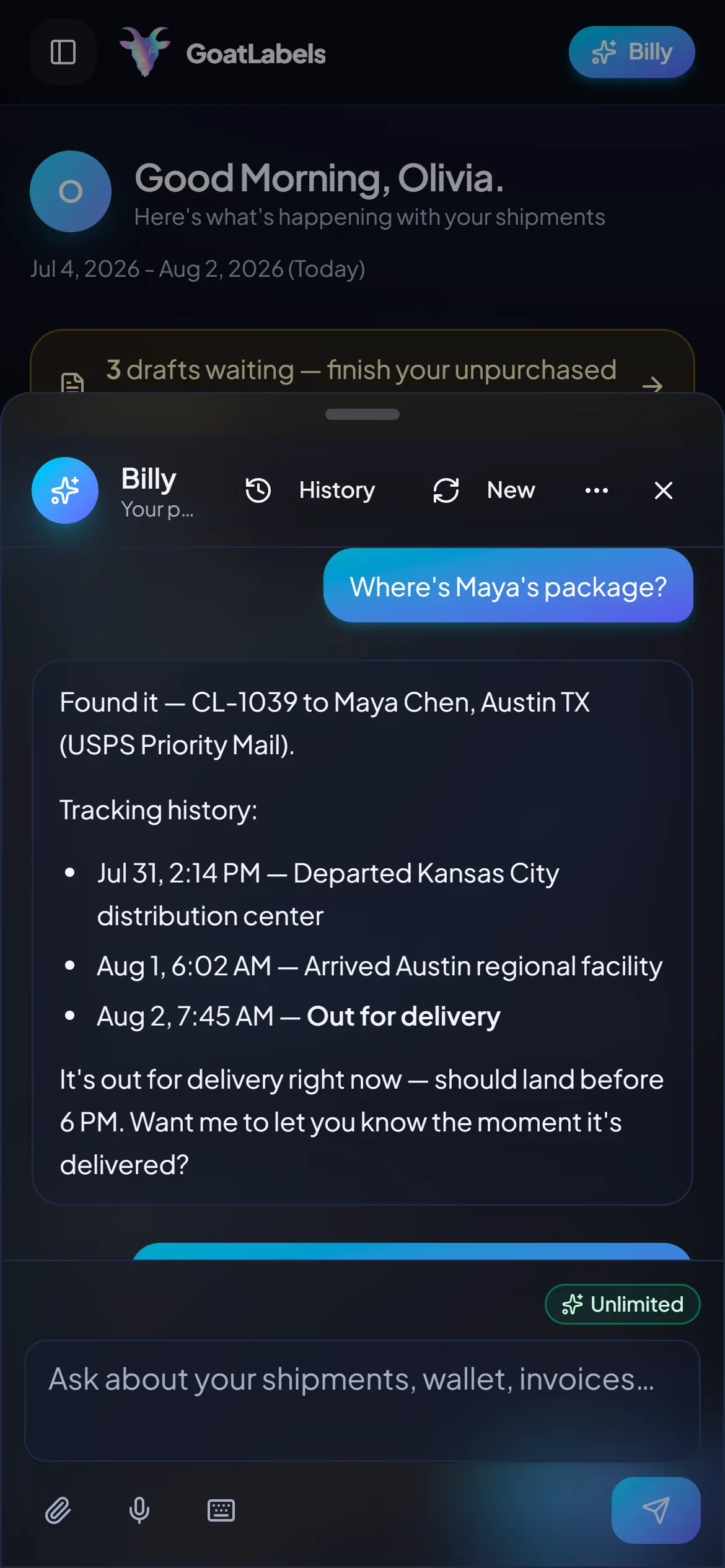
Paste the order and Billy drafts the specific, material-naming description the quarantine desk clears from data — a pine-wood toy, not homewares. Declared value and HS code stay yours to supply, because they are the seller's legal statements and the tax lines turn on them.
BillyLIVEWhere the service supports DDP, an Australian quote is one all-in number per carrier with the taxes-and-duties portion broken out inside it, so the famous economy-versus-express gap on this lane is a comparison you see, not a rumour you price by. What you approve is what leaves the balance.
USPS hands to Australia Post's every-address network, PO boxes and outback routes included; UPS, FedEx, and DHL fly their own networks into the capitals in days. The four diverge harder across the Pacific than on any domestic parcel, which is why this lane rewards a per-order quote most.
UPS$12.48FedEx$13.22DHL$14.10USPS$11.79Customs items ride the same shipment objects the dashboard uses, on unlimited calls with signed webhooks, so a store can generate declared, validated Australian labels in code. Per-SKU customs templates apply there too — the declaration that cleared keeps clearing.
Declared label ready
Ballarat, VIC · materials named on the form
On the longest lane you ship, the packed weight and the service family are the two levers that actually move the number — and both of them live where the box is being taped, not where the laptop is. Weigh it, quote it, and see every tier on one screen before committing to any of them.
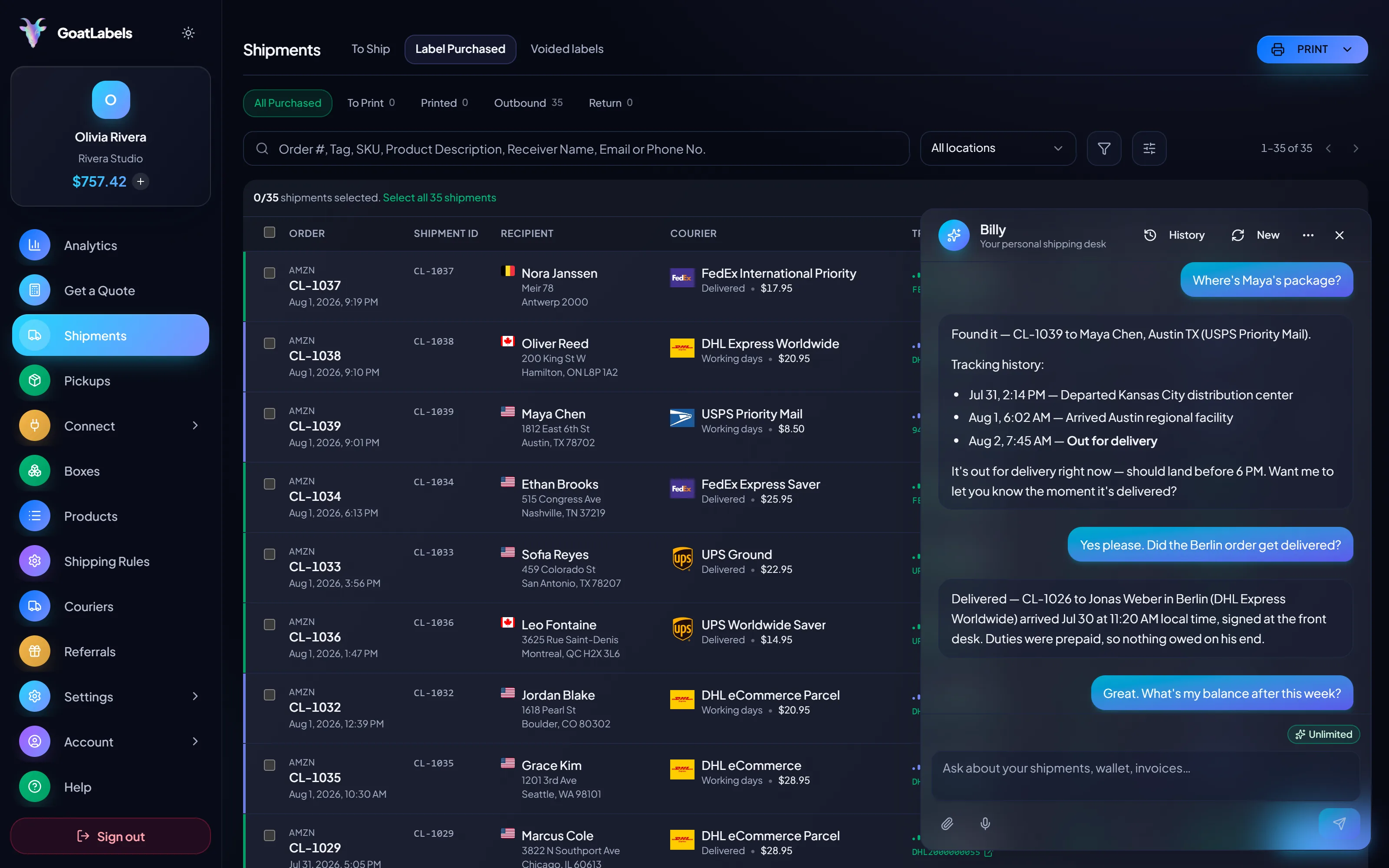
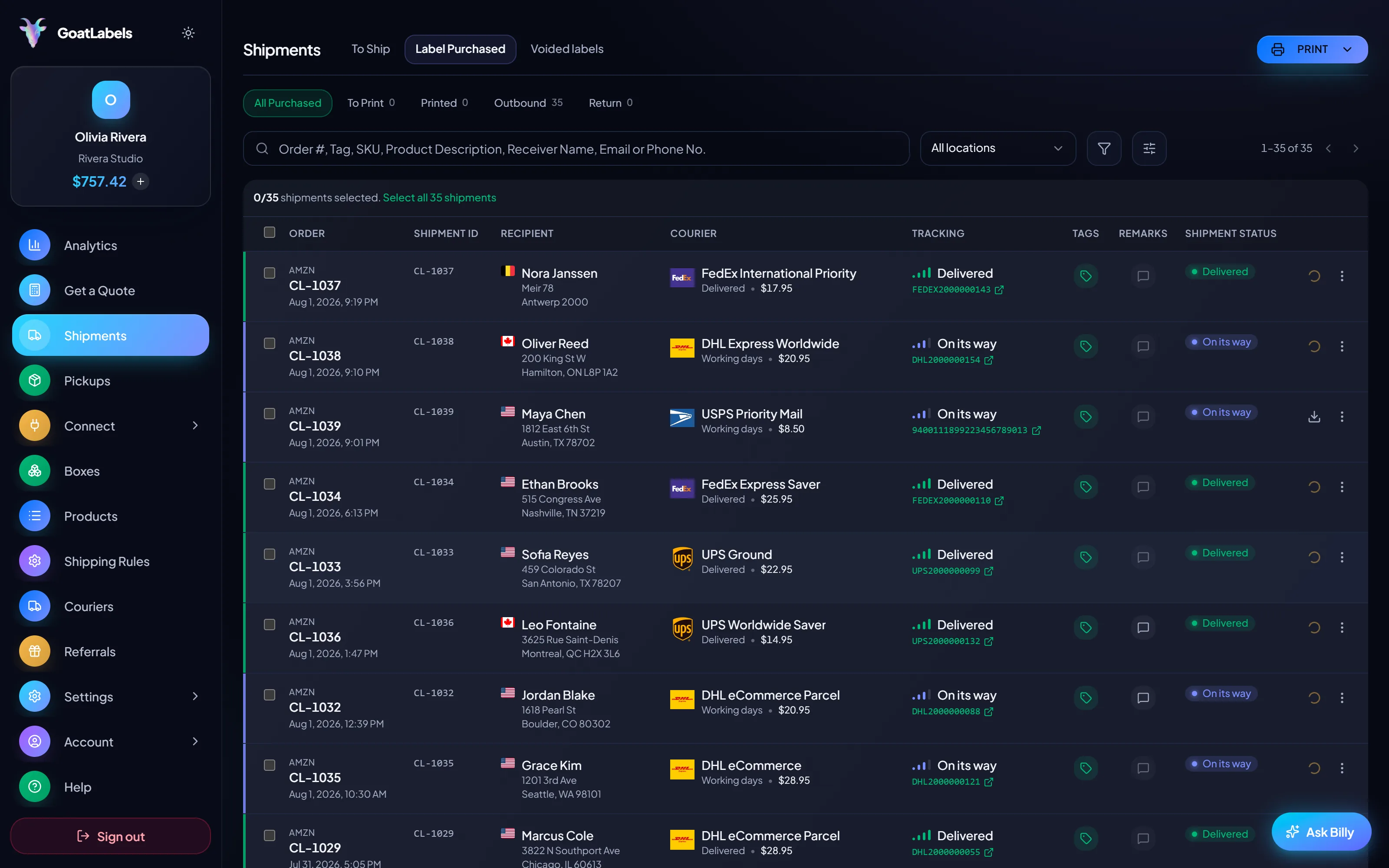
A quiet stretch in the tracking is this lane working normally — the parcel is flying, queuing, and clearing, and none of that produces a scan. Ask out loud and Billy pulls the shipment up and reads back the last real event and the tier you bought, so you can answer a buyer without refreshing a tracking page for the ninth time. Included on every plan. This is the real product, not a render.
Listening
"Has the Ballarat parcel scanned since it left?"
In transit
Ballarat, VIC · last event was the export scan
Speaks plain English · reads back the last real scan and the tier you bought · included on every plan, never a pricier tier.
A trans-Pacific parcel quoted across the postal stream and the couriers at once — each column one all-in number with the taxes-and-duties portion visible inside it, so the speed-versus-price spread this lane is famous for is a decision you make per order. Figures are an illustrative example, not a live quote.
Priority Mail Intl
1–3 weeks$42.60
$5.80 of taxes & duties shown inside the total
all-in · the tier spread priced honestly
Intl Connect Plus
6–10 days$38.90
$6.40 of taxes & duties shown inside the total
all-in · the tier spread priced honestly
Express Worldwide
2–5 days$54.30
$7.10 of taxes & duties shown inside the total
all-in · the tier spread priced honestly
Everything this lane punishes you for getting wrong is a field: the packed weight, the description that names a material, the service family you picked. Put them on the shipment object and the parcel stops depending on what somebody remembered at eleven at night. REST, JSON, one Bearer header, unlimited calls on every plan including Free.
POST /api/v1/shipments
Authorization: Bearer sk_live_…
Idempotency-Key: ord_8421

{
  "to": { "name": "Joyce", "city": "Berlin", "country": "DE" },
  "parcel": { "weight": 2.6, "weight_unit": "lb" },
  "service": "fedex_intl_priority"
}
Most US stores send Australian parcels in ones and twos, months apart — the exact shape a monthly plan prices worst. Customs items, saved declarations, and every service family are on the free plan, so the long lane costs the postage on the parcels it carries and nothing at all in the months it carries none.
 — check a parcel mid-ocean without opening the dashboard
Rate by plan
illustrativePro: one flat monthly plan, unlimited shipments
$0 / forever
Two parcels across the Pacific this month, and nothing owed for the months with none.
The assistant that drafts a material-naming customs description from a pasted order runs on Free, unlimited, in the web app. Pro adds Billy on Telegram.
Telegram, ProGET /api/v1/shipments
200 OK · plan: free
Unlimited calls on Free — still unlimited on Pro.
Put a real parcel through and compare the side-by-side rate against what that label costs you on
ShippoPirate ShipShipStationLabel prices are quoted live from USPS, UPS, FedEx, and DHL as one all-in number, with the taxes-and-duties portion shown inside it where the service supports DDP. Quarantine treatment and re-export charges are set and billed by the Australian authorities, not by us; the dated block above names the source. Full pricing details
Australia sorts sellers by two questions nobody else asks this hard: what the parcel is made of, and whether its weight can survive the distance. These are the four shapes that answer differently.
 The materials the desk is looking for
A bark-edge board, a beeswax candle, a seed-bead bracelet — none of them contraband, all of them questions. A description that answers the question in plain words is the cheapest way through the desk there is.
 Where distance punishes packaging
Padding that costs nothing domestically becomes a real line item across an ocean. Weigh the box as it will actually travel, then read the tier spread — on this lane the packing decision and the service decision are the same decision.
Weighed packed, then quoted
Filler, mailer, and the invoice all travel too

 The order that starts as a question
 The quiet stretch mid-ocean
1
branded tracking page answering the where-is-it question while nothing scans
The rest of the international-lane series:Canada,the UK,the EU,Japan (the other trans-Pacific lane),Germany, andMexico — and the declaration every lane starts from, oncustoms forms for small parcels.
A video took off and I had 80 TikTok Shop orders by morning. I printed every label from my phone on the bus to the post office.
Early customer · TikTok
TikTok Shop seller
TikTok ShopI run my Etsy shop from the kitchen. The AI reads the order, picks the carrier, the label prints. That's the whole workflow now.
Early customer · Etsy
Etsy maker
EtsyThe API is what every shipping API pretends to be. Idempotency that actually works.
Sasha R.
Staff engineer, marketplace
Enter one real Australian order, see the postal stream and the couriers priced all-in on the same screen, and ship it with a declaration the quarantine desk can clear from data.
No card required. Customs templates on every plan.
Updated