

USPS
Ground Advantage
2 to 5 days$11.40
all-in · the same figure on every ledger row
Multi-store shipping breaks when each channel has its own label tool, balance, and history. Consolidation means one order queue, one funding balance, and one ledger — synced stores flow in automatically, everything else arrives by file — with tracking returned to each channel under its own rules.
Shopify, Amazon, eBay, Etsy, Walmart, TikTok Shop and seven more flow in on their own. Faire and other exports arrive as a file; DM sales arrive as a paste.


 one queue
Card, Apple Pay, Google Pay, ACH, or crypto top up one prepaid wallet — no per-store float, no per-tool balance to reconcile.
Updated 2026-08-15
Nobody plans a fragmented shipping stack. It accretes: the Etsy shop came first and used Etsy's labels, the Shopify store arrived with its own shipping screen, and the eBay account still prints from whatever was installed the year it opened. Each tool was the path of least resistance on the day that channel launched, and each one made sense alone. The cost only shows up in aggregate, and it lands in three places that never appear on any invoice.
The first is money parked in the wrong places. Three tools means three balances or three payment methods on file, and float sitting in a label tool for a slow channel is float you cannot spend shipping a busy one. The second is the packing session itself: every extra tab is a context switch, and a batch that should be one pick-pack-print run becomes three smaller runs with three login screens between them. The third is the quietest and the most expensive — no single view of what delivery actually costs. When each channel prices its labels in its own silo, nobody ever sees that one channel has been paying retail-shaped rates for a year, because no report puts the channels side by side. Consolidation is not a feature preference; it is the only way the comparison ever gets made.
The honest version of multi-store shipping starts with an unglamorous admission: not every channel syncs, and a tool that implies otherwise is selling you a connector it does not have. There are 13 connectors here, Shopify, Etsy, WooCommerce, TikTok Shop, Amazon, eBay, Squarespace, Wix, Walmart, Square, BigCommerce, Magento and Temu, and everything else arrives through one of two doors. Channels with an export arrive as a file; the column mapping, saved presets, per-row address validation, and row-by-row purchase that make a file safe to buy against are thebulk CSV page's subject, not this one's. Channels with no export at all — a sale closed in an Instagram DM, a Facebook message with an address in it — arrive as a paste or a screenshot that Billy reads into a draft, which is theno-connector workflow's page. Big Cartel is the cleanest example of the file door, since it sells no labels by design and has no connector here, andshipping labels for Big Cartel storescovers it end to end. The matrix below is the map: for each common channel, how orders get in, how tracking gets back, and what the marketplace holds you to.
| Channel | How orders arrive | How tracking gets back | What the channel expects of you |
|---|---|---|---|
| Shopify | Syncs. Sold orders drop into the To Ship queue on their own. | Pushed back to the order when the label prints. | The order marked fulfilled with a tracking number, which the sync does for you. |
| Etsy | Syncs into the same queue alongside the other connected stores. | Pushed back to the Etsy order on print. | Orders marked shipped with tracking; buyers get Etsy's own notifications from that. |
| WooCommerce | Syncs. Your own store, so orders arrive like any connected channel. | Pushed back to the order when you print. | Whatever your own store's policy is — you set the rules on this one. |
| TikTok Shop | Syncs, with one carve-out: orders shipping USPS still go through TikTok Shipping. | Pushed back to the store for the labels you buy yourself. | Valid tracking inside TikTok's shipping window, per its seller policy. |
| eBay | Syncs. Awaiting-shipment orders land in the same queue as your other stores. | Pushed back to the eBay order when the label prints. | Tracking uploaded before the stated handling time runs out — it feeds your seller metrics. |
| Amazon | Syncs. Seller Central orders arrive in the queue without a report export. | Shipment confirmed back to Amazon with carrier and tracking on print. | A confirmed shipment with valid tracking; Amazon grades sellers on it. |
| Faire | No connector. Wholesale orders come across as an export or are entered per carton. | You enter a tracking number against the Faire order for every carton shipped. | Tracking per carton — a multi-box order with one number entered is incomplete. |
| Squarespace / Wix / Square / BigCommerce / Magento | Syncs. Connected site builders and carts arrive like any other connected store. | Pushed back to the order when the label prints. | Whatever notification flow the builder runs when an order is marked shipped. |
| Walmart / Temu | Syncs. Marketplace orders arrive in the queue with the rest. | Pushed back to the marketplace order on print. | Valid tracking inside the marketplace's handling window, per its seller policy. |
| Big Cartel / other exports | No connector. Export the orders to a file and import it. | You mark the order shipped in the store's own dashboard. | Whatever notification flow the store runs when an order is marked shipped. |
| Instagram / Facebook DMs | No export exists at all. The order is a message — paste it or screenshot it and Billy drafts the label. | You send the buyer their tracking in the same thread the sale happened in. | Nothing formal. The buyer expects a reply; the thread is the order record. |
Channel policy reference — verified against each marketplace's own seller documentation on 2026-08-15.Marketplace shipping policies move without notice: handling-time windows, tracking-upload rules, and which orders a platform insists on labelling itself all change on the platform's schedule, not ours. No deadline figures are printed in the matrix for exactly that reason — check the channel's own seller help centre for the current window before you rely on one. Next review: 2027-02.
Getting orders in is half the loop. The half that protects your seller account is getting tracking back out, and here the channels genuinely differ — not in spirit, since every marketplace wants proof the parcel moved, but in mechanics and in consequences. For the thirteen synced stores the loop closes itself: print the label and tracking pushes back to the connected store, which marks the order fulfilled and fires the platform's own buyer notifications. For everything that came in by file or by paste, the write-back is yours to do, and it is worth doing in the same sitting as the print run. Marketplaces score sellers on whether tracking appeared inside the handling window, and a marketplace that never saw your tracking treats a delivered parcel as an unshipped order.
The practical discipline is a two-column habit: when a batch finishes, the labels you bought are sitting in one purchase history in the order you bought them, so pasting tracking back into eBay or Amazon is a top-to-bottom copy job rather than a hunt across three tools. Sellers who fragment this step are the ones who find a defect on their account weeks later — not because a parcel was late, but because the number that proved it shipped never made it back to the channel that was keeping score.
The consolidation payoff that survives longest is the ledger. Every label bought here — synced, imported, or pasted — is a ledger entry against one prepaid balance, carrying its cost, its carrier, and the order it belonged to. That turns a question three tools cannot answer into a filter: what did delivery cost per channel last month, which channel's parcels keep triggering the expensive services, and is the channel you think of as your best actually your best after postage. A wholesale channel that ships cartons and a DM channel that ships mailers should not be priced by the same habit, and the only way to see that is on one ledger where they sit in adjacent rows.
One balance also ends the float problem. A single wallet funded by card, Apple Pay, Google Pay, ACH, or crypto pays for every channel's labels, so a busy week on one store spends the money a quiet week on another store left alone. An accepted void credits back to that same balance (the void page covers the mechanics), and Free has no monthly fee for up to 50 shipments a month, so consolidating three tools into one does not mean trading three small fees for one big one. If your channel mix leans on Etsy or TikTok Shop specifically, the Etsy page and the TikTok Shop page cover each connector's own quirks in depth. Shipping from more than one warehouse or store address, rather than selling on more than one channel, is covered onmulti-location shipping software.
A multi-store morning is not one workflow, it is three arriving at once: connected stores have already filled the queue overnight, the Faire and Big Cartel exports come in as files, and the DM sales come in as screenshots. All of it converges on one To Ship list, gets labelled from one wallet, and sends tracking back out under each channel's own rules.
Instagram buyer sent their address in the thread — screenshot pasted straight into the queue.
Sync covers 13 stores: Shopify, Etsy, WooCommerce, TikTok Shop, Amazon, eBay, Squarespace, Wix, Walmart, Square, BigCommerce, Magento and Temu. Every other channel arrives by file or by paste, labelled as such here and in the product.
 One queue
Connected stores get tracking pushed back on print. For file and paste channels, the purchase history holds the tracking numbers in batch order, so the write-back is a copy job, not a hunt.
Shopify, Etsy, WooCommerce, TikTok Shop, Amazon, eBay, Squarespace, Wix, Walmart, Square, BigCommerce, Magento and Temu connect once and flow into the To Ship queue with tracking pushed back on print. The file and paste intakes exist for everything else, so Faire, Big Cartel and the sales that close in a DM run through the same queue and the same wallet instead of a second tool.
 Shopify
 Etsy
Etsy WooCommerce
 TikTok Shop
 eBay
eBay Amazon
 Squarespace
 Wix
Wix Walmart
 Instagram
 Facebook
 Square
Consolidating channels only works if the one tool holds the whole loop: money in one place, every intake honestly handled, one all-in price per parcel, and a ledger that can answer per-channel questions.
Card, Apple Pay, Google Pay, ACH, and crypto all fund a single prepaid wallet that pays for every channel's labels. No float stranded in the slow channel's tool while the busy channel waits, and an accepted void credits back to the same balance.
A sale that closes in an Instagram or Facebook thread has no file to import. Paste the message or the screenshot and Billy reads the buyer, the address, and the parcel into a draft — the DM channel joins the queue instead of living in your camera roll.
BillyLIVEEvery parcel gets one number that already includes the fees, and that exact amount leaves the wallet. When every channel's labels price the same way, per-channel cost stops being a reconciliation project and starts being a filter on one ledger.
USPS, UPS and FedEx are quoted on each domestic parcel, and DHL on international lanes, regardless of where the order came from. The wholesale channel's cartons and the DM channel's mailers have different winners, and a consolidated queue is the only place that comparison happens per order.
UPS$12.48FedEx$13.22DHL$14.10USPS$11.79A REST API with unlimited calls on every plan, signed webhooks for label and tracking events, and idempotency keys so a retried job never buys twice. When the multi-channel queue outgrows tapping, the same lifecycle runs from a script.
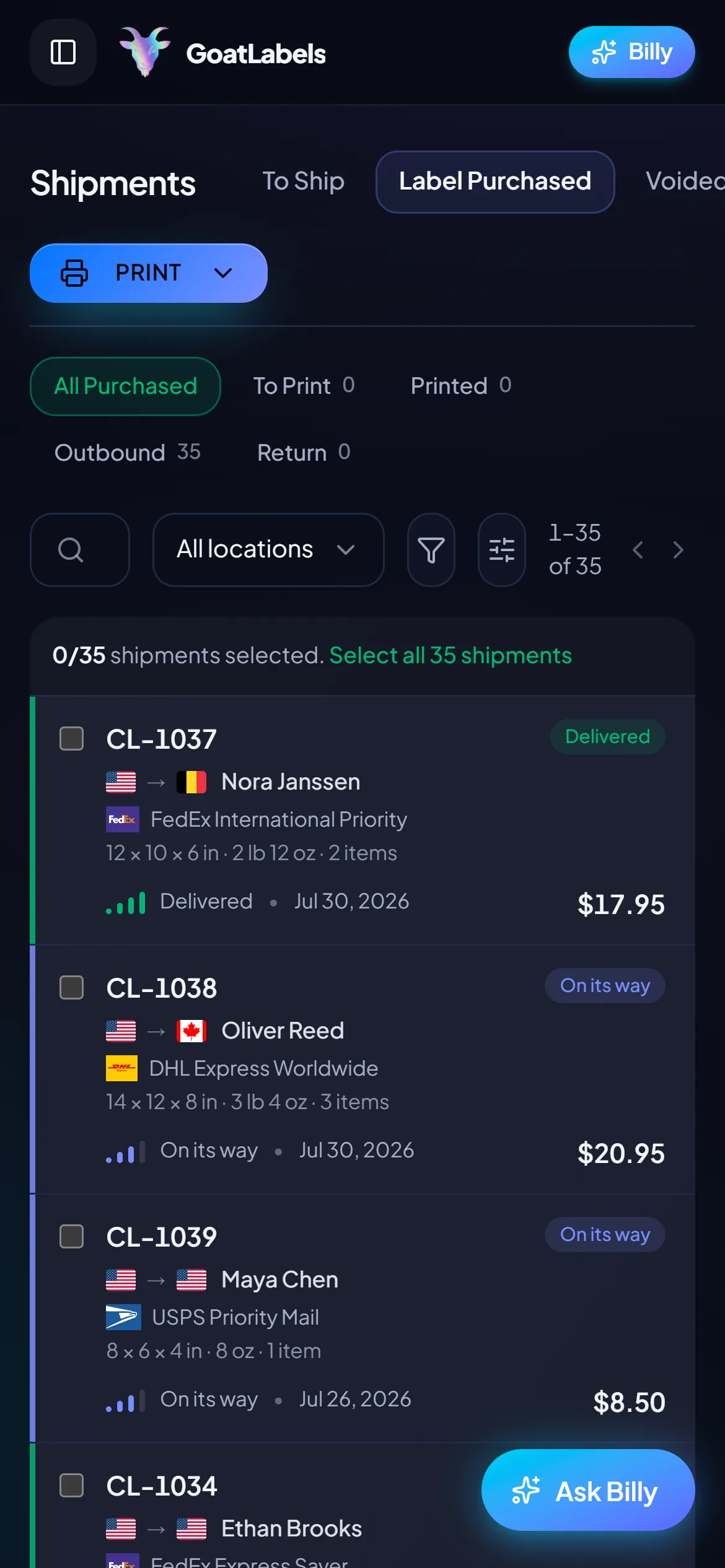
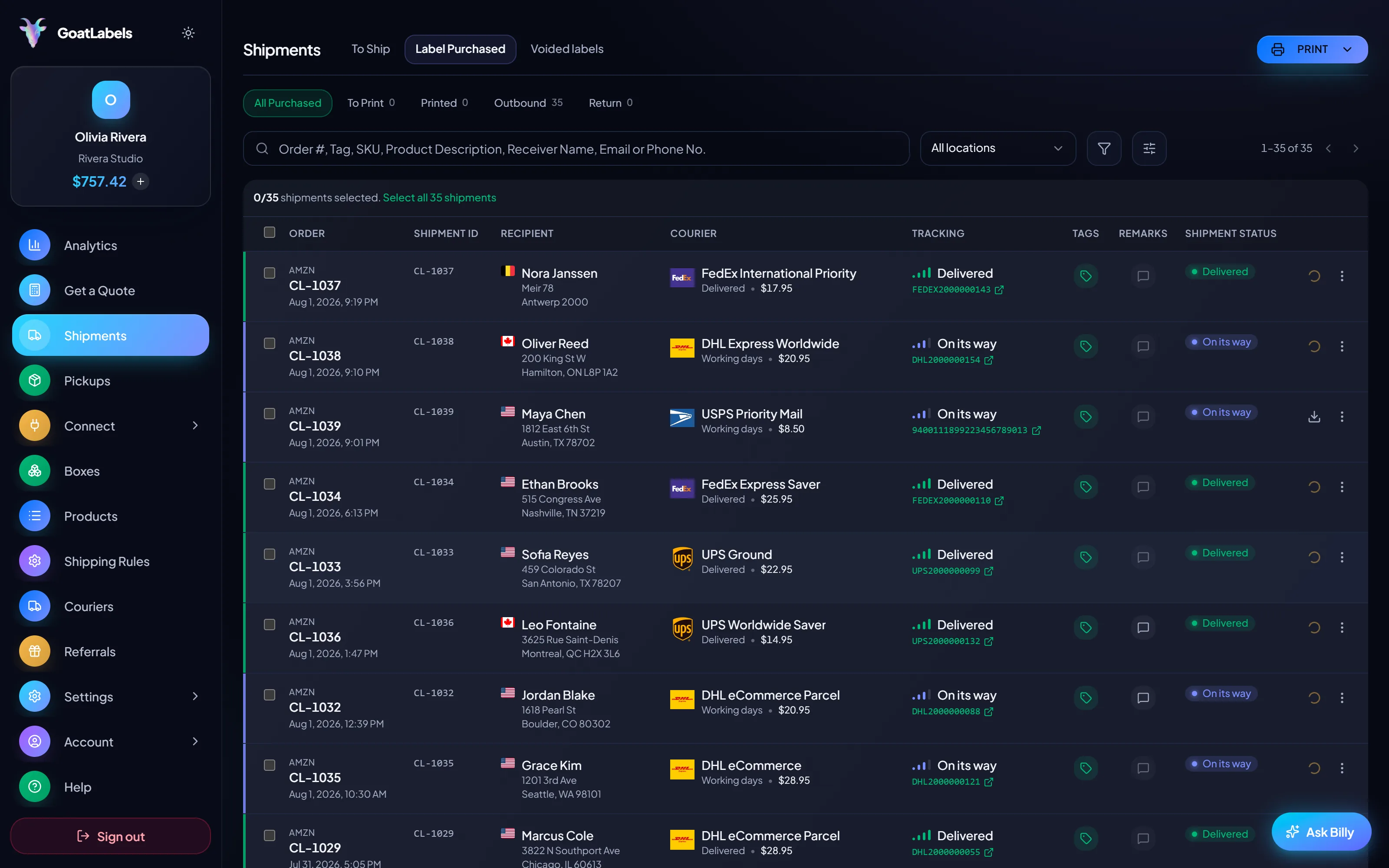
Batch printed
Three channels · one balance · one purchase history
The fragmentation tax is mostly paid in context switches. Three tools turn what should be a single pick-pack-print pass into three smaller ones with a login screen between each, and the switches are the part that never appears on an invoice. One queue collapses them back into one pass — and it fits on the phone, standing at the table where the parcels already are.
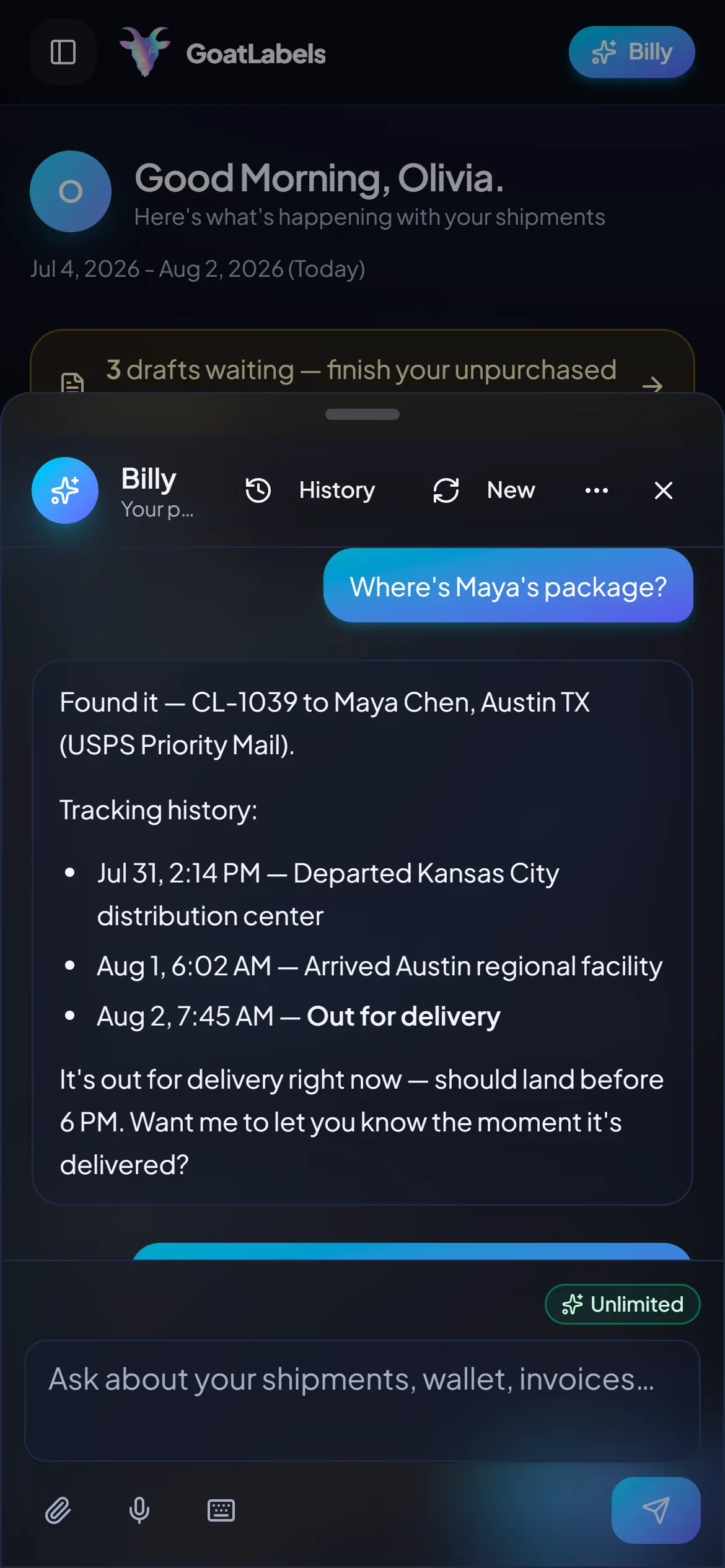
Buyers ask in whatever channel they bought in, and the seller's first problem is working out which tool the label was bought from. When every channel's labels live in one history, that step disappears: say the question out loud and Billy finds the shipment and reads its status back. Included on every plan. This is the real product, not a render.
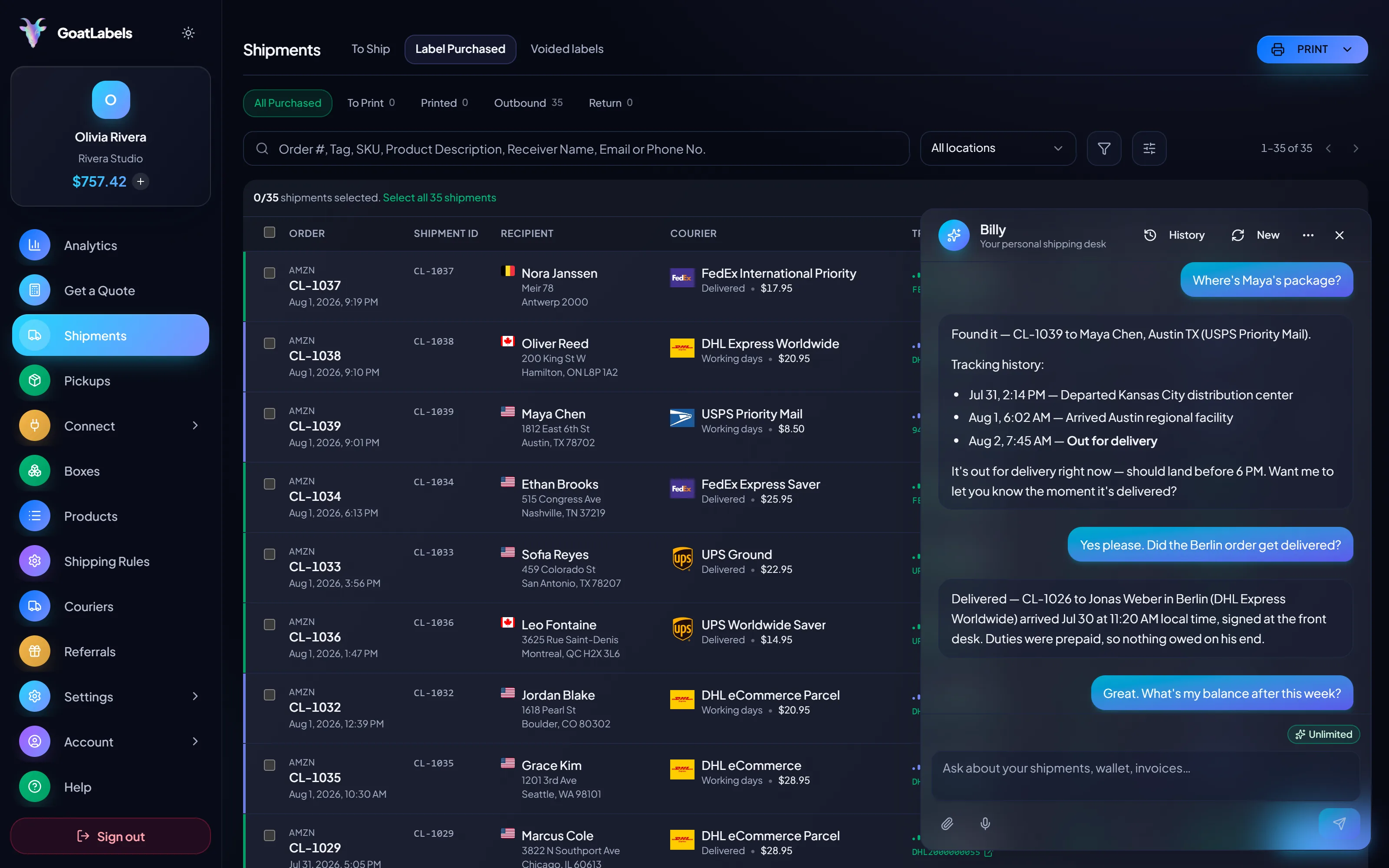
Listening
"Where's the order for Dana?"
Out for delivery
One history · the store is on the ledger entry
Speaks plain English · one purchase history behind every channel · included on every plan, on Telegram with Pro.
Wholesale cartons and DM mailers do not have the same cheapest carrier, so a channel that has always printed from one tool has been quietly defaulting for years — that is the fragmentation tax in miniature. Every parcel in the queue is quoted by each carrier on its lane, whatever channel it came from, and the column you pick is the exact amount that leaves the wallet. The sample parcel below is an illustration.
Ground Advantage
2 to 5 days$11.40
all-in · the same figure on every ledger row
Ground
1 to 5 days$9.85
all-in · the same figure on every ledger row
Ground
1 to 5 days$11.20
all-in · the same figure on every ledger row
Connected stores take their tracking number back on their own. For everything that arrived as a file or a paste, that number has to travel back by hand — unless a script already has it. Signed webhooks hand you the label and tracking events the moment a label is bought, which is what turns the manual half of a multi-channel loop into code.
POST /api/v1/shipments
Authorization: Bearer sk_live_…
Idempotency-Key: ord_8421

{
  "to": { "name": "Joyce", "city": "Berlin", "country": "DE" },
  "parcel": { "weight": 2.6, "weight_unit": "lb" },
  "service": "fedex_intl_priority"
}
Consolidating three tools should not mean swapping three small subscriptions for one large one. There is no per-store charge, no per-seat charge, and no monthly fee on Free, where the only thing that costs money is a label. Free covers 50 shipments a month across every channel together, not per store; past that, Pro is one flat $40 monthly plan with unlimited shipments.
 — find an order without knowing which channel it came from
Rate by plan
illustrativePro: one flat monthly plan, unlimited shipments
$0 / forever
Add the second and third channel without adding a second and third bill.
The assistant that reads a DM sale into a drafted, validated label runs unlimited on Free. The channel with no export is the one most likely to be left out of a consolidation, so it is the one not to charge for.
Telegram, ProGET /api/v1/shipments
200 OK · plan: free
Unlimited calls on Free — still unlimited on Pro.
Put a real parcel through and compare the side-by-side rate against what that label costs you on
ShippoPirate ShipShipStationLabel prices are quoted live from USPS, UPS, FedEx, and DHL as one all-in number, and that exact amount leaves the single prepaid wallet — which is what makes per-channel cost a filter on one ledger rather than a reconciliation across three. Full pricing details
The mixes differ — marketplace plus own site, wholesale plus DTC, storefronts plus DMs — but the failure mode is identical: three tools, three balances, and no single number for what delivery costs.

 Etsy or eBay first, Shopify second
The marketplace taught you shipping and the new site came with its own label screen, so the same packing table now runs two workflows. Sync the stores that sync, import the marketplace that does not, and the two channels become one afternoon print run with per-channel cost visible on one ledger.
 Faire cartons and website mailers
Wholesale cartons and DTC mailers should never be priced by the same habit. One queue quotes both against every carrier on the lane, and one ledger finally shows which side of the business delivery is eating.
Per-channel cost, one filter
Wholesale vs DTC · same ledger, adjacent rows

 The channel with no export
 Fewer tabs before the busy quarter
1
queue, balance, and ledger across every channel
A video took off and I had 80 TikTok Shop orders by morning. I printed every label from my phone on the bus to the post office.
Early customer · TikTok
TikTok Shop seller
TikTok ShopI run my Etsy shop from the kitchen. The AI reads the order, picks the carrier, the label prints. That's the whole workflow now.
Early customer · Etsy
Etsy maker
EtsyThe API is what every shipping API pretends to be. Idempotency that actually works.
Sasha R.
Staff engineer, marketplace
Connect the stores that sync, import the channels that export, paste the sales that arrive as messages — and run all of it from one queue, one balance, and one ledger.
Sign up in seconds. No card required. Your channels keep working exactly as they do today.
Updated