

USPS
Ground Advantage
3–6 days$16.90
$1.20 of Premium insurance included
all-in · one wallet behind every row
TCGplayer sellers ship in ounces, where small choices compound: when an order's value requires tracking, when a parcel outgrows an envelope, and how a day's orders batch. Export orders, map columns once, validate addresses, and rate-shop each row — light-parcel pricing is exactly where carriers differ most.
A few ounces of cards gets genuinely different prices. USPS, UPS and FedEx are quoted side by side on every domestic row of your export, DHL on international ones.


 DHL: international
Card, Apple Pay, Google Pay, ACH, or crypto fund one prepaid wallet. A slow release week costs nothing to keep open.
A card seller's day does not arrive as an order, it arrives as a file. Pull the Shipping Export, sort it by order value so the tracked and untracked populations get packed differently, map the columns once, and every row is address-validated and priced across USPS, UPS and FedEx (DHL on international rows) before a cent leaves the wallet.
playset arrived bent last time — can you send this one rigid, to Boise?
There is no TCGplayer connector, so the day arrives as a Seller Portal export. Map its columns once and save the preset; tomorrow's file is the same shape dropped into the same mapping.
 Billy AI
A failed row is reported and retryable, never silently skipped. Then each tracking number goes back into its TCGplayer order — the one step no third-party tool can take for you.
Store sync spans 13 store connectors, including Shopify, eBay, Etsy, Amazon, and TikTok Shop — worth connecting if you also move sealed product or break slots, because those orders land in the same To Ship queue and the same wallet. TCGplayer itself is not one of them: singles orders arrive as a Seller Portal export, and tracking numbers go back by hand.
 Shopify
 Etsy
Etsy WooCommerce
 TikTok Shop
 Amazon
 eBay
eBay Squarespace
 Wix
Wix WalmartShopify PlusSoon
 Square
 BigCommerce
 Magento
 ZapierSoon
 NetSuiteSoon
 EcwidSoon
 Temu
Temu SheinSoon
 ChannelAdvisorSoon
 SkuVaultSoon
 Zoho InventorySoon
 Patreon
Most e-commerce shipping advice is written for pound-scale parcels, and almost none of it survives contact with a card business. A TCGplayer order is often a single trading card in a penny sleeve — a parcel whose weight is measured in single ounces and whose postage can exceed the sale price of the card inside it. At that scale the decisions that barely register for other sellers become the whole margin: one more ounce of packaging, one protective case too many, one habitual service choice, and an order that should have earned two dollars earns nothing.
The ounce economy has a second property that matters here: it is exactly the corner of the rate chart where carriers disagree with each other most, proportionally. On a light parcel, the gap between the cheapest and the most expensive quote is routinely a large fraction of the total price, which makes rate-shopping per order worth more to a card seller than to almost anyone else. Where the carrier-by-carrier crossover sits for ground services generally is mapped onthe cheapest ground shipping services page— this page stays on what is specific to cards: the value thresholds, the physical breakpoints, and the batched day.
TCGplayer does not ask how heavy an order is; it asks what the order is worth. The seller policy draws a value line, and orders above it must travel with tracking for the sale to stay inside seller protection and for your shipping metrics to hold. Below the line, untracked envelope shipping is permitted and often rational — the risk you carry on a two-dollar common is not worth parcel postage. The discipline is checking the order value against the line before packing, not after, because the packaging decision and the service decision both follow from it.
This is also the rule that quietly reprices borderline orders. An order a few cents over the line cannot ship as a stamped envelope, so it absorbs the full jump to tracked parcel pricing at once — which is why experienced card sellers sort a day's export by order value first and handle the two populations separately. When you buy a tracked label here, the tracking number is on the shipment record immediately; entering it against the TCGplayer order remains your step, and doing it promptly is what keeps the marketplace's clock happy.
TCGplayer policy reference — verified against TCGplayer's published seller documentation on 2026-08-15. The tracking requirement applies to orders of $50 or more; below it, untracked envelope shipping is permitted. Sellers using TCGplayer Pro or Direct operate under additional program terms. TCGplayer revises seller policy, thresholds, and program eligibility, so confirm the current figures in Seller Portal before relying on them. Re-check cadence: every 6 months, by the named marketing owner recorded with this page. TCGplayer is a trademark of its owner and is not affiliated with GoatLabels.
Postal pricing is not a smooth curve — it is a staircase, and card orders live on the first three steps. A thin, flexible envelope that bends through automation is priced on the letter scale. Make it rigid — a top loader, a one-touch magnetic case — or let it pass the thickness limit, and the same weight is repriced as a large envelope or a parcel, because it now has to be handled outside the letter stream. Stack enough cards and the weight steps do the same thing again, ounce band by ounce band. None of these breakpoints care what the cards are worth; they care whether the piece bends, how thick it is, and what the scale says.
The practical skill is knowing which side of each breakpoint an order sits on before choosing packaging, because packaging is the one input you control completely. Protecting a common in a rigid case can triple its postage for no protective benefit the buyer will notice; shipping a playset in a flexible sleeve when it should have been a tracked bubble mailer is how a good month grows a claims problem. If a parcel is ever heavier or larger than what its label declared, the carrier corrects the price after the fact — that arrives as a post-shipment billing adjustment, which is its own subject.
A card seller's day does not arrive as one order; it arrives as thirty. The workable loop starts in Seller Portal: pull the Shipping Export for the day's open orders and you have a file whose columns map cleanly onto a label import. Map those columns once, save the preset, and every subsequent day is the same file shape dropped into the same mapping — the mechanics of the importer itself, from parsing to per-row purchase, are documented onthe bulk CSV labels page. What is TCGplayer-specific is the mapping, so here it is.
| Shipping Export column | GoatLabels import field | Worth knowing |
|---|---|---|
| FirstName + LastName | Recipient name | Two export columns, one import field — map both. |
| Address1 / Address2 | Street address lines | Address2 is empty on most card orders; map it anyway so apartment lines survive. |
| City / State / PostalCode / Country | City, state, ZIP, country | Every row is validated against the live address database before any label is priced. |
| Order # | Order reference | Carried onto the shipment record so a tracking number can be matched back to the sale. |
| Product Weight | Package weight | TCGplayer sums card weights; add your mailer and rigid holder before trusting it, or override per row. |
| Value of Products | Reference value | The column your tracking decision reads — sort the file by it before you buy anything. |
Column names above were read from a Seller Portal Shipping Export pulled on 2026-08-15; TCGplayer can rename or reorder them, and a saved mapping preset is exactly the thing that absorbs that when it happens. Once the file is mapped, every address is validated before any label is priced, every row gets a live quote from each carrier, and the batch is purchased row by row from one prepaid wallet: a failed row is reported and retryable, not silently skipped. The only manual step left is pasting each tracking number back into its TCGplayer order, which is the marketplace's requirement, not ours.
Direct is the program where TCGplayer's warehouse ships to your buyers, and if you qualify for it and it fits your inventory, it removes the per-order shipping problem for the listings it covers. Be honest about that: for Direct-fulfilled sales, you do not need this page. What Direct leaves behind is still substantial, though. Listings outside the program, orders below its eligibility bar, and sales in categories it does not take all still ship from your desk under the ounce rules above, and Direct adds a new parcel class of its own, because consolidated inventory shipments to TCGplayer are heavy, dense boxes where the carrier spread is dollars per box rather than cents per envelope. A card business at Direct scale usually ships both kinds in the same week, from the same wallet.
Everything below runs on the free account, because a card seller's economics cannot carry a software subscription. The only meter on the account is postage.
Card, Apple Pay, Google Pay, ACH, and crypto top up one balance, and each label debits its exact quoted price. On margins where a quarter matters, the ledger reads label by label, and an accepted void credits back, spendable on the reprint.
Not every sale arrives in the export — a local buyer, a social sale, a make-good reship. Paste the message or drop a screenshot and Billy drafts the label for you to confirm, with the address validated before money moves.
BillyLIVEThe quoted number is the number that leaves the wallet — no fee stack appearing afterwards to erase a two-dollar margin. If a carrier ever corrects a weight after shipping, it posts as its own visible adjustment entry, never a mystery.
USPS wins most single-card parcels, but not all of them, and heavier playset or sealed orders flip more often than habit suggests. Every domestic row gets USPS, UPS and FedEx priced side by side, DHL on international lanes, so the winner is checked rather than assumed.
UPS$12.48FedEx$13.22DHL$14.10USPS$11.79Card sellers automate early. The REST API covers quoting and purchase with unlimited calls on every plan, signed webhooks instead of polling, and idempotency keys so a retried job never buys a label twice.
Card order · label ready
Boise, ID · tracked, number back on the order
Every breakpoint that reprices a card order happens where the parcel is being packed — the moment the piece stops bending, the moment the scale crosses a band. None of those moments happen at a desk, so the queue, the live quotes, and the buy button all fit on the phone next to the scale.
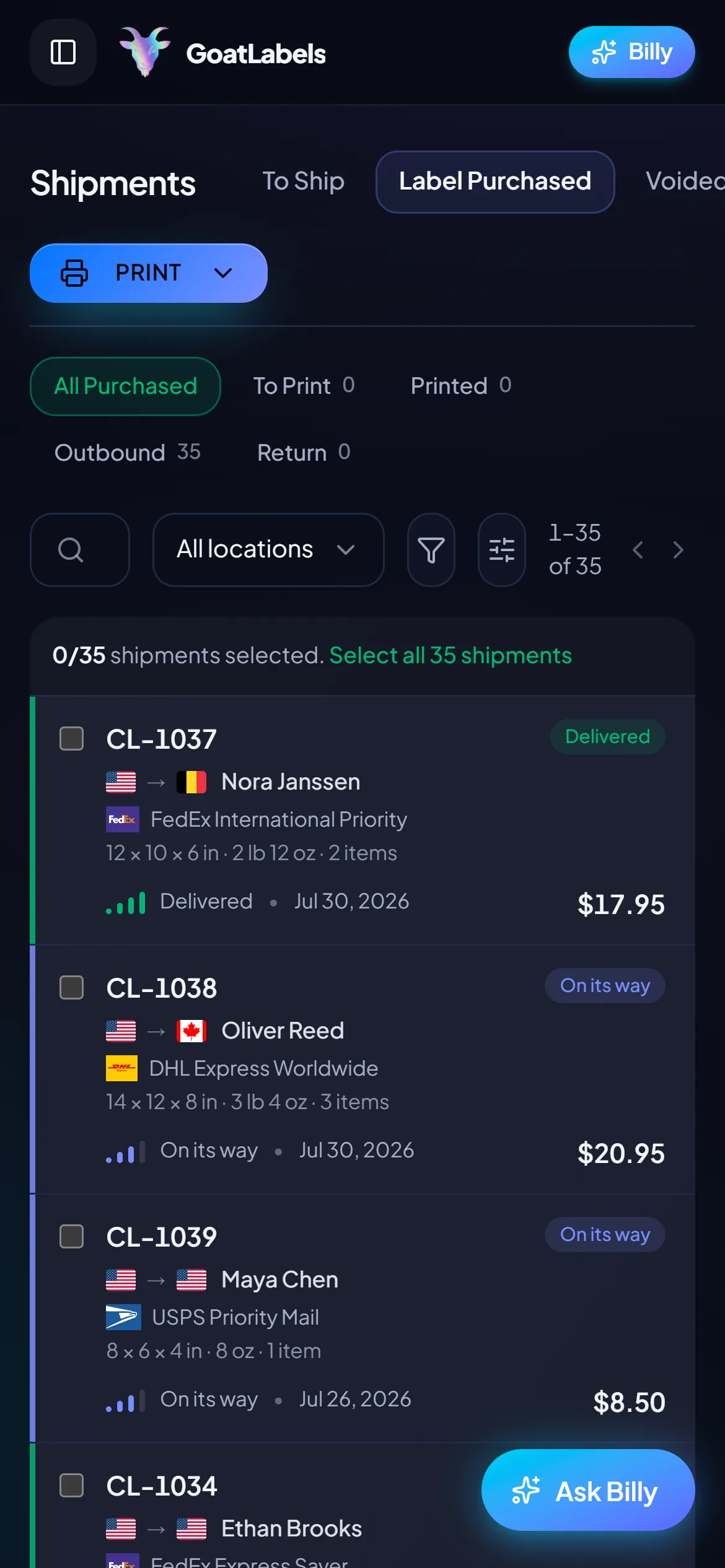
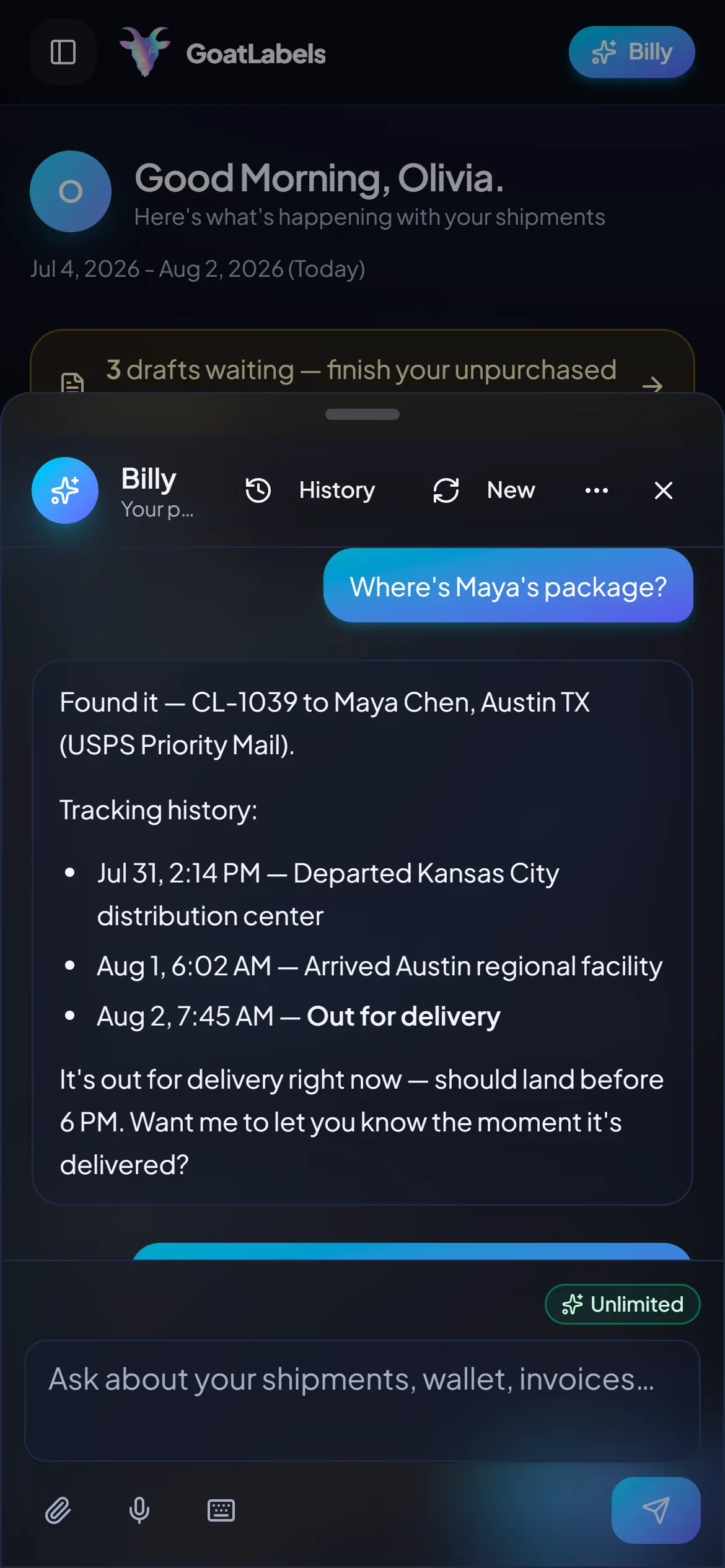
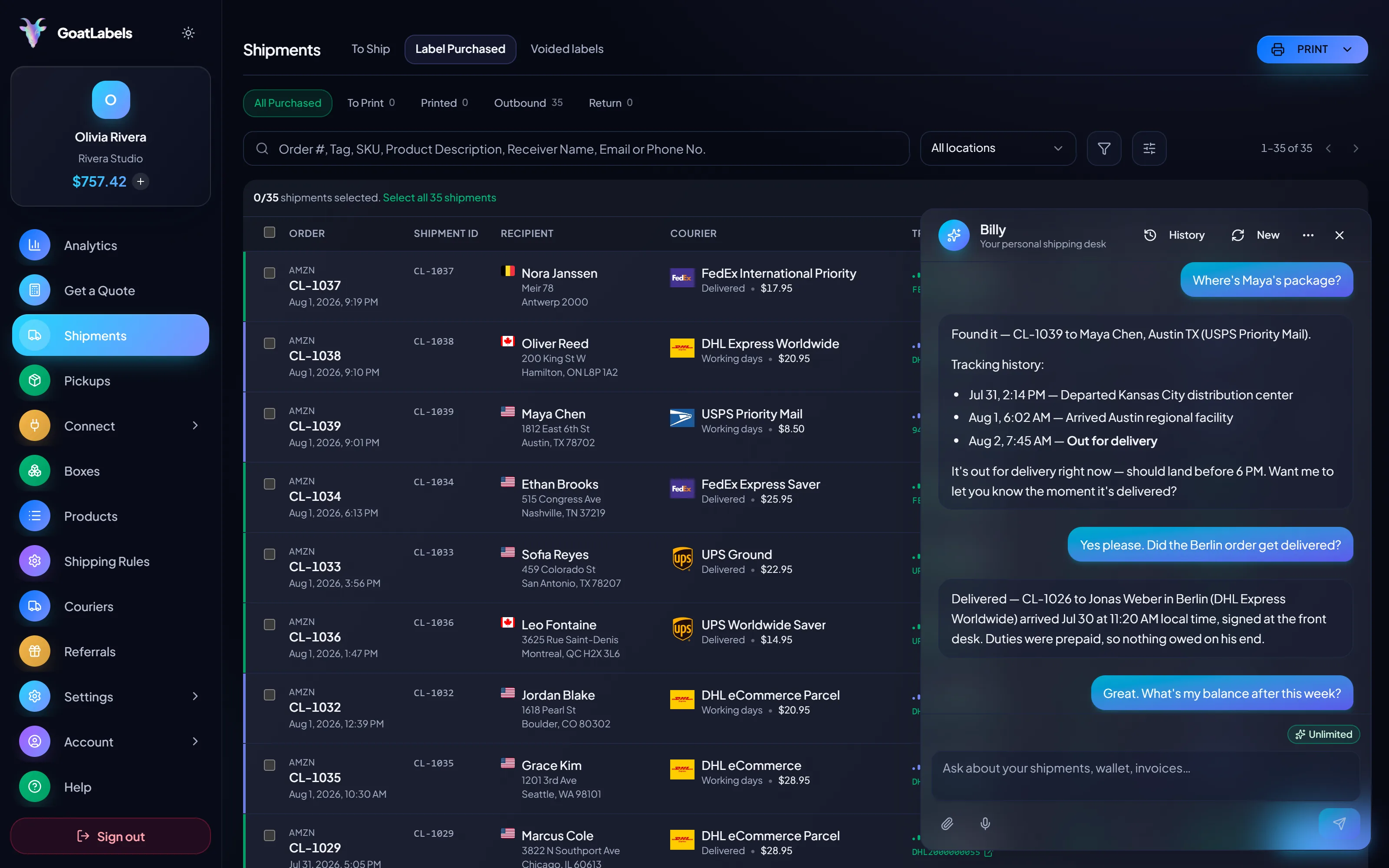
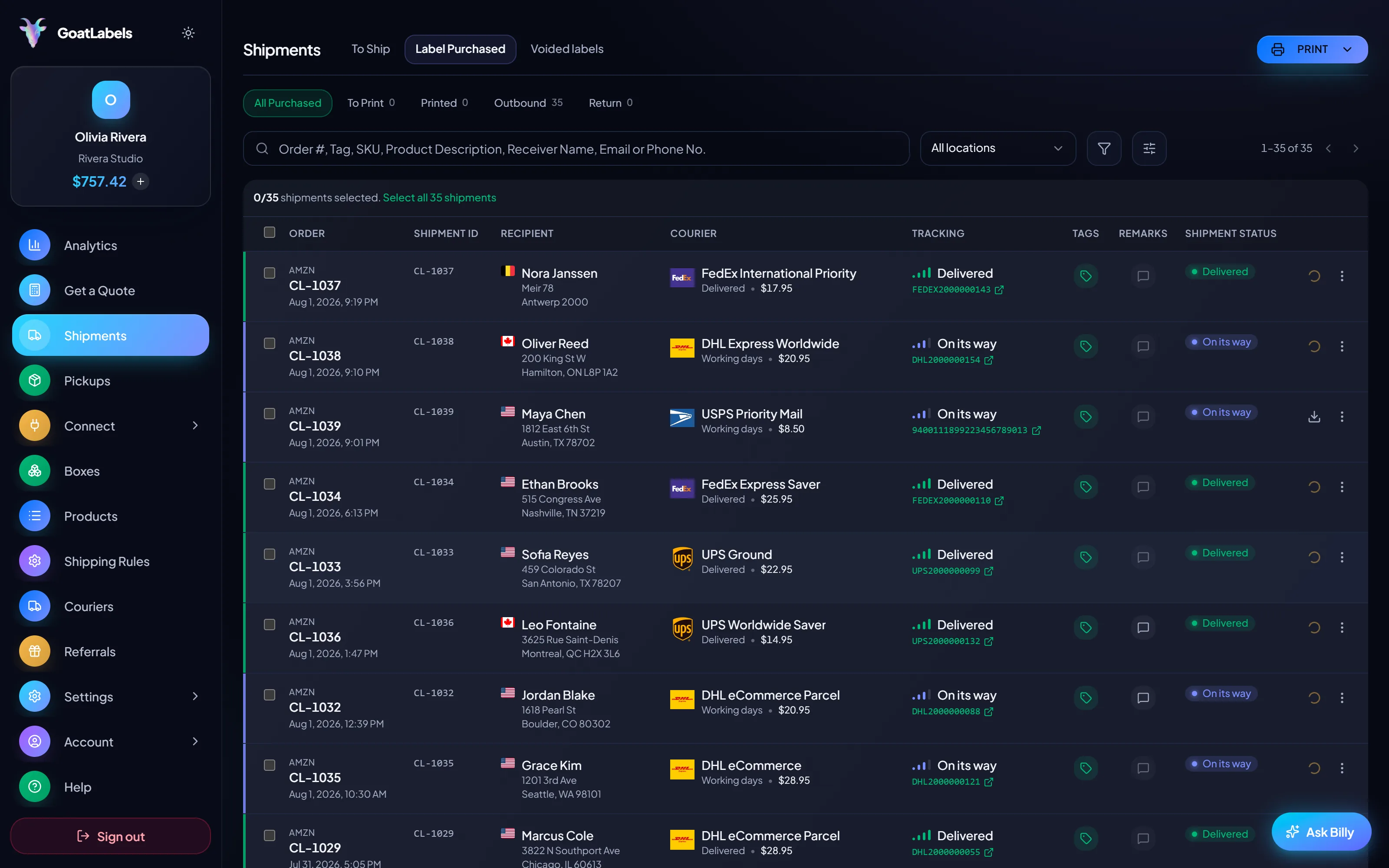
Packing cards is a two-handed job, and the questions are always the same two: did this one need tracking, and where is it now. Ask out loud: Billy finds the shipment, reads the status back, and quotes the parcel in your hands across USPS, UPS and FedEx (DHL on international lanes). Included on every plan. This is the real product, not a render.
Listening
"Where's the playset that went to Boise?"
Out for delivery
Boise, ID · scanned this morning
Speaks plain English · remembers your saved mailer and box sizes · at the packing table, in the browser, or on Telegram with Pro.
Single-card parcels usually go USPS and usually should. The orders that repay rate-shopping are the other ones (sealed product, deep playsets, and the consolidated inventory boxes a Direct seller sends in), where the carrier spread is dollars per box rather than cents per envelope. Figures are illustrative.
Ground Advantage
3–6 days$16.90
$1.20 of Premium insurance included
all-in · one wallet behind every row
Ground
3–5 days$14.20
$1.20 of Premium insurance included
all-in · one wallet behind every row
Home Delivery
3–5 days$14.80
$1.20 of Premium insurance included
all-in · one wallet behind every row
Card businesses automate early, usually the day the export stops fitting on one screen. Quote and buy per row from your own code: REST and JSON, one Bearer header, and idempotency keys so re-running yesterday's batch cannot buy yesterday's labels a second time.
POST /api/v1/shipments
Authorization: Bearer sk_live_…
Idempotency-Key: ord_8421

{
  "to": { "name": "Joyce", "city": "Berlin", "country": "DE" },
  "parcel": { "weight": 2.6, "weight_unit": "lb" },
  "service": "fedex_intl_priority"
}
The ounce economy is decided by fixed costs, and a software subscription is the most fixed cost there is. Free covers 50 shipments a month with the CSV import, the carrier quote, Billy, and the API all included. Past that, Pro is one flat monthly plan with unlimited shipments.
 — draft the odd order without opening the dashboard
Rate by plan
illustrativePro: one flat monthly plan, unlimited shipments
$0 / forever
Enough for a steady day of singles, and nothing owed in a week with no sales.
The assistant that reads a pasted card sale into a draft label — with the address validated before money moves — runs unlimited in the web app on Free. Pro adds Billy on Telegram.
Telegram, ProGET /api/v1/shipments
200 OK · plan: free
Unlimited calls on Free — still unlimited on Pro.
Put a real parcel through and compare the side-by-side rate against what that label costs you on
ShippoPirate ShipShipStationLabel prices are quoted live from USPS, UPS, FedEx, and DHL as one all-in number, and that exact amount leaves your prepaid balance. TCGplayer's own seller fees and policy figures are TCGplayer's — read the current ones in Seller Portal. Full pricing details
Same export, same wallet, same live quotes on every row. What changes is which line each of these sellers keeps landing next to.
 Commons, bulk lots, penny sleeves
Postage that can exceed the card is the whole problem, and it is decided by packaging you control completely. Sort the export by value, keep the untracked population in flexible envelopes, and let the carriers argue over the rest.
 Untracked envelope to tracked parcel
An order a few cents over absorbs the whole jump at once, so it gets packed as a different animal entirely. The point of sorting first is that the packaging call and the service call are the same call.
Sorted by value before packing
Two populations, two ways of packing them

The sales that never reach the export
 Consolidated boxes, not envelopes
1
prepaid balance behind both the ounce parcels and the inventory boxes
Related reading: shipping labels for Whatnot sellers,the cheapest ground shipping services, andcheap shipping labels.
A video took off and I had 80 TikTok Shop orders by morning. I printed every label from my phone on the bus to the post office.
Early customer · TikTok
TikTok Shop seller
TikTok ShopI run my Etsy shop from the kitchen. The AI reads the order, picks the carrier, the label prints. That's the whole workflow now.
Early customer · Etsy
Etsy maker
EtsyThe API is what every shipping API pretends to be. Idempotency that actually works.
Sasha R.
Staff engineer, marketplace
Pull today's Shipping Export, map it once, and watch every row get validated and priced across USPS, UPS and FedEx (DHL on international rows) before a cent leaves the wallet.
No card required. No contract. No monthly fee on Free, up to 50 shipments a month.
Updated