

USPS
Ground Advantage
2 to 5 days$11.40
all-in · the quoted total is the ledger row
If revenue arrives as crypto, shipping is usually the first expense that forces a bank detour. A prepaid wallet funded directly from crypto removes that step: treasury converts to postage in one hop, labels are bought in dollars from the balance, and each label posts to the ledger against its funding.
USPS, UPS and FedEx quoted on every domestic parcel, DHL on international lanes, one all-in price each, bought from a balance your crypto funded, not from a card you had to go get.


 DHL: international
The balance is held in dollars from the moment it is funded: accepted voids credit it back, adjustments post against it, and nothing silently converts twice.
A crypto-native business can run most of its life without touching a bank. Revenue settles to a treasury wallet, contractors invoice in stablecoins, software subscriptions increasingly take crypto directly. Then a physical product sells, and the loop breaks on the least glamorous expense there is: postage. Nearly every shipping platform wants a card or a bank account, so the workflow becomes off-ramp to an exchange, withdraw to a checking account, wait out the transfer, then feed a card number into a label tool — four hops, several days of latency, and two extra accounts that exist for no reason except that the post office does not take tokens.
The detour costs more than time. Every hop is a reconciliation surface: the exchange statement, the bank statement, and the label platform's billing each tell a fragment of the story, and at month end somebody has to stitch a single parcel's cost back together across all three. For a business whose whole appeal is a short, legible money loop, postage quietly becomes the longest and least legible line in the books.
GoatLabels collapses the detour to a single hop because the prepaid wallet funds directly from crypto, alongside card, Apple Pay, Google Pay, and ACH. The conversion point is the funding moment and only the funding moment: crypto goes in, a dollar balance comes out, and everything downstream of that balance is ordinary dollar commerce. The payment walkthrough itself — assets, confirmation, how the top-up lands — is covered end to end on the crypto shipping labels page; what this page cares about is the shape of the operation around it.
That shape is deliberately boring. Each domestic order is quoted against USPS, UPS and FedEx at once (DHL on international lanes), each as one all-in price, which is how a label stays cheap without a negotiated carrier contract. Buying the label debits the balance by exactly the quoted amount, and the debit is its own ledger line tied to that shipment. So the treasury view reads in one place: a funding event where crypto became balance, followed by a row per parcel drawing it down. No exchange statement, no bank statement, no card bill — the loop from on-chain revenue to a parcel in the mail has one ledger in the middle, and you can read it top to bottom.
The question every crypto-funded operator eventually asks is what happens when money has to come back. The answer is the most useful design fact on this page: once funded, the balance is dollars, so every correction is a dollar event. A label bought against the wrong parcel is voided for a wallet credit after the carrier accepts the void: the credit posts to the same balance in dollars, and at no point does anything convert back into a token. There is no second disposal to account for, no spread paid twice, no waiting on a chain to confirm before you can buy the corrected label.
Corrections can also run the other way. A carrier that reweighs or remeasures a parcel after acceptance bills the difference later, and how each carrier detects, bills, and lets you dispute that is the carrier billing adjustments page's territory. Here the operational fact is where it lands: the adjustment posts against the wallet as its own record, visible in the same ledger as the label it corrects. One honesty note belongs in your runbook — if an adjustment arrives when the balance cannot cover it, the remainder is charged to the card on file. A crypto-native operation that keeps a modest float in the wallet keeps its corrections on the wallet ledger too, which is exactly where you want them.
Your accountant will ask two questions, and the one-conversion design answers both cleanly. First: when you funded the wallet, what was the crypto worth? Funding is a disposal of the asset at that moment's fair value, with gain or loss measured against your basis — that is the only crypto-flavoured entry in the whole flow, and the funding record gives it a timestamp and an amount. Second: what did each shipment actually cost? The per-label ledger answers that row by row, corrections included, because voids and adjustments post as their own entries rather than as silent edits to old ones.
From the disposal onward, postage from a crypto-funded wallet books exactly like postage from any prepaid balance: an asset when you top up, an expense as labels draw it down, income if you charge buyers for shipping. The chart of accounts and the worked journal entries for all of that live on the bookkeeping for shipping costs page — the crypto version differs only in that one extra funding entry. Hand your accountant the funding records and the shipment ledger and the conversation is short. None of this is tax advice; the design goal is simply that when someone qualified asks for the numbers, they exist, they are dated, and there are not three statements to reconcile first.
The whole operation is three moves and one ledger. Funding converts once — crypto becomes a dollar balance, and that is the only crypto-flavoured entry anywhere in the flow. Orders then arrive from wherever your buyers are and Billy drafts them without anyone retyping an address. Each label debits the balance by exactly its quoted all-in amount, as its own row. No exchange statement, no bank statement, and no card bill sitting between the treasury and the parcel.
paid — shipping to Lisbon, address below
Nothing downstream of funding is denominated in anything but dollars, which is what keeps the whole operation to a single reconciliation surface instead of three.
 Billy AI
Void it and, after the carrier accepts the void, the credit returns to the same dollar balance: no second disposal to account for, and no on-chain round trip.
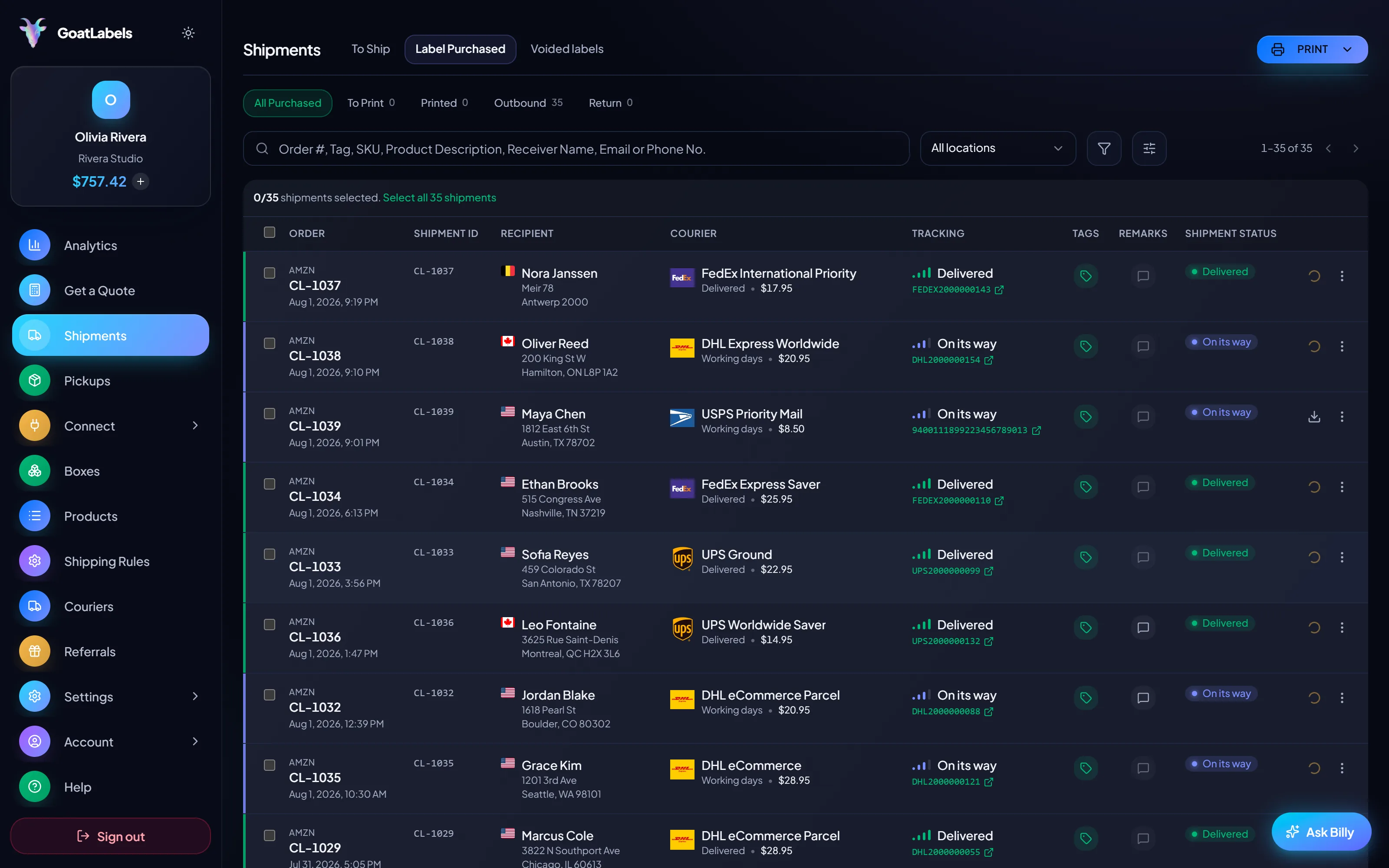
13 store connectors, including Shopify, Etsy, WooCommerce, Amazon and TikTok Shop, sync into a single To Ship queue, and every one of those labels draws down the same balance your treasury funded — so a widening channel mix never becomes a second set of books. Paste an Instagram or Facebook DM, or a screenshot of a chat, and Billy builds the label from it; that shipment posts to exactly the same ledger as a synced one.
 Shopify
 Etsy
Etsy WooCommerce
 TikTok Shop
 Amazon
 eBay
eBay Squarespace
 Wix
Wix WalmartShopify PlusSoon
 Square
 BigCommerce
 Magento
 ZapierSoon
 NetSuiteSoon
 EcwidSoon
 Temu
Temu SheinSoon
 ChannelAdvisorSoon
 SkuVaultSoon
 Zoho InventorySoon
 Patreon
Everything a crypto-funded shipping operation touches — the funding rail, the intake, the pricing, the corrections — behaves like one ledger instead of four statements.
Top up the prepaid balance from crypto directly — or card, Apple Pay, Google Pay, ACH when you want them — and the conversion happens once, at funding. The balance is dollars, every label debits it as its own ledger line, and an accepted void credits the same balance back in dollars.
A Discord handle and a pasted address are enough: Billy drafts the label from a pasted order, a screenshot, or a spoken address, and the destination is validated with a residential or commercial badge before any balance moves. Included on every plan.
BillyLIVEThe quoted price is the amount that leaves the balance — surcharges included, nothing bolted on after. If a carrier corrects a shipment post-acceptance, that arrives as its own adjustment record against the wallet, not as an unexplained difference in a statement.
Priced against the same box at once, with DHL on international lanes, each as one all-in number, without you holding a carrier account or a negotiated contract. The cheapest label is a choice per order, not a default you inherited.
UPS$12.48FedEx$13.22DHL$14.10USPS$11.79A REST API with unlimited calls on every plan and signed webhooks for events — the same rails a crypto-native team already builds on. Buy, void, and reconcile from your own scripts instead of a dashboard.
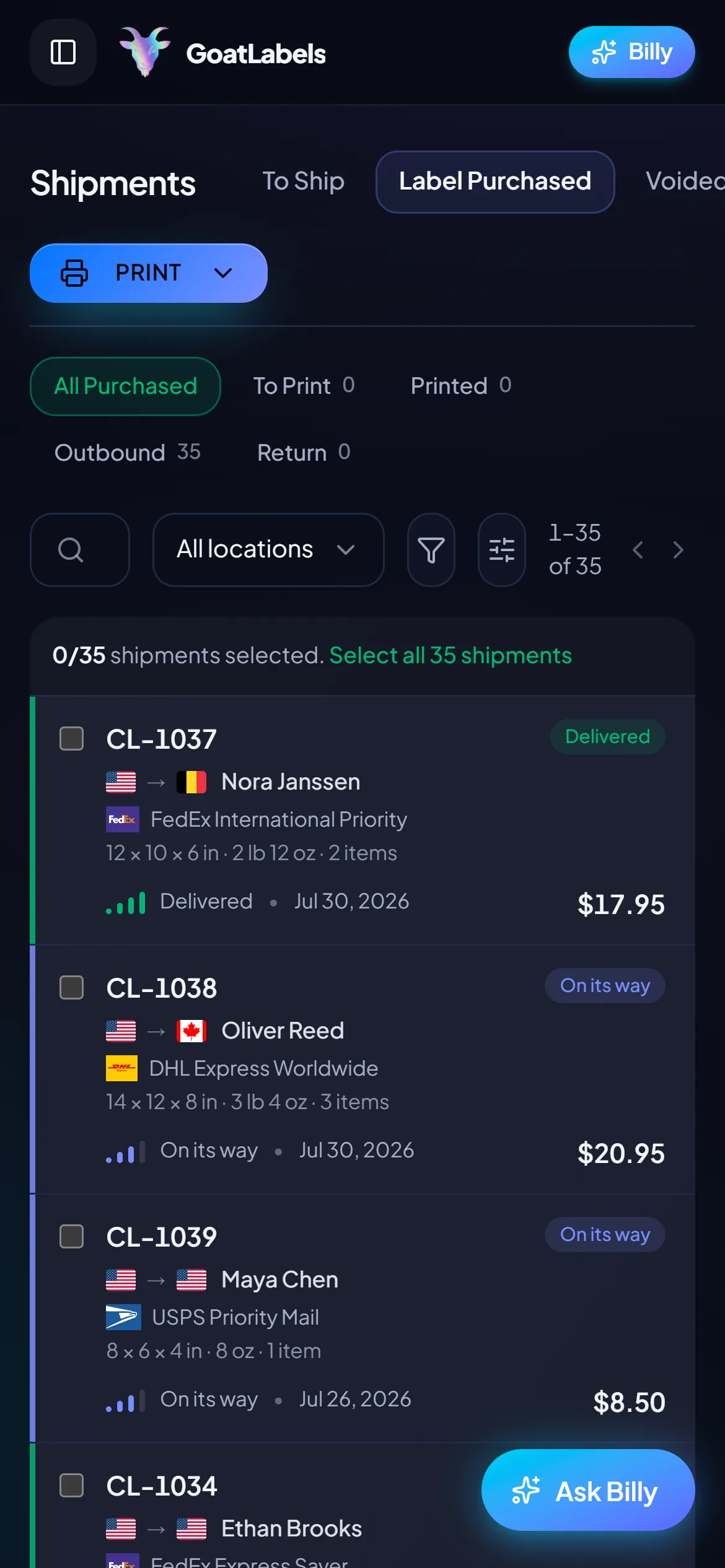
Label bought from the balance
One ledger row · Lisbon, PT
A crypto-native team is rarely all in one room. The funded balance, the quotes, the buy button, and the ledger row it writes all fit on a phone, so whoever is actually holding the parcel can ship it without a company card, a bank login, or a message to whoever holds the treasury keys.
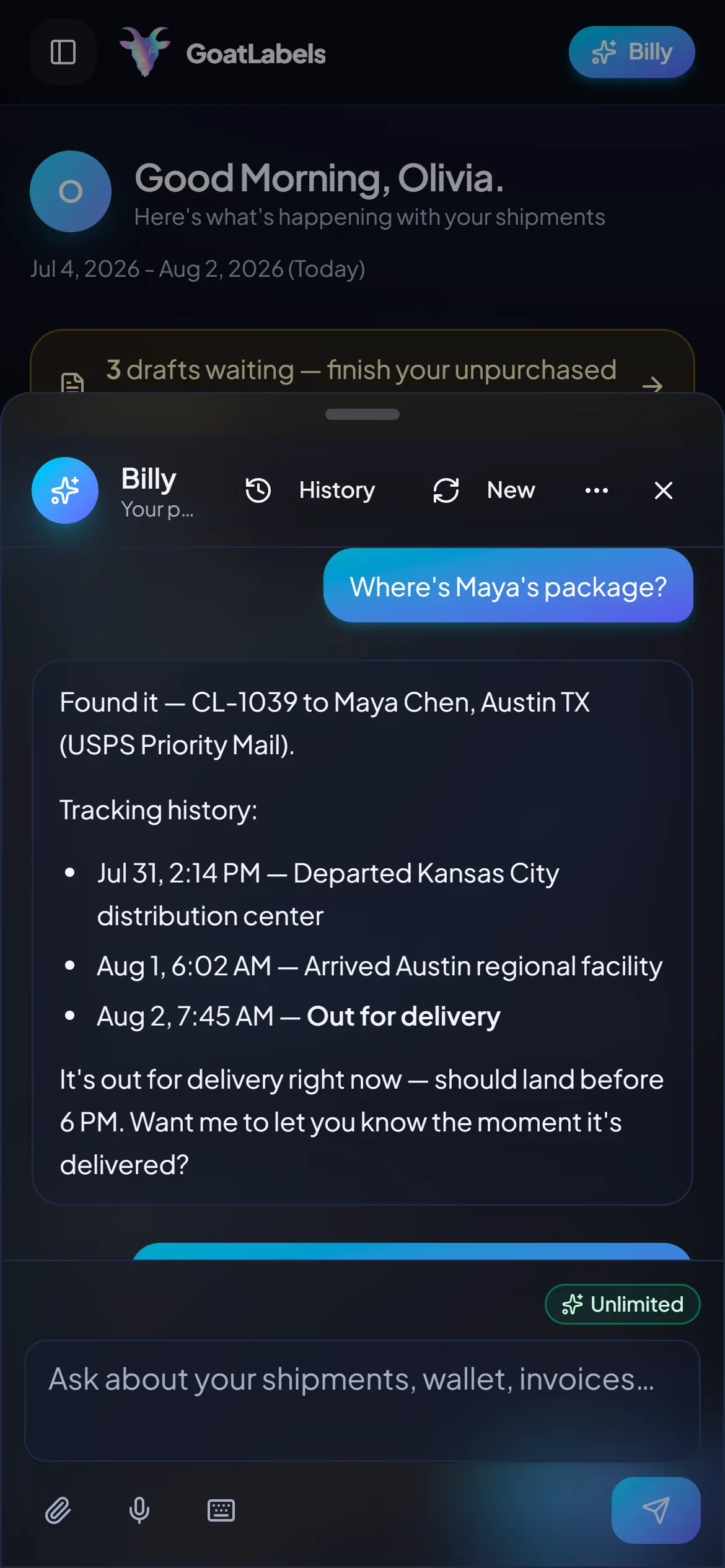
Where a parcel is, what it cost, whether a void credited back — those are one-line answers buried in rows. Ask out loud and Billy reads the shipment back: the latest scan, the amount that left the balance, and what any correction posted against it. Included on every plan, so the operational view costs nothing on top of the postage. This is the real product, not a render.
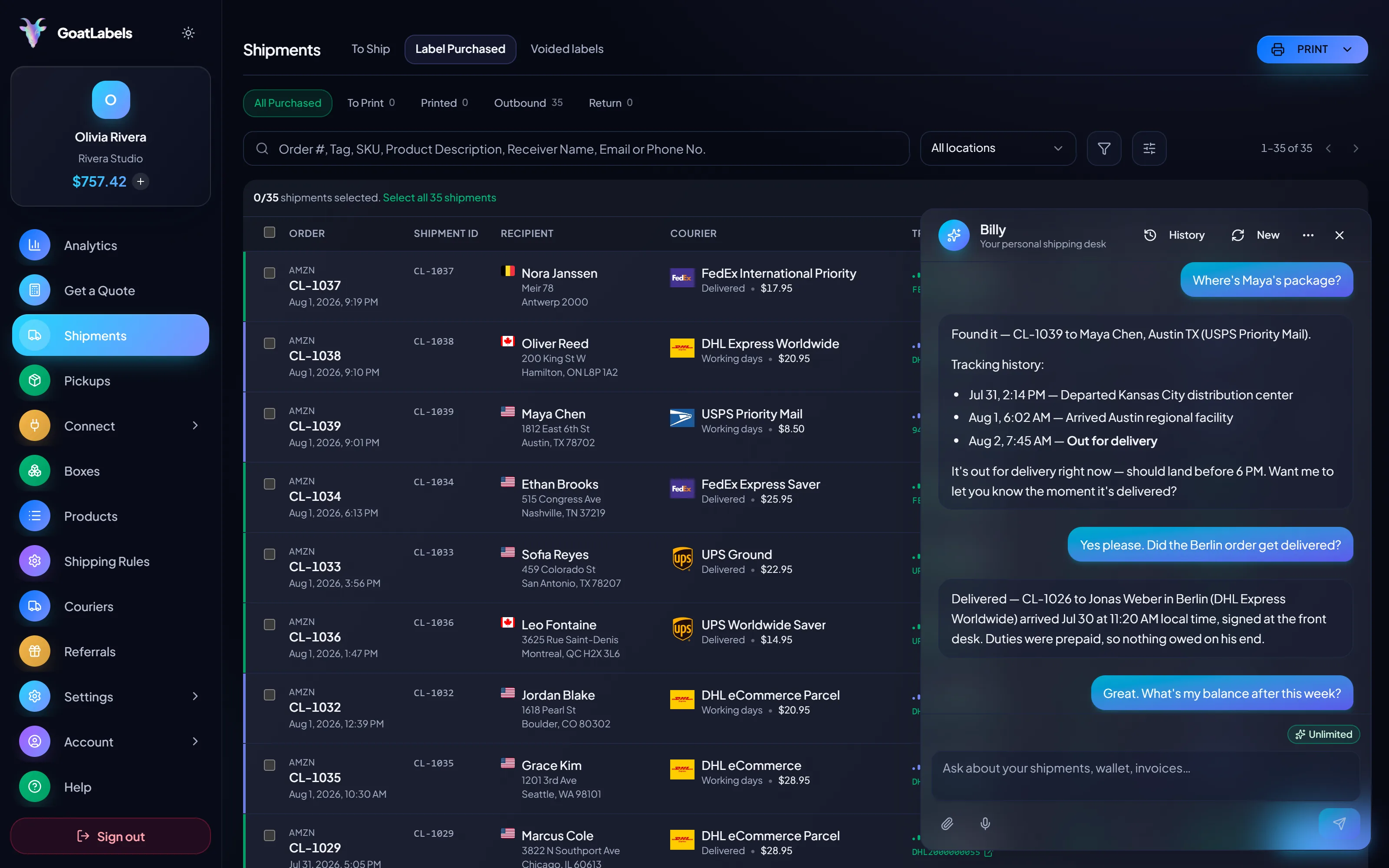
Listening
"What did the Lisbon parcel cost us?"
In transit
Debited at quote · void credit still available
Speaks plain English · reads shipment and wallet records back · drafts labels from a paste, a screenshot, or your voice · included on every plan.
Once the balance is funded, nothing about the rates depends on the rail that funded it: the same carriers quote the same parcel, each as one all-in number, and the column you pick is the exact figure that leaves the balance. That is the whole point of converting once: from here down it is ordinary dollar commerce with an ordinary dollar audit trail.
Ground Advantage
2 to 5 days$11.40
all-in · the quoted total is the ledger row
Ground
1 to 5 days$9.85
all-in · the quoted total is the ledger row
Ground
1 to 5 days$11.20
all-in · the quoted total is the ledger row
A team that already runs on scripts and webhooks should not be clicking through a dashboard to spend its own treasury. Quote, buy, void, and reconcile over REST and JSON with one Bearer header, and let signed webhooks push tracking and adjustment events into whatever you already run. Unlimited calls on every plan, so the automation never becomes its own line item.
POST /api/v1/shipments
Authorization: Bearer sk_live_…
Idempotency-Key: ord_8421

{
  "to": { "name": "Joyce", "city": "Berlin", "country": "DE" },
  "parcel": { "weight": 2.6, "weight_unit": "lb" },
  "service": "fedex_intl_priority"
}
A crypto-funded operation should not need a subscription to justify itself. Free covers 50 shipments a month with the wallet, Billy, and the API all included — fund from crypto, pay per label, stop there. Pro is a flat monthly plan that buys unlimited shipments when volume makes the math work.
 — draft and check shipments where your team already talks
Rate by plan
illustrativePro: one flat monthly plan, unlimited shipments
$0 / forever
Fund the wallet from crypto, pay per label, and keep the whole loop on one ledger.
Paste the order, drop a screenshot, or dictate it — Billy structures the draft and the address is validated before the balance is touched. Included unlimited in the web app on Free; Pro adds Billy on Telegram.
Telegram, ProGET /api/v1/shipments
200 OK · plan: free
Unlimited calls on Free — still unlimited on Pro.
Email contact@goatlabels.io and we will return rate-shopped quotes on the same parcels, run through the bulk importer. If your current rates win, keep them.
ShippoPirate ShipShipStationLabels are quoted live from USPS, UPS, FedEx, and DHL as one all-in dollar price, and that exact amount leaves the prepaid balance your crypto funded. Full pricing details
Four shapes of operation where the off-ramp existed for one reason only — postage — and what changes for each once that reason goes away.
 Drops, merch, and token communities
Revenue settles to a treasury wallet and the only fiat step left in the business is postage. Funding the shipping balance directly removes the exchange and the checking account from the loop, and leaves one ledger showing what each parcel actually cost.
 Independent shops, uneven volume
Low and lumpy volume makes a monthly subscription the worst possible shape of cost. Fund the balance when there is something to ship, spend it label by label, and on Free (up to 50 shipments a month) let a quiet month bill nothing at all; the wallet does not expire between drops.
Fund once, spend gradually
The balance is dollars from the moment it lands

 Orders that arrive as messages
 Teams that automate their own back office
1
REST API and signed webhook feed behind the same funded balance
Updated 2026-08-15
A video took off and I had 80 TikTok Shop orders by morning. I printed every label from my phone on the bus to the post office.
Early customer · TikTok
TikTok Shop seller
TikTok ShopI run my Etsy shop from the kitchen. The AI reads the order, picks the carrier, the label prints. That's the whole workflow now.
Early customer · Etsy
Etsy maker
EtsyThe API is what every shipping API pretends to be. Idempotency that actually works.
Sasha R.
Staff engineer, marketplace
Fund a prepaid wallet from crypto, quote every parcel across the carriers that serve it, and read the whole operation off one ledger, voids and adjustments included.
No contract. No bank account required to fund. No monthly fee on Free, up to 50 shipments a month.
Updated