

USPS
Ground Advantage
2–5 days$7.40
$1.20 of Premium insurance included
all-in · the exact figure your model has to recover
Free shipping is a pricing decision, not a shipping one: the cost moves into the item price or out of margin. Charging recovers cost per order but taxes conversion; a threshold splits the difference by paying for shipping with bigger baskets. Your average order economics decide, not fashion.
Every model on this page works better when the underlying label is cheaper: USPS, UPS and FedEx quoted on each domestic parcel, DHL on international lanes, cheapest all-in number wins.


 DHL: international
A prepaid wallet debited exactly the quoted all-in amount — funded by card, Apple Pay, Google Pay, ACH, or crypto — is what makes shipping-price strategy computable at all.
Updated
Shipping cost never disappears; it only moves. Every store is choosing, knowingly or not, one of three places to put it. Bake it in: raise item prices to absorb an average label cost and advertise free shipping. Buyers see one clean number, conversion improves, and the risk moves onto you — orders that ship cheaper than the average are extra margin, orders that ship dearer eat it. Pass it through: charge shipping at checkout, exactly or approximately. Every order carries its own freight and margins are protected, but the buyer meets a second number after emotionally committing to the first, which is where carts go to die. Threshold: charge below a line, free above it. The buyer is invited to solve the problem by buying more, and the bigger basket pays for the label.
None of the three is the correct one. Each is correct for a particular shape of catalogue: baked-in suits uniform, light, high-margin items whose label costs cluster tightly; pass-through suits heavy, bulky, or wildly variable parcels where no average is honest; thresholds suit catalogues where a plausible second item exists. The decision inputs are your average order value, your average label cost, and your margin — three numbers this page assumes you know, and the last of which you only know precisely when every label is bought at one all-in price.
Abstractions hide the trade, so here is one order run through all three models. The shape to notice before the table: the buyer's total barely moves across the first two columns, yet the checkout experience is completely different — one store looks generous and one looks stingy, on identical economics. The threshold column is the interesting one: the seller absorbs a slightly bigger label and more cost of goods, and still comes out ahead on margin because the basket grew. That is the entire threshold thesis in one row of arithmetic.
| One order, three ways | Baked in | Pass-through | Threshold |
|---|---|---|---|
| Item price shown to the buyer | $42.00 | $36.00 | $36.00 (free at $45) |
| Shipping shown at checkout | Free | $6.40 | Free — buyer added a $12 item |
| Buyer pays in total | $42.00 | $42.40 | $48.00 |
| Label cost to the seller | $6.40 | $6.40 | $6.90 (heavier basket) |
| Cost of goods | $14.00 | $14.00 | $18.20 (two items) |
| Margin on the order | $21.60 | $22.00 | $22.90 |
Worked example — one illustrative order, priced mid-2026.The item, goods cost, and margins are invented for the arithmetic; the label figures reflect a typical light domestic parcel at commercial pricing, verified against the carriers' published commercial rate charts on 2026-08-15. Label costs move with annual rate changes and with your parcels' weight and zones, so rerun this table with your own ledger numbers before acting on it — the method is the asset, not these dollars. Re-checked at the carriers' annual rate announcements by the named marketing owner recorded with this page.
The threshold formula is short enough to do on a receipt. Call your current average order value AOV, your average label cost L, and your contribution margin ratem — the share of each product dollar that is profit before shipping. Place the threshold T a step above AOV, and the free-shipping deal breaks even when the extra margin from the bigger basket covers the label you are now absorbing: it pays for itself whenever m × (T − AOV) ≥ L. Rearranged, the lowest defensible threshold is T = AOV + L ÷ m. Anything below that line is a discount wearing a shipping costume; anything far above it stops changing behaviour because buyers cannot see a realistic path to reaching it.
Two refinements make the formula honest. First, use the label cost of the basket that actually crosses the threshold — an extra item adds weight, and a heavier parcel can cross a weight tier. Second, treat the formula as a floor, then round to a number that reads well on a banner. Rerun it quarterly: AOV drifts, and L drops the moment you start rate-shopping every parcel, which lowers the threshold you can afford and makes the offer stronger at the same margin. The mechanics of pushing L down are the cheap shipping labels page'swhole subject, and keeping fixed tooling costs out of L entirely is what the no-monthly-minimum pricing model is for. One more input if you sell on a marketplace: several of them badge or boost free-shipping listings in search, so the model doubles as a visibility decision — the Etsy-specific version of that trade lives onthe shipping labels for Etsy page.
Flat and free models price on averages, and averages have a failure mode: the buyer who orders from the far end of the country. Distance bands move the same parcel's label cost substantially between nearby and cross-country destinations, and destination fees stack on top for residential and harder-to-reach addresses —the shipping surcharges pageowns those triggers, and the assembled anatomy of how a rate is built lives on the rate calculation page. A free-shipping banner priced on your best-case zone is a coupon your most distant buyers redeem every time.
The structural fixes are three. Price the model on the zone-weighted average of what you actually shipped last quarter, not on the label cost you remember. Fence the outliers: keep calculated shipping for the few heavy or oversized items where variance is genuinely unpriceable, and let the ordinary catalogue stay flat or free. And shrink the variance itself by quoting every parcel across carriers — the carrier that wins a nearby zone is often not the one that wins a distant one, and picking the winner per order narrows the spread between your cheapest and dearest deliveries; the ground-tier crossover detail is the cheapest ground services page's. A narrower spread makes every model on this page safer, which is the quiet way the label tool and the pricing strategy turn out to be the same decision.
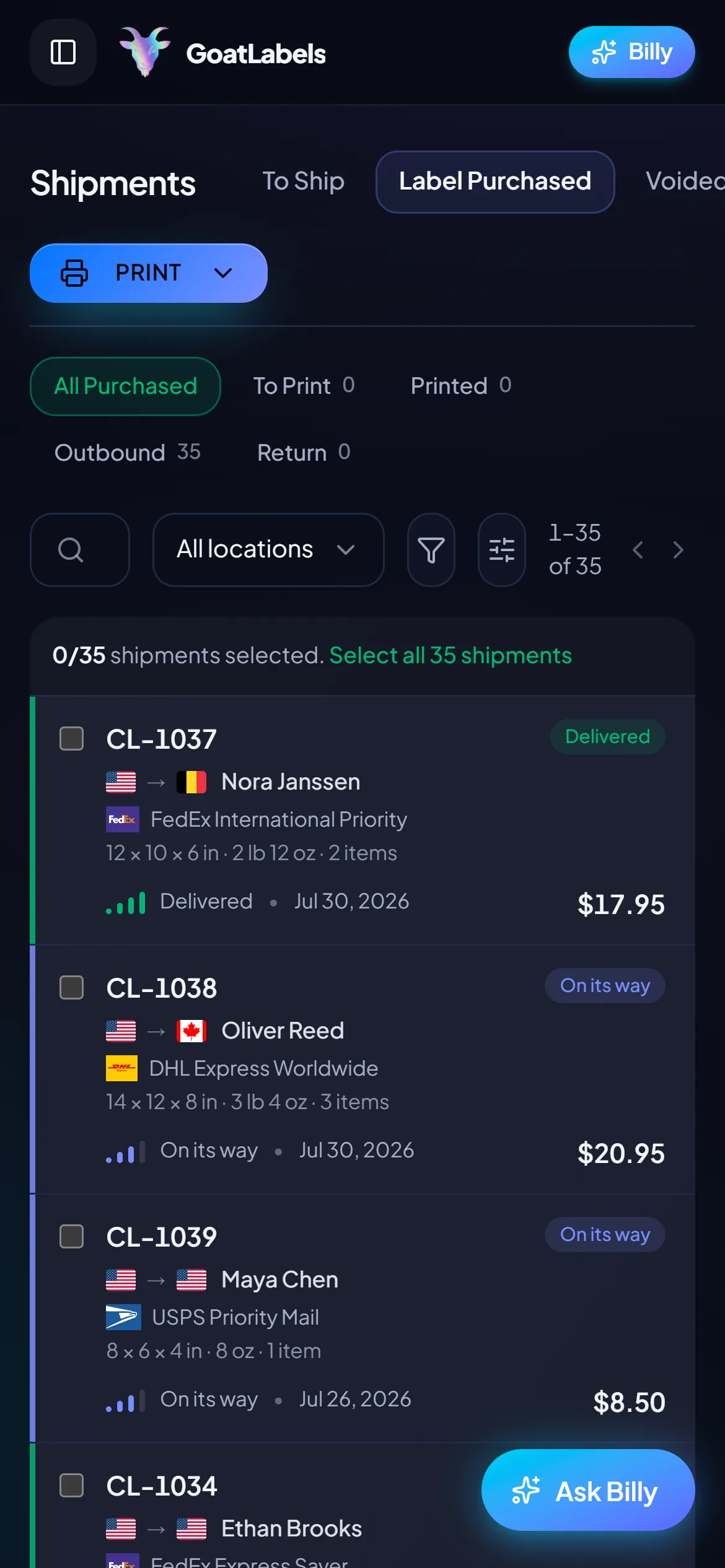
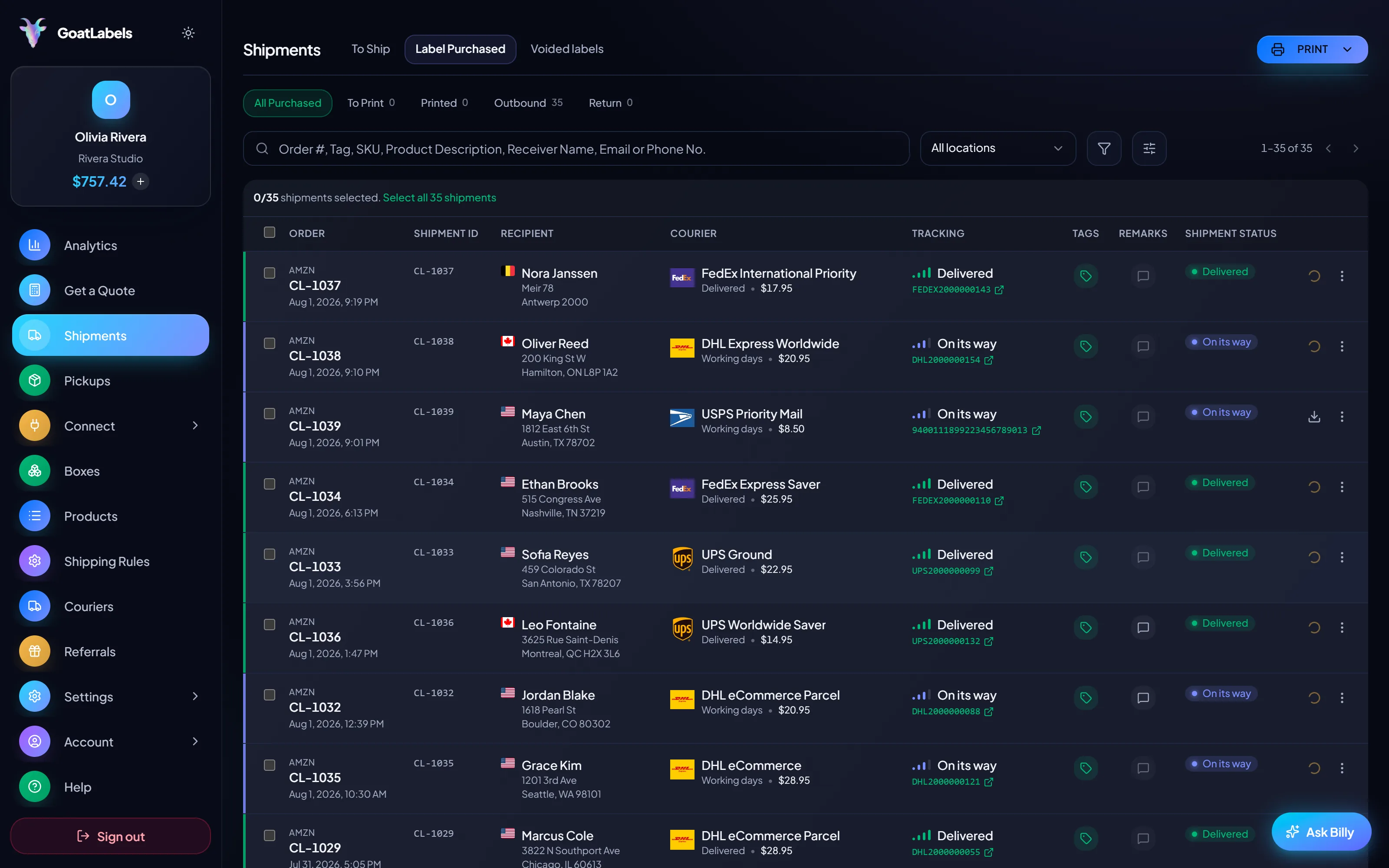
The break-even formula on this page needs a real average label cost, and an average is only as good as the records under it. This is the loop that produces them: the order arrives however it arrived, the destination is validated before money moves, the carriers on the lane quote the packed parcel, and the exact quoted amount leaves one prepaid balance as its own line. Read L off the history instead of reconstructing it from invoices.
Added a second thing so I would get the free shipping — worth it?
A free-shipping promise is made before the parcel is packed, weighed, or priced, which is why the cost side has to stay legible afterwards. Every order that lands here ends up as a comparable line.
 Billy AI
The quoted number is the debited number, so the average of your ledger is your real L. Rerun the threshold formula off that figure rather than off the label price you remember paying.
Thirteen store connectors, Shopify, Amazon, eBay, Etsy, TikTok Shop and more, sync into the To Ship queue, so whatever each storefront shows the buyer at checkout, the parcel beneath it is rate-shopped the same way. That is what makes a cross-channel average worth computing: one ledger and one L, however many different shipping promises you are making.
 Shopify
 Etsy
Etsy WooCommerce
 TikTok Shop
 Amazon
 eBay
eBay Squarespace
 Wix
Wix WalmartShopify PlusSoon
 Square
 BigCommerce
 Magento
 ZapierSoon
 NetSuiteSoon
 EcwidSoon
 Temu
Temu SheinSoon
 ChannelAdvisorSoon
 SkuVaultSoon
 Zoho InventorySoon
 Patreon
Whichever model wins, the arithmetic improves when the label under it is cheaper and the ledger under it is legible.
Every model on this page needs your real L — and a prepaid wallet where each label is its own ledger line at the exact quoted amount gives you that number without spreadsheet archaeology. Fund it by card, Apple Pay, Google Pay, ACH, or crypto; read your average off the history.
Billy drafts the label from a pasted order or screenshot and the destination is validated — with a residential or commercial badge — before payment. You see the true all-in cost of honouring a free-shipping promise while the promise is still editable.
BillyLIVEA subscription is a fixed cost that quietly inflates every order's shipping line at low volume. There is no monthly fee on Free (50 shipments a month), so the label cost in your threshold formula is the label cost — nothing amortised, nothing hidden.
USPS, UPS and FedEx quoted on every domestic parcel, DHL on international lanes, means the winner is picked per order and per destination. That lowers the average the flat models are priced on and trims the variance that makes distant buyers expensive — both levers, one habit.
UPS$12.48FedEx$13.22DHL$14.10USPS$11.79The REST API returns the all-in prices for any parcel and destination, unlimited calls on every plan, enough to compute your zone-weighted average from real quotes instead of estimates, and to re-check the threshold whenever rates move.
Absorbed cost known
CL-1046 · threshold order
Free shipping is promised at checkout and paid for at the packing table, and the two are usually hours and one device apart. Quoting the packed parcel on the phone in your hand is how the promise and its real cost finally meet — before the label is bought, not at the end of the quarter.
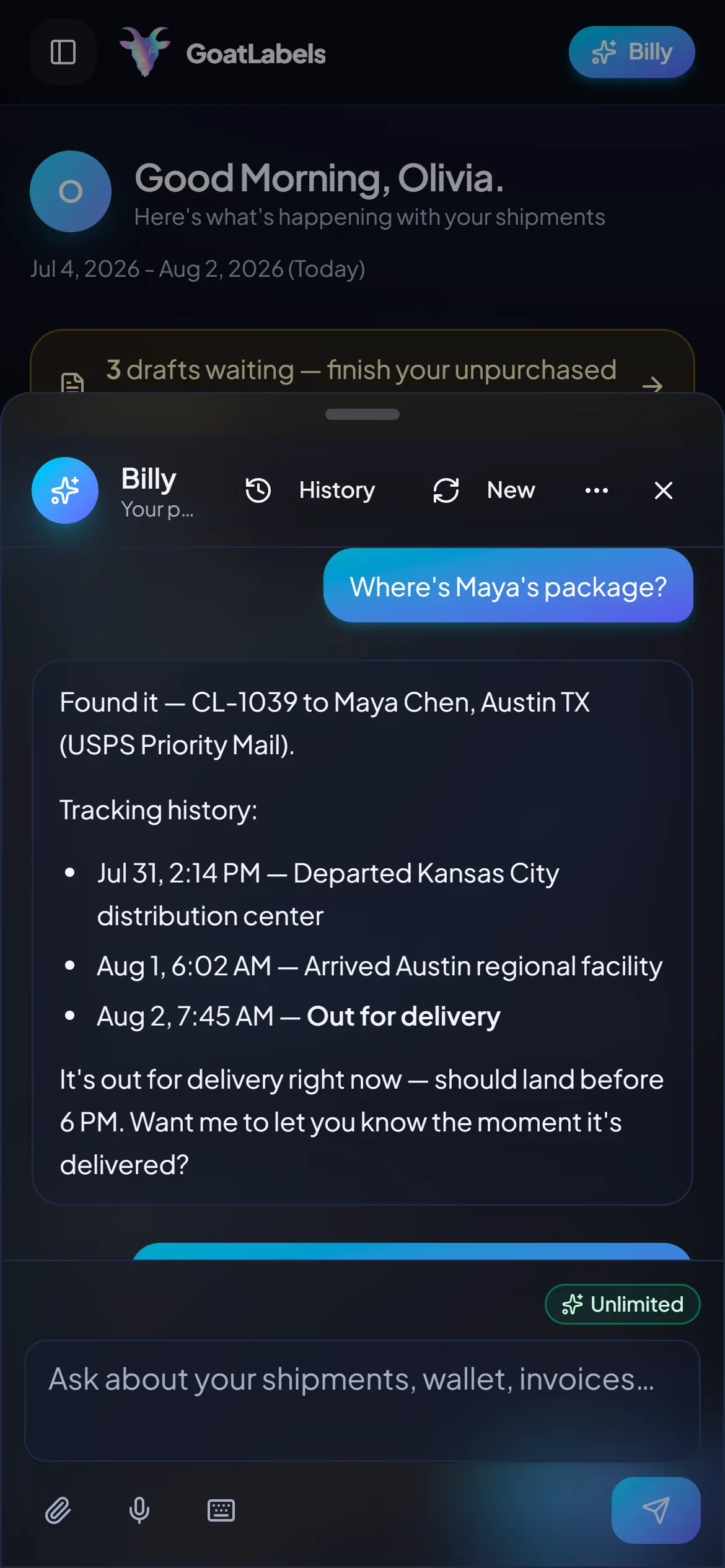
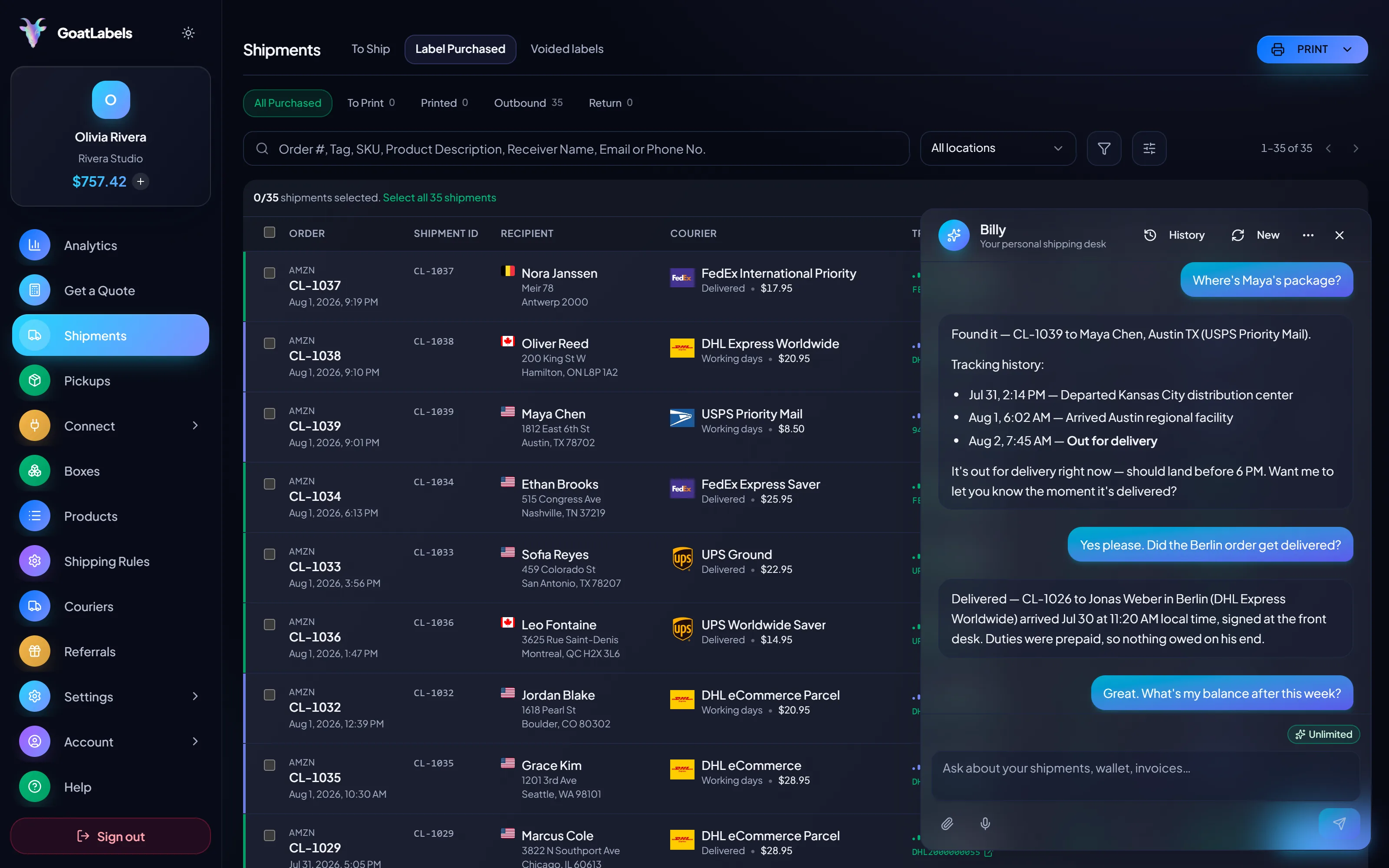
Hold the mic and ask about an order: Billy finds the shipment, reads back what the label came to, and quotes the parcel in your hands against every carrier on the lane, so the number you are absorbing gets said out loud instead of looked up next quarter. It remembers repeat buyers and saved box sizes, which is exactly what makes a threshold basket quotable before it ships. Included on every plan. This is the real product, not a render.
Listening
"What did the free-shipping order to Austin cost me?"
Delivered
CL-1046 · Austin, TX · label cost on the ledger
Speaks plain English · reads back what each label cost · quotes each carrier as one all-in number · included on every plan, never a pricier tier.
Free shipping does not remove the label, it moves the label onto your side of the ledger — so this is the number the model has to recover. The same packed parcel priced against three carriers as one all-in figure each, with the column you pick being the exact amount that leaves your balance. Figures are illustrative.
Ground Advantage
2–5 days$7.40
$1.20 of Premium insurance included
all-in · the exact figure your model has to recover
Ground
3–4 days$10.80
$1.20 of Premium insurance included
all-in · the exact figure your model has to recover
Home Delivery
2–4 days$11.40
$1.20 of Premium insurance included
all-in · the exact figure your model has to recover
A break-even formula is only as current as the L inside it, and L moves whenever carrier rates do. Quote real parcels to real destinations from your own script — REST, JSON, one Bearer header, signed webhooks instead of polling, real idempotency keys — and recompute a zone-weighted average whenever you want one. Unlimited calls on every plan.
POST /api/v1/shipments
Authorization: Bearer sk_live_…
Idempotency-Key: ord_8421

{
  "to": { "name": "Joyce", "city": "Berlin", "country": "DE" },
  "parcel": { "weight": 2.6, "weight_unit": "lb" },
  "service": "fedex_intl_priority"
}
Every dollar of tooling overhead is a dollar your shipping model has to recover at checkout. GoatLabels prices like the strategy this page recommends: nothing fixed at low volume, a flat plan when volume makes it cheaper — so the only shipping cost in your formula is the label itself.
 — check a label cost without opening the dashboard
Rate by plan
illustrativepay for labels, not for seats
$0 / forever
Pay per label at commercial pricing, and let your threshold formula breathe.
Paste the order and the label is drafted, validated, and priced all-in before you commit to what the buyer pays. The margin table on this page assumes you know your label cost at decision time — this is how you know it.
Telegram, ProGET /api/v1/shipments
200 OK · plan: free
Unlimited calls on Free — still unlimited on Pro.
Put a real parcel through and compare the side-by-side rate against what that label costs you on
ShippoPirate ShipShipStationLabel prices are quoted live from USPS, UPS, FedEx, and DHL as one all-in number, and that exact amount leaves your prepaid balance — which is what makes an average label cost a fact rather than an estimate. Full pricing details
Same wallet, same carrier quotes, same per-label ledger, whichever model you land on. These are the four shapes of catalogue where one of the three is clearly correct and the other two quietly bleed.
 Where baking it in works
When every parcel weighs roughly the same and margin is generous, an average is honest and one clean price converts better than a price plus a shipping line. The risk you take on is variance — and variance shrinks when every label is rate-shopped instead of defaulted.
 Where pass-through is the honest answer
No flat number is fair to both a local buyer and a cross-country one once the parcel is big. Charge calculated shipping on the outliers, keep the ordinary catalogue simple, and stop subsidising distance out of margin.
Fence the outliers
Calculated for the heavy few, flat or free for everything else

 Committing to a number before the parcel is weighed

 Where a threshold earns its keep
T
set from your own AOV, label cost, and margin — then re-run when any of the three moves
A video took off and I had 80 TikTok Shop orders by morning. I printed every label from my phone on the bus to the post office.
Early customer · TikTok
TikTok Shop seller
TikTok ShopI run my Etsy shop from the kitchen. The AI reads the order, picks the carrier, the label prints. That's the whole workflow now.
Early customer · Etsy
Etsy maker
EtsyThe API is what every shipping API pretends to be. Idempotency that actually works.
Sasha R.
Staff engineer, marketplace
Know your average label cost from a real ledger, run the threshold formula on your own numbers, and let the carriers compete for every parcel underneath it.
Sign up in seconds. No card required. No monthly fee on Free, up to 50 shipments a month.
Updated