

USPS
Ground Advantage
3–6 days$16.90
$1.20 of Premium insurance included
all-in · payable from the credited balance
A Stamps.com refund for an unused label waits on the carrier's e-refund review, and for a USPS label USPS confirms it never entered the mailstream; the credit then returns to your Stamps.com balance, not your card. An accepted GoatLabels void credits a prepaid wallet that funds USPS, UPS, FedEx, or DHL on the next quote.
Stamps.com refunds land in the Stamps.com balance. A wallet credit funds USPS, UPS or FedEx, whichever wins the domestic requote, and DHL on international lanes.


 one balance
Card, Apple Pay, Google Pay, ACH, or crypto fund one prepaid wallet, and an accepted void credits that same wallet back.
Checked on from Stamps.com's own pages. Plans, fees and policies change, so confirm on the vendor's current page before you decide. Stamps.com is a trademark of its owner and is not affiliated with GoatLabels.
Trace a single misprint through this side. The label is bought from a prepaid balance, the carrier reviews the void against its own window, and a grant credits that balance as spendable value — value that is allowed to become a UPS label if UPS is what the corrected parcel now needs. No mailstream to watch, and no second currency to manage.
just realised I gave you my old address — the new one is in Bozeman
A void is only available while the label is unscanned, and that limit is the carrier's on every platform. What differs afterwards is what the returned value is allowed to become.
 Billy AI
Value that came back from a USPS misprint can buy the UPS label the corrected parcel actually needs, quoted beside USPS and FedEx on the same screen (DHL joins on international lanes).
Shopify, Etsy, WooCommerce, TikTok Shop and the rest sync into one To Ship queue drawing on one prepaid balance. There is no postage instrument sitting beside it holding value only one carrier can spend, so nothing has to be moved between the two and nothing gets stranded in the wrong one when you stop shipping.
 Shopify
 Etsy
Etsy WooCommerce
 TikTok Shop
 Amazon
 eBay
eBay Squarespace
 Wix
Wix WalmartShopify PlusSoon
 Square
 BigCommerce
 Magento
 ZapierSoon
 NetSuiteSoon
 EcwidSoon
 Temu
Temu SheinSoon
 ChannelAdvisorSoon
 SkuVaultSoon
 Zoho InventorySoon
 Patreon
When you ask Stamps.com for a USPS label's postage back, you are not really asking Stamps.com. USPS postage is sold under USPS rules, and an unused-label refund is a USPS decision from the moment you request it. The sequence runs in one direction: you flag the misprinted label inside your Stamps.com account, the request is submitted into the Postal Service's electronic refund process, and USPS then does the only thing that can prove a negative — it watches. If the label never picks up an acceptance scan, an origin scan, or any other evidence of entering the mailstream, the refund is eventually approved and the postage value is returned to your account balance.
The waiting period exists because a printed label is not a dead label. Plenty of parcels are printed on Monday and handed over on Friday, so the Postal Service will not certify a label as unused on the day you ask. It holds the request open long enough to be confident the label is not simply travelling slowly, and only then releases the credit. That is why a Stamps.com refund is measured in weeks on the calendar even when every step goes right: most of the elapsed time is USPS deliberately waiting to see whether the label moves.
Where the numbers are. Stamps.com's refund request windows and refund timing, linked to its help center and dated, are in the facts block near the top of this page. USPS sets its own refund terms for USPS labels, and both companies revise them without notice, so check the current pages before relying on a figure.
Here is the nuance most refund explainers skip: when the credit finally lands, it lands in the Stamps.com account balance, not on your card. Stamps.com's help center describes that balance as prepaid money for postage, package insurance and post-shipment adjustments, so the credit can buy a UPS or FedEx label through Stamps.com as well as a USPS one, but it stays inside Stamps.com while the account is open. It is also separate from the subscription fee, which is billed to your card on its own track; the fee mechanics live on our Stamps.com monthly fee page. The rule is blunt. A refund that arrives as account credit is really a store credit for one vendor.
That matters most on the way out the door. If you are winding the account down, an unspent balance comes back only after you close the account, on Stamps.com's own refund timeline, and promotional postage does not come back at all; the sequence for doing that cleanly is covered step by step in our guide to cancelling Stamps.com. The practical rule is worth saying once, bluntly: the more misprints you refund, the more of your money waits in a balance that can only become Stamps.com labels until the account is closed.
Now run the identical mistake through GoatLabels. You print a label, spot the wrong apartment number, and void it before the parcel is scanned; the granted void credits your prepaid wallet, spendable on the very next label — the full mechanic, carrier windows and all, lives on our void-a-shipping-label page. The structural difference is not speed alone. The wallet is carrier-neutral: it funds USPS, UPS, FedEx, and DHL alike, so value that came back from a USPS misprint can buy the UPS label that actually fits the corrected parcel.
There is no second currency to manage. One balance, topped up by card, Apple Pay, Google Pay, ACH, or crypto, sits behind every carrier and every channel, and a void is a ledger line on that balance rather than a claim ticket in a queue. Compare that with the two-account shape on the other side (a card paying a subscription, a postage balance only Stamps.com can spend, and a refund pipeline connecting them) and the comparison stops being about patience and starts being about where your money is allowed to go. We ran the same comparison against Pirate Ship's refund flow, and the wallet half of the answer is identical; it is the competitor half that changes shape.
Both systems agree on the hard cases. A label with an acceptance scan has been used; the service was performed, and neither USPS verification nor a wallet void applies. A label that has aged past the carrier's request window is written off, however it was bought. And a duplicate printed from a stale browser tab that ships alongside the original was used too — both parcels moved, so both labels get billed.
The honest difference between the platforms is what the recoverable case costs you. On Stamps.com a recoverable misprint costs a request, a verification hold, and a credit that stays in the Stamps.com balance. On a wallet the carrier still reviews the void, and after it accepts, the credit posts to the balance that buys every carrier's labels instead of staying tied to one platform. And if a label was used but billed wrong — the parcel moved and the price changed afterwards — that is not a refund case on either platform; it is a post-shipment billing adjustment, which follows its own process entirely. Knowing which of the three buckets your label is in before you chase it is most of the work.
The carrier's decision is the same on both sides — nobody voids a scanned label. What differs is where the money lands once the decision is made, and what it is allowed to become next.
| GoatLabels | Stamps.com | |
|---|---|---|
| Who decides the refund | The carrier reviews the void against its own window — the request goes out with the shipment record attached. | The carrier. Stamps.com files an electronic refund request for the unused label, and for a USPS label the Postal Service checks it never entered the mailstream. |
| What the wait is for | The carrier's review, the only slow step; after it is granted, the credit posts to the wallet. | USPS watching the mailstream long enough to be confident the label was never mailed. |
| What comes back | Spendable balance in the prepaid wallet the label was bought from. | Credit in the Stamps.com account balance, not a refund to your card. |
| What the credit can buy | Any next label — USPS, UPS, FedEx, or DHL, whichever wins the quote. | Postage, insurance and adjustments bought through Stamps.com, on the carriers your plan reaches. It stays inside Stamps.com until you close the account. |
| Where it shows up | Its own ledger line on the wallet, next to the purchase it reverses. | A postage-balance movement, separate from the card that pays the subscription. |
Stamps.com is a trademark of its owner and is not affiliated with GoatLabels. Its refund flow and USPS's verification terms change — check both companies' current published pages before you rely on a specific window or figure.
Everything on the GoatLabels side of this comparison is one design decision: labels are bought from a prepaid, carrier-neutral balance, so returned value goes back to work instead of into a separate postage account.
Card, Apple Pay, Google Pay, ACH, and crypto top up a single balance that funds USPS, UPS, FedEx, and DHL alike. An accepted void credits that same balance — so a USPS mistake can fund a UPS correction without your money changing citizenship on the way.
Most refund requests are address defects that were visible before purchase. Billy drafts the label from a pasted order or screenshot and the destination is validated — with a residential or commercial badge — before any money moves, which removes a common reason for a refund request.
BillyLIVEEvery quote is one all-in number, and that exact amount leaves the wallet at purchase — so a granted void returns exactly what you paid, with no separate fee stack to unpick and, on Free, no subscription running in the background while you wait.
The corrected parcel gets fresh quotes from USPS, UPS and FedEx (DHL on international lanes), not a reflexive rebuy of the original service. A misprint is an accidental chance to re-ask which carrier should have won — the requote makes that a decision instead of a habit.
UPS$12.48FedEx$13.22DHL$14.10USPS$11.79The REST API covers the same lifecycle as the dashboard — buy, void, rebuy — with signed webhooks carrying the outcome instead of you polling for it, and idempotency keys so a retried request never buys a label twice. Unlimited calls on every plan.
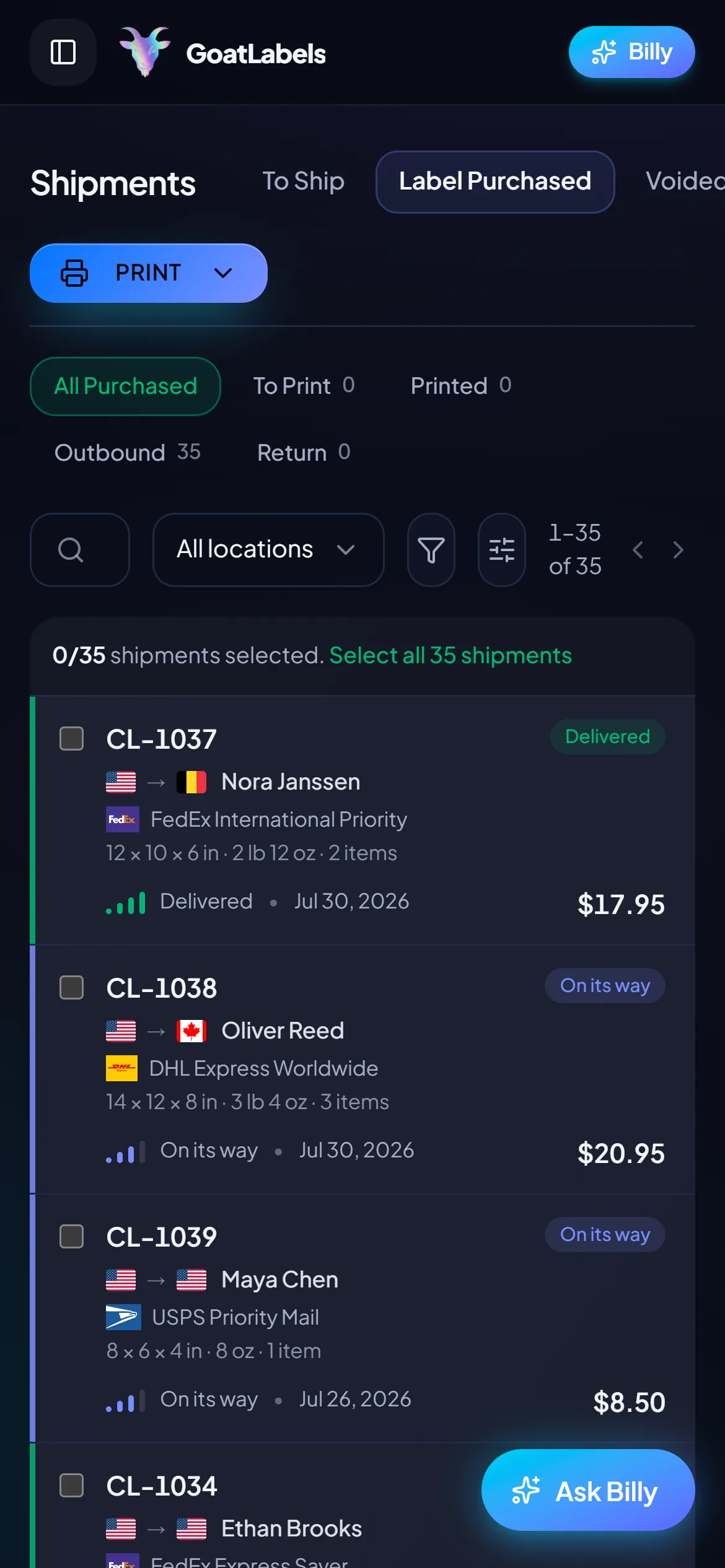
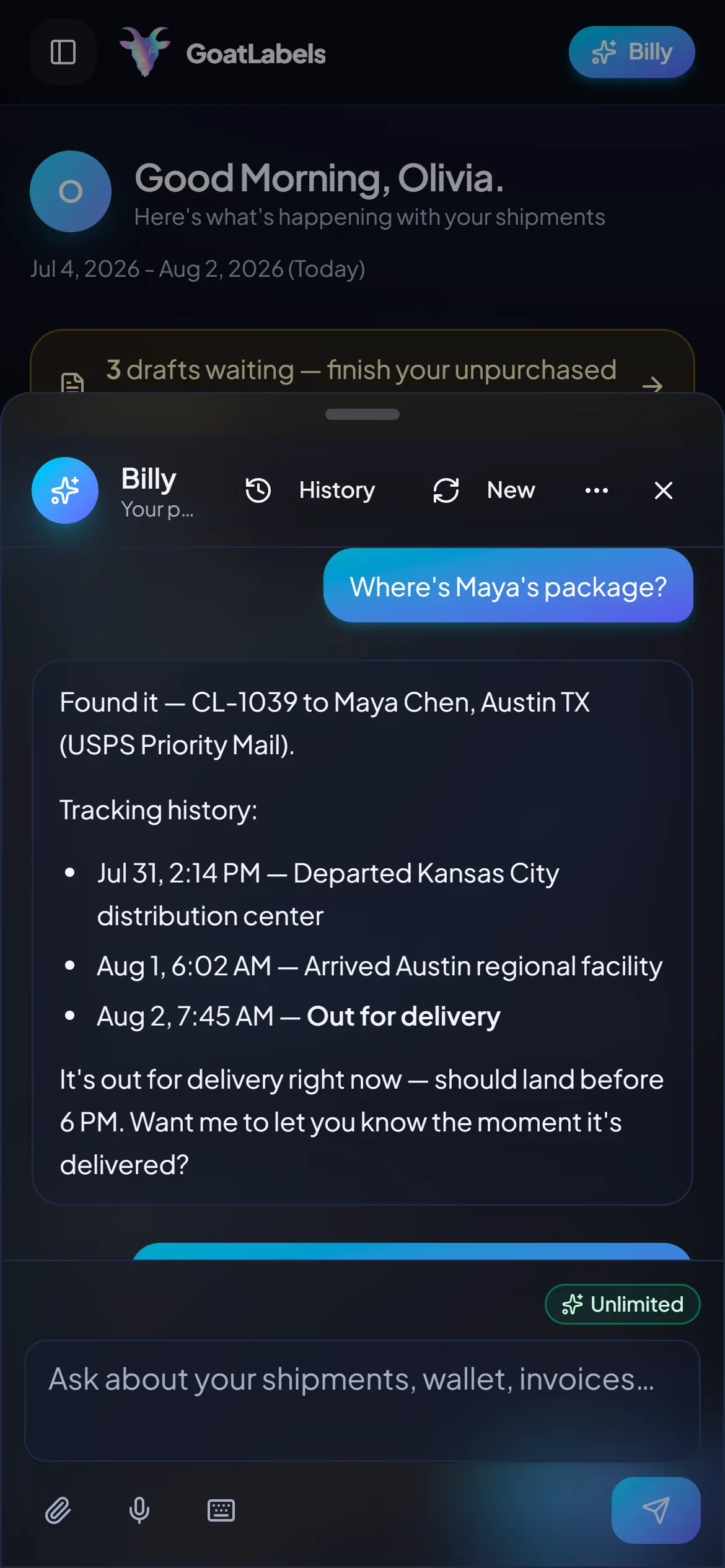
Void granted · credited
Spendable on any carrier's next label
A misprint is only cheap while the parcel is unscanned, and that window is the few minutes between printing the label and handing the parcel over. Everything the fix needs (void request, requote, reprint) fits in one hand at the packing table, with no account to top up in between, and the credit posts back to the balance after the carrier accepts the void.
One prepaid balance means one number to ask about, and it answers for every carrier at once. Ask out loud and Billy finds the shipment, quotes the corrected parcel across USPS, UPS and FedEx (DHL on international lanes), and buys from the same balance an accepted void credits. Included on every plan. This is the real product, not a render.
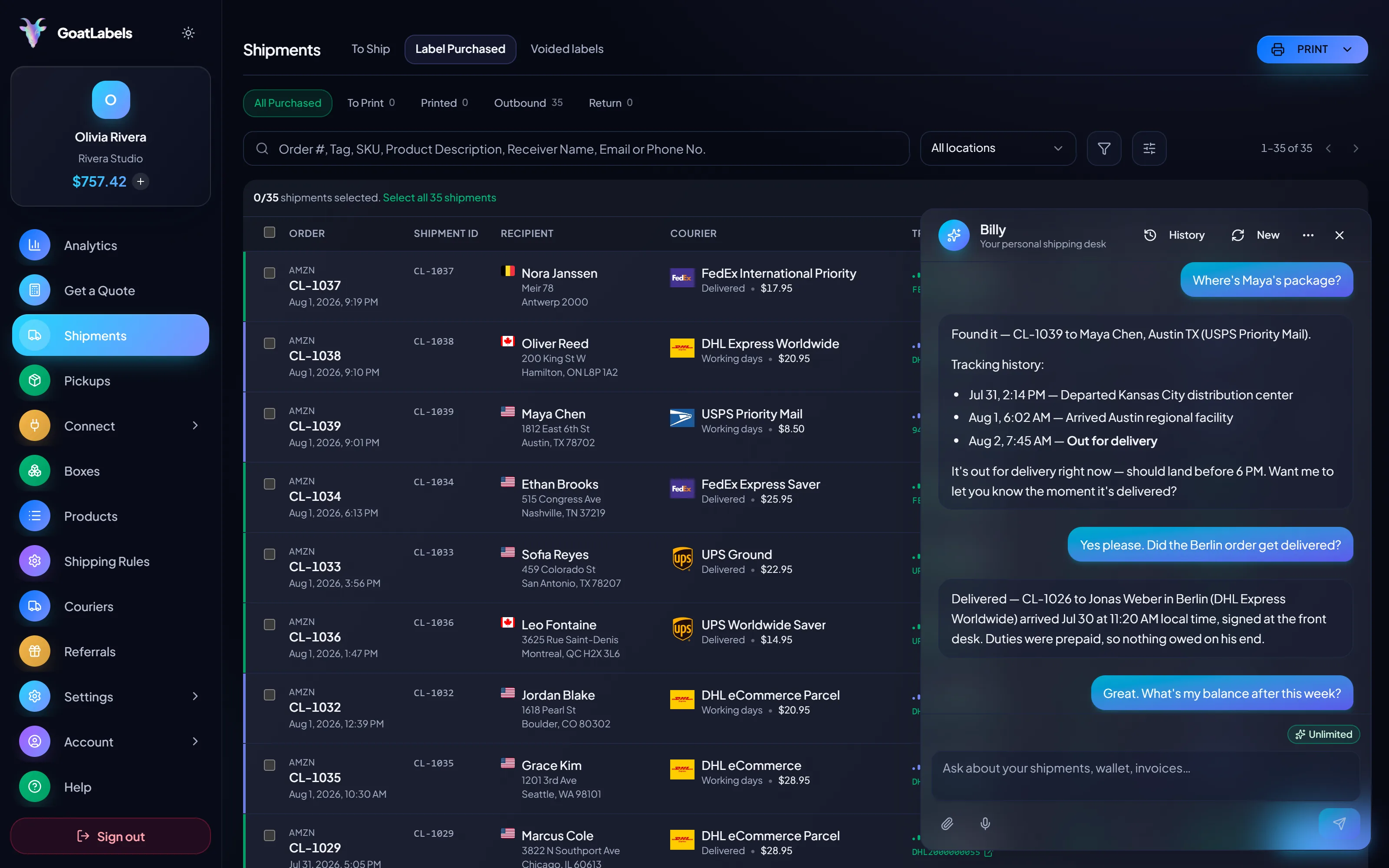
Listening
"Requote the Bozeman parcel across every carrier."
Out for delivery
Bozeman, MT · scanned this morning
Speaks plain English · one balance behind all four carriers · phone, browser, or Telegram on Pro.
Here the returned value funds whichever of these columns wins the corrected parcel, after the void is granted. That is exactly when it matters, because the rebox that fixed the address usually changed the weight too. Figures are illustrative.
Ground Advantage
3–6 days$16.90
$1.20 of Premium insurance included
all-in · payable from the credited balance
Ground
3–5 days$14.20
$1.20 of Premium insurance included
all-in · payable from the credited balance
Home Delivery
3–5 days$14.80
$1.20 of Premium insurance included
all-in · payable from the credited balance
Everything the dashboard does with a misprint is in the API, and every call draws on the same carrier-neutral balance. There is no postage account to fund on the side, no per-carrier ledger to keep in step, and nothing to poll: a signed webhook carries the void outcome to your code.
POST /api/v1/shipments
Authorization: Bearer sk_live_…
Idempotency-Key: ord_8421

{
  "to": { "name": "Joyce", "city": "Berlin", "country": "DE" },
  "parcel": { "weight": 2.6, "weight_unit": "lb" },
  "service": "fedex_intl_priority"
}
The other side of this comparison has two money flows: a postage balance only Stamps.com can spend, and a card paying a subscription on its own cycle. This side has one. Free covers 50 shipments a month with the carrier quote, Billy, and the API included; Pro is a flat plan taken for volume, never for permission to print.
 — draft the correction without opening the dashboard
Rate by plan
illustrativePro: one flat monthly plan, unlimited shipments
$0 / forever
Top up when you choose, spend label by label, owe nothing in a month you did not ship in.
The assistant that validates a destination — residential or commercial — before anything is bought runs unlimited in the web app on Free. It is the cheapest refund policy there is: the misprint that never got printed.
Telegram, ProGET /api/v1/shipments
200 OK · plan: free
Unlimited calls on Free — still unlimited on Pro.
Put a real parcel through and compare the side-by-side rate against what that label costs you on
ShippoPirate ShipShipStationLabel prices are quoted live from USPS, UPS, FedEx, and DHL as one all-in number, and that exact amount leaves the prepaid balance — the same amount a granted void returns to it. Stamps.com's fees and USPS's refund terms are theirs to change; read both before relying on a figure. Full pricing details
A refund that lands weeks later is fine if nothing is waiting on it. These are the four shapes of seller for whom something usually is.
 Where UPS and FedEx start winning
The parcels most likely to be misprinted are the awkward ones, and the awkward ones are exactly where another carrier wins the requote. A wallet credit, next to fresh quotes on the corrected parcel, settles that in one step.
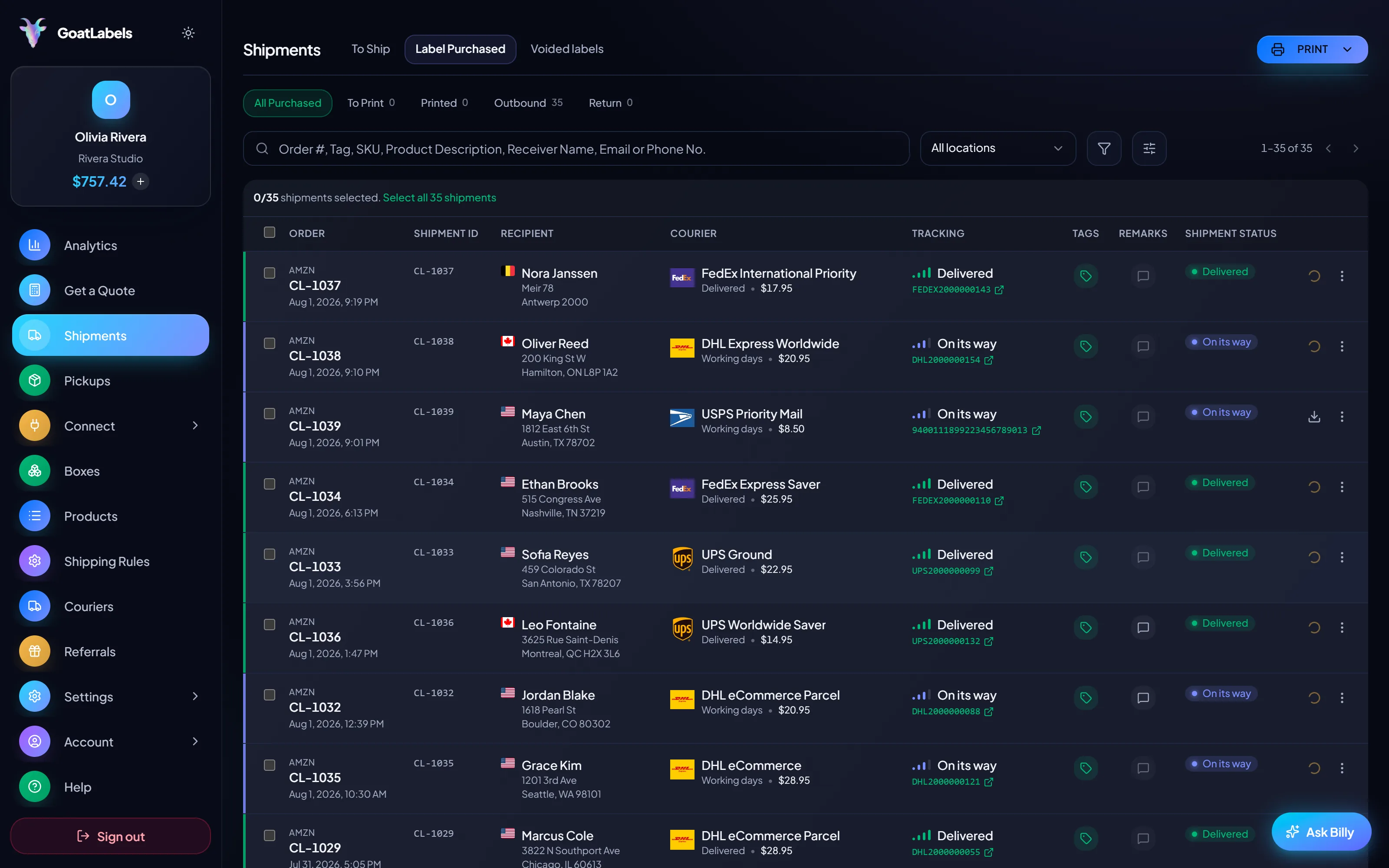
 The correction that changed the weight
Fixing an address usually means repacking, and repacking moves the parcel along the rate curve. The corrected label deserves a fresh quote rather than the service the wrong one happened to be bought on.
Requote, then rebuy
The winner is not always the carrier you started with

Where misprints actually come from
 International, quoted beside domestic
1
balance behind every international service in the quote
Updated
Related reading: how voiding works carrier by carrier,what the Stamps.com monthly fee covers, andhow to cancel Stamps.com cleanly if the balance question has you halfway out the door.
A video took off and I had 80 TikTok Shop orders by morning. I printed every label from my phone on the bus to the post office.
Early customer · TikTok
TikTok Shop seller
TikTok ShopI run my Etsy shop from the kitchen. The AI reads the order, picks the carrier, the label prints. That's the whole workflow now.
Early customer · Etsy
Etsy maker
EtsyThe API is what every shipping API pretends to be. Idempotency that actually works.
Sasha R.
Staff engineer, marketplace
Fund a prepaid wallet with card, Apple Pay, Google Pay, ACH, or crypto, buy the cheapest all-in quote, and know that after the carrier accepts a void, the credit comes back as balance any carrier can spend.
Sign up in seconds. No card required. No monthly fee on Free, up to 50 shipments a month.
Updated