

USPS
Priority Mail Intl
10–15 days$7.40
$1.90 of duties & taxes prepaid, not billed to your backer
all-in · no surprises
Crowdfunding fulfillment is one enormous batch and then nothing for a year — the shape monthly software prices worst. The specific work is not printing: it is repairing survey addresses that have aged since the campaign, and rate-shopping one SKU at one weight a single time.
Weigh the finished reward once, then let USPS, UPS, FedEx, and DHL all price that exact parcel — and reuse the winner across the whole batch.


 all quoted
 Top up from the campaign funds by card, Apple Pay, Google Pay, ACH, or crypto, spend it down over the batch, and stop.
Crowdfunding fulfillment is the worst-shaped job in shipping. You do nothing for a year, then three hundred identical boxes need labels in a fortnight, then you do nothing again. Every piece of ongoing shipping software is priced and designed for the opposite shape — a steady trickle of different parcels — which is why creators keep concluding that their only options are a spreadsheet and the post office counter, or a 3PL quote that eats the shipping line of the budget. The actual work is narrower than either. Two things decide whether a campaign fulfills cleanly, and neither of them is printing.
The survey closes within weeks of the campaign. Manufacturing, tooling revisions, and a container crossing an ocean happen after that. By the time the boxes are in your hallway, the address list is a year or more old, and a chunk of it is quietly wrong: people move, apartment numbers get dropped by a free-text form that never asked for one, someone posts a new address in a campaign comment thread you skimmed in March, and international backers change countries more often than you would guess.
What makes this expensive is that it fails silently. A stale row does not look broken. It produces a plausible-looking label that you print, stick on a box, and pay for — and you discover the problem three weeks later when the box comes back with the postage already spent, or worse, when it does not come back at all and the backer opens a message you have no tracking answer for. At three hundred units the difference between finding the bad rows before printing and finding them afterwards is the whole margin on the shipping tier.
So validate first. Every row is checked before any money moves: the address is validated at quote time and comes back with a residential-or-commercial classification, and rows that fail are listed with the reason — postal code that does not match the city, a missing secondary unit, a country code the carrier will not accept. You repair those rows against the backer's own message, re-run the check, and only then buy. Fixing a row is free. Printing a bad one costs the label, the return, and the reship. If some do slip through anyway, what each carrier does with an undeliverable parcel — and who pays to send it again — is worth reading before the boxes start coming back.
Mechanically it is a CSV job: export the survey, upload the file, map your columns to shipping fields once, and save that mapping under a name so the late-pledge file and the replacement file take minutes instead of an afternoon. We keep the full walkthrough on bulk shipping labels from a CSV rather than repeating it here.
An ongoing store has a different parcel in every order, which is why rate-shopping there is a per-order chore. A campaign is the opposite: one reward tier is one product in one box at one weight, repeated hundreds of times. That turns rate-shopping from a chore into a single decision with three hundred units of leverage behind it — and it is the highest-value hour of the entire fulfillment.
Do it properly once. Pack a finished reward exactly as it will ship, including the padding and the thank-you card. Weigh it on a real scale rather than estimating from the manufacturer's spec, because printed matter and board games are consistently heavier than creators expect. Measure the box after it is taped, not the flat carton. Then quote that parcel against USPS, UPS, FedEx, and DHL at the same time and read four all-in prices with four delivery windows side by side. There is no default carrier here and no loyalty tax for staying with one, so the winner is whichever number is lowest for that specific box to that specific zone.
Two things are worth checking while you have the parcel on the scale. First, a tabletop box or an art book is bulky rather than heavy, which is the profile most likely to be billed on dimensional weight instead of actual weight — see package size and weight limits by carrier for the two levers that move that number. Second, if you have a deluxe tier with an extra component in it, quote that box separately: an extra half-pound can push a tier across a price band, and which cheap ground service wins flips with it. The crossover between the budget ground tiers lives on cheapest ground shipping services. Two or three parcel specs, two or three rate-shops, and the pricing work for the whole campaign is done.
International backers are one sentence of extra work per row — declared value, an item description, and the HS code you supply — and the form itself is covered on customs forms for small parcels.
A campaign is not a trickle of different parcels — it is one reward, in one box, at one weight, repeated until the hallway is empty. So the work splits in two: get the aged backer addresses clean before any money moves, then rate-shop that single parcel spec properly once and reuse the winner across the whole batch. Nothing here is a discount you have to qualify for. The labels get cheaper because the addresses stop being wrong and four carriers price the same box instead of one.
Hey! 2x hoodies (M) 1x tee (L) 😅 Ship to: Maya R. Austin, TX 78701
Upload the survey export and map your columns once — the preset is still there for the late-pledge file and the replacements. Address changes that arrived in a comment thread or a DM get pasted straight in and drafted the same way.

The exact quoted amount leaves the prepaid wallet you funded out of the campaign — nothing is added at checkout. A reward that never ships voids back to that balance instead of queueing behind a card refund.
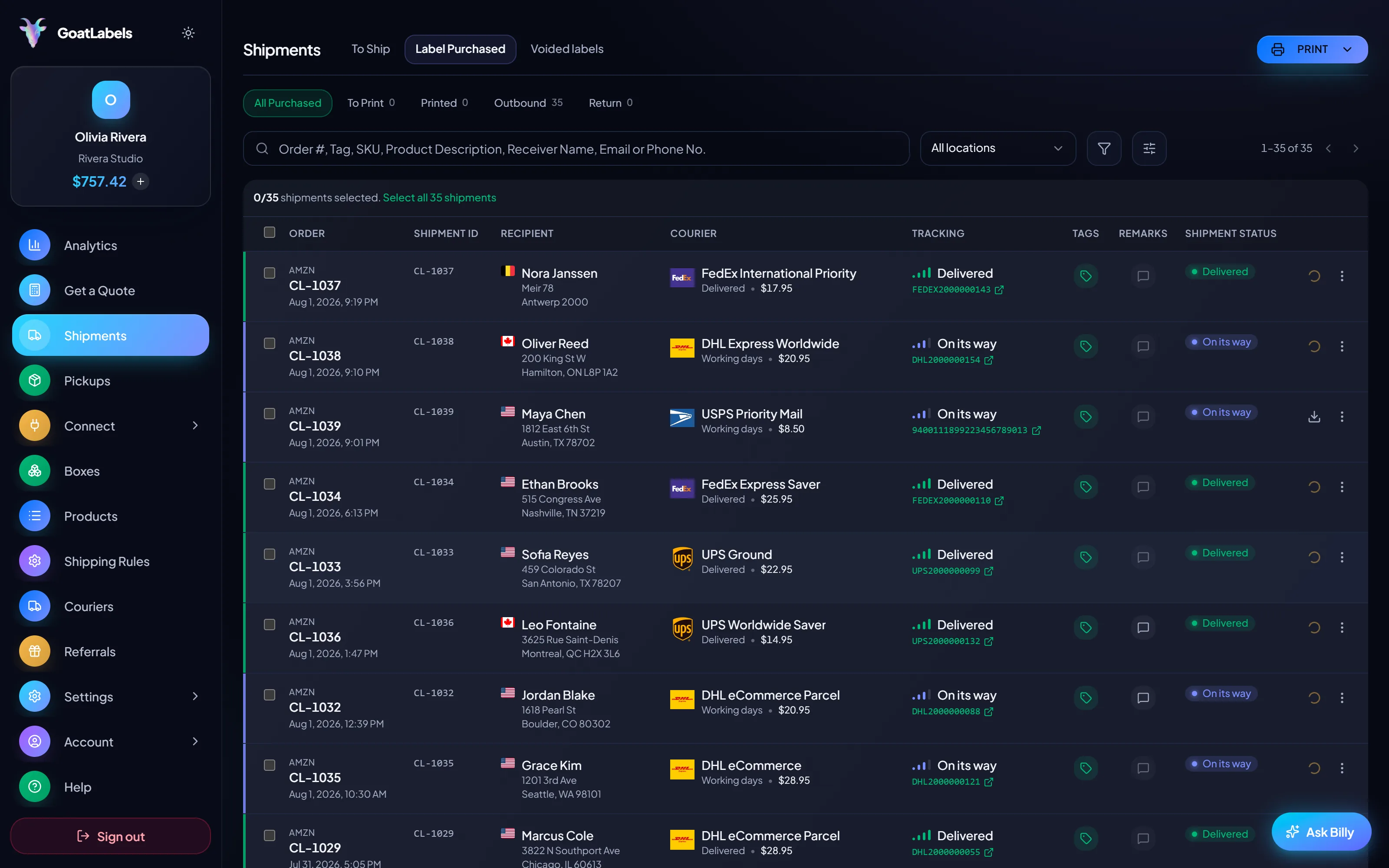
If the campaign turned into a shop, Shopify, Etsy, WooCommerce, and TikTok Shop sync their orders into the same To Ship queue your survey rows land in — so late pledges and store sales get quoted against USPS, UPS, FedEx, and DHL in one place rather than one screen at a time. Paste an Instagram or Facebook DM from a backer who moved and Billy builds the corrected label straight from the message.
 Shopify
  Etsy
Etsy  WooCommerce
  TikTok Shop
  Amazon
  eBay
eBay  Squarespace
  Wix
Wix  Walmart Shopify Plus Soon
 Square
  BigCommerce
  Magento
  Zapier Soon
 NetSuite Soon
 Ecwid Soon
 Temu
Temu  Shein Soon
 ChannelAdvisor Soon
 SkuVault Soon
 Zoho Inventory Soon
No seats, no per-channel add-ons, no module you have to buy to unlock a carrier. These five are the ones that actually show up in the shipping line of the budget.
Top up out of the campaign funds with card, Apple Pay, Google Pay, ACH, or crypto, spend it down across the batch, and stop. The eleven months you ship nothing bill you nothing, so no subscription gets spread across three hundred boxes. Void a reward's label and the amount credits back to the balance rather than sitting in a card refund queue.
The AI assistant drafts a label from a survey row, a pasted address change, or a screenshot of a backer's message, and validates the address before you spend anything. On a list that has aged a year that check is the whole game: a stale row prints a perfectly plausible label, and you find out three weeks later when the box comes back with the postage already spent.
One all-in price per service at quote time, and that exact amount leaves the balance. Fuel, residential, and handling are inside it — which matters most when you are multiplying a single quote by three hundred. The only thing that can move it is a carrier re-weigh, and that arrives as its own clear ledger entry.
USPS, UPS, FedEx, and DHL quoted against the same taped, weighed box — four all-in prices and four delivery windows on one screen. For a campaign that is a single decision with hundreds of units of leverage behind it, not a per-order chore. International backers get duties and taxes quoted inside the same number, so a cheap overseas rate is still cheap at the backer's door.
UPS $12.48 FedEx $13.22 DHL $14.10 USPS $11.79 REST, JSON, one Bearer header, real idempotency keys, and signed webhooks — with unlimited calls on Free as well as Pro. If your pledge manager can export, it can also drive the quote-and-buy loop, and automating a three-hundred-row batch never pushes you onto a pricier plan.
Reward label ready
CL-1038 · Seattle, US
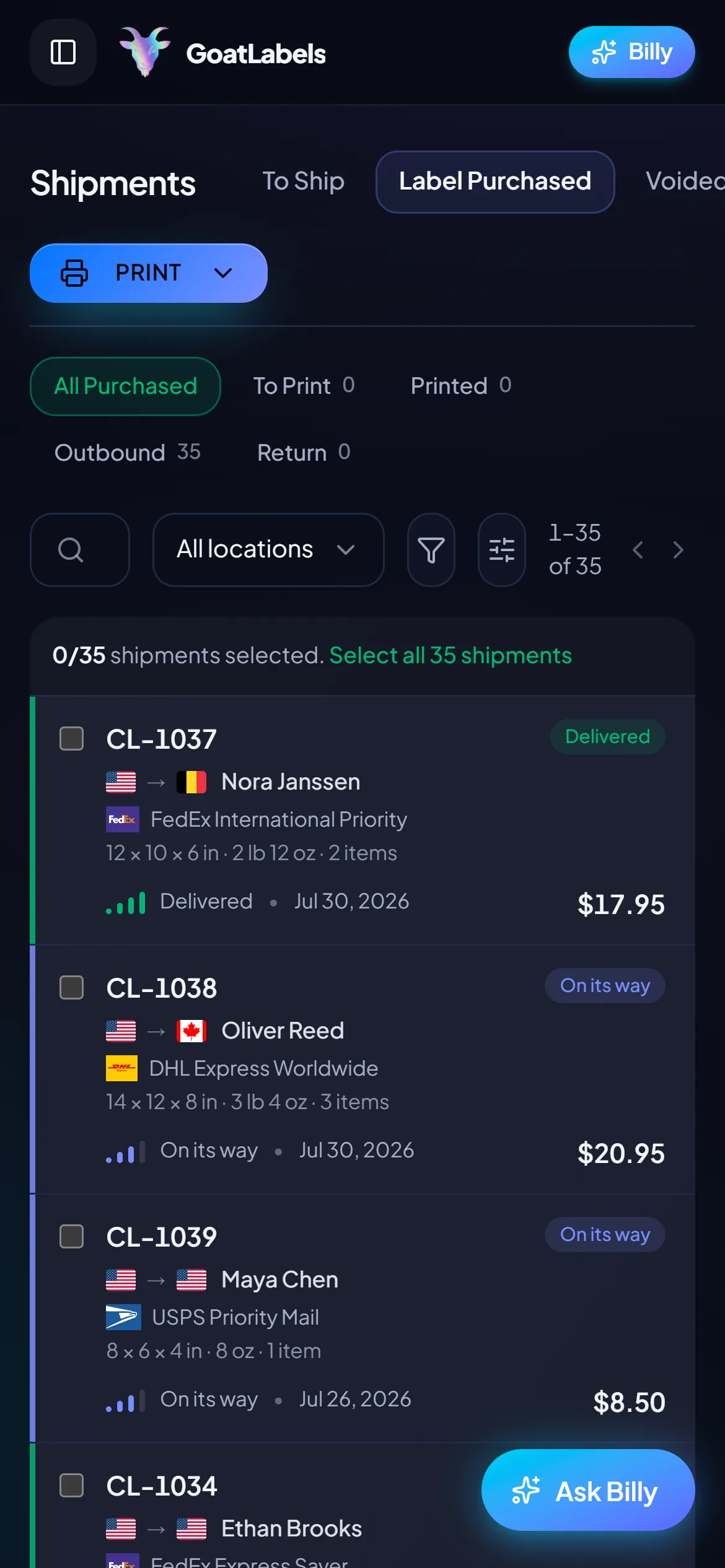
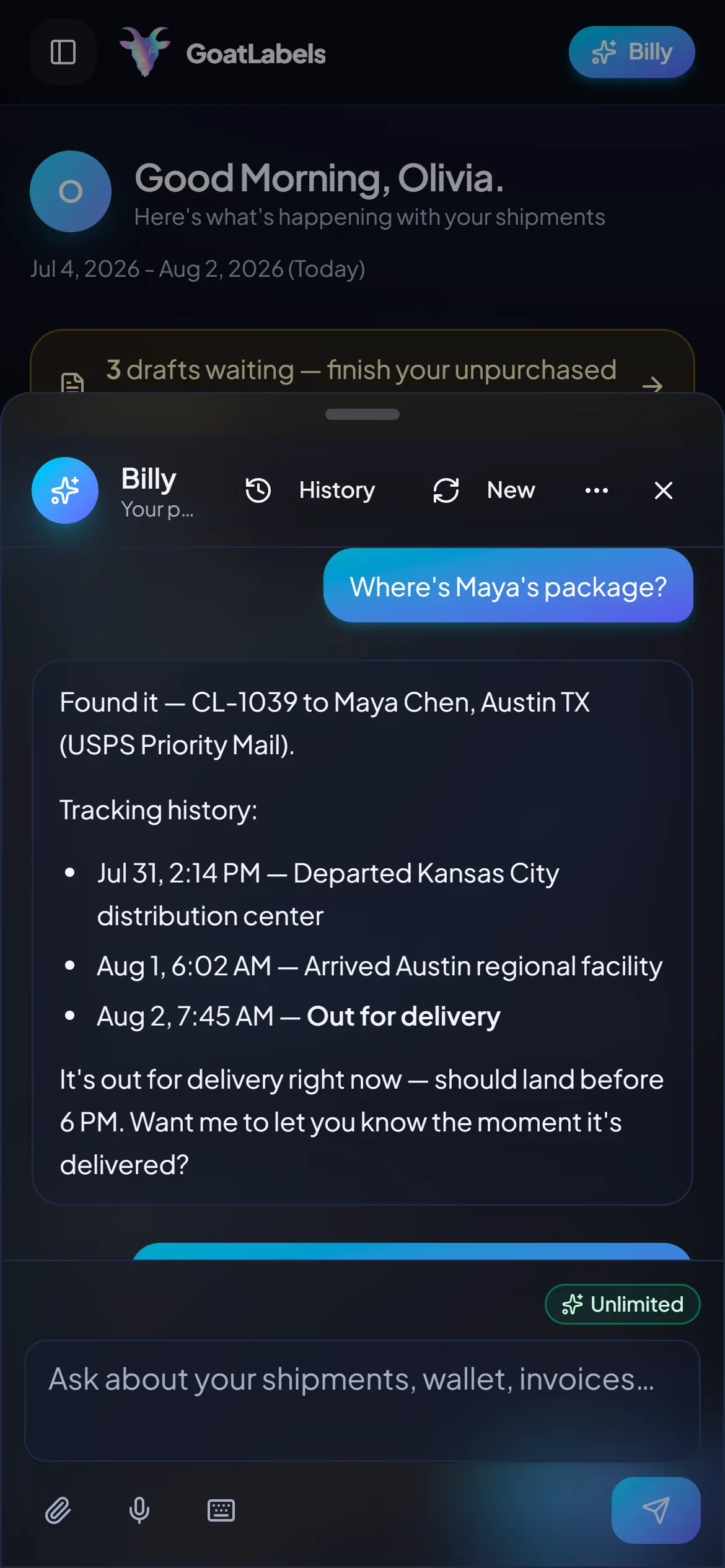
Reward fulfillment is a garage job: cartons stacked to the ceiling, a tape gun in one hand, and no laptop within reach of the scale. The queue, the four quotes, and the buy button all fit on the phone in your pocket, so the batch moves at the speed you can pack it rather than the speed you can get back to a desk.
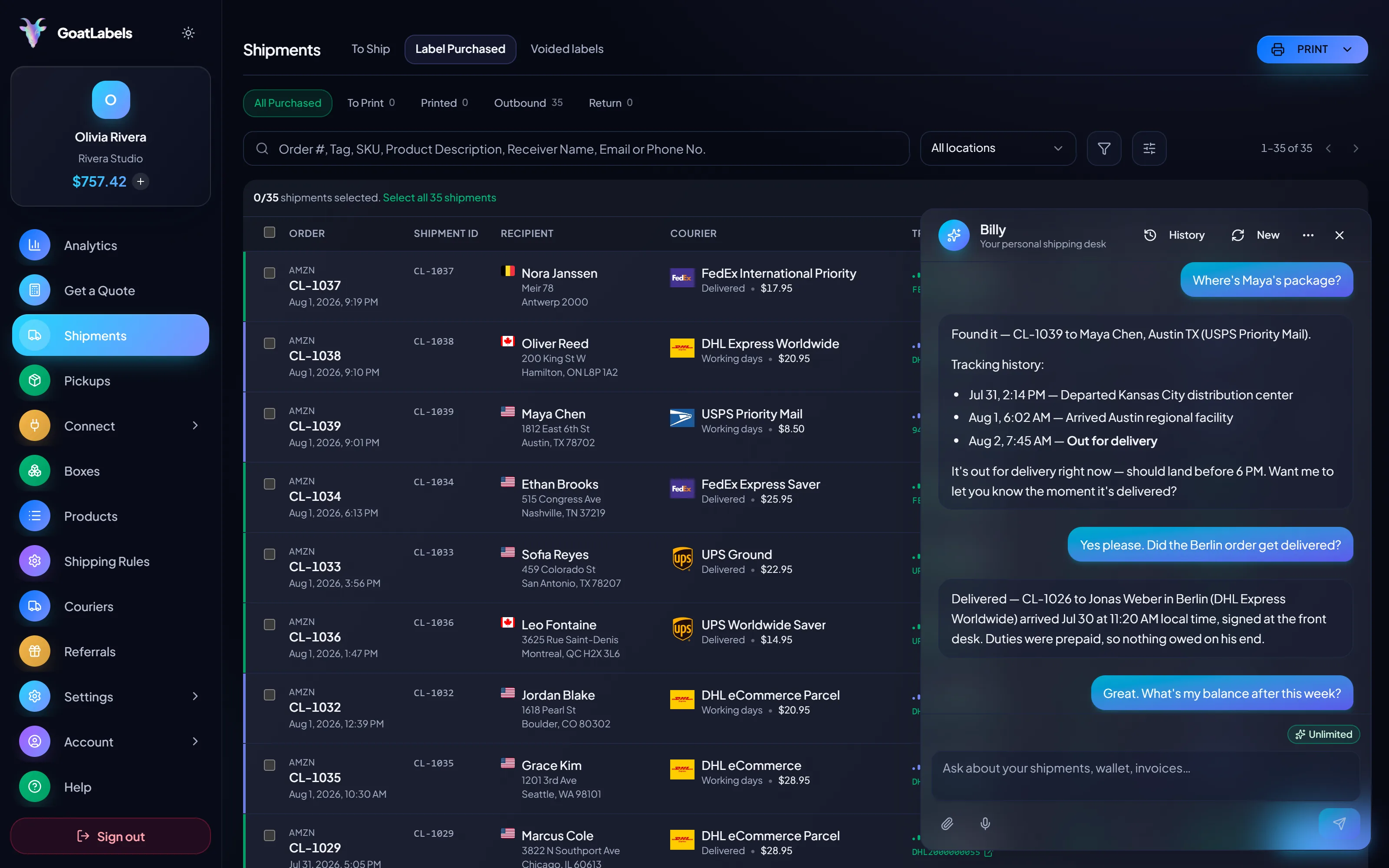
Three weeks after the batch goes out the questions start, and they all sound the same: where is mine, did it ship, why has tracking not moved. Hold the mic, name the backer, and Billy pulls that label's tracking history and reads it back. While you are still packing it will also quote USPS, UPS, FedEx, and DHL on the box in your hands and queue the one you pick — and it remembers the parcel spec you saved, so a replacement ships exactly like the original did. This is the real product, not a render.
Listening
"Where's Maya's package?"
Out for delivery
CL-1039 · Austin, TX · by 6 PM
Speaks plain English · quotes all four carriers as one all-in price each · remembers saved box sizes and repeat backers · included on every plan, never a pricier tier.
On a campaign the same number gets bought hundreds of times over, so a surcharge that only appears on the invoice is not a rounding error — it is the shipping line of the budget. Each column here is one all-in number locked at quote time: no fuel line, no residential line, and no carrier bill arriving the week after to undo the arithmetic you did on the scale.
Priority Mail Intl
10–15 days$7.40
$1.90 of duties & taxes prepaid, not billed to your backer
all-in · no surprises
Intl Connect Plus
3–5 days$8.90
$2.20 of duties & taxes prepaid, not billed to your backer
all-in · no surprises
Express Worldwide
1–2 days$9.80
$2.50 of duties & taxes prepaid, not billed to your backer
all-in · no surprises
If your pledge manager or survey tool can export, it can also call this: REST, JSON, one Bearer header, signed webhooks instead of polling, and real idempotency keys. Unlimited calls on every plan, so automating a three-hundred-row fulfillment does not move you onto a pricier one.
POST /api/v1/shipments
Authorization: Bearer sk_live_…
Idempotency-Key: ord_8421

{
  "to": { "name": "Joyce", "city": "Berlin", "country": "DE" },
  "parcel": { "weight": 2.6, "weight_unit": "lb" },
  "service": "fedex_intl_priority"
}
A campaign does not need a subscription; it needs a wallet for about three weeks. Free covers 50 shipments a month with everything else unlimited, and Pro is a flat monthly plan with unlimited shipments and cheaper label pricing — worth having during a heavy fulfillment month and pointless in the eleven quiet ones. Take it for the batch, drop back after, and the account and the saved column preset survive either way.
Volume pricing
illustrativemore volume → lower per-label rates
$0 / forever
Fund the wallet out of the campaign, pay per reward, and pay nothing at all in the months you are not fulfilling.
The assistant that reads a survey row or a pasted address change into a draft — and validates it before you spend anything — runs unlimited in the web app on Free. Pro adds Billy on Telegram.
GET /api/v1/shipments
200 OK · plan: free
Unlimited calls on Free — still unlimited on Pro.
On Pro we will work with you to beat the label rates you are already getting from
ShippoPirate ShipShipStation Label prices are quoted live from USPS, UPS, FedEx, and DHL as one all-in number, and that exact amount leaves your prepaid balance — no surcharges added at checkout. Full pricing details
Four shapes of campaign where doing your own fulfillment beats outsourcing it — usually because the picking and packing was never the expensive part, the postage was.
Heavy boxes, one SKU, one weight
A game box is the textbook case for rate-shopping once: identical, heavy for its size, and shipped hundreds of times. Weigh the taped box, quote it against four carriers, and the winner applies to the entire print run.
Light, flat, and easy to underprice
Printed matter is cheap to make and surprisingly awkward to ship: flat mailers, a weight that sits right on a price band, and backers who expect it to arrive undamaged. Quote the real packed weight, not the estimate from the printer's spec sheet.
Validated before it prints
Row 118 · missing apartment number · fix, re-check, buy
The survey closed a long time ago
When receiving and storage exceed the budget
$0
monthly minimum to print — fund the wallet in fulfillment month only
There is no monthly minimum to print, so a campaign costs you the labels in fulfillment month and nothing at all in the eleven months either side of it. The optional flat-rate Pro plan exists for sellers shipping every week, which a crowdfunding creator is not — the full breakdown is on pricing. Fund the prepaid wallet out of the campaign funds with a card, Apple Pay, Google Pay, ACH, or crypto, spend it down over the batch, and if a label goes unused the credit comes back to that same wallet rather than queueing behind a card reversal.
A video took off and I had 80 TikTok Shop orders by morning. I printed every label from my phone on the bus to the post office.
Early customer · TikTok
TikTok Shop seller
I run my Etsy shop from the kitchen. The AI reads the order, picks the carrier, the label prints. That's the whole workflow now.
Early customer · Etsy
Etsy maker
The API is what every shipping API pretends to be. Idempotency that actually works.
Sasha R.
Staff engineer, marketplace
Upload the backer survey, fix the addresses that aged, rate-shop the one parcel you are shipping three hundred times, and buy the batch from a prepaid wallet.
Sign up in seconds. No card required. Nothing bills you in the months you are not fulfilling.