

USPS
Priority Mail Intl
10–15 days$21.40
$0.00 of duties & taxes prepaid, not billed to your buyer
all-in · no surprises
A de minimis threshold is the declared value below which a destination country waives duty, tax, or both. What counts toward it differs by country — some count goods value only, others add shipping and insurance — so the same parcel can clear free in one market and get billed in the next.
USPS, UPS, FedEx, and DHL quoted on the same international parcel, with duties and taxes inside the all-in number where the service supports DDP, instead of surfacing at the buyer's door.


 all four
Customs items carry description, declared value, origin country, and your HS code — saved as templates so the second parcel to the same market takes seconds.
Updated 2026-10-21
De minimis is a customs authority deciding that below a certain declared value, the cost of assessing a parcel exceeds the revenue from taxing it. Below the line, the destination waives duty, tax, or both and lets the parcel through unassessed. That is the entire mechanism, and everything confusing about it comes from what the waiver does not include. A threshold is a property of the destination, not of the parcel. The same box with the same declared value can clear one border untouched and be assessed at the next, because each country writes its own line, its own valuation basis, and its own list of exclusions.
What de minimis never waived is the declaration itself. A parcel under the line still crosses the border as a declared item with a description, a value, and an origin — the waiver applies to the money, not the paperwork. Nothing about a low value makes the paperwork optional. How to fill that form out correctly, and who pays when a shipment is sent DDP versus DDU, is covered in our guide to customs forms for small parcels. It also never waived prohibited and restricted goods rules: a parcel that needs a permit needs it at any value. And several destinations carve whole product categories out of their relief entirely, so a low-value parcel of the wrong category is assessed as if the threshold did not exist.
Two countries can publish the same threshold number and produce opposite outcomes for your parcel, because they disagree about what counts toward it. One counts the intrinsic value of the goods alone. Another counts goods plus shipping plus insurance — the CIF basis — so the postage you paid pushes the parcel over a line the goods alone would have cleared. The valuation basis is the quiet variable that decides most borderline cases. A seller who only ever reads the headline number will price a lane confidently and be wrong in both directions: leaving margin on the table where the basis is generous, and surprising buyers with bills where it is not.
Currency conversion adds a second wobble. Your declared value is written in your selling currency but assessed in the destination currency at the rate in force when the parcel is processed, so a parcel that sat a few percent under the line at checkout can drift over it in transit. The practical rule: if a parcel prices within roughly ten percent of a destination threshold, assume it can land on either side and set the buyer's expectation accordingly.
Threshold reference, checked 2026-10-21 against each customs authority's own published guidance.Sources: European Commission, EUR 3 customs duty, Council of the EU, 11 February 2026, GOV.UK, VAT on goods sold to UK customers, CBSA, low-value shipment thresholds, ATO, GST on low value imported goods, Japan Customs, 10,000 yen exemption, and CBP, suspension of duty-free de minimis. These figures move, and the US suspension in particular remains politically live, so re-check the authority for your lane before pricing a catalogue around any row. Review cadence: every 6 months.
| Destination | What counts toward the line | Duty vs tax | Who collects when crossed |
|---|---|---|---|
| European Union | Intrinsic value of the goods alone, shipping and insurance excluded | No duty relief since 1 July 2026: a flat EUR 3 customs duty per item category on goods sold to consumers in consignments up to EUR 150, scheduled until 1 July 2028; VAT due from the first euro | VAT collected at checkout via IOSS, or by the carrier or post at import plus a handling fee |
| United Kingdom | Value of the goods alone for the consignment test | Duty relieved up to GBP 135; VAT due on all consignments | Seller charges VAT at the point of sale up to GBP 135; above it, duty and VAT are billed at the border |
| Canada | Value for duty of the goods | Postal imports: relief up to CAD 20. Courier imports from the US or Mexico: tax relief to CAD 40, duty relief to CAD 150 | Canada Post collects with a handling fee on postal items; couriers assess and bill duty, tax, and brokerage |
| Australia | Customs value of the goods | Duty and border-collected GST relieved up to AUD 1,000, but GST on low-value goods moves to the checkout | Sellers and platforms over the registration turnover threshold collect GST at sale; above AUD 1,000 the border collects |
| Japan | Roughly the CIF value — goods plus shipping and insurance feed the dutiable base | Duty and consumption tax both relieved up to JPY 10,000, with named product categories excluded from relief | Japan Customs assesses above the line; the carrier or post collects on delivery |
| United States | Aggregate fair retail value per person per day, historically USD 800 | Duty-free de minimis treatment for commercial shipments suspended since 29 August 2025, so duty applies regardless of value | The carrier or broker collects duty at entry; check CBP guidance for the current mechanics |
Read the duty-vs-tax column twice, because it is the one sellers skip. Duty relief and tax relief are separate decisions. Some major markets, the UK among them, collect consumption tax from the first unit of value while still relieving duty below a threshold; the EU has dropped its duty relief altogether. A parcel can be genuinely duty-free and still arrive with a tax bill and a carrier handling fee stapled to it. When a seller tells a buyer there will be nothing to pay, this split is usually the sentence they got wrong.
Above the threshold, the parcel stops being freight and becomes an entry. Duty is calculated from the HS code you supplied and the origin you declared, tax is calculated on the value — in many places on the value plus the duty just assessed — and someone has to physically collect that money before the buyer gets the box. Who that someone is depends on how the parcel travelled. In the postal stream, the destination post typically holds the item and notifies the buyer to pay duty, tax, and a handling fee before delivery or pickup. In the express stream, the carrier brokers the entry itself, advances the money to customs, and bills the buyer — adding a disbursement or advancement fee for fronting the cash. Either way the fee arrives as a surprise, attached to a parcel the buyer thought was already paid for.
The commercial damage is rarely the duty itself; it is the doorstep surprise. A buyer asked to pay a second time frequently refuses, and a refused parcel starts the long, expensive journey home — what happens to a returned parcel explains who pays for that leg, and it is usually you. The fix is to surface the landed cost before the buyer commits. GoatLabels quotes international lanes as one all-in number, with duties and taxes inside it where the service supports DDP, so the threshold conversation happens at checkout where it costs nothing, not at the door where it costs the sale.
Every seller who reads a threshold table invents the same two tricks within the hour. The first is splitting one order into two parcels so each rides under the line. Customs authorities got there first: most reserve the right to treat parcels from the same sender to the same recipient arriving together as a single consignment and assess the combined value. Even when the split works, you have paid a second full shipping charge to dodge a duty that is usually smaller — the arithmetic almost never closes. The second trick is writing a smaller number on the form. That is a false declaration, and it fails in layers: authorities can reassess a parcel whose declared value does not match its contents, marketplace payment records make the real transaction trivially checkable, penalties and seizure sit behind repeat offences, and any insurance claim on the parcel is capped at the value you wrote down. The parcel does not get cheaper by being described dishonestly; it gets riskier.
The boring strategy wins. Declare the price the buyer actually paid, supply the correct HS code for the product, and let the threshold fall where it falls — priced in, visible, and nobody surprised. GoatLabels stores customs items with description, declared value, origin country, and your HS code as saved templates, so declaring honestly is also the fast path: the second parcel of the same product to the same market is a template pick, not a form. And because the quote is all-in, a lane where thresholds make one carrier's stream cheaper than another's shows up as a visible price gap — which is the same reason a cheap label stays cheap across a border, not just inside one.
A threshold belongs to the destination, so the only cheap place to handle one is before the label is bought. The order arrives however it arrives, Billy drafts the customs description, your saved template supplies the declared value, the origin country, and your HS code, and all four carriers come back with one all-in number each, the landed cost inside it where the service supports DDP. The buyer learns what the border costs at checkout instead of at the door.
Will I have to pay anything when it arrives? The last parcel I ordered from abroad got held at the depot.
Every parcel crossing a border is a declared item whether or not it is assessed. A threshold waives money, never paperwork, so the customs lines get filled in either way — and a low value never makes a permit or a restricted-goods rule optional.
 Billy AI
Above the line a parcel stops being freight and becomes an entry, and somebody collects before the buyer gets the box. Deciding who that is, and what it costs, at quote time is the difference between a priced lane and a refused parcel.
Thirteen store connectors, Shopify, Amazon, eBay, Etsy, TikTok Shop and more, sync into the To Ship queue, and a cross-border order from any of them is declared the same way: description, declared value, origin, HS code. The destination sets the threshold, not the platform, so one saved template serves an Etsy sale flying east and a Shopify sale crossing the nearest land border.
 Shopify
 Etsy
Etsy WooCommerce
 TikTok Shop
 Amazon
 eBay
eBay Squarespace
 Wix
Wix WalmartShopify PlusSoon
 Square
 BigCommerce
 Magento
 ZapierSoon
 NetSuiteSoon
 EcwidSoon
 Temu
Temu SheinSoon
 ChannelAdvisorSoon
 SkuVaultSoon
 Zoho InventorySoon
 Patreon
A threshold is only a problem when it is discovered after purchase. Everything here exists to move that discovery to quote time.
Card, Apple Pay, Google Pay, ACH, and crypto top up one balance, and an international label leaves it as one all-in amount — postage, duties, and taxes together where the lane supports it, so your ledger shows what the border actually cost.
Billy drafts the customs description from a pasted order or a screenshot, and your saved templates carry declared value, origin, and the HS code you supply. The declared value is the price the buyer paid — the honest number is also the fastest one to reuse.
BillyLIVEDuties and taxes surface inside the quoted number on covered lanes, which is where the de minimis line stops being trivia and becomes a price you can compare. A lane that crosses the threshold is priced as crossing it, before money moves.
USPS rides the postal collection path; UPS, FedEx, and DHL broker their own entries. The same parcel is quoted across all four, so the collection mechanism — and its fees — is part of the comparison instead of a surprise attached to whichever carrier you habitually pick.
UPS$12.48FedEx$13.22DHL$14.10USPS$11.79Customs items and templates travel through the same REST API as domestic labels, with signed webhooks and unlimited calls on every plan — batch international lanes without re-keying a declaration per parcel.
All-in quote ready
CL-1042 · Lyon, FR
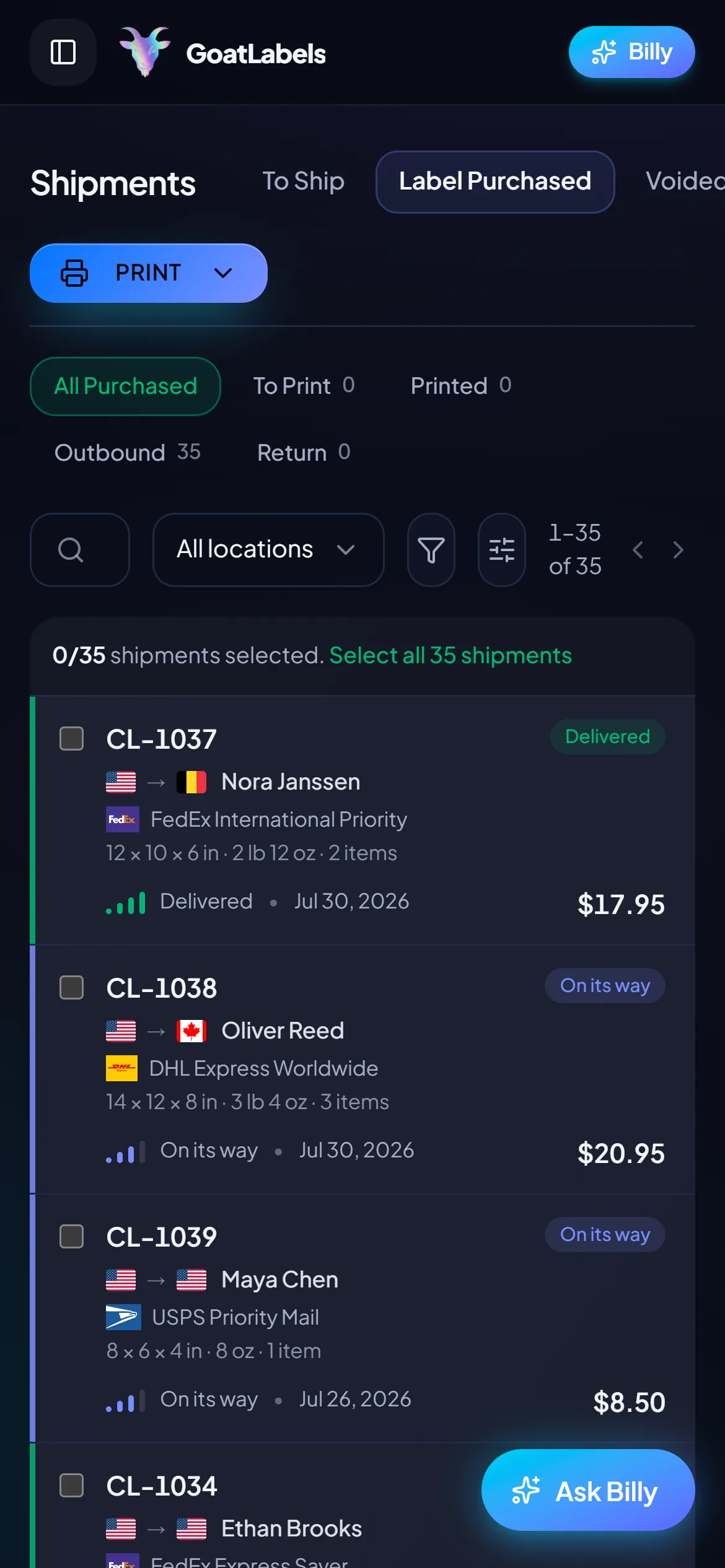
Nobody looks up a destination's valuation basis while holding a roll of tape, which is exactly why the declaration has to travel with the parcel instead of waiting for a desk. Template, declared value, and an all-in quote per carrier all fit on the screen already in your hand.
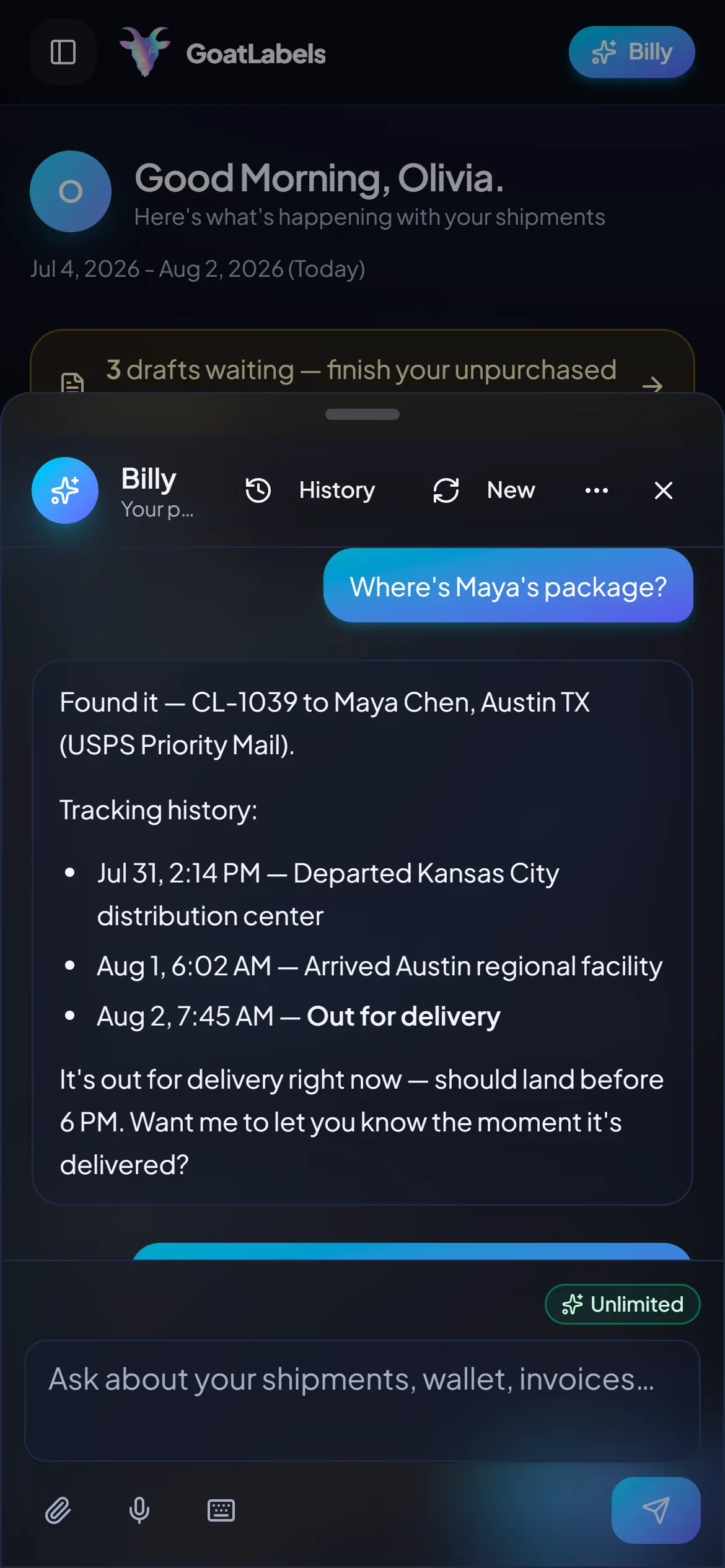
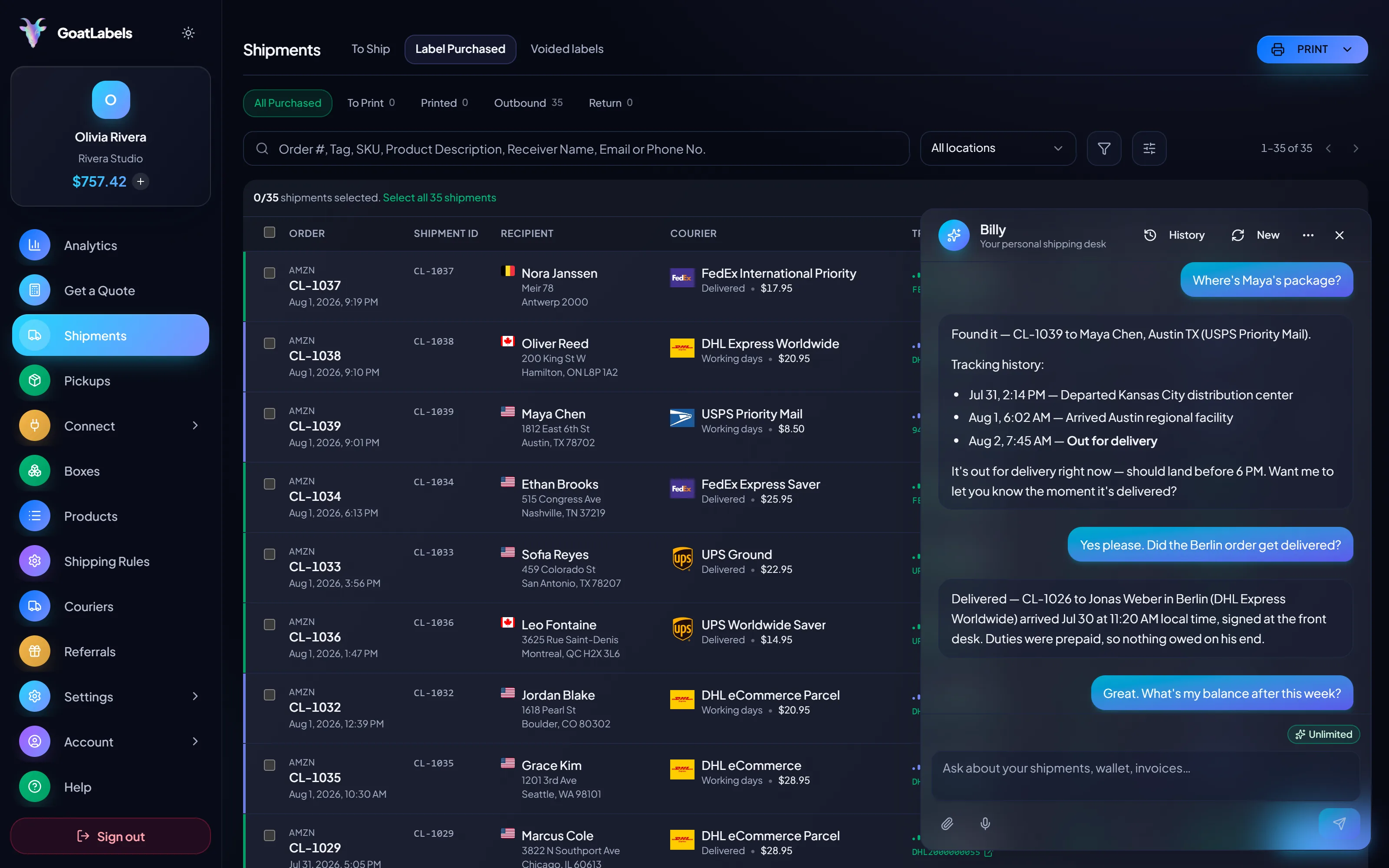
Hold the mic, say where the parcel is going and what is inside it, and Billy drafts the customs description, pulls the declared value off your saved template, and reads back what each carrier's all-in number comes to on that lane. It remembers the products you send abroad and the boxes you send them in, and it answers for the shipment afterwards — including where it has reached in the entry process. Included on every plan. This is the real product, not a render.
Listening
"Has the Lyon parcel cleared customs yet?"
Cleared, out for delivery
CL-1042 · Lyon, FR · duties prepaid
Speaks plain English · drafts customs descriptions · reads the all-in rate (duties where DDP applies) back per carrier · included on every plan, never a pricier tier.
The same parcel quoted across every carrier at once, each column one all-in number, with duties and taxes inside it where the service supports DDP. Whether the lane clears under the destination threshold or crosses it, the buyer-facing cost is decided at quote time instead of at the door.
Priority Mail Intl
10–15 days$21.40
$0.00 of duties & taxes prepaid, not billed to your buyer
all-in · no surprises
Intl Connect Plus
3–5 days$27.10
$8.40 of duties & taxes prepaid, not billed to your buyer
all-in · no surprises
Express Worldwide
1–2 days$31.60
$8.40 of duties & taxes prepaid, not billed to your buyer
all-in · no surprises
Description, declared value, origin country, and your HS code travel through the same REST call as a domestic label — so a catalogue selling into six markets is not six hand-typed declarations a day. JSON, one Bearer header, signed webhooks instead of polling, real idempotency keys, and unlimited calls on every plan.
POST /api/v1/shipments
Authorization: Bearer sk_live_…
Idempotency-Key: ord_8421

{
  "to": { "name": "Joyce", "city": "Berlin", "country": "DE" },
  "parcel": { "weight": 2.6, "weight_unit": "lb" },
  "service": "fedex_intl_priority"
}
International labels are not a premium module here. Free covers 50 shipments a month with all four carriers, saved customs templates, and the API included; Pro is a flat monthly plan with unlimited shipments. The only thing a border adds to your cost is whatever the destination itself charges.
 — draft a customs description without opening the dashboard
Rate by plan
illustrativePro: one flat monthly plan, unlimited shipments
$0 / forever
Fund a wallet, declare honestly, and pay per label whether the parcel crosses a line or not.
The assistant that reads an order into a draft, writes the customs description, and validates the destination before you spend anything runs unlimited in the web app on Free. Pro adds Billy on Telegram.
Telegram, ProGET /api/v1/shipments
200 OK · plan: free
Unlimited calls on Free — still unlimited on Pro.
On Pro we will work with you to beat the label rates you are already getting on your export lanes from
ShippoPirate ShipShipStationLabel prices are quoted live from USPS, UPS, FedEx, and DHL as one all-in number, with duties and taxes inside it on covered lanes, and that exact amount leaves your prepaid balance. Thresholds, valuation bases, and collection rules belong to each destination's customs authority — check the authority for your lane before pricing a catalogue around any of them. Full pricing details
Same wallet, same customs templates, same all-in quote, whether you export twice a month or twice an hour. These are the four shapes of seller a destination threshold reaches first.
 One catalogue, several borders
A headline threshold read once and applied everywhere is wrong in both directions — generous where the valuation basis excludes shipping, expensive where it does not. Quoting the lane with duties inside the number where the service supports DDP turns the question into a price you can put on a product page.
 Borderline value, either side of it
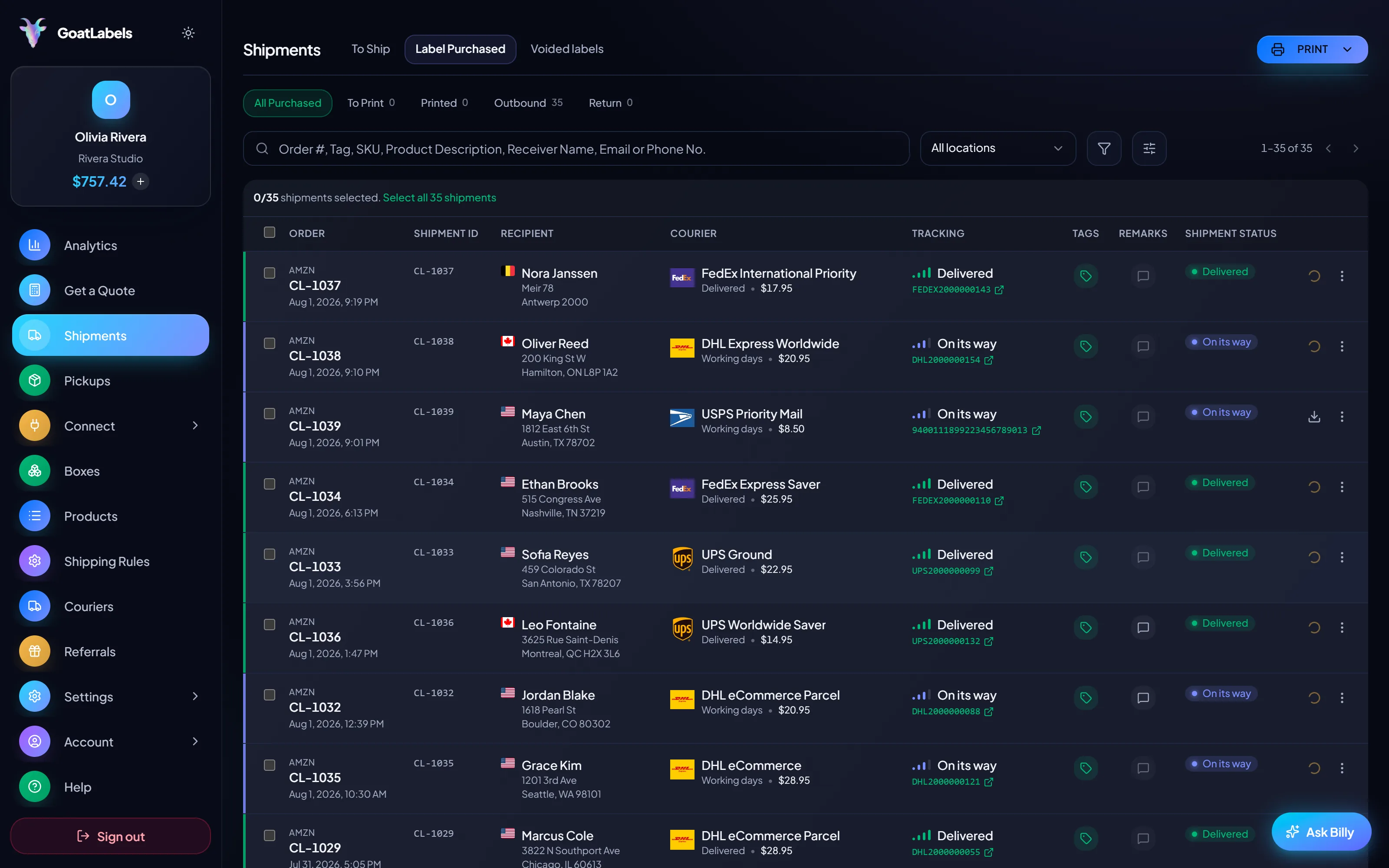
A parcel priced just under a destination threshold can drift over it in transit on exchange rate alone. Treat those as either-side parcels, set the buyer's expectation accordingly, and let the quote show the all-in cost, duties included where DDP applies, rather than the hope.
Declared once, reused
Description, value, origin, and HS code straight off the template

 Answering before the parcel answers for you
 The bill nobody warned the buyer about
DDP
duties prepaid at quote time, so the doorstep surprise never happens
A video took off and I had 80 TikTok Shop orders by morning. I printed every label from my phone on the bus to the post office.
Early customer · TikTok
TikTok Shop seller
 TikTok Shop
I run my Etsy shop from the kitchen. The AI reads the order, picks the carrier, the label prints. That's the whole workflow now.
Early customer · Etsy
Etsy maker
EtsyThe API is what every shipping API pretends to be. Idempotency that actually works.
Sasha R.
Staff engineer, marketplace
Quote every carrier on the lane with duties visible, declare the honest value from a saved template, and let the threshold fall where it falls, with nobody surprised.
No card required. No monthly fee on Free, up to 50 shipments a month.
Updated