

USPS
Ground Advantage
2 to 5 days$11.40
all-in at purchase
PayPal's shipping flow is built around PayPal: a label starts from a PayPal order or a Quick Label, on USPS, UPS, or DHL Express, with no FedEx. That is fine for pure PayPal sellers. GoatLabels starts from the order wherever it happened (synced store, pasted DM, CSV) and rate-shops USPS, UPS and FedEx on every domestic parcel, with DHL on international lanes, from one prepaid wallet.
Synced store, pasted DM, invoice, or CSV — the order starts the label here, however the money moved.


 any origin
Card, Apple Pay, Google Pay, ACH, or crypto fund one prepaid balance behind every label you print.
Checked on from PayPal Shipping's own pages. Plans, fees and policies change, so confirm on the vendor's current page before you decide. PayPal Shipping is a trademark of its owner and is not affiliated with GoatLabels.
A payment-first flow checks for a transaction record at the front door, which is why half your month arrives at it as a blank form. The loop below has no front door of that kind: a synced storefront order, a pasted DM, an emailed invoice, and a CSV row all reach the same draft, get the same address validation, and are quoted against the same carriers. Whatever rail the money arrived on is simply never part of the question.
paying the invoice by bank transfer today — ship to the warehouse when it clears
Nothing here inspects how you got paid. That is the whole structural difference, and everything else on this page follows from it.
 Billy AI
One wallet sits behind every channel, so a marketplace sale and a bank-transfer invoice are paid for identically and reconcile against one ledger instead of two systems.
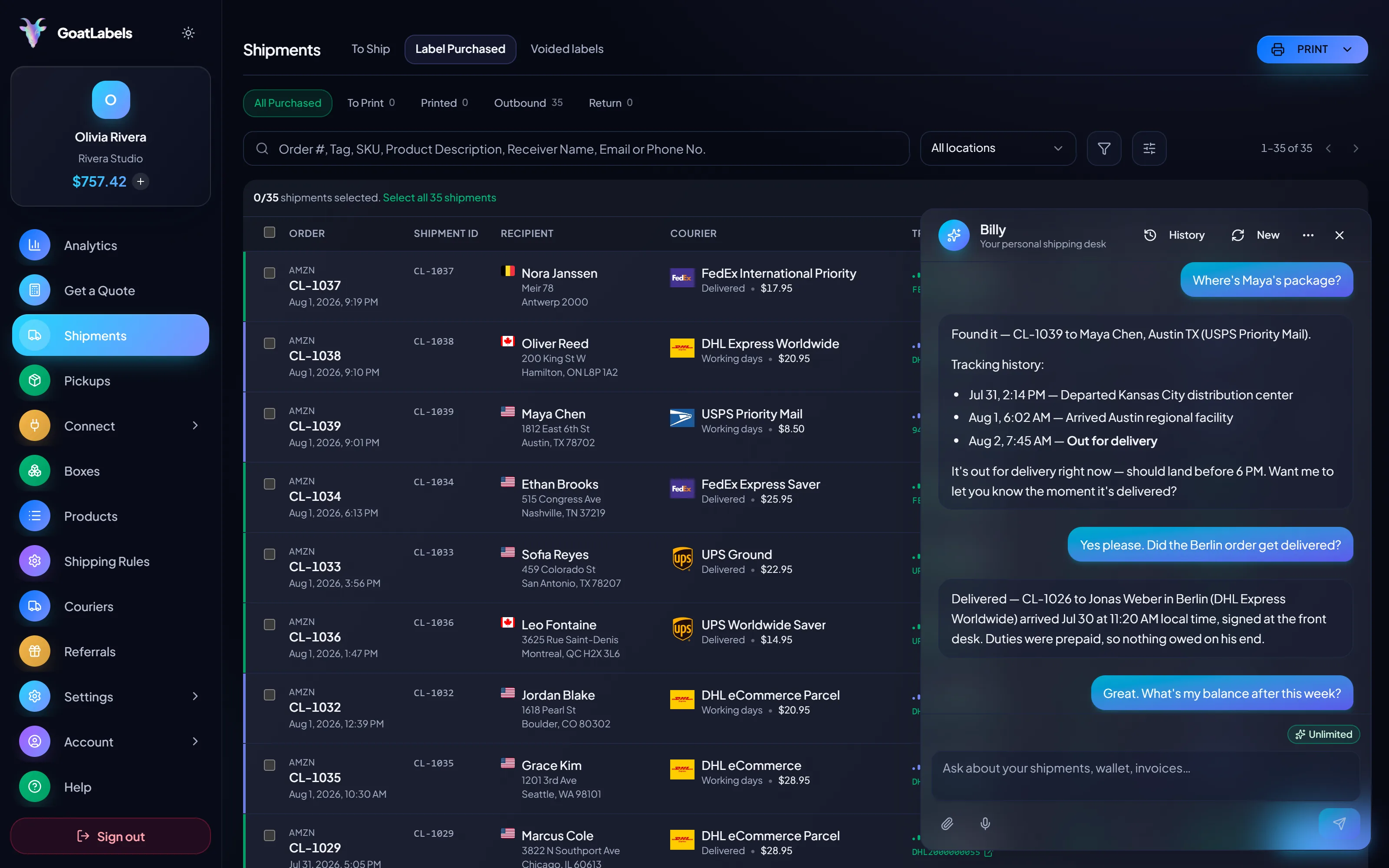
Thirteen store connectors, Shopify, Amazon, eBay, Etsy, TikTok Shop and more, sync straight into the To Ship queue, all of them running their own checkouts, none of them producing the payment record a tethered flow needs. Instagram and Facebook DMs are pasted in instead. Every one of them becomes the same label, from the same balance, with the same live quotes behind it.
 Shopify
 Etsy
Etsy WooCommerce
 TikTok Shop
 Amazon
 eBay
eBay Squarespace
 Wix
Wix WalmartShopify PlusSoon
 Square
 BigCommerce
 Magento
 ZapierSoon
 NetSuiteSoon
 EcwidSoon
 Temu
Temu SheinSoon
 ChannelAdvisorSoon
 SkuVaultSoon
 Zoho InventorySoon
 Patreon
Usually a PayPal transaction: the label begins from a payment record in your PayPal activity or an order in the Shipping Center, and a Quick Label covers anything else by hand.
PayPal's shipping flow is organised around one object: the transaction. A label begins from a payment record: you open the activity, choose to ship it, and the buyer's details carry over into the label form. That design is genuinely convenient when it applies, because the address arrives typed by the buyer at checkout and the tracking lands back on the original transaction. The tether is the feature. It is also the constraint, and everything else on this page follows from it. Notice what the design quietly assumes: that a sale and a PayPal payment are the same event. PayPal does offer a Quick Label for everything else, but it is a blank form: the address, the parcel, and the record all have to be typed in by hand.
Sales that exist as transaction records inside PayPal get the smooth path; everything you sell that PayPal did not process goes through the Quick Label door, typed by hand. The specifics, with links to PayPal's own help pages, are in the dated source block above.
Any sale that was not paid through PayPal, such as a marketplace checkout, a bank-transfer invoice or a DM sale; those only fit a hand-typed Quick Label.
Now inventory your actual month. The Etsy order paid through Etsy's own checkout. The wholesale invoice a client settled by bank transfer. The Instagram sale agreed in a DM and paid however the buyer preferred. The backlog of orders sitting in a CSV export from a platform you are leaving. None of these are PayPal transactions, so none of them gets the tethered path, only a blank Quick Label form, and a seller with mixed channels ends up running two shipping systems, one for PayPal sales and one for everything else, reconciling between them forever. The cost is not dramatic on any single day; it is a standing tax on every order that arrived through the wrong door, paid in copied addresses and second logins.
GoatLabels starts from the order, wherever it happened. Synced stores flow into the queue on their own; a pasted DM or screenshot becomes a drafted label through Billy, the workflow our AI shipping labels page owns in full; and an exported backlog runs through the CSV importer as a batch. Sellers whose business runs on invoices should read the invoicing-sellers page, which owns that argument in depth, and DM-native sellers have the Instagram page. The point here is narrower: no order is turned away at the door for having been paid the wrong way.
USPS, UPS, and DHL Express, with no FedEx, per PayPal's own help pages (dated in the source block above).
The second gap is narrower than it sounds. PayPal's Shipping Center does compare rates across its three carriers, so the gap is the fourth: no FedEx quote, on exactly the light e-commerce parcels where carriers disagree with each other most. Rate-shopping is not a power feature; it is the observation that the same parcel has several prices and you may as well see them. A seller who never compares is not getting a bad deal every time — they are getting an unexamined one every time, which costs more in aggregate than any single overpriced label.
Every domestic GoatLabels label is quoted across USPS, UPS and FedEx as all-in numbers (DHL joins on international lanes), the winner is a choice rather than a default, and the amount you approve is what the prepaid wallet is debited at purchase; the mechanics behind that all-in number live on the cheap shipping labels page. The wallet is funded by card, Apple Pay, Google Pay, ACH, or crypto, there is no subscription on Free (up to 50 shipments a month), and the pricing model fits on one page. PayPal's flow charges through your PayPal account, which is tidy, but tidiness and a multi-carrier quote are not in competition; you can have both.
Sellers whose every sale is a PayPal transaction.
Said plainly, because a versus page owes you the concession: if every sale you make is a PayPal transaction, PayPal's shipping flow is probably all you need. The tether that frustrates mixed-channel sellers is pure convenience for single-channel ones — the address is already there, the label ties to the payment, the tracking lands on the same record, and there is nothing to reconcile because there is only one system. A seller who invoices through PayPal, gets paid through PayPal, and ships a handful of parcels a week has no problem this page solves.
The switching trigger is the first month the tether costs you real time: the first marketplace store, the first DM sale, the first wholesale invoice paid by bank transfer, the first heavy parcel where you wondered what another carrier would have charged. That is the moment the shipping tool should stop caring how the money arrived, and the moment starting from the order, with every carrier that serves the lane bidding on it, stops being a feature list and becomes the workflow you actually run.
Neither column is wrong — they are built around different objects. The question is whether your sales all live inside one payment system, or only some of them do.
| GoatLabels | PayPal Shipping | |
|---|---|---|
| What can start a label | Any order, from anywhere — a synced store, a pasted DM, an invoice, a CSV row. | A PayPal transaction or Shipping Center order, or a hand-typed Quick Label with no order behind it. |
| Carrier choice | USPS, UPS and FedEx quoted against each other on every domestic parcel; DHL on international lanes. | USPS, UPS, and DHL Express, compared against each other; no FedEx. |
| Mixed sales channels | One queue and one wallet for every channel you sell on. | PayPal orders flow in; sales from other channels become hand-typed Quick Labels. |
| How labels are paid for | A prepaid wallet funded by card, Apple Pay, Google Pay, ACH, or crypto. | Charged through your PayPal account as you buy. |
| Automation | A REST API with unlimited calls, signed webhooks, and idempotency keys. | The Shipping Center web flow, with bulk label buys for selected orders. |
PayPal is a trademark of its owner and is not affiliated with GoatLabels. Its shipping flow and carrier list are dated and linked in the source block above; check PayPal's current help pages before you rely on any specific here. Updated .
Once a label can start from anywhere, the rest of the stack stops caring how you got paid — one wallet, four carriers, and an API, shared by every channel you sell on.
Bank-transfer invoices, marketplace checkouts, and DM sales all draw labels from the same prepaid wallet, topped up by card, Apple Pay, Google Pay, ACH, or crypto. Your payment mix stays your business — the label neither knows nor cares.
A sale that lives in a chat thread never becomes a transaction record anywhere — Billy reads the pasted message or screenshot, drafts the label, and validates the address before money moves. The order-shaped gap in payment-first tools is exactly the gap it closes.
BillyLIVEFree has no monthly fee to keep the option open, so running GoatLabels alongside PayPal's flow during a trial month costs nothing — print the PayPal sales there, the rest here, and let the ledger decide who keeps the job.
USPS, UPS and FedEx come back as all-in prices on the same screen for a domestic parcel, DHL joins on international lanes, and the winner changes with weight, zone, and deadline. A shorter carrier list answers part of the question before it is asked; a full screen of quotes asks all of it.
UPS$12.48FedEx$13.22DHL$14.10USPS$11.79If your channels are worth automating, the REST API covers the whole lifecycle (create, quote, buy, void) with signed webhooks, idempotency keys, and unlimited calls on every plan. On PayPal's side, labels are bought in the Shipping Center web flow.
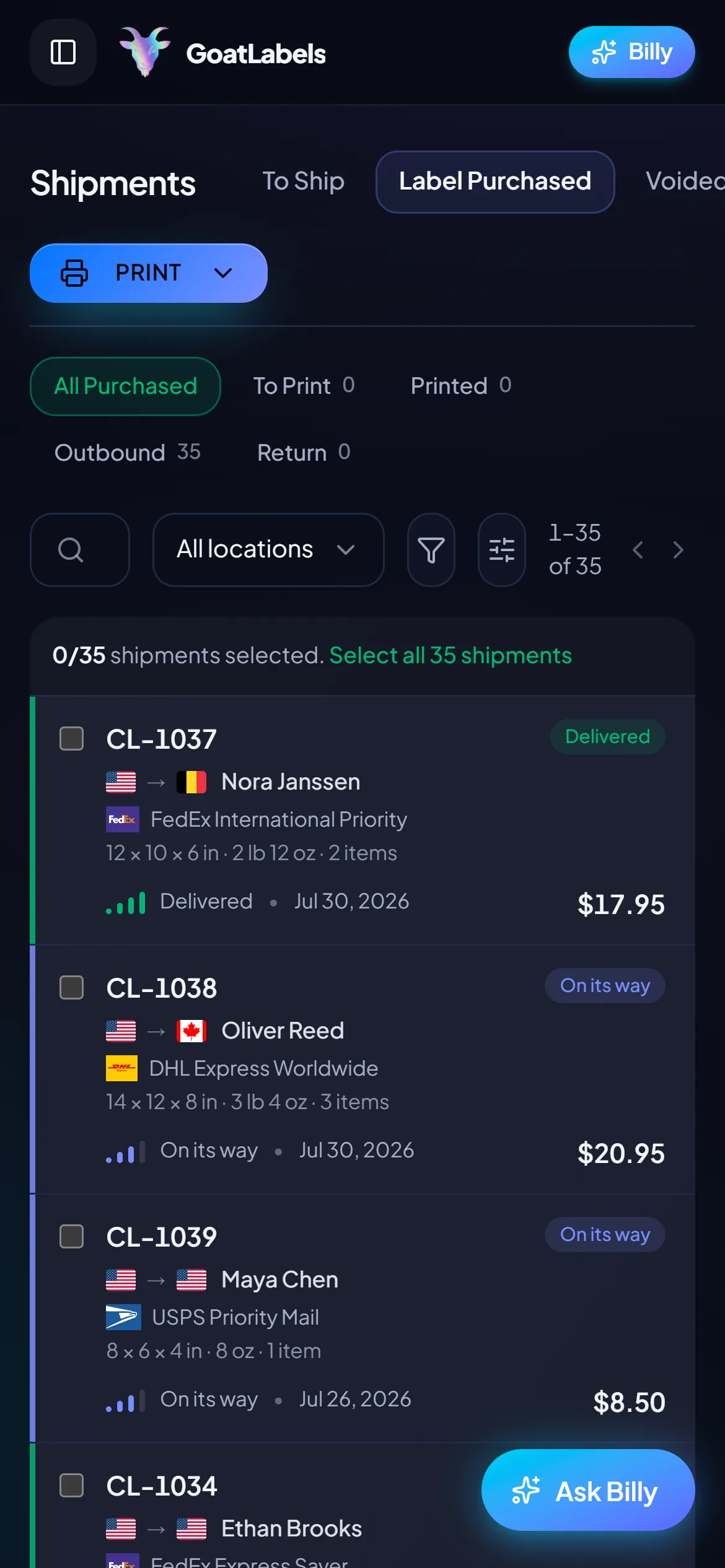
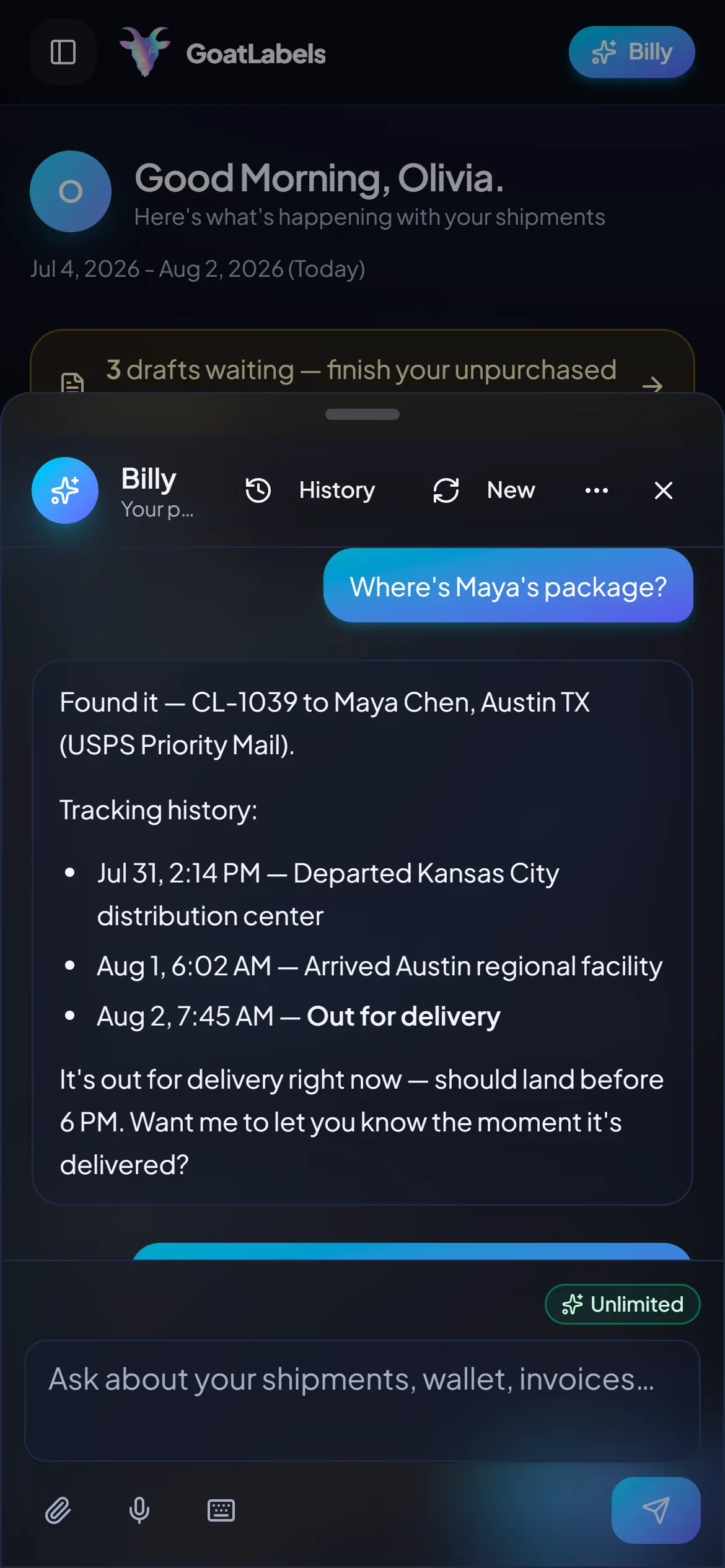
DM sale · label ready
No transaction record required
The sales a tethered flow cannot see are almost never the ones you are sitting at a desk for. They are a message agreed on the bus, an invoice settled while you are out, a market-stall follow-up. Everything needed to turn one of those into a bought label fits in a thumb.
An order agreed in conversation has no record to open, no ship button to press, and nothing to carry the address across. Speak it instead: Billy structures the buyer, the destination, and the parcel into a draft, validates the address before money moves, and quotes every carrier that serves the lane. It is the same draft a synced storefront order becomes, which is the point: the door the order walked in through never changes what happens next. Included on every plan. This is the real product, not a render.
Listening
"Invoice sale — two kilos to Priya in Austin."
Draft ready
Address validated · carriers quoted
Speaks plain English · drafts from voice, paste, or a screenshot · remembers repeat buyers and saved boxes · included on every plan.
This is what the second gap looks like once the label form is open. The same parcel, priced by several carriers at once, each as one all-in number with its delivery window attached — and the winner moves with weight, zone, and deadline rather than staying wherever the tool put it. A seller who never compares is not getting a bad price every time; they are getting an unexamined one. Figures are illustrative.
Ground Advantage
2 to 5 days$11.40
all-in at purchase
Ground
1 to 5 days$9.85
all-in at purchase
Ground
1 to 5 days$11.20
all-in at purchase
PayPal's labels are bought in the Shipping Center web flow. Here the whole lifecycle is REST and JSON over one Bearer header (create, quote, buy, void) with unlimited calls on every plan, so automating the channels a tether could never see costs nothing extra.
POST /api/v1/shipments
Authorization: Bearer sk_live_…
Idempotency-Key: ord_8421

{
  "to": { "name": "Joyce", "city": "Berlin", "country": "DE" },
  "parcel": { "weight": 2.6, "weight_unit": "lb" },
  "service": "fedex_intl_priority"
}
A versus page is only useful if you can test it cheaply, and Free has no monthly fee to keep the option open. Run both for a month: print the PayPal sales where you print them today, bring everything a tether cannot see over here, and let the ledger decide. Free covers 50 shipments a month; past that, Pro is one flat $40 monthly plan with unlimited shipments.
 — draft a label from the thread the sale happened in
Rate by plan
illustrativePro: one flat monthly plan, unlimited shipments
$0 / forever
Enough to ship the orders that never became a transaction record, and nothing owed if you ship none.
The assistant that turns a chat message or an emailed invoice into a validated draft label runs unlimited on Free. It is the piece that closes the order-shaped gap a payment-first tool leaves open, so it is not something to put behind a tier. Pro adds Billy on Telegram.
Telegram, ProGET /api/v1/shipments
200 OK · plan: free
Unlimited calls on Free — still unlimited on Pro.
Put a real parcel through and compare the side-by-side rate against what that label costs you on
ShippoPirate ShipShipStationLabel prices are quoted live from USPS, UPS, FedEx, and DHL as one all-in number, and that exact amount leaves your prepaid balance. PayPal is a trademark of its owner and is not affiliated with GoatLabels; its shipping flow and pricing are its own, and change. Full pricing details
The tether is convenience for a single-channel seller and a standing tax for everyone else. These are the four shapes where a sale routinely arrives through the wrong door.

 Marketplace plus a shop of your own
Each storefront runs its own checkout, so most of the month never produces the payment record a tethered flow starts from. One queue and one prepaid balance behind all of them is the difference between shipping and reconciling.
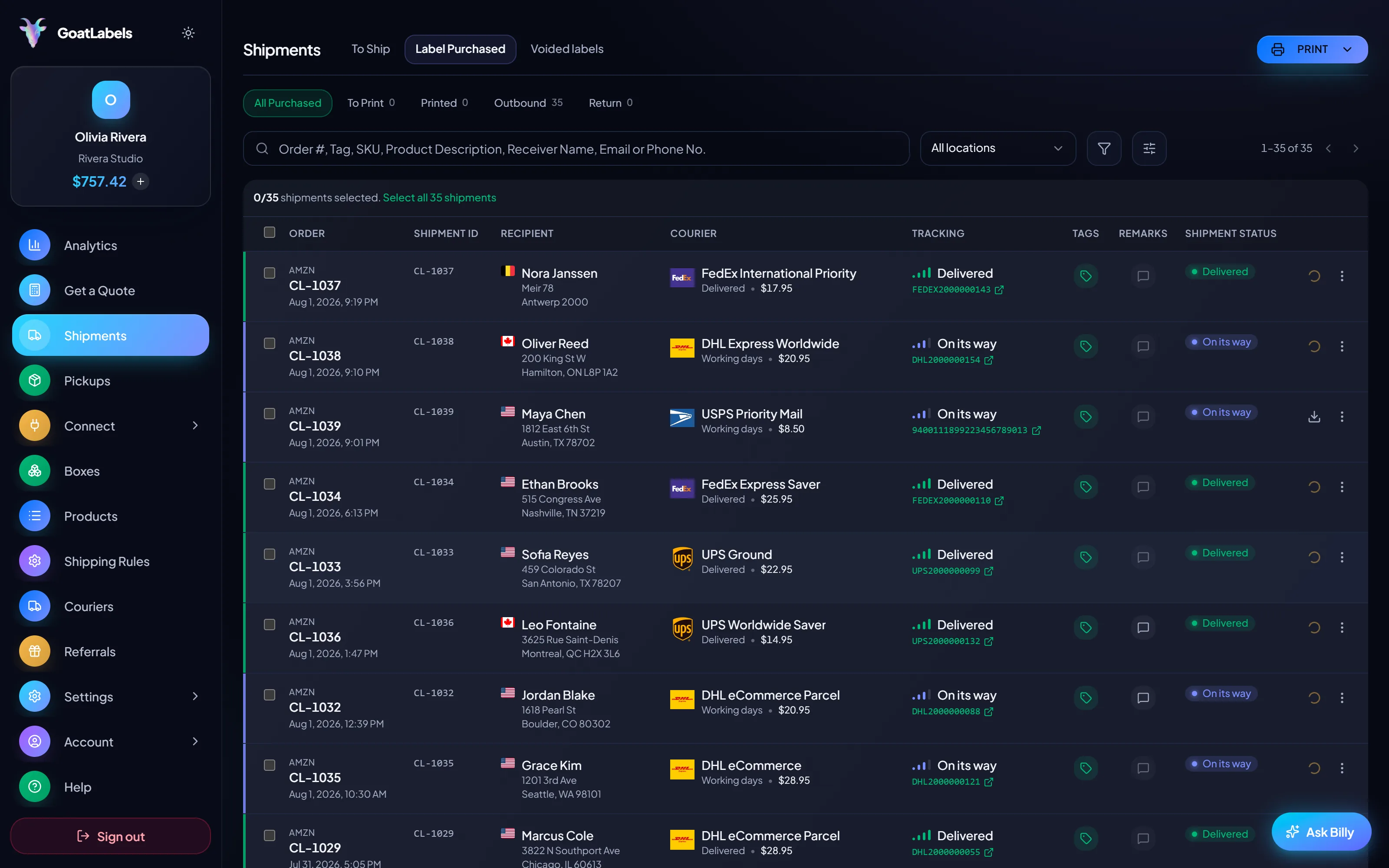
Wholesale, bank transfer, net terms
A client settling an invoice by bank transfer is a real sale with no payment record to ship from. Starting at the order rather than the money is what lets one label system cover the retail buyer and the wholesale one at once.
Order first, money second
The rail you got paid on never reaches the label

 Agreed in a thread, paid however
 An export from the platform you are leaving
1
queue behind synced stores, pasted messages, invoices and imported rows alike
More in this series:when the platform's own label is the right answer,shipping the sales that happen in DMs, andshipping for invoicing sellers.
A video took off and I had 80 TikTok Shop orders by morning. I printed every label from my phone on the bus to the post office.
Early customer · TikTok
TikTok Shop seller
 TikTok Shop
I run my Etsy shop from the kitchen. The AI reads the order, picks the carrier, the label prints. That's the whole workflow now.
Early customer · Etsy
Etsy maker
EtsyThe API is what every shipping API pretends to be. Idempotency that actually works.
Sasha R.
Staff engineer, marketplace
Fund a prepaid wallet, bring one non-PayPal order (a DM, an invoice, a marketplace sale), and compare the all-in quotes against whatever you would have paid.
No card required. No monthly fee on Free, up to 50 shipments a month. No contract.
Updated