

USPS
Priority Mail Intl
10–15 days$7.40
$1.90 of duties and taxes prepaid inside the same number
all-in · one column on the statement
Updated
An Easyship bill has two layers: the subscription tier, which decides shipment quota and feature access, and the postage layer, where courier rates and margins live. This page maps each charge to its trigger (quota crossings, feature gates, courier selection) and contrasts a model where, on Free up to 50 shipments a month, the only meter is postage, and past that Pro is one flat $40 a month.
USPS, UPS and FedEx quoted at all-in prices on every domestic parcel, DHL on international lanes. Postage is the only thing on the bill.


 DHL: international
Card, Apple Pay, Google Pay, ACH, or crypto fund one prepaid balance. Labels out, voids back in — that is the ledger.
Read an Easyship statement carefully and every line resolves into one of two layers. The first is the subscription layer: a monthly tier that decides how many shipments you may create, how many teammates can log in, and which features are switched on for your account. The second is the postage layer: what the couriers charge for the labels themselves, quoted through Easyship's negotiated rates or through courier accounts you connected yourself. The two layers move independently — you can have an expensive plan month with cheap postage, or a cheap plan month wrecked by one heavy international parcel — and confusion between them is where most surprise comes from.
The layers also fail differently. Postage scales with what you actually shipped, which feels fair even when it is large. The subscription layer scales with what you committed to shipping, which is a forecast — and a wrong forecast costs money in both directions. Undersize the plan and the quota mechanics below kick in; oversize it and every quiet month subsidises capacity you never used. Where each platform earns inside the postage layer is the reseller-margin story, and that explainer lives onhow does Pirate Ship make money— the economics are the same across the category, ours included.
The quota is the load-bearing number in the subscription layer, so the definition of a shipment matters more than it looks. A shipment is a record on the platform, not a box on a truck: it counts against a monthly cap, and the meter resets with the billing month. That definition has edges worth checking against Easyship's current terms before you rely on them — how a multi-parcel order counts, what happens to a shipment you create and never buy, whether a cancelled label gives the count back. None of those edge cases would matter if the meter did not exist; all of them matter because it does.
The practical consequence is that your quota consumption tracks your order flow, not your spending. A month of many small, cheap parcels burns quota exactly as fast as a month of heavy expensive ones, which is why sellers with high-count, low-value volume — stickers, cards, small accessories — hit tier ceilings sooner than their postage spend would ever suggest. When the counter passes the cap, Easyship's help center says you are prompted to upgrade to a higher plan, prorated for the current month.
Quota is the visible meter; feature gating is the quiet one. Across the tiers, capability is distributed the way subscription software always distributes it: the entry tier proves the product works, and the things an operation eventually leans on, such as shipping rules, branded tracking, more seats, automatic order sync, and multi-box shipments, sit one or two tiers up. The individual assignments get reshuffled between pricing revisions, which is why this page describes the pattern and leaves the current feature matrix to Easyship's own pricing page.
The pattern has a cost the matrix never shows: a feature gate converts a workflow decision into a billing decision. Wanting to automate a repetitive step, or give a packer their own login, becomes a question about the monthly bill — and because upgrading re-prices the whole account, the feature you wanted arrives bundled with a higher fee on everything else. It is worth naming that the gate is a pricing instrument, not an engineering constraint; the software could do the thing on every tier, and the tier sheet is what says it may not.
Abstract tiers become concrete the moment you push a real month through them, so take two sellers. The first ships forty parcels a month — an evening-and-weekend shop with steady, small volume. The second ships four hundred — a full-time operation with a helper on packing days. Neither number is exotic, and the two months meet completely different pricing machinery on a tiered platform, which is exactly the point of working the example.
For the forty-a-month seller, the question is whether the entry tier's cap clears their volume and whether any feature they rely on is gated above it; if both answers are friendly, their subscription layer is genuinely cheap, and the decision is quota headroom. The four-hundred-a-month seller is making a different bet: they must pick the tier whose cap clears their busiest month, not their average one, because the months that overshoot force the upgrade mid-cycle. That asymmetry — pricing set by the peak, paid through the troughs — is the recurring cost of any quota model, and it is invisible on the pricing page because the pricing page does not know your variance.
Now put the same two months through GoatLabels. The statement is one column: top-ups in, labels out. The forty-parcel seller is on Free and sees forty debits, each the all-in price that was quoted before purchase. The four-hundred-parcel seller is past Free's 50 shipments a month, so the statement shows four hundred label debits plus one flat $40 Pro line, and no line records a seat, a tier ladder, or an overage. Void a label and, after the carrier accepts the void, the credit appears in the same column; the mechanics of that are onvoiding a shipping label.
Two honest footnotes belong on any wallet statement. First, a carrier billing adjustment — a reweigh or remeasure after shipping — posts as its own ledger entry, and if one ever exceeds the wallet balance, a card on file covers the difference; the wallet is the default rail, not a hard ceiling. Second, we earn the same way every postage reseller earns: inside the label price, not beside it. What the model removes is not our margin — it is the forecast. Nothing on a wallet statement required you to predict your month in advance, and that is the entire difference this page has been mapping. The plan-free model in full detail is on the pricing page.
Checked on from Easyship's own pages. Plans, fees and policies change, so confirm on the vendor's current page before you decide. Easyship is a trademark of its owner and is not affiliated with GoatLabels.
The whole point of mapping a bill to its triggers is to find out which charges you actually caused. Work this loop and the answer is uncomfortable in its simplicity: you caused exactly one, and it was the label. No charge is created by the calendar turning over, by a teammate logging in, by a feature being switched on, or by a counter reaching a number. An order arrives, Billy drafts it, the carriers on its lane bid, and the winning all-in price debits the balance. That single debit is the entire statement.
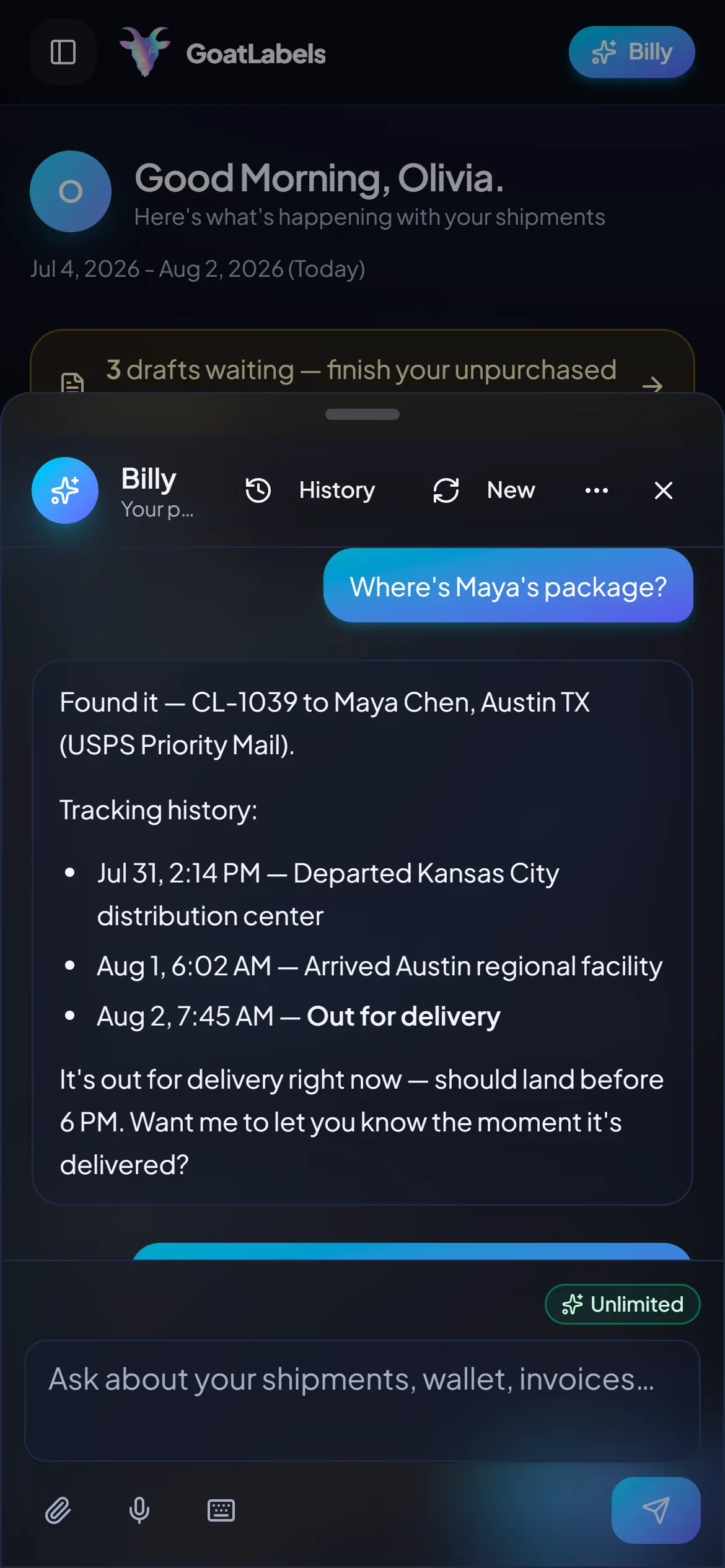
two of the small ones to Chicago please
Creating a shipment is free because nothing is counting them. On a quota model the record itself is the billable event, which is why a month of small cheap parcels can burn a tier as fast as a month of heavy expensive ones.
 Billy AI
Void it and, after the carrier accepts the void, the credit appears in the same column. Two honest footnotes: a carrier reweigh posts later as its own ledger entry, and if one ever exceeds the balance a card on file covers the difference — the wallet is the default rail, not a hard ceiling.
Shopify, Etsy, WooCommerce, TikTok Shop, Amazon, eBay, Squarespace, Wix, Walmart, Square, BigCommerce, Magento, and Temu sync orders into one To Ship queue, with tracking pushed back on print. Instagram and Facebook stay paste-only. Integration availability is one of the standard rungs on a subscription ladder — connect this many stores, unlock that connector — so it is worth saying plainly that the list here does not vary by account and does not generate a line on the statement.
 Shopify
 Etsy
Etsy WooCommerce
 TikTok Shop
 Amazon
 eBay
eBay Squarespace
 Wix
Wix WalmartShopify PlusSoon
 Square
 BigCommerce
 Magento
 ZapierSoon
 NetSuiteSoon
 EcwidSoon
 Temu
Temu SheinSoon
 ChannelAdvisorSoon
 SkuVaultSoon
 Zoho InventorySoon
 Patreon
The carriers, connectors, API and assistant that Easyship spreads across a subscription ladder are on every GoatLabels account: Free covers 50 shipments a month, and Pro adds unlimited shipments and Billy on Telegram for one flat $40. The only number that scales with your month is postage.
Card, Apple Pay, Google Pay, ACH, and crypto top up the same wallet, and every charge on the account is a label you chose to buy at a price you saw first. On Free there is no plan line, no overage line and no seat line, so the statement is the shipping; past 50 shipments a month, Pro adds one flat $40 line.
Paste an order, drop a screenshot, or say the address out loud and Billy drafts the whole label for you to confirm. On tiered platforms, assistant features are classic upper-tier bait; here the assistant is simply how the product works, at every volume.
BillyLIVEFree covers 50 shipments a month. Past that, Pro is one flat monthly plan with unlimited shipments: no overage fees, no month priced by its own peak, and the quoted label price is what you pay.
USPS, UPS and FedEx are rate-shopped on every domestic parcel, with DHL on international lanes, from the first label onward. Carrier access is not a tier benefit: every account sees the same carriers and services on the same box, at the same price on either plan.
UPS$12.48FedEx$13.22DHL$14.10USPS$11.79REST, JSON, signed webhooks, idempotency keys, unlimited calls — included on every account rather than unlocked by tier. Automate on day one or never; the bill does not change either way.
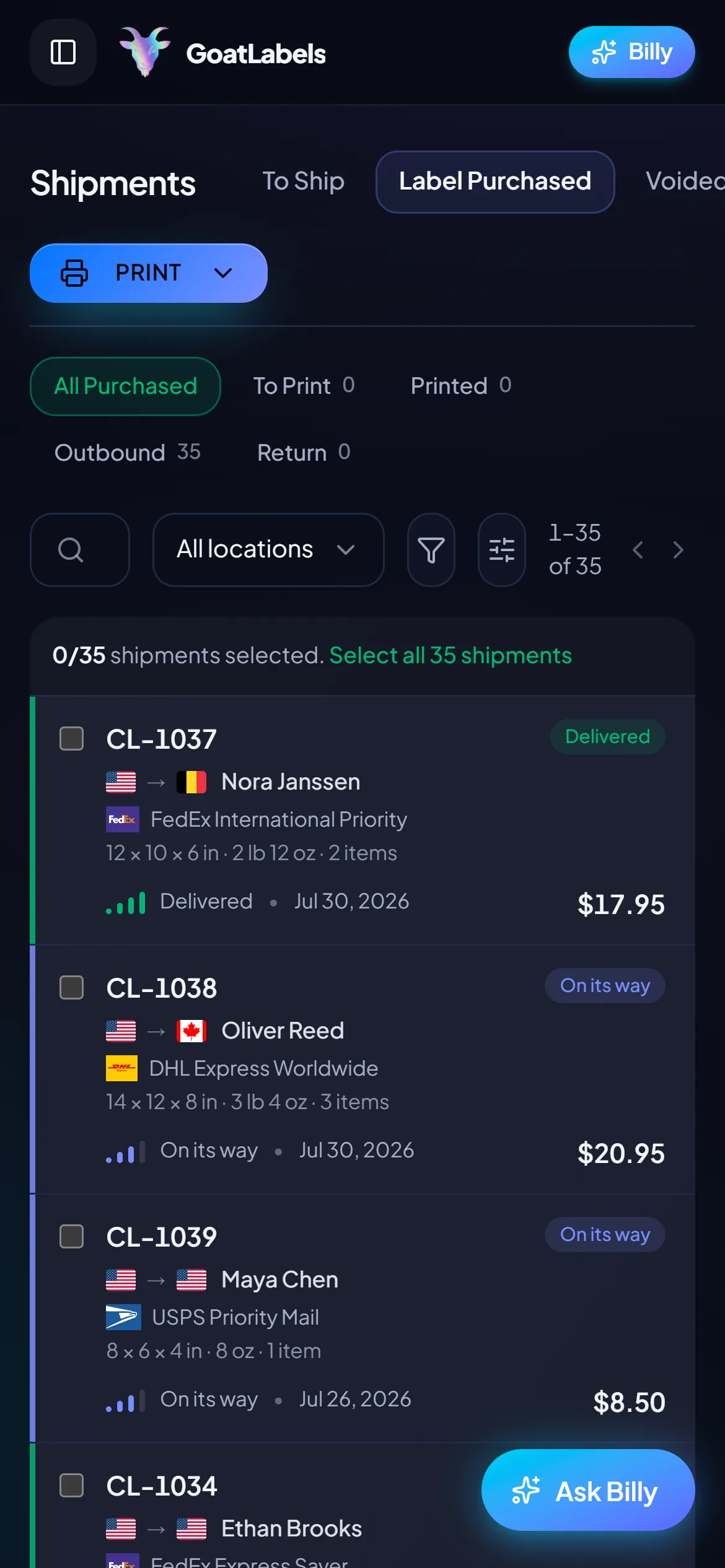
One line added to the statement
Chicago, IL · the amount you were quoted
A subscription layer bills whether you opened the app or not, which is why a metered month has to be watched. A postage-only bill has the opposite property: the statement can only grow when you deliberately buy something, and the whole buying flow fits on the phone at the packing table.
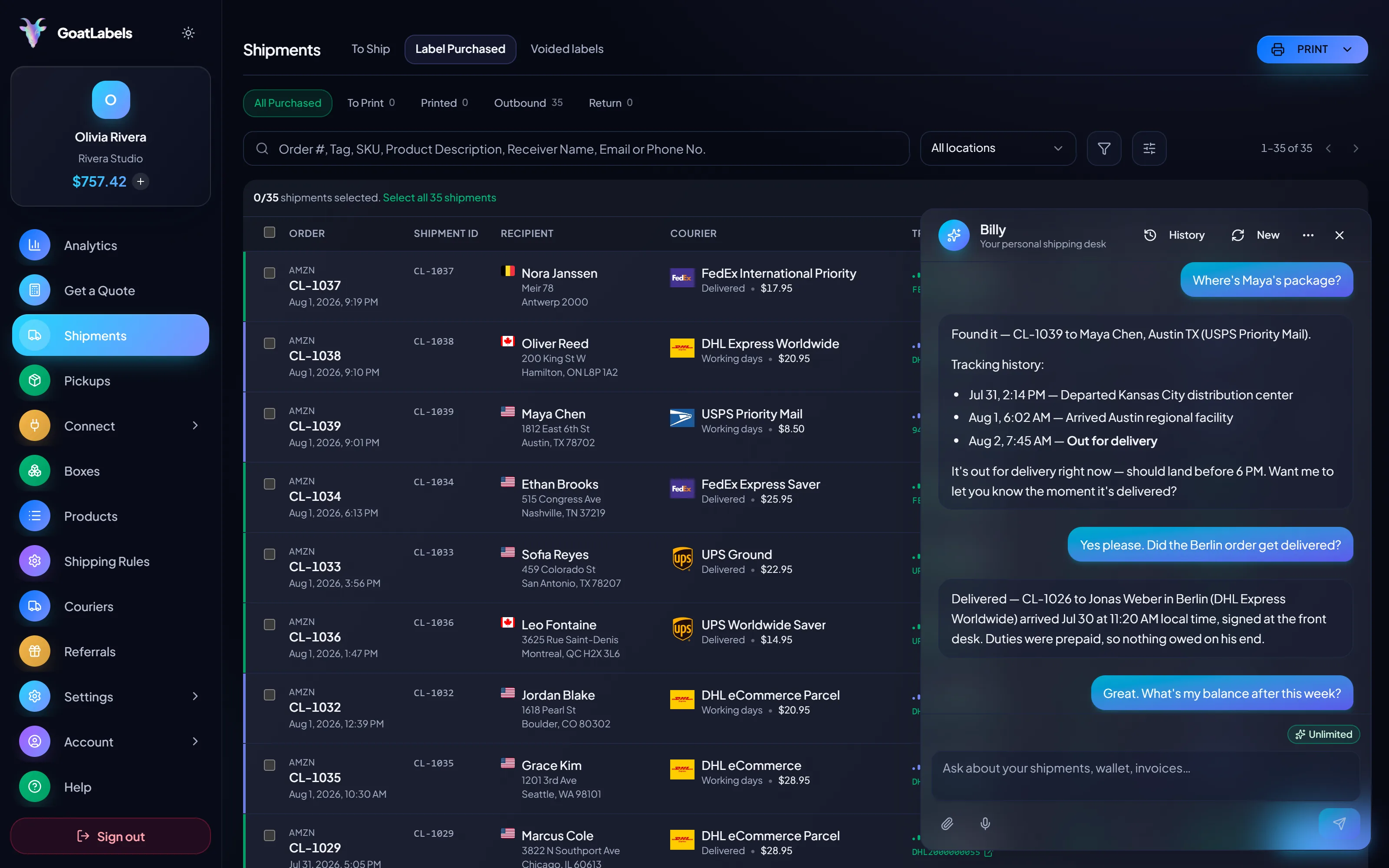
A single-layer bill has a pleasant side effect: every question about it has a single-number answer. Ask which parcel a charge belongs to, or what a given order cost to deliver, and Billy finds the shipment and reads back the amount that was paid and anything that has posted against it since. No tier apportionment, no seat share, no plan fee to allocate. Included on every plan. This is the real product, not a render.
Listening
"What did the Chicago order cost to ship?"
Delivered
Chicago, IL · one debit, nothing since
Speaks plain English · finds a shipment by order or buyer · answers in the same currency the statement is in · included on every plan.
This is the postage layer with nothing sitting on top of it. Each carrier returns one all-in number with duties and surcharges already inside, and the column you pick is the exact amount that appears on the statement — no fuel line arriving separately, no plan fee to apportion across the month's parcels. Figures below are illustrative.
Priority Mail Intl
10–15 days$7.40
$1.90 of duties and taxes prepaid inside the same number
all-in · one column on the statement
Intl Connect Plus
3–5 days$8.90
$2.20 of duties and taxes prepaid inside the same number
all-in · one column on the statement
Express Worldwide
1–2 days$9.80
$2.50 of duties and taxes prepaid inside the same number
all-in · one column on the statement
API access is one of the reliable rungs on a subscription ladder: deeper endpoints, higher tier, and usage that meters. Here it generates nothing on the statement at all. REST and JSON over one Bearer header, signed webhooks instead of polling, and calls nobody is counting — identical on a free wallet and on Pro.
POST /api/v1/shipments
Authorization: Bearer sk_live_…
Idempotency-Key: ord_8421

{
  "to": { "name": "Joyce", "city": "Berlin", "country": "DE" },
  "parcel": { "weight": 2.6, "weight_unit": "lb" },
  "service": "fedex_intl_priority"
}
A page that maps somebody else's bill has to map its own. On Free there is no subscription layer: postage is the only thing that can generate a charge. Pro is a subscription line, and we would rather name it than dress it up: it buys unlimited shipments and Billy on Telegram. It does not buy access to carriers, connectors or the API, which are identical on both, so choosing Pro is arithmetic about your volume, not a gate you are paying to open.
 — draft a label without opening the dashboard
Rate by plan
illustrativepay for labels, not for seats
$0 / forever
One kind of line on the statement, and none at all in a month you did not ship.
Billy drafts a label from a pasted order, a screenshot, or a spoken address and validates it before money moves — unlimited, in the web app, on Free. Pro adds Billy on Telegram, which is a second place to reach him rather than permission to use him.
Telegram, ProGET /api/v1/shipments
200 OK · plan: free
Unlimited calls on Free — still unlimited on Pro.
Put a real parcel through and compare the side-by-side rate against what that label costs you on
ShippoPirate ShipShipStationLabel prices are quoted live from USPS, UPS, FedEx, and DHL as one all-in number, and that exact amount is what leaves the prepaid balance. Easyship's tier names, caps, and amounts are theirs to change; the dated Easyship facts above are a snapshot, so confirm every current figure on their pricing page. Full pricing details
Because quota tracks order flow rather than postage, the sellers who meet the ceiling first are rarely the ones with the biggest bill. These four shapes hit it soonest.
 Stickers, cards, small accessories
A hundred cheap parcels consume exactly as much of a monthly cap as a hundred expensive ones, so these sellers meet a tier ceiling long before their postage bill suggests they should. Here a hundred parcels a month means Pro at one flat $40, and past that the only number that grows is the postage itself.
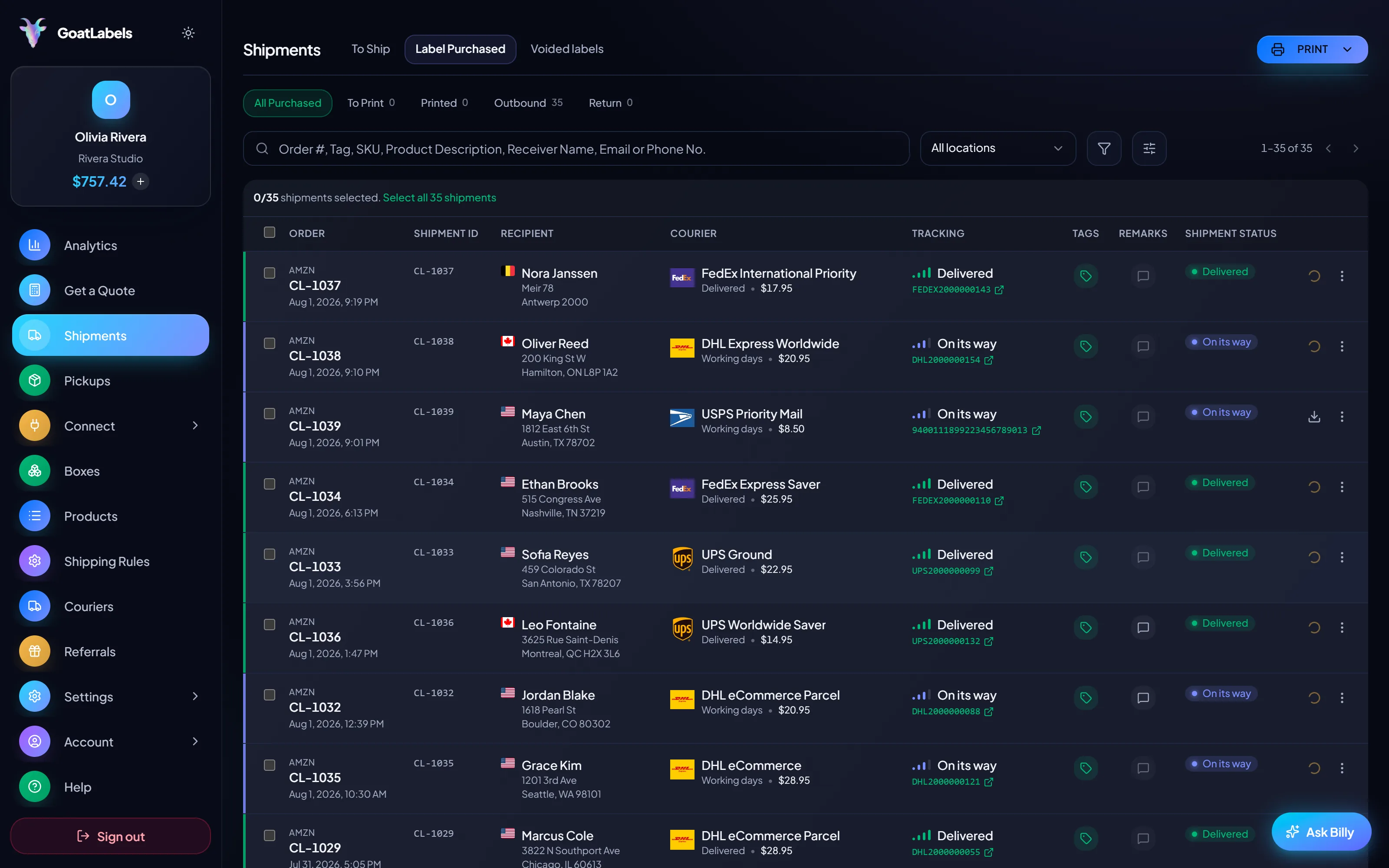
 Priced by the peak, paid through the trough
A quota has to clear the busiest month and is paid for in every other one. That asymmetry never shows up on a pricing page, because the pricing page does not know your variance — but it is on your statement all year.
Nothing shipped on Free, nothing billed
On Free a quiet month produces an empty statement, not a smaller one

 DMs, screenshots, and typed addresses

 Bookkeepers, partners, and future you
1
column to read — top-ups in, labels out, corrections dated and referenced
The rest of the series: EasyPost pricing explained,Shippo pricing explained, andShipStation pricing explained. Weighing a move? Start with the Easyship alternative page orthe migration sequence.
A video took off and I had 80 TikTok Shop orders by morning. I printed every label from my phone on the bus to the post office.
Early customer · TikTok
TikTok Shop seller
TikTok ShopI run my Etsy shop from the kitchen. The AI reads the order, picks the carrier, the label prints. That's the whole workflow now.
Early customer · Etsy
Etsy maker
EtsyThe API is what every shipping API pretends to be. Idempotency that actually works.
Sasha R.
Staff engineer, marketplace
Fund a wallet with card, Apple Pay, Google Pay, ACH, or crypto, quote your next parcel across USPS, UPS and FedEx, plus DHL on international lanes, and read a statement with exactly one kind of line on it.
Sign up in seconds. No card required. No monthly fee on Free, up to 50 shipments a month.
Updated