

USPS
Ground Advantage
2–5 days$7.40
$1.20 of that all-in figure is prepaid insurance, quoted inside the same number
all-in · spread inside, never added on
Pirate Ship says it is paid by the carriers, not by you: its homepage lists no monthly fees, markup or hidden costs. GoatLabels runs a reseller model across four carriers instead of two, with no monthly fee on Free, up to 50 shipments a month.
Pirate Ship says it is paid by the carriers, not by you, and its homepage lists no monthly fees, markup or hidden costs.


 no markup
USPS, UPS and FedEx rate-shopped per domestic label, DHL on international lanes, paid from one prepaid wallet, no monthly fee on Free, up to 50 shipments a month.
Pirate Ship answers the question itself: its homepage says it is paid by the carriers, not by you, lists no monthly fees, markup or hidden costs, and says it passes through the full UPS discounts (checked 2026-10-17). It sells discounted USPS and UPS labels as a licensed USPS Connect eCommerce Platform, which puts it in the reseller model, and that model is worth stating without euphemism because it is both simple and sound. Carriers run commercial pricing programs that grant steep discounts to partners who bring them volume. A reseller joins those programs, pools the parcels of many small shippers into one negotiated relationship, and receives pricing that no individual seller shipping thirty boxes a month could get alone. Resellers generally earn from that relationship, either by keeping part of the discount or by being paid by the carrier for the volume they bring. What a carrier pays any one reseller is not public, and we do not guess at Pirate Ship's numbers.
The carrier is not being tricked into this; the carrier designed it. A postal network wants the long tail of small e-commerce parcels but has no economical way to sell to millions of tiny shippers one at a time. Resellers are its distribution arm: they do the acquisition, the software, and the support, and the discount tier they receive is effectively the carrier's marketing budget for volume it would not otherwise win. Every free shipping tool you have ever used sits somewhere inside this arrangement.
For a reseller that keeps a spread, the part that sounds impossible, free software, no markup and cheaper labels all at once, resolves the moment you see where the spread lives. It is carved out of the discount, not stacked on top of the price. Retail counter pricing is the ceiling. The reseller's negotiated cost sits far below that ceiling. Your price sits between the two, much closer to the bottom than the top, which is why the arithmetic works for everyone in the chain at once: the reseller keeps a slice of the discount, you keep the rest of it, and both of you come out ahead of the counter.
A reseller that is paid by the carrier, as Pirate Ship says it is, can pass a commercial rate through untouched and still fund the business. Either way, nothing about the model is hidden or hostile. It is the same economics as any distributor in any industry, and it answers the question this page exists to ask: the business is not a charity, and it does not need to be one to charge you nothing monthly. If current numbers matter to your decision, take them from Pirate Ship's own site, which is the only source that stays current on its rates.
Per-label pennies are a real business at volume, but they discipline what a free tool can afford to build. Features that generate more labels pay for themselves; features that do not, struggle for a budget. That is why spread-funded tools tend to run lean carrier lists — every additional carrier is an integration, a negotiation, and a volume commitment before it earns its first cent — and why deep inventory suites, warehouse tooling, and phone-first support usually live behind subscriptions instead, or inside companies whose real revenue comes from somewhere else entirely.
The limits are ones you can feel as a user if you know where to press. A spread-funded tool has no incentive to quote a carrier it earns nothing on, no margin for the parcels that need hand-holding, and no appetite for features that make shipping cheaper without making it more frequent. None of that is a scandal; it is the shape of the model. But it means the honest comparison between free tools is rarely about price posture — it is about which carriers are actually in the quote, and what happens to you on the day a label goes wrong.
So, the question we would ask if we were you: how does GoatLabels make money? We are a postage reseller. Carriers grant us commercial pricing, we pass most of the discount through, and we keep a spread inside the rate you pay — the same economics behind every cheap shipping label we sell. Free has no monthly fee and covers 50 shipments a month, and Pro is a published flat $40 a month past that, so there is no surprise fee waiting offstage: the spread is most of the business, and a month you ship nothing on Free costs you nothing.
The difference we would point to is where we spend the spread. We run the model across four carriers (USPS, UPS and FedEx quoted against each other on every domestic parcel, DHL on international lanes) because a reseller earns its spread on whichever carrier wins, which means we have no reason to steer you toward the wrong one; the full argument lives on our four-carrier rate-shopping page. For the volume where a flat plan beats a spread, Pro exists as a published price, not a quiet upsell. And if what you want is the head-to-head rather than the economics, that is GoatLabels vs Pirate Ship. This page had one job: to answer the trust question the way we would want it answered ourselves — yes it is free, yes the model works, and yes, so do we.
Checked on from Pirate Ship's own pages. Plans, fees and policies change, so confirm on the vendor's current page before you decide. Pirate Ship is a trademark of its owner and is not affiliated with GoatLabels.
Everything above is easier to trust once you can point at the moment the money is made. Here is the loop, annotated. The order arriving earns us nothing. Billy drafting it earns us nothing. The quotes coming back earn us nothing, and the ones you did not pick earn us nothing either. The single point of revenue is the label you buy, and what we keep is the gap between the commercial rate the carrier charges us and the rate we quoted you — carved out of the discount, never stacked on top of it.
can you post the two mugs to Baltimore?
This is why drafting, quoting, and syncing are free on both plans. A reseller has no revenue until a label is bought, so everything before that step is cost, which is exactly the incentive that keeps them free.
 Billy AI
Void the label and, after the carrier accepts the void, the credit returns to your balance — which also reverses the spread, because it was never a fee we charged you separately. There is nothing to claw back, and nothing to argue about, precisely because the earning lived inside the rate.
Every integration on a spread-funded product has to pay for itself in labels, which is why the honest version of this section is a list with a boundary. Live and syncing into one To Ship queue: Shopify, Etsy, WooCommerce, TikTok Shop, Amazon, eBay, Squarespace, Wix, Walmart, Square, BigCommerce, Magento, and Temu. Not live, and we will not imply otherwise: Shopify Plus, Zapier, NetSuite, Ecwid, Shein, ChannelAdvisor, SkuVault, and Zoho Inventory. Instagram and Facebook are paste-only. That boundary is the model showing through the product, exactly as the prose above describes.
 Shopify
 Etsy
Etsy WooCommerce
 TikTok Shop
 Amazon
 eBay
eBay Squarespace
 Wix
Wix WalmartShopify PlusSoon
 Square
 BigCommerce
 Magento
 ZapierSoon
 NetSuiteSoon
 EcwidSoon
 Temu
Temu SheinSoon
 ChannelAdvisorSoon
 SkuVaultSoon
 Zoho InventorySoon
 Patreon
Per-label economics discipline what gets built: features that turn into bought labels pay for themselves, and features that do not have to justify themselves some other way. Rather than hide that, here is the product read through it.
Card, Apple Pay, Google Pay, ACH, and crypto fund one balance that is spent label by label. On Free, a tool that earns inside the rate has no reason to bill you for a month you did not ship in, and no reason to hold your money hostage either, which is why the credit posts back to the balance after the carrier accepts a void.
Billy drafts the label from a pasted order, a screenshot, or your voice, and validates the address before anything is bought. It runs unlimited on the free plan because a draft that becomes a purchase is precisely the kind of feature per-label economics can pay for. That is not a nobler reason than a subscription — it is just a legible one.
BillyLIVEThe quote is one number with surcharges inside it, and that exact amount leaves your balance. A reseller that also earned from checkout surprises would be running two revenue models and hoping you only noticed one; keeping the earning in a single place is what makes the quote safe to trust.
Every additional carrier is an integration, a negotiation, and a volume commitment before it earns a cent, which is why lean carrier lists are the norm in spread-funded tools. We spend the money there instead: USPS, UPS and FedEx quoted against each other on every domestic parcel, with DHL joining on international lanes. We earn on whichever one wins, so we have no reason to steer you — the full version of that argument is on our four-carrier rate-shopping page.
UPS$12.48FedEx$13.22DHL$14.10USPS$11.79REST, JSON, signed webhooks, idempotency keys, unlimited calls on every plan including Free. A per-call price would be a second revenue model bolted onto the first; a label bought by a script is worth exactly what a label bought by a human is, so there is nothing to meter.
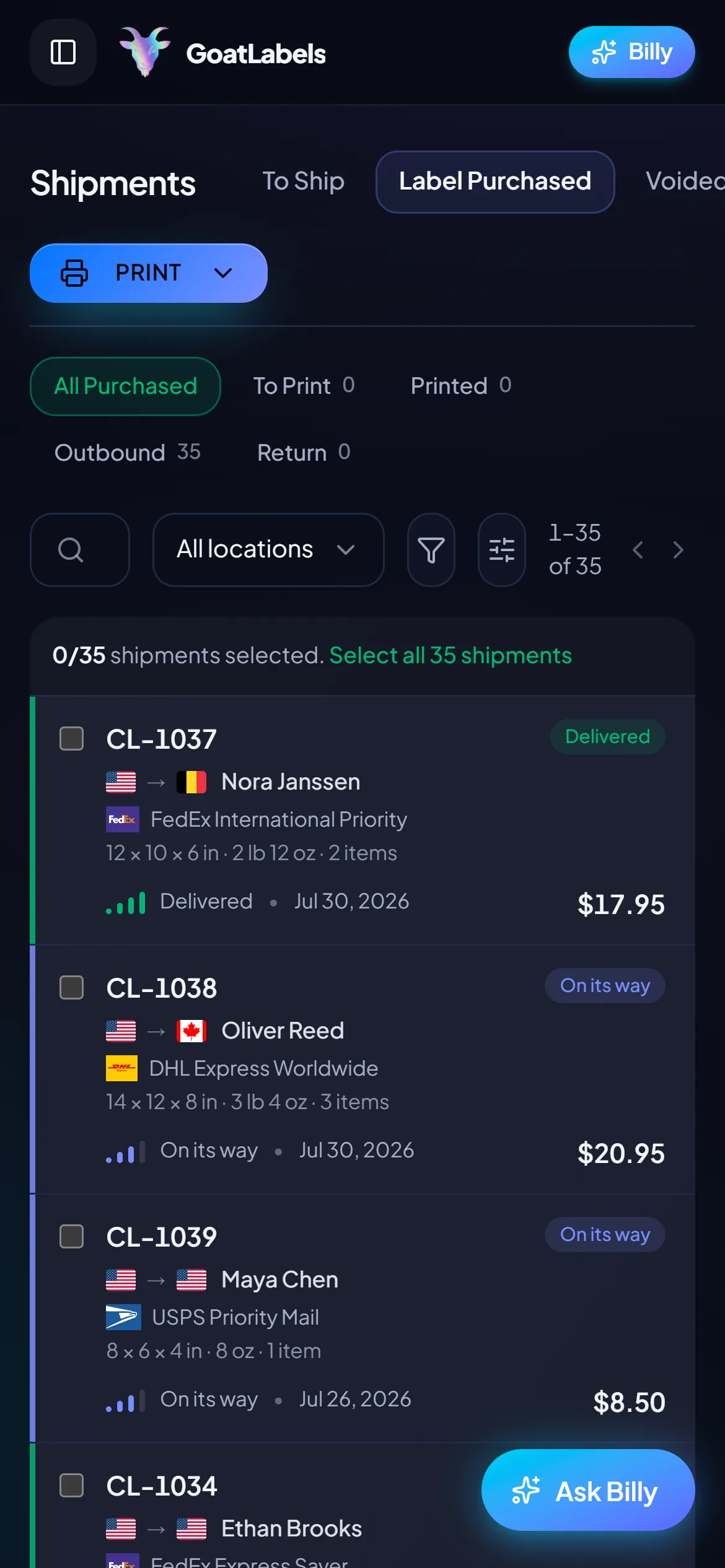
Label bought
Baltimore, MD · the only revenue event
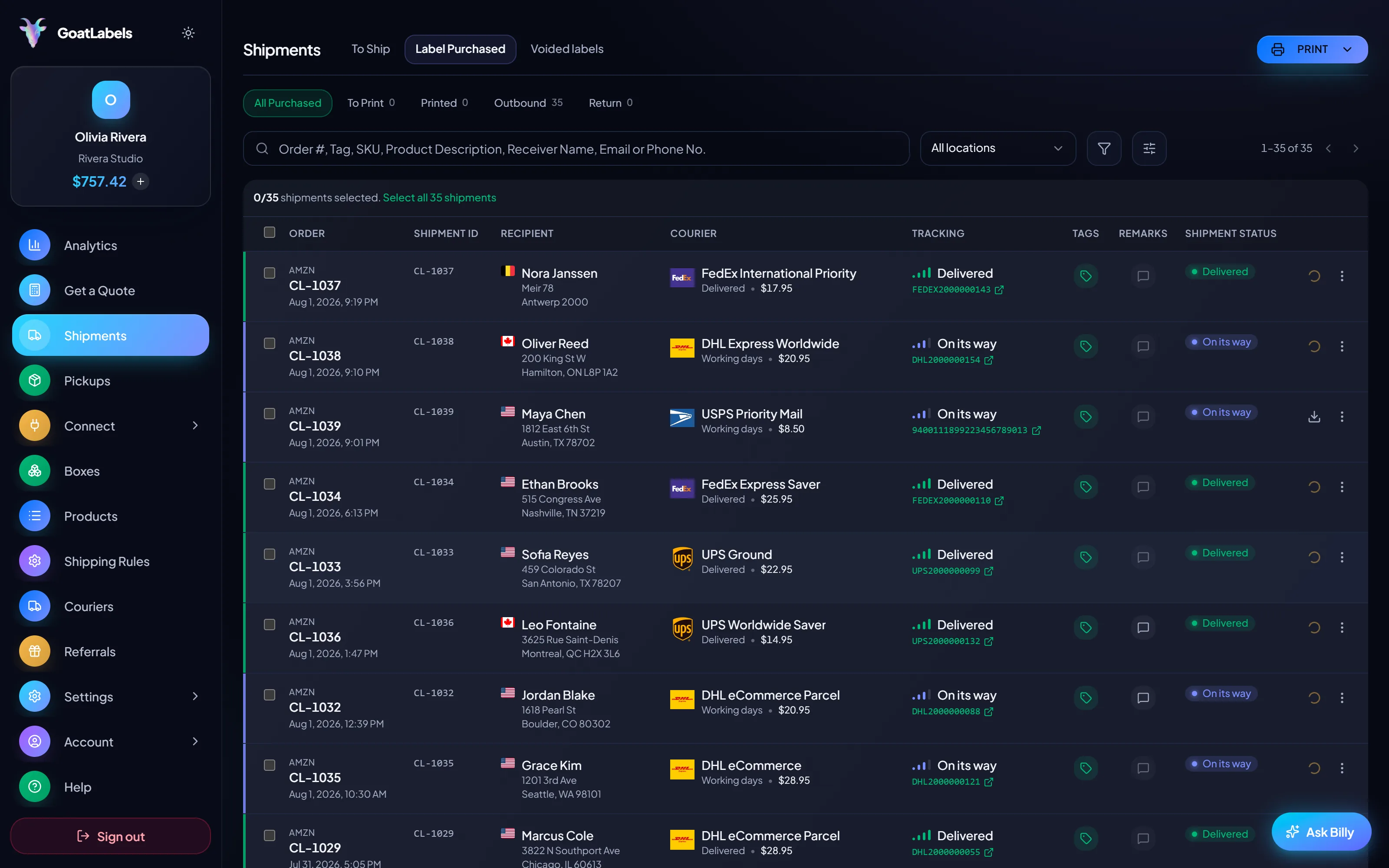
Read the mobile app through the economics and it stops looking like a nice-to-have. A tool that earns only when a label is bought has every reason to make buying possible at the packing table, on the bus, at the kitchen counter — wherever the parcel actually is when it is ready to go.
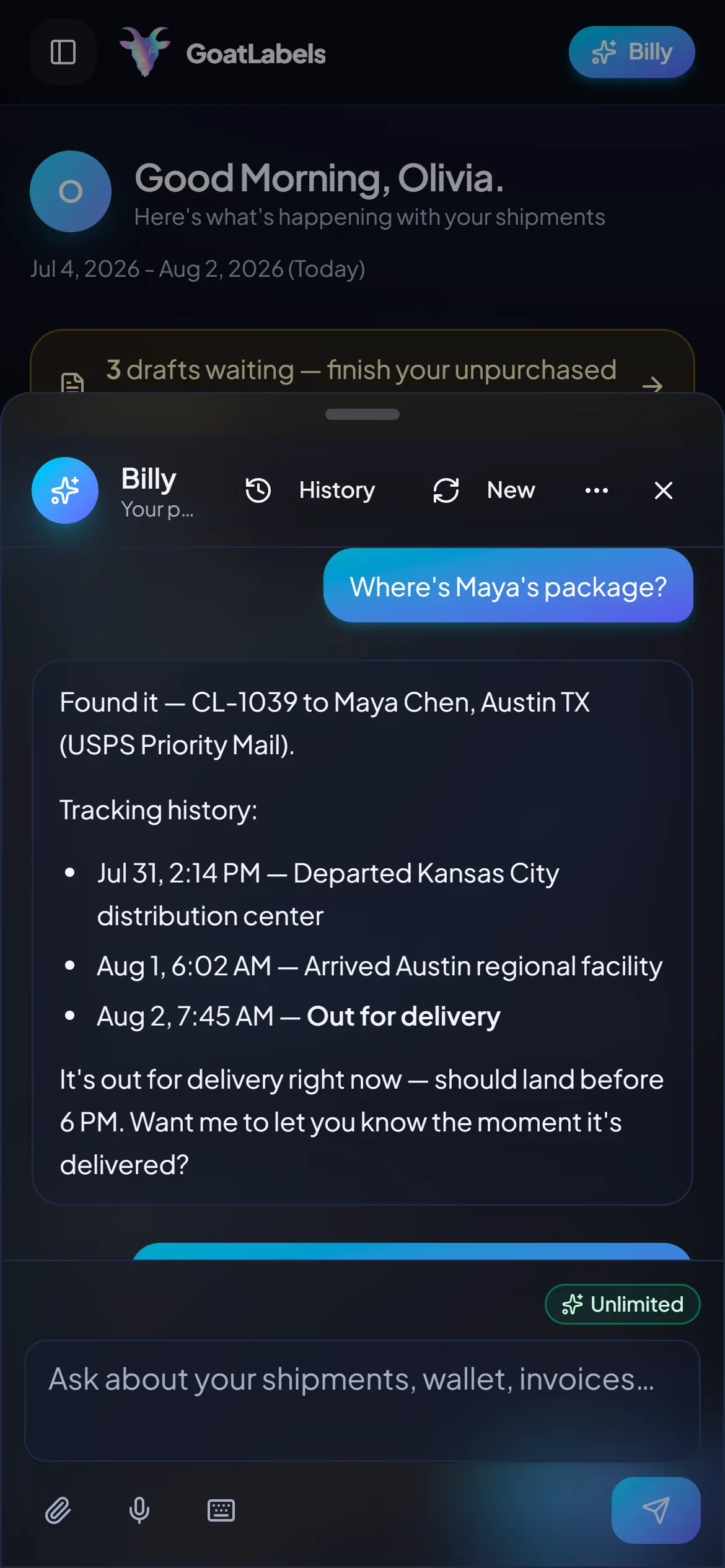
Support is the classic thing a per-label business struggles to fund, and this is the honest workaround: an assistant that answers the questions a person would otherwise have to. Ask where a parcel is or what one cost, and Billy finds the shipment and reads it back — on every plan, because a seller who can self-serve an answer is cheaper to serve than one who cannot. This is the real product, not a render.
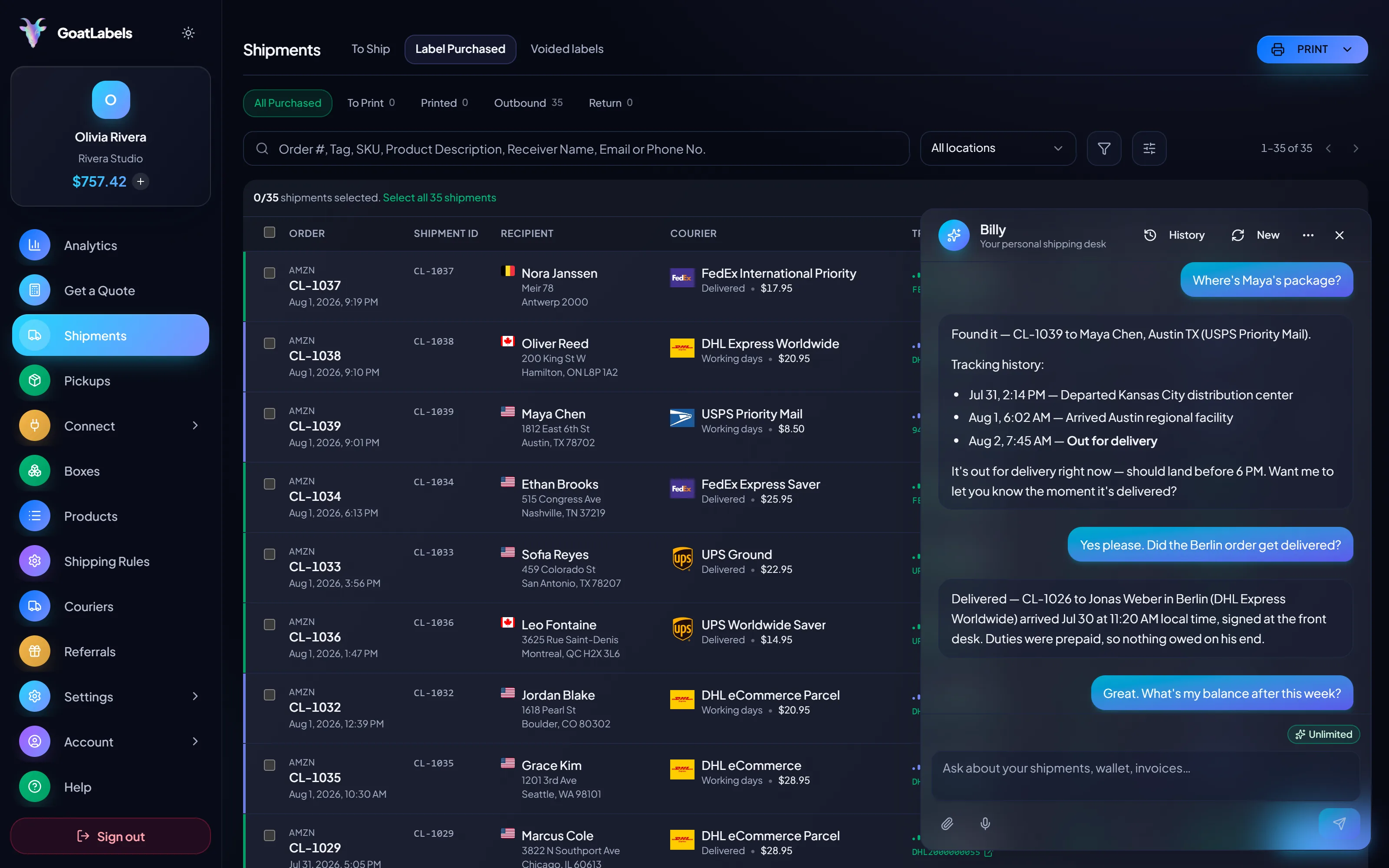
Listening
"Where are the two mugs going to Baltimore?"
Out for delivery
Baltimore, MD · scanned this morning
Speaks plain English · remembers repeat buyers and saved boxes · included on every plan, because the model can afford what reduces the cost of serving you.
This is the part of the model worth checking for yourself. Each column is one all-in number with our spread already inside it, and the spread does not change by carrier — so there is no column here we would rather you chose. A tool that earned more on one carrier would have a reason to make that carrier win, and that reason is what four-carrier rate-shopping removes. Figures are illustrative, not a rate quote; take current numbers from the carriers and from Pirate Ship's own site.
Ground Advantage
2–5 days$7.40
$1.20 of that all-in figure is prepaid insurance, quoted inside the same number
all-in · spread inside, never added on
Ground
3–4 days$10.80
$1.20 of that all-in figure is prepaid insurance, quoted inside the same number
all-in · spread inside, never added on
Home Delivery
2–4 days$11.40
$1.20 of that all-in figure is prepaid insurance, quoted inside the same number
all-in · spread inside, never added on
Metered API pricing is a second revenue model, and a reseller does not need one: whether a purchase came from a dashboard click or a POST, the earning is identical and it already happened inside the rate. So the calls are not counted on any plan — REST and JSON over one Bearer header, signed webhooks instead of polling, and real idempotency keys.
POST /api/v1/shipments
Authorization: Bearer sk_live_…
Idempotency-Key: ord_8421

{
  "to": { "name": "Joyce", "city": "Berlin", "country": "DE" },
  "parcel": { "weight": 2.6, "weight_unit": "lb" },
  "service": "fedex_intl_priority"
}
Everything the prose above describes is on this card. Free is the reseller model working as designed: fund a prepaid wallet, buy labels at commercial pricing with our spread inside it, and pay nothing monthly. Free covers 50 shipments a month; past that, Pro is a published flat fee with unlimited shipments.
 — draft a label without opening the dashboard
Rate by plan
illustrativepay for labels, not for seats
$0 / forever
The spread pays for the software, so the software costs you nothing.
The assistant that drafts labels from a pasted order, a screenshot, or your voice runs unlimited on Free — it exists because drafted labels become bought labels, which is exactly how this model pays for features.
Telegram, ProGET /api/v1/shipments
200 OK · plan: free
Unlimited calls on Free — still unlimited on Pro.
Put a real parcel through and compare the side-by-side rate against what that label costs you on
Pirate ShipShippoShipStationLabel prices are quoted live from USPS, UPS, FedEx, and DHL as one all-in number — the exact amount that leaves your wallet. Competitor rates move constantly, so compare against their current sites rather than any figure printed here. Full pricing details
Pooled volume is what makes commercial pricing reachable for people who could never negotiate it alone. These are the four shapes of seller the arrangement was effectively built for — and the one place it runs out.
 Thirty parcels a month, or three hundred
A carrier's best commercial tiers go to partners who bring enormous, predictable volume. Alone you are not that; inside the pool you are part of something that is. This is the whole benefit of the arrangement, and it is real.
 Busy December, empty February
On Free, per-label economics have a property a subscription cannot copy: nothing is owed in a month nothing shipped. A December past 50 shipments needs Pro ($40 a month, no minimum term), which you can cancel before February.
No revenue for us either
On Free a quiet month costs you nothing because it pays us nothing

 The cheapest integration there is

 Where the model honestly runs out
0
warehouse suites, inventory systems, or phone-first support — those live behind subscriptions, and this page will not pretend otherwise
Pirate Ship is a trademark of its owner and is not affiliated with GoatLabels. For the side-by-side, read GoatLabels vs Pirate Ship orhow four-carrier rate shopping changes the quote.
A video took off and I had 80 TikTok Shop orders by morning. I printed every label from my phone on the bus to the post office.
Early customer · TikTok
TikTok Shop seller
TikTok ShopI run my Etsy shop from the kitchen. The AI reads the order, picks the carrier, the label prints. That's the whole workflow now.
Early customer · Etsy
Etsy maker
EtsyThe API is what every shipping API pretends to be. Idempotency that actually works.
Sasha R.
Staff engineer, marketplace
Fund a prepaid wallet, quote your next domestic parcel across USPS, UPS and FedEx (DHL joins on international lanes), and let the carriers compete inside the same reseller economics you just read about.
Sign up in seconds. No card required. No monthly fee on Free, up to 50 shipments a month.
Updated