

USPS
Priority Mail Intl
10–15 days$7.40
$1.90 of duties and taxes prepaid inside the same number
all-in · no plan line attached
Easyship prices access by plan: each tier caps shipments and features, and crossing the cap prompts an upgrade to the next plan. GoatLabels Free covers 50 shipments a month with no monthly fee, and past that Pro is one flat plan with unlimited shipments: you fund a prepaid wallet by card, Apple Pay, Google Pay, ACH, or crypto, and rate-shop USPS, UPS and FedEx on every domestic parcel, with DHL on international lanes.
USPS, UPS and FedEx quoted on every domestic parcel, DHL on international lanes, on every account; carrier access is not a plan feature here.


 DHL: international
Card, Apple Pay, Google Pay, ACH, or crypto top up one prepaid balance that only moves when a label is bought.
Easyship is a capable multi-carrier platform, and nothing on this page pretends otherwise. The thing worth understanding before you sign up is not any single price — it is the shape of the pricing. Easyship sells access by plan, and a plan is a prediction: you are asked to guess, in advance, how much you will ship, how many people will help you ship it, and which features the next quarter will turn out to need. Small sellers are precisely the people least able to make that guess, because a good month on Etsy or a video that travels on TikTok can triple volume without warning.
Once you look at the tiers as a metering system rather than a menu, they decompose into four levers, and every one of them converts a fact about your business into a billing event. The table below maps each lever to the moment it actually bites a small operation.
| Lever | What it meters | Where it bites a small seller |
|---|---|---|
| Shipment quota | Each tier carries a monthly cap on shipments. Every label you create counts down against it, whether the parcel was profitable or a favor. | The month a marketplace feature or a holiday spike lands — the cap does not know your December from your February. |
| Seat count | Team members are a tiered resource. Adding a packer or a part-time helper can mean a plan question, not just a login. | The week you hire your first helper and discover a second pair of hands is a pricing event. |
| Feature gates | Capabilities such as shipping rules, branded tracking, automatic order sync, and multi-box shipments unlock by plan rather than shipping with the product. | When the feature you suddenly need sits one tier up, the fix is an upgrade that also re-prices every shipment you were already sending. |
| The cap boundary | Easyship's help center says that when volume exceeds the plan's limit, you are prompted to upgrade to the next plan, prorated for the current month. | At the exact moment volume is going well, the marginal parcel gets more expensive instead of less. |
The quota boundary is where a metered plan stops being an abstraction. Ship past the cap and Easyship's help center says you are prompted to upgrade to a higher plan, prorated for the current month and charged in full from the next billing cycle unless you downgrade again, slow months included. GoatLabels has a boundary too: Free stops at 50 shipments a month and past that Pro is a flat $40 a month, but there is one step rather than a ladder, and Pro has no minimum term, so you can cancel it when volume drops.
The subtler cost is the attention. A seller on a metered plan carries a running count in the back of their head all month — how many shipments are left, whether the restock drop should wait for the first, whether an upgrade now would pay for itself before the season ends. That is real cognitive overhead spent on your software vendor's billing model instead of on packing boxes, and it renews every single month. The plan-sizing decision is never actually finished; it is only postponed until the next unusual month reopens it.
Here is the whole difference in one sentence: a plan is priced on what you might ship, a wallet is spent on what you did ship. GoatLabels has two plans, and the choice is about volume, not access: every account gets USPS, UPS and FedEx on every domestic parcel with DHL on international lanes, the same rate-shopping, the same API, Billy in the web app and the same store sync, and Pro ($40 a month) adds unlimited shipments past 50 a month, Billy on Telegram. You top up a prepaid balance by card, Apple Pay, Google Pay, ACH, or crypto, and each label debits its all-in quoted price from that balance. Fifty labels in November and three in January is not a sizing mistake here; it is just two different months.
There is no overage rate: Free covers 50 shipments a month, and past that Pro is one flat $40 a month with unlimited shipments. There is no seat arithmetic: team seats, the API, webhooks and store sync are on both plans. If a label is bought in error, an accepted void credits the wallet rather than starting a card-refund wait; the mechanics of that live on our void-a-label page. The one honest caveat: a carrier adjustment that exceeds the wallet balance falls back to a card on file, so the wallet is the default rail, not a hard ceiling. For what labels themselves cost, start withcheap shipping labelsand the pricing page; for funding the balance without touching a bank card at all, seecrypto shipping labels.
For a line-by-line teardown of what actually generates an Easyship bill — both layers of it — seeEasyship pricing explained. If you have already decided and want the migration sequence, that isswitching from Easyship.
Checked on from Easyship's own pages. Plans, fees and policies change, so confirm on the vendor's current page before you decide. Easyship is a trademark of its owner and is not affiliated with GoatLabels.
On a tiered platform the shipment counter decides your plan, and each step up the ladder bills from then on. Here Free counts shipments toward 50 a month like any capped plan, and past that there is one step, a flat $40 Pro plan with no minimum term. An order arrives however it arrived, Billy drafts it, the carriers on its lane bid, and the winning all-in price debits a prepaid balance.
can you ship the bundle to Portland?
Store sync and pasted orders land in the same To Ship queue on every account. Which channels sync is a product fact, not a plan feature — nothing here unlocks by promising a bigger month.
 Billy AI
Void it and, after the carrier accepts the void, the credit returns to the balance, spendable on the next label. The one honest caveat: a carrier adjustment larger than the balance falls back to a card on file, so the wallet is the default rail rather than a hard ceiling.
Shopify, Etsy, WooCommerce, TikTok Shop, Amazon, eBay, Squarespace, Wix, Walmart, Square, BigCommerce, Magento, and Temu sync orders into one To Ship queue, with tracking pushed back when you print. Instagram and Facebook stay paste-only — Billy builds the label straight from the message. On a tiered platform, which integrations you get is part of what the tier sells; here the list is simply the list, identical on a brand-new free account.
 Shopify
 Etsy
Etsy WooCommerce
 TikTok Shop
 Amazon
 eBay
eBay Squarespace
 Wix
Wix WalmartShopify PlusSoon
 Square
 BigCommerce
 Magento
 ZapierSoon
 NetSuiteSoon
 EcwidSoon
 Temu
Temu SheinSoon
 ChannelAdvisorSoon
 SkuVaultSoon
 Zoho InventorySoon
 Patreon
The features Easyship distributes across a tier ladder are on every account here: the API, webhooks, store sync, team seats and Billy in the web app. Pro adds unlimited shipments past 50 a month, Billy on Telegram.
Card, Apple Pay, Google Pay, ACH, and crypto all feed the same balance, and the balance only moves when a label is bought; on Pro the $40 monthly fee is paid from it too. A slow month leaves it untouched; a busy month spends it faster, and a month past 50 shipments also needs Pro ($40 a month, no minimum term). Voided labels credit back to it after the carrier accepts the void, spendable on the next label.
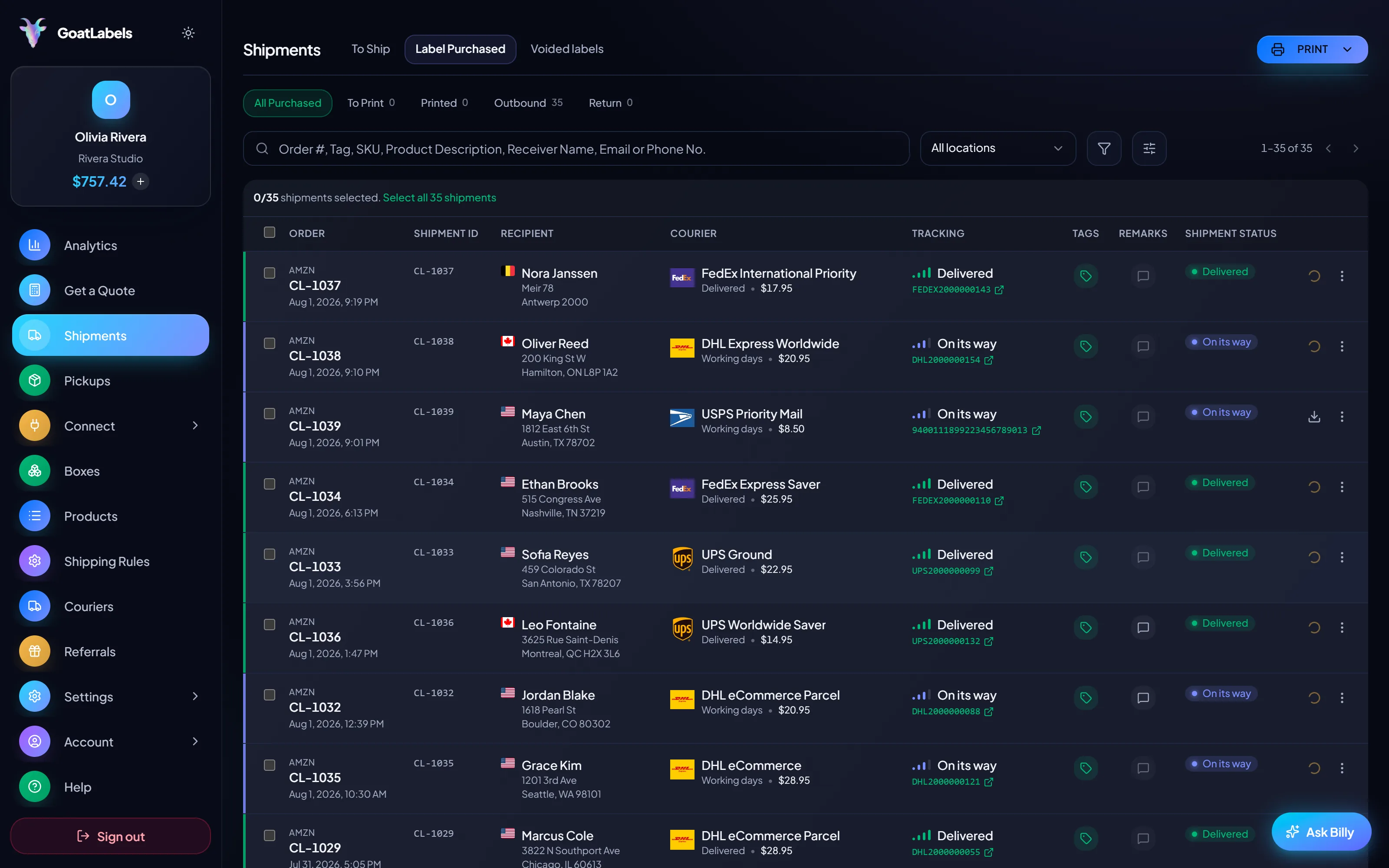
Paste an order, drop a screenshot, or speak an address and Billy drafts the whole label for you to confirm. On a metered platform this is exactly the kind of capability that lands behind a tier gate; here it ships with every wallet, including one funded with a single label's worth.
BillyLIVEFree covers 50 shipments a month; past that, Pro is one flat monthly plan with unlimited shipments, so a spike never meets a per-label overage.
Carrier breadth is not a reward for committing to volume. The first label a brand-new account buys is rate-shopped at all-in prices across every carrier on its lane, exactly like the ten-thousandth, because which carrier wins a parcel has nothing to do with which plan you chose.
UPS$12.48FedEx$13.22DHL$14.10USPS$11.79REST, JSON, signed webhooks, idempotency keys, unlimited calls — on every account, not as a developer tier. Automate on day one or never; the price of the API does not change either way.
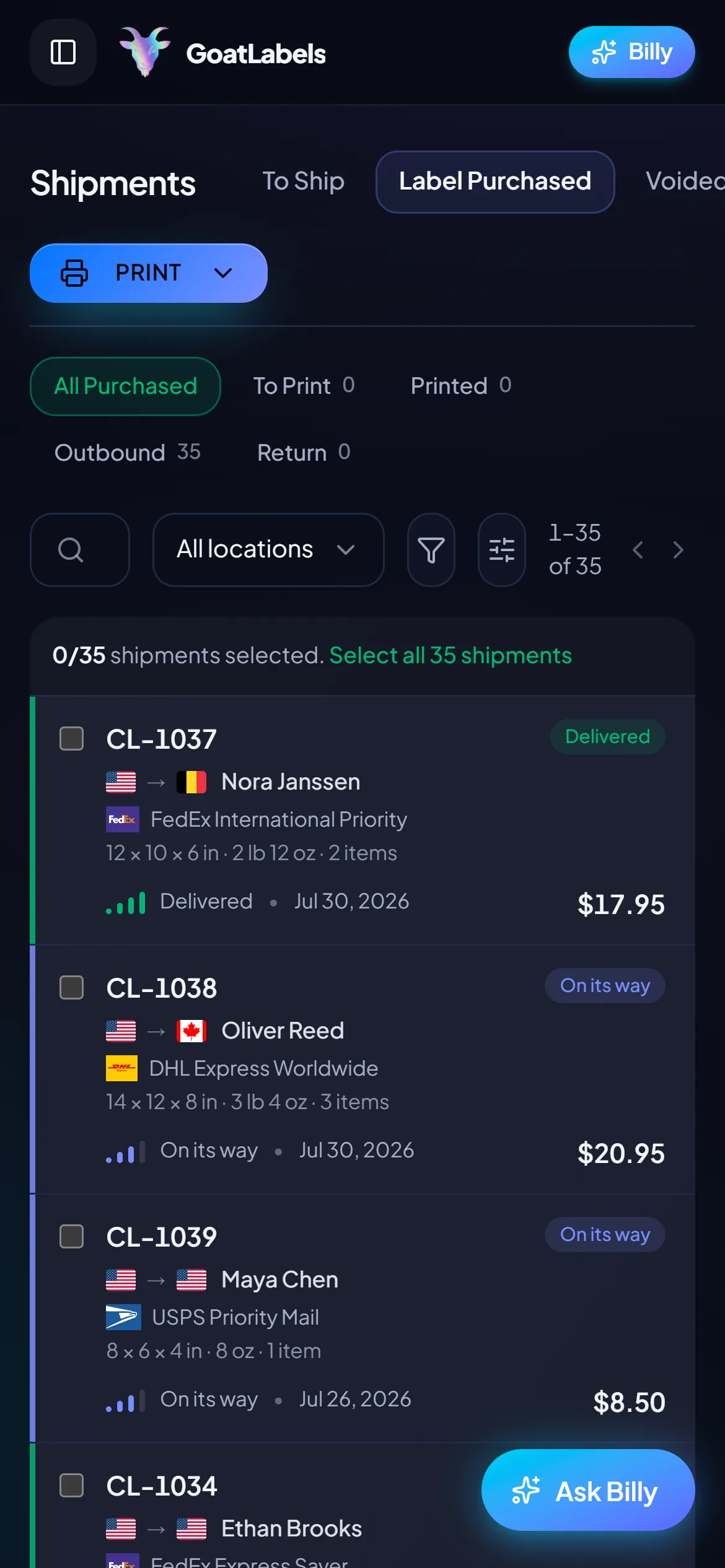
Label ready · all-in price paid
Portland, OR · debited from the balance
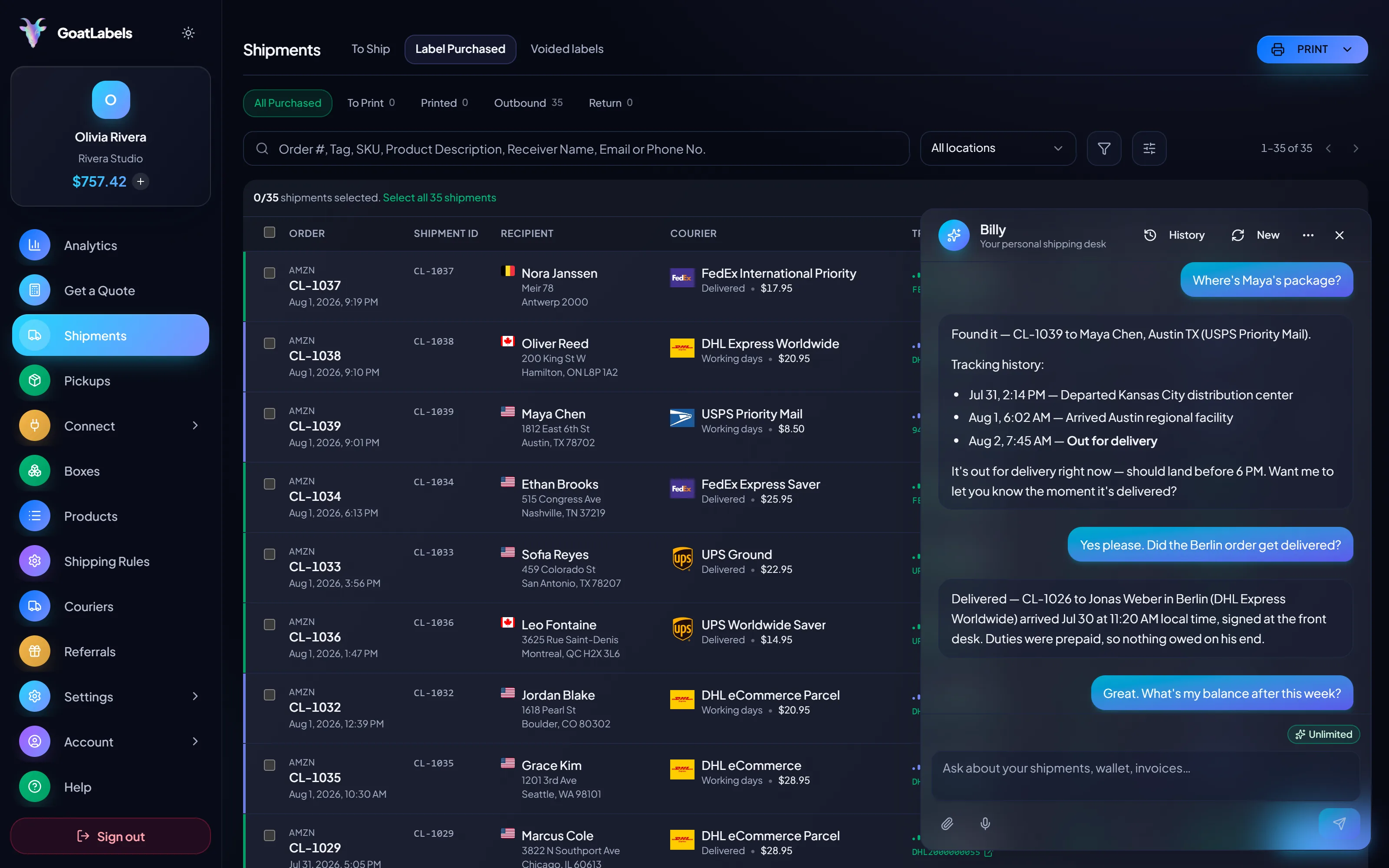
Plan ladders tend to sort capability by where you are sitting as much as by what you pay — the real workflow on the desktop app, a viewer on the phone. There is no such split to price here. Quoting, buying, printing, the wallet, and Billy are the same product on a phone as on a laptop, on the smallest account there is.
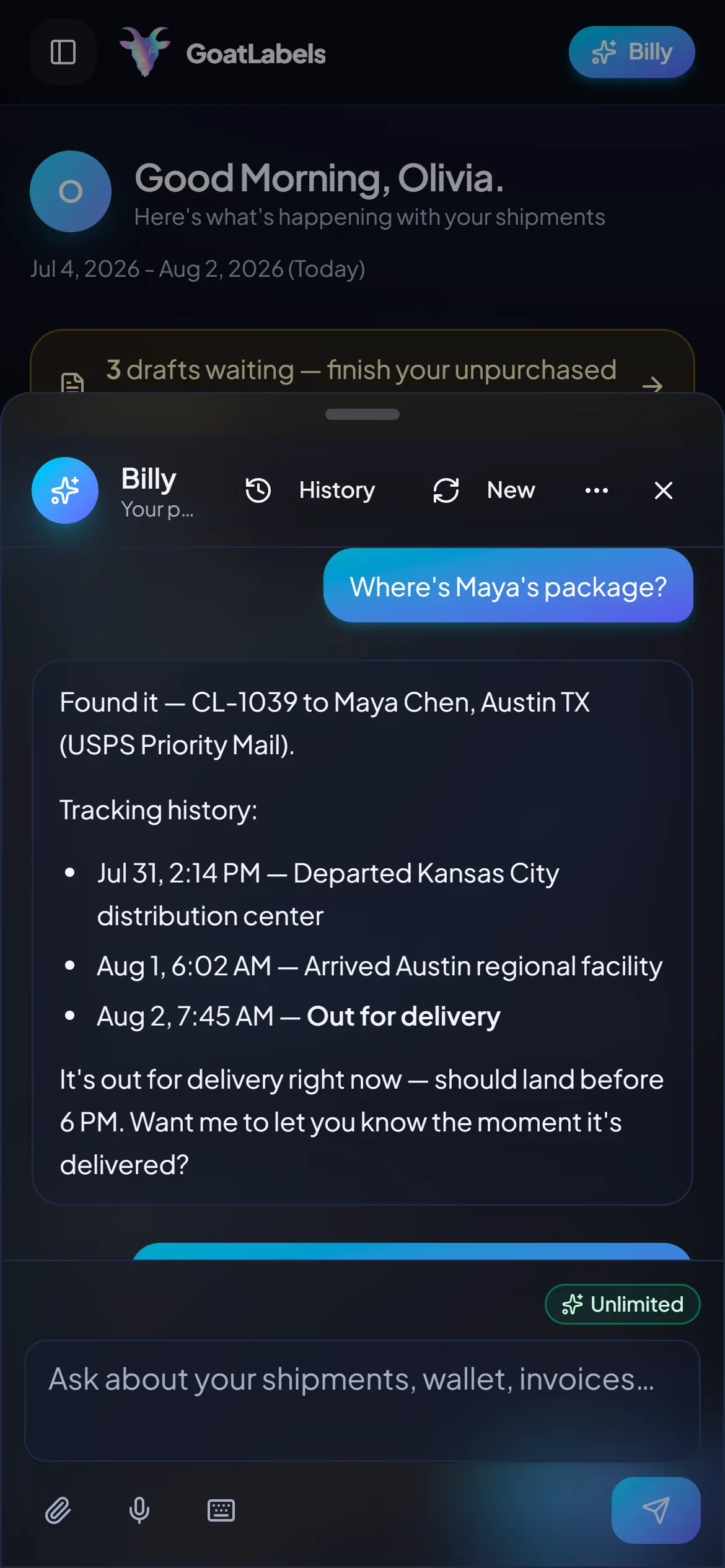
Assistant features are exactly the kind of capability a plan ladder likes to keep one rung above wherever you are. Hold the mic, ask where a parcel is or what one cost, and Billy finds the shipment and reads it back — on a free wallet, on the busiest month, on the quietest one. Included on every plan. This is the real product, not a render.
Listening
"Where is the Portland bundle?"
Out for delivery
Portland, OR · scanned this morning
Speaks plain English · remembers repeat buyers and saved box sizes · included on every plan, so nothing about it depends on how big you promised your month would be.
Here is the trade this page keeps naming, made concrete. We rate-shop USPS, UPS, FedEx, and DHL — four carriers that cover most small-parcel lanes including international, quoted as one all-in number each, with duties inside where the service supports DDP. What we do not have is the long tail of regional couriers a broker marketplace reaches, and if one of those is load-bearing for you, that is a real reason to stay. Figures below are illustrative.
Priority Mail Intl
10–15 days$7.40
$1.90 of duties and taxes prepaid inside the same number
all-in · no plan line attached
Intl Connect Plus
3–5 days$8.90
$2.20 of duties and taxes prepaid inside the same number
all-in · no plan line attached
Express Worldwide
1–2 days$9.80
$2.50 of duties and taxes prepaid inside the same number
all-in · no plan line attached
On a metered platform the API is one of the levers the ladder is built from — deeper access, higher tier. Here it is the same REST and JSON on a free wallet as on Pro: one Bearer header, signed webhooks instead of polling, real idempotency keys, and calls that are never counted.
POST /api/v1/shipments
Authorization: Bearer sk_live_…
Idempotency-Key: ord_8421

{
  "to": { "name": "Joyce", "city": "Berlin", "country": "DE" },
  "parcel": { "weight": 2.6, "weight_unit": "lb" },
  "service": "fedex_intl_priority"
}
There is a paid plan, and it is worth being precise about what it does: Pro ($40 a month) buys unlimited shipments and Billy on Telegram. It does not unlock a carrier, a store integration or an API call; those are on Free too. That is the difference from a tier ladder — the decision is about your volume this quarter, not about which capabilities you are willing to pay to switch on.
 — draft a label without opening the dashboard
Rate by plan
illustrativePro: one flat monthly plan, unlimited shipments
$0 / forever
Fund a balance, print what you ship, owe nothing in the month you ship nothing.
The assistant that turns a pasted order or a screenshot into a drafted, address-validated label runs unlimited in the web app on Free. Pro adds Billy on Telegram, which is a place to reach him, not permission to use him.
Telegram, ProGET /api/v1/shipments
200 OK · plan: free
Unlimited calls on Free — still unlimited on Pro.
On Pro we will work with you to beat the label rates you are already getting from
EasyshipShippoShipStationLabel prices are quoted live from USPS, UPS, FedEx, and DHL as one all-in number, and that exact amount leaves your prepaid balance. Easyship's own tiers, caps, and amounts are theirs and change — take every current figure from their pricing page, not from this one. Full pricing details
The plan-sizing problem does not bite everyone equally. It bites hardest where volume is real but lumpy — which is most of small e-commerce, and all four of these shapes.
 Live commerce and viral drops
A tier has to be sized for the busiest month and is paid for in every other one. When a video travels, a tier climbs with the count; here a month past 50 shipments moves you to one flat Pro plan ($40 a month, no minimum term), which you can cancel when volume drops.
 Holiday-heavy, February-empty
Half the year at full volume and half at almost none is the worst possible fit for a monthly fee. On Free a quiet month costs nothing; a full-volume month past 50 needs Pro ($40 a month, no minimum term), which you can cancel for the quiet half.
Nothing shipped on Free, nothing owed
The balance simply sits there, still yours

 No feed, no connector, no tier for it

 Where a helper is a hiring decision, not a pricing one
1
prepaid balance behind every channel, with no seat count deciding who may print
An alternative page you can trust has to be able to lose the comparison. There are sellers for whom the metered plan is the right trade, because what the tiers buy is genuinely wide: Easyship brokers a courier marketplace that reaches far past the four carriers we quote, and it plugs into fulfillment infrastructure that a label tool has no opinion about. Concretely, stay if any of these describe you:
International shipping on GoatLabels means customs done properly — declarations, HS codes you supply, and saved templates — which is covered oncustoms forms for small parcels.
Related reading: how Easyship pricing actually works,the Easyship migration sequence, andthe carrier-accounts question.
A video took off and I had 80 TikTok Shop orders by morning. I printed every label from my phone on the bus to the post office.
Early customer · TikTok
TikTok Shop seller
TikTok ShopI run my Etsy shop from the kitchen. The AI reads the order, picks the carrier, the label prints. That's the whole workflow now.
Early customer · Etsy
Etsy maker
EtsyThe API is what every shipping API pretends to be. Idempotency that actually works.
Sasha R.
Staff engineer, marketplace
Top up a wallet with card, Apple Pay, Google Pay, ACH, or crypto, quote your next real parcel against every carrier on its lane, and see what shipping costs when nothing else is on the bill.
No card required. No contract. No monthly fee on Free, up to 50 shipments a month.
Updated