

USPS
Ground Advantage
2–5 days$7.40
$1.20 of Premium insurance included
all-in · exactly what a granted void returns
When you void in ShipStation, the refund is issued by the postage provider you bought the label from, under that provider's void and refund policy and timing. On GoatLabels, after the carrier accepts the void, the credit posts to your prepaid wallet, so the value funds the next label instead of returning to a card.
USPS, UPS, FedEx, and DHL apply the same unused-label rules through every reseller. What differs is where the approved value goes next.


 all four
Card, Apple Pay, Google Pay, ACH, or crypto fund one wallet — and a granted void credits that same wallet, whatever the rail.
Checked on from ShipStation's own pages. Plans, fees and policies change, so confirm on the vendor's current page before you decide. ShipStation is a trademark of its owner and is not affiliated with GoatLabels.
The comparison this page makes is only checkable if you can see where the value went, so here is the whole route in a sentence: the label is bought from a prepaid wallet, the carrier reviews the void on its own clock, and a grant credits that same wallet. There is no funding path to trace afterwards, because there was only ever one.
sorry — wrong apartment, it's 4B not 4D. can you still fix it?
Most voids begin as a message like this rather than as a decision. What matters afterwards is not who raised the request — the carrier decides that identically on every platform — but how many systems you have to read to find the money.
 Billy AI
The carrier still owns the decision and its own review window, and nothing here shortens that. What changes is the leg after approval: no return pipeline to retrace, so the value is either granted and in the balance, or not granted at all.
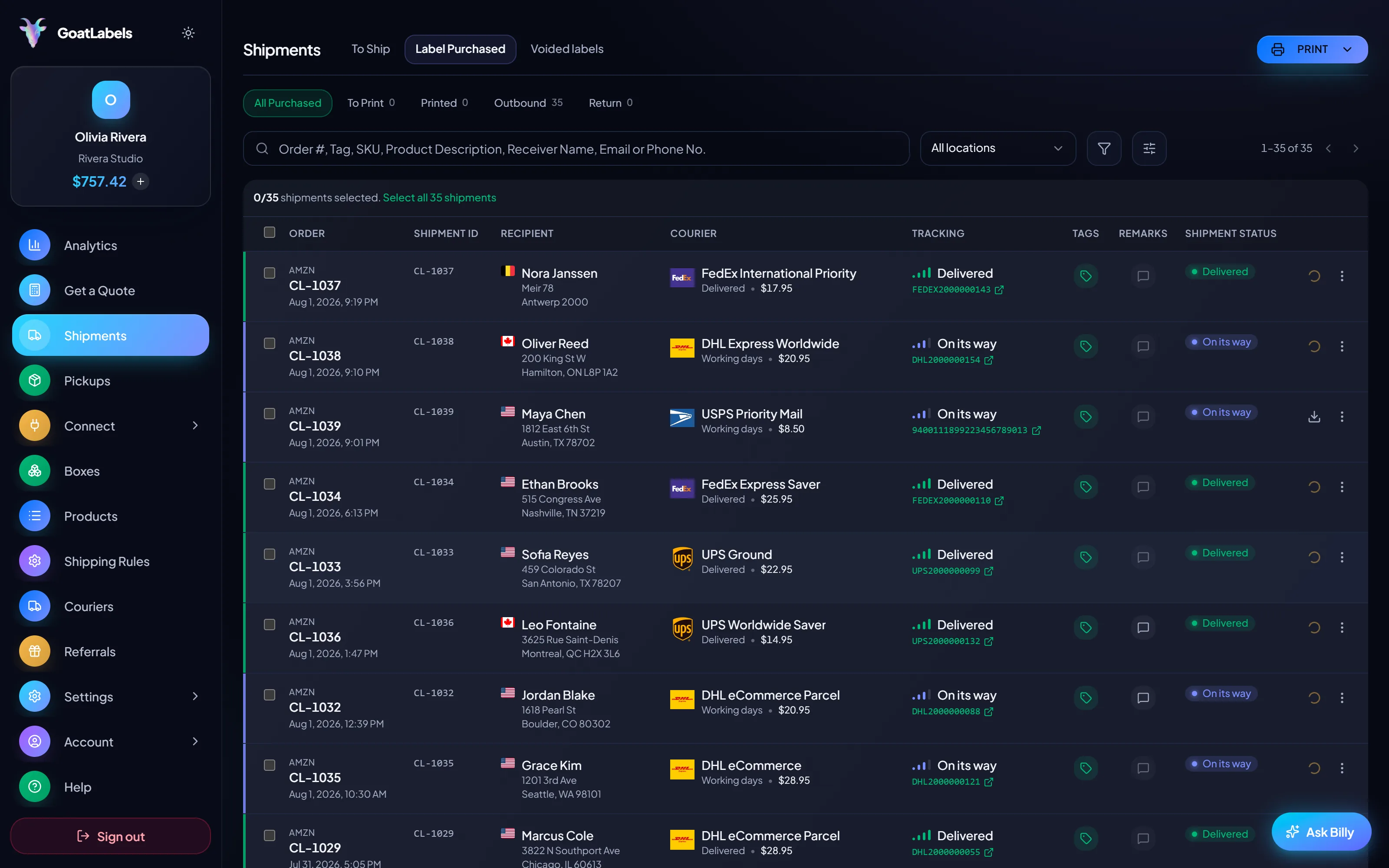
Shopify, Etsy, WooCommerce, TikTok Shop and the rest sync into a single To Ship queue funded by a single wallet, so an accepted void on a TikTok order and one on a Shopify order credit the same balance and read as two lines in the same ledger. Reconciling a void stops being a per-channel exercise and becomes a column.
 Shopify
 Etsy
Etsy WooCommerce
 TikTok Shop
 Amazon
 eBay
eBay Squarespace
 Wix
Wix WalmartShopify PlusSoon
 Square
 BigCommerce
 Magento
 ZapierSoon
 NetSuiteSoon
 EcwidSoon
 Temu
Temu SheinSoon
 ChannelAdvisorSoon
 SkuVaultSoon
 Zoho InventorySoon
 Patreon
ShipStation is a subscription suite in front of carrier billing, and its refund path follows from that architecture. When you void a label there, ShipStation forwards a refund request to whoever issued the postage, and the money — once approved — retraces the path that funded it. That path is not one path. Postage bought through the ShipStation Balance you topped up comes back to that balance, and labels billed through a connected carrier account resolve on the carrier's own invoice, where an unused label is simply never charged. The void is one click, but the money's route home depends on plumbing you configured months ago and probably forgot.
None of this is a criticism of ShipStation specifically — it is what refunds look like whenever labels are paid for through funding pipelines rather than from a held balance. The point of tracing it is practical: until you know which pipeline your label rode in on, you cannot know where to watch for the money, and sellers regularly spend a support thread discovering that the refund they were hunting on a card statement had quietly landed in a postage balance instead.
ShipStation void flow, checked against ShipStation's Void Labels help article on 2026-10-17. As of that date: voids are raised from the shipment record inside ShipStation; refunds are issued by the postage provider the label was bought from, under that provider's void and refund policy, and voided UPS from ShipStation labels are credited to the ShipStation Balance, not to your card; post-billed carrier accounts such as UPS and FedEx do not charge for labels that are never used; a Voided status does not show the refund status; and each carrier's void window applies as published. Day counts are deliberately absent here, because published figures for the same carrier conflict across sources, so the governing documents named on the void page are the only numbers worth trusting.
Strip the resellers away and every void has the same skeleton: the carrier checks that the label never entered its network, applies its own age limit, and only then releases value. That review is the slow half of every refund on every platform, and nothing any software vendor does can shorten it — a point worth stating plainly because refund-speed marketing often implies otherwise. USPS wants evidence the postage went unused; carriers that bill on movement may simply never invoice an unmoved label, which means there is nothing to refund at all, just an invoice line that never appears. Which of those worlds your label lives in depends on the carrier and the billing arrangement, not on the logo on the dashboard.
What a platform does control is everything after approval. On ShipStation, approval releases the money into whichever return path the label was funded through, and that path decides where and how long you wait for it. The distinction this whole series turns on is that second leg: the carrier clock is universal, the plumbing clock is a design choice. TheEasyPost andShippo pages walk the same two clocks through API-first and per-label-fee models, and theStamps.com page does it for a postage-balance subscription; the ShipStation edition is distinct because its funding paths are plural, so the second clock does not even have one length.
Run the identical mistake through a prepaid wallet and the second clock disappears, because there is no pipeline to retrace. A granted void credits the wallet the label was bought from, spendable on the next label once it posts: the mechanicvoiding a shipping label owns and explains in full. What belongs to this page is the contrast with the plural destinations above: here the destination is always the same place, regardless of carrier and regardless of whether the wallet was topped up by card, Apple Pay, Google Pay, ACH, or crypto. There is nothing to configure that could route a credit somewhere surprising, and nothing to remember about which funding path a given label used.
The visibility differs too. Because the credit is a ledger event rather than a reversal in transit, it posts, once granted, as its own line, next to the purchase it undoes, on the same balance that will buy the correction. A ShipStation seller reconciles a void across systems: label status in one place, money in another, arriving later. A wallet seller reads one column. For a shop that voids twice a year the difference is cosmetic; for one that voids weekly — relabelled batches, buyers who correct addresses an hour after paying — it is the difference between a bookkeeping task and a glance.
The honest floor under this comparison is that some labels are beyond both models. A label with an acceptance scan has been performed and cannot be voided anywhere — that money is spent, and if the parcel then costs more than quoted, the difference arrives as apost-shipment billing adjustment, which is a different process with its own page. A label older than its carrier's window is written off on every platform alike. And a duplicate that shipped alongside its twin gets billed twice by a carrier that scanned both, no matter who sold either label. The wallet changes what a fixable mistake costs you in time and float; it does not make unfixable mistakes fixable, and a comparison page that implied otherwise would deserve the distrust it earned.
So the fair summary is narrow and real. Carrier rules: identical. Approval odds: identical. What happens to approved value: structurally different — a plural, configured return pipeline on one side, a single prepaid balance on the other. If you are already weighing the platforms more broadly, ShipStation pricing explained covers what the subscription buys, and the void behaviour described here is one of the quieter things a seller gives up or gains in that trade.
Follow a single voided label through both systems. The carrier's decision is the same on both sides — every row below is about what happens to the money after the carrier says yes.
| GoatLabels | ShipStation | |
|---|---|---|
| Where the value lands | Credited to the prepaid wallet the label was bought from, as its own ledger line. | Issued by the postage provider under its own policy: labels on ShipStation's carrier accounts credit the ShipStation Balance, and post-billed accounts never charge an unused label. |
| When you can spend it again | When the credit posts, the corrected label can be bought from the same balance. | When the postage provider's refund posts, which ShipStation's help says is often the same day for UPS from ShipStation labels and later for others. |
| Who decides whether the void is granted | The carrier, under its own published terms — identical on both platforms. | The carrier, under the same terms. No reseller can void a label the carrier will not. |
| How you see the outcome | A visible state on the shipment — requested, then granted or refused — plus a wallet entry. | Label status changes in ShipStation; the money's arrival is confirmed wherever it lands. |
| What varies by carrier | Only the carrier's own window and review — the credit destination never changes. | Both the review and the destination: different carriers and funding setups return value to different places. |
ShipStation is a trademark of its owner and is not affiliated with GoatLabels. Its void flow and billing arrangements are its own to change — check ShipStation's current help documentation for specifics.
After the carrier accepts the void, nothing external is involved: no processor, no funding path, no statement cycle. These are the pieces that keep a wrong label a small fix.
Card, Apple Pay, Google Pay, ACH, and crypto all fund the same prepaid wallet, and a granted void credits that wallet no matter which rail the money arrived on. There is no configuration in which the credit lands somewhere you have to go looking for it.
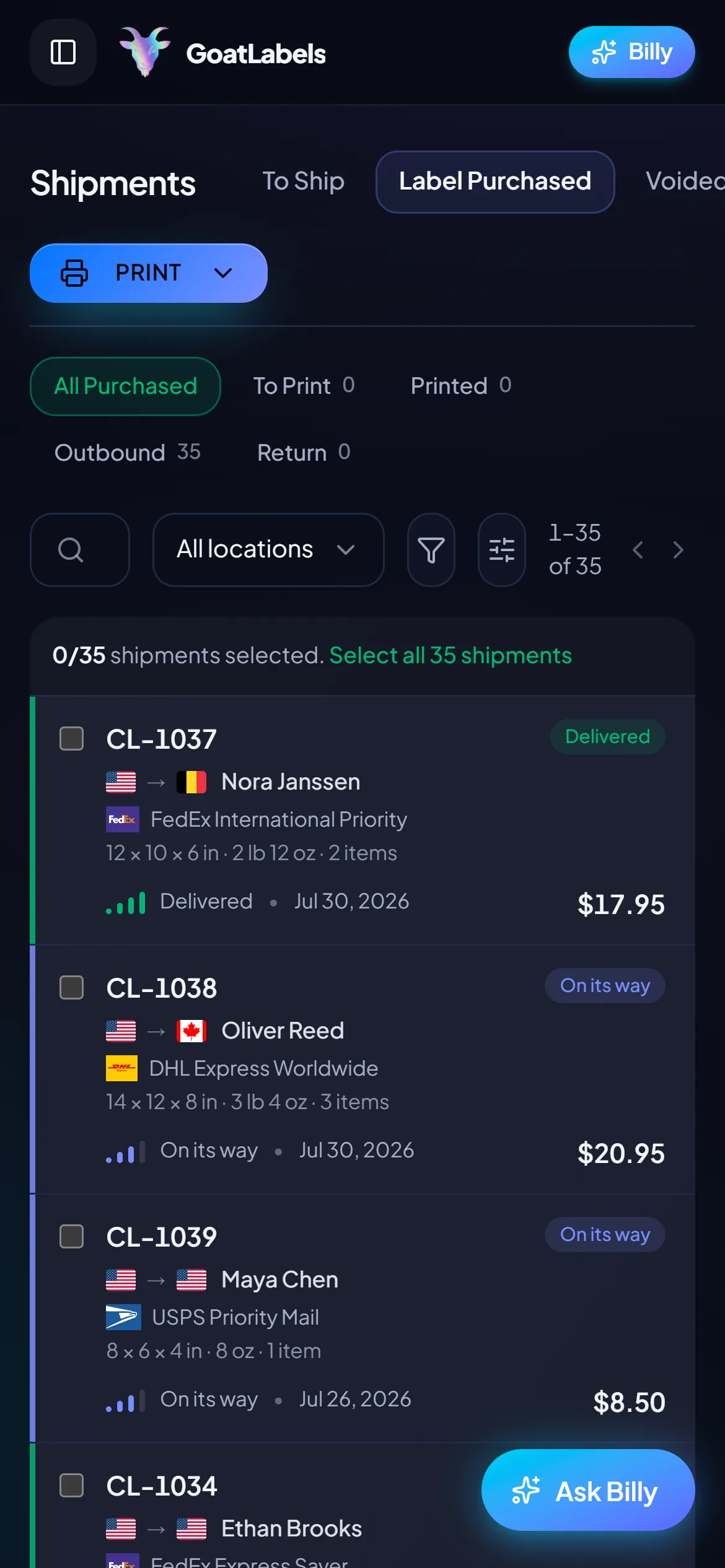
Most voids are address defects that were visible at quote time. Billy drafts the label from a pasted order or screenshot with the destination validated and classified before money moves — the cheapest void is the one that never happens.
BillyLIVEFree has no monthly fee for up to 50 shipments a month, so a week spent voiding and rebuying two labels costs the price of two labels, one of which comes back. The quote you accepted is the exact amount debited, and the exact amount a granted void returns.
The corrected parcel gets fresh quotes from USPS, UPS and FedEx (DHL on international lanes) rather than a reflex rebuy of the original service. A void that ends in a cheaper carrier winning the replacement is a mistake that turned a small profit.
UPS$12.48FedEx$13.22DHL$14.10USPS$11.79Over the REST API a void is requested against the shipment, and a signed webhook carries the granted-or-refused outcome to your code. Unlimited calls on every plan, with idempotency keys so a retried rebuy can never buy twice.
Void granted · credited
Balance updated · replacement ready
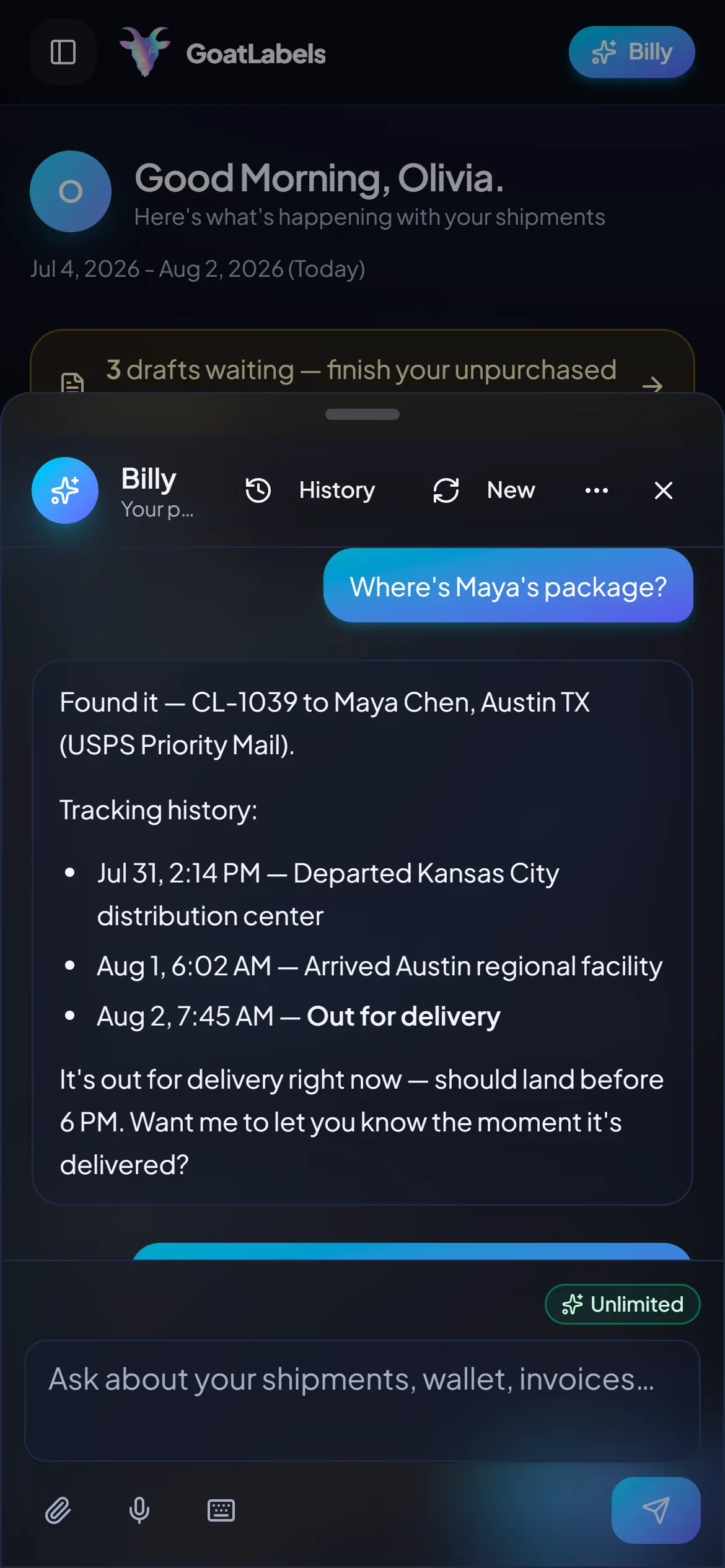
The window in which a void is still free is short, and it almost always opens while you are packing — the buyer's correction lands an hour after they paid. Requesting the void, watching the credit post, and buying the replacement all fit on the phone already in your hand.
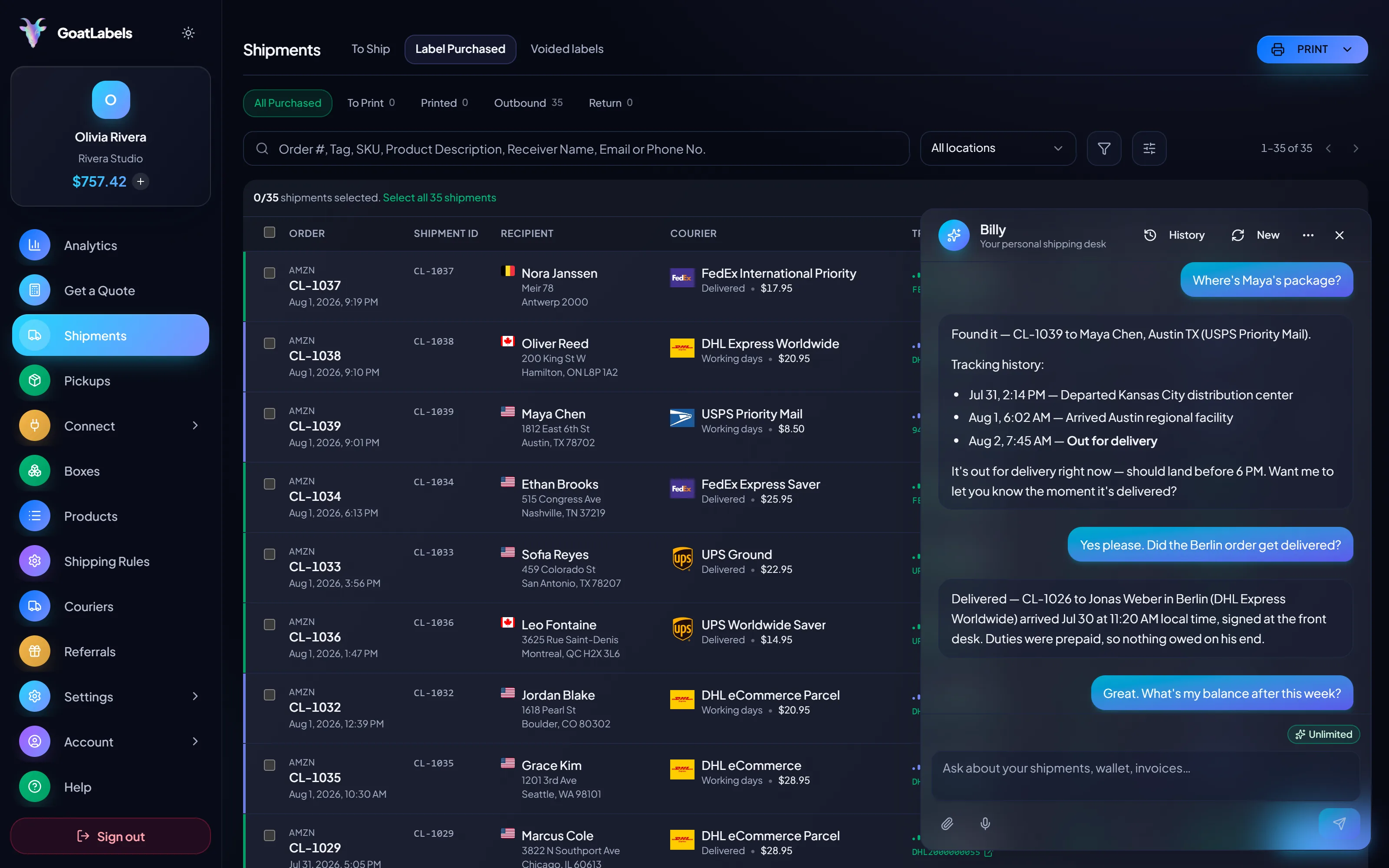
"Did that void go through?" has one answer here because it has one place to look. Ask out loud and Billy reads the shipment's state and the wallet line back to you, instead of you checking a label status in one system and a balance in another and deciding whether the two agree. Included on every plan. This is the real product, not a render.
Listening
"Did the void on the 4B relabel go through?"
Out for delivery
Replacement label · scanned this morning
Speaks plain English · reads the same ledger the wallet shows · phone, browser, or Telegram on Pro.
A granted void returns the exact amount that left the balance, because the quote was one all-in number with nothing added at checkout — no fee stack to unpick, no partial to argue about, nothing routed anywhere on the way home. The replacement then gets fresh quotes rather than a reflex rebuy of the service that was wrong the first time. Figures are illustrative.
Ground Advantage
2–5 days$7.40
$1.20 of Premium insurance included
all-in · exactly what a granted void returns
Ground
3–4 days$10.80
$1.20 of Premium insurance included
all-in · exactly what a granted void returns
Home Delivery
2–4 days$11.40
$1.20 of Premium insurance included
all-in · exactly what a granted void returns
Request the void against the shipment and take the granted-or-refused outcome on a signed webhook instead of refreshing a page. The credit is a record you can read as well, which turns "where did the refund end up" into a query rather than a support thread across two systems.
POST /api/v1/shipments
Authorization: Bearer sk_live_…
Idempotency-Key: ord_8421

{
  "to": { "name": "Joyce", "city": "Berlin", "country": "DE" },
  "parcel": { "weight": 2.6, "weight_unit": "lb" },
  "service": "fedex_intl_priority"
}
A week spent voiding and rebuying two labels costs the price of two labels here, one of which comes back, because Free has no plan fee running underneath it. Free covers 50 shipments a month, with the API, store sync, webhooks and team seats unlimited. Past that, Pro is one flat $40 monthly plan with unlimited shipments, never something you need to unlock a void.
 — fix an address without opening the dashboard
Rate by plan
illustrativePro: one flat monthly plan, unlimited shipments
$0 / forever
Fund a wallet, buy per label, and let a quiet month cost nothing at all.
The assistant that validates a destination before any money moves runs unlimited in the web app on Free. The void you never have to request is the cheapest one on either platform.
Telegram, ProGET /api/v1/shipments
200 OK · plan: free
Unlimited calls on Free — still unlimited on Pro.
On Pro we will work with you to beat the label rates you are already getting from
ShipStationShippoEasyPostLabel prices are quoted live from USPS, UPS, FedEx, and DHL as one all-in number, and that exact amount leaves the prepaid balance — which is the exact amount a granted void puts back. ShipStation's own plans and billing arrangements are its own to change. Full pricing details
For a shop that voids twice a year the difference is cosmetic. These are the four shapes of seller who void often enough that where the value lands stops being a detail.
 TikTok Shop and live commerce
A hundred orders overnight means a handful of wrong ones by morning. Void, requote, and rebuy from the same balance, instead of waiting to learn which pipeline took the value home.
 Label state here, money over there
The tedious half of a refund is rarely the waiting. It is reading a label state in one system and a balance in another and deciding whether the two agree — which one ledger collapses into a glance.
One line, next to the purchase
The credit sits beside the label it undoes

The correction that arrives an hour late

 Same destination on every channel
1
place to look for the money, whichever storefront the order came from
Updated 2026-10-21
The rest of the series:EasyPost refunds vs void to wallet,Pirate Ship refunds vs void to wallet, andShippo refund policy vs void to wallet — with the void mechanics themselves onhow to void a shipping label.
A video took off and I had 80 TikTok Shop orders by morning. I printed every label from my phone on the bus to the post office.
Early customer · TikTok
TikTok Shop seller
TikTok ShopI run my Etsy shop from the kitchen. The AI reads the order, picks the carrier, the label prints. That's the whole workflow now.
Early customer · Etsy
Etsy maker
EtsyThe API is what every shipping API pretends to be. Idempotency that actually works.
Sasha R.
Staff engineer, marketplace
Fund a wallet, buy the cheapest all-in quote, void it before it ships, and check the ledger. The whole experiment costs nothing if the carrier grants the void — and teaches you more than any comparison table.
No card required. Credits land as spendable balance.
Updated