

USPS
Ground Advantage
2 to 5 days$11.40
all-in · no surprises
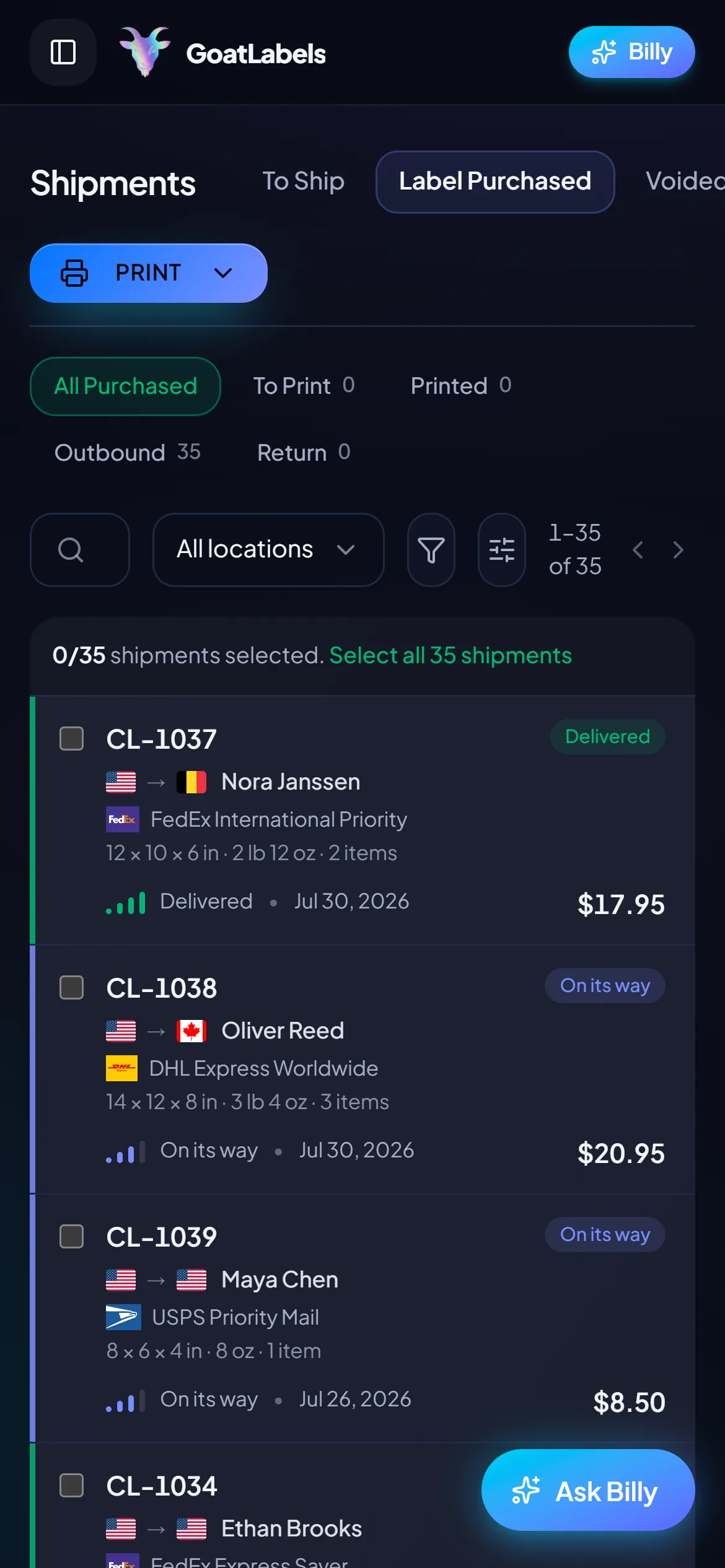
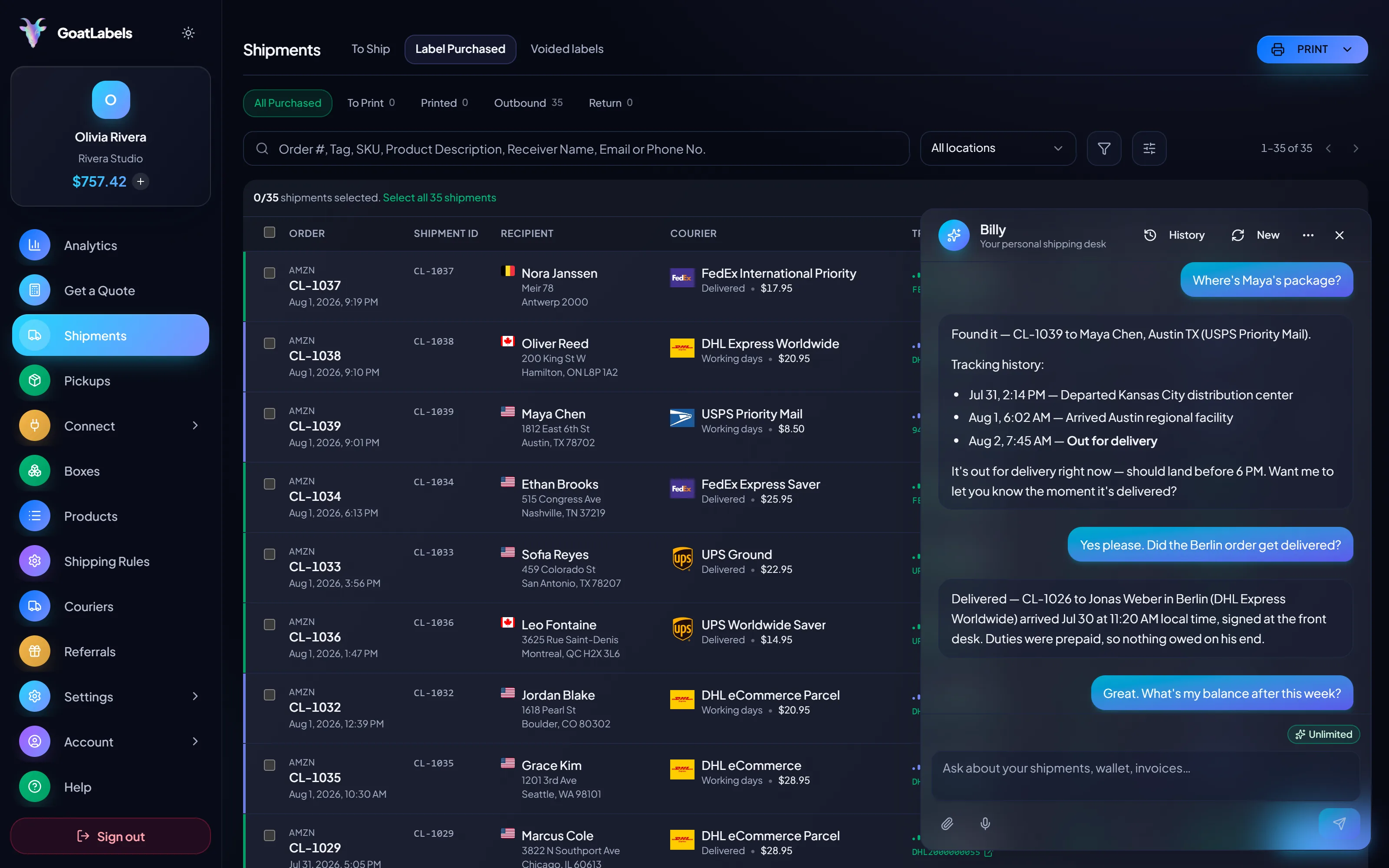
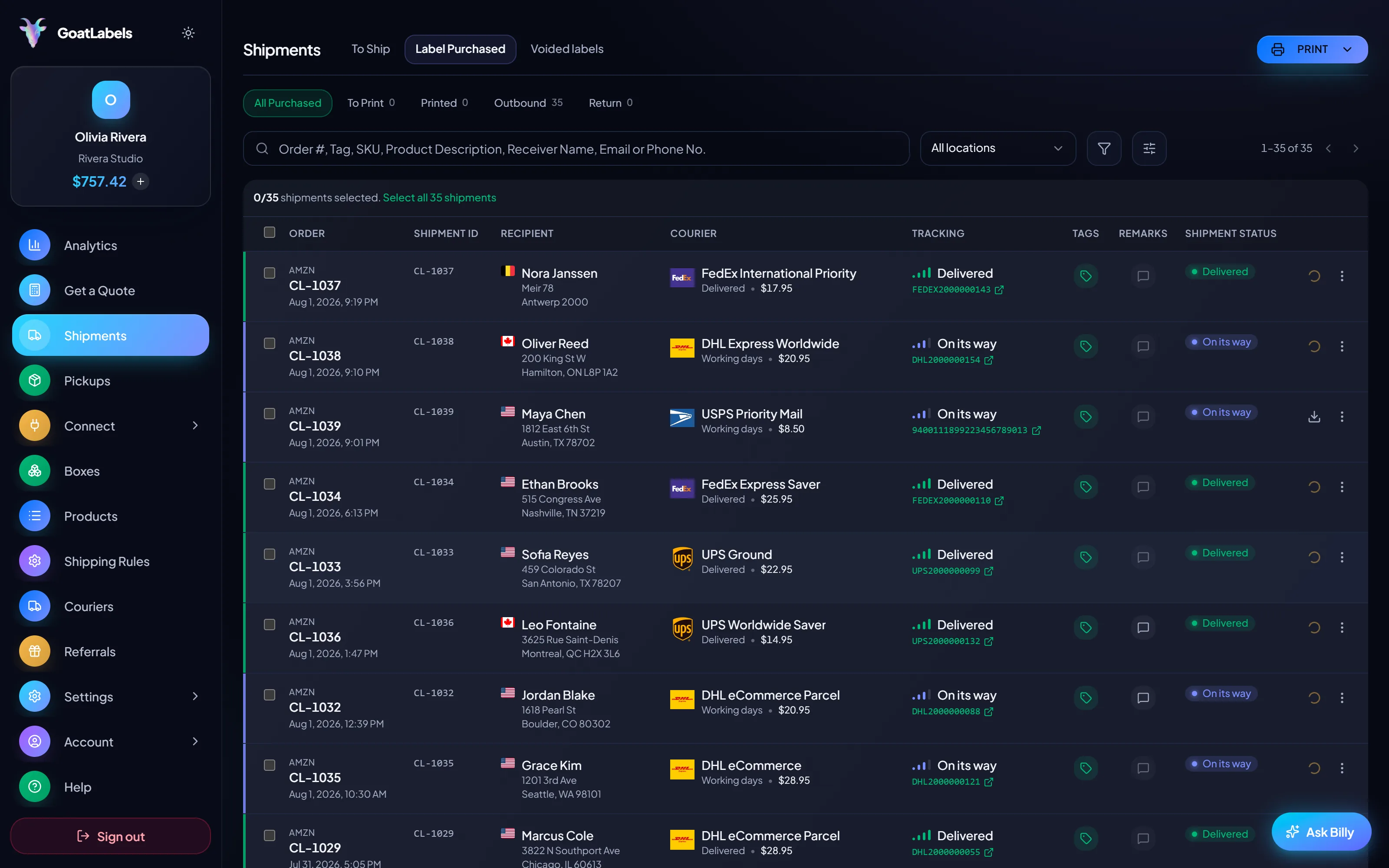
GoatLabels pairs its free API with a complete web dashboard — every rate, label, void and refund works in the browser too, so ops staff aren't locked out of an API-first tool.
USPS, UPS, FedEx, and DHL side by side in the browser — the same rates the API returns.


 all quoted
 Labels bought in the browser and labels bought by your code spend the same balance.
EasyPost is deliberately API-first, and that is a real design choice rather than an oversight. The cost lands on whoever is not an engineer: support, warehouse, and finance staff who need to reprint a label or void a shipment and have to file a ticket to do it.
| GoatLabels | EasyPost | |
|---|---|---|
| Who can create a label | Anyone with a login. The dashboard rate-shops, buys, prints, voids, and tracks without a line of code. | Whoever can call the API, or whoever has the internal tool an engineer built on top of it. |
| Voiding a bad label | A support agent voids it in the browser and the wallet is credited — no engineering ticket. | Typically an API call, so an internal tool has to exist before a non-developer can do it. |
| Feature parity | Rates, labels, voids, refunds, and tracking all work in the UI and via the API, on the same objects. | The API is the complete surface; the dashboard covers a narrower slice of it. |
| Onboarding a new ops hire | A login and a walkthrough. Billy AI drafts labels from pasted order text for anything unstructured. | Training on whatever internal tooling your team has built, which is your team's to maintain. |
| Internal tools to build | None required to get shipping — build them later if you want a workflow we don't have. | An admin UI is usually the first thing a team builds after the integration. |
| Developer surface | REST + JSON, Bearer auth, idempotency keys, signed webhooks, free and unlimited. | Mature, well-documented API with a large SDK ecosystem — their core strength. |
EasyPost is a trademark of its owner and is not affiliated with GoatLabels. Their plans, fees, and carrier list change — compare against their current pricing page before you decide.
The most expensive thing about an API-first shipping tool is not its fee — it is the queue of one-line requests from support to backend. Reprint that label. Void this one. Check where order 1847 is. Every one of those is a browser action here, on the same objects your integration created.
Teams on API-first platforms almost always end up building an internal shipping console, then maintaining it forever. That console already exists here, it is not a second-class view of the data, and it does not drift from the API because both read and write the same shipments.
A label bought in the browser and a label bought by a cron job debit the same prepaid wallet, so finance reconciles one balance instead of matching UI activity against API activity. Voids credit that balance from either path.
The integration you would write here is the same one you have: create a shipment, read four rates, buy the one your logic picks, receive signed webhooks for tracking. What changes is what happens on the days the automation is not the answer — a customer changes their address after checkout, a warehouse prints on the wrong stock, a support agent needs to void and rebuy. Those are browser actions on GoatLabels, performed by whoever is closest to the problem, against the exact shipment objects your code created. Everything is funded from one prepaid wallet topped up with card, Apple Pay, Google Pay, ACH, or crypto, so the UI path and the API path never need reconciling against each other.
Hey! 2x hoodies (M) 1x tee (L) 😅 Ship to: Maya R. Austin, TX 78701
Connectors, REST API, DMs, and screenshots — one queue, visible to your code and to your ops team.

Bought in the browser or by your code — same object, same balance, same webhooks.
Shopify, Etsy, WooCommerce, and TikTok Shop sync into To Ship and push tracking back when you print, and your API integration feeds the same queue. The orders that break the automation — the phone order, the corrected address, the replacement shipment — get handled in the same screen instead of becoming a ticket for whoever owns the integration.
 Shopify
  Etsy
Etsy  WooCommerce
  TikTok Shop
  Amazon
  eBay
eBay  Squarespace
  Wix
Wix  Walmart Shopify Plus Soon
 Square
  BigCommerce
  Magento
  Zapier Soon
 NetSuite Soon
 Ecwid Soon
 Temu
Temu  Shein Soon
 ChannelAdvisor Soon
 SkuVault Soon
 Zoho Inventory Soon
Parity is the claim worth checking on any dashboard: can a person do what the API can do? Here rate shopping, label purchase, voids, refunds to the wallet, tracking, and bulk printing are all browser actions on the same objects, which is what keeps ops off your engineering backlog.
Card, Apple Pay, Google Pay, ACH bank transfer, and crypto all top up the same balance, and both the dashboard and the API spend from it. Void a shipment from either side and the credit lands in the same place, so there is one number for finance to look at.
A DM, a comment thread, a voice note, a screenshot — Billy reads any of them and drafts the whole label inside the dashboard. It is the tool for the order that never entered your system cleanly, and it needs no engineering time to use.
No per-shipment platform fee on either path, so a label a support agent buys costs exactly what a label your code buys costs. Free covers 50 shipments a month with the full API and the full dashboard; Pro is a flat monthly fee for unlimited shipments and cheaper label pricing.
USPS, UPS, FedEx, and DHL quoted live and shown side by side in the browser, with the all-in price that will leave your balance. Your integration sees exactly the same rates from the rates endpoint, so a human overriding the automated choice is making a comparable decision rather than a blind one.
UPS $12.48 FedEx $13.22 DHL $14.10 USPS $11.79 REST and JSON, one Bearer header, idempotency keys so a retried request never buys two labels, and signed webhooks for tracking and label events instead of polling. The dashboard is not a wrapper around a different system — it calls the same surface your code does.
Label ready
CL-1038 · Brooklyn, NY
On an API-first platform, every non-engineering shipping task waits for tooling. Here the packing bench, the phone in someone's hand, and the support agent's browser are all first-class clients of the same shipments your integration created.
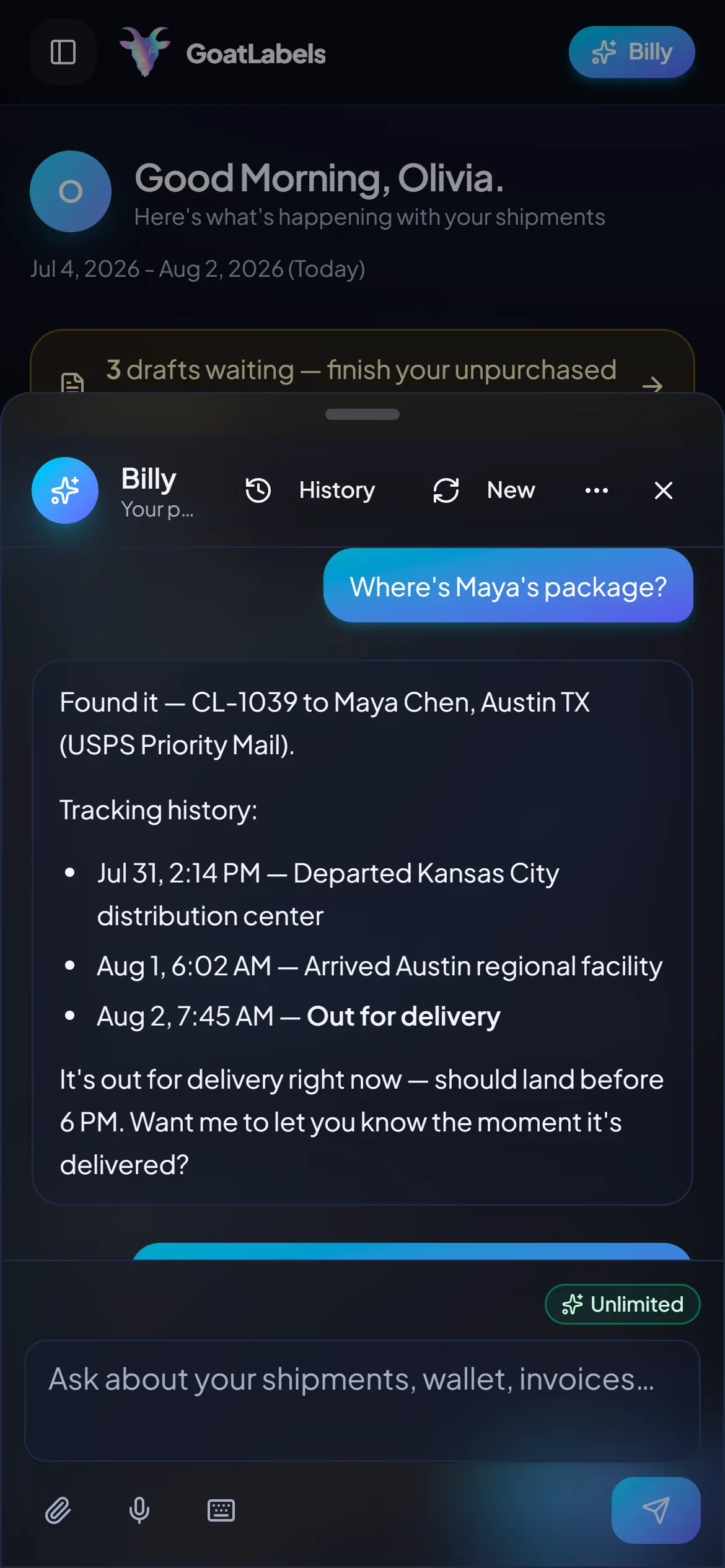
The point of a first-class dashboard is that the person with the problem can solve it. Billy goes one step further: hold the mic, ask where a parcel is or draft a new label by describing it, and it rate-shops four carriers and queues the label against your prepaid balance — then answers questions about it afterwards. This is the real product, not a render.
Listening
"Where's Maya's package?"
Out for delivery
CL-1039 · Austin, TX · by 6 PM
Plain English in — names, addresses, weights, carriers, services · nothing to import and nothing to map · reads the all-in rate back before a cent leaves the wallet · phone, browser, or Telegram.
Three carriers on the same parcel, each an all-in number that is the exact amount leaving your prepaid balance — identical whether the person choosing is your rate-shopping logic or a warehouse lead clicking the cheapest one that still makes the delivery date.
Ground Advantage
2 to 5 days$11.40
all-in · no surprises
Ground
1 to 5 days$9.85
all-in · no surprises
Ground
1 to 5 days$11.20
all-in · no surprises
REST, JSON, one Bearer header. The UI and the API are two front doors on the same objects, so a shipment created by your integration is fully editable, voidable, and printable in the browser — and a shipment created in the browser shows up in your API reads and fires the same signed webhooks.
POST /api/v1/shipments
Authorization: Bearer sk_live_…
Idempotency-Key: ord_8421

{
  "to": { "name": "Joyce", "city": "Berlin", "country": "DE" },
  "parcel": { "weight": 2.6, "weight_unit": "lb" },
  "service": "fedex_intl_priority"
}
Free covers 50 shipments a month with the public API, the store connectors, the full dashboard, and Billy all unlimited underneath it — we make a little on each label instead. Pro is a flat monthly fee for unlimited shipments, cheaper label pricing, and Billy on Telegram. The dashboard is not a paid add-on on either plan.
Volume pricing
illustrativemore volume → lower per-label rates
$0 / forever
The whole UI and the whole API, before you pay anything.
The assistant that reads a DM, a screenshot, or a voice note into a drafted label runs unlimited in the web app on Free. Pro adds Billy on Telegram.
GET /api/v1/shipments
200 OK · plan: free
Unlimited calls on Free — still unlimited on Pro.
On Pro we will work with you to beat the label rates you are already getting from
ShippoPirateShipShipStation Label prices are quoted live from USPS, UPS, FedEx, and DHL and shown as one all-in number — the same number that leaves your wallet, whichever path bought the label. EasyPost's plans move, so compare against their current pricing page rather than a figure on ours. Full pricing details
If a human never touches a shipment, this page is not for you. It is for the teams where support, warehouse, and finance staff currently depend on an engineer to do routine shipping work.
TikTok Shop & live commerce
During a drop the exceptions arrive faster than tickets get triaged. Anyone on shift can rate-shop, buy, reprint, or void in the browser without waiting for the person who wrote the integration.
Etsy & independent creators
Store orders, phone orders, and comment-thread orders land in the same To Ship list, so nobody has to know which ones the automation covers before they can help.
One queue, connector or not
Order #1024 · pasted from a comment thread
The orders that never became JSON
REST and the UI, one balance
1
wallet behind the API and the dashboard
A video took off and I had 80 TikTok Shop orders by morning. I printed every label from my phone on the bus to the post office.
Early customer · TikTok
TikTok Shop seller
I run my Etsy shop from the kitchen. The AI reads the order, picks the carrier, the label prints. That's the whole workflow now.
Early customer · Etsy
Etsy maker
The API is what every shipping API pretends to be. Idempotency that actually works.
Sasha R.
Staff engineer, marketplace
Still comparing? GoatLabels vs EasyPost covers who owns the carrier account, EasyPost pricing explained walks the fee math, and migrating an integration off EasyPost maps the endpoints one by one.
Fund a wallet with card, Apple Pay, Google Pay, ACH, or crypto, buy one label from the browser and one from the API, and confirm they are the same object, the same rate, and the same balance.
Sign up in seconds. No card required. No per-shipment platform fee.