

USPS
Ground Advantage
2 to 5 days$11.40
all-in · no surprises
For a startup, GoatLabels removes the variable EasyPost line item entirely: the API is free and unlimited, so shipping cost is purely the rate-shopped carrier price.
USPS, UPS, FedEx, and DHL quoted live — the carrier price is the whole shipping line in your model.


 all quoted
 Top up with card, Apple Pay, Google Pay, ACH, or crypto and spend it label by label.
Both platforms create shipments, rate-shop, buy labels, void, and track. The difference a seed-stage finance model cares about is which of those lines grows with shipment count and which of them stays flat at zero.
| GoatLabels | EasyPost | |
|---|---|---|
| Cost per shipment | Carrier rate only. There is no GoatLabels API fee to add on top of it, at any volume. | A per-shipment platform fee on paid usage, on top of the carrier rate — check their current pricing page for the tiers. |
| What scales with growth | Carrier spend, which is a cost of goods. The platform line stays at zero as shipments 10x. | Carrier spend plus a metered platform line that grows with the same volume curve as revenue. |
| Carrier accounts | Discounted USPS, UPS, FedEx, and DHL rates are built in — nothing to negotiate before you ship. | Broad carrier network; the best pricing generally assumes you bring your own negotiated accounts. |
| How labels are funded | A prepaid wallet topped up by card, Apple Pay, Google Pay, ACH, or crypto — you cannot overspend it. | Standard billing against the account, settled after the fact. |
| Non-engineering path | A full dashboard plus Billy AI, so support and ops ship without a sprint from the API team. | API-first. Anything a non-developer needs, someone builds. |
| Developer surface | REST + JSON, Bearer auth, idempotency keys, signed webhooks, OpenAPI 3.1. | Mature, well-documented API with a large integration ecosystem — this is their strength. |
EasyPost is a trademark of its owner and is not affiliated with GoatLabels. Their plans, fees, and carrier list change — compare against their current pricing page before you decide.
A per-shipment platform fee is the one shipping cost that grows exactly as fast as your order count and never gets cheaper for being predictable. On GoatLabels that row leaves the model entirely: the API is free and unlimited, so shipping cost is carrier rate times parcels, full stop.
Prepaid means you spend what you ship. A quiet month between launches costs nothing — no platform minimum to clear, no plan to downgrade, no procurement conversation to reverse when the next drop lands and volume triples in a week.
REST and JSON, one Bearer header, idempotency keys so a retry cannot double-buy a label, and signed webhooks instead of polling. A startup that has two backend engineers should not spend either of them on shipping middleware.
Nothing in the migration is exotic: create a shipment, read back four rates, buy the one you want. Store connectors and the REST API feed the same To Ship queue, so an early-stage team can port the integration and keep the old one running until they trust the new rates. What changes is the accounting underneath — every label is a debit against a prepaid wallet funded by card, Apple Pay, Google Pay, ACH, or crypto, and there is no per-shipment platform fee sitting between the carrier price and your balance. That makes the shipping row in your unit-economics sheet a single number you can forecast from parcel count alone, whether you ship forty orders this month or four thousand.
Hey! 2x hoodies (M) 1x tee (L) 😅 Ship to: Maya R. Austin, TX 78701
Connectors, REST API, DMs, and screenshots — one queue, no import mapping, no per-call meter.

No per-shipment platform fee. Signed webhooks push tracking back to the store and to your stack.
Shopify, Etsy, WooCommerce, and TikTok Shop sync into To Ship and get tracking pushed back when you print. Early-stage order flow is rarely that tidy, though: the first hundred customers often arrive through a DM, a founder's inbox, or a spreadsheet. Billy turns any of those into a drafted label without an engineer writing a connector for a channel you may not still be using next quarter.
 Shopify
  Etsy
Etsy  WooCommerce
  TikTok Shop
  Amazon
  eBay
eBay  Squarespace
  Wix
Wix  Walmart Shopify Plus Soon
 Square
  BigCommerce
  Magento
  Zapier Soon
 NetSuite Soon
 Ecwid Soon
 Temu
Temu  Shein Soon
 ChannelAdvisor Soon
 SkuVault Soon
 Zoho Inventory Soon
This is the honest overlap: rates, labels, voids, tracking, and webhooks across four carriers are table stakes and both platforms do them. What a startup is really choosing between is a metered platform line that compounds with growth and one that stays flat at zero while carrier spend does the scaling.
Card, Apple Pay, Google Pay, ACH bank transfer, and crypto all top up the same balance, and every method buys identical rates, carriers, and features. Prepaid also means shipping cannot quietly overrun a monthly budget — you fund what you intend to ship, and voids credit straight back.
A DM, a comment thread, a voice note, a screenshot — Billy reads any of them and drafts the whole label. For a team without a dedicated ops hire, that is the difference between a founder retyping addresses at midnight and confirming a draft on their phone.
There is no per-shipment fee on any plan, so the shipping row in your model is carrier rate times parcels. Free covers 50 shipments a month with the full API underneath it; Pro is a flat monthly fee for unlimited shipments and cheaper label pricing — a choice you make when volume justifies it, not a gate on printing.
Live all-in rates from USPS, UPS, FedEx, and DHL side by side, and the number you see is the exact amount that leaves your balance. Discounted rates are built in, so you are not blocked on negotiating carrier contracts before your first hundred orders — which is exactly where a bring-your-own-account model costs an early-stage team the most.
UPS $12.48 FedEx $13.22 DHL $14.10 USPS $11.79 REST and JSON, one Bearer header, idempotency keys so a retried request never buys two labels, and signed webhooks for tracking and label events instead of polling. Unlimited calls on every plan, including Free, so load testing your integration costs nothing.
Label ready
CL-1038 · Brooklyn, NY
EasyPost assumes there is an engineer between an order and a label. Before that engineer exists — or while they are shipping the actual product — someone at a startup is standing at a folding table with a phone. This is the workflow for that person, and it uses the same free API underneath.
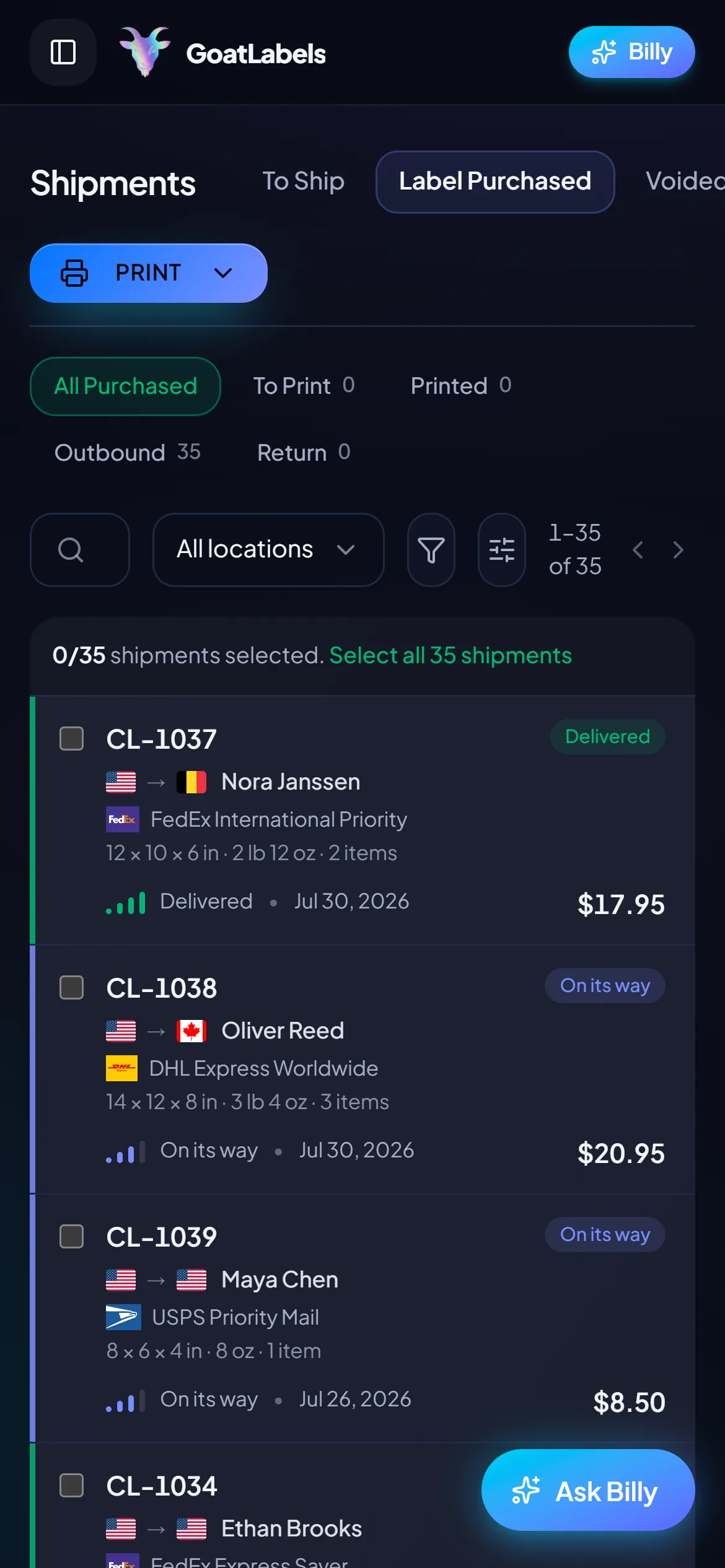
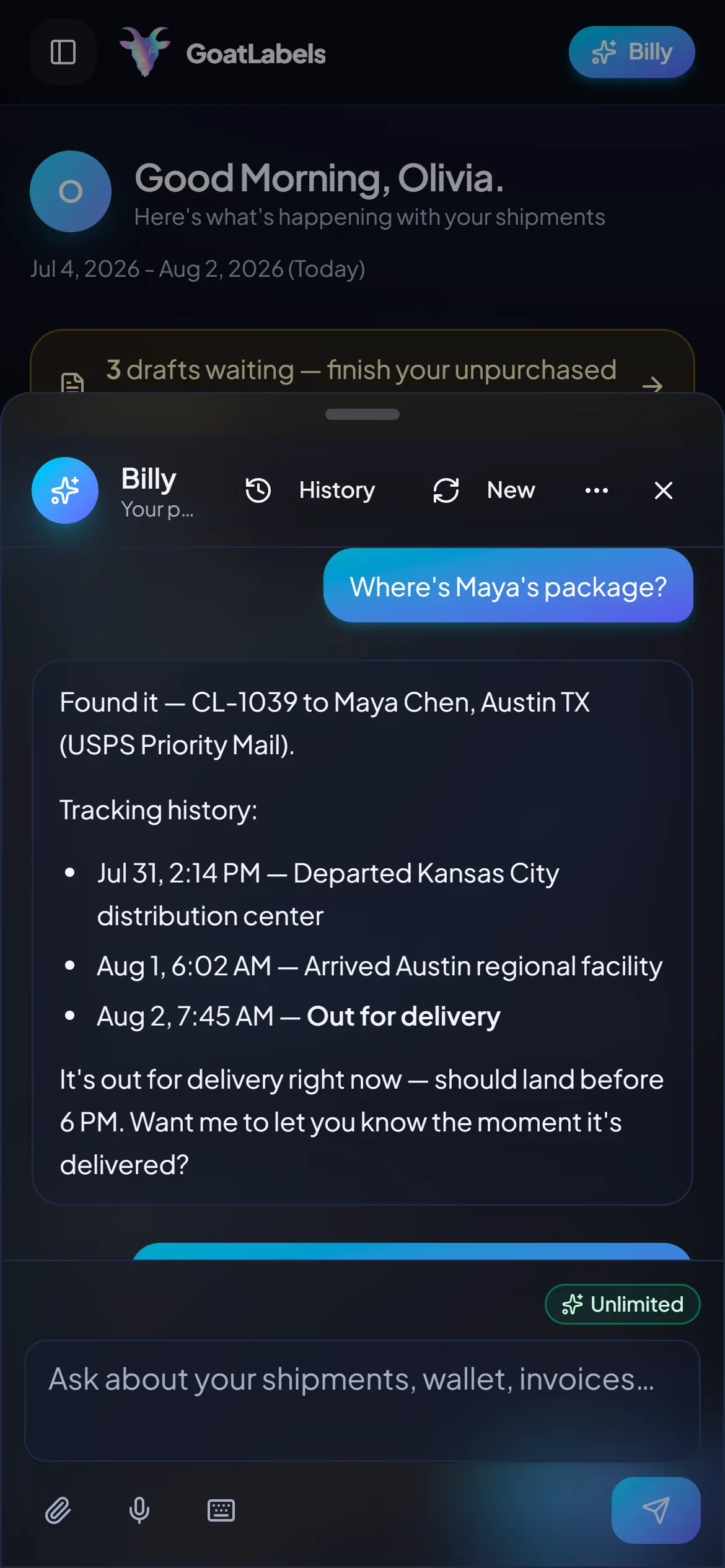
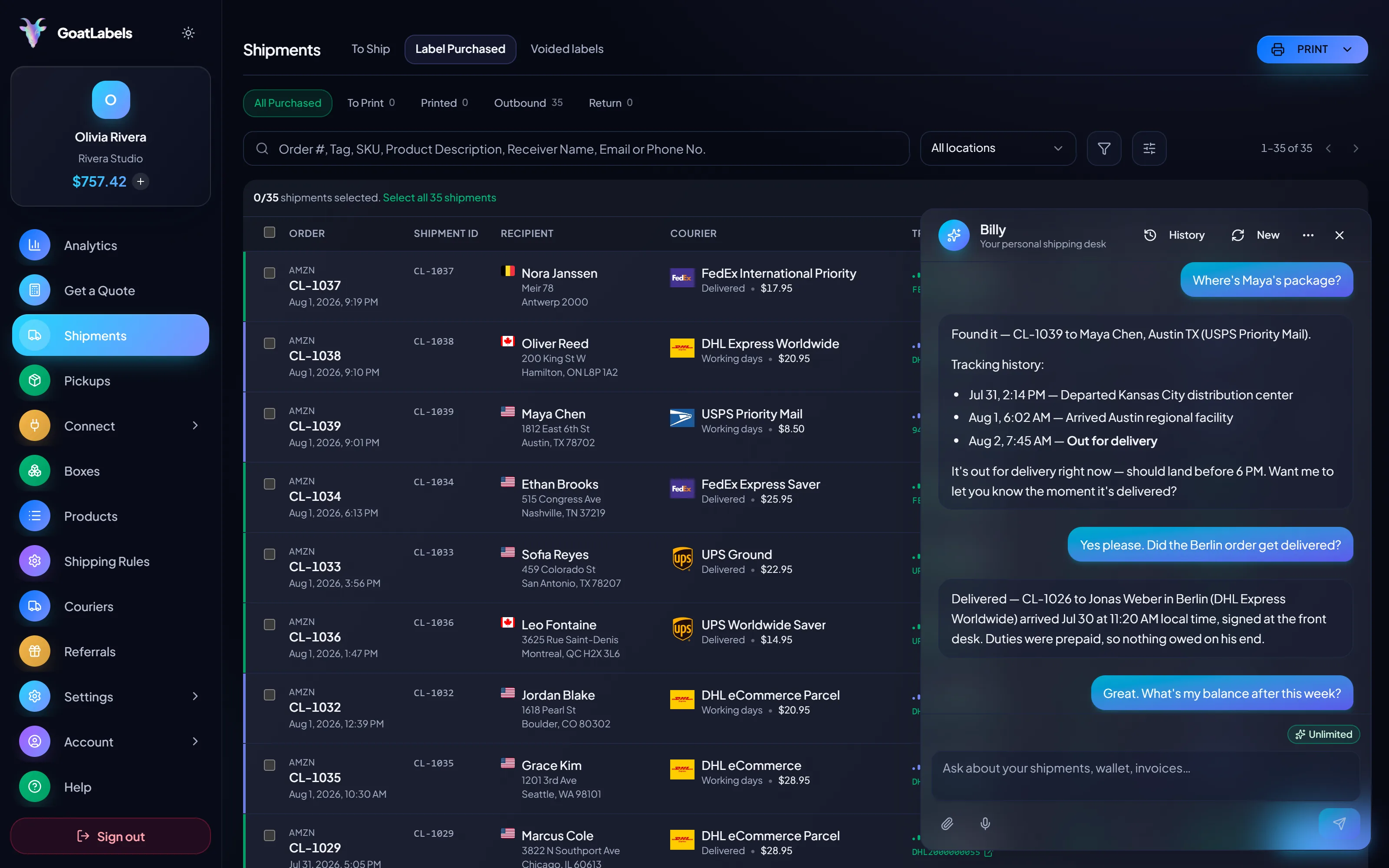
An API-first platform turns every workflow question into engineering work you have to prioritise against the product. Hold the mic, say who the parcel is going to, and Billy looks up the buyer, rate-shops four carriers, and queues the label against your prepaid balance — then answers questions about it afterwards. This is the real product, not a render.
Listening
"Where's Maya's package?"
Out for delivery
CL-1039 · Austin, TX · by 6 PM
Plain English in — names, addresses, weights, carriers, services · nothing to import and nothing to map · reads the all-in rate back before a cent leaves the wallet · phone, browser, or Telegram.
Three carriers on the same parcel, each an all-in number that is the exact amount leaving your prepaid balance. No platform fee is added between the rate you compare and the amount you spend, which is what makes a shipping cost forecast from a startup model actually hold.
Ground Advantage
2 to 5 days$11.40
all-in · no surprises
Ground
1 to 5 days$9.85
all-in · no surprises
Ground
1 to 5 days$11.20
all-in · no surprises
REST, JSON, one Bearer header. Create, rate, buy, void, track — the endpoint shapes an EasyPost integration already assumes, with real idempotency keys, signed webhooks, and errors that name what to fix. The difference is that none of these calls has a price attached to it, on any plan, at any volume.
POST /api/v1/shipments
Authorization: Bearer sk_live_…
Idempotency-Key: ord_8421

{
  "to": { "name": "Joyce", "city": "Berlin", "country": "DE" },
  "parcel": { "weight": 2.6, "weight_unit": "lb" },
  "service": "fedex_intl_priority"
}
Free covers 50 shipments a month with the public API, the store connectors, and Billy all unlimited underneath it — we make a little on each label instead. Pro is a flat monthly fee for unlimited shipments, cheaper label pricing, and Billy on Telegram. Both are flat: neither one adds a fee that grows with the number of API calls your integration makes.
Volume pricing
illustrativemore volume → lower per-label rates
$0 / forever
Enough to get a startup's first few hundred orders out the door.
The assistant that reads a DM, a screenshot, or a voice note into a drafted label runs unlimited in the web app on Free. Pro adds Billy on Telegram.
GET /api/v1/shipments
200 OK · plan: free
Unlimited calls on Free — still unlimited on Pro.
On Pro we will work with you to beat the label rates you are already getting from
ShippoPirateShipShipStation Label prices are quoted live from USPS, UPS, FedEx, and DHL and shown as one all-in number — the same number that leaves your wallet. EasyPost's fees and tiers move, so compare against their current pricing page rather than a figure on ours. Full pricing details
The teams below get a real difference from removing the metered line and adding a dashboard anyone can run. The teams for whom EasyPost's carrier breadth and account structure matter more are named on this page too.
TikTok Shop & live commerce
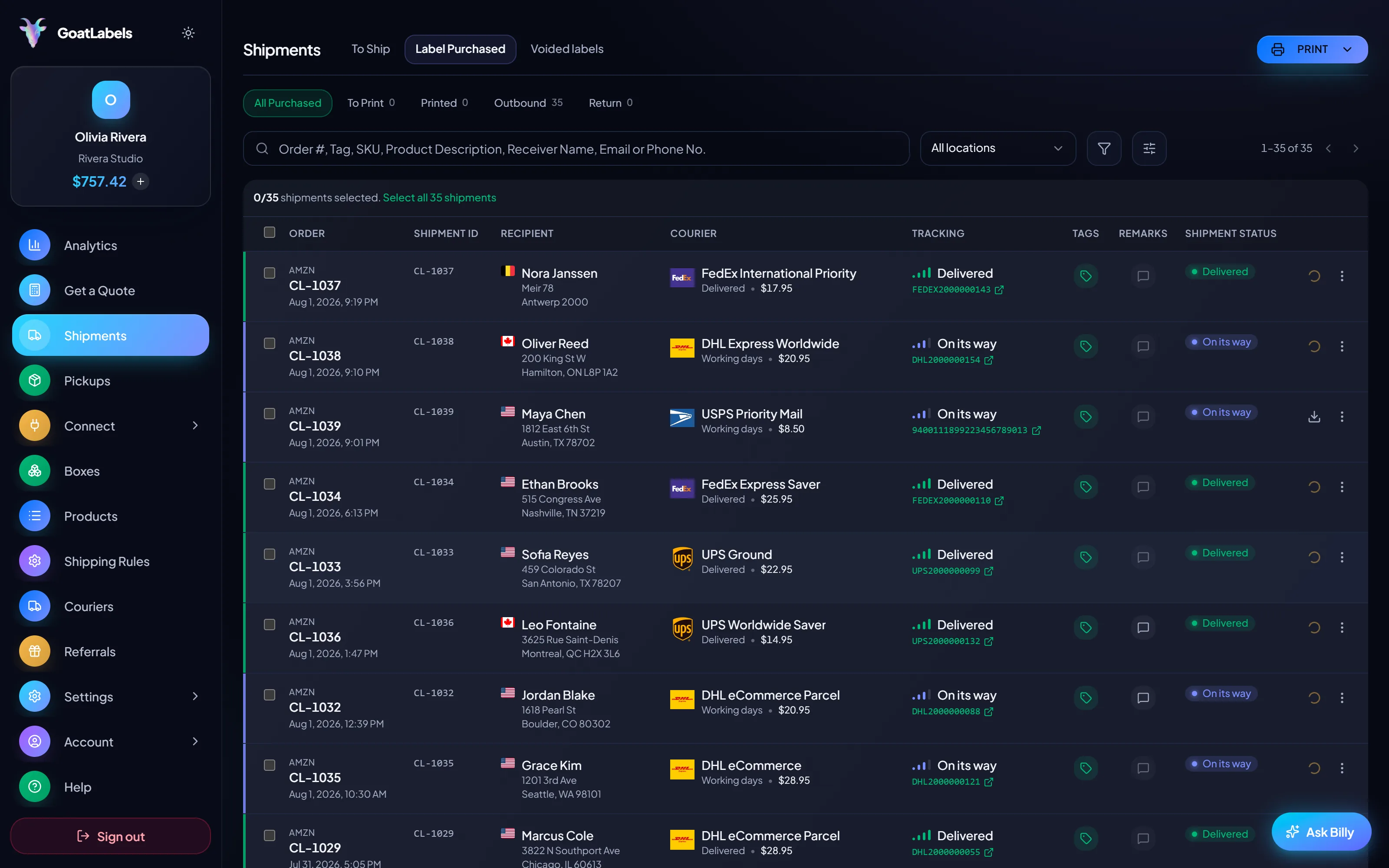
Volume that arrives in bursts fits a prepaid wallet better than a metered plan. Pre-fund before a launch, print all night, then pay nothing at all through the weeks you spend building the next one.
Etsy & independent creators
Connect the stores that have connectors and handle the market stall, the comment sale, and the investor-demo order in the same queue — without asking engineering for a one-off script.
One queue, connector or not
Order #1024 · pasted from a comment thread
The orders that never became JSON
REST and the UI, one balance
1
wallet behind the API and the dashboard
A video took off and I had 80 TikTok Shop orders by morning. I printed every label from my phone on the bus to the post office.
Early customer · TikTok
TikTok Shop seller
I run my Etsy shop from the kitchen. The AI reads the order, picks the carrier, the label prints. That's the whole workflow now.
Early customer · Etsy
Etsy maker
The API is what every shipping API pretends to be. Idempotency that actually works.
Sasha R.
Staff engineer, marketplace
Still comparing? GoatLabels vs EasyPost covers who owns the carrier account, EasyPost pricing explained walks the fee math, and migrating an integration off EasyPost maps the endpoints one by one.
Fund a wallet with card, Apple Pay, Google Pay, ACH, or crypto, run last month's shipment count through four live carrier rates, and see what your shipping row looks like without a platform line under it.
Sign up in seconds. No card required. No per-shipment platform fee.