

USPS
Ground Advantage
2 to 5 days$11.40
all-in fare · window shown per service
Every carrier prices speed on a curve: economy, standard ground, and expedited tiers for the same parcel. The upgrade pays when item value, a promised date, or a marketplace ship-by clock costs more than the fare difference — and it never pays when the transit gap between tiers collapses for your zone.
USPS, UPS and FedEx priced side by side with each service's delivery estimate, DHL on international lanes, so the days you are buying are visible before you pay for them.


 DHL: international
Card, Apple Pay, Google Pay, ACH, or crypto fund one prepaid wallet. Each label debits its own all-in price, express or economy.
Updated
The framework on this page only survives contact with a busy day if applying it costs seconds. That is what the loop below is for: the order arrives however it arrives, the constraint attached to it — a promised date, a ship-by clock, or nothing at all — goes in with it, and what comes back is every carrier's ladder with a fare and a delivery window against each rung. The decision is then a reading exercise, not a judgement call.
it's a present — does it get there before Saturday if I order now?
Most orders carry no date at all, and those are the ones a store-wide default service quietly overcharges every single time.
 Billy AI
Upgrading one urgent order never touches how the rest of the day ships. That is the whole difference between a per-order decision and a store setting.
Thirteen store connectors, Shopify, Amazon, eBay, Etsy, TikTok Shop and more, sync into one To Ship queue, and a pasted Instagram or Facebook DM lands beside them. Every one of those orders reaches the same quote screen, where the tier is chosen against that order's own deadline instead of inheriting whatever default a channel's shipping settings were left on.
 Shopify
 Etsy
Etsy WooCommerce
 TikTok Shop
 Amazon
 eBay
eBay Squarespace
 Wix
Wix WalmartShopify PlusSoon
 Square
 BigCommerce
 Magento
 ZapierSoon
 NetSuiteSoon
 EcwidSoon
 Temu
Temu SheinSoon
 ChannelAdvisorSoon
 SkuVaultSoon
 Zoho InventorySoon
 Patreon
Strip the brand names away and all four carriers sell the same ladder: an economy ground tier that moves with the densest, cheapest part of the network, a standard ground tier that is the default for most parcels, a mid-speed tier that promises a small, fixed number of days, and an overnight-or-nearly tier where the parcel flies. What separates the rungs is not effort — nobody at the carrier runs faster for an express parcel — but which network the parcel enters. Ground tiers ride trucks on schedules built for density; the express tiers ride planes on schedules built for deadlines, and the fare difference is the cost of the seat.
Which carrier's ground tier wins on a given parcel is its own comparison, decided by weight, destination density, and who runs the final mile — that derivation lives onthe cheapest ground shipping services pageand is not repeated here. This page is about the vertical question instead of the horizontal one: given the carrier, when is the next rung up worth its fare? The answer is never a feeling — it is three checks, and they take less time than reading a review.
The upgrade pays when a day of transit costs you more than the fare difference, and only three things reliably put a price on a day. The first is a promised date: a birthday, a wedding, an event — anything where late means worthless. There the calculation is explicit: work backwards from the date, find the cheapest tier whose window clears it, and buy that one, which is sometimes ground and sometimes overnight. The second is the marketplace ship-by clock, and it is widely misread — most marketplaces time your acceptance scan, not the delivery, so the fix for a tight clock is usually shipping today on a cheap tier rather than shipping tomorrow on an expensive one.
The third case, item value, is the subtle one, because value argues for speed less often than sellers assume. A four-figure parcel does not become safer by moving faster; it becomes safer by being tracked densely and insured properly, and insurance here is a per-shipment toggle whose premium sits inside the all-in quote. Where value does justify speed is exposure time on high-theft categories and perishables — fewer nights in a trailer is a real reduction in the window where things go wrong. The matrix below compresses all three cases into the decision you actually make at the quote screen.
| The order in front of you | Tier to buy | Why |
|---|---|---|
| Low-value item, no promised date, near zone | Economy ground | The transit gap between tiers is smallest exactly where the fare gap still exists — you would pay for speed the parcel cannot express. |
| Low-value item, distant zone, patient buyer | Economy or standard ground | Distance widens the transit gap, but with nothing costing you per day of transit, the cheaper fare still wins. |
| High-value item, no date pressure | Standard ground, tracked and insured | Value argues for coverage and scan density, not for speed. A faster tier does not reduce the odds of loss — insurance addresses that. |
| Any item, buyer paid for or was promised a date | The cheapest tier whose window beats the date | Work backwards from the date. Sometimes ground clears it and the upgrade money is wasted; check before assuming. |
| Marketplace ship-by clock at risk | Faster handling first, faster tier second | Ship-by clocks time the acceptance scan, not delivery. Getting the parcel scanned today usually beats paying for speed tomorrow. |
| Date must be certain, not just likely | A guaranteed express service | Only services with a money-back guarantee promise anything. Everything else is an estimate, however fast. |
Carriers price speed nationally, but they deliver it locally, and the two diverge most on short lanes. A parcel travelling two zones often moves through the same regional hub on the same overnight linehaul whether you bought the economy tier or the mid-speed one — the tiers only fork when the distance is long enough to need decisions the cheap tier makes slowly. On those short lanes the paid tier's window and the ground window overlap almost completely, which means the upgrade fare buys you a stronger promise on paper and the identical truck in practice. Sellers shipping mostly regionally can run express budgets that purchase nothing at all.
You do not have to theorize about where your lanes sit. The quote screen shows each service's delivery window for the actual destination next to its fare, so a collapsed gap is visible as two prices with the same date beside them — at which point the decision makes itself. The habit worth building is glancing at the window column before the price column: the days on offer vary by lane far more than the fares do, and reading them in that order is what stops the reflexive upgrade.
Every delivery window on a quote is one of two legal species, and they look identical on screen. An estimate is the carrier's honest forecast, with no remedy if it is wrong. A guarantee is a term of the service: miss the commitment and the carrier owes the postage back. Broadly, the overnight and express products carry money-back guarantees and the ground and economy products do not — but carriers suspend, restore, and re-scope guarantees, sometimes seasonally, so the current status of any specific service belongs in the dated reference below rather than in a sentence that pretends to be permanent. If a date genuinely must hold, the only rational buy is a service whose guarantee is currently in force, and a missed guaranteed delivery is a refund you have to claim, not one that arrives on its own.
Service and guarantee reference — verified against each carrier's published service guide on 2026-10-16. USPS: Priority Mail Express carries a money-back guarantee; Priority Mail and Ground Advantage are estimates. UPS: Next Day Air Early, Next Day Air, Next Day Air Saver and 2nd Day Air A.M. carry UPS's money-back policy; 2nd Day Air, 3 Day Select, Ground and Ground Saver do not (UPS Service Guarantee page, checked 2026-10-13). The UPS-specific status table, service by service, is onUPS Ground vs 2nd Day Air vs Next Day Air. FedEx: overnight and 2Day express products fall under the money-back guarantee where currently in effect; Ground Economy is an estimate. DHL Express services quote committed delivery windows on international lanes. Carriers rename services and suspend or reinstate guarantees without notice — confirm against the carrier's own service guide before relying on a guarantee. Re-check cadence: at each carrier's annual rate announcement, by the named marketing owner recorded with this page.
The reason most sellers overspend on speed is not bad math — it is that their tooling made speed a store setting. One default service, chosen once, applied to a farm order and a birthday present alike, and revisited never. The framework on this page only works if applying it costs seconds, which is the actual argument for rate-shopping every order: when every carrier and all its tiers are priced on one screen with windows attached, the three checks — is there a date, is there a clock, does the gap exist on this lane — happen in the time it takes to read the list. Season matters too: peak-season fees land hardest on express products, which shifts the break-even for the exact weeks you are busiest — the trigger-by-trigger breakdown lives onthe surcharges page. Buy speed the way you buy anything else for the business: per decision, with the price in view, and only when something real is on the other side of the fare.
The decision this page describes takes seconds when the information is on one screen. That screen is the product: every carrier that serves your lane (USPS, UPS and FedEx at home, DHL on international lanes), every service tier, each with its fare and its delivery window.
Card, Apple Pay, Google Pay, ACH, and crypto top up one prepaid balance. An overnight fare and an economy fare debit the same wallet at their exact quoted price, so upgrading one urgent order never touches how the rest of the day ships.
Paste the order and say the constraint — needs to be there by Friday — and Billy drafts the label against the quotes that clear it, cheapest first, for you to confirm. The address is validated before any money moves.
BillyLIVEEach tier is quoted as one final number with fees folded in, because a break-even computed on sticker rates is wrong exactly when it matters. The number beside the window is the number that leaves the wallet.
USPS, UPS, FedEx, and DHL each price their own speed ladder, and the cheapest way to hit a date is often another carrier's slower tier, not your carrier's faster one. Quoting every carrier on the lane at once is what surfaces that.
UPS$12.48FedEx$13.22DHL$14.10USPS$11.79The REST API returns every service with fare and delivery window, so a rules engine can buy ground by default and upgrade only when the promised date requires it. Unlimited calls, signed webhooks, on every plan.
Same window, two fares
The gap collapsed on this lane
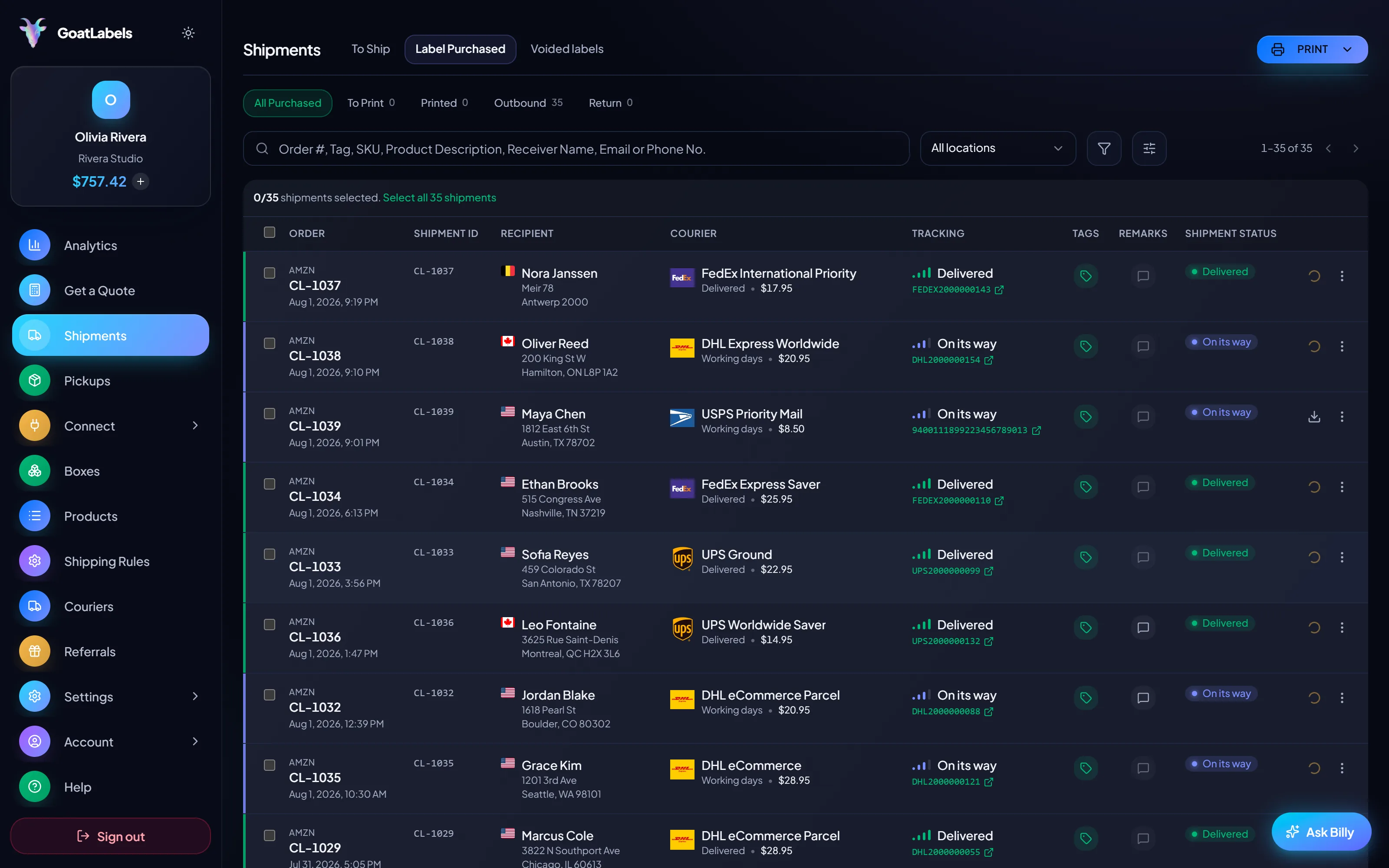
Sellers overspend on speed because the decision was made once, in a settings screen, and never revisited. It gets revisited when it costs seconds — and it costs seconds when the fares and the windows are both on the phone already in your hand at the bench.
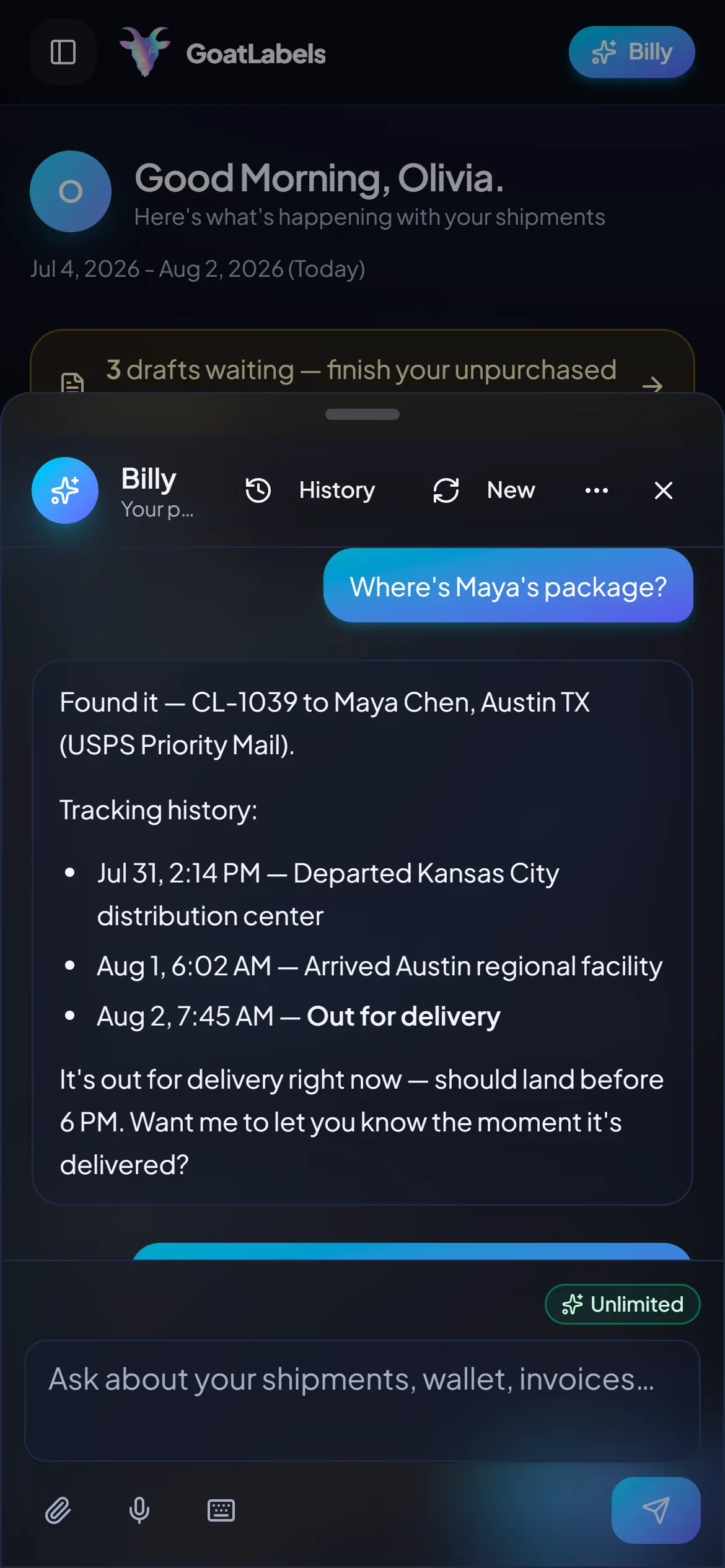
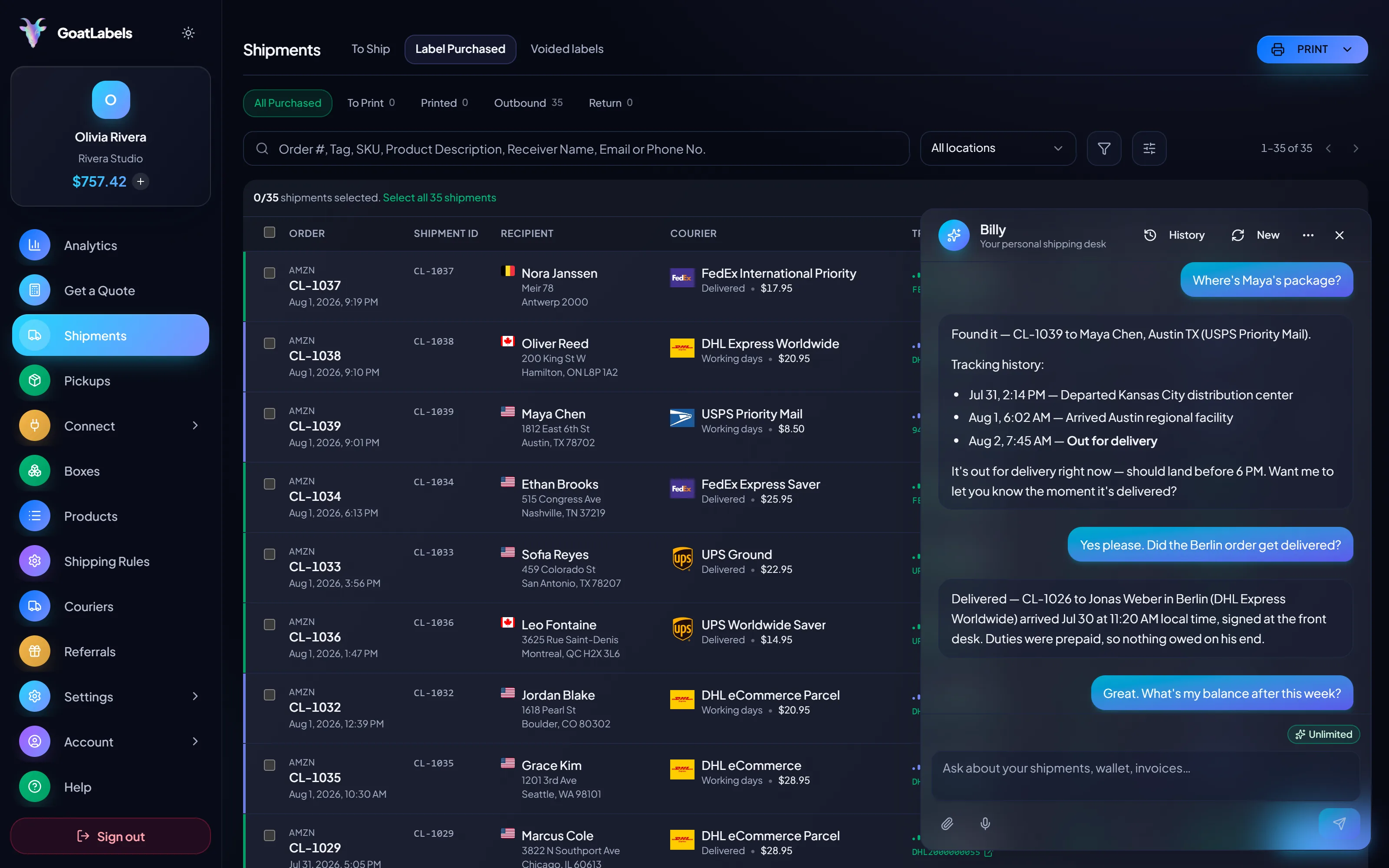
Nobody at the packing table wants to remember which product name maps to which ladder rung on which carrier. Say the constraint out loud — has to be there by Friday, or there is no rush at all — and Billy drafts the shipment against the quotes that actually clear it, cheapest qualifying one first, with the destination validated before any money moves. You still confirm the buy; the part that gets delegated is the translation from a date into a tier. Included on every plan. This is the real product, not a render.
Listening
"Needs to be there by Friday — what clears it cheapest?"
Quotes ready
Cheapest qualifying tier first
Speaks plain English · takes a date instead of a product name · quotes every carrier's ladder on the real lane · included on every plan.
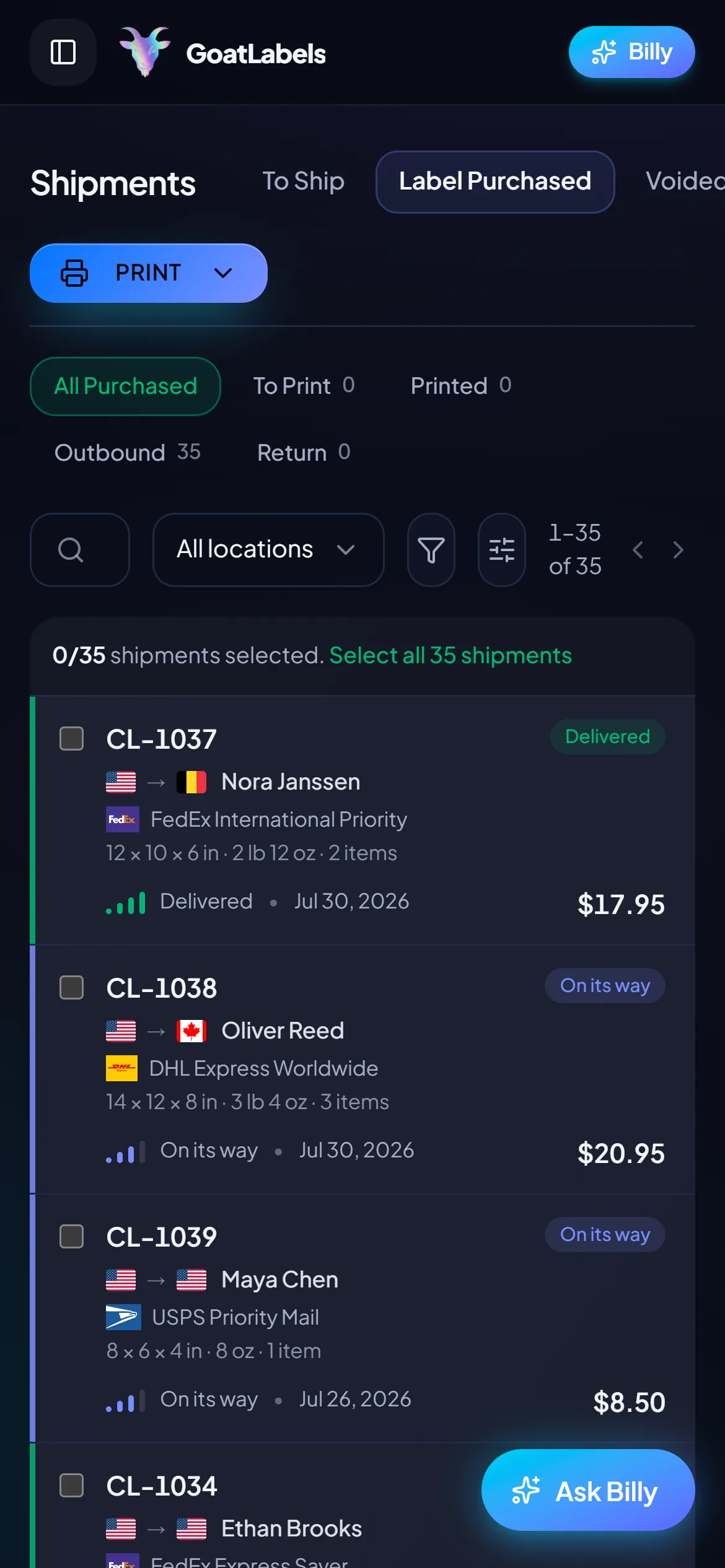
This is the screen the whole framework runs on. Each column is one carrier's service with its all-in fare and its delivery window side by side, so the days you are being asked to buy are visible before you buy them — and a collapsed gap shows up as two prices with the same date beside them. Whether a given window is a guarantee or an estimate is a per-service question, answered in the dated reference above. Figures are illustrative.
Ground Advantage
2 to 5 days$11.40
all-in fare · window shown per service
Ground
1 to 5 days$9.85
all-in fare · window shown per service
Ground
1 to 5 days$11.20
all-in fare · window shown per service
Every quote comes back with its fare and its delivery window attached, which is exactly enough for a rules engine to do what this page asks a human to do: buy the cheap tier by default, and upgrade only on the orders where a date is actually on the other side of the fare. REST, JSON, one Bearer header, unlimited calls on every plan.
POST /api/v1/shipments
Authorization: Bearer sk_live_…
Idempotency-Key: ord_8421

{
  "to": { "name": "Joyce", "city": "Berlin", "country": "DE" },
  "parcel": { "weight": 2.6, "weight_unit": "lb" },
  "service": "fedex_intl_priority"
}
Nothing here gates a carrier or a speed behind a subscription, which matters more than it sounds: the moment a tool charges for access to the fast tier, the break-even you calculated stops being about the parcel. Free covers 50 shipments a month with all four carriers and their full ladders. Pro is a flat monthly plan for unlimited shipments, economy and overnight alike.
 — check what clears a date without opening the dashboard
Rate by plan
illustrativePro: one flat monthly plan, unlimited shipments
$0 / forever
Upgrade the one order that needs it, from a balance you funded once, in a month you may barely ship in.
The assistant that turns needs to be there by Friday into a shortlist of qualifying quotes runs unlimited on Free in the web app. Pro adds Billy on Telegram.
Telegram, ProGET /api/v1/shipments
200 OK · plan: free
Unlimited calls on Free — still unlimited on Pro.
Put a real parcel through and compare the side-by-side rate against what that label costs you on
ShippoPirate ShipShipStationFares are quoted live from USPS, UPS, FedEx, and DHL as one all-in number with the carrier's own delivery estimate beside it, and that exact amount leaves your prepaid balance. Which services carry a money-back guarantee is the carriers' to set and change — the dated reference above records what was verified, and their own service guides are the current source. Full pricing details
Speed is worth buying when a day of transit costs more than the fare difference, and only a few things reliably put a price on a day. These are the four orders where the answer is clearest — including the two where the cheap tier wins outright.
 Birthdays, events, anything late means worthless
Find the cheapest rung whose window clears the date and buy that one — which is sometimes ground and sometimes overnight, and is a different answer per lane. The reflexive upgrade is what this check exists to stop.
 Value argues for cover, not speed
A four-figure parcel does not get safer by moving faster. What reduces the exposure is tracking density and insurance, which is a per-shipment toggle with its premium inside the all-in fare — not a rung further up the ladder.
Upgrade for dates
Insure for value — they are different problems

 The date question, in the DMs

 Short lanes, where the gap collapses
0
days bought when the paid tier and the ground tier show the same date on a short lane — the fare buys a stronger promise and the identical truck
Related reading: the cheapest ground shipping services,flat rate vs weight-based shipping, andUSPS shipping labels. UPS air tiers by name: UPS Next Day Air Saver,UPS Next Day Air Early,UPS 2nd Day Air A.M., andthe UPS overnight envelope.
A video took off and I had 80 TikTok Shop orders by morning. I printed every label from my phone on the bus to the post office.
Early customer · TikTok
TikTok Shop seller
TikTok ShopI run my Etsy shop from the kitchen. The AI reads the order, picks the carrier, the label prints. That's the whole workflow now.
Early customer · Etsy
Etsy maker
EtsyThe API is what every shipping API pretends to be. Idempotency that actually works.
Sasha R.
Staff engineer, marketplace
Quote your next parcel across USPS, UPS and FedEx (DHL on international lanes) and read the delivery window next to every fare. If the gap has collapsed on your lane, you will see it before you pay for it.
No card required. No monthly fee on Free, up to 50 shipments a month. No contract.
Updated