

USPS
Ground Advantage
2 to 5 days$11.40
all-in · margin inside, not added after
Veeqo's Shipping plan has no subscription and no per-label fee on your bill; Veeqo says it earns a small commission on labels, and paid Inventory and High Volume plans add inventory tools. It is part of Amazon, offers Amazon single sign-on, and pays Veeqo Credits on labels. Free software still has a structure, and this page maps it.
Veeqo is part of Amazon and earns a commission on labels. GoatLabels earns inside the label: USPS, UPS and FedEx rate-shopped, DHL on international lanes, margin in the postage, nothing else.


 postage only
Card, Apple Pay, Google Pay, ACH, or crypto top up one balance. No marketplace sign-in, no rewards ledger, no suite.
Start with the answer most comparison pages refuse to give cleanly. The honest answer to the headline question is yes: Veeqo's shipping is free, and there is no catch waiting in a fee schedule. The Shipping plan has no subscription, no shipment quota, and no per-label platform fee on your bill; Veeqo says it earns a small commission on labels bought through it instead. Paid Inventory and High Volume plans exist, but they sell inventory, picking, and account-management features, not access to shipping. For shipping alone, you pay carriers for postage and Veeqo for nothing. Competitor pages tend to hedge this because a free rival is uncomfortable; hedging it would cost this page its credibility in one paragraph.
But a price of zero is not an absence of structure. Software that costs real money to build and run and charges nothing for itself is being paid for somewhere, and the somewhere shapes the product as surely as a price list would. Veeqo's own FAQ points at two sources: it was acquired by Amazon in 2021 and is now part of Amazon, and it earns a commission on the labels it sells. The rest of this page is about what follows from that ownership.
Amazon does not need Veeqo to make money the way an independent software company would. What Amazon gets from a free, capable shipping and inventory suite is position: it sits inside the operations of multichannel sellers, most of whom sell on Amazon among other places. That is why sign-up offers Amazon single sign-on, why the product is built for multichannel inventory rather than as a bare label tool, and why the roadmap reads like logistics infrastructure rather than a feature race. None of that is sinister. It is simply what a product optimises for when the entity paying for it is not the person using it.
The practical consequence for a seller is about alignment, not cost. A tool owned by a marketplace is steered by the owner's priorities, and those can change without a pricing page ever moving. The site's framework for when a platform's own tooling is the right answer lives onthe Amazon Buy Shipping comparison, and the parallel argument about how independent free shipping tools finance themselves — a reseller spread inside commercial postage rates, which is how GoatLabels earns too — is explained end to end onhow Pirate Ship makes money.
The one place Veeqo's pricing has a moving part is the rewards program. Veeqo Credits accrue against qualifying shipping activity — buy labels through Veeqo and a slice of that spend comes back as credits you can put toward future labels there. Structurally this is a loyalty instrument, and it behaves like every loyalty instrument: it rewards concentration. The more of your volume you route through the platform, the more the program returns, and the returned value is spendable only inside the platform that issued it. It is a real benefit, and it is also a gentle one-way valve.
Read the accrual terms rather than the headline. Which purchases qualify, what rate they accrue at, when credits expire, and whether the program continues at all are decisions Amazon makes and can revise; a rewards program is a marketing budget, and marketing budgets get cut. None of that makes the credits a trick — it makes them a variable, and variables belong in your margin maths as variables rather than as constants.
Veeqo's zero price is attached to a multichannel platform, and adopting a platform is not free in the way the price is. Even the free Shipping plan is organised around connected stores, warehouses, and SKUs, and the paid plans build stock levels, picking, and listings on top of that, which is exactly right for a multichannel inventory business and a poor fit for a seller whose orders arrive as Instagram DMs, invoices, or a spreadsheet from a craft fair. A tool organised around an order feed starts from the feed, not from a pasted address. The cost of free software is measured in what it assumes about you, and Veeqo assumes a warehouse.
There is also a quieter assumption: that you are comfortable running your operations inside the ecosystem of a company that competes with most of its users somewhere. Plenty of sellers are, and reasonably so. The point of naming the assumption is only that it is part of the price — the part that does not appear on a pricing page and therefore never gets compared.
GoatLabels is the other way to arrive at zero software cost: Free is $0 for up to 50 shipments a month; past that, Pro is a flat $40 a month for unlimited shipments, with no per-label platform fee on either. Nothing is subsidising the tool, so the tool has to be worth using on the economics of the label alone: you prepay a wallet by card, Apple Pay, Google Pay, ACH, or crypto, every domestic parcel is quoted across USPS, UPS and FedEx (DHL joins on international lanes), and the margin lives inside the all-in rate you see before you buy. A month you ship nothing costs nothing, and there is no rewards ledger asking you to concentrate volume anywhere — the incentive to come back is supposed to be the price on the next quote, or it is not working.
The comparison worth making is therefore not free versus free. It is suite versus postage: whether you want inventory software with shipping inside it, or shipping with nothing around it. Sellers who want the second thing can read the same bill-anatomy treatment of the paid platforms onShipStation pricing andShippo pricing, or just quote one real parcel here against a pricing page with two flat plans on it — which is the entire pitch.
Checked on from Veeqo's own pages. Plans, fees and policies change, so confirm on the vendor's current page before you decide. Veeqo is a trademark of its owner and is not affiliated with GoatLabels.
Postage-only economics show up as a shape, not as a discount. There is no ecosystem to sign into, no catalogue to set up before the first label, and no rewards ledger quietly asking you to route more volume through one place. The order arrives however it arrived, the address is validated before money moves, USPS, UPS and FedEx quote the parcel (DHL too on international lanes), and the winner leaves a prepaid balance you funded yourself.
Two of these to Portland — paid by transfer, no cart, no SKU, no stock line anywhere. Still needs a label by four.
Veeqo's free plan is built around connected stores and warehouses, and its inventory tools are paid plans. This loop makes no assumption about either, which is the practical difference between a zero attached to an ecosystem and a zero attached to a label.
 Billy AI, included
Money in, labels out — that is the whole ledger. Nothing is accruing on the side, so there is no balance you would lose by quoting your next parcel somewhere else.
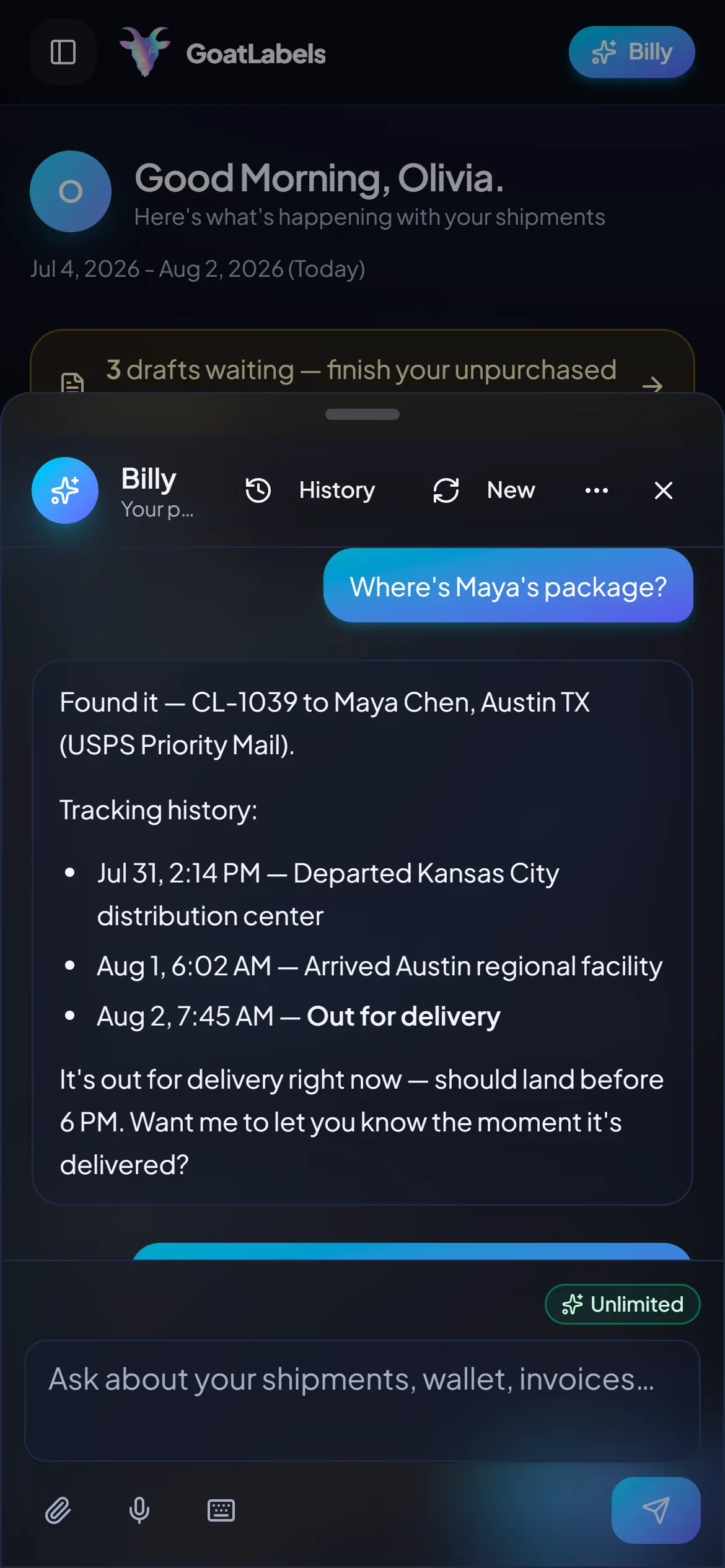
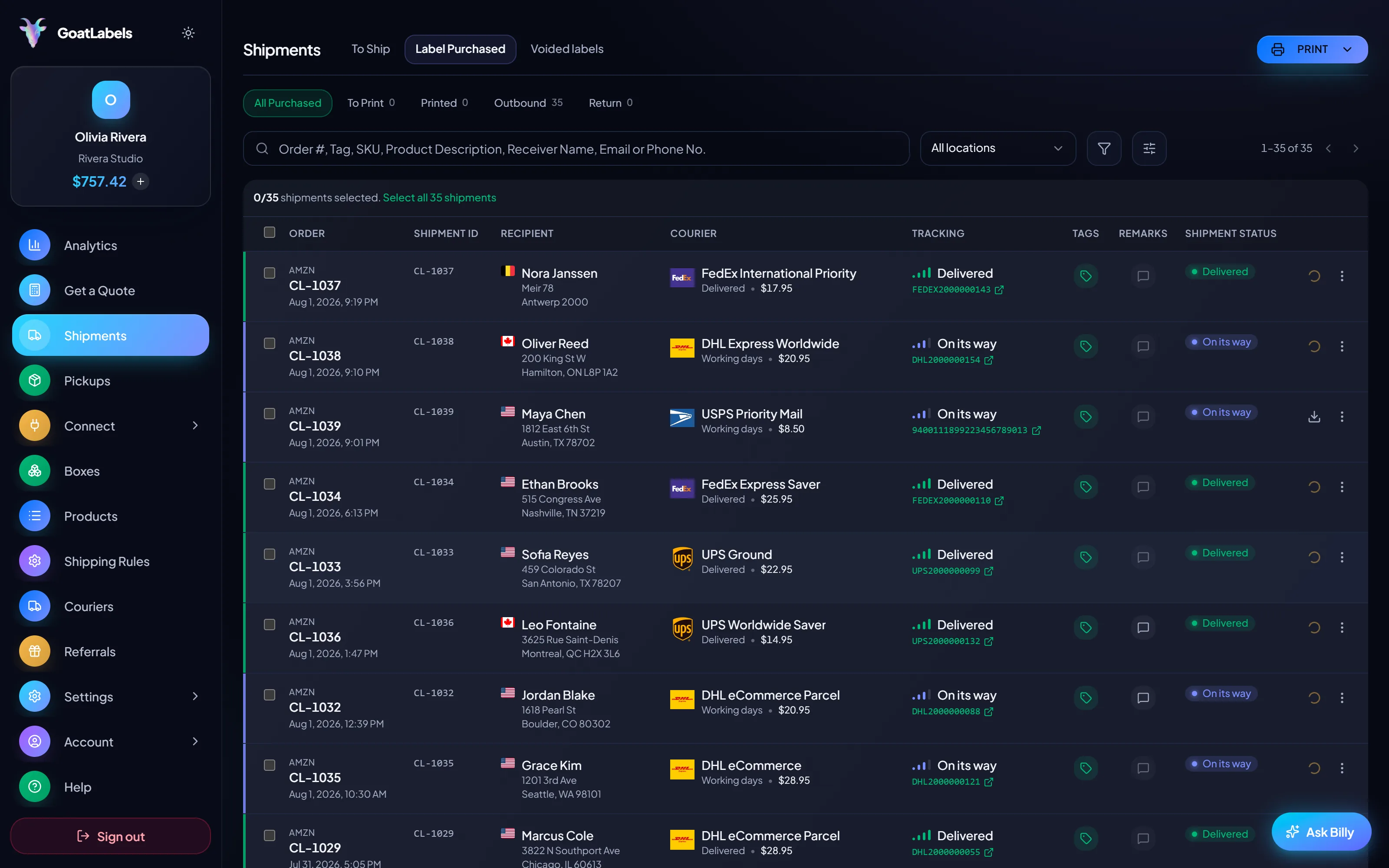
Shopify, Etsy, WooCommerce, TikTok Shop, Amazon, eBay, Walmart, Square, BigCommerce, Magento and the rest of the connector list sync orders into one To Ship queue and push tracking back when you print. What none of them ask is that you move your catalogue, your stock levels, and your purchase orders in first. The connector is an order feed; the product on the other end of it is a label.
 Shopify
 Etsy
Etsy WooCommerce
 TikTok Shop
 Amazon
 eBay
eBay Squarespace
 Wix
Wix WalmartShopify PlusSoon
 Square
 BigCommerce
 Magento
 ZapierSoon
 NetSuiteSoon
 EcwidSoon
 Temu
Temu SheinSoon
 ChannelAdvisorSoon
 SkuVaultSoon
 Zoho InventorySoon
 Patreon
Veeqo's free plan is the shipping layer of a multichannel inventory platform, with inventory tools sold as paid plans. This free is the opposite shape: nothing but the label, priced across USPS, UPS and FedEx (DHL on international lanes), paid from a balance you control.
Card, Apple Pay, Google Pay, ACH, and crypto top up one prepaid balance. Labels debit it, accepted voids credit it, and there is no credits program steering where your volume goes — the incentive to stay is the next quote, not an accrued balance you would forfeit.
A multichannel platform starts from the order feed. Billy drafts a label from a pasted DM, a screenshot, or a spoken address, the order shapes that never arrive through a feed.
BillyLIVENo subscription on Free and no per-label software fee, like Veeqo's Shipping plan, and the financing is in plain sight: a small margin inside each label's all-in rate. No credits program to model, and no program terms to re-read each quarter.
USPS, UPS and FedEx are quoted on every domestic parcel, DHL on international lanes, each as one all-in number, and the one you pick is the exact amount that leaves the wallet. Discounted rates are table stakes; the product is the competition between them on your specific box, weight, and zone.
UPS$12.48FedEx$13.22DHL$14.10USPS$11.79The REST API quotes, buys, and voids against the same prepaid wallet as the dashboard, with unlimited calls and signed webhooks on every plan. Automation is not a tier — it is the same product over HTTP.
Bought from your own balance
No suite adopted · no credits accrued
An inventory platform assumes a desk somewhere in a building with shelves in it. A postage-only tool can assume much less: the queue, the quotes, the wallet, and the print button are the same product on the phone in your hand, which is where most of the orders arrived in the first place.
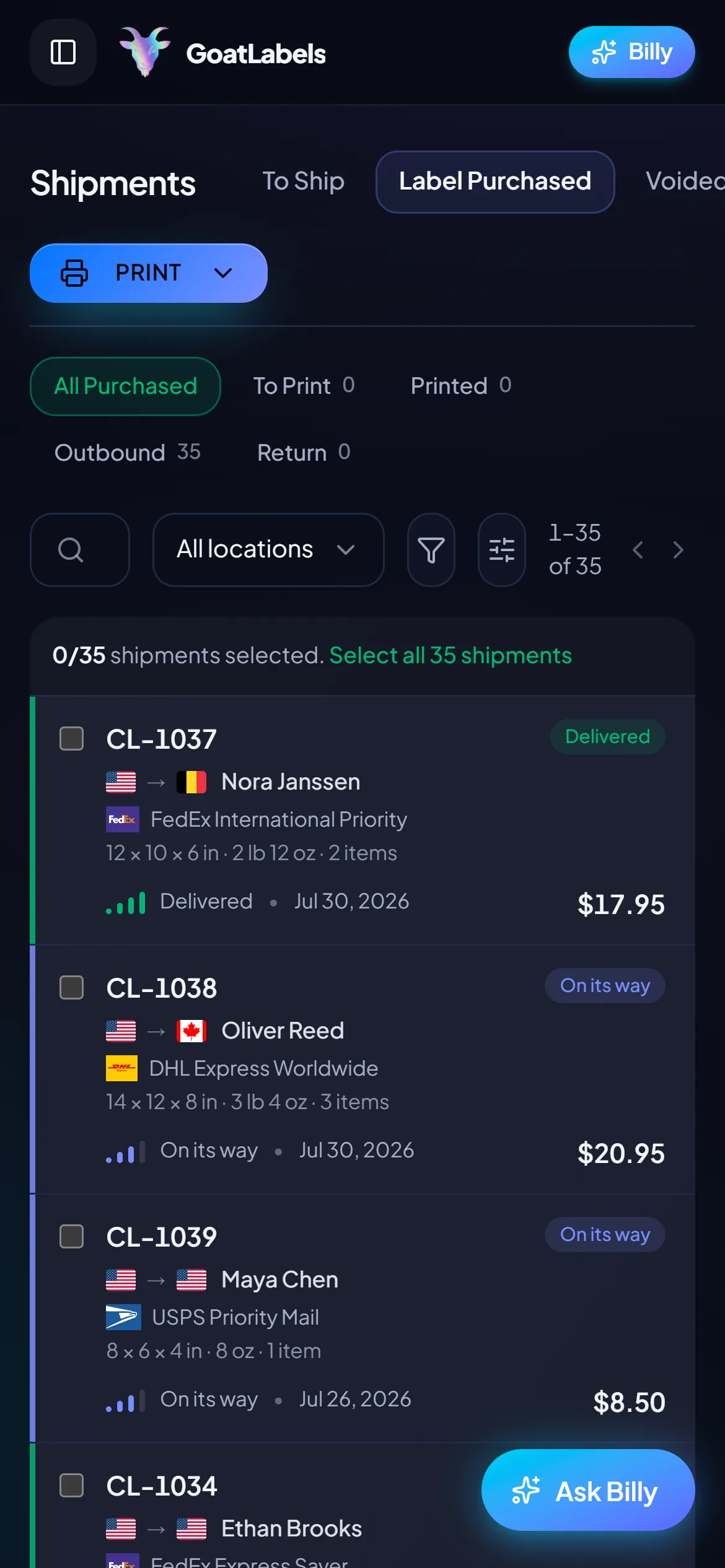
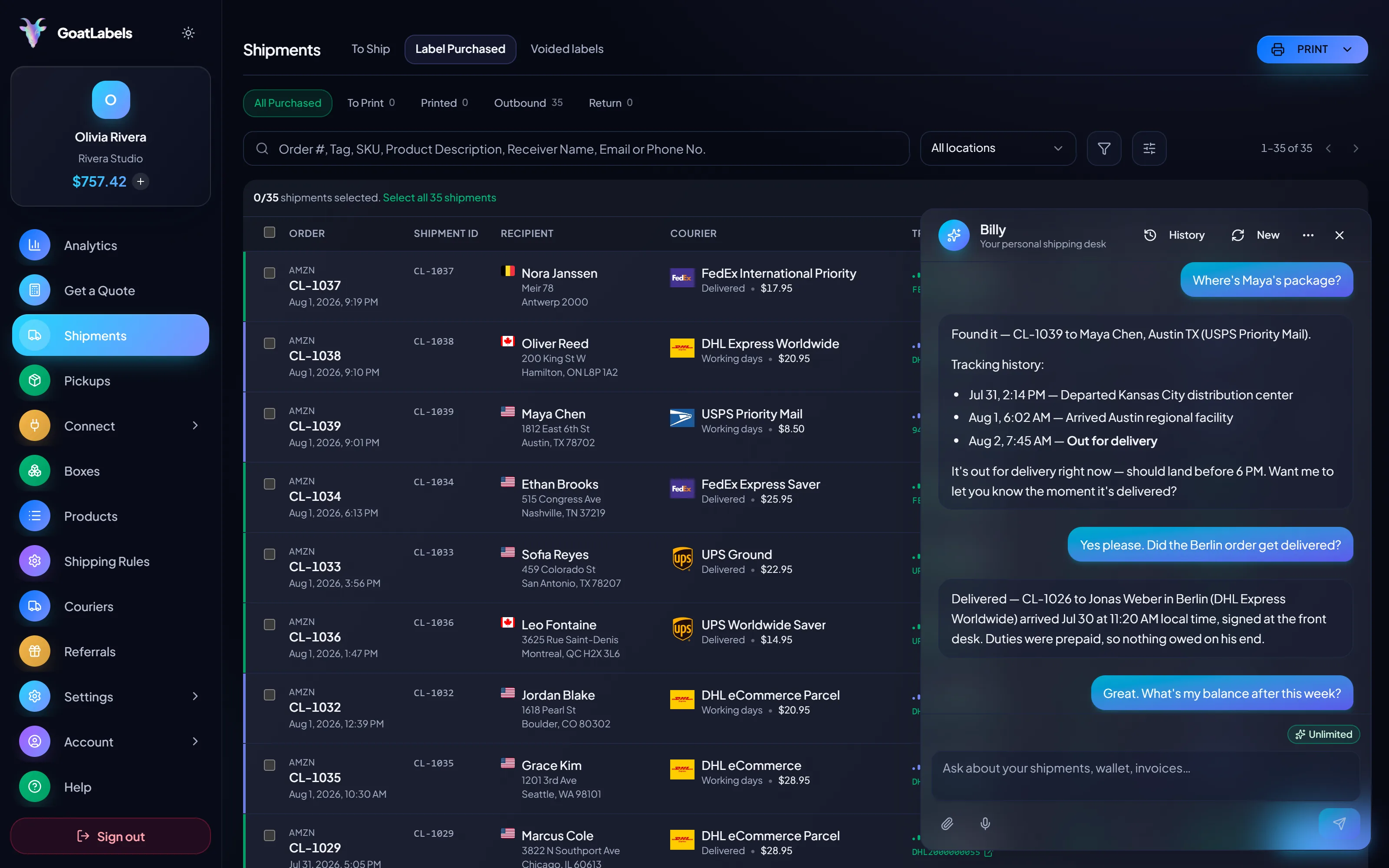
Loyalty mechanics work by making leaving expensive. This one has no ledger behind it: hold the mic, say where the parcel is going, and Billy quotes USPS, UPS and FedEx on the box in your hands (DHL on international lanes) and reads the all-in prices back. Unlimited on Free, on Telegram with Pro, and worth nothing if you stop — which is rather the point. This is the real product, not a render.
Listening
"What did that Portland order cost to ship?"
Answered from the ledger
One all-in figure · no credits, no accrual
Speaks plain English · quotes each carrier as one all-in price · included on every plan, never an ecosystem tier.
Every tool in this category can show a good rate from one carrier; the useful question is whether UPS and FedEx were standing next to it on a domestic parcel (DHL on international lanes) when you pressed buy. Each column here is one all-in number, and the margin that funds this product is already inside it rather than added afterwards. The sample parcel below is an illustration.
Ground Advantage
2 to 5 days$11.40
all-in · margin inside, not added after
Ground
1 to 5 days$9.85
all-in · margin inside, not added after
Ground
1 to 5 days$11.20
all-in · margin inside, not added after
An API is where ecosystem gravity usually shows: the calls are free, and what they are wired into is not. Here it is the same shipments, the same carrier quote, and the same prepaid wallet as the dashboard: REST, JSON, one Bearer header, and unlimited calls on every plan including Free.
POST /api/v1/shipments
Authorization: Bearer sk_live_…
Idempotency-Key: ord_8421

{
  "to": { "name": "Joyce", "city": "Berlin", "country": "DE" },
  "parcel": { "weight": 2.6, "weight_unit": "lb" },
  "service": "fedex_intl_priority"
}
This is the entire structure: two plans and no rewards accrual to model, no suite you must adopt to reach the label. Free covers 50 shipments a month with all four carriers, the store connectors, Billy, and the full API. Past 50 shipments a month, Pro is one flat $40 monthly plan with unlimited shipments. Everything else on this page is postage.
 — draft a label without opening the dashboard
Rate by plan
illustrativePro: one flat monthly plan, unlimited shipments
$0 / forever
Postage-only economics, stated in one line: we earn a small margin inside each label.
The assistant that turns a pasted order, a screenshot, or a voice note into a drafted, validated label runs unlimited on Free. There is no suite edition where it unlocks.
Telegram, ProGET /api/v1/shipments
200 OK · plan: free
Unlimited calls on Free — still unlimited on Pro.
On Pro we will work with you to beat the label rates you are already getting from
VeeqoShipStationShippoLabel prices are quoted live from USPS, UPS, FedEx, and DHL and shown as one all-in number — the same number that leaves your wallet. Veeqo's program terms are Amazon's to change; check their current pages rather than any figure quoted about them elsewhere. Full pricing details
This is not a page arguing that a free suite is a trap. It is a page arguing that free comes in shapes, and the shape has to match the business. Here is where the postage-only shape wins, and where it plainly does not.

 DMs, invoices, market stalls, one-offs
A multichannel platform is built around orders that arrive as structured data from a store feed. When the order is a message with an address in it, the label is the only part you ever wanted.

 Where a suite genuinely earns its zero
If you hold stock across several channels and want levels, orders, and shipping in one system, Veeqo is built for you: shipping is free and the paid Inventory plan adds stock sync, and this page will not pretend otherwise. Take the suite. The comparison worth making then is suite against suite, not suite against a wallet.
The test that settles it
Do you need stock managed, or a parcel priced?
 An assumption that never reaches a pricing page
 Unlimited API calls on the free plan
1
prepaid balance behind the dashboard and the API alike
Veeqo is a trademark of its owner and is not affiliated with GoatLabels. The rest of the pricing-explained series:EasyPost,Shippo, andShipStation — and the economics of every free label tool, ours included, onhow free shipping software makes money. Leaving Veeqo? See a Veeqo alternative without Amazon lock-in.
A video took off and I had 80 TikTok Shop orders by morning. I printed every label from my phone on the bus to the post office.
Early customer · TikTok
TikTok Shop seller
TikTok ShopI run my Etsy shop from the kitchen. The AI reads the order, picks the carrier, the label prints. That's the whole workflow now.
Early customer · Etsy
Etsy maker
EtsyThe API is what every shipping API pretends to be. Idempotency that actually works.
Sasha R.
Staff engineer, marketplace
Fund a wallet, quote one real parcel across USPS, UPS and FedEx (DHL on international lanes), and compare the all-in number against what you paid last time. That test costs nothing on either platform.
No card required. No monthly fee on Free, up to 50 shipments a month. No contract.
Updated