

USPS
Ground Advantage
2 to 5 days$11.40
all-in · no plan fee on Free
ShippingEasy prices by throughput: your monthly shipment count decides the tier, and the tier decides the bill even in a slow month. GoatLabels has two flat plans: Free covers up to 50 shipments a month with no monthly fee, Pro is $40 a month with unlimited shipments, and labels are paid from a prepaid wallet that only moves when a label is bought, each domestic label rate-shopped across USPS, UPS and FedEx, DHL on international lanes.
ShippingEasy meters throughput. Here, on Free, the only thing that moves money is a label being bought, quoted across USPS, UPS and FedEx first (DHL on international lanes); past 50 shipments a month, Pro adds one flat $40.


 no tier ladder
Card, Apple Pay, Google Pay, ACH, or crypto fund one prepaid wallet. It only moves when a label does.
Updated
ShippingEasy prices access by throughput. Each plan tier carries a monthly shipment allowance, and your recent volume decides which tier you are on — ship more and you climb, and the climb is stickier than the descent, because nobody downgrades a plan in the week they are busy shipping. The subtle cost is not the fee itself; it is that a tier prices your best month into all of them. An allowance sized for your November bills through February, and an allowance sized for February gets crossed in November. Either way you are paying for the distance between your peak and your average, and for a small seller that distance is usually the largest number in the comparison.
The mechanic is worth naming precisely because it is not unique to ShippingEasy — it is the family pricing model, and the same anatomy on the flagship is taken apart line by line onShipStation pricing explained. What is specific to this page is the question of whether ShippingEasy is the right member of that family to be on at all, which is where the map comes in.
ShippingEasy does not stand alone. It is one brand inside Auctane, the portfolio that also holds ShipStation, Stamps.com, Endicia, ShipEngine, and several international shipping brands — one company behind what looks like a market of competitors. Consolidation of that kind tends to have a direction, and Endicia's own homepage shows one: it now points online sellers to ShipStation. A seller choosing a tool today is really choosing a position inside that map, and the map is the thing no individual brand's site will draw for you.
| Brand | What it was | Where it sits in the family now | New signups |
|---|---|---|---|
| ShipStation | The multi-carrier ops suite that became the family's flagship. | Its pricing page footer reads ShipStation Global, 2026 Auctane Inc., and Endicia's homepage points online sellers here. | Taking new signups on a free trial. |
| ShippingEasy | A small-seller shipping tool with an email-marketing suite bolted on. | Named as an Auctane brand in Auctane's privacy policy; priced by monthly shipment count into plans. | Taking new signups on a 30-day free trial. |
| Stamps.com | Desktop postage printing with a monthly subscription. | Still sold on monthly plans. | Taking new signups. |
| Endicia | Developer-leaning USPS postage, meter-style balance. | Its homepage says it is now part of Auctane and points office mailers to Stamps.com and online sellers to ShipStation. | Its homepage routes new visitors to sibling brands. |
Family map, checked on 2026-10-17. Sources: ShipStation pricing, ShippingEasy pricing, Auctane privacy policy, Stamps.com pricing, and Endicia's homepage. Auctane can rearrange the portfolio at any time, so treat every current-status cell above as dated: the brand's own signup page is the only authority on whether it still takes new customers, and its own pricing page is the only authority on plans.
The practical reading of the map is this: if you are considering ShippingEasy today, you are choosing one brand in a family where Endicia's homepage already routes online sellers to ShipStation, a bigger suite with the same tiered pricing model underneath. If the tier model is what you were trying to leave, moving brands inside the family does not leave it.
Put the two models side by side on the month every subscription quietly depends on: the slow one. Under a shipment-count tier, January bills like November. The plan does not know you shipped almost nothing — it knows the tier you were on when the rush ended, and it charges the calendar, not the activity. On Free a wallet inverts every part of that: the balance sits untouched and the month costs precisely the postage of whatever you actually sent, which might be zero. Past 50 shipments a month, Pro is one flat $40 with no minimum term, so you can cancel it when the rush ends. A prepaid wallet is a pricing model with no opinion about your volume, and for sellers whose year breathes, that absence of opinion is the entire saving.
The other half of the comparison is what happens on the label itself. Here every domestic parcel is quoted across USPS, UPS and FedEx (DHL on international lanes), and the winning all-in number is the exact amount that leaves the wallet. If a label is voided, after the carrier accepts the void the credit lands back in that same balance, as covered onvoiding a shipping label. Orders arrive by sync from any of the 13 connected stores, by CSV, or as a pasted message Billy drafts from, and all of it is on Free; Pro ($40 a month) adds unlimited shipments past 50 a month and Billy on Telegram. What a month costs is listed in full on the pricing page, and the list is short.
The honest case for staying is not the shipping — it is everything ShippingEasy bundled around the shipping. Its customer-marketing side, the email campaigns and review requests wired directly to shipment events, is a genuine product that GoatLabels simply does not have. A seller whose repeat-purchase engine runs on those automations is not overpaying for shipping software; they are paying for marketing software that happens to print labels, and the tier fee can be a fair price for that bundle. If that is you, the honest move is to price the bundle against standalone email tools rather than against a label wallet.
The sellers this page is actually for are the ones who opened ShippingEasy for the labels and never touched the campaigns — who are paying a throughput tier for a rate sheet and a print button. For that job, the comparison is one real parcel: quote it here across USPS, UPS and FedEx, look at the all-in number, and let the label, not the plan, be the thing that gets compared. The same argument at the small-seller scale is worked through onthe ShipStation small-business alternative, and it lands the same way for its smaller sibling.
Checked on from ShippingEasy's own pages. Plans, fees and policies change, so confirm on the vendor's current page before you decide. ShippingEasy is a trademark of its owner and is not affiliated with GoatLabels.
Under a shipment-count tier, the allowance decides your plan and the plan bills even in a slow month. Here the loop is shorter: the order lands however it arrived, the address is validated before money moves, USPS, UPS and FedEx quote a domestic parcel (DHL an international one), and the winning all-in number leaves a prepaid balance. On Free a month you did not ship in bills nothing.
An Etsy sale, two DM orders, and a CSV from last weekend's market stall. Three intakes, one queue.
A throughput tier turns your volume into a decision you have to make in advance and revisit every time the season moves. Here there is one step, Free up to 50 shipments a month and Pro past that, so which intake you use becomes a convenience question rather than a pricing one.
 Billy AI, on every plan
At month end the total on Free is the sum of the labels; on Pro it is the labels plus one flat $40.
Shopify, Etsy, WooCommerce, TikTok Shop, Amazon, eBay, Walmart, Square, BigCommerce, Magento and the rest of the connector list drop orders into one To Ship queue and push tracking back when you print — on Free exactly as on Pro. A platform that reserves channels for higher tiers is charging you for the shape of your business. This one charges for postage.
 Shopify
 Etsy
Etsy WooCommerce
 TikTok Shop
 Amazon
 eBay
eBay Squarespace
 Wix
Wix WalmartShopify PlusSoon
 Square
 BigCommerce
 Magento
 ZapierSoon
 NetSuiteSoon
 EcwidSoon
 Temu
Temu SheinSoon
 ChannelAdvisorSoon
 SkuVaultSoon
 Zoho InventorySoon
 Patreon
Free covers 50 shipments a month with no monthly fee; past that, Pro is a flat $40 a month with no minimum term. These four pieces stand behind every label.
Card, Apple Pay, Google Pay, ACH, and crypto top up one prepaid balance that only moves when a label is bought; on Pro the $40 monthly fee is paid from it too. A rush month spends faster and a quiet month spends nothing on Free; a rush month past 50 shipments needs Pro ($40 a month, no minimum term), which you can cancel before February.
A DM, a comment thread, a screenshot, a voice note: Billy drafts the whole label from any of them, address validated before money moves. Drafting is never charged, but on Free every shipment you create this month, drafted or bought, counts toward the 50.
BillyLIVEFree covers 50 shipments a month; past that, Pro is one flat monthly plan with unlimited shipments. Crossing 50 brings one flat fee, never a per-label overage rate.
USPS, UPS and FedEx come back as live all-in numbers on the same domestic parcel, DHL on international lanes, and the one you pick is the exact amount that leaves the balance. Commercial USPS rates are the floor of this comparison, not the headline — the product is the competition.
UPS$12.48FedEx$13.22DHL$14.10USPS$11.79Thirteen store connectors, Shopify, Amazon, eBay, Etsy, TikTok Shop and more, sync into one To Ship queue with tracking pushed back at print. A backlog arrives as CSV; automation runs over a REST API with unlimited calls and signed webhooks, none of it tier-gated.
Bought from the balance
Paid from the wallet · no renewal date on Free
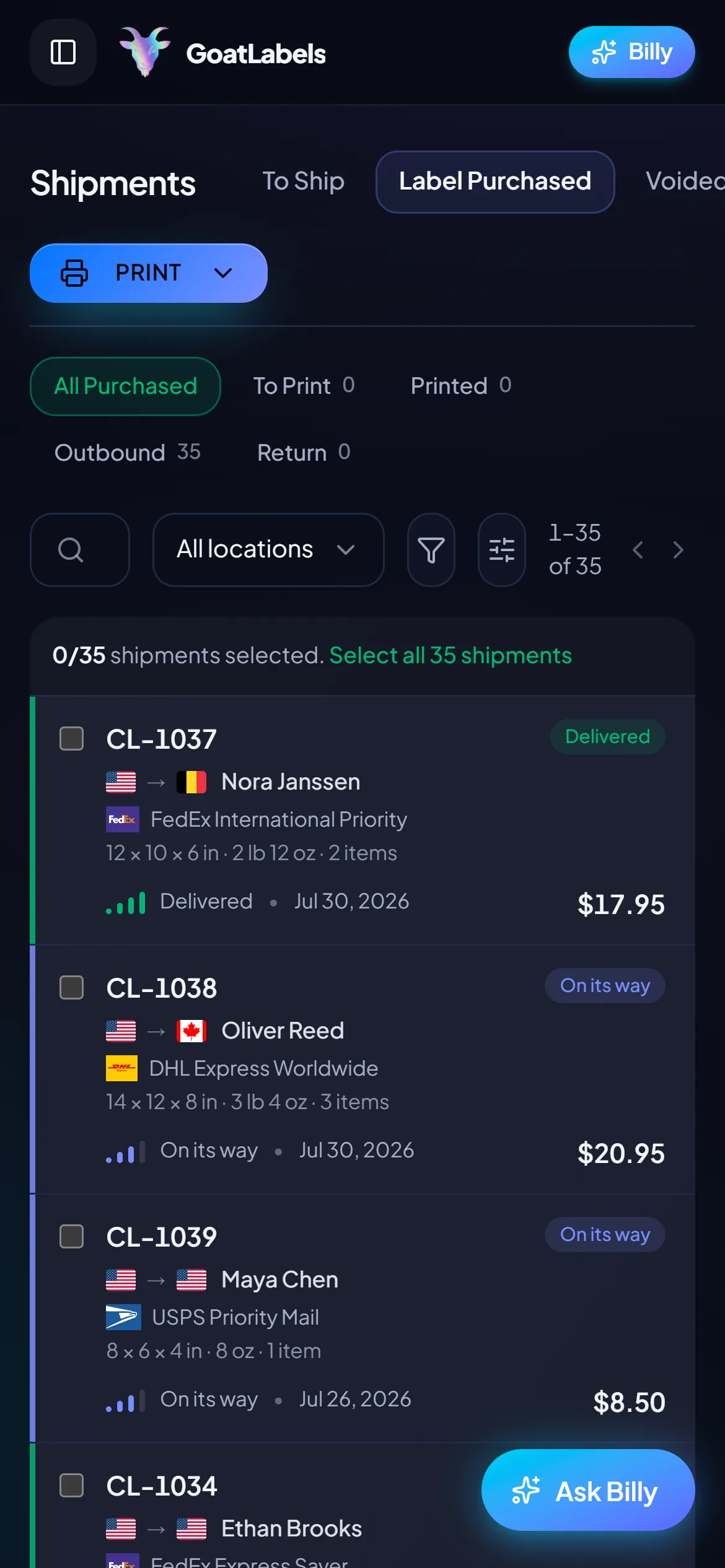
Metered platforms tend to have opinions about where you work as well as how much you ship — a desktop edition, a seat to add, a mobile view that can look but not buy. There is no edition here and no seat: the queue, the live quotes, the wallet, and the print button are the same product on the phone in your apron pocket as on the laptop upstairs.
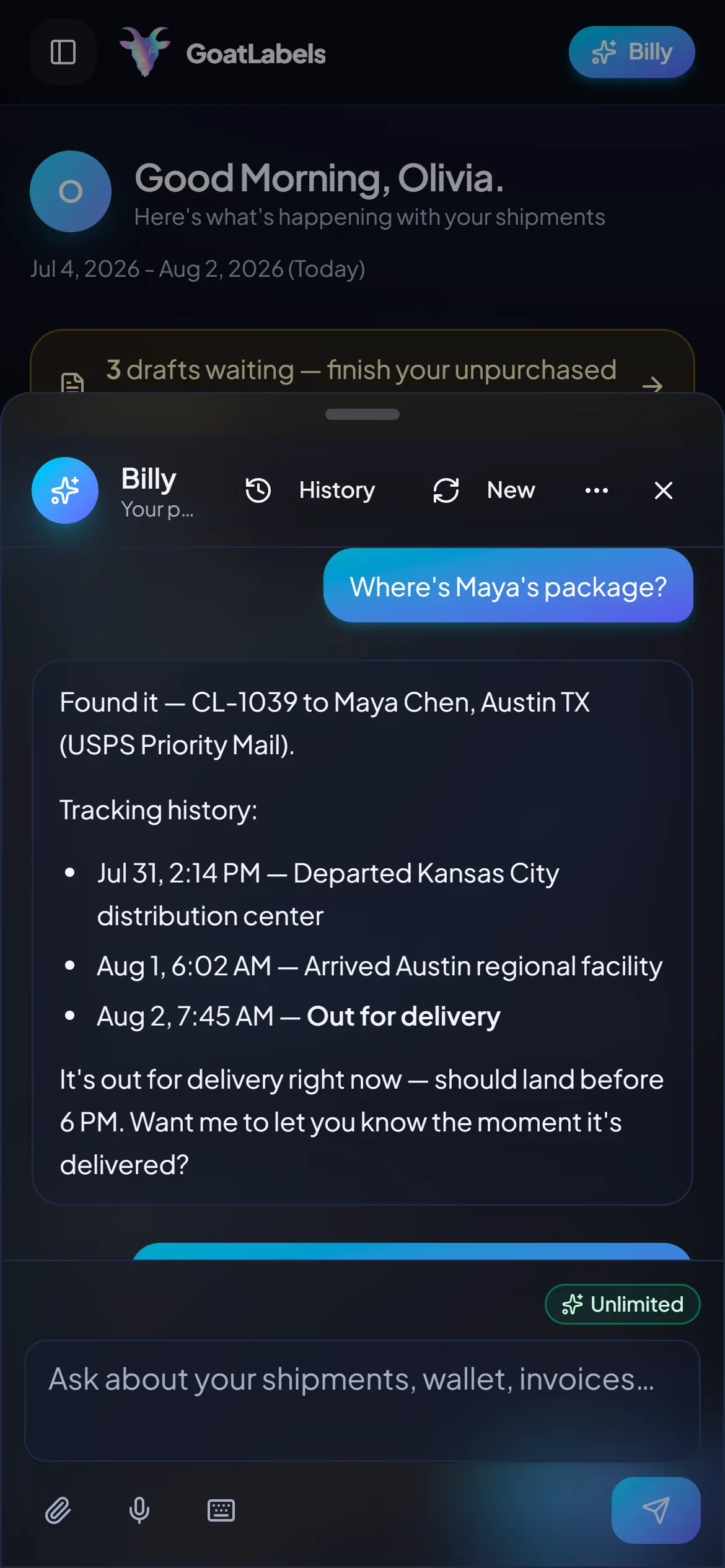
An AI assistant is exactly the kind of feature a tiered platform likes to park one plan above wherever you happen to be. Hold the mic, say where the parcel is going, and Billy quotes USPS, UPS and FedEx (DHL on international lanes), reads the all-in prices back out loud, and queues the one you pick: unlimited on Free, with Telegram added on Pro. This is the real product, not a render.
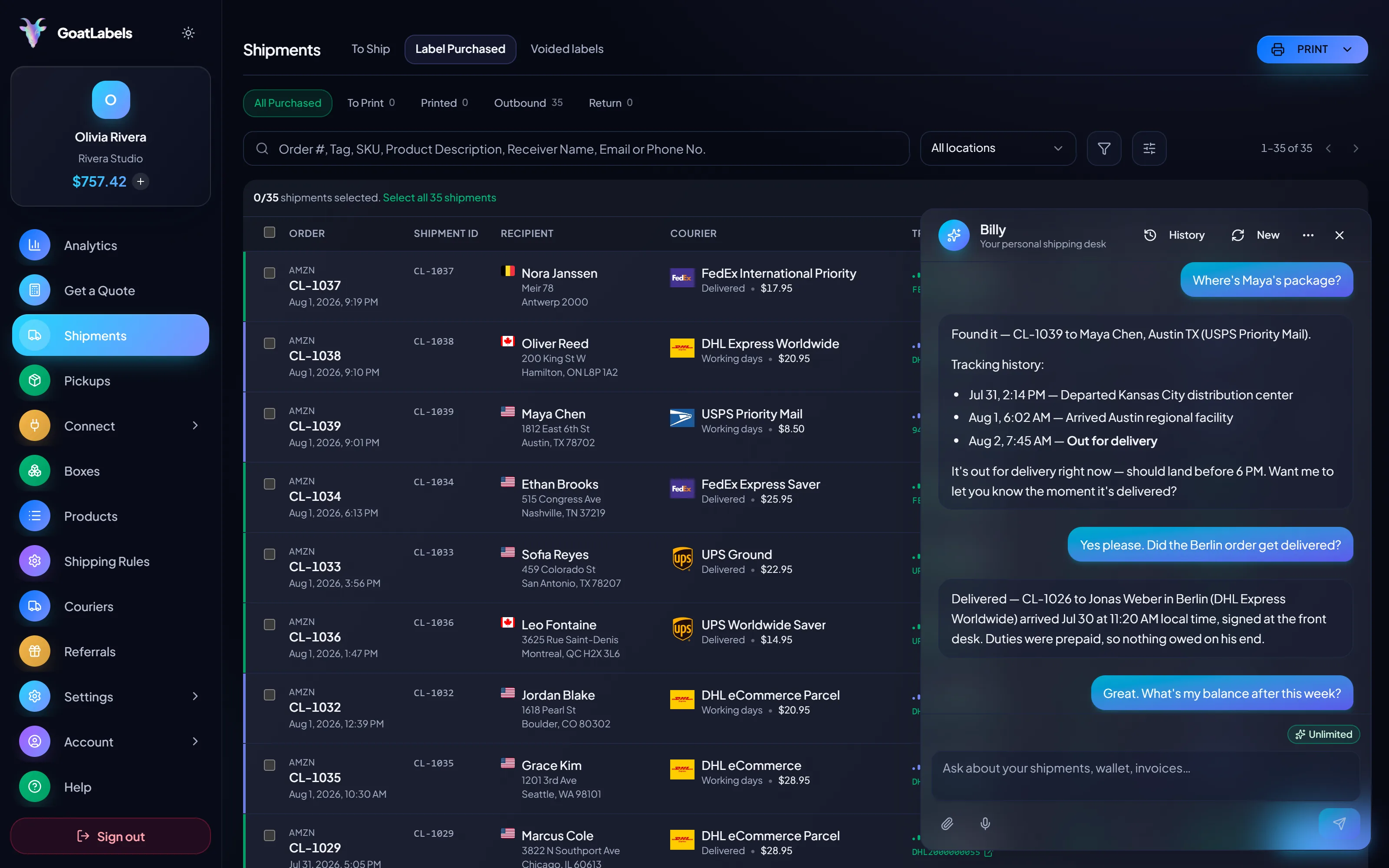
Listening
"What did the last Etsy label cost me?"
Answered from the ledger
One all-in figure · no plan fee on Free
Speaks plain English · quotes each carrier on the lane as one all-in price · unlimited on Free, on Telegram with Pro.
On a metered platform the label price is only half of what shipping costs you; the other half arrives on the renewal date. On Free there is no other half, and on Pro it is one flat $40 a month. Each carrier comes back as one all-in number locked at quote time, and that exact figure is what leaves the wallet. The sample parcel below is an illustration.
Ground Advantage
2 to 5 days$11.40
all-in · no plan fee on Free
Ground
1 to 5 days$9.85
all-in · no plan fee on Free
Ground
1 to 5 days$11.20
all-in · no plan fee on Free
On a tiered platform, API access is usually the thing living one plan above wherever you are, and outgrowing the dashboard becomes a billing event. Here it is simply the same product over HTTP: REST, JSON, one Bearer header, signed webhooks instead of polling, and unlimited calls on Free as well as on Pro.
POST /api/v1/shipments
Authorization: Bearer sk_live_…
Idempotency-Key: ord_8421

{
  "to": { "name": "Joyce", "city": "Berlin", "country": "DE" },
  "parcel": { "weight": 2.6, "weight_unit": "lb" },
  "service": "fedex_intl_priority"
}
ShippingEasy's pricing page asks how much you ship before it tells you what you pay. This one asks only one thing: do you ship more than 50 a month? Fund a wallet and pay per label; Free covers up to 50 shipments a month, and past that Pro is one flat $40 monthly plan with unlimited shipments.
 — draft a label without opening the dashboard
Rate by plan
illustrativePro: one flat monthly plan, unlimited shipments
$0 / forever
Up to 50 shipments a month, paid per label from a wallet that charges your actual month.
The assistant that drafts a label from a pasted order, a screenshot, or a voice note is not a tier feature. It runs unlimited in the web app on Free; Pro adds Billy on Telegram.
Telegram, ProGET /api/v1/shipments
200 OK · plan: free
Unlimited calls on Free — still unlimited on Pro.
Email contact@goatlabels.io last month's shipments and we will return rate-shopped quotes to compare against what you pay on
ShippingEasyShipStationStamps.comLabel prices are quoted live from USPS, UPS, FedEx, and DHL and shown as one all-in number — the exact amount that leaves your prepaid wallet. ShippingEasy's tiers and allowances are Auctane's to change; check its own pricing page for the current numbers. Full pricing details
The distance between your busiest month and your average month is where a shipment-count tier earns its margin. These are the four shapes of seller where that distance is widest, and where one step, Free up to 50 shipments a month and a flat $40 Pro past that, removes most of it.

 A loud quarter and three quiet ones
Climbing a tier in the rush is easy and climbing back down is the thing nobody remembers to do. Here there is one step: Free up to 50 shipments a month, and Pro at a flat $40 past that with no minimum term, so you can cancel it when the loud quarter ends and the quiet ones cost nothing on Free.
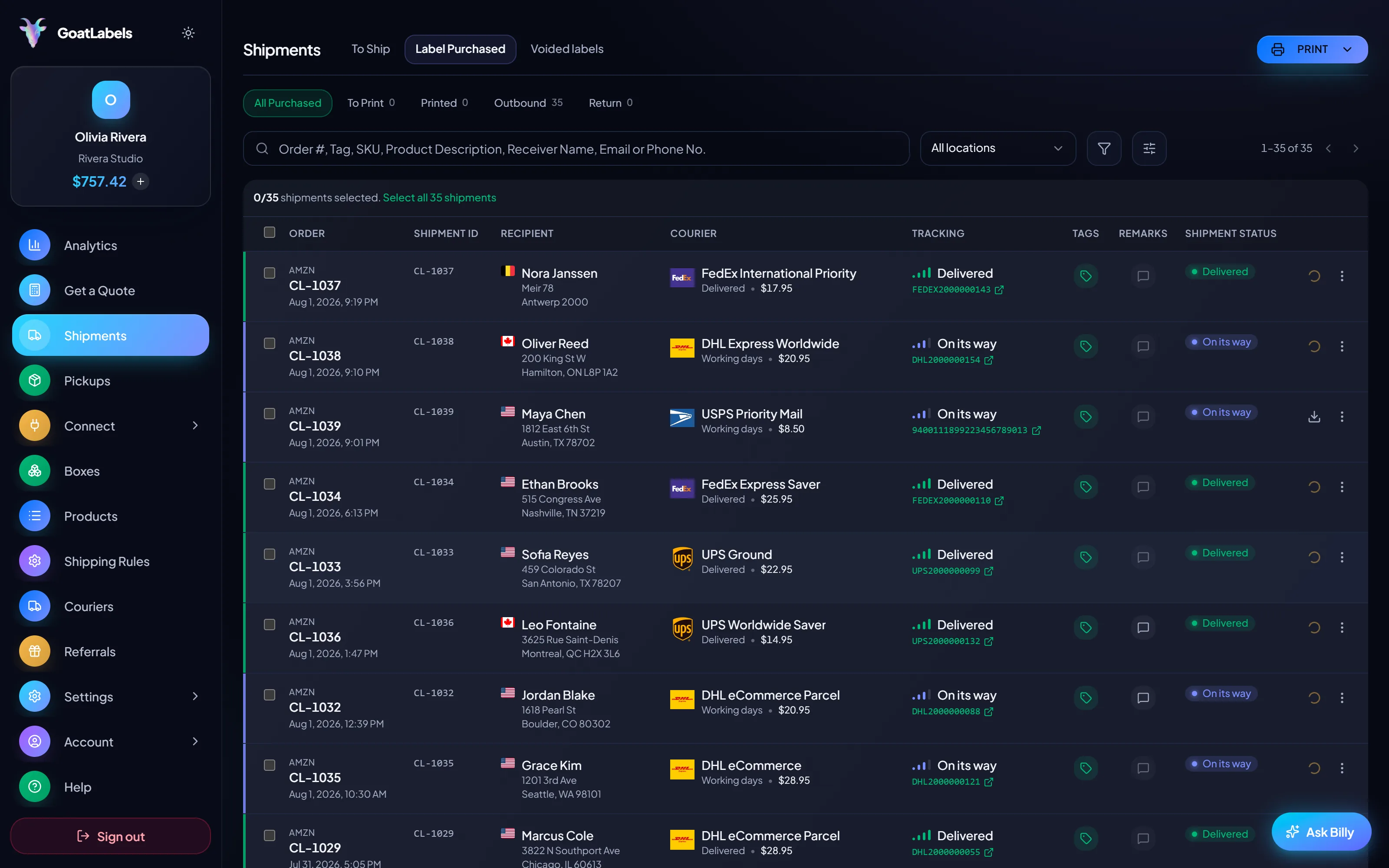
Paying a throughput tier for a print button
ShippingEasy's marketing suite is a real product, and a seller running repeat purchases on it is buying something. A seller who only ever pressed print is paying the same fee for a rate sheet — which is the one comparison this page exists to make.
Price the bundle, not the brand
Campaigns used this month · labels printed this month

 The sales no allowance was designed for
 A migration that keeps the pricing model
1
prepaid balance on Free or Pro, whichever channel the order came from
ShippingEasy, ShipStation, Stamps.com, and Endicia are trademarks of their owners and are not affiliated with GoatLabels. Related reading:GoatLabels vs ShipStation,ShipStation pricing explained, andthe small-business case against tiers.
A video took off and I had 80 TikTok Shop orders by morning. I printed every label from my phone on the bus to the post office.
Early customer · TikTok
TikTok Shop seller
TikTok ShopI run my Etsy shop from the kitchen. The AI reads the order, picks the carrier, the label prints. That's the whole workflow now.
Early customer · Etsy
Etsy maker
EtsyThe API is what every shipping API pretends to be. Idempotency that actually works.
Sasha R.
Staff engineer, marketplace
Fund a wallet with card, Apple Pay, Google Pay, ACH, or crypto, quote your next real parcel across USPS, UPS and FedEx, and compare the all-in number with what the tier was costing you per label.
No card required. No monthly fee on Free, up to 50 shipments a month.
Updated