

USPS
Ground Advantage
2–5 days$7.40
$1.20 of Premium insurance included
all-in · debited from the wallet, not a meter
SendPro's model descends from the postage meter: a subscription tier decides your features, postage sits in a refillable balance, and hardware may be leased with return obligations. GoatLabels strips that to postage alone: a prepaid wallet, USPS, UPS and FedEx rate-shopped per domestic label with DHL on international lanes, and labels printed as PDFs on hardware you already own.
USPS, UPS and FedEx priced on every domestic parcel, DHL on international lanes, each as one all-in number, on every plan, including Free.


 DHL: international
Card, Apple Pay, Google Pay, ACH, or crypto fund one prepaid wallet — spent label by label, never financed, never metered.
SendPro is the postage meter grown up. Its ancestor sat in a mailroom, franked envelopes all day, and was refilled like a utility — and the modern product still carries that shape. It assumes shipping is a department: a steady monthly volume that justifies a subscription, a fixed station where the work happens, postage treated as an operational supply you keep topped up, and a vendor relationship with several simultaneous lines on it. For an actual mailroom, that shape is not wrong.
The assumption breaks for a small e-commerce seller, because e-commerce volume is not a department — it is a curve. A drop month and a dead month arrive in the same quarter, the packing table is wherever the boxes are, and a bill that has a software line, a refill line, and possibly an equipment line on it is a lot of structure wrapped around what the seller actually wanted, which is a label. The meter heritage is not a flaw in SendPro; it is a fit question, and this page is for the people it no longer fits.
Here is the thing no other shipping platform on our comparison shelf can claim: a SendPro setup can involve hardware you do not own. A leased device is a second contract living alongside the subscription, with its own term, its own end date, and a return obligation when it ends. Cancel the software and the lease does not notice. It keeps its own calendar: Pitney Bowes ends a lease through a termination request in Your Account, separate from cancelling a PitneyShip subscription in the app.
That is a switching cost measured in paperwork rather than dollars, and it deserves to be priced into any comparison honestly: moving off SendPro can mean coordinating a subscription end date, a lease end date, an equipment return, and a postage refund so that none of them strands the others. The full sequence — all four terminations in the right order — is its own page: how to cancel Pitney Bowes SendPro. The point this page needs is simpler: a wallet model has no equivalent of any of it, because nothing is leased, nothing renews on Free (Pro cancels anytime), and nothing needs returning.
The two models sound alike — money set aside for postage — and behave nothing alike. A meter-style balance belongs to the machine and its vendor: it is refilled on a schedule or a threshold, the refill can be financed and therefore carries an account of its own, and when you leave, the residue has to be formally refunded out of the system. It is postage as inventory, managed the way a mailroom manages toner.
A prepaid wallet is just money waiting for labels. You fund it when you choose — card, Apple Pay, Google Pay, ACH, or crypto — it is spent only when a label is bought, and the amount that leaves is the quoted all-in price and nothing else. There is no refill schedule because there is no meter, no financing because there is nothing to finance, and no reclaim process at the end because a wallet with a balance in it simply keeps the balance until you spend it. The difference shows up on the worst day, not the best one: the day you stop, one model owes you paperwork and the other owes you nothing.
A meter meters. The product's centre of gravity is postage applied to a piece, which is why the workflow orbits a single carrier relationship and a device that dispenses its postage. Rate comparison, where it exists in that world, is a feature bolted to the side of a franking pipeline. GoatLabels inverts the geometry: the quote is the centre, and the carriers orbit it. Every domestic parcel is priced across USPS, UPS and FedEx simultaneously, with DHL on international lanes, each as one all-in number, and the number you pick is the exact amount that leaves the wallet: a mechanism the cheap-labels page walks through end to end.
The output side is deliberately boring: a standard 4×6 PDF, printed on hardware you already own — a thermal printer, an office laser, a browser print dialog, a phone share sheet. No dispensing device sits between you and the label, which is precisely why nothing in this paragraph needs a lease. The USPS services a meter defaulted to are all still available at commercial pricing; they simply compete for each parcel now instead of owning the workflow.
If your operation franks real letter mail — invoices, statements, envelopes by the tray — a label platform does not replace that, and the meter remains the right tool for it. The same is true for a genuine mailroom with steady volume, established approval chains, and staff whose day is built around the station: the subscription amortises, the lease is just procurement, and the structure this page has been arguing against is exactly what a department wants. And if your organisation's shipping is fused to Pitney Bowes' broader services — permits, presort, enterprise carrier contracts — the switching question is bigger than software and deserves a slower answer than a landing page. This page is for the seller whose SendPro bill outlived the mailroom that justified it: parcels not envelopes, a curve not a department, and no appetite for a lease on the way out.
Meter-era models bundle four layers into one relationship. Read each layer for what it obliges you to do on the day you leave — that is where the two models actually diverge.
| SendPro model | GoatLabels | |
|---|---|---|
| Hardware | May be leased — a contract with its own term, its own renewal, and a return obligation when it ends. | None sold, none leased. Labels are 4×6 PDFs printed on whatever printer you already own. |
| Postage | Refilled into a meter-style balance on the account, sometimes financed through a credit line that is itself an account to settle. | A prepaid wallet you fund by card, Apple Pay, Google Pay, ACH, or crypto — spent label by label, never financed. |
| Software | Subscription tiers that decide which features and carriers your plan unlocks. | No tier decides access: USPS, UPS and FedEx (DHL on international lanes), the API, and Billy in the web app are on every plan, including Free; Pro adds Billy on Telegram. |
| Ending it | Up to four separate terminations — subscription, lease and return, postage balance, final billing. | Stop shipping, and cancel Pro if you are on it (no minimum term). An idle Free account costs nothing and owes nothing. |
Pitney Bowes and SendPro are trademarks of their owner and are not affiliated with GoatLabels. Plans, lease terms, and product names are theirs and change — their current site and your own agreement are the authoritative sources.
Checked on from Pitney Bowes SendPro's own pages. Plans, fees and policies change, so confirm on the vendor's current page before you decide. Pitney Bowes SendPro is a trademark of its owner and is not affiliated with GoatLabels.
Read the decode table again and notice what the label itself never needed: hardware, a refill schedule, or a tier that unlocks a carrier. This is the loop that remains once those come out. An order arrives, the assistant drafts it, the carriers quote the parcel, and the winner prints as a standard 4×6 PDF on a printer you already own. Nothing is licensed, nothing is metered, and nothing has to be returned at the end of it.
1x replacement part — ship to Marcus D., Dayton, OH 45402
A meter workflow starts at a station because the station is where the postage lives. Here the postage is money in a wallet, so the workflow starts wherever the order did.
 Billy AI
Void it and, after the carrier accepts the void, the credit returns to the balance rather than becoming a refund request under somebody's postage rules. That difference is the fourth row of the decode table, in practice.
The franking model assumes work arrives as a stack of physical pieces at a station. E-commerce work arrives as records in somebody else's system, which is why thirteen store connectors, Shopify, Amazon, eBay, Etsy, TikTok Shop and more, sync into one To Ship queue here and push tracking back when you print. Channels with no connector, a DM, a forwarded order email, a screenshot, reach a label the same way, without a device or a desktop install in the path.
 Shopify
 Etsy
Etsy WooCommerce
 TikTok Shop
 Amazon
 eBay
eBay Squarespace
 Wix
Wix WalmartShopify PlusSoon
 Square
 BigCommerce
 Magento
 ZapierSoon
 NetSuiteSoon
 EcwidSoon
 Temu
Temu SheinSoon
 ChannelAdvisorSoon
 SkuVaultSoon
 Zoho InventorySoon
 Patreon
Selling postage alone does not mean selling less. The pieces below are what an office moving from a meter to e-commerce shipping actually uses — none behind a tier, none attached to a device.
Card, Apple Pay, Google Pay, ACH bank transfer, and crypto top up the same prepaid balance, and everyone who ships in your office spends from it. Money in, labels out — a single ledger your bookkeeper can read at a glance.
Paste the order email, drop a screenshot, or say the address out loud — Billy drafts the label, validates the address before anything is spent, and hands it back for a human to confirm. Meter workflows never had a step like this to remove.
BillyLIVEFree covers 50 shipments a month with all four carriers, the connectors, the API, and Billy underneath. Past 50 shipments a month, Pro is one flat plan with unlimited shipments.
They come back as live all-in numbers on the same box, with DHL added on international lanes, and the one you pick is the exact amount that leaves the wallet. The office default dies quietly: each parcel just goes with whoever won it.
UPS$12.48FedEx$13.22DHL$14.10USPS$11.79REST and JSON with one Bearer header, idempotency keys so a retry cannot double-buy, and signed webhooks for tracking and label events. Unlimited calls on every plan, spending from the same wallet as the dashboard.
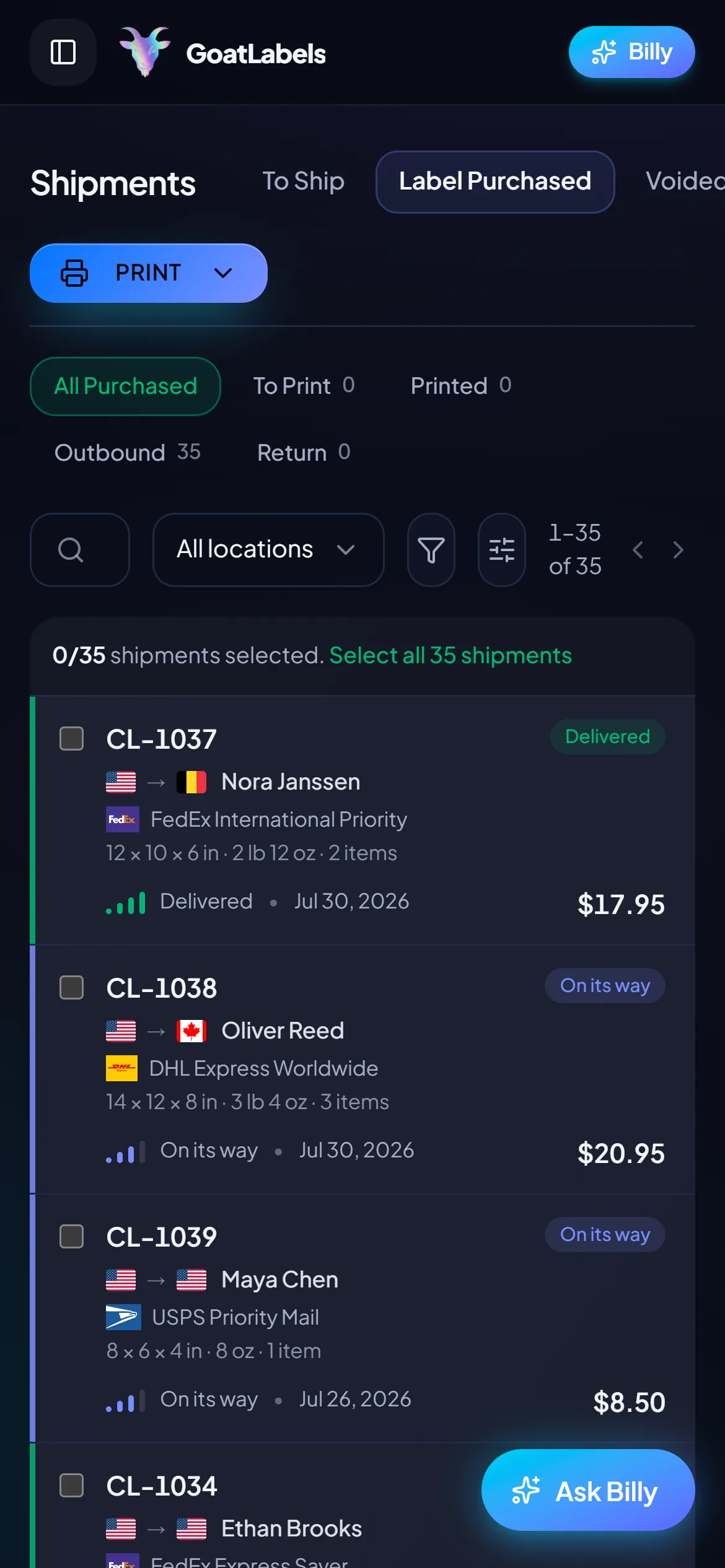
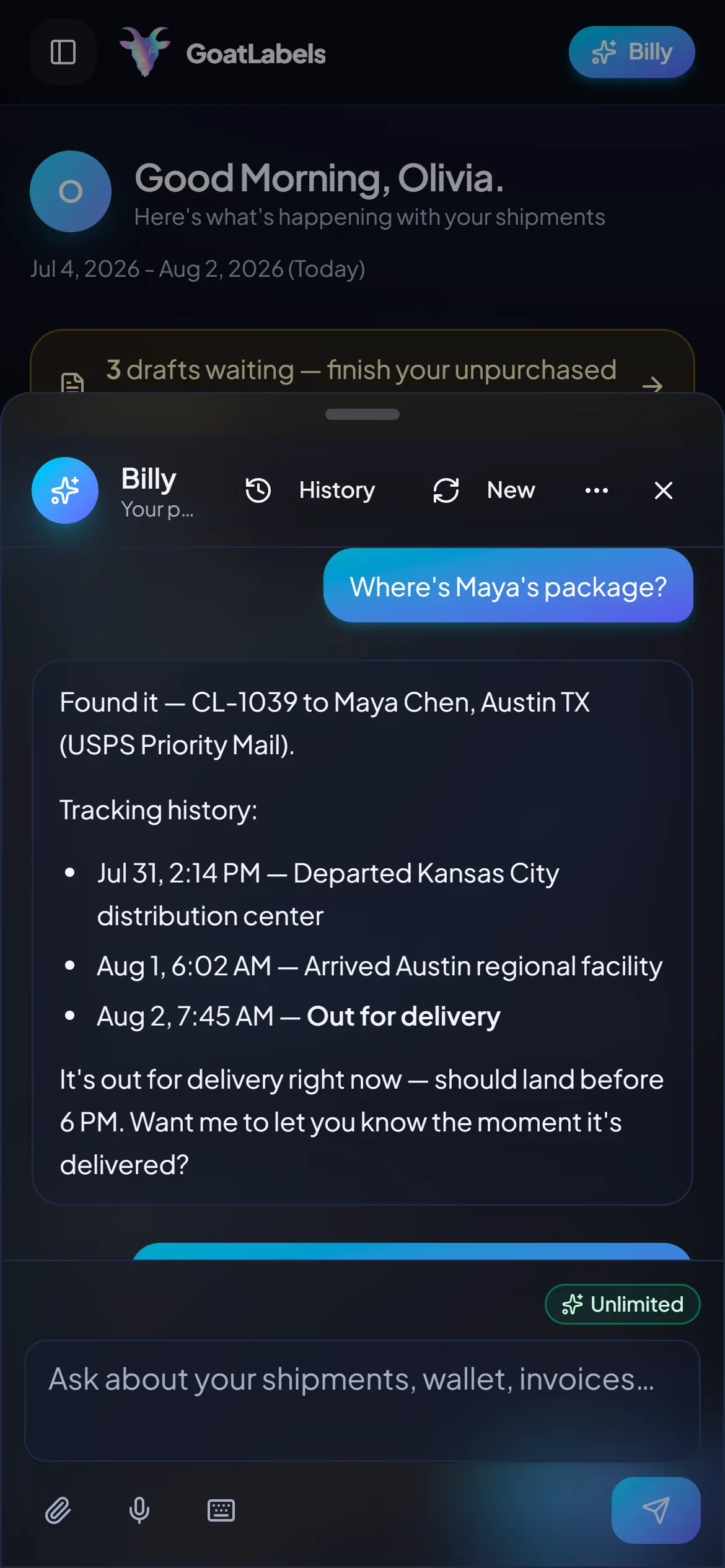
Label ready as a PDF
Dayton, OH · printed on your own printer
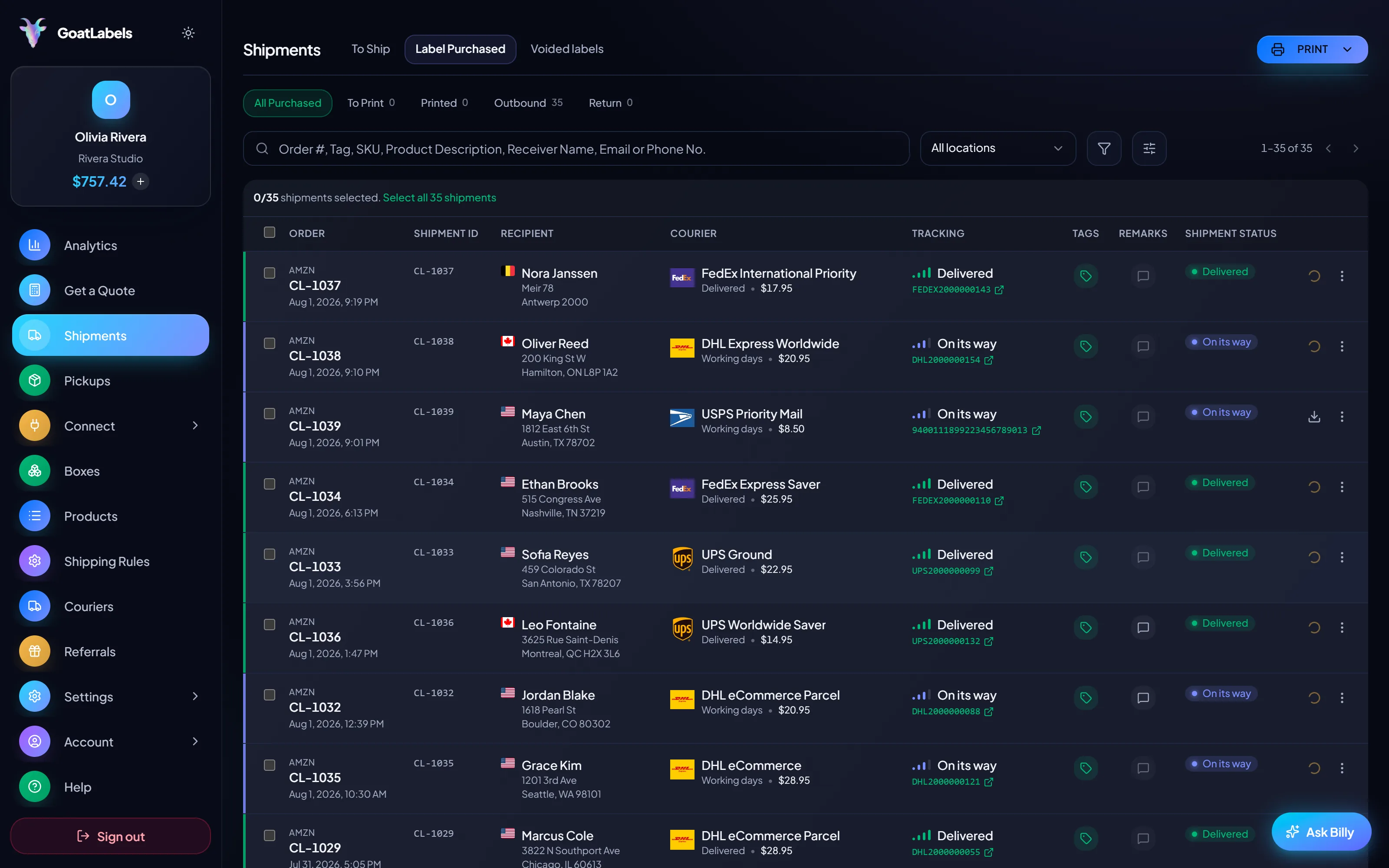
A meter lives on a desk because the licensed hardware has to. Take the hardware out of the model and the desk stops being load-bearing: the queue, the quotes, the wallet, and the print button all fit on a phone, which is what a packing table that moves with the boxes actually needs.
In the meter model the answer to 'did that go out' lived at the station, in its logs, with whoever was standing there. Ask out loud instead and Billy finds the shipment and reads its tracking history back — which carrier, which scan, where it is now — on the phone of whoever was asked the question. Included on every plan, never a licensed seat. This is the real product, not a render.
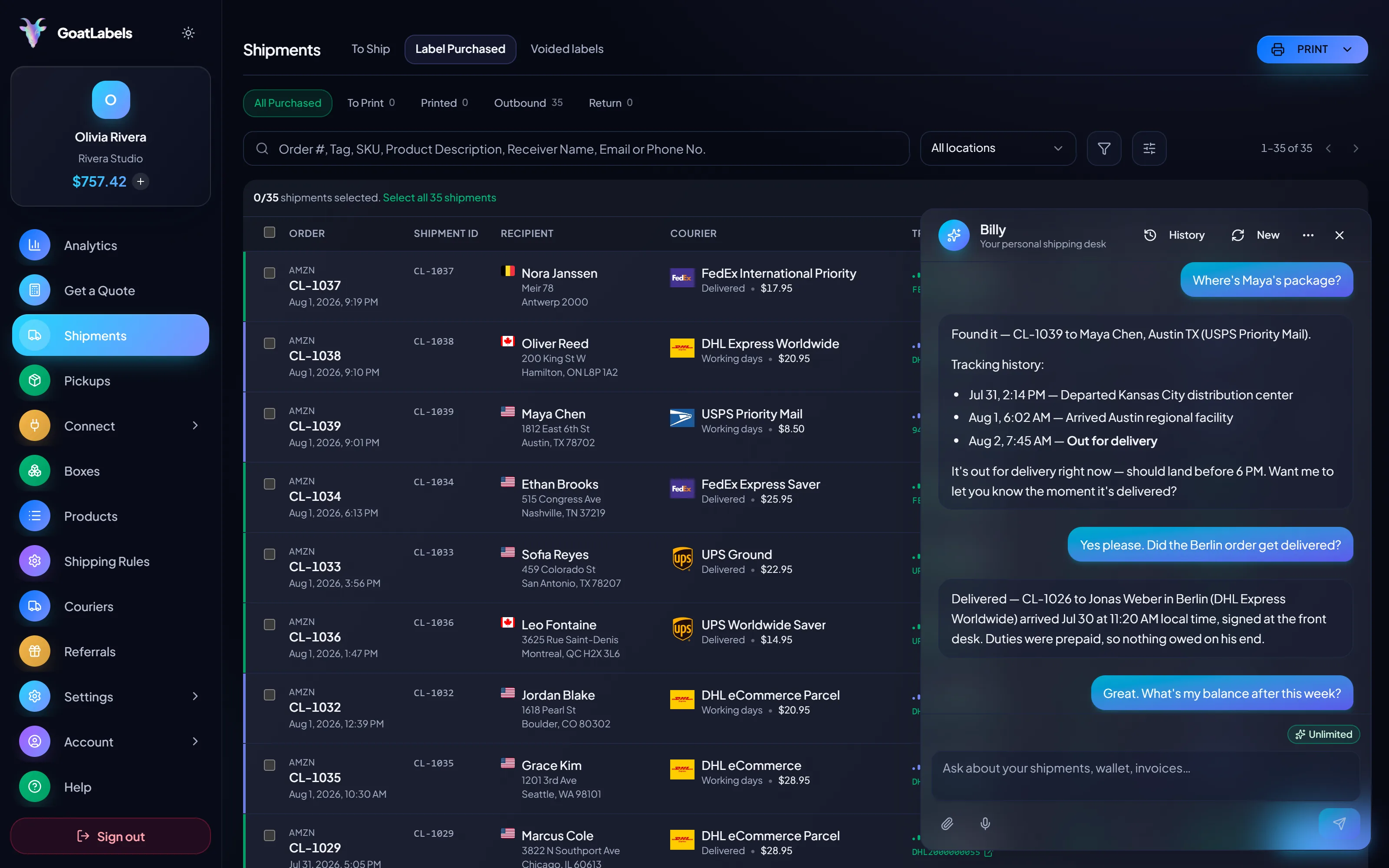
Listening
"Did the Dayton replacement part go out?"
Out for delivery
Dayton, OH · scanned this morning
Speaks plain English · included on every plan, never a seat or a device · browser, phone, or Telegram on Pro.
The franking model puts a single postage relationship at the centre and bolts comparison to the side of it. Here the quote is the centre: the same parcel priced across carriers, each column one all-in number locked at quote time, and the column you pick is exactly what leaves the wallet. No refill threshold decides when you may buy it. Figures are illustrative.
Ground Advantage
2–5 days$7.40
$1.20 of Premium insurance included
all-in · debited from the wallet, not a meter
Ground
3–4 days$10.80
$1.20 of Premium insurance included
all-in · debited from the wallet, not a meter
Home Delivery
2–4 days$11.40
$1.20 of Premium insurance included
all-in · debited from the wallet, not a meter
Meter-era automation meant a desktop application, a driver, and a machine that had to be present. This one is an HTTP call: create, quote, buy, and void over REST and JSON behind a single Bearer header, from a server that has never met a piece of hardware. And it is not a tier — the calls are unlimited on the free plan too.
POST /api/v1/shipments
Authorization: Bearer sk_live_…
Idempotency-Key: ord_8421

{
  "to": { "name": "Joyce", "city": "Berlin", "country": "DE" },
  "parcel": { "weight": 2.6, "weight_unit": "lb" },
  "service": "fedex_intl_priority"
}
The decode table's last row is the one that matters most: on the day you stop, one model owes you paperwork and the other owes you nothing. Free covers 50 shipments a month with USPS, UPS and FedEx on domestic parcels and DHL on international lanes, the connectors, Billy in the web app, and the API underneath; Pro adds unlimited shipments and Billy on Telegram.
 — draft a label without walking to any station
Rate by plan
illustrativeone flat plan, unlimited shipments
$0 / forever
An office that ships in bursts pays for the bursts, and nothing in between.
The assistant that reads a forwarded order into a draft label, and validates the address before anything is spent, runs unlimited in the web app on Free — for everyone in the office, not for a named user on a device. Pro adds Billy on Telegram.
Telegram, ProGET /api/v1/shipments
200 OK · plan: free
Unlimited calls on Free — still unlimited on Pro.
On Pro we will work with you to beat the label rates you are already getting from
Stamps.comShippoShipStationLabel prices are quoted live from USPS, UPS, FedEx, and DHL as one all-in number, and that exact amount leaves your prepaid wallet. Pitney Bowes and SendPro are trademarks of their owner and are not affiliated with GoatLabels; their plans and lease terms are theirs to change. Full pricing details
The decode table is about layers; this is about people. Three of these four are the ones a meter no longer fits, and the fourth is the one it still does — which this page has been honest about from the start.
 Envelopes went digital, parcels did not
Statements moved to email and the tray emptied, but the shipping did not stop — it just stopped looking like mail. What is left is parcels, which want a quote rather than a frank, and a station that is no longer where the work happens.
 A contract that keeps its own calendar
Leased hardware does not notice a cancelled subscription — it has its own term, its own notice window, and a return obligation at the end. Sequencing all of that is a page of its own; the point here is that a wallet model has no equivalent to sequence.
Nothing to return
No device, no refill account, no notice window

 A drop month and a dead month, same quarter
Where a meter is still the right tool
0
reasons to switch if your day is trays of envelopes rather than parcels
Updated
Ready to leave? How to cancel Pitney Bowes SendPro sequences the exit. Comparing the field: the Stamps.com small-business alternative covers the other desktop-postage exit,USPS shipping labels covers the carrier you kept, andpricing is one page long.
A video took off and I had 80 TikTok Shop orders by morning. I printed every label from my phone on the bus to the post office.
Early customer · TikTok
TikTok Shop seller
 TikTok Shop
I run my Etsy shop from the kitchen. The AI reads the order, picks the carrier, the label prints. That's the whole workflow now.
Early customer · Etsy
Etsy maker
 Etsy
EtsyThe API is what every shipping API pretends to be. Idempotency that actually works.
Sasha R.
Staff engineer, marketplace
Fund a prepaid wallet with card, Apple Pay, Google Pay, ACH, or crypto, quote one real parcel across USPS, UPS and FedEx (DHL on international lanes), and print the winner as a PDF on the printer you already own.
No contract. No card required. Nothing to lease or return.
Updated