

USPS
Ground Advantage
2–5 days$7.40
$1.20 of that all-in figure is prepaid insurance, quoted inside the same number
all-in · no refill, no reconciliation
SendPro cancellation has up to four separate ends: the software subscription, any equipment lease with its return process, the postage balance refund, and final billing. Miss one and charges continue. This page sequences all four, then covers printing your remaining labels from a wallet with nothing to lease or return.
USPS, UPS and FedEx rate-shopped on every domestic parcel, DHL on international lanes, printed as a 4×6 PDF on hardware you own outright.


 DHL: international
Card, Apple Pay, Google Pay, ACH, or crypto into one prepaid wallet — no refills, no financing line, no reclaim process at the end.
Work them in order, keep every confirmation, and skip the ones your account does not have — a subscription-only account is a one-step exit, a leased meter with financed refills is the full sequence.
The visible one, and the only one most people cancel. A PitneyShip subscription is cancelled in the app under Profile, Cancel Subscription, and it stops exactly one of the charges on the relationship. Save the confirmation and treat it as step one of four, not as the finish line.
A leased device is a separate contract with its own term and end date. It does not end because the software did. Pitney Bowes ends it through Request Termination of Contract under Contract Details in Your Account and then sends a return kit; follow the return to its end and keep the proof of return until the final statement is clean.
Unused postage is withdrawn from the meter before it goes back, and Pitney Bowes returns it to the original funding source rather than through your card issuer. If refills were financed through Purchase Power, pay that line off and ask for it to be closed too: Pitney Bowes lists finance and inactivity fees on it, so an open credit line is a live billing surface even with the meter gone.
The last termination is vigilance. Watch one or two statements for subscription residue, lease charges, refill financing, or fees you cannot map to a signed agreement. With written confirmations from the first three steps in hand, anything that posts afterwards is a short, winnable dispute.
Pitney Bowes and SendPro are trademarks of their owner and are not affiliated with GoatLabels. Their cancellation flows, lease terms, and refund policies are theirs and change — your agreement and their current support pages are the authoritative source for the exact process.
The reason SendPro cancellations go wrong is that the word cancellation is singular and the relationship is not. A meter-heritage account can have four financial surfaces running at once: a software subscription billing monthly, an equipment lease with its own contract and term, a postage balance — possibly fed by a financing line — and the ordinary tail of final billing. Each one can generate a charge on its own authority, which means cancelling the subscription alone can leave three ways to be billed by a product you no longer use.
None of this is a trick; it is inheritance. The postage meter was always a bundle of device, consumable, and service, and the modern product still unbundles into exactly those pieces when you leave. The practical consequence is simple: before you cancel anything, inventory what your account actually has. Open your agreement and your last two invoices and answer three questions — is there a lease, is there a balance, is there financing behind the refills? The answers decide which of the four ends below apply to you, and the checklist runs shortest for subscription-only accounts.
Order matters because the subscription is the piece you can see, and the lease is the piece that bills after you stop looking. If your account has leased equipment, look up the lease's end date under Contract Details in Your Account and read your agreement before touching the subscription, because the lease runs on its own contract dates, independent of the software's billing cycle. The clean sequence is to submit the lease termination request first, then cancel the subscription so both end near each other, rather than cancelling the software first and discovering the lease still has months of its own term to run.
Whichever channel you cancel through, be explicit that you are ending the subscription, not pausing or downgrading it, and get the confirmation in writing with a date and a reference. Retention flows exist to convert a cancellation into a smaller subscription; a written confirmation is what converts your version of events into evidence. And before the account loses its login, pull anything you will want later — shipment history, postage purchase records, the invoices you may need for a dispute — because exporting from a live account is a download, and reconstructing the same records from a closed one is a support ticket.
A postage meter is not ordinary office hardware — it is a postage-dispensing device operated under USPS regulation and licensed through the vendor, which is why you cannot simply drop it at a recycler and move on. The device has to be formally withdrawn from service and returned through Pitney Bowes' process, and the return is what closes the meter side of the account. Follow their instructions for the return shipment, photograph what you send, and keep the tracking number and any receipt of return until the final statement is clean.
The return also settles the money: Pitney Bowes has you withdraw unused postage from the meter before it ships back, and a meter that no longer works has its funds withdrawn at their facility and credited to the account. Treat withdraw-and-return as one motion: postage withdrawn, meter back, confirmation saved, and the refund to your funding source becomes a record rather than an argument.
Whatever postage remains is withdrawn from the meter as part of Pitney Bowes' return steps and goes back to the original funding source; if that source was a USPS prepaid account, Pitney Bowes points you to USPS's own withdrawal rules first. Note the amount you expect back and keep the confirmation. If your refills were financed through Purchase Power, pay off the balance and ask Pitney Bowes in writing to close the line, because its fees guide lists finance charges and an inactivity fee on that account.
The parcels do not pause while the paperwork winds down, and they do not need to. A prepaid wallet funds the first label in minutes by card, Apple Pay, Google Pay, ACH, or crypto, and every domestic parcel is quoted across USPS, UPS and FedEx (DHL on international lanes) as all-in numbers, with the winner printed as a standard 4×6 PDF on any printer you already own. Nothing in that sentence involves a lease, a meter, a refill, or a notice period, which is the point: the replacement should have none of the structure you just spent a checklist dismantling.
The sensible move is to overlap rather than leap: open the wallet account while the exit runs, ship a handful of real parcels through it, and let the meter wind down behind a workflow that is already working. The overlap costs nothing on this side, because an idle account has no fee to accrue. What it costs when you do ship is one page of pricing, with no monthly fee on Free (up to 50 shipments a month), and the fuller case for it is laid out on the SendPro alternative page, with cheap shipping labels covering how the four-way quote arrives at its all-in price.
Checked on from Pitney Bowes SendPro's own pages. Plans, fees and policies change, so confirm on the vendor's current page before you decide. Pitney Bowes SendPro is a trademark of its owner and is not affiliated with GoatLabels.
The advice in the section above is to overlap rather than leap: have the replacement running while the lease and the subscription wind down. This is what that replacement is, end to end, and the striking thing is how few steps it has. No meter to license, no device to install, no refill to schedule, no station to sit at. An order arrives however it arrives, Billy drafts it, the carriers bid on the parcel, and the winner prints as a 4×6 PDF on a printer you already own.
posting the invoice pack to Hartford, CT
Start this while the exit is in progress, not after it. An idle account accrues nothing here, so running both in parallel while the lease and the subscription wind down costs you only the labels you actually buy.
 Billy AI
Void a label and, after the carrier accepts the void, the credit lands back on your balance, spendable on the next label. That is the whole reclaim story here: no termination request and no postage withdrawal.
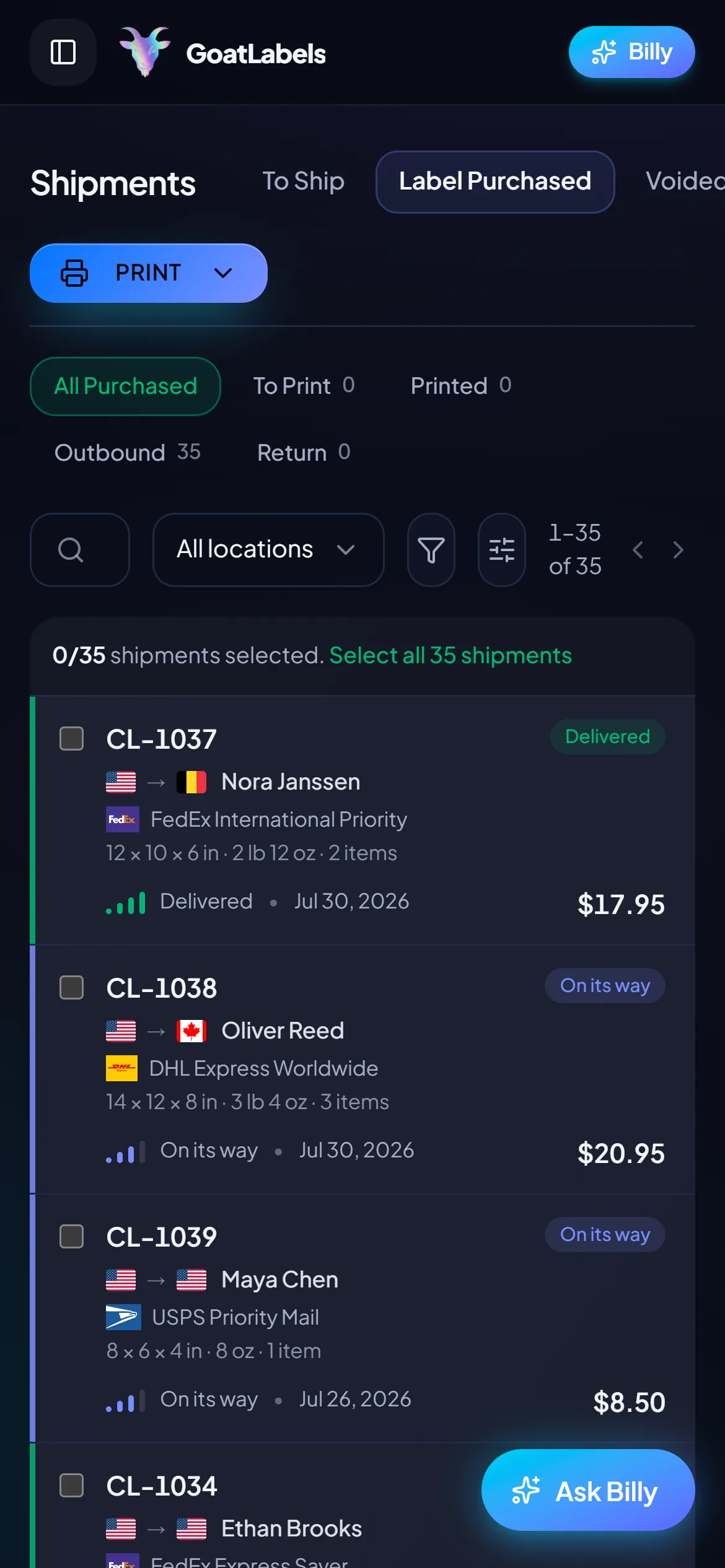
The meter workflow assumed a fixed desk where somebody keyed each recipient in. Thirteen connectors replace that habit outright: Shopify, Etsy, WooCommerce, TikTok Shop, Amazon, eBay, Squarespace, Wix, Walmart, Square, BigCommerce, Magento, and Temu sync orders into one To Ship queue, with tracking pushed back when you print. Instagram and Facebook stay paste-only, and a plain typed address still works exactly as it always did — for the office mail that never came from a store at all.
 Shopify
 Etsy
Etsy WooCommerce
 TikTok Shop
 Amazon
 eBay
eBay Squarespace
 Wix
Wix WalmartShopify PlusSoon
 Square
 BigCommerce
 Magento
 ZapierSoon
 NetSuiteSoon
 EcwidSoon
 Temu
Temu SheinSoon
 ChannelAdvisorSoon
 SkuVaultSoon
 Zoho InventorySoon
 Patreon
The replacement is deliberately structureless: money in a wallet, carriers quoted, a PDF out. Each piece below exists so that no future version of you ever needs a four-step exit checklist again.
Card, Apple Pay, Google Pay, ACH bank transfer, and crypto top up the same balance, spent label by label. No refill schedule, no financing line, and a balance that stays yours instead of needing a reclaim process.
Paste an order email, drop a screenshot, or say the address — Billy drafts the label and validates the address before a cent moves. The fixed desk the meter workflow assumed simply is not required.
BillyLIVENo monthly fee: pay per label from the wallet and let a quiet month cost zero. Free covers 50 shipments a month; Pro is a flat plan for volume above that, and dropping back down is a click rather than a notice period.
USPS, UPS and FedEx priced side by side on the same domestic box, DHL on international lanes, each as one all-in number that is exactly what leaves the balance. The single-carrier default retires with the meter.
UPS$12.48FedEx$13.22DHL$14.10USPS$11.79REST and JSON, one Bearer header, idempotency keys so a retry cannot double-buy a label, and signed webhooks for tracking events. Unlimited calls on every plan, same wallet as the dashboard.
Label ready · nothing metered
Hartford, CT · printed as a 4×6 PDF
A meter ties postage to a place: the machine is where the machine is, and everything that ships has to come to it. Take that constraint away and the workflow stops needing a mailroom at all — the queue, the quotes, the wallet, and the print button are on the phone in your pocket, which is a bigger practical change than the money.
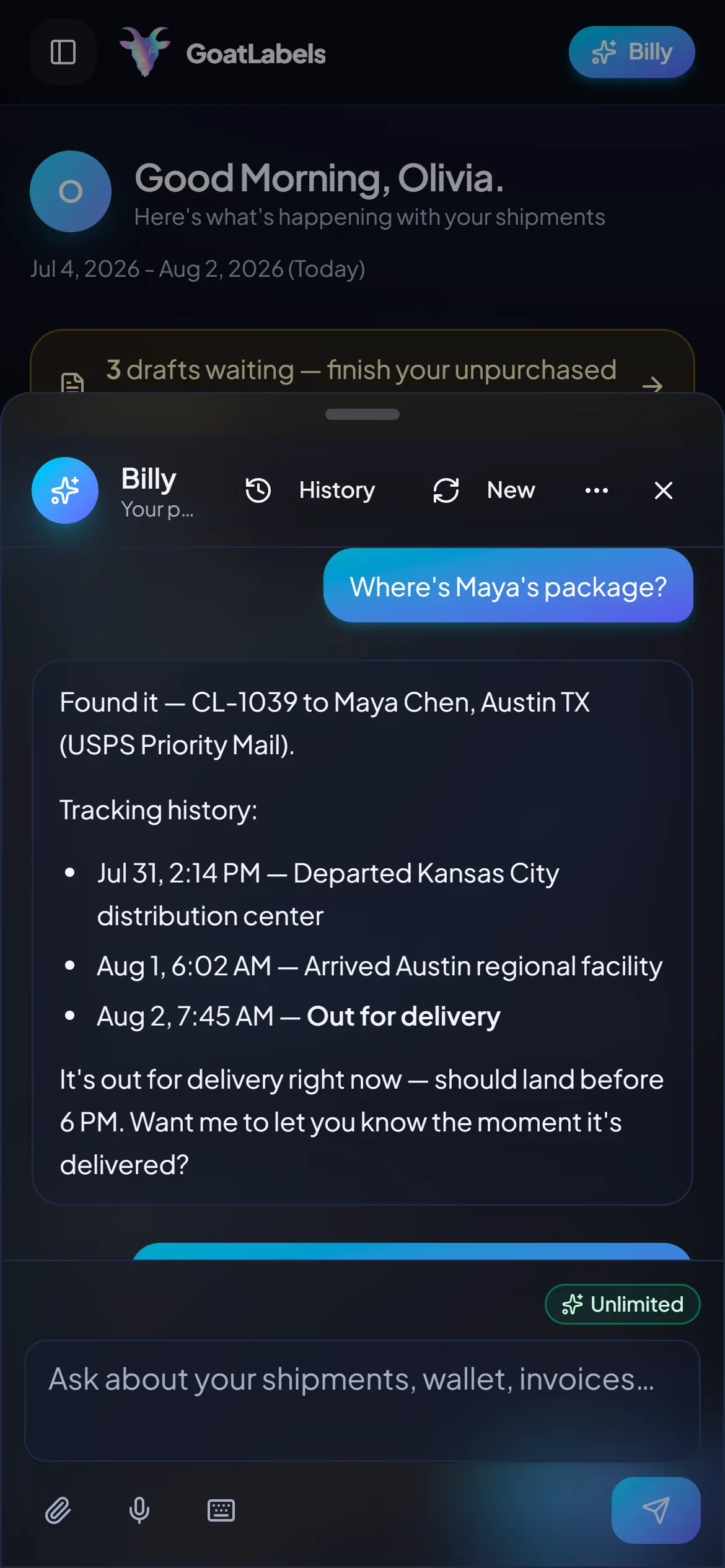
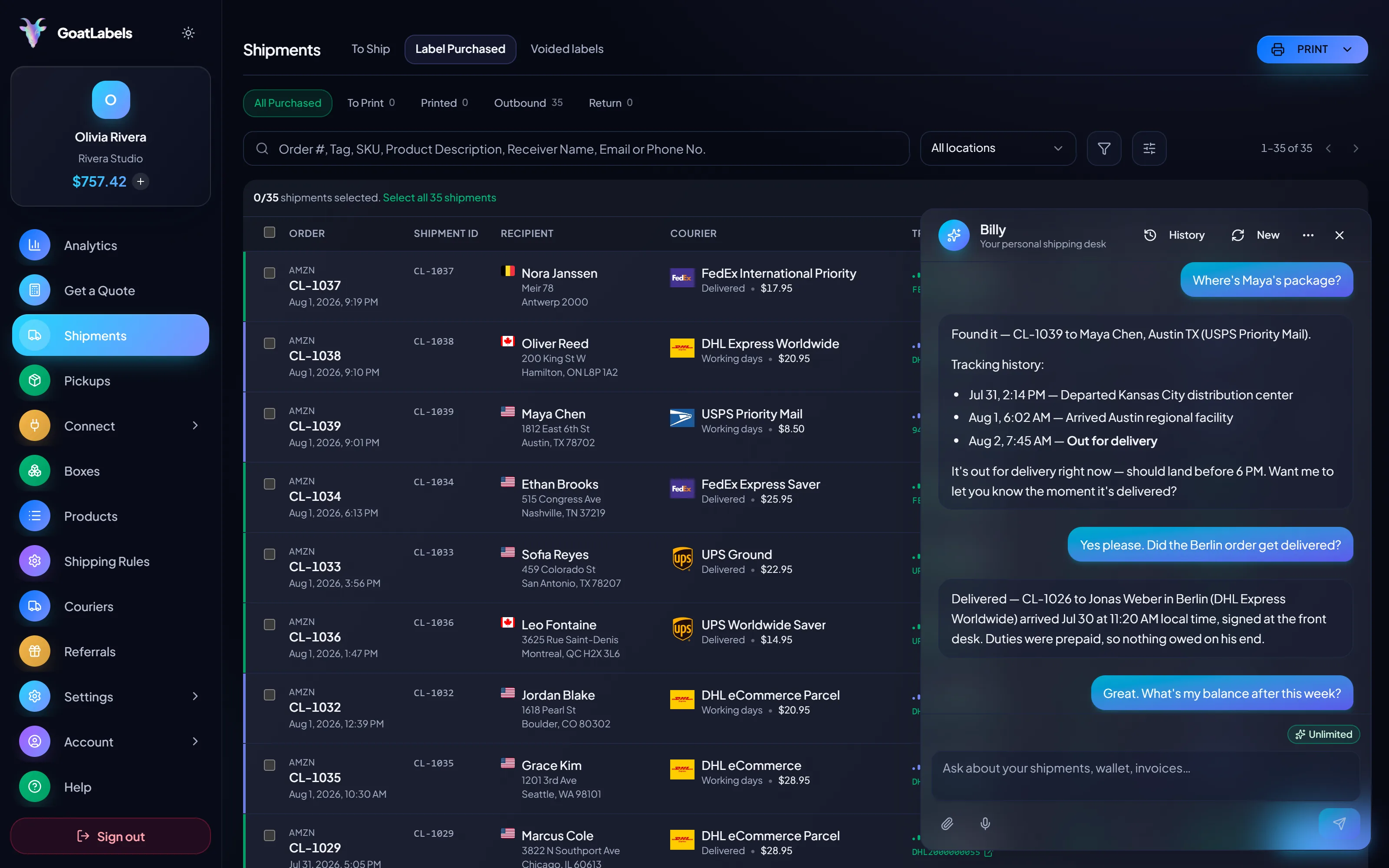
Anyone who has just worked a four-step exit knows what the questions felt like on the way out: a channel per product line, a queue, a reference. Ask this one out loud instead — Billy finds the shipment, tells you where it is and what it cost, and answers for the label afterwards. Included on every plan, on the phone at the bench or in the browser. This is the real product, not a render.
Listening
"Where is the Hartford envelope?"
Out for delivery
Hartford, CT · scanned this morning
Speaks plain English · finds a shipment by recipient or order · remembers saved box sizes · included on every plan, so it never becomes its own line to terminate.
A meter turns postage into a balance sitting inside a licensed device, which is why leaving one involves a termination request, a postage withdrawal, and a meter return. Here the same money is a prepaid balance you already own: each carrier returns one all-in number, the column you pick is what leaves the balance, and an accepted void puts it back. Figures are illustrative, not a rate quote.
Ground Advantage
2–5 days$7.40
$1.20 of that all-in figure is prepaid insurance, quoted inside the same number
all-in · no refill, no reconciliation
Ground
3–4 days$10.80
$1.20 of that all-in figure is prepaid insurance, quoted inside the same number
all-in · no refill, no reconciliation
Home Delivery
2–4 days$11.40
$1.20 of that all-in figure is prepaid insurance, quoted inside the same number
all-in · no refill, no reconciliation
Most people arriving from a meter do not want an API today. It matters anyway, because the reason this checklist existed is that the last tool made leaving expensive — and an integration layer you have to migrate onto later is exactly how that starts again. REST and JSON over one Bearer header, unlimited calls on Free, and an OpenAPI spec you can read before you commit to anything.
POST /api/v1/shipments
Authorization: Bearer sk_live_…
Idempotency-Key: ord_8421

{
  "to": { "name": "Joyce", "city": "Berlin", "country": "DE" },
  "parcel": { "weight": 2.6, "weight_unit": "lb" },
  "service": "fedex_intl_priority"
}
The honest test of a replacement, for anyone who has just read four steps of exit paperwork, is what leaving this one would take. On Free, nothing at all: no contract, no lease, no meter, and no monthly fee, so an account you stop using simply sits there costing zero. Past 50 shipments a month, Pro is a flat $40 monthly plan, and dropping back down is a click rather than a notice period — that asymmetry is the whole design.
 — draft a label without opening the dashboard
Rate by plan
illustrativepay for labels, not for seats
$0 / forever
An idle account accrues nothing, which is what makes overlapping with the exit free.
The assistant that reads a pasted order email into a validated draft runs unlimited on Free. It is not a module, not an add-on, and not a separate agreement — which means it is not something a future exit checklist would have to name.
Telegram, ProGET /api/v1/shipments
200 OK · plan: free
Unlimited calls on Free — still unlimited on Pro.
Put a real parcel through and compare the side-by-side rate against what that label costs you on
ShippoPirate ShipShipStationLabel prices are quoted live from USPS, UPS, FedEx, and DHL as one all-in number, and that exact amount leaves your prepaid balance. Pitney Bowes' own fees, terms, and return steps are theirs to change; your agreement and their current support pages remain the authoritative source, as the dated Pitney Bowes facts above say. Full pricing details
The exit sequence is the same for all of them; what differs is which of the four terminations actually applies, and what the day after has to look like.
 Subscription-only, no lease in sight
The shortest version of the checklist: cancel the subscription, confirm it in writing, watch a statement. What replaces it needs to be equally undramatic: a balance, a quote per carrier, and a PDF on the printer already in the corner.
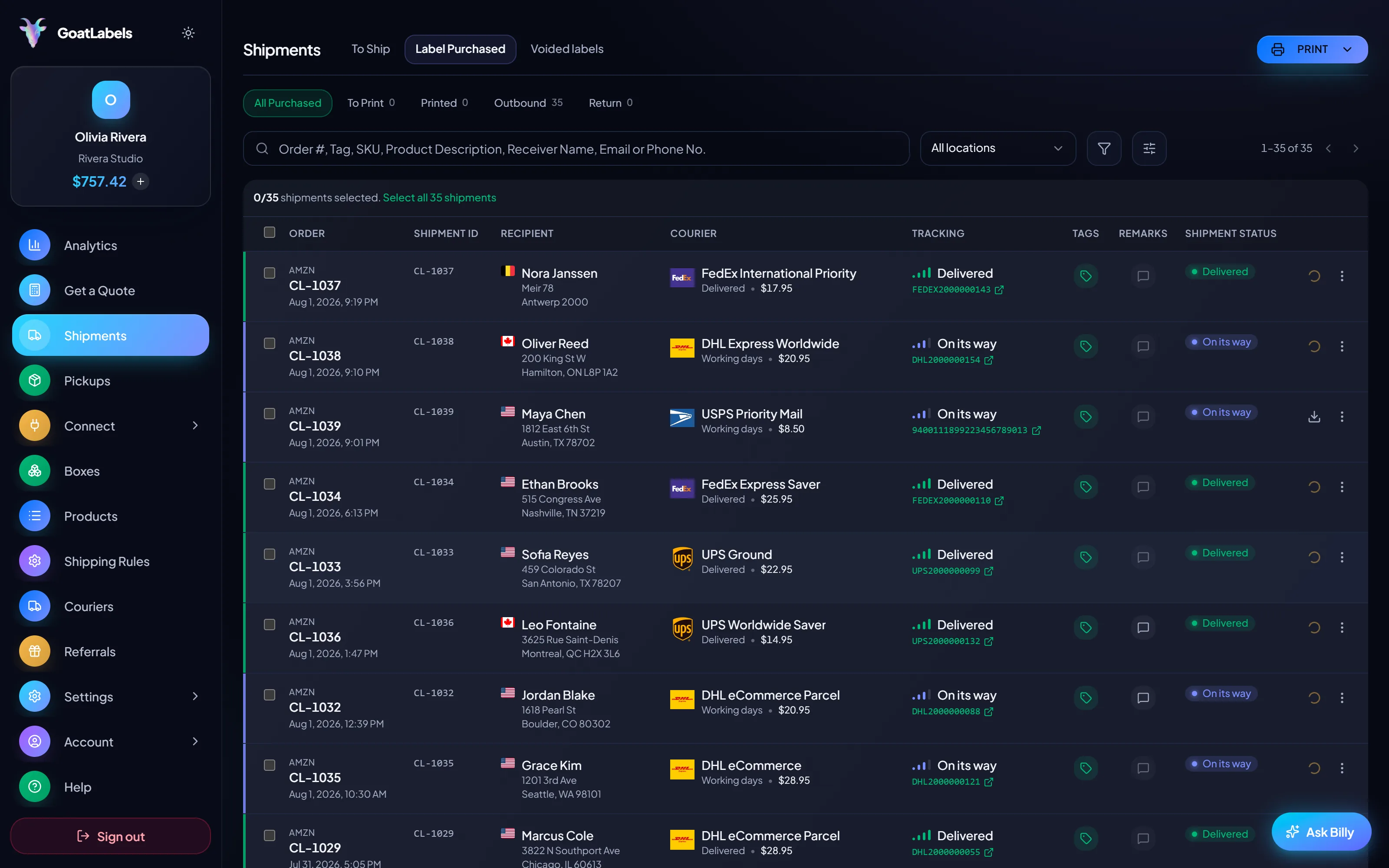

 Orders now arrive from three storefronts
Once orders come from connected stores rather than a stack of paperwork, the fixed station is the bottleneck rather than the postage. Sync replaces retyping, and the queue lives wherever the packing happens.
The station was the constraint
Not the postage — which is why the desk goes first

 DMs, emails, and typed addresses
 Balance, financing line, and a return kit
0
reclaim processes on this side: a prepaid balance is already yours, and an accepted void credits back to it
Still deciding? The SendPro alternative page makes the case before you commit to the exit. Related exits: cancelling Stamps.com. Afterwards: USPS shipping labels, cheap shipping labels, and pricing.
A video took off and I had 80 TikTok Shop orders by morning. I printed every label from my phone on the bus to the post office.
Early customer · TikTok
TikTok Shop seller
TikTok ShopI run my Etsy shop from the kitchen. The AI reads the order, picks the carrier, the label prints. That's the whole workflow now.
Early customer · Etsy
Etsy maker
EtsyThe API is what every shipping API pretends to be. Idempotency that actually works.
Sasha R.
Staff engineer, marketplace
Fund a prepaid wallet with card, Apple Pay, Google Pay, ACH, or crypto, print one real parcel at the all-in USPS, UPS, FedEx, or DHL rate, and finish the checklist knowing exactly what ships tomorrow.
Sign up in seconds. No card required. Nothing recurring, leased, or metered.
Updated