

USPS
Ground Advantage
2–5 days$7.40
$1.20 of Premium insurance included
all-in · zone priced, no inspection clause
Media Mail is a restricted USPS service: it carries bound books, printed music, and recorded media, and excludes anything carrying advertising, blank media, and most games. Parcels are openable for inspection, and an ineligible item is rerated to the full price — billed to whoever the carrier can reach.
Quote the same box of books against USPS services, UPS and FedEx at once; sometimes the restricted service is not even the cheap one. DHL quotes international lanes only.


 DHL: international
Card, Apple Pay, Google Pay, ACH, or crypto fund one prepaid wallet — no monthly software fee eating a used-book margin.
Updated 2026-08-15
Media Mail is a statutory bargain, not a marketing tier: Congress subsidized the movement of educational material, and the Domestic Mail Manual polices what qualifies so the discount cannot become general freight. The eligible list is short and literal — bound books of eight or more printed pages, printed music, printed test materials, sound recordings, recorded video, and certain loose-leaf medical information. The exclusions are just as literal, and two of them do nearly all the disqualifying. The advertising exclusion removes anything carrying current ads, which is why magazines and catalogs are out and why comic books sit in a gray zone their binding alone would not predict. And the named exclusions remove things that physically resemble media but are not treated as such — video games, computer drives, and blank anything: blank tapes, blank journals, pages meant to be written on rather than read.
The matrix below gives the items sellers actually argue about, each with a verdict and the DMM basis it rests on. The pattern worth internalizing: eligibility follows what the thing is, never what shelf it was sold from. A bookstore can ship plenty that Media Mail refuses, and a game store almost nothing it accepts.
| Item | Verdict | What it rests on |
|---|---|---|
| Textbooks, novels, used books | Eligible | Bound books of eight or more printed pages fall squarely inside the DMM's book provision, provided they carry no current advertising. |
| Comic books and manga | Risky | The binding qualifies as a book, but the DMM's advertising exclusion is the trap: many issues carry ad pages, which technically disqualifies the piece. |
| Coloring books and blank journals | Excluded | The book provision covers printed reading matter. Pages that are blank or meant to be filled in are not printed content, so neither item qualifies. |
| Vinyl records, CDs, DVDs, cassettes | Eligible | Sound recordings and recorded video fall under the DMM's recorded-media provisions — the classic Media Mail cargo. |
| Console and PC video games | Excluded | USPS excludes video games, computer drives, and digital storage drives by name, even though a game disc physically resembles eligible recorded media. |
| Magazines and catalogs | Excluded | Periodicals carry advertising by construction, and the advertising exclusion removes them regardless of content. |
| Sheet music and printed scores | Eligible | Printed music is one of the DMM's named media categories, bound or loose. |
| Mixed bundle: a board game with its rulebook | Excluded | Eligibility is judged on the whole parcel. One ineligible item — the game — disqualifies the box, rulebook and all. |
Eligibility reference — compiled from the USPS Domestic Mail Manual's Media Mail content standards and USPS's published customer guidance, verified on 2026-08-15. The service's weight ceiling is 70 lb per parcel, pricing is by weight only with no zone component, and USPS quotes typical transit of 2–8 days, unguaranteed. USPS revises the DMM continuously; where a parcel is worth arguing over, read the current Media Mail standards at pe.usps.com rather than any third-party summary, this one included. Next review: at the next USPS price change.
The discount's price is a clause most sellers never read: Media Mail parcels may be opened and inspected by the Postal Service. That is not a threat, it is the enforcement mechanism that keeps the rate alive, and it means every Media Mail parcel you send is a representation you are making about its contents. Inspection is sampling, not screening — most parcels sail through unopened, which is exactly what makes the rule feel optional right up until it is not.
When an inspected parcel fails, it is rerated: the postage is recalculated at the applicable full service price, and the difference must be paid before the parcel completes its journey. In practice the demand lands on whoever the Postal Service can reach — frequently the recipient at delivery, meaning your buyer pays your postage shortfall at their own door, which converts a shipping shortcut into a customer-service incident. When such a shortfall is billed back through your postage provider instead, it arrives asa post-shipment billing adjustment. One rule of thumb absorbs all of this: if you would have to explain to an inspector why an item counts as media, it does not.
Media Mail's structural quirk is that it prices weight and ignores distance, while ordinary ground services price both. That single difference decides every comparison. Send a heavy box of hardcovers across the country and Media Mail's flat geography is unbeatable. Send one paperback to the next state and the short-zone ground price frequently undercuts it — while also moving faster, arriving with denser tracking, and carrying zero inspection exposure. Booksellers who default every order to Media Mail out of identity rather than arithmetic routinely overpay on exactly their lightest, nearest orders.
The operational answer is to stop deciding by category and start deciding by quote. Price the parcel across USPS services, UPS and FedEx at once, with the transit windows visible beside the prices, and the Media-Mail-versus-ground question answers itself per order instead of per identity. Which ground service wins among the carriers — and where weight, destination density, and final-mile handoffs flip the answer — is derived once onthe cheapest ground shipping services page, and this page will not re-run it.
A correct Media Mail parcel is mostly a correct ordinary parcel with two extra disciplines. The first is purity: the box must contain only eligible media and the minimal packaging protecting it. Tossing in a bookmark is fine; tossing in a thank-you tote bag, a candle, or the action figure that goes with the book converts the whole parcel to the full parcel rate under the whole-parcel rule. If an order mixes media and non-media, ship two parcels or price the whole thing as ordinary ground — the combined quote is often smaller than intuition expects. The second discipline is honesty at the scale: books are dense, Media Mail is priced per pound, and a declared weight the acceptance scale disagrees with is the fastest route to a correction.
The label itself needs nothing exotic: the service marking is carried by the label you purchase, the address should be validated before money moves — done automatically here, with a residential or commercial badge on the destination — and a padded mailer or snug box beats a loose one, because Media Mail rides space-available transport and gets handled accordingly. Wrap corners, immobilize the contents, and treat the transit estimate as a floor, not a promise. Buyers forgive slow; they do not forgive a postage-due card where their book should have been.
The order of operations on a media parcel is not the same as on any other parcel, and getting it backwards is what produces postage-due cards. Decide what is going in the box before you decide what service carries it, because the whole-parcel rule means one ineligible item reclassifies everything around it. Only once the box is pure does the pricing question open up — and then it is a real question, since a weight-only rate and a zone-priced ground rate can land either way round.
the two Steinbeck hardcovers plus the sheet music — ship to Idaho Falls, ID 83402
If an order mixes media and non-media, split it into two parcels or price the whole thing as ordinary ground. The combined ground quote is frequently smaller than intuition expects, and it carries no inspection exposure at all.
 Billy AI
Books are dense and the restricted rate is priced per pound, so declare the weight the acceptance scale will agree with. A shortfall billed back through your postage provider arrives as a post-shipment billing adjustment, which is its own page's subject.
A used-media inventory rarely lives in one place: a shop on Shopify or WooCommerce, a stall on Etsy, a record drop on TikTok Shop, and a steady trickle of collector DMs with no order feed behind them at all. Orders from the connected ones sync into a single To Ship queue, and a pasted DM lands beside them. What none of them can tell you is whether the box qualifies — the eligibility line is a property of the contents, never of the shelf they were sold from.
 Shopify
 Etsy
Etsy WooCommerce
 TikTok Shop
 Amazon
 eBay
eBay Squarespace
 Wix
Wix WalmartShopify PlusSoon
 Square
 BigCommerce
 Magento
 ZapierSoon
 NetSuiteSoon
 EcwidSoon
 Temu
Temu SheinSoon
 ChannelAdvisorSoon
 SkuVaultSoon
 Zoho InventorySoon
 Patreon
Media Mail is one price among many, and the sellers it serves — books, records, used media — run on margins that cannot fund shipping software. Everything here works on the free account.
Card, Apple Pay, Google Pay, ACH, and crypto fund one prepaid balance, debited per label at the exact quoted price. No subscription line on Free, so a month where nothing sells is a month that costs nothing.
A sale from a book fair, a collector DM, a record swap — paste the message or drop a screenshot and Billy drafts the label for you to confirm, with the address validated and classified before any money moves.
BillyLIVEEvery quoted service prices as one final number, so comparing a restricted rate against ordinary ground is reading two numbers, not reconstructing two fee schedules. What you see is what the wallet pays.
The moment an item fails the eligibility matrix — a video game, a mixed bundle, a magazine lot — USPS, UPS and FedEx are already quoted on the same screen, so the fallback price is one glance away, not another tool.
UPS$12.48FedEx$13.22DHL$14.10USPS$11.79High-volume book and media operations buy labels from scripts. The REST API quotes every service, buys from the same wallet, and signs its webhooks — unlimited calls on every plan.
Box of hardcovers · label ready
Idaho Falls, ID · quoted both ways
A lot of used media is bought and shipped nowhere near a desk — a fair, a garage, a storage unit, somebody's front room. The eligibility judgment happens where the box is, so the pricing should too: weigh it, compare the restricted rate against ordinary ground, and print, all from the phone already in your hand.
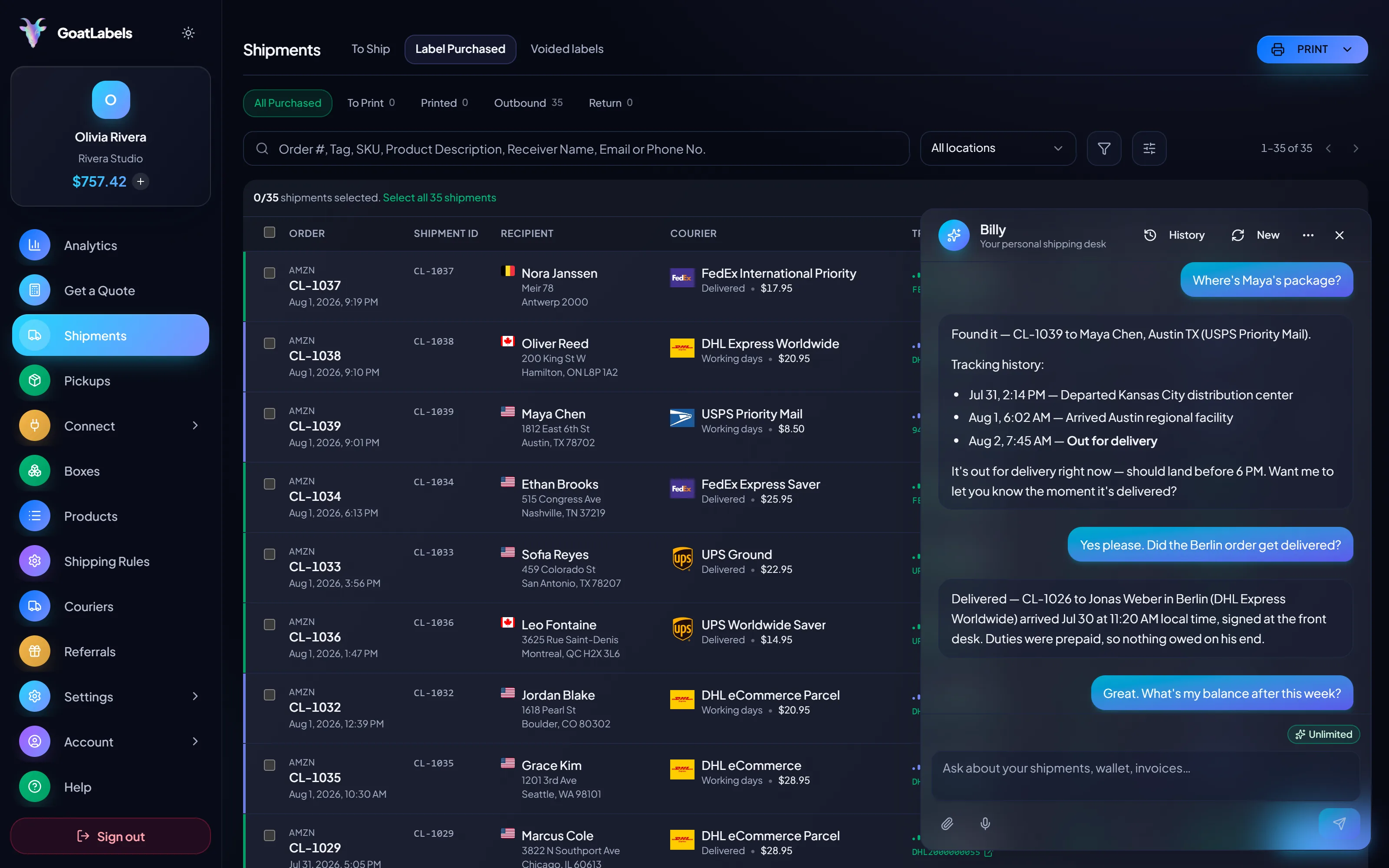
A restricted media rate rides space-available transport and carries an unguaranteed transit estimate, which means the buyer question this service generates most often is simply 'where is it'. Ask out loud and Billy finds the shipment and reads the tracking history back, so a slow parcel gets a real answer instead of a shrug. Included on every plan. This is the real product, not a render.
Listening
"Where are the Steinbeck hardcovers?"
In transit
Idaho Falls, ID · scanned overnight
Speaks plain English · remembers repeat buyers and saved box sizes · included on every plan.
The restricted rate prices weight and ignores distance; every column here prices both. That is the whole reason a paperback going one state over so often loses to ordinary ground — faster, denser tracking, and no inspection clause attached. Put your current Media Mail figure from the USPS chart next to these and let the parcel decide. Figures are illustrative.
Ground Advantage
2–5 days$7.40
$1.20 of Premium insurance included
all-in · zone priced, no inspection clause
Ground
3–4 days$10.80
$1.20 of Premium insurance included
all-in · zone priced, no inspection clause
Home Delivery
2–4 days$11.40
$1.20 of Premium insurance included
all-in · zone priced, no inspection clause
An inventory of ten thousand listings cannot be quoted by hand, and it should not be classified by machine either. The API handles the half that is mechanical — quote every service on a parcel, buy the one you chose, push tracking back — while the eligibility call stays a human judgment about contents, exactly where the DMM puts it.
POST /api/v1/shipments
Authorization: Bearer sk_live_…
Idempotency-Key: ord_8421

{
  "to": { "name": "Joyce", "city": "Berlin", "country": "DE" },
  "parcel": { "weight": 2.6, "weight_unit": "lb" },
  "service": "fedex_intl_priority"
}
Sellers who reach for a restricted media rate are, by definition, counting pennies on the postage. A monthly software fee sitting on top of that would undo the discount before the parcel moved. Free covers 50 shipments a month with every service quoted; Pro ($40 a month) is needed once you ship more than 50 a month and adds Billy on Telegram.
 — draft a label from a book fair without opening the dashboard
Rate by plan
illustrativeone flat plan, unlimited shipments
$0 / forever
A shelf-clearing month and a dead month cost exactly what they should.
The assistant that turns a collector DM into a draft label, and validates the address before anything is spent, runs unlimited in the web app on Free. Pro adds Billy on Telegram.
Telegram, ProGET /api/v1/shipments
200 OK · plan: free
Unlimited calls on Free — still unlimited on Pro.
Put a real parcel through and compare the side-by-side rate against what that label costs you on
ShippoPirate ShipShipStationLabel prices are quoted live from USPS, UPS, FedEx, and DHL as one all-in number, and that exact amount leaves your prepaid balance. Media Mail eligibility, weight limits, and pricing are the Postal Service's — read the current standards at pe.usps.com before relying on any summary. Full pricing details
The matrix above is one list, but sellers meet it from four directions — and three of those four are where a parcel gets rerated at somebody else's door.
 The service's core case
Bound books without current advertising are what the statute was written for, and a heavy box travelling a long way is where the flat, distance-blind price is unbeatable. The discipline is purity and honest weight: no tote bag in the box, and a declared weight the acceptance scale agrees with.
 Recorded media, and its lookalikes
Vinyl, CDs, DVDs, and cassettes are named categories. A console game on an identical disc is named too — as an exclusion. The physical resemblance is the trap, and it is an often-missed rule on this page.
Priced as ordinary ground
Game discs never qualify, however they look

 Bound like a book, printed with ads
 The whole-parcel rule, learned the hard way
1
ineligible item reclassifies the entire box, rulebook and all
Related reading: USPS shipping labels,the cheapest ground shipping services, andcarrier billing adjustments.
A video took off and I had 80 TikTok Shop orders by morning. I printed every label from my phone on the bus to the post office.
Early customer · TikTok
TikTok Shop seller
 TikTok Shop
I run my Etsy shop from the kitchen. The AI reads the order, picks the carrier, the label prints. That's the whole workflow now.
Early customer · Etsy
Etsy maker
EtsyThe API is what every shipping API pretends to be. Idempotency that actually works.
Sasha R.
Staff engineer, marketplace
Price your next media parcel against USPS services, UPS and FedEx at once. If ordinary ground beats the restricted rate on your lane, the numbers will say so before you commit to an inspection clause.
Sign up in seconds. No card required. No monthly fee on Free, up to 50 shipments a month.
Updated