

USPS
Ground Advantage
2 to 5 days$11.40
all-in · the quoted total is the wallet debit
The choice is metering versus flat access. ShipEngine's Free plan uses its own carriers with no usage charges, while its Advanced plans bill by label volume, meter overages and connect your own carrier accounts. GoatLabels' REST API is free to call without limits, signs its webhooks, and buys labels from the same prepaid wallet as the dashboard: four carriers included, no carrier accounts to connect.
USPS, UPS and FedEx quoted on every domestic shipment, DHL on international lanes, all from our own carrier relationships: no applications, credentials, or carrier invoices on your side.


 one call
Card, Apple Pay, Google Pay, ACH, or crypto fund the same prepaid balance behind the API and the dashboard.
ShipEngine's Advanced plan prices access the way infrastructure vendors do: each label includes one call to each metered function, and calls beyond that are billed per call. (The Free plan has no usage charges, but it ships only on ShipEngine's own carrier accounts.) The decode that matters before you integrate is which of your calls the meter can see. A production label integration does far more than buy labels — it quotes at checkout, re-quotes when an address is corrected, validates destinations, polls or receives tracking, and retries everything that times out. Under a metered model, each of those behaviours is a line your plan has an opinion about, and the integration you write starts bending around the meter: you cache rates you would rather re-fetch, batch validations you would rather run inline, and think twice about a health check that costs money.
The second axis is carrier access. ShipEngine's Free plan ships on its own discounted carrier accounts, and connecting accounts you hold (your UPS number, your FedEx credentials) takes the Advanced plan, which is a genuine strength at contract-holding scale and a week of paperwork below it. Whether bringing your own carrier accounts beats a shared four-carrier panel is a whole argument of its own, and it is owned bythe EasyPost comparison andthe carrier-accounts page rather than re-run here.
The GoatLabels model deletes the meter instead of discounting it. Every API call is free on every plan: create shipments, list rates, read tracking, manage webhooks, and hammer your staging environment without a line item appearing anywhere. Address validation is included as well, 100 a month on Free and unlimited on Pro. The one thing that moves money is a label purchase, and it moves money in the most literal way available — the all-in carrier rate you were quoted is debited from a prepaid wallet, the same wallet the dashboard uses, funded by card, Apple Pay, Google Pay, ACH, or crypto. Your shipping forecast becomes shipments times carrier rate, with no per-request or per-label platform fee; past Free's 50 shipments a month the only addition is Pro's flat monthly fee.
That structure changes how you write the integration. Quote-heavy patterns — cart estimates, background re-pricing, a re-quote on every address edit — stop being budget decisions. Retries are safe twice over: free at the request layer, and guarded by real idempotency keys at the purchase layer, so a timed-out buy that runs again returns the original label instead of buying a second one. The wider comparison of metered versus free API surfaces is worked through onthe free shipping API pageand EasyPost vs a free shipping API; this page's claim is narrower and checkable in an afternoon: nothing you can call atapi.goatlabels.io has a price on it except the label.
Webhooks are where label APIs quietly differ most, because they are the part you only evaluate after you have integrated. Every GoatLabels delivery is signed: an X-GoatLabels-Signature header carries a timestamp and an HMAC-SHA256 of the payload computed with your endpoint's secret, so your server verifies the sender instead of trusting it. Every delivery attempt — including each retry — writes its own row to a delivery log you can read back over the API, and any delivery can be replayed against your endpoint, which turns the debugging session every webhook consumer eventually has from guesswork into a diff.
The event most generic comparisons never list isshipment.adjustment.created. When a carrier re-rates a shipment after the fact — a re-weigh, a dimension correction — the adjustment is recorded as its own object, exposed at/v1/adjustments, and pushed to you with the wallet delta attached, so your reconciliation job hears about the correction the moment it exists instead of finding it in a month-end statement. One accuracy note belongs next to that: if an adjustment exceeds the wallet balance, the card on file is charged for the difference. How carriers detect, bill, and let you dispute these corrections isits own page; what this page owns is the fact that your code can subscribe to them.
POST /v1/webhooks
{ "url": "https://example.com/hooks/shipping",
  "events": ["shipment.adjustment.created", "shipment.delivered"] }

# each delivery arrives signed:
X-GoatLabels-Signature: t=1755216000,v1=hmac-sha256(secret, "t.body")

# and adjustments are readable as records, not statement lines:
GET /v1/adjustments
{ "object": "list", "data": [ { "shipment_id": "...",
  "reason": "reweigh", "delta_amount": 1.42 } ] }
Dated sample. Shapes match the OpenAPI 3.1 spec served at /docs, checked 2026-10-17. The spec is the contract; this block is an illustration of it, not a substitute for it.
The honest concession, in full: ShipEngine's carrier catalogue is far wider than four. If your routing guide includes regional parcel carriers, international postal operators, or LTL freight, GoatLabels cannot quote those lanes — USPS, UPS, FedEx, and DHL, plus an international network, are the honest list here; regional carriers, most postal operators and LTL freight are not on it. And if your company already holds negotiated contracts that beat any shared panel, an API built to drive your own accounts is the right architecture, and paying its meter is rational. Teams at that scale should stay, and this page will not pretend otherwise.
The team this page is for looks different: the big four cover their lanes, no negotiated contracts exist to bring, and the meter is pure friction — a cost on every quote their integration would prefer to make freely. For that team the evaluation is mechanical rather than rhetorical. Point a copy of your rating step at the API, log both responses for a week, and compare two things: the all-in numbers, and the absence of a usage line on this side of the ledger. The account, the key, and every call in that test are free, so the evaluation costs exactly the labels you choose to buy during it.
Checked on from ShipEngine's own pages. Plans, fees and policies change, so confirm on the vendor's current page before you decide. ShipEngine is a trademark of its owner and is not affiliated with GoatLabels.
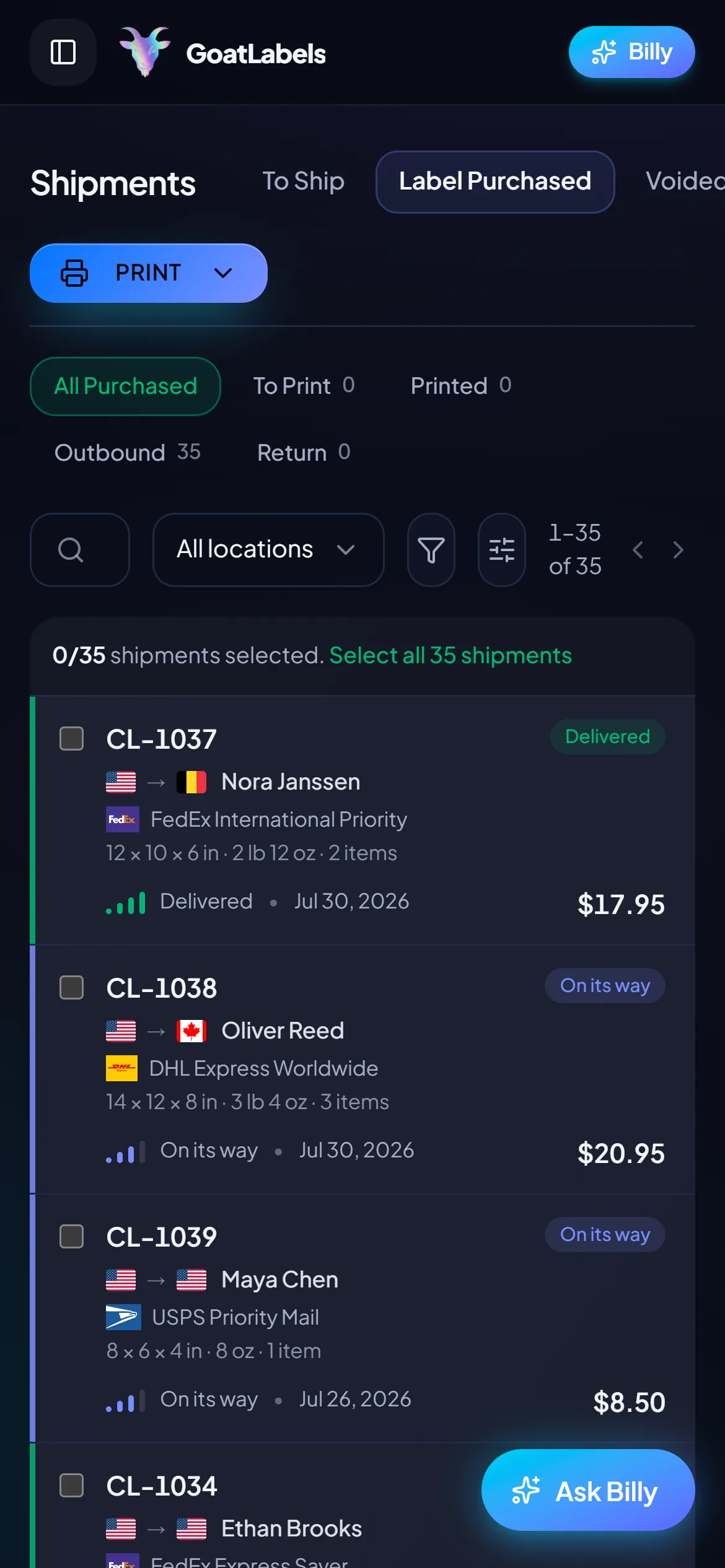
A production integration handles the orders that arrive as data. Every shipping operation also has the ones that do not — the support replacement, the DM, the reship a warehouse lead buys from a phone. Both paths end in the same place here: the same shipment objects, the same prepaid wallet, the same signed webhooks. Your code never grows a free-text parser, and your ledger never forks between what the API bought and what a person did.
customer never got #8421 — reship to the same address today
Quoting, re-quoting and retrying carry no charge, so the integration can do what the order flow actually needs instead of what a meter makes affordable.
 Billy AI
The forecast is shipments times carrier rate, with no per-label platform fee, plus Pro's flat fee past Free's 50 shipments a month. If a carrier re-rates a parcel afterwards, shipment.adjustment.created pushes the correction with the wallet delta attached rather than burying it in a statement.
Shopify, Etsy, WooCommerce, TikTok Shop, Amazon, eBay and the rest sync orders into the same To Ship queue your integration reads, and tracking pushes back to the channel on print — so the marketplace plumbing most teams end up maintaining is not code you own or debug. Paste an Instagram or Facebook DM and Billy produces the same shipment object; that path is not a second API.
 Shopify
 Etsy
Etsy WooCommerce
 TikTok Shop
 Amazon
 eBay
eBay Squarespace
 Wix
Wix WalmartShopify PlusSoon
 Square
 BigCommerce
 Magento
 ZapierSoon
 NetSuiteSoon
 EcwidSoon
 Temu
Temu SheinSoon
 ChannelAdvisorSoon
 SkuVaultSoon
 Zoho InventorySoon
 Patreon
A metered API teaches you to call it less. An unmetered one lets the code do what the order flow actually needs — quote often, validate everything, retry safely.
Labels bought by your integration and labels bought by a human in the dashboard debit the same prepaid balance, funded by card, Apple Pay, Google Pay, ACH, or crypto. Support reprints and warehouse voids never fork your ledger.
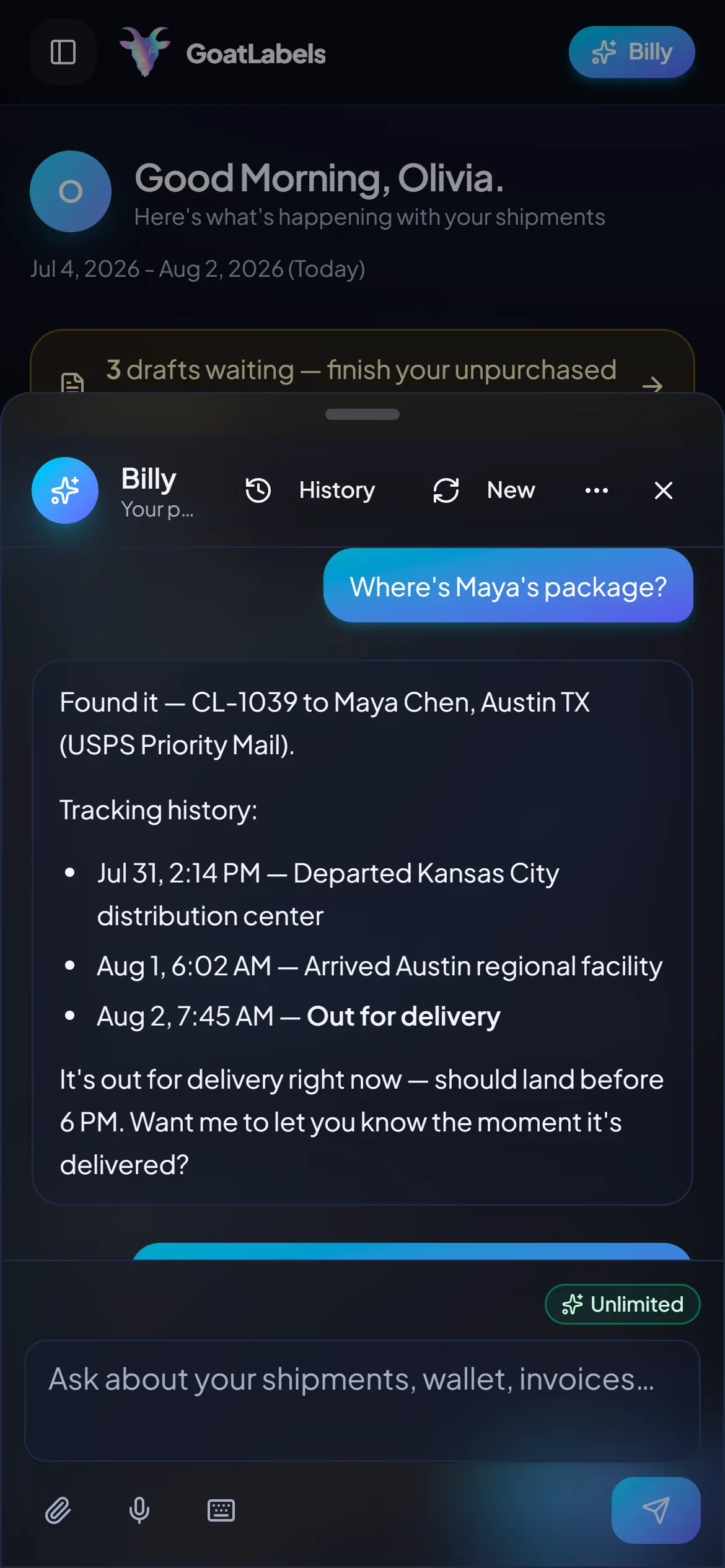
The DM order, the replacement a support agent ships from a phone — Billy drafts those from a pasted message or screenshot, and they land as the same shipment objects your integration reads. Your code never grows a free-text parser.
BillyLIVEShipping cost is shipments times carrier rate, with no per-call charge, no per-label platform fee, and one flat Pro fee past Free's 50 shipments a month.
Every domestic shipment returns USPS, UPS and FedEx as live all-in rates in one response, with DHL on international lanes: sort it, pick the winner, buy. No carrier accounts to connect, no credentials to rotate, no separate carrier invoices to reconcile afterwards.
UPS$12.48FedEx$13.22DHL$14.10USPS$11.79HMAC-signed deliveries, a per-attempt delivery log readable over the API, one-call replay, and the shipment.adjustment.created event pushing post-purchase corrections with the wallet delta attached. Polling is optional; verification is not.
Label bought outside the API
Same wallet · same webhook fires
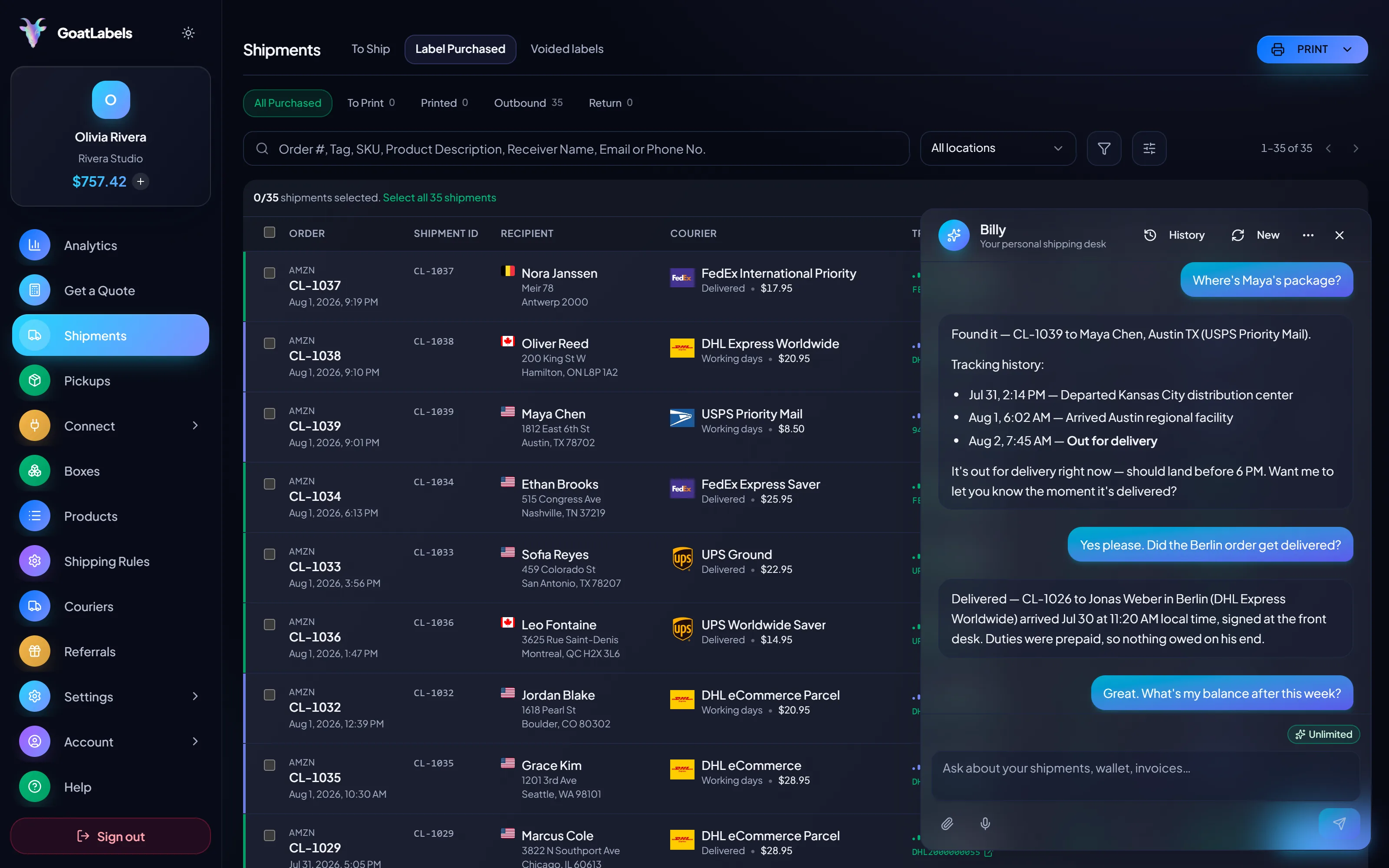
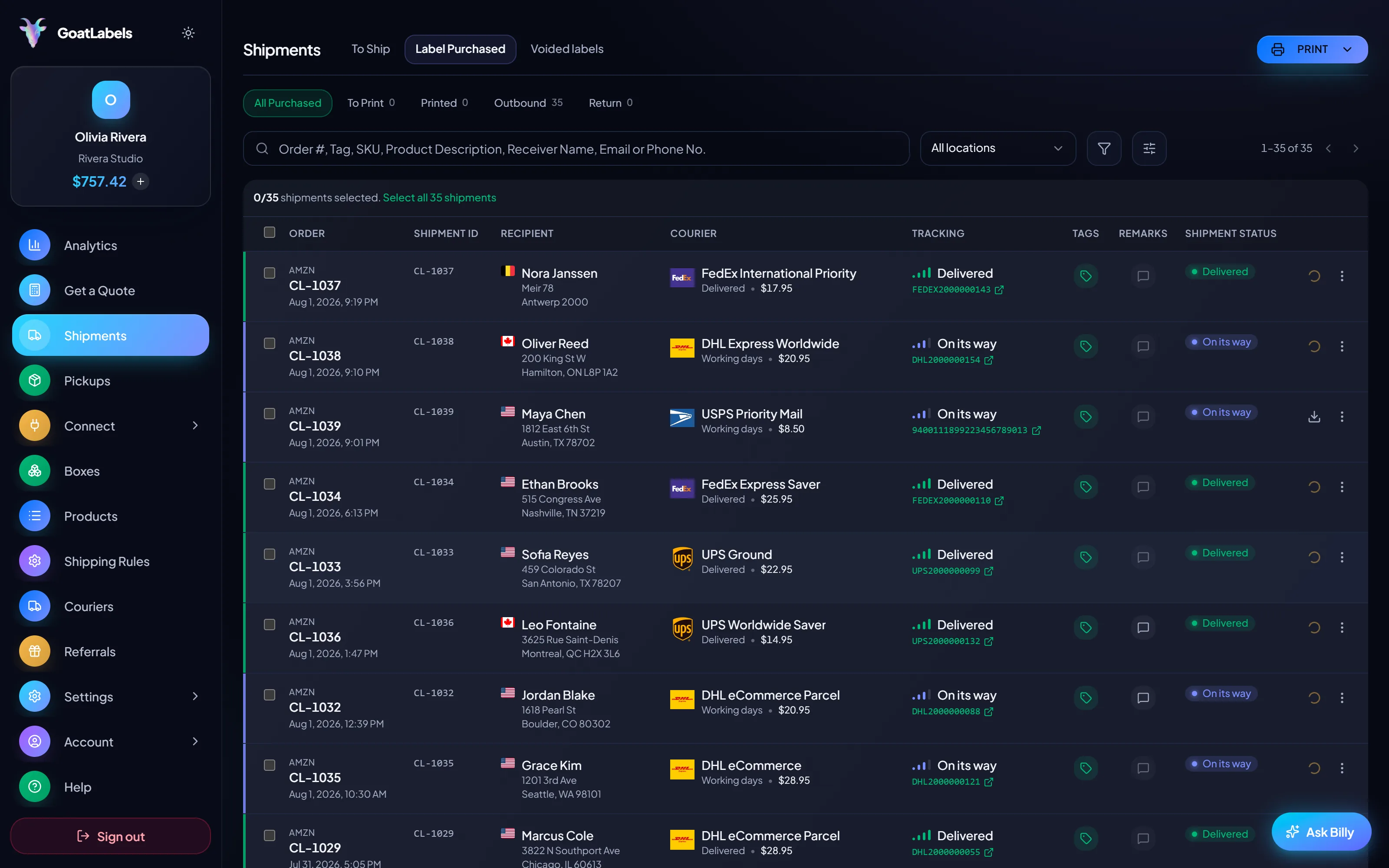
Every API-driven shipping operation still has humans buying labels — a support agent handling a replacement, a warehouse lead reprinting at the bench, a founder on a Sunday. Those labels debit the same prepaid wallet and become the same shipment records, so nothing in your reconciliation ever has to know which of the two bought them.
Not every question about a parcel deserves a query. Ask where a shipment is and Billy reads the latest scan back in plain English, drafts a replacement from a pasted support thread, and quotes the carriers on it, all against the same records your integration writes and reads. Included on every plan, and none of it billed per call. This is the real product, not a render.
Listening
"What happened to shipment 8421?"
Latest event
Adjustment posted · wallet delta recorded
Speaks plain English · reads shipment records back · drafts labels from a pasted thread · included on every plan, never a pricier tier.
Under a metered model you learn to cache rates you would rather re-fetch. Here every domestic shipment returns USPS, UPS and FedEx as live all-in numbers (DHL on international lanes) in a single response you can call as often as your checkout wants: sort the array, pick the winner, buy it. The number you sorted on is the number that debits the wallet.
Ground Advantage
2 to 5 days$11.40
all-in · the quoted total is the wallet debit
Ground
1 to 5 days$9.85
all-in · the quoted total is the wallet debit
Ground
1 to 5 days$11.20
all-in · the quoted total is the wallet debit
REST and JSON with one Bearer header. Create the shipment, read the carriers from the rates array, buy the winner from the wallet, and let signed webhooks carry tracking and adjustments back instead of polling for them.
POST /api/v1/shipments
Authorization: Bearer sk_live_…
Idempotency-Key: ord_8421

{
  "to": { "name": "Joyce", "city": "Berlin", "country": "DE" },
  "parcel": { "weight": 2.6, "weight_unit": "lb" },
  "service": "fedex_intl_priority"
}
A metered API turns cost modelling into a guess about which of your calls the meter counts. On Free the model has one term: shipments times carrier rate. Free covers 50 shipments a month with unlimited API calls behind it; past 50 you need Pro, a flat $40 a month, one fixed line rather than a meter that grows with your calls.
 — for the orders that never reach your integration
Rate by plan
illustrativePro: one flat monthly plan, unlimited shipments
$0 / forever
A free key, unlimited calls, and a staging environment nobody has to budget for.
The assistant that drafts a shipment from a pasted support thread is included in the web app on Free, writing the same objects your code reads. Pro adds Billy on Telegram.
Telegram, ProGET /api/v1/shipments
200 OK · plan: free
Unlimited calls on Free — still unlimited on Pro.
Put a real parcel through and compare the side-by-side rate against what that label costs you on
ShippoPirate ShipShipStationLabels are quoted live from USPS, UPS, FedEx, and DHL as one all-in number and debited from the prepaid wallet at exactly that amount. ShipEngine's plans, allowances, and overage fees are in the dated source block on this page, linked to ShipEngine's own pricing and help pages. Full pricing details
A usage price does not fall evenly across integrations. These are the four shapes where quoting freely is the difference between a correct implementation and a cheap one.
 Cart estimates and address edits
Cart estimates, a re-quote on every corrected address, background re-pricing — the calls that make a checkout accurate are exactly the ones a meter teaches you to skip. Unlimited calls means the rating step runs whenever the order changes rather than whenever the budget allows.
 Finance, month end, and re-weighs
A re-weigh discovered at month end is a reconciliation problem. The same re-weigh pushed as an event with the wallet delta attached is a row your job already knows how to handle. Adjustments are records here, exposed at /v1/adjustments and delivered as shipment.adjustment.created.
Corrections as first-class objects
Read them over the API, not off a statement

 The orders your integration never sees
 Where deliveries get debugged
1
signed delivery log per attempt, readable over the API and replayable
Updated
ShipEngine is a trademark of its owner and is not affiliated with GoatLabels; its current plans and carrier catalogue live on its own site. More for API teams:GoatLabels vs EasyPost,the Shippo API comparison, andwhat a free shipping API includes. Building the integration yourself? Start at theshipping API for developers; no developer on the team? See theShipEngine alternative for small teams.
A video took off and I had 80 TikTok Shop orders by morning. I printed every label from my phone on the bus to the post office.
Early customer · TikTok
TikTok Shop seller
 TikTok Shop
I run my Etsy shop from the kitchen. The AI reads the order, picks the carrier, the label prints. That's the whole workflow now.
Early customer · Etsy
Etsy maker
EtsyThe API is what every shipping API pretends to be. Idempotency that actually works.
Sasha R.
Staff engineer, marketplace
A free key, unlimited calls, and USPS, UPS and FedEx in every domestic rates array (DHL on international lanes). Run it beside ShipEngine for a week and let the two ledgers argue it out.
No contract. No card required. Unlimited calls on every plan.
Updated